
JET ENGINES
CONTENTS
1. History of Jet Engines
2. Introduction
3. Parts Of Jet Engine
4. How A Jet Engine works
5. Types Of Jet Engine
6. Comparison Of Turbojets
7. Jet Engine Vs Rockets
8. Difficulties
9. Suggestion For Improvement
10.Merits And Demerits
11.Uses
12. Conclusion
1.HISTORY OF JET ENGINES
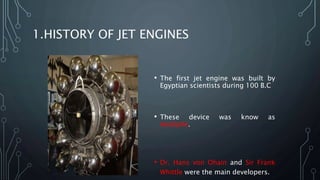
• The first jet engine was built by
Egyptian scientists during 100 B.C
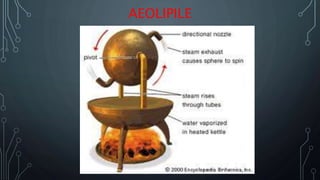
• These device was know as
Aeolipile.
• Dr. Hans von Ohain and Sir Frank
Whittle were the main developers.
AEOLIPILE
2.INTRODUCTION
• Jet engine is nothing but a Gas turbine.
• It works under the principle of Newton’s third law
• It states that “For every acting force there is an
equal and opposite force”.
• Gas turbine operates like toy balloon
3.PARTS OF JET ENGINE
 FAN
 COMPRESSOR
 COMBUSTOR
 TURBINE
 MIXER
 NOZZLE
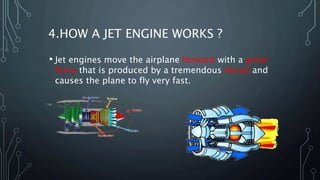
4.HOW A JET ENGINE WORKS ?
• Jet engines move the airplane forward with a great
force that is produced by a tremendous thrust and
causes the plane to fly very fast.
CONTINUED . . .
Air Intake
 Sucked in by the
compressor
Compressor
 Series of vanes and stators.
 The vanes rotate, while the
stator remains stationary.
 Compressor speed and
temperature increases
gradually
Fuel Burner
 Fuel is mixed with the air,
and electric sparks light
the air, causing it to
combust.
Combustion Chamber
 The air is burnt.
 Increase in the
temperature of the air,
thus increases the
pressure inside the
CONTINUED . . .
Turbine
 Works like a windmill
 The blades gain energy from the
hot gases moving past them.
 This movement is used to power
the compressor.
Jet Pipe and Propelling Nozzle
 The hot air rushes out of the
nozzle.
 High pressure
 Hot air rushes out at very high
speed
5. TYPES OF JET ENGINES
• Ramjet
• Turbojet
• Turbofan
• Turboprop
• Turbo shaft
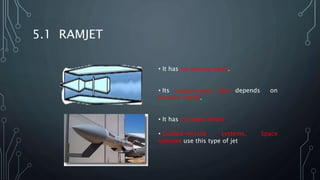
5.1 RAMJET
• It has no moving parts.
• Its compression ratio depends on
forward speed.
• It has no static thrust
• Guided-missile systems, Space
vehicles use this type of jet
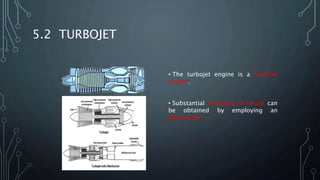
5.2 TURBOJET
• The turbojet engine is a reaction
engine.
• Substantial increases in thrust can
be obtained by employing an
afterburner
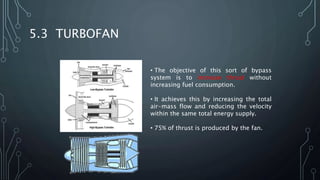
5.3 TURBOFAN
• The objective of this sort of bypass
system is to increase thrust without
increasing fuel consumption.
• It achieves this by increasing the total
air-mass flow and reducing the velocity
within the same total energy supply.
• 75% of thrust is produced by the fan.
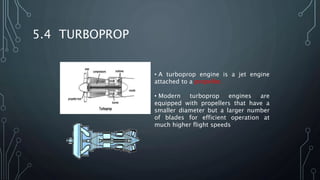
5.4 TURBOPROP
• A turboprop engine is a jet engine
attached to a propeller.
• Modern turboprop engines are
equipped with propellers that have a
smaller diameter but a larger number
of blades for efficient operation at
much higher flight speeds
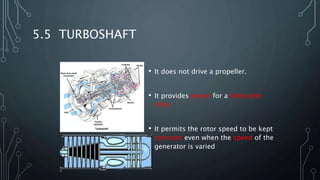
5.5 TURBOSHAFT
• It does not drive a propeller.
• It provides power for a helicopter
rotor.
• It permits the rotor speed to be kept
constant even when the speed of the
generator is varied
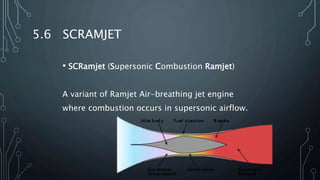
5.6 SCRAMJET
• SCRamjet (Supersonic Combustion Ramjet)
A variant of Ramjet Air-breathing jet engine
where combustion occurs in supersonic airflow.
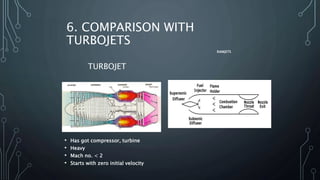
6. COMPARISON WITH
TURBOJETS
TURBOJET
• Has got compressor, turbine
• Heavy
• Mach no. < 2
• Starts with zero initial velocity
RAMJETS
NO COMPRESSOR, TURBINE
LIGHT IN WEIGHT
MACH NO 2 TO 5
START ONLY AT MACH 2 AND ABOVE
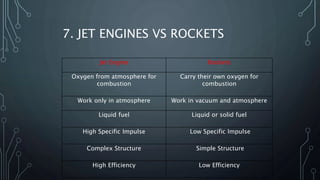
7. JET ENGINES VS ROCKETS
Jet Engine Rockets
Oxygen from atmosphere for
combustion
Carry their own oxygen for
combustion
Work only in atmosphere Work in vacuum and atmosphere
Liquid fuel Liquid or solid fuel
High Specific Impulse Low Specific Impulse
Complex Structure Simple Structure
High Efficiency Low Efficiency
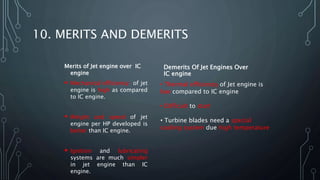
10. MERITS AND DEMERITS
Merits of Jet engine over IC
engine
 Mechanical efficiency of jet
engine is high as compared
to IC engine.
 Weight and speed of jet
engine per HP developed is
better than IC engine.
 Ignition and lubricating
systems are much simpler
in jet engine than IC
engine.
• Thermal efficiency of Jet engine is
low compared to IC engine
• Difficult to start
• Turbine blades need a special
cooling system due high temperature
Demerits Of Jet Engines Over
IC engine
11. JET ENGINE USES
 The industry they’re most
prominent in is in the transport
industry, where they are used to
propel aircraft, boats, and in
some one of creations such as a
turbojet powered truck.
 The first use of the jet engine
was to power military aircraft.
 The Bell P-59A Airacomet was
also developed by the
Americans. They had a massive
advantage over propeller driven
planes, in that they were much
 The General electric
company used a “turboprop”
jet engine to run an electric
generator.
 The jet engine is not only
used on aircraft but on
boats, where water jets are
used to propel the boat
forward..
12.CONCLUSION
• Normal type of jet engine is used for domestic purpose i.e.
Traveling, carrying goods etc.
• Ram type of jet engines is used only in Defence sector.
Because it travels at supersonic speed and generally high level
of training is required.
• Since it travels at such a high speed it cannot be used for
traveling.
• That is why turbo-jet engines are very common in use.

Jet Engines - Type & Structure

  • 1.
  • 2.
    CONTENTS 1. History ofJet Engines 2. Introduction 3. Parts Of Jet Engine 4. How A Jet Engine works 5. Types Of Jet Engine 6. Comparison Of Turbojets 7. Jet Engine Vs Rockets 8. Difficulties 9. Suggestion For Improvement 10.Merits And Demerits 11.Uses 12. Conclusion
  • 3.
    1.HISTORY OF JETENGINES • The first jet engine was built by Egyptian scientists during 100 B.C • These device was know as Aeolipile. • Dr. Hans von Ohain and Sir Frank Whittle were the main developers.
  • 4.
  • 5.
    2.INTRODUCTION • Jet engineis nothing but a Gas turbine. • It works under the principle of Newton’s third law • It states that “For every acting force there is an equal and opposite force”. • Gas turbine operates like toy balloon
  • 6.
    3.PARTS OF JETENGINE  FAN  COMPRESSOR  COMBUSTOR  TURBINE  MIXER  NOZZLE
  • 7.
    4.HOW A JETENGINE WORKS ? • Jet engines move the airplane forward with a great force that is produced by a tremendous thrust and causes the plane to fly very fast.
  • 8.
    CONTINUED . .. Air Intake  Sucked in by the compressor Compressor  Series of vanes and stators.  The vanes rotate, while the stator remains stationary.  Compressor speed and temperature increases gradually Fuel Burner  Fuel is mixed with the air, and electric sparks light the air, causing it to combust. Combustion Chamber  The air is burnt.  Increase in the temperature of the air, thus increases the pressure inside the
  • 9.
    CONTINUED . .. Turbine  Works like a windmill  The blades gain energy from the hot gases moving past them.  This movement is used to power the compressor. Jet Pipe and Propelling Nozzle  The hot air rushes out of the nozzle.  High pressure  Hot air rushes out at very high speed
  • 10.
    5. TYPES OFJET ENGINES • Ramjet • Turbojet • Turbofan • Turboprop • Turbo shaft
  • 11.
    5.1 RAMJET • Ithas no moving parts. • Its compression ratio depends on forward speed. • It has no static thrust • Guided-missile systems, Space vehicles use this type of jet
  • 12.
    5.2 TURBOJET • Theturbojet engine is a reaction engine. • Substantial increases in thrust can be obtained by employing an afterburner
  • 13.
    5.3 TURBOFAN • Theobjective of this sort of bypass system is to increase thrust without increasing fuel consumption. • It achieves this by increasing the total air-mass flow and reducing the velocity within the same total energy supply. • 75% of thrust is produced by the fan.
  • 14.
    5.4 TURBOPROP • Aturboprop engine is a jet engine attached to a propeller. • Modern turboprop engines are equipped with propellers that have a smaller diameter but a larger number of blades for efficient operation at much higher flight speeds
  • 15.
    5.5 TURBOSHAFT • Itdoes not drive a propeller. • It provides power for a helicopter rotor. • It permits the rotor speed to be kept constant even when the speed of the generator is varied
  • 16.
    5.6 SCRAMJET • SCRamjet(Supersonic Combustion Ramjet) A variant of Ramjet Air-breathing jet engine where combustion occurs in supersonic airflow.
  • 17.
    6. COMPARISON WITH TURBOJETS TURBOJET •Has got compressor, turbine • Heavy • Mach no. < 2 • Starts with zero initial velocity RAMJETS NO COMPRESSOR, TURBINE LIGHT IN WEIGHT MACH NO 2 TO 5 START ONLY AT MACH 2 AND ABOVE
  • 18.
    7. JET ENGINESVS ROCKETS Jet Engine Rockets Oxygen from atmosphere for combustion Carry their own oxygen for combustion Work only in atmosphere Work in vacuum and atmosphere Liquid fuel Liquid or solid fuel High Specific Impulse Low Specific Impulse Complex Structure Simple Structure High Efficiency Low Efficiency
  • 19.
    10. MERITS ANDDEMERITS Merits of Jet engine over IC engine  Mechanical efficiency of jet engine is high as compared to IC engine.  Weight and speed of jet engine per HP developed is better than IC engine.  Ignition and lubricating systems are much simpler in jet engine than IC engine. • Thermal efficiency of Jet engine is low compared to IC engine • Difficult to start • Turbine blades need a special cooling system due high temperature Demerits Of Jet Engines Over IC engine
  • 20.
    11. JET ENGINEUSES  The industry they’re most prominent in is in the transport industry, where they are used to propel aircraft, boats, and in some one of creations such as a turbojet powered truck.  The first use of the jet engine was to power military aircraft.  The Bell P-59A Airacomet was also developed by the Americans. They had a massive advantage over propeller driven planes, in that they were much  The General electric company used a “turboprop” jet engine to run an electric generator.  The jet engine is not only used on aircraft but on boats, where water jets are used to propel the boat forward..
  • 21.
    12.CONCLUSION • Normal typeof jet engine is used for domestic purpose i.e. Traveling, carrying goods etc. • Ram type of jet engines is used only in Defence sector. Because it travels at supersonic speed and generally high level of training is required. • Since it travels at such a high speed it cannot be used for traveling. • That is why turbo-jet engines are very common in use.