PSYCHROMETRY 
PROPERTIES, processes AND charts 
-Presented by-PRABHAV JOSHI 
(ENROLL NO-120070125031) 
-Guided by-PURVI MA’M
CONTENTS 
 What is PSYCHROMETRY? 
 Properties of 
PSYCHROMETRY 
 PSYCHROMETRIC Processes 
 PSYCHROMETRIC CHART
Psychrometry 
OPsychrometry is the science dealing 
with the physical laws of air – water 
vapour 
mixtures. 
OWhen designing an air conditioning 
system, the temperature and moisture 
content of the air to be conditioned, 
and the same properties of the air 
needed to produce the desired air 
conditioning effect. 
OIn other words, we can say that 
Psychrometry is the study of MOIST 
AIR or mixture of dry air and water 
vapour.
PROPERTIES OF 
PSYCHROMETRY 
 DEW POINT TEMPERATURE 
 RELATIVE HUMIDITY 
 HUMIDITY RATIO 
 DRY-BULB TEMPERATURE 
 WET BULB TEMPERATURE 
 HUMIDITY 
• Specific humidity 
• Absolute humidity 
 PSYCHROMETRIC RATIO
Dew Point 
O The temperature at which moisture starts to 
condense out of the air is known as DEW POINT. 
O Dew point is also known as saturation temperature. 
O Dew point temperature is determined by moving 
from a state point horizontally to the left along lines 
of constant humidity ratio until the upper, curved, 
saturation temperature boundary is reached.
Dew Point 
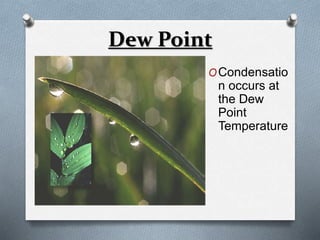
OCondensatio 
n occurs at 
the Dew 
Point 
Temperature
Relative Humidity 
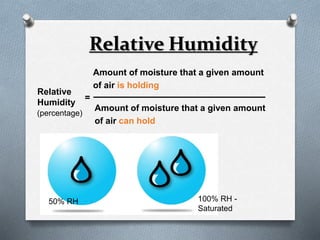
Relative 
Humidity 
Amount of moisture that a given amount 
of air is holding 
= 
Amount of moisture that a given amount 
of air can hold 
50% RH 100% RH - 
Saturated 
(percentage)
Humidity Ratio 
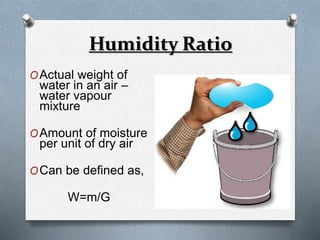
OActual weight of 
water in an air – 
water vapour 
mixture 
OAmount of moisture 
per unit of dry air 
OCan be defined as, 
W=m/G
DRY -BULB 
TEMPERATURE 
 The dry-bulb temperature is the 
temperature indicated by a 
thermometer exposed to the air in a 
place sheltered from direct solar 
radiation. The term dry-bulb is 
customarily added to temperature to 
distinguish it from wet-bulb and dew 
point temperature.
WET BULB 
TEMPERATURE 
 Wet bulb temperature is the temperature 
recorded by thermometer when the bulb is 
enveloped by cotton wick saturated with 
water. 
 The accuracy of a simple wet-bulb 
thermometer depends on how fast air 
passes over the bulb and how well the 
thermometer is shielded from the radiant 
temperature of its surroundings.
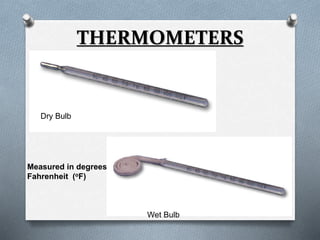
THERMOMETERS 
Dry Bulb 
Wet Bulb 
Measured in degrees 
Fahrenheit (oF)
HUMIDITY 
• Specific Humidity: 
 Specific humidity is defined as the 
proportion of the mass of water vapour 
per unit mass of the moist air sample (dry 
air plus the water vapour); it is closely 
related to humidity ratio and always lower 
in value. 
• Absolute Humidity: 
 The mass of water vapor per unit volume 
of air containing the water vapor. This 
quantity is also known as the water 
vapour density.
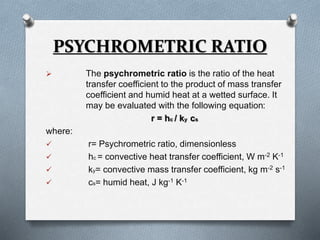
PSYCHROMETRIC RATIO 
 The psychrometric ratio is the ratio of the heat 
transfer coefficient to the product of mass transfer 
coefficient and humid heat at a wetted surface. It 
may be evaluated with the following equation: 
r = hc / ky cs 
where: 
 r= Psychrometric ratio, dimensionless 
 hc = convective heat transfer coefficient, W m-2 K-1 
 ky= convective mass transfer coefficient, kg m-2 s-1 
 cs= humid heat, J kg-1 K-1
PSYCHROMETRIC PROCESSES 
 SENSIBLE HEATING 
 SENSIBLE COOLING 
 DEHUMIDIFICATION 
 HUMIDFIYING 
 ADIABATIC COOLING 
 ADIABATIC MIXING 
(MOIST AIR & WATER VAPOR)
Psychrometric Processes or 
Air conditioning Processes 
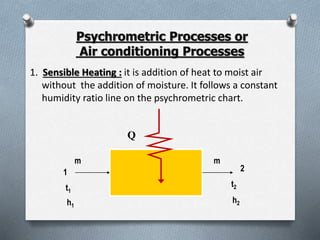
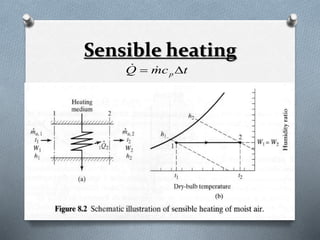
1. Sensible Heating : it is addition of heat to moist air 
without the addition of moisture. It follows a constant 
humidity ratio line on the psychrometric chart. 
m m 
1 2 
tt2 
1 
hh1 
2 
Q
Sensible heating 
Q mc t p   
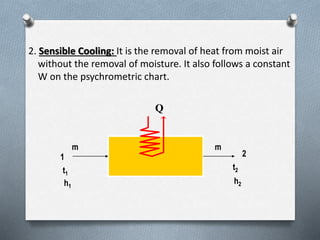
2. Sensible Cooling: It is the removal of heat from moist air 
without the removal of moisture. It also follows a constant 
W on the psychrometric chart. 
m m 
1 2 
tt2 
1 
hh1 
2 
Q
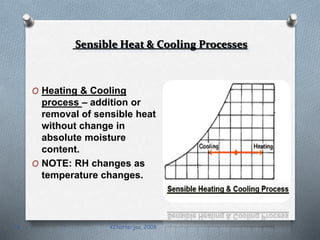
Sensible Heat & Cooling Processes 
O Heating & Cooling 
process – addition or 
removal of sensible heat 
without change in 
absolute moisture 
content. 
O NOTE: RH changes as 
temperature changes. 
18 KChatterjea, 2008
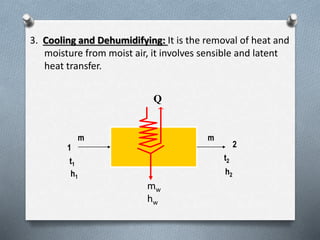
3. Cooling and Dehumidifying: It is the removal of heat and 
moisture from moist air, it involves sensible and latent 
heat transfer. 
m m 
1 2 
tt2 
1 
hh1 
2 
Q 
mw 
hw
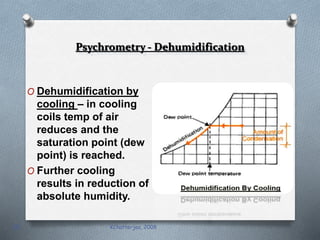
Psychrometry - Dehumidification 
O Dehumidification by 
cooling – in cooling 
coils temp of air 
reduces and the 
saturation point (dew 
point) is reached. 
O Further cooling 
results in reduction of 
absolute humidity. 
20 KChatterjea, 2008
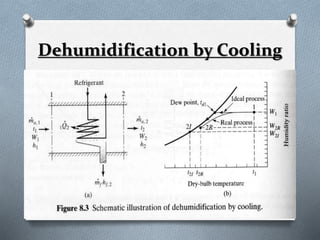
Dehumidification by Cooling
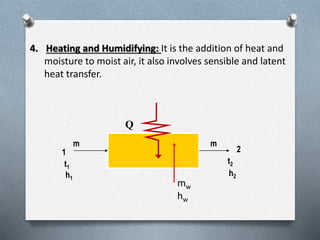
4. Heating and Humidifying: It is the addition of heat and 
moisture to moist air, it also involves sensible and latent 
heat transfer. 
m m 
1 2 
tt2 
1 
hh1 
2 
Q 
mw 
hw
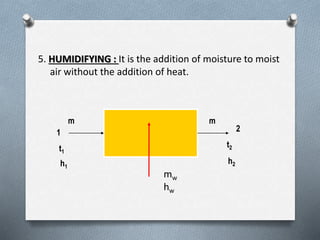
5. HUMIDIFYING : It is the addition of moisture to moist 
air without the addition of heat. 
m m 
1 2 
tt2 
1 
hh1 
2 
mw 
hw
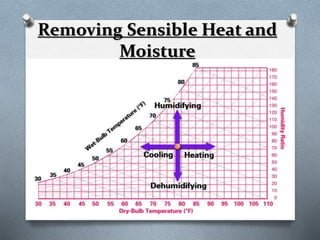
Removing Sensible Heat and 
Moisture
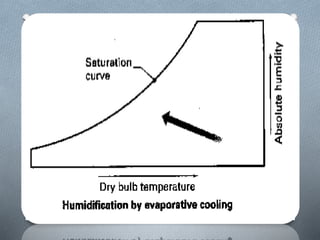
Adiabatic or evaporative 
cooling 
 A psychrometric process which invovles 
the cooling without heat loss or gain. 
Sensible heat lost by air is converted to 
latent heat in the added water vapor.
ADIABATIC MIXING OF 
MOIST AIR & STREAM 
OA psychrometric process that 
invovles no net heat loss or 
gain during the mixing of two 
air streams.
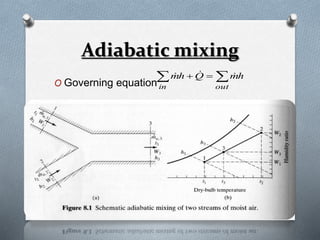
Adiabatic mixing 
      
O Governing equation 
mh Q mh 
in out
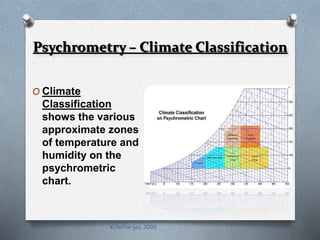
Psychrometry – Climate Classification 
O Climate 
Classification 
shows the various 
approximate zones 
of temperature and 
humidity on the 
psychrometric 
chart. 
29 KChatterjea, 2008
Breakdown of the Lines 
Dry 
Blub 
Relative 
Humidity 
Dew 
Point 
100% 
Saturation 
Enthalpy 
Grains 
of 
Moisture 
Wet 
Blub 
Specific 
Volume
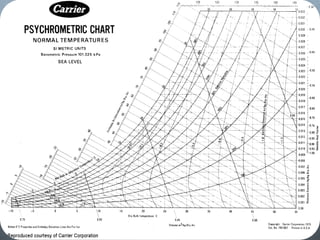
Psychrometric chart 
description 
O Vertical lines are dry-bulb temperature 
O Horizontal lines are humidity ratio (right axis) or 
dew point temp (left axis) 
O Slanted lines are wet-bulb temp and enthalpy 
O Specific volume are the “other” slanted lines
REFERENCES 
 I have collected information regarding PSYCHROMETRY topic 
from the book “ENGINEERING THERMODYNAMICS” by 
Mr. P. K. NAG... 
 Overview of Psychometrics: 
http://www.handsdownsoftware.com/Overview_of_ 
Psychrometrics.pdf 
 For some topics I have taken a help of GOOGLE and 
WIKIPEDIA…..
Any Questions???
-THANK YOU FOR YOUR 
ATTENTION….

PSYCHROMETRY

  • 1.
    PSYCHROMETRY PROPERTIES, processesAND charts -Presented by-PRABHAV JOSHI (ENROLL NO-120070125031) -Guided by-PURVI MA’M
  • 2.
    CONTENTS  Whatis PSYCHROMETRY?  Properties of PSYCHROMETRY  PSYCHROMETRIC Processes  PSYCHROMETRIC CHART
  • 3.
    Psychrometry OPsychrometry isthe science dealing with the physical laws of air – water vapour mixtures. OWhen designing an air conditioning system, the temperature and moisture content of the air to be conditioned, and the same properties of the air needed to produce the desired air conditioning effect. OIn other words, we can say that Psychrometry is the study of MOIST AIR or mixture of dry air and water vapour.
  • 4.
    PROPERTIES OF PSYCHROMETRY  DEW POINT TEMPERATURE  RELATIVE HUMIDITY  HUMIDITY RATIO  DRY-BULB TEMPERATURE  WET BULB TEMPERATURE  HUMIDITY • Specific humidity • Absolute humidity  PSYCHROMETRIC RATIO
  • 5.
    Dew Point OThe temperature at which moisture starts to condense out of the air is known as DEW POINT. O Dew point is also known as saturation temperature. O Dew point temperature is determined by moving from a state point horizontally to the left along lines of constant humidity ratio until the upper, curved, saturation temperature boundary is reached.
  • 6.
    Dew Point OCondensatio n occurs at the Dew Point Temperature
  • 7.
    Relative Humidity Relative Humidity Amount of moisture that a given amount of air is holding = Amount of moisture that a given amount of air can hold 50% RH 100% RH - Saturated (percentage)
  • 8.
    Humidity Ratio OActualweight of water in an air – water vapour mixture OAmount of moisture per unit of dry air OCan be defined as, W=m/G
  • 9.
    DRY -BULB TEMPERATURE  The dry-bulb temperature is the temperature indicated by a thermometer exposed to the air in a place sheltered from direct solar radiation. The term dry-bulb is customarily added to temperature to distinguish it from wet-bulb and dew point temperature.
  • 10.
    WET BULB TEMPERATURE  Wet bulb temperature is the temperature recorded by thermometer when the bulb is enveloped by cotton wick saturated with water.  The accuracy of a simple wet-bulb thermometer depends on how fast air passes over the bulb and how well the thermometer is shielded from the radiant temperature of its surroundings.
  • 11.
    THERMOMETERS Dry Bulb Wet Bulb Measured in degrees Fahrenheit (oF)
  • 12.
    HUMIDITY • SpecificHumidity:  Specific humidity is defined as the proportion of the mass of water vapour per unit mass of the moist air sample (dry air plus the water vapour); it is closely related to humidity ratio and always lower in value. • Absolute Humidity:  The mass of water vapor per unit volume of air containing the water vapor. This quantity is also known as the water vapour density.
  • 13.
    PSYCHROMETRIC RATIO The psychrometric ratio is the ratio of the heat transfer coefficient to the product of mass transfer coefficient and humid heat at a wetted surface. It may be evaluated with the following equation: r = hc / ky cs where:  r= Psychrometric ratio, dimensionless  hc = convective heat transfer coefficient, W m-2 K-1  ky= convective mass transfer coefficient, kg m-2 s-1  cs= humid heat, J kg-1 K-1
  • 14.
    PSYCHROMETRIC PROCESSES SENSIBLE HEATING  SENSIBLE COOLING  DEHUMIDIFICATION  HUMIDFIYING  ADIABATIC COOLING  ADIABATIC MIXING (MOIST AIR & WATER VAPOR)
  • 15.
    Psychrometric Processes or Air conditioning Processes 1. Sensible Heating : it is addition of heat to moist air without the addition of moisture. It follows a constant humidity ratio line on the psychrometric chart. m m 1 2 tt2 1 hh1 2 Q
  • 16.
    Sensible heating Qmc t p   
  • 17.
    2. Sensible Cooling:It is the removal of heat from moist air without the removal of moisture. It also follows a constant W on the psychrometric chart. m m 1 2 tt2 1 hh1 2 Q
  • 18.
    Sensible Heat &Cooling Processes O Heating & Cooling process – addition or removal of sensible heat without change in absolute moisture content. O NOTE: RH changes as temperature changes. 18 KChatterjea, 2008
  • 19.
    3. Cooling andDehumidifying: It is the removal of heat and moisture from moist air, it involves sensible and latent heat transfer. m m 1 2 tt2 1 hh1 2 Q mw hw
  • 20.
    Psychrometry - Dehumidification O Dehumidification by cooling – in cooling coils temp of air reduces and the saturation point (dew point) is reached. O Further cooling results in reduction of absolute humidity. 20 KChatterjea, 2008
  • 21.
  • 22.
    4. Heating andHumidifying: It is the addition of heat and moisture to moist air, it also involves sensible and latent heat transfer. m m 1 2 tt2 1 hh1 2 Q mw hw
  • 23.
    5. HUMIDIFYING :It is the addition of moisture to moist air without the addition of heat. m m 1 2 tt2 1 hh1 2 mw hw
  • 24.
  • 25.
    Adiabatic or evaporative cooling  A psychrometric process which invovles the cooling without heat loss or gain. Sensible heat lost by air is converted to latent heat in the added water vapor.
  • 27.
    ADIABATIC MIXING OF MOIST AIR & STREAM OA psychrometric process that invovles no net heat loss or gain during the mixing of two air streams.
  • 28.
    Adiabatic mixing      O Governing equation mh Q mh in out
  • 29.
    Psychrometry – ClimateClassification O Climate Classification shows the various approximate zones of temperature and humidity on the psychrometric chart. 29 KChatterjea, 2008
  • 30.
    Breakdown of theLines Dry Blub Relative Humidity Dew Point 100% Saturation Enthalpy Grains of Moisture Wet Blub Specific Volume
  • 31.
    Psychrometric chart description O Vertical lines are dry-bulb temperature O Horizontal lines are humidity ratio (right axis) or dew point temp (left axis) O Slanted lines are wet-bulb temp and enthalpy O Specific volume are the “other” slanted lines
  • 32.
    REFERENCES  Ihave collected information regarding PSYCHROMETRY topic from the book “ENGINEERING THERMODYNAMICS” by Mr. P. K. NAG...  Overview of Psychometrics: http://www.handsdownsoftware.com/Overview_of_ Psychrometrics.pdf  For some topics I have taken a help of GOOGLE and WIKIPEDIA…..
  • 33.
  • 34.
    -THANK YOU FORYOUR ATTENTION….