CONTENTS
 INTRODUCTION.
 HISTORY
 DESIGN OF ENGINE
 COMPONENTS
 WORKING OF ENGINE
 PRINCIPLE OF
OPERATION
 MERITS AND
DEMERITS.
 APPLICATIONS
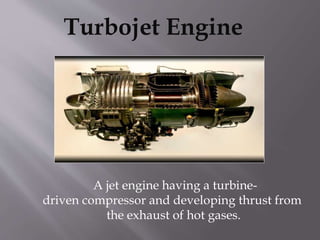
Turbojet Engine
A jet engine having a turbine-
driven compressor and developing thrust from
the exhaust of hot gases.
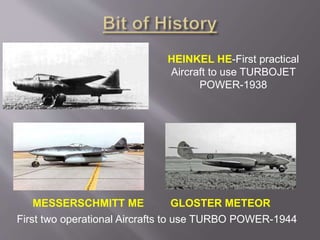
HEINKEL HE-First practical
Aircraft to use TURBOJET
POWER-1938
MESSERSCHMITT ME GLOSTER METEOR
First two operational Aircrafts to use TURBO POWER-1944
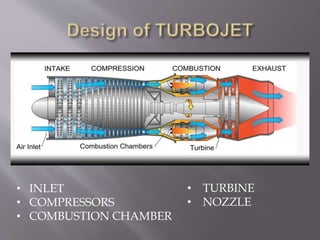
• TURBINE
• NOZZLE
• INLET
• COMPRESSORS
• COMBUSTION CHAMBER
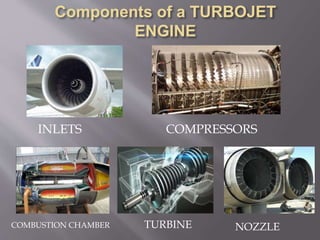
INLETS COMPRESSORS
COMBUSTION CHAMBER TURBINE NOZZLE
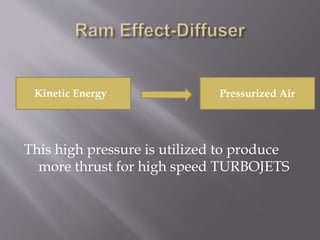
This high pressure is utilized to produce
more thrust for high speed TURBOJETS
Kinetic Energy Pressurized Air
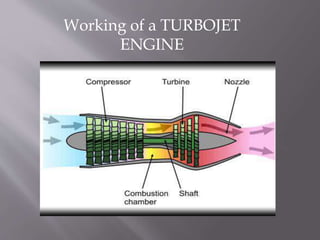
Working of a TURBOJET
ENGINE
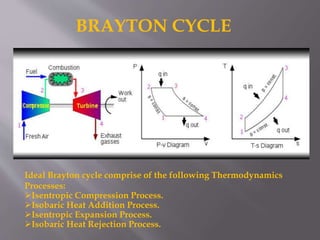
Ideal Brayton cycle comprise of the following Thermodynamics
Processes:
Isentropic Compression Process.
Isobaric Heat Addition Process.
Isentropic Expansion Process.
Isobaric Heat Rejection Process.
BRAYTON CYCLE
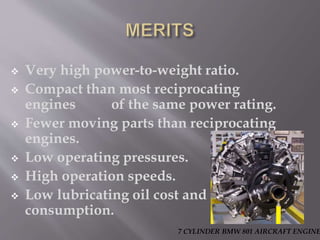
 Very high power-to-weight ratio.
 Compact than most reciprocating
engines of the same power rating.
 Fewer moving parts than reciprocating
engines.
 Low operating pressures.
 High operation speeds.
 Low lubricating oil cost and
consumption.
7 CYLINDER BMW 801 AIRCRAFT ENGINE
 Cost
 Longer startup than reciprocating
engines
 Less responsive to changes in power
demand compared to reciprocating
engines.
 Poor takeoff characteristics at low speeds
 At low speeds the fuel consumption is
more
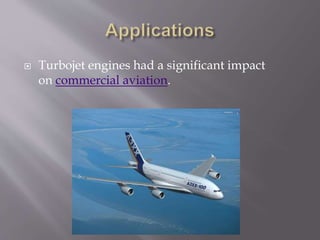
 Turbojet engines had a significant impact
on commercial aviation.
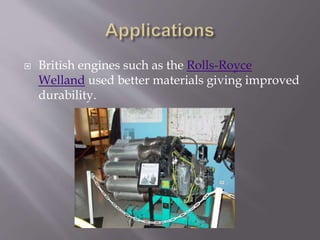
 British engines such as the Rolls-Royce
Welland used better materials giving improved
durability.
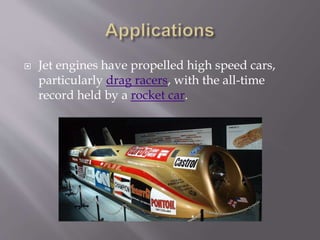
 Jet engines have propelled high speed cars,
particularly drag racers, with the all-time
record held by a rocket car.
Turbojet engines
Turbojet engines

Turbojet engines

  • 2.
    CONTENTS  INTRODUCTION.  HISTORY DESIGN OF ENGINE  COMPONENTS  WORKING OF ENGINE  PRINCIPLE OF OPERATION  MERITS AND DEMERITS.  APPLICATIONS
  • 3.
    Turbojet Engine A jetengine having a turbine- driven compressor and developing thrust from the exhaust of hot gases.
  • 4.
    HEINKEL HE-First practical Aircraftto use TURBOJET POWER-1938 MESSERSCHMITT ME GLOSTER METEOR First two operational Aircrafts to use TURBO POWER-1944
  • 5.
    • TURBINE • NOZZLE •INLET • COMPRESSORS • COMBUSTION CHAMBER
  • 6.
  • 7.
    This high pressureis utilized to produce more thrust for high speed TURBOJETS Kinetic Energy Pressurized Air
  • 8.
    Working of aTURBOJET ENGINE
  • 9.
    Ideal Brayton cyclecomprise of the following Thermodynamics Processes: Isentropic Compression Process. Isobaric Heat Addition Process. Isentropic Expansion Process. Isobaric Heat Rejection Process. BRAYTON CYCLE
  • 10.
     Very highpower-to-weight ratio.  Compact than most reciprocating engines of the same power rating.  Fewer moving parts than reciprocating engines.  Low operating pressures.  High operation speeds.  Low lubricating oil cost and consumption. 7 CYLINDER BMW 801 AIRCRAFT ENGINE
  • 11.
     Cost  Longerstartup than reciprocating engines  Less responsive to changes in power demand compared to reciprocating engines.  Poor takeoff characteristics at low speeds  At low speeds the fuel consumption is more
  • 12.
     Turbojet engineshad a significant impact on commercial aviation.
  • 13.
     British enginessuch as the Rolls-Royce Welland used better materials giving improved durability.
  • 14.
     Jet engineshave propelled high speed cars, particularly drag racers, with the all-time record held by a rocket car.