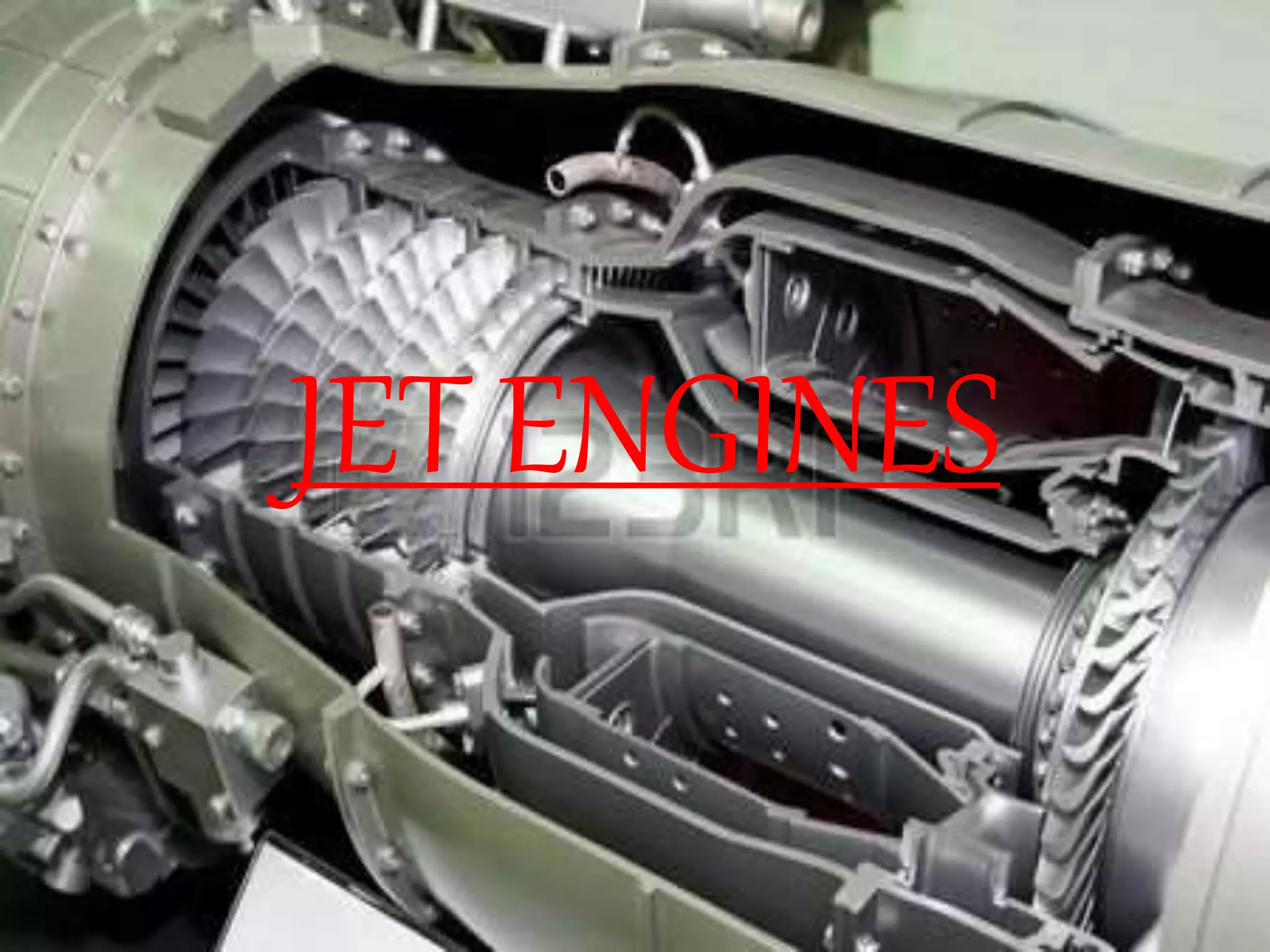
JET ENGINES
History Of Jet Engines:-
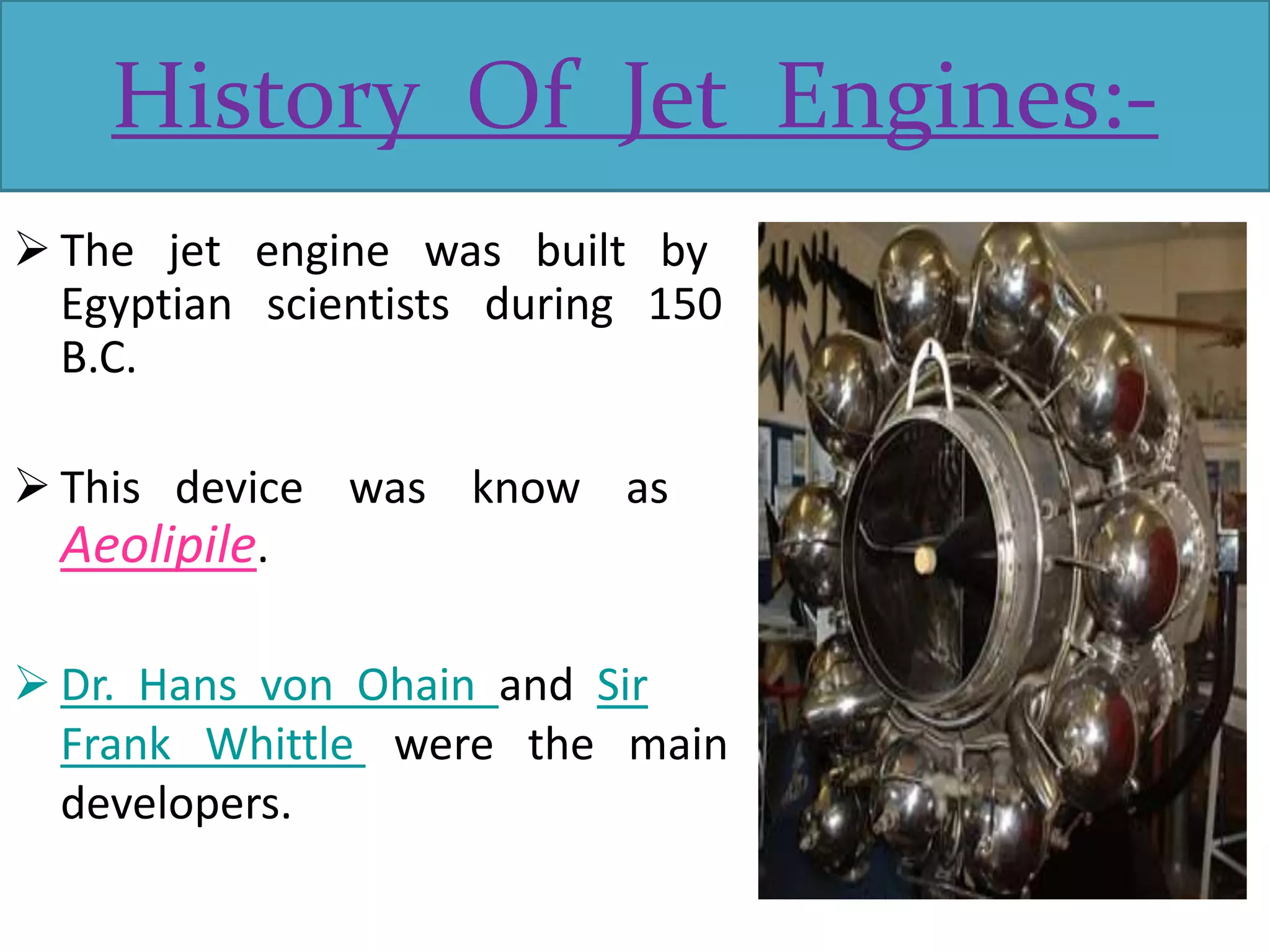
 The jet engine was built by
Egyptian scientists during 150
B.C.
 This device was know as
Aeolipile.
 Dr. Hans von Ohain and Sir
Frank Whittle were the main
developers.
Aeolipile:-
Introduction:-
 Jet engine is a reaction engine discharging a
fast moving jet that generates thrust by jet
propulsion in accordance with Newton’s third
law of motion.
 Jet engine moves the airplane forward with a
great force that is produced by a tremendous
thrust and causes the plane to fly very fast.
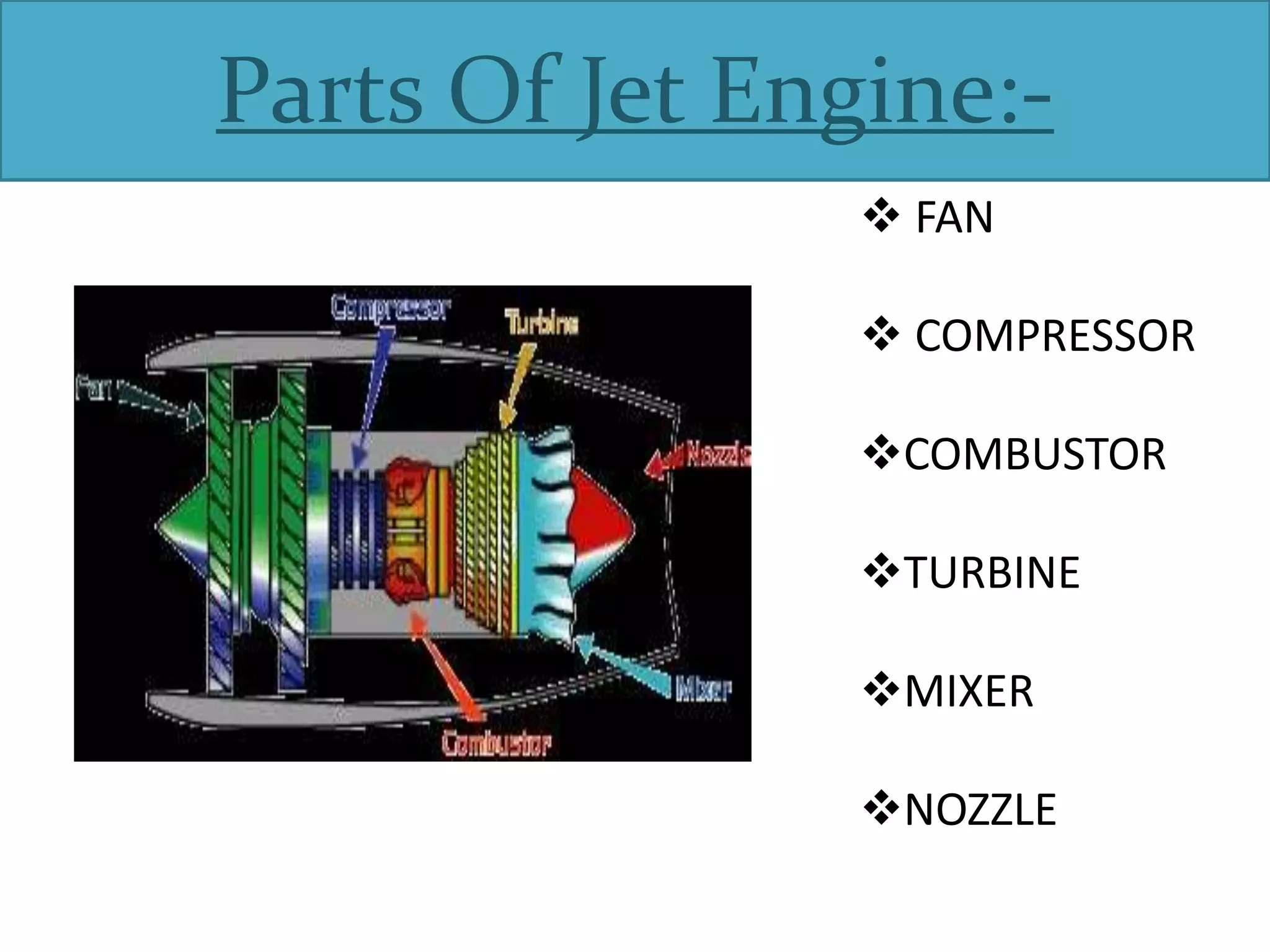
Parts Of Jet Engine:-
 FAN
 COMPRESSOR
COMBUSTOR
TURBINE
MIXER
NOZZLE
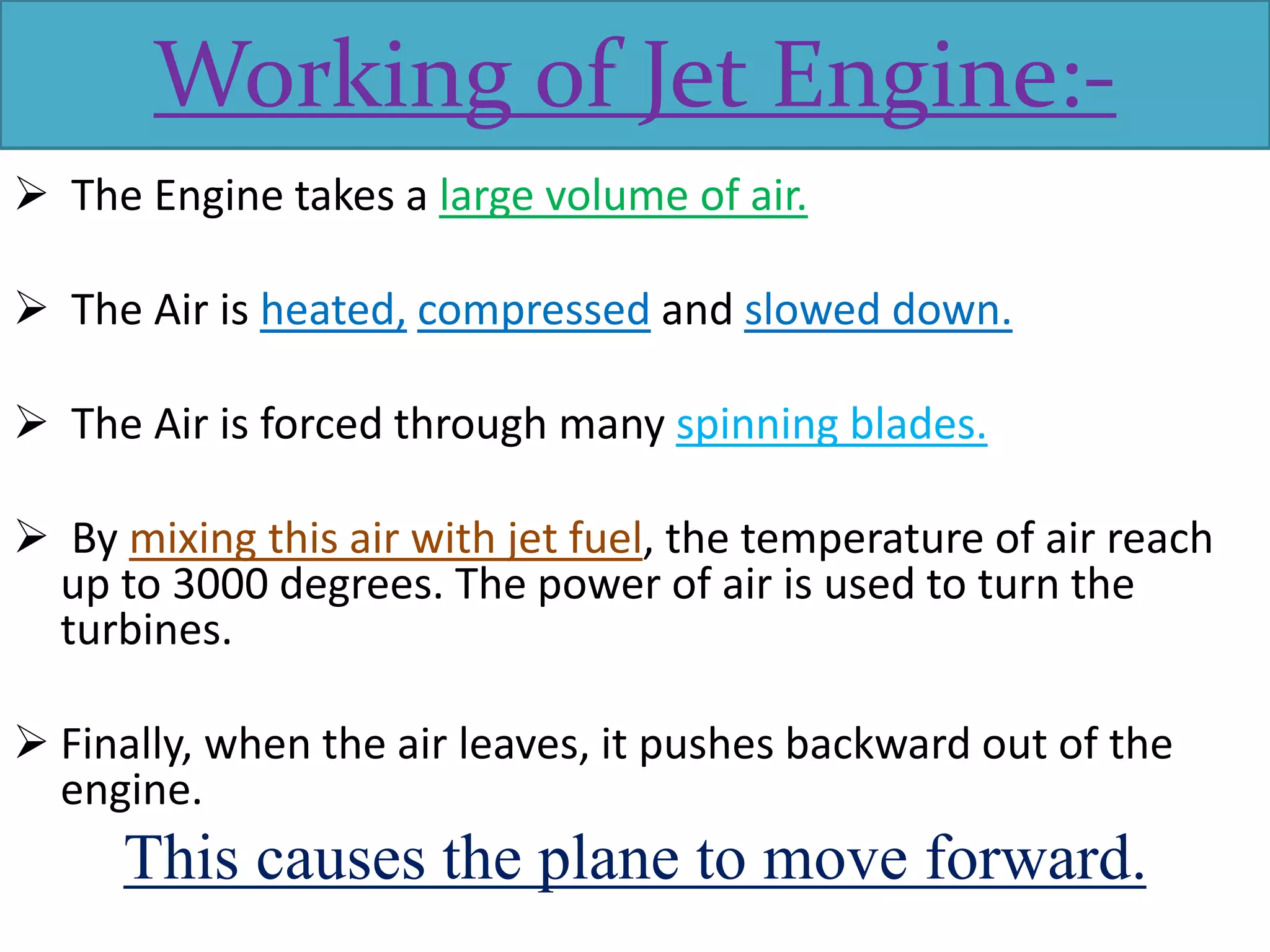
Working of Jet Engine:-
 The Engine takes a large volume of air.
 The Air is heated, compressed and slowed down.
 The Air is forced through many spinning blades.
 By mixing this air with jet fuel, the temperature of air reach
up to 3000 degrees. The power of air is used to turn the
turbines.
 Finally, when the air leaves, it pushes backward out of the
engine.
This causes the plane to move forward.
1. Ramjet
2. Turbojet
3. Turbofan
4. Turboprop
5. Turbo shaft
Types of Jet Engines:-
Ramjet:-
 It is the most simple jet
Engine.
 It has no moving parts.
 It develops no static thrust.
 It requires another aircraft
to assist take off.
 Use:- In Guided-missile
systems, space vehicles.
 Turbojet sucks in air &
compress or squeezes it.
 All thrust produced by hot,
high-speed exhaust gases.
 The gases flow through
turbine & make it spin.
 These gases bounce back &
shoot out the rear of the
exhaust, pushing plane
forward.
Turbojet:-
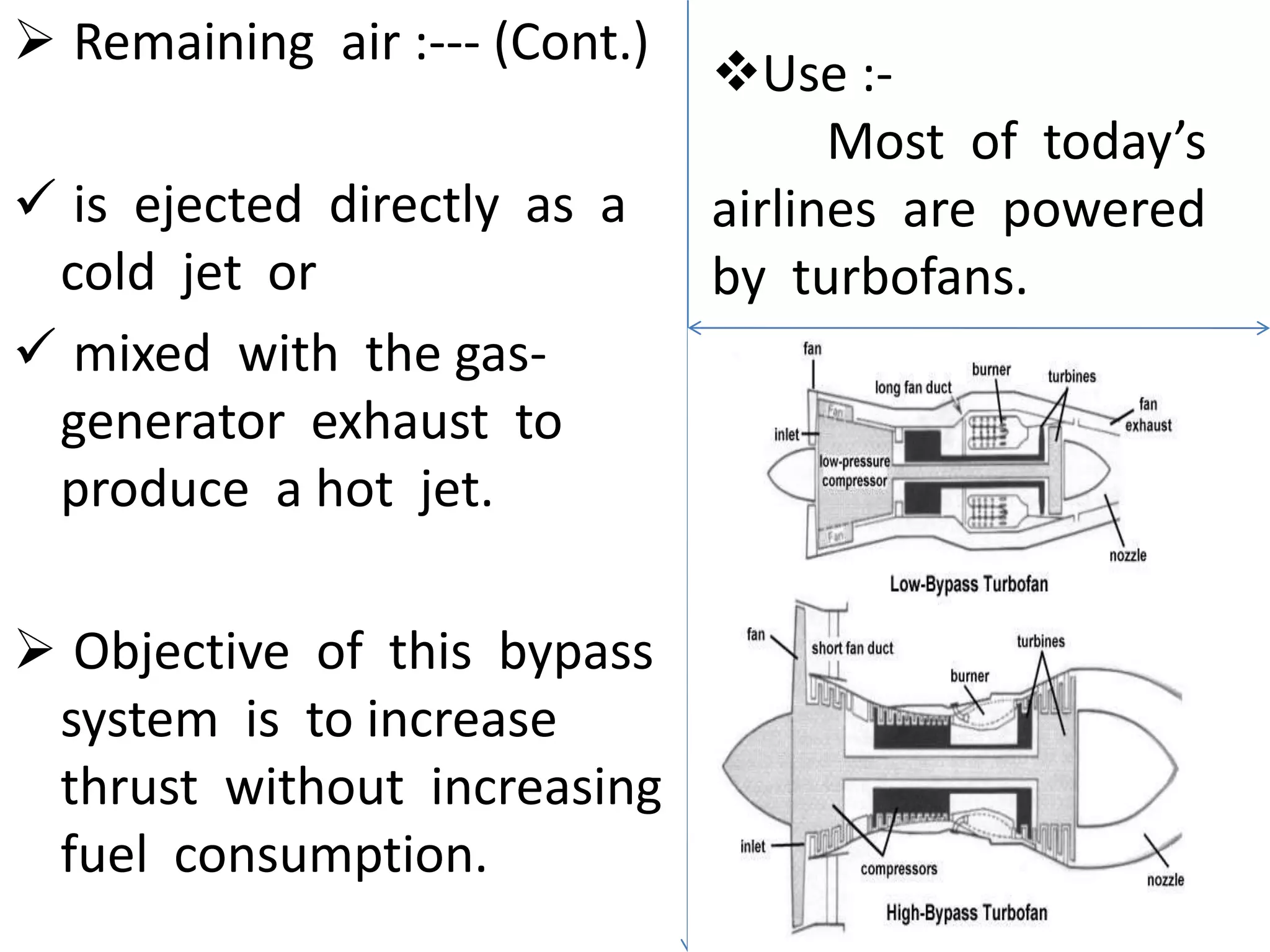
Turbofan:-
 A large fan at the front,
which sucks in air.
 Some portion of air
goes into the
combustion chamber.
 Remaining air :---
 Passes through a fan or
 Low-pressure compressor
or
 Remaining air :--- (Cont.)
 is ejected directly as a
cold jet or
 mixed with the gas-
generator exhaust to
produce a hot jet.
 Objective of this bypass
system is to increase
thrust without increasing
fuel consumption.
Use :-
Most of today’s
airlines are powered
by turbofans.
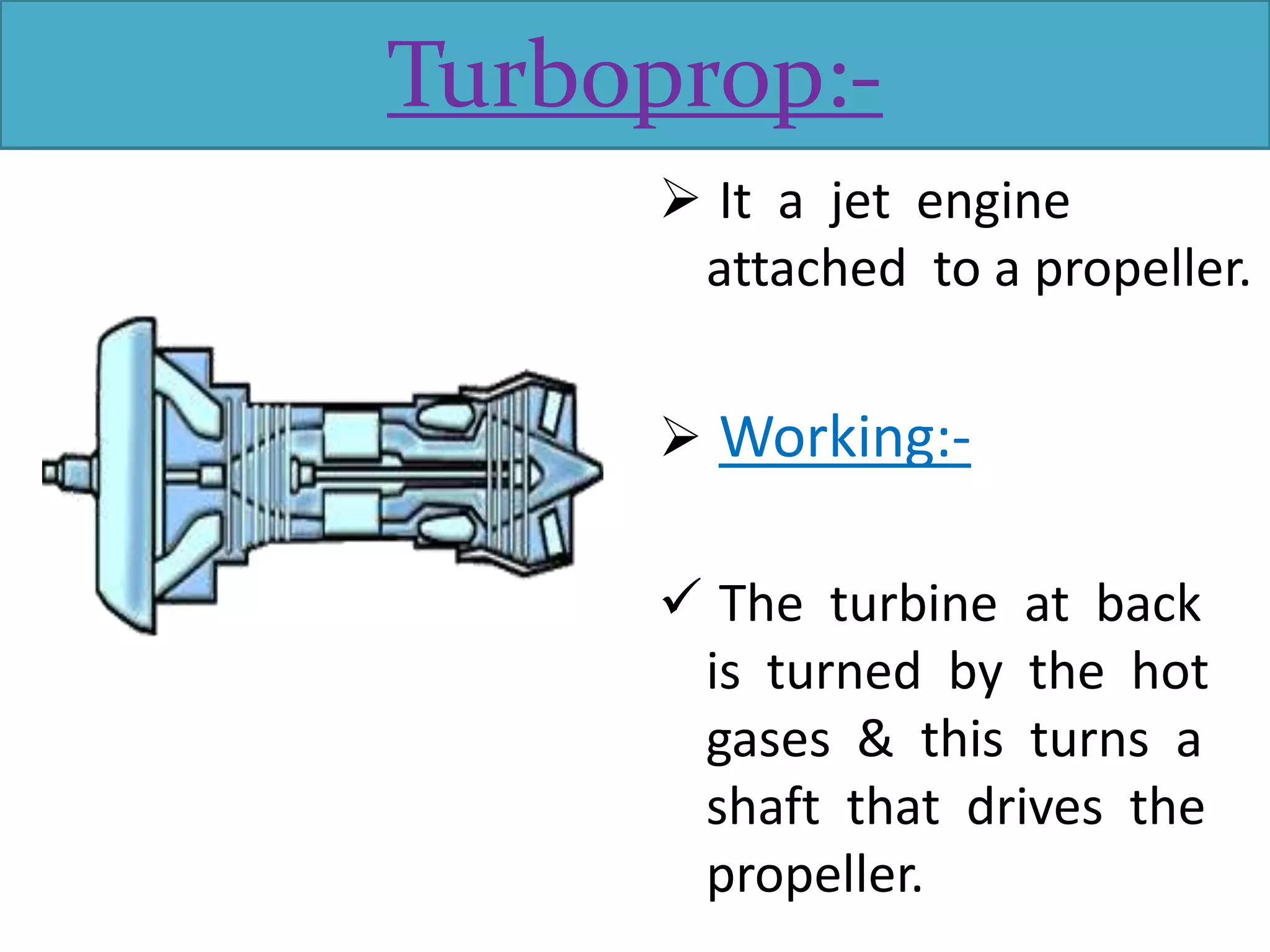
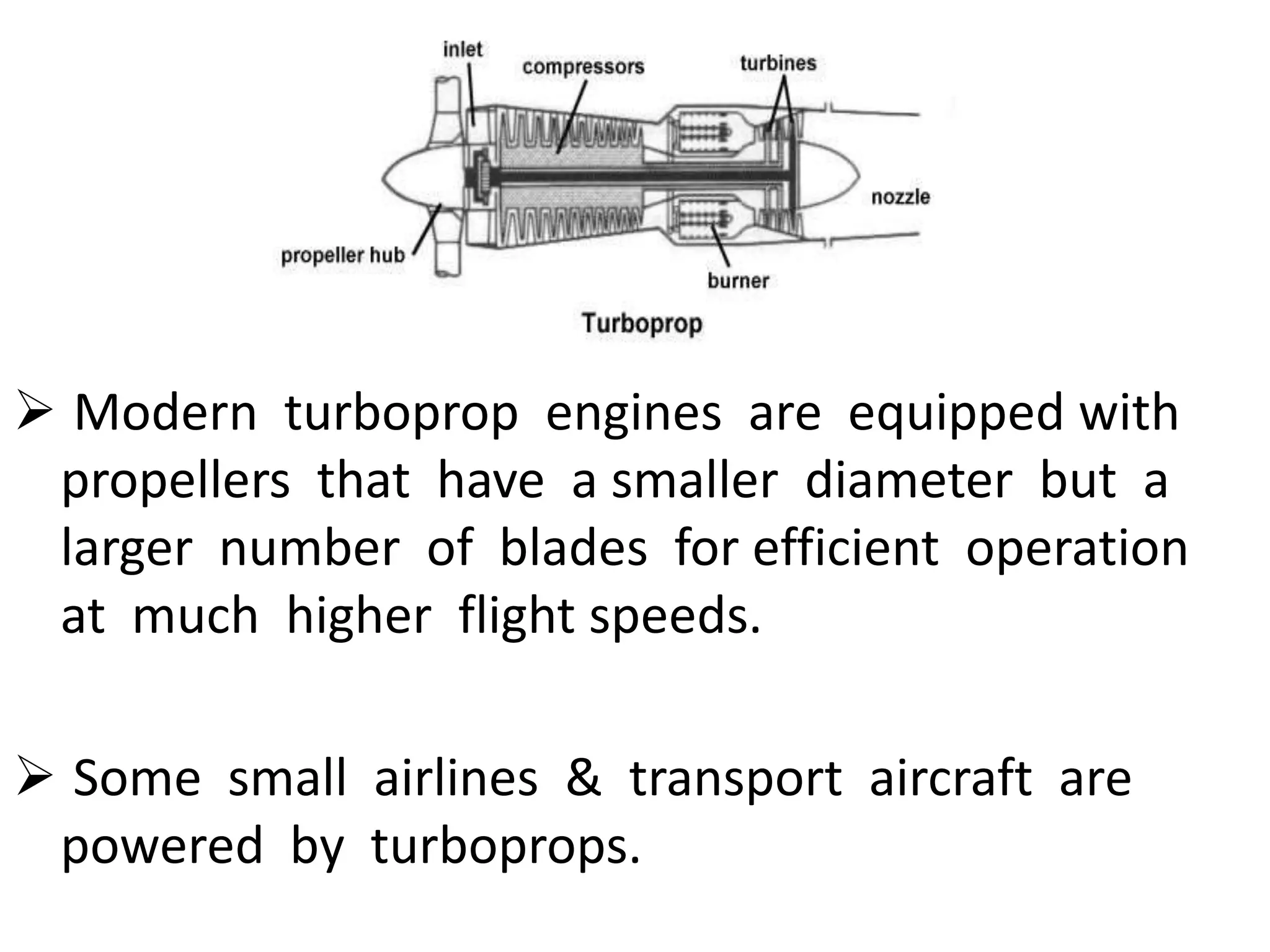
 It a jet engine
attached to a propeller.
 Working:-
 The turbine at back
is turned by the hot
gases & this turns a
shaft that drives the
propeller.
Turboprop:-
 Modern turboprop engines are equipped with
propellers that have a smaller diameter but a
larger number of blades for efficient operation
at much higher flight speeds.
 Some small airlines & transport aircraft are
powered by turboprops.
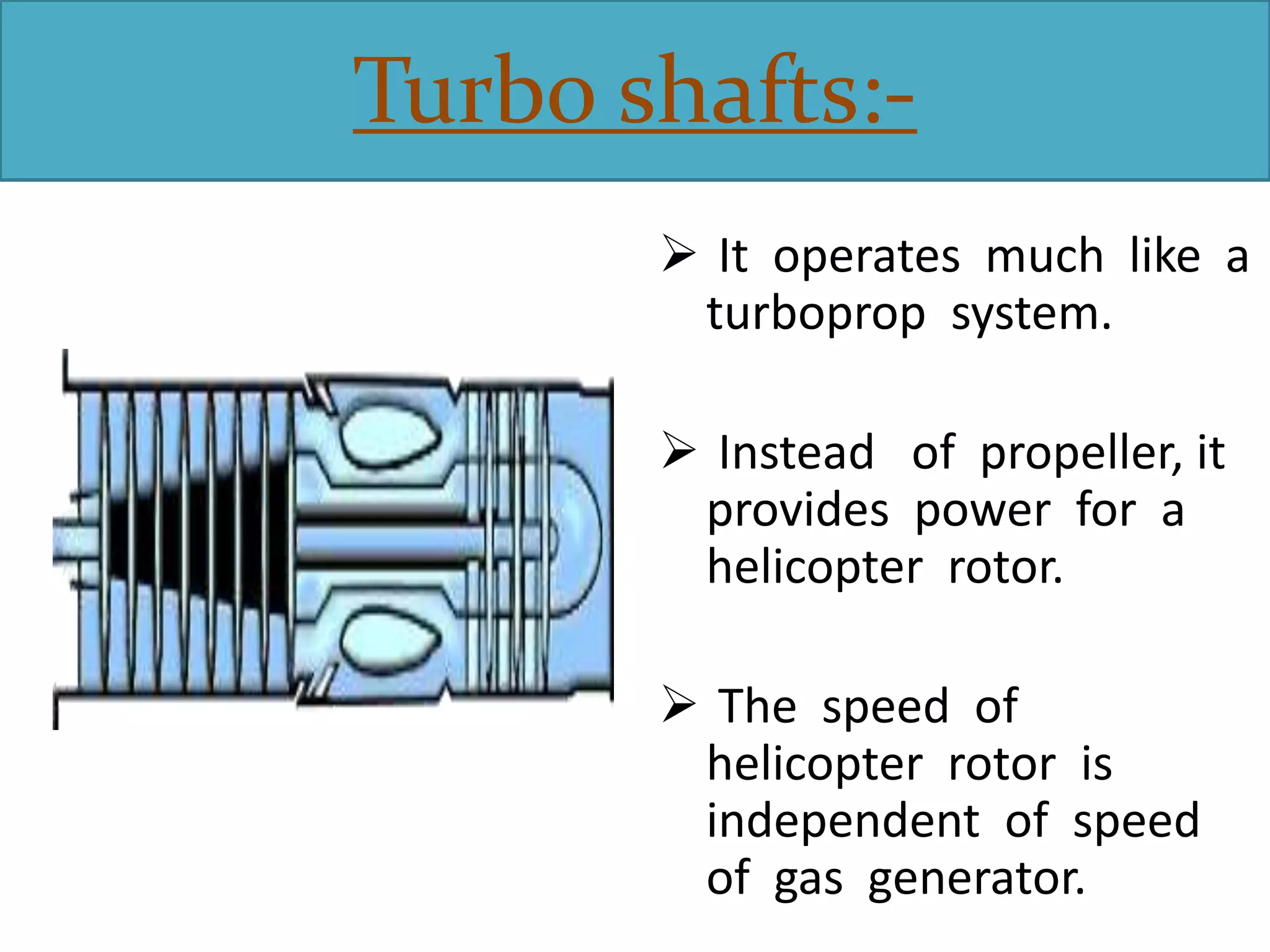
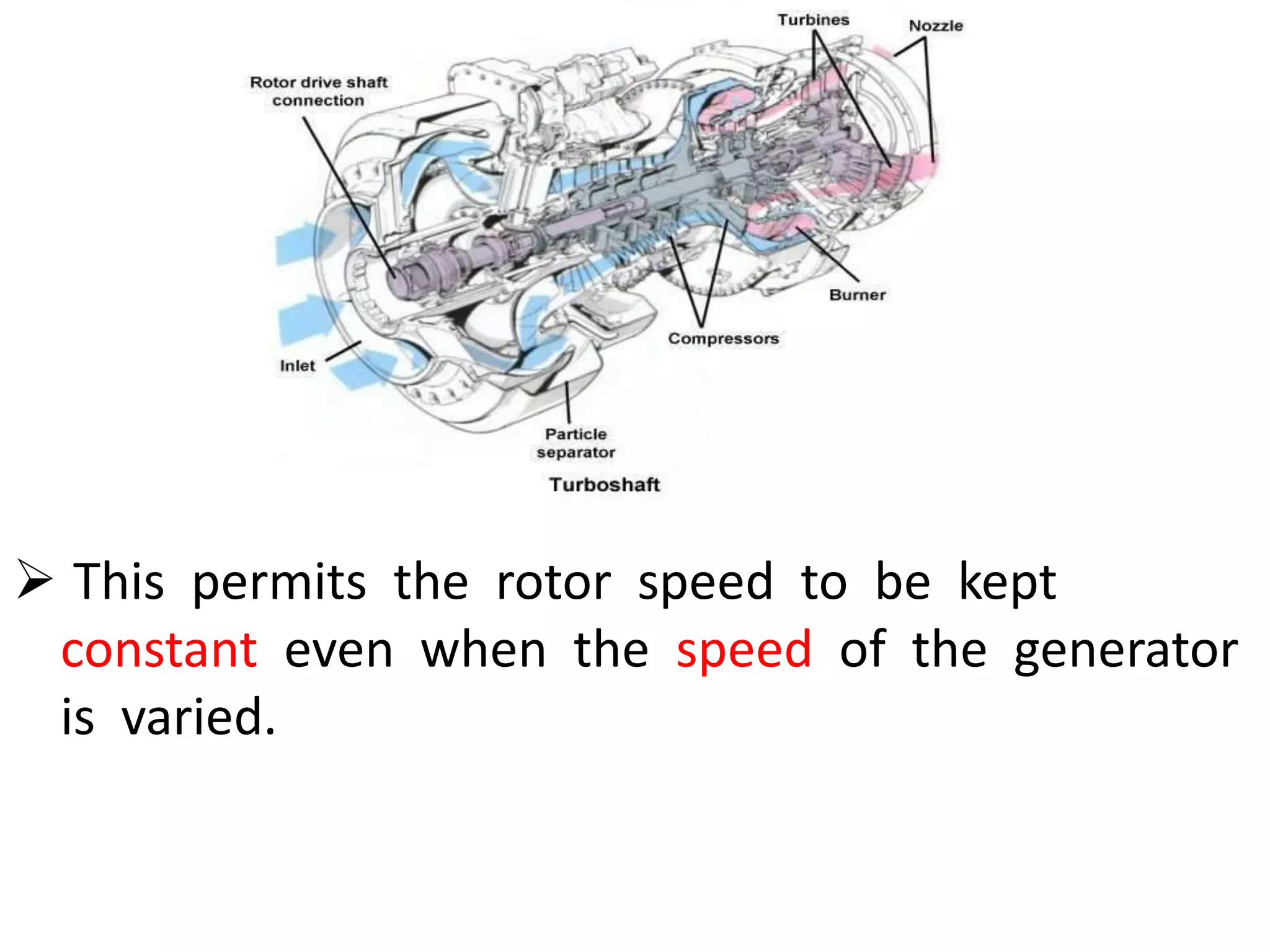
 It operates much like a
turboprop system.
 Instead of propeller, it
provides power for a
helicopter rotor.
 The speed of
helicopter rotor is
independent of speed
of gas generator.
Turbo shafts:-
 This permits the rotor speed to be kept
constant even when the speed of the generator
is varied.
 The industry they’re most prominent in is in the
transport industry, where they are used to propel
aircraft, boats and in some one of creations such as a
turbojet powered truck.
 The first use of the jet engine was to power military
aircraft.
 The jet engine is not only used on aircraft but on
boats, where water jets are used to propel the boat
forward.
Uses of Jet Engine:-
 http://www.freepatentsonline.com Harris,
William S.
 http://www.freepatentsonline.com Jaeckel,
Ernst (DE)
 http:// www.google.com
 http:// www.boeing.com
 http:// www.jet engine.com
References:-
THANK YOU!

Jet engines

  • 1.
  • 2.
    History Of JetEngines:-  The jet engine was built by Egyptian scientists during 150 B.C.  This device was know as Aeolipile.  Dr. Hans von Ohain and Sir Frank Whittle were the main developers.
  • 3.
  • 4.
    Introduction:-  Jet engineis a reaction engine discharging a fast moving jet that generates thrust by jet propulsion in accordance with Newton’s third law of motion.  Jet engine moves the airplane forward with a great force that is produced by a tremendous thrust and causes the plane to fly very fast.
  • 5.
    Parts Of JetEngine:-  FAN  COMPRESSOR COMBUSTOR TURBINE MIXER NOZZLE
  • 6.
    Working of JetEngine:-  The Engine takes a large volume of air.  The Air is heated, compressed and slowed down.  The Air is forced through many spinning blades.  By mixing this air with jet fuel, the temperature of air reach up to 3000 degrees. The power of air is used to turn the turbines.  Finally, when the air leaves, it pushes backward out of the engine. This causes the plane to move forward.
  • 7.
    1. Ramjet 2. Turbojet 3.Turbofan 4. Turboprop 5. Turbo shaft Types of Jet Engines:-
  • 8.
    Ramjet:-  It isthe most simple jet Engine.  It has no moving parts.  It develops no static thrust.  It requires another aircraft to assist take off.  Use:- In Guided-missile systems, space vehicles.
  • 9.
     Turbojet sucksin air & compress or squeezes it.  All thrust produced by hot, high-speed exhaust gases.  The gases flow through turbine & make it spin.  These gases bounce back & shoot out the rear of the exhaust, pushing plane forward. Turbojet:-
  • 10.
    Turbofan:-  A largefan at the front, which sucks in air.  Some portion of air goes into the combustion chamber.  Remaining air :---  Passes through a fan or  Low-pressure compressor or
  • 11.
     Remaining air:--- (Cont.)  is ejected directly as a cold jet or  mixed with the gas- generator exhaust to produce a hot jet.  Objective of this bypass system is to increase thrust without increasing fuel consumption. Use :- Most of today’s airlines are powered by turbofans.
  • 12.
     It ajet engine attached to a propeller.  Working:-  The turbine at back is turned by the hot gases & this turns a shaft that drives the propeller. Turboprop:-
  • 13.
     Modern turbopropengines are equipped with propellers that have a smaller diameter but a larger number of blades for efficient operation at much higher flight speeds.  Some small airlines & transport aircraft are powered by turboprops.
  • 14.
     It operatesmuch like a turboprop system.  Instead of propeller, it provides power for a helicopter rotor.  The speed of helicopter rotor is independent of speed of gas generator. Turbo shafts:-
  • 15.
     This permitsthe rotor speed to be kept constant even when the speed of the generator is varied.
  • 16.
     The industrythey’re most prominent in is in the transport industry, where they are used to propel aircraft, boats and in some one of creations such as a turbojet powered truck.  The first use of the jet engine was to power military aircraft.  The jet engine is not only used on aircraft but on boats, where water jets are used to propel the boat forward. Uses of Jet Engine:-
  • 17.
     http://www.freepatentsonline.com Harris, WilliamS.  http://www.freepatentsonline.com Jaeckel, Ernst (DE)  http:// www.google.com  http:// www.boeing.com  http:// www.jet engine.com References:-
  • 18.