AIR COMPRESSOR
PACKAGE
Prepared by :
Sujeet Tambe
Sr Process Engineer
CONTENTS :
• INTRODUCTION AND BASICS OF AIR COMPRESSOR
• MODELS OF COMPRESSION CYCLE
• TYPES OF COMPRESSOR
• SIZING AND SEPECIFYING AIR COMPRESSOR
• AUXILLARY EQUIPMENTS
INTRODUCTION AND BASICS :
 Compressor is an equipment used to compress gases from lower pressure to
high pressure
 It converts mechanical energy to pressure energy
 Density change is appreciable so Bernoulli equation does not hold
 Air compressor is used to deliver compressed air required in plant for
various application.
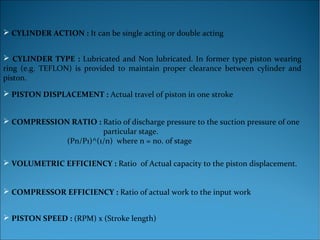
 PISTON DISPLACEMENT : Actual travel of piston in one stroke
 COMPRESSION RATIO : Ratio of discharge pressure to the suction pressure of one
particular stage.
(Pn/P1)^(1/n) where n = no. of stage
 VOLUMETRIC EFFICIENCY : Ratio of Actual capacity to the piston displacement.
 COMPRESSOR EFFICIENCY : Ratio of actual work to the input work
 PISTON SPEED : (RPM) x (Stroke length)
 CYLINDER ACTION : It can be single acting or double acting
 CYLINDER TYPE : Lubricated and Non lubricated. In former type piston wearing
ring (e.g. TEFLON) is provided to maintain proper clearance between cylinder and
piston.
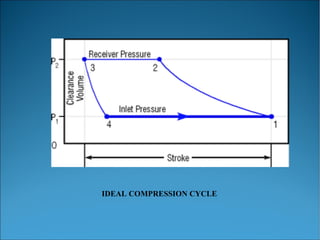
IDEAL COMPRESSION CYCLE
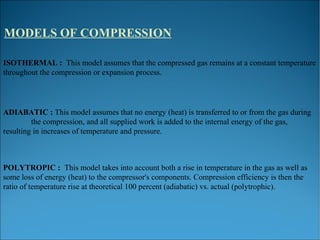
MODELS OF COMPRESSION
ISOTHERMAL : This model assumes that the compressed gas remains at a constant temperature
throughout the compression or expansion process.
ADIABATIC : This model assumes that no energy (heat) is transferred to or from the gas during
the compression, and all supplied work is added to the internal energy of the gas,
resulting in increases of temperature and pressure.
POLYTROPIC : This model takes into account both a rise in temperature in the gas as well as
some loss of energy (heat) to the compressor's components. Compression efficiency is then the
ratio of temperature rise at theoretical 100 percent (adiabatic) vs. actual (polytrophic).
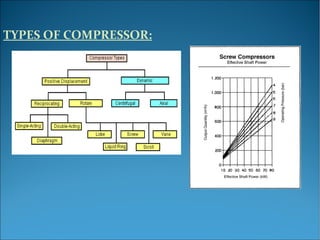
TYPES OF COMPRESSOR:
ROTARY SCREW TYPE:
Capacity control for these compressors is accomplished by variable speed and variable
compressor displacement.
For the latter control technique, a slide valve is positioned in the casing. As the compressor
capacity is reduced, the slide valve opens, bypassing a portion of the compressed air back to
the suction.
RECIPROCATING TYPE:
Capacity control for these compressors is accomplished by unloading individual cylinders.
Typically, this is accomplished by throttling the suction pressure to the cylinder or bypassing
air either within or outside the compressor.
SIZING AND SPECIFYING AIR
COMPRESSOR
• Air consumption for total plant based on histogram and peak
consumption
• Size Air compressor for average or max. anticipated operating flow.
• Calculate capacity based site condition in terms of NM3/hr or SCFM
• Actual capacity will vary significantly compare to capacity at standard
condition.
SIZING AIR COMPRESSOR :
SPECIFICATION FOR AIR COMPRESSOR :
• The compressor package shall include oil free, reciprocating or rotary
screw air compressor together with all necessary accessories required for
safe and satisfactory operation.
• Reciprocating Air compressor shall have NRV, Suction strainer,
Intercooler and after cooler with automatic moisture separator & safety
valve, suction silencer
• For high flow rotary screw compressor can be considered.
• Drive arrangement – generally v-belt driven or gear box operated
• Capacity control – Load unload through pressure switch, VFD
• For higher compression ratio the multiple stages shall be considered
SPECIFICATION FOR AIR COMPRESSOR :
Temperature read out on panel : - Delivery air
- LP element outlet
- HP element inlet
- HP element outlet
- Oil
- Cooling air / water
Pressure readouts on panel : - Delivery air
- Inter-cooler
- Air filter pressure differential
- Oil
Safety shut down controls : - Low oil pressure (oil lubricated)
- High intercooler temperature
- High discharge pressure
- Cooling media low pressure
- High coolant temperature
- Motor overload
AUXILLARY EQUIPMENTS:
(1) AIR RECEIVER
:
• Takes care of load variation in case of surge or shortfall
• Separates the condensate
• Acts as a fluctuation damper in case of load on/off
• It should be installed between compressor and dryer so that moisture does
not ingress into air dryer
• Shall have following accessories
- Auto drain valve (timer operated)
- Pressure safety valve
- Foundation bolts
- Pressure gauge
- Inspection window with opening cover
(2) AIR DRYER:
• Refrigerated type air dryer
• For instrument air consider atmosphere dew point better than -22°C
• Good practice is to keep dew point at rated pressure not more than 4°C
• Dryer shall be complete with refrigeration unit including hermetically
sealed compressor, moisture separator, automatic drain valve, HP & LP
switch.
Air compressor

Air compressor

  • 1.
    AIR COMPRESSOR PACKAGE Prepared by: Sujeet Tambe Sr Process Engineer
  • 2.
    CONTENTS : • INTRODUCTIONAND BASICS OF AIR COMPRESSOR • MODELS OF COMPRESSION CYCLE • TYPES OF COMPRESSOR • SIZING AND SEPECIFYING AIR COMPRESSOR • AUXILLARY EQUIPMENTS
  • 3.
    INTRODUCTION AND BASICS:  Compressor is an equipment used to compress gases from lower pressure to high pressure  It converts mechanical energy to pressure energy  Density change is appreciable so Bernoulli equation does not hold  Air compressor is used to deliver compressed air required in plant for various application.
  • 4.
     PISTON DISPLACEMENT: Actual travel of piston in one stroke  COMPRESSION RATIO : Ratio of discharge pressure to the suction pressure of one particular stage. (Pn/P1)^(1/n) where n = no. of stage  VOLUMETRIC EFFICIENCY : Ratio of Actual capacity to the piston displacement.  COMPRESSOR EFFICIENCY : Ratio of actual work to the input work  PISTON SPEED : (RPM) x (Stroke length)  CYLINDER ACTION : It can be single acting or double acting  CYLINDER TYPE : Lubricated and Non lubricated. In former type piston wearing ring (e.g. TEFLON) is provided to maintain proper clearance between cylinder and piston.
  • 5.
  • 6.
    MODELS OF COMPRESSION ISOTHERMAL: This model assumes that the compressed gas remains at a constant temperature throughout the compression or expansion process. ADIABATIC : This model assumes that no energy (heat) is transferred to or from the gas during the compression, and all supplied work is added to the internal energy of the gas, resulting in increases of temperature and pressure. POLYTROPIC : This model takes into account both a rise in temperature in the gas as well as some loss of energy (heat) to the compressor's components. Compression efficiency is then the ratio of temperature rise at theoretical 100 percent (adiabatic) vs. actual (polytrophic).
  • 7.
  • 8.
    ROTARY SCREW TYPE: Capacitycontrol for these compressors is accomplished by variable speed and variable compressor displacement. For the latter control technique, a slide valve is positioned in the casing. As the compressor capacity is reduced, the slide valve opens, bypassing a portion of the compressed air back to the suction. RECIPROCATING TYPE: Capacity control for these compressors is accomplished by unloading individual cylinders. Typically, this is accomplished by throttling the suction pressure to the cylinder or bypassing air either within or outside the compressor.
  • 9.
    SIZING AND SPECIFYINGAIR COMPRESSOR • Air consumption for total plant based on histogram and peak consumption • Size Air compressor for average or max. anticipated operating flow. • Calculate capacity based site condition in terms of NM3/hr or SCFM • Actual capacity will vary significantly compare to capacity at standard condition. SIZING AIR COMPRESSOR :
  • 10.
    SPECIFICATION FOR AIRCOMPRESSOR : • The compressor package shall include oil free, reciprocating or rotary screw air compressor together with all necessary accessories required for safe and satisfactory operation. • Reciprocating Air compressor shall have NRV, Suction strainer, Intercooler and after cooler with automatic moisture separator & safety valve, suction silencer • For high flow rotary screw compressor can be considered. • Drive arrangement – generally v-belt driven or gear box operated • Capacity control – Load unload through pressure switch, VFD • For higher compression ratio the multiple stages shall be considered
  • 11.
    SPECIFICATION FOR AIRCOMPRESSOR : Temperature read out on panel : - Delivery air - LP element outlet - HP element inlet - HP element outlet - Oil - Cooling air / water Pressure readouts on panel : - Delivery air - Inter-cooler - Air filter pressure differential - Oil Safety shut down controls : - Low oil pressure (oil lubricated) - High intercooler temperature - High discharge pressure - Cooling media low pressure - High coolant temperature - Motor overload
  • 12.
    AUXILLARY EQUIPMENTS: (1) AIRRECEIVER : • Takes care of load variation in case of surge or shortfall • Separates the condensate • Acts as a fluctuation damper in case of load on/off • It should be installed between compressor and dryer so that moisture does not ingress into air dryer • Shall have following accessories - Auto drain valve (timer operated) - Pressure safety valve - Foundation bolts - Pressure gauge - Inspection window with opening cover
  • 13.
    (2) AIR DRYER: •Refrigerated type air dryer • For instrument air consider atmosphere dew point better than -22°C • Good practice is to keep dew point at rated pressure not more than 4°C • Dryer shall be complete with refrigeration unit including hermetically sealed compressor, moisture separator, automatic drain valve, HP & LP switch.