
Tapeshwar Yadav.
P.G final Year, Biochemistry
‘’Centre for The Knowledge’’
 Basic structural and functional unit of life
 Understanding of cell morphology is critical
to the study of biochemistry.
 Divided and classified in many ways.
 One common classification method is
absence or presence of a cell nucleus.
 Prokaryotes – have no nucleus
 Eukaryotes – have a nucleus
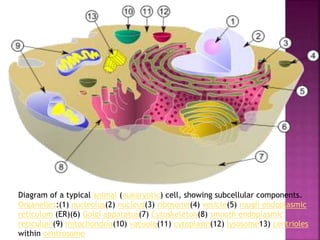
Diagram of a typical animal (eukaryotic) cell, showing subcellular components.
Organelles:(1) nucleolus(2) nucleus(3) ribosome(4) vesicle(5) rough endoplasmic
reticulum (ER)(6) Golgi apparatus(7) Cytoskeleton(8) smooth endoplasmic
reticulum(9) mitochondria(10) vacuole(11) cytoplasm(12) lysosome13) centrioles
within centrosome
 Organised structures in the cell.
 Enclosed by plasma membrane with in the
cytosol.
 All organelle have specific functions.
 Plasma membrane has highly selective
permeability;
 Entry and exit of compounds is regulated.
 Most prominent organelle of cell
 All cells except mature RBCs in circulation
 Occupies most of the available space
e.g.small lymphocytes and spermatozoa
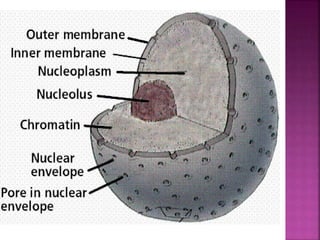
 Two membranes-outer membrane continuous
with membrane of ER, inner one is
perinuclear membrane with numerous pores.
 Nucleus contains DNA-chemical basis of
genes governs all the functions of cells
 Long DNA molecules complexed with proteins
to form chromatin-organised into
chromosomes
 DNA replication & RNA synthesis
(transcription) are taking place inside the
nucleus.
 Lighter shaded area of the nucleus is
neucleolus,area for RNA processing &
Ribosome synthesis
 Very prominent in cells actively synthesising
proteins.
 George palade-1974
 Network of interconnecting membranes
enclosing channels or cisternae
 Continuous from perinuclear envelope to
outer plasma membrane
 Prominent in cells actively synthesising
 Proteins ,glycoproteins,lipoproteins.
 Function: detoxification of various
drugs:microsomal cytP450 hydroxylation of
benzpyrine, aminopyrine,morphine ,etc.
cholesterol synthesis(partial)
 Electron microscopic appearance
 Rough ER-ribosomes attached to cytoplasmic
side of membrane –where protiens are
synthesised
 Smooth ER-no ribosomes attached
 Cells are fractionated –complex ER is
disrupted –reassembled to form microsomes.
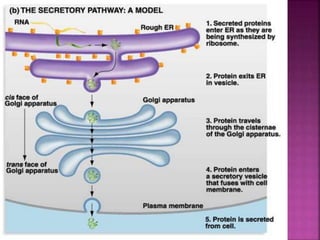
 Camillo Golgi-1906
 Network of flattened smooth membranes and
vesicles.
 Converging area of ER.
 While moving through ER CHTgroups are
added to nascent proteins-glycoproteins
reach the golgi area.
 Function: protein sorting
packaging & secretion
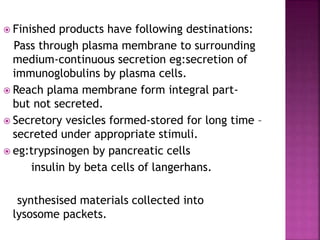
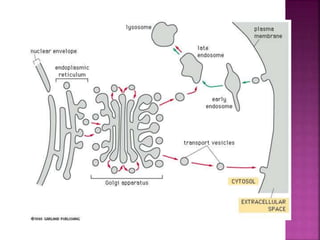
 Finished products have following destinations:
Pass through plasma membrane to surrounding
medium-continuous secretion eg:secretion of
immunoglobulins by plasma cells.
 Reach plama membrane form integral part-
but not secreted.
 Secretory vesicles formed-stored for long time –
secreted under appropriate stimuli.
 eg:trypsinogen by pancreatic cells
insulin by beta cells of langerhans.
synthesised materials collected into
lysosome packets.
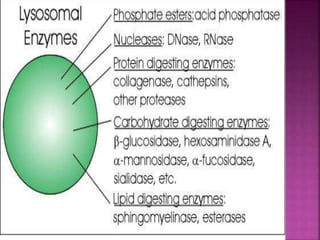
 Tiny organelles
 Bags of enzymes
 Optimum PH-5
 Functions:degradation of proteins,
carbohydrates,lipids & nucleotides
 Clinical applications:
gout
postmortem autolysis
inclusion cell disease
 Granular matrix
 0.3 -1.5mm in diameter
 Peroxidases and catalase
 Prominent in leucocytes and platelets
 Peroxidation of PUFA in vivo leads to hydro
peroxide formation
 Deficiency:adreno-leuco dystrophy(Brown –
schilder’s disease)
insufficient oxidation of VLCFA
 Zellweger syndrome-peroxisomal ghosts
 Primary hyperoxaluria
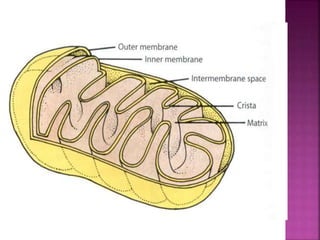
 Spherical ,oval or rod like bodies
 0.5 -1um in diameter;7um in length
 Absent in erythrocytes
 Fully packed in tail of spermatozoa
 Power house of cell
 Two membranes-inner convolutes into folds
or cristae
 contains enzymes of ETC
 Cyt.p450 system-steroidogenesis
Functions:
 ETC
 ATP generation
 TCA cycle; beta oxidation of FA
 Ketone body production
 A part of urea synthesis ,heme
synthesis,pyrimidine synthesis
 A part of gluconeogenesis
 Microtubules –tubulin.
Role in mitosis.
 Microfilaments –actin-generation of forces
for internal cell motion.
 Microtrabaculae –slender fragile tubes.
 Protein synthesis
 Glycolysis
 Glycogen metabolism
 HMP shunt pathway
 Fatty acid synthesis
 Cholesterol synthesis
 Purine synthesis
 A part of heme synthesis,urea
synthesis,pyrimidine synthesis
 Large organelle, without specific shape
 Store waste or raw materials used in
synthesis of proteins
 Some enzymes are present in certain
organelles only-marker enzymes
 Albert Claude -1974-fractionating subcellular
organelles by applying centrifugal forces
 After centrifugation –seperated organelles
are identified by detection of marker
enzymes
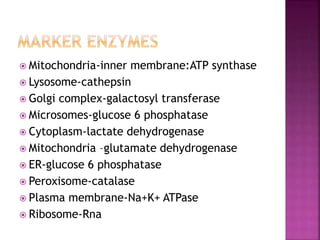
 Mitochondria-inner membrane:ATP synthase
 Lysosome-cathepsin
 Golgi complex-galactosyl transferase
 Microsomes-glucose 6 phosphatase
 Cytoplasm-lactate dehydrogenase
 Mitochondria –glutamate dehydrogenase
 ER-glucose 6 phosphatase
 Peroxisome-catalase
 Plasma membrane-Na+K+ ATPase
 Ribosome-Rna
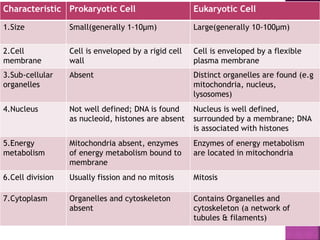
Characteristic Prokaryotic Cell Eukaryotic Cell
1.Size Small(generally 1-10µm) Large(generally 10-100µm)
2.Cell
membrane
Cell is enveloped by a rigid cell
wall
Cell is enveloped by a flexible
plasma membrane
3.Sub-cellular
organelles
Absent Distinct organelles are found (e.g
mitochondria, nucleus,
lysosomes)
4.Nucleus Not well defined; DNA is found
as nucleoid, histones are absent
Nucleus is well defined,
surrounded by a membrane; DNA
is associated with histones
5.Energy
metabolism
Mitochondria absent, enzymes
of energy metabolism bound to
membrane
Enzymes of energy metabolism
are located in mitochondria
6.Cell division Usually fission and no mitosis Mitosis
7.Cytoplasm Organelles and cytoskeleton
absent
Contains Organelles and
cytoskeleton (a network of
tubules & filaments)
‘’Centre for The Cureness’’
“To be good & to do good that is the whole of
religion”

Cell

  • 1.
    Tapeshwar Yadav. P.G finalYear, Biochemistry
  • 2.
    ‘’Centre for TheKnowledge’’
  • 3.
     Basic structuraland functional unit of life  Understanding of cell morphology is critical to the study of biochemistry.  Divided and classified in many ways.  One common classification method is absence or presence of a cell nucleus.
  • 4.
     Prokaryotes –have no nucleus  Eukaryotes – have a nucleus
  • 5.
    Diagram of atypical animal (eukaryotic) cell, showing subcellular components. Organelles:(1) nucleolus(2) nucleus(3) ribosome(4) vesicle(5) rough endoplasmic reticulum (ER)(6) Golgi apparatus(7) Cytoskeleton(8) smooth endoplasmic reticulum(9) mitochondria(10) vacuole(11) cytoplasm(12) lysosome13) centrioles within centrosome
  • 6.
     Organised structuresin the cell.  Enclosed by plasma membrane with in the cytosol.  All organelle have specific functions.  Plasma membrane has highly selective permeability;  Entry and exit of compounds is regulated.
  • 8.
     Most prominentorganelle of cell  All cells except mature RBCs in circulation  Occupies most of the available space e.g.small lymphocytes and spermatozoa  Two membranes-outer membrane continuous with membrane of ER, inner one is perinuclear membrane with numerous pores.  Nucleus contains DNA-chemical basis of genes governs all the functions of cells  Long DNA molecules complexed with proteins to form chromatin-organised into chromosomes
  • 9.
     DNA replication& RNA synthesis (transcription) are taking place inside the nucleus.  Lighter shaded area of the nucleus is neucleolus,area for RNA processing & Ribosome synthesis  Very prominent in cells actively synthesising proteins.
  • 10.
     George palade-1974 Network of interconnecting membranes enclosing channels or cisternae  Continuous from perinuclear envelope to outer plasma membrane  Prominent in cells actively synthesising  Proteins ,glycoproteins,lipoproteins.  Function: detoxification of various drugs:microsomal cytP450 hydroxylation of benzpyrine, aminopyrine,morphine ,etc. cholesterol synthesis(partial)
  • 11.
     Electron microscopicappearance  Rough ER-ribosomes attached to cytoplasmic side of membrane –where protiens are synthesised  Smooth ER-no ribosomes attached  Cells are fractionated –complex ER is disrupted –reassembled to form microsomes.
  • 12.
     Camillo Golgi-1906 Network of flattened smooth membranes and vesicles.  Converging area of ER.  While moving through ER CHTgroups are added to nascent proteins-glycoproteins reach the golgi area.  Function: protein sorting packaging & secretion
  • 14.
     Finished productshave following destinations: Pass through plasma membrane to surrounding medium-continuous secretion eg:secretion of immunoglobulins by plasma cells.  Reach plama membrane form integral part- but not secreted.  Secretory vesicles formed-stored for long time – secreted under appropriate stimuli.  eg:trypsinogen by pancreatic cells insulin by beta cells of langerhans. synthesised materials collected into lysosome packets.
  • 16.
     Tiny organelles Bags of enzymes  Optimum PH-5  Functions:degradation of proteins, carbohydrates,lipids & nucleotides  Clinical applications: gout postmortem autolysis inclusion cell disease
  • 18.
     Granular matrix 0.3 -1.5mm in diameter  Peroxidases and catalase  Prominent in leucocytes and platelets  Peroxidation of PUFA in vivo leads to hydro peroxide formation  Deficiency:adreno-leuco dystrophy(Brown – schilder’s disease) insufficient oxidation of VLCFA  Zellweger syndrome-peroxisomal ghosts  Primary hyperoxaluria
  • 20.
     Spherical ,ovalor rod like bodies  0.5 -1um in diameter;7um in length  Absent in erythrocytes  Fully packed in tail of spermatozoa  Power house of cell  Two membranes-inner convolutes into folds or cristae  contains enzymes of ETC  Cyt.p450 system-steroidogenesis
  • 21.
    Functions:  ETC  ATPgeneration  TCA cycle; beta oxidation of FA  Ketone body production  A part of urea synthesis ,heme synthesis,pyrimidine synthesis  A part of gluconeogenesis
  • 22.
     Microtubules –tubulin. Rolein mitosis.  Microfilaments –actin-generation of forces for internal cell motion.  Microtrabaculae –slender fragile tubes.
  • 23.
     Protein synthesis Glycolysis  Glycogen metabolism  HMP shunt pathway  Fatty acid synthesis  Cholesterol synthesis  Purine synthesis  A part of heme synthesis,urea synthesis,pyrimidine synthesis
  • 24.
     Large organelle,without specific shape  Store waste or raw materials used in synthesis of proteins
  • 25.
     Some enzymesare present in certain organelles only-marker enzymes  Albert Claude -1974-fractionating subcellular organelles by applying centrifugal forces  After centrifugation –seperated organelles are identified by detection of marker enzymes
  • 26.
     Mitochondria-inner membrane:ATPsynthase  Lysosome-cathepsin  Golgi complex-galactosyl transferase  Microsomes-glucose 6 phosphatase  Cytoplasm-lactate dehydrogenase  Mitochondria –glutamate dehydrogenase  ER-glucose 6 phosphatase  Peroxisome-catalase  Plasma membrane-Na+K+ ATPase  Ribosome-Rna
  • 27.
    Characteristic Prokaryotic CellEukaryotic Cell 1.Size Small(generally 1-10µm) Large(generally 10-100µm) 2.Cell membrane Cell is enveloped by a rigid cell wall Cell is enveloped by a flexible plasma membrane 3.Sub-cellular organelles Absent Distinct organelles are found (e.g mitochondria, nucleus, lysosomes) 4.Nucleus Not well defined; DNA is found as nucleoid, histones are absent Nucleus is well defined, surrounded by a membrane; DNA is associated with histones 5.Energy metabolism Mitochondria absent, enzymes of energy metabolism bound to membrane Enzymes of energy metabolism are located in mitochondria 6.Cell division Usually fission and no mitosis Mitosis 7.Cytoplasm Organelles and cytoskeleton absent Contains Organelles and cytoskeleton (a network of tubules & filaments)
  • 28.
    ‘’Centre for TheCureness’’
  • 29.
    “To be good& to do good that is the whole of religion”