JAUNDICE
&
LFT
Prof (Dr.) ViyatprajnaAcharya
MBBS, MD PhD
DIAGNOSIS??
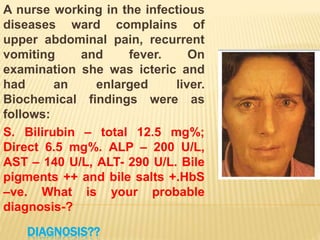
A nurse working in the infectious
diseases ward complains of
upper abdominal pain, recurrent
vomiting and fever. On
examination she was icteric and
had an enlarged liver.
Biochemical findings were as
follows:
S. Bilirubin – total 12.5 mg%;
Direct 6.5 mg%. ALP – 200 U/L,
AST – 140 U/L, ALT- 290 U/L. Bile
pigments ++ and bile salts +.HbS
–ve. What is your probable
diagnosis-?
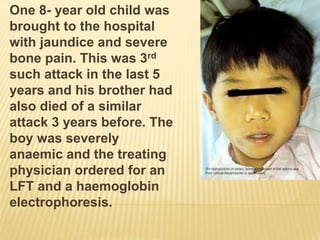
One 8- year old child was
brought to the hospital
with jaundice and severe
bone pain. This was 3rd
such attack in the last 5
years and his brother had
also died of a similar
attack 3 years before. The
boy was severely
anaemic and the treating
physician ordered for an
LFT and a haemoglobin
electrophoresis.
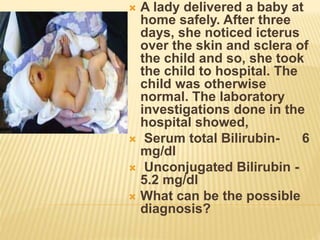
 A lady delivered a baby at
home safely. After three
days, she noticed icterus
over the skin and sclera of
the child and so, she took
the child to hospital. The
child was otherwise
normal. The laboratory
investigations done in the
hospital showed,
 Serum total Bilirubin- 6
mg/dl
 Unconjugated Bilirubin -
5.2 mg/dl
 What can be the possible
diagnosis?
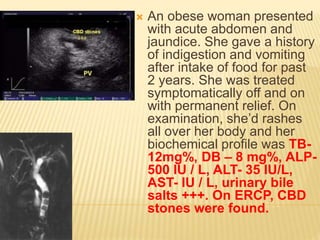
 An obese woman presented
with acute abdomen and
jaundice. She gave a history
of indigestion and vomiting
after intake of food for past
2 years. She was treated
symptomatically off and on
with permanent relief. On
examination, she’d rashes
all over her body and her
biochemical profile was TB-
12mg%, DB – 8 mg%, ALP-

500 IU / L, ALT- 35 IU/L,
AST- IU / L, urinary bile
salts +++. On ERCP, CBD
stones were found.
JAUNDICE / ICTERUS - CARDINAL
MANIFESTATION OF SEVERAL DISEASES
DUE TO AFFECTION OF LIVER AND
BILIARY TRACT / A HEMOLYTIC DISORDER
 Clinically- Yellow discoloration of sclera,
skin, mucous membranes due to
deposition of bile pigment
(Hyperbilirubinemia)
 Biochemically – Serum bilirubin >
2mg/dl
FATE OF HEMOGLOBIN
 Humans- 250-400 mg bilirubin produced
everyday (80% from heme and 20% from
non-heme proteins)
 Senescent RBC rupture (80%), premature
erythroid cell damage in BM (10%),
Myoglobin and Cytochrome damage
(10%) – pool of heme
 1g Hb = 35 mg bilirubin
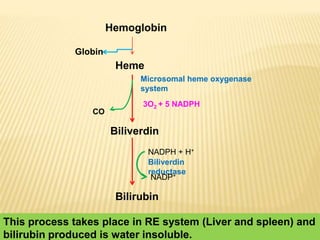
Hemoglobin
Heme
Globin
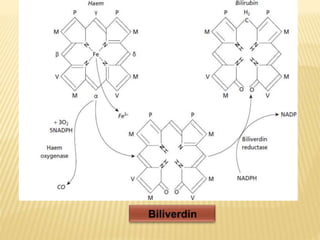
Microsomal heme oxygenase
system
CO
3O2 + 5 NADPH
Biliverdin
Bilirubin
Biliverdin
reductase
NADPH + H+
NADP+
This process takes place in RE system (Liver and spleen) and
bilirubin produced is water insoluble.
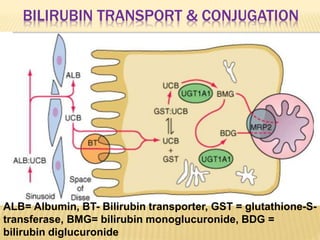
BILIRUBIN TRANSPORT & CONJUGATION
ALB= Albumin, BT- Bilirubin transporter, GST = glutathione-S-
transferase, BMG= bilirubin monoglucuronide, BDG =
bilirubin diglucuronide
 Bilirubin binds to albumin- travel to
hepatocytes
 Albumin is left, BT carries UCB into the
hepatocytes
 Ligandin / Protein Y / glutathione-S-
transferase – binds to UCB and prevents its
efflux
 Conjugation with Glucuronic acid with the
help of bilirubin Uridine diphosphate
glucuronyl transferase - BMG= bilirubin
monoglucuronide, BDG = bilirubin
diglucuronide
 Conjugated bilirubin poured into 2nd part of
duodenum through bile
 Unchanged through proximal intestine
 Distal ileum & Colon- deconjugated by
bacteria
 reduced to urobilinogen
 Urobilinogen further reduced
Setrcobilinogen & Mesobilinogen
 80% of these excreted either unchanged
or converted to urobilins , stercobilins
Feces, urine (impart
colour)
 20% of these – enterohepatic circulation
 A small fraction (< 3 mg/ dl) – in urine
 If bacterial flora reduced, bilirubin is not
converted to urobilinogen instead re-oxidized
to Biliverdin → green stool
ALTERNATIVE ROUTES OF BILIRUBIN
ELIMINATION
 In the absence of bilirubin
glucuronidation a fraction of bilirubin
is excreted as hydroxylated products
– may be by Microsomal P450
system or mitochondrial bilirubin
oxidase system in liver and other
tissues
 Normal level of Serum bilirubin- 0.2-
1.0 mg /dl
 80% UC bilirubin – 0.2-0.8 mg/dl
 20% C bilirubin – 0- 0.2 mg/dl
 Latent jaundice – 1-2 mg/dl
 Jaundice - > 2 mg / dl
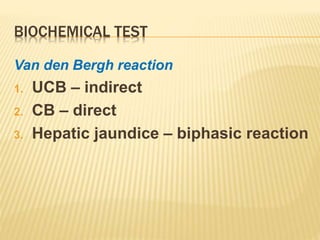
BIOCHEMICAL TEST
Van den Bergh reaction
1. UCB – indirect
2. CB – direct
3. Hepatic jaundice – biphasic reaction
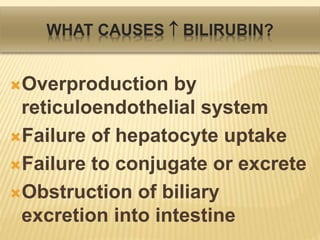
WHAT CAUSES  BILIRUBIN?
Overproduction by
reticuloendothelial system
Failure of hepatocyte uptake
Failure to conjugate or excrete
Obstruction of biliary
excretion into intestine
CLASSIFICATION OF JAUNDICE
Inherited hyperbilirubinemia
Acquired hyperbilirubinemia
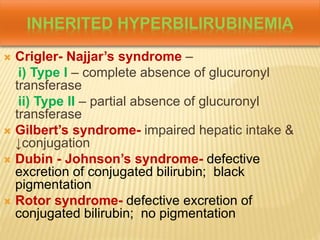
INHERITED HYPERBILIRUBINEMIA
 Crigler- Najjar’s syndrome –
i) Type I – complete absence of glucuronyl
transferase
ii) Type II – partial absence of glucuronyl
transferase
 Gilbert’s syndrome- impaired hepatic intake &
↓conjugation
 Dubin - Johnson’s syndrome- defective
excretion of conjugated bilirubin; black
pigmentation
 Rotor syndrome- defective excretion of
conjugated bilirubin; no pigmentation
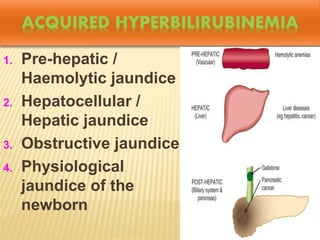
ACQUIRED HYPERBILIRUBINEMIA
1. Pre-hepatic /
Haemolytic jaundice
2. Hepatocellular /
Hepatic jaundice
3. Obstructive jaundice
4. Physiological
jaundice of the
newborn
PRE-HEPATIC / HEMOLYTIC JAUNDICE
A. Hemolytic disease of the newborn
 Rh incompatibility
 Erythroblastosis fetalis
B. Hemolytic disease due to other causes
Congenital spherocytosis
G-6-PD deficiency
Incompatible blood transfusion
Hereditary spherocytosis
FEATURES OF PRE-HEPATIC / HEMOLYTIC
JAUNDICE
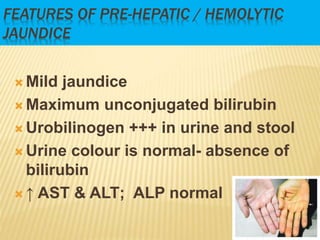
 Mild jaundice
 Maximum unconjugated bilirubin
 Urobilinogen +++ in urine and stool
 Urine colour is normal- absence of
bilirubin
 ↑ AST & ALT; ALP normal
HEPATIC / HEPATOCELLULAR JAUNDICE
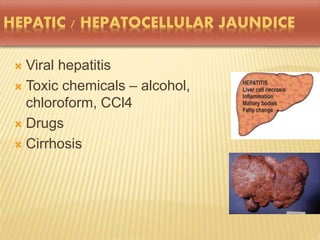
 Viral hepatitis
 Toxic chemicals – alcohol,
chloroform, CCl4
 Drugs
 Cirrhosis
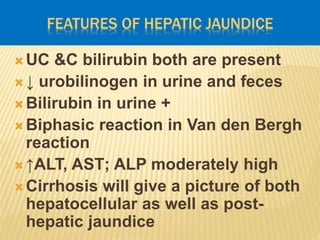
FEATURES OF HEPATIC JAUNDICE
UC &C bilirubin both are present
 ↓ urobilinogen in urine and feces
 Bilirubin in urine +
 Biphasic reaction in Van den Bergh
reaction
 ↑ALT, AST; ALP moderately high
 Cirrhosis will give a picture of both
hepatocellular as well as post-
hepatic jaundice
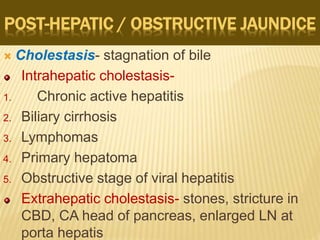
POST-HEPATIC / OBSTRUCTIVE JAUNDICE
 Cholestasis- stagnation of bile
Intrahepatic cholestasis-
1. Chronic active hepatitis
2. Biliary cirrhosis
3. Lymphomas
4. Primary hepatoma
5. Obstructive stage of viral hepatitis
Extrahepatic cholestasis- stones, stricture in
CBD, CA head of pancreas, enlarged LN at
porta hepatis
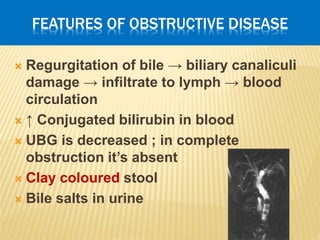
FEATURES OF OBSTRUCTIVE DISEASE
 Regurgitation of bile → biliary canaliculi
damage → infiltrate to lymph → blood
circulation
 ↑ Conjugated bilirubin in blood
 UBG is decreased ; in complete
obstruction it’s absent
 Clay coloured stool
 Bile salts in urine
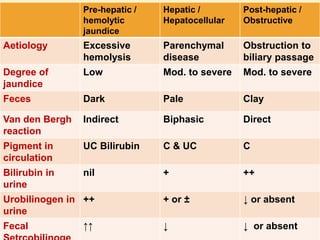
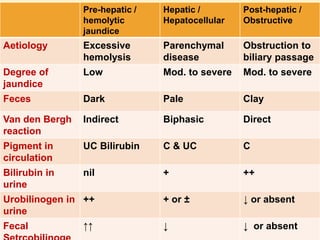
Pre-hepatic /
hemolytic
jaundice
Hepatic /
Hepatocellular
Post-hepatic /
Obstructive
Aetiology Excessive
hemolysis
Parenchymal
disease
Obstruction to
biliary passage
Degree of
jaundice
Low Mod. to severe Mod. to severe
Feces Dark Pale Clay
Van den Bergh
reaction
Indirect Biphasic Direct
Pigment in
circulation
UC Bilirubin C & UC C
Bilirubin in
urine
nil + ++
Urobilinogen in
urine
++ + or ± ↓ or absent
Fecal ↑↑ ↓ ↓ or absent
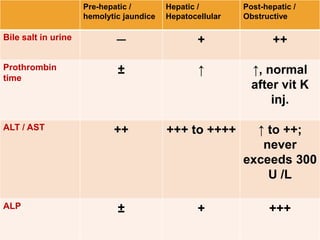
Pre-hepatic /
hemolytic jaundice
Hepatic /
Hepatocellular
Post-hepatic /
Obstructive
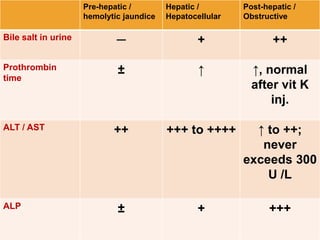
Bile salt in urine ─ + ++
Prothrombin
time
± ↑ ↑, normal
after vit K
inj.
ALT / AST ++ +++ to ++++ ↑ to ++;
never
exceeds 300
U /L
ALP ± + +++
PHYSIOLOGICAL JAUNDICE OF THE
NEWBORN
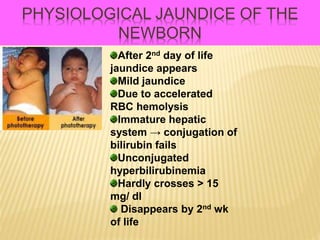
After 2nd day of life
jaundice appears
Mild jaundice
Due to accelerated
RBC hemolysis
Immature hepatic
system → conjugation of
bilirubin fails
Unconjugated
hyperbilirubinemia
Hardly crosses > 15
mg/ dl
Disappears by 2nd wk
of life
KERNICTERUS
 Kern= Nucleus of brain
Icterus = jaundice
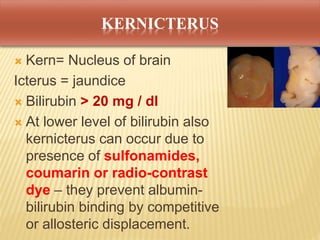
 Bilirubin > 20 mg / dl
 At lower level of bilirubin also
kernicterus can occur due to
presence of sulfonamides,
coumarin or radio-contrast
dye – they prevent albumin-
bilirubin binding by competitive
or allosteric displacement.
 Hyperbilirubinemia- induced toxic
encephalopathy – mental
retardation
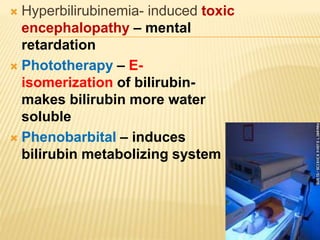
 Phototherapy – E-
isomerization of bilirubin-
makes bilirubin more water
soluble
 Phenobarbital – induces
bilirubin metabolizing system
Only God can turn
a mess into a
message, a test
into a testimony, a
trial into a
triumph , a victim
LIVER FUNCTION TEST
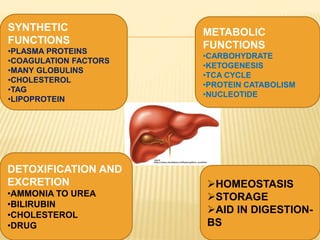
SYNTHETIC
FUNCTIONS
•PLASMA PROTEINS
•COAGULATION FACTORS
•MANY GLOBULINS
•CHOLESTEROL
•TAG
•LIPOPROTEIN
METABOLIC
FUNCTIONS
•CARBOHYDRATE
•KETOGENESIS
•TCA CYCLE
•PROTEIN CATABOLISM
•NUCLEOTIDE
DETOXIFICATION AND
EXCRETION
•AMMONIA TO UREA
•BILIRUBIN
•CHOLESTEROL
•DRUG
HOMEOSTASIS
STORAGE
AID IN DIGESTION-
BS
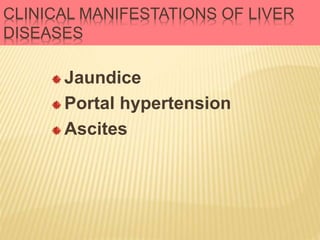
CLINICAL MANIFESTATIONS OF LIVER
DISEASES
Jaundice
Portal hypertension
Ascites
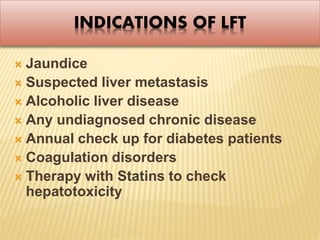
INDICATIONS OF LFT
 Jaundice
 Suspected liver metastasis
 Alcoholic liver disease
 Any undiagnosed chronic disease
 Annual check up for diabetes patients
 Coagulation disorders
 Therapy with Statins to check
hepatotoxicity
CLASSIFICATION OF LFT
I. Tests of hepatic excretory function
II. Plasma proteins (tests for synthetic
function of liver)
III. Liver enzyme panel
IV. Special tests
I.TESTS OF HEPATIC EXCRETORY FUNCTION
 Serum bilirubin- Total, UC, C
 Urine – bile pigments, bile slats,
urobilinogen
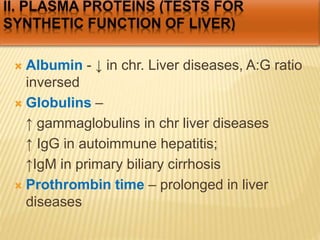
 Albumin - ↓ in chr. Liver diseases, A:G ratio
inversed
 Globulins –
↑ gammaglobulins in chr liver diseases
↑ IgG in autoimmune hepatitis;
↑IgM in primary biliary cirrhosis
 Prothrombin time – prolonged in liver
diseases
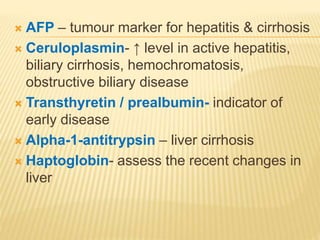
 AFP – tumour marker for hepatitis & cirrhosis
 Ceruloplasmin- ↑ level in active hepatitis,
biliary cirrhosis, hemochromatosis,
obstructive biliary disease
 Transthyretin / prealbumin- indicator of
early disease
 Alpha-1-antitrypsin – liver cirrhosis
 Haptoglobin- assess the recent changes in
liver
III. LIVER ENZYME PANEL
Hepatocellular damage – ALT & AST (5-40
U/L)
very high levels – viral & toxic hepatitis
ALT is more specific for liver than AST; but in
alcoholic hepatitis – AST elevated
Moderate elevation (100-300 U /L)-
alcoholic hepatitis, AI hepatitis, Wilson’s
disease, Non-alcoholic chr hepatitis
Minor elevation (100 U/ L)- Chr viral
hepatitis, fatty liver & in nonalcoholic
steatohepatitis
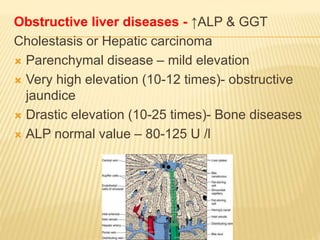
Obstructive liver diseases - ↑ALP & GGT
Cholestasis or Hepatic carcinoma
 Parenchymal disease – mild elevation
 Very high elevation (10-12 times)- obstructive
jaundice
 Drastic elevation (10-25 times)- Bone diseases
 ALP normal value – 80-125 U /l
LIVER SPECIFIC ENZYMES- GGT (?) & 5’
NUCLEOTIDASE
 GGT- sensitive to alcohol abuse
↑levels in Chr alcoholism,
pancreatic disease, MI, renal failure,
COPD, DM
 5’ Nucleotidase – More specific for
obstructive liver disease
 GST (Glutathione- S- Transferase)-
very specific
IV. TESTS BASED ON METABOLIC FUNCTION
OF LIVER
 Galactose tolerance test
 BSP excretion test
 Blood ammonia estimation- Gives
impression of liver’s capacity to
generate urea from ammonia
↑NH3- cirrhosis, portocaval
anastomosis
Obsolete
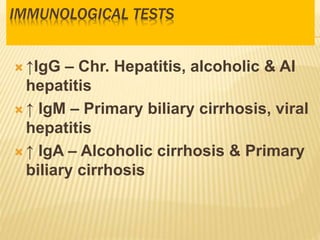
IMMUNOLOGICAL TESTS
 ↑IgG – Chr. Hepatitis, alcoholic & AI
hepatitis
 ↑ IgM – Primary biliary cirrhosis, viral
hepatitis
 ↑ IgA – Alcoholic cirrhosis & Primary
biliary cirrhosis
Pre-hepatic /
hemolytic
jaundice
Hepatic /
Hepatocellular
Post-hepatic /
Obstructive
Aetiology Excessive
hemolysis
Parenchymal
disease
Obstruction to
biliary passage
Degree of
jaundice
Low Mod. to severe Mod. to severe
Feces Dark Pale Clay
Van den Bergh
reaction
Indirect Biphasic Direct
Pigment in
circulation
UC Bilirubin C & UC C
Bilirubin in
urine
nil + ++
Urobilinogen in
urine
++ + or ± ↓ or absent
Fecal ↑↑ ↓ ↓ or absent
Pre-hepatic /
hemolytic jaundice
Hepatic /
Hepatocellular
Post-hepatic /
Obstructive
Bile salt in urine ─ + ++
Prothrombin
time
± ↑ ↑, normal
after vit K
inj.
ALT / AST ++ +++ to ++++ ↑ to ++;
never
exceeds 300
U /L
ALP ± + +++
Hard work is a substitute to good luck
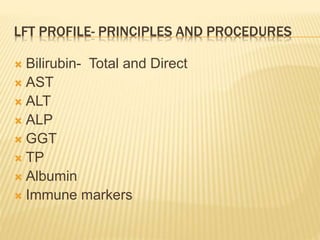
LFT PROFILE- PRINCIPLES AND PROCEDURES
 Bilirubin- Total and Direct
 AST
 ALT
 ALP
 GGT
 TP
 Albumin
 Immune markers
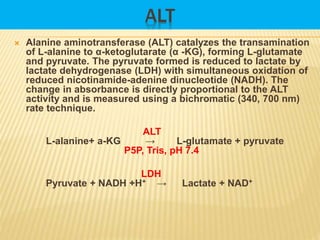
ALT
 Alanine aminotransferase (ALT) catalyzes the transamination
of L-alanine to α-ketoglutarate (α -KG), forming L-glutamate
and pyruvate. The pyruvate formed is reduced to lactate by
lactate dehydrogenase (LDH) with simultaneous oxidation of
reduced nicotinamide-adenine dinucleotide (NADH). The
change in absorbance is directly proportional to the ALT
activity and is measured using a bichromatic (340, 700 nm)
rate technique.
ALT
L-alanine+ a-KG → L-glutamate + pyruvate
P5P, Tris, pH 7.4
LDH
Pyruvate + NADH +H+ → Lactate + NAD+
AST
 Aspartate aminotransferase (AST) catalyzes the transamination
from L-aspartate to a-ketoglutarate, forming L-glutamate and
oxaloacetate. The oxaloacetate formed is reduced to malate by
malate dehydrogenase (MDH) with simultaneous oxidation of
reduced nicotinamide adenine dinucleotide (NADH). The change in
absorbance with time due to the conversion of NADH to NAD is
directly proportional to the AST activity and is measured using a
bichromatic (340, 700 nm) rate technique.
AST
L-aspartate + a-ketoglutarate ————> L-glutamate +
Oxalacetate
pH 7.8
MDH
Oxaloacetate + NADH ————> Malate + NAD
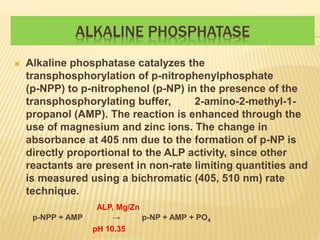
ALKALINE PHOSPHATASE
 Alkaline phosphatase catalyzes the
transphosphorylation of p-nitrophenylphosphate
(p-NPP) to p-nitrophenol (p-NP) in the presence of the
transphosphorylating buffer, 2-amino-2-methyl-1-
propanol (AMP). The reaction is enhanced through the
use of magnesium and zinc ions. The change in
absorbance at 405 nm due to the formation of p-NP is
directly proportional to the ALP activity, since other
reactants are present in non-rate limiting quantities and
is measured using a bichromatic (405, 510 nm) rate
technique.
ALP, Mg/Zn
p-NPP + AMP → p-NP + AMP + PO4
pH 10.35
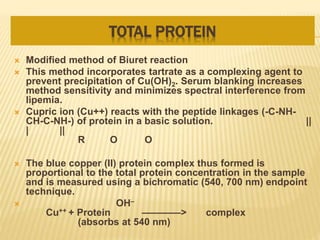
TOTAL PROTEIN
 Modified method of Biuret reaction
 This method incorporates tartrate as a complexing agent to
prevent precipitation of Cu(OH)2. Serum blanking increases
method sensitivity and minimizes spectral interference from
lipemia.
 Cupric ion (Cu++) reacts with the peptide linkages (-C-NH-
CH-C-NH-) of protein in a basic solution. ||
| ||
R O O
 The blue copper (II) protein complex thus formed is
proportional to the total protein concentration in the sample
and is measured using a bichromatic (540, 700 nm) endpoint
technique.
 OH–
Cu++ + Protein ————> complex
(absorbs at 540 nm)
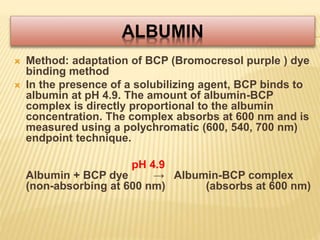
ALBUMIN
 Method: adaptation of BCP (Bromocresol purple ) dye
binding method
 In the presence of a solubilizing agent, BCP binds to
albumin at pH 4.9. The amount of albumin-BCP
complex is directly proportional to the albumin
concentration. The complex absorbs at 600 nm and is
measured using a polychromatic (600, 540, 700 nm)
endpoint technique.
pH 4.9
Albumin + BCP dye → Albumin-BCP complex
(non-absorbing at 600 nm) (absorbs at 600 nm)
DIRECT BILIRUBIN
 Modified Doumas reference method
 Diazotized sulfanilic acid is formed by combining sodium
nitrite and sulfanilic acid at low pH. The sample is diluted
in 0.05M HCl. A blank reading is taken to eliminate
interference from non-bilirubin pigments. Upon addition
of the diazotized sulfanilic acid, the conjugated bilirubin is
converted to diazo-bilirubin, a red chromophore which
absorbs at 540 nm and is measured using a bichromatic
(540, 700 nm) endpoint technique.
Conjugated bilirubin + Diazotized sulfanilic acid → Red
chromophore (absorbs at 540 nm)

TOTAL BILIRUBIN
 Diazotized sulfanilic acid is formed by combining
sodium nitrite and sulfanilic acid at low pH.
Bilirubin in the sample, including the delta form is
solubilized by dilution in a mixture of
caffeine/benzoate/acetate/EDTA. Upon addition of
the diazotized sulfanilic acid, the solubilized
bilirubin is converted to diazo-bilirubin, a red
chromophore which absorbs at 540nm and is
measured using a bichromatic (540, 700 nm)
endpoint technique.

 Solubilized bilirubin + Diazotized sulfanilic acid —
——> Red chromophore (absorbs at 540 nm)
GAMMA-GLUTAMYL TRANSFEREASE
 The method uses the substrate L-gamma-
glutamyl-3-carboxy-4-nitranilide with
glycylglycine.
Gamma-glutamyl transferase catalyzes the transfer
of the glutamyl moiety from Gamma-glutamyl-3-
carboxy-4-nitranilide (GCNA) to glycylglycine
thereby releasing 5-amino-2-nitrobenzoate which
absorbs at 405 nm. This change is proportional to
the Gamma-glutamyl transferase activity and is
measured using a bichromatic (405, 600 nm) rate
technique.
GGT
GCNA + glycylglycine →L-g-glutamyl-glycylglycine + 5-
amino-2-nitrobenzoate
FOR MORE PPT ON MEDICAL BIOCHEMISTRY
PLEASE VISIT WWW.VPACHARYA.COM
DO NOT THINK……ACT
DO NOT PRETEND……BE
DO NOT DREAM………….REALISE