STEREOCHEMISTRY
DEFINITION:
The branch of chemistry which deals with three dimensional structure of molecule
and their effect on physical and chemical properties is known as stereochemistry.
ISOMERS AND THEIR CLASSIFICATION
You are already familiar with the concept of isomers: different compounds which
have the same molecular formula. Here we will learn to make distinction between
various kinds of isomers, especially the stereoisomers.
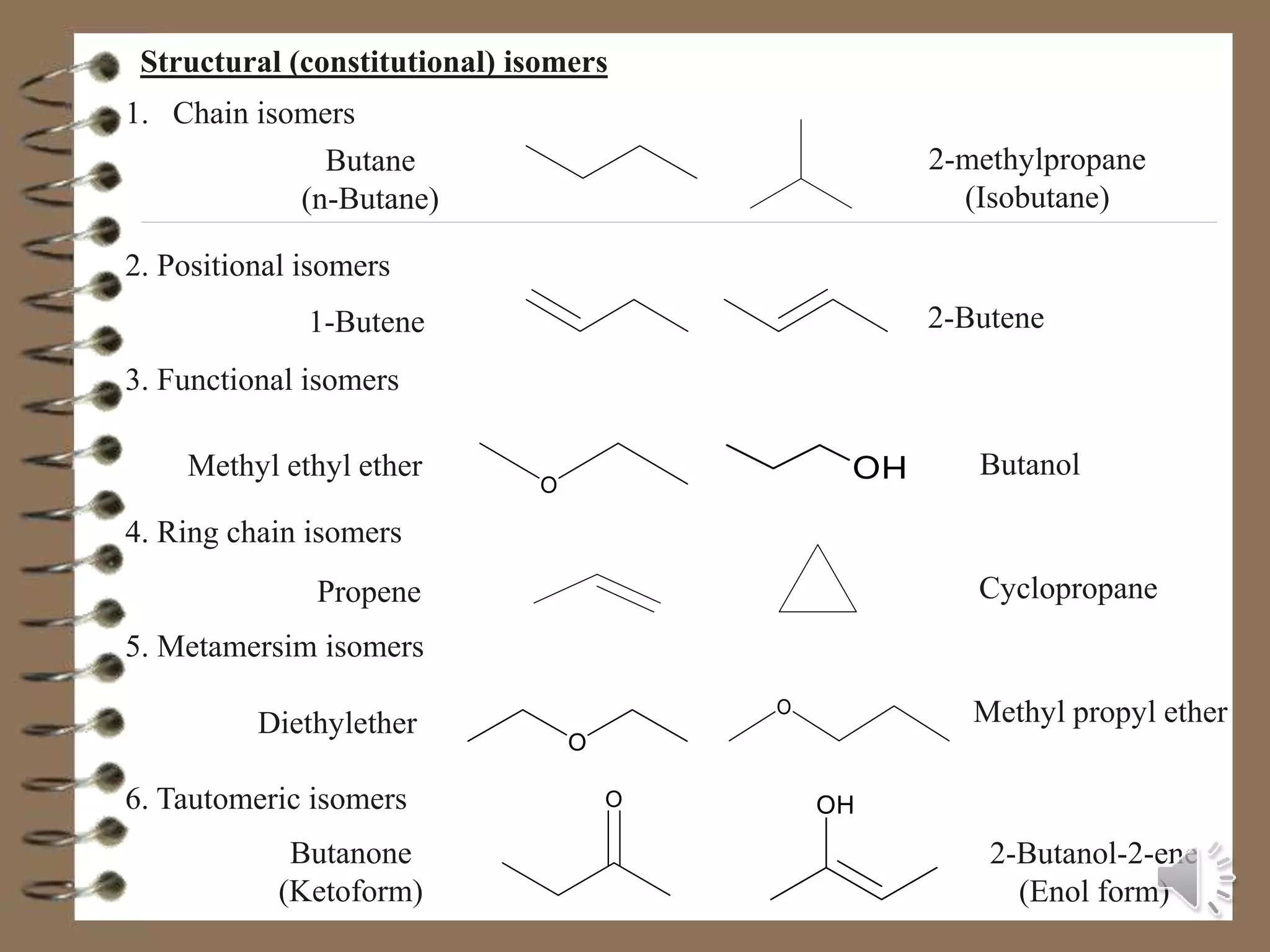
Structural (constitutional) isomers
1. Chain isomers
2. Positional isomers
3. Functional isomers
4. Ring chain isomers
5. Metamersim isomers
6. Tautomeric isomers
2-methylpropane
(Isobutane)
Butane
(n-Butane)
1-Butene 2-Butene
Methyl ethyl ether Butanol
Methyl propyl ether
Diethylether
Cyclopropane
Propene
Butanone
(Ketoform)
2-Butanol-2-ene
(Enol form)
OPTICALACTIVITY
We know that ordinary lights are composed of rays of different wavelengths vibrating in all
directions perpendicular to the path of its propagation. These vibrations can be made to occur
in a single plane by passing ordinary light through the polarizing Nicol prism. Such light whose
vibrations occur in only one plane is called plane polarized light.
Compounds which rotate the plane of polarized light are called optically active
compounds and this property is known as optical activity. Rotation of plane of
polarized light can be of two types.
• Dextrorotatory : If the compound rotates the plane of polarization to the right
(clockwise) it is said to be dextrorotatory (Latin: dexter-right) and is denoted by (+),
or ‘d’.
• Levorotatory : If the compound rotates the plane of polarization to the left
(counterclockwise) it is said to be levorotatory (Latin: levus-left) and is denoted by
(-) or ‘l’
CHIRALITY
The word chiral (Greek word Chier, meaning hand) is used for those objects which have
right-handed and left-handed forms, i.e., molecules which have “handedness” and the
general property of “handedness” is termed chirality. An object which is not
superimposable upon its mirror image is chiral.
Achiral: Object and molecules which are superimposable on their mirror images is
achiral. Achiral molecule has internal plane of symmetry, a hypothetical plane which
bisects an object or molecule into mirror-reflactive halves. An object or molecule
with an internal plane of symmetry is achiral.
The term Asymmetric center and chiral center- Three terms are used to designate, a
carbon atom bonded tetrahedral to four different substituents in a chiral molecule:
Asymmetric atom, chiral center or stereogenic center.
Let us understand chiral and achiral center taking few more examples.
Chiral centres are shown by astrik (*)
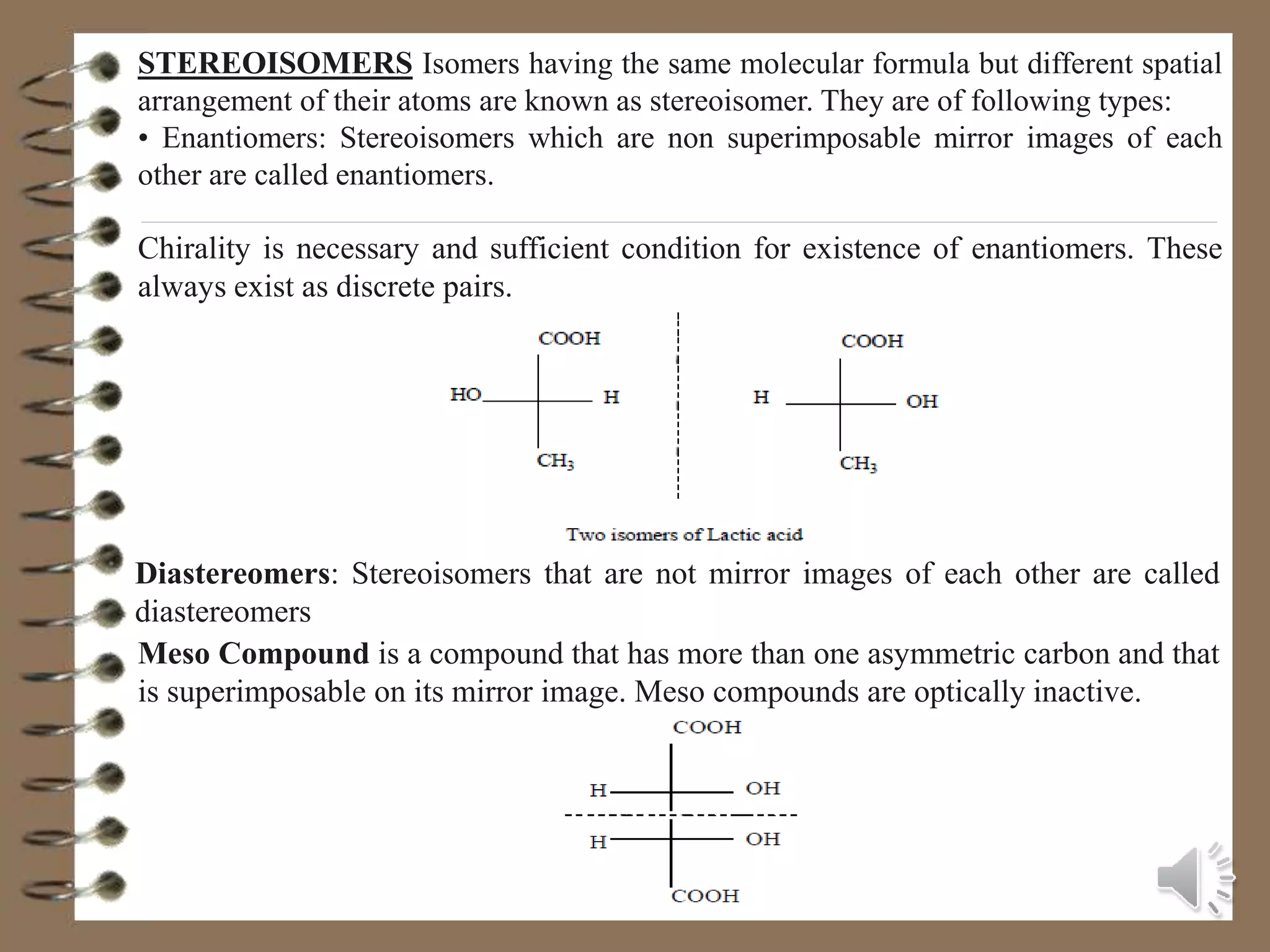
STEREOISOMERS Isomers having the same molecular formula but different spatial
arrangement of their atoms are known as stereoisomer. They are of following types:
• Enantiomers: Stereoisomers which are non superimposable mirror images of each
other are called enantiomers.
Chirality is necessary and sufficient condition for existence of enantiomers. These
always exist as discrete pairs.
Diastereomers: Stereoisomers that are not mirror images of each other are called
diastereomers
Meso Compound is a compound that has more than one asymmetric carbon and that
is superimposable on its mirror image. Meso compounds are optically inactive.
Geomatrical Isomers:
Geometrical isomers occurs as a result of restricted rotation about a carbon-carbon
bond. This is also called cis-trans isomerism. This isomerism exhibited by variety of
compounds such as compound containing double bond C=C, C=N, N=N, compound
containing cyclic structure or compound containing restricted rotation due to steric
hindrance.
Conformational isomers: Conformational isomers are the isomers that can be
converted into one another by rotation around a single bond. Example: eclipsed,
gauche and anti butane are all conformational isomers of one another.
(eclipsed means that identical groups are all directly in line with one another,
gauche means that identical groups are 60 degree from one another and anti means
that identical groups are 180 degree from one another.)
These molecules can be interconverted by rotating around the central carbon-carbon
single bond.
• A solid wedge or thick line ( ) it represents bond projection towards the
observer or above the plane of paper.
• A continuous line or ordinary line ( ) it represents bond in the plane of paper.
• A dashed wedge or broken line ( ) it represents bond projection away from the
observer or below the plane of paper. Example: CH4 (methane)
Fischer projection provide an easy way to draw three dimensional molecule on two
dimensional paper and all the bonds are drawn as solid lines around asymmetric
carbon atom.
The sawhorse formula indicates the arrangement of all the atoms or groups on two
adjacent carbon atoms. The bonds between the two carbon atoms are drawn
diagonally and of relatively greater length for the sake of clarity. The lower left
hand carbon is taken as the front carbon or towards the observer and the upper right
hand carbon as the back carbon or away from the observer. e.g. ethane
All parallel bonds in sawhorse formula are eclipsed and all anti parallel bonds are
opposite or scattered. Gauche representation is that in which bulky groups are
nearer to each other at 60 angles.
Newman devised a very simple method of projecting three dimensional formulas on
two dimensional paper which are known as Newman projection.
PLANE OF SYMMETRY
The plane which divides a molecule in to two equal halves which are related as
object and mirror image is known as plane of symmetry. For example
The molecules having plane of symmetry are achiral (optically inactive).
A center of symmetry in a molecule is said to exist if a line is drawn from any
atom or group to this point and when extended to an equal distance beyond this
point, meets the identical atom or group.
All lines are passing through this point, hence it is the center point of the molecule.
D, L SYSTEM OF NOMENCLATURE
This nomenclature is mainly used in sugar chemistry or optically active polyhydric
carbonyl compounds. This is a relative nomenclature because all the configurations
described with respect to glyceraldehydes.
All sugars whose Fischer projection formula shows the OH group on the right hand
side of the chiral atom belong to the D-series.
Similarly, if OH is on the left hand side, then the sugar belongs to the L-series.
ERYTHRO AND THREO SYSTEM OF NOMENCLATURE
This nomenclature is mainly used only in those compounds which have only two
chiral carbons and the following structures:
R’-Cab-Cab-R’’ or R’-Cab-Cbc-R’’
i.e. out of six substituent on two asymmetric carbons, at least one should be same in
both the carbons.
When two like groups in fisher projection formula are drawn on the same side of
vertical line, the isomer is called erythro form; if these are placed on the opposite
sides the isomer is said to be threo form.
Following are some examples of threo and erythro form.
R.S. NOMENCLATURE
The order of rearrangement of four groups around a chiral carbon is called the
absolute configuration around that atom.
The R, S nomenclature involves two steps:
Step I: The four ligands (atom or groups) attached to the chiral center are assigned a
sequence of priority according to sequence rules.
Rule 1: If all the four atoms directly attached to the chiral carbon are different,
priority depends on their atomic number. The atom having highest atomic number
gets the highest priority, i.e., (1).The atom with lowest atomic number is given
lowest priority, i.e. (2), the group with next higher atomic number is given the next
higher priority (3) and so on. For example:
Rule 2: if two or more than two isotopes of the same element are present, the
isotope of higher mass receives the higher priority.
Rule 3: if two or more of the atoms directly bonded to the chiral carbon are
identical, the atomic number of the next atom is used for priority assignment. If
these atoms also have identical atoms attached to them, priority is determined at the
first point of difference along the chain. The atom that has attached to it an atom of
higher priority gets the higher priority.
Rule 4: If a double or a triple bond is linked to chiral center, the involved electrons
are duplicated or triplicated respectively.
• By this rule, we obtain the following priority sequence:
If n = number of chiral centers, the maximum possible number of stereoisomers is 2n
Possible combinations for 2,3-dibromobutane.
Possible combinations for 2-bromo-3-chlorobutane
E-Z NOTATION FOR GEOMETRIC ISOMERISM (E-Z system)
The problem with the cis-trans system for naming geometric isomers. Consider a
simple case of geometric isomerism which we've already discussed on the previous
talk.
You can tell which is the cis and which the trans form just by looking at them.
There are problems as compounds get more complicated. For example, could you
name these two isomers using cis and trans?
Because everything attached to the carbon-carbon double bond is different, there
aren't any obvious things which you can think of as being "cis" or "trans" to each
other. The E-Z system gets around this problem completely - but unfortunately
makes things slightly more difficult for the simple examples you usually meet in
introductory courses.
How the E-Z system works
We'll use the last two compounds as an example to explain how the system works.
You look at what is attached to each end of the double bond in turn, and give the
two groups a "priority" according to a set of rules which we'll explore in a minute.
In the example above, at the left-hand end of the bond, it turns out that bromine has
a higher priority than fluorine. And on the right-hand end, it turns out that chlorine
has a higher priority than hydrogen.
If the two groups with the higher priorities are on the same side of the double bond,
that is described as the (Z)- isomer. So you would write it as (Z)-name of
compound. The symbol Z comes from a German word (zusammen) which means
together.
If the two groups with the higher priorities are on opposite sides of the double bond,
then this is the (E)- isomer. E comes from the German entgegen which means
opposite.
So the two isomers are:
Summary
(E)- : The higher priority groups are on opposite sides of the double bond.
(Z)- : The higher priority groups are on the same side of the double bond.
Notes that:
Home Works
Write the name of the following compounds using E & Z system:

Stereochemistry

  • 1.
  • 2.
    DEFINITION: The branch ofchemistry which deals with three dimensional structure of molecule and their effect on physical and chemical properties is known as stereochemistry. ISOMERS AND THEIR CLASSIFICATION You are already familiar with the concept of isomers: different compounds which have the same molecular formula. Here we will learn to make distinction between various kinds of isomers, especially the stereoisomers.
  • 3.
    Structural (constitutional) isomers 1.Chain isomers 2. Positional isomers 3. Functional isomers 4. Ring chain isomers 5. Metamersim isomers 6. Tautomeric isomers 2-methylpropane (Isobutane) Butane (n-Butane) 1-Butene 2-Butene Methyl ethyl ether Butanol Methyl propyl ether Diethylether Cyclopropane Propene Butanone (Ketoform) 2-Butanol-2-ene (Enol form)
  • 4.
    OPTICALACTIVITY We know thatordinary lights are composed of rays of different wavelengths vibrating in all directions perpendicular to the path of its propagation. These vibrations can be made to occur in a single plane by passing ordinary light through the polarizing Nicol prism. Such light whose vibrations occur in only one plane is called plane polarized light. Compounds which rotate the plane of polarized light are called optically active compounds and this property is known as optical activity. Rotation of plane of polarized light can be of two types. • Dextrorotatory : If the compound rotates the plane of polarization to the right (clockwise) it is said to be dextrorotatory (Latin: dexter-right) and is denoted by (+), or ‘d’. • Levorotatory : If the compound rotates the plane of polarization to the left (counterclockwise) it is said to be levorotatory (Latin: levus-left) and is denoted by (-) or ‘l’
  • 5.
    CHIRALITY The word chiral(Greek word Chier, meaning hand) is used for those objects which have right-handed and left-handed forms, i.e., molecules which have “handedness” and the general property of “handedness” is termed chirality. An object which is not superimposable upon its mirror image is chiral. Achiral: Object and molecules which are superimposable on their mirror images is achiral. Achiral molecule has internal plane of symmetry, a hypothetical plane which bisects an object or molecule into mirror-reflactive halves. An object or molecule with an internal plane of symmetry is achiral.
  • 6.
    The term Asymmetriccenter and chiral center- Three terms are used to designate, a carbon atom bonded tetrahedral to four different substituents in a chiral molecule: Asymmetric atom, chiral center or stereogenic center. Let us understand chiral and achiral center taking few more examples. Chiral centres are shown by astrik (*)
  • 7.
    STEREOISOMERS Isomers havingthe same molecular formula but different spatial arrangement of their atoms are known as stereoisomer. They are of following types: • Enantiomers: Stereoisomers which are non superimposable mirror images of each other are called enantiomers. Chirality is necessary and sufficient condition for existence of enantiomers. These always exist as discrete pairs. Diastereomers: Stereoisomers that are not mirror images of each other are called diastereomers Meso Compound is a compound that has more than one asymmetric carbon and that is superimposable on its mirror image. Meso compounds are optically inactive.
  • 8.
    Geomatrical Isomers: Geometrical isomersoccurs as a result of restricted rotation about a carbon-carbon bond. This is also called cis-trans isomerism. This isomerism exhibited by variety of compounds such as compound containing double bond C=C, C=N, N=N, compound containing cyclic structure or compound containing restricted rotation due to steric hindrance.
  • 9.
    Conformational isomers: Conformationalisomers are the isomers that can be converted into one another by rotation around a single bond. Example: eclipsed, gauche and anti butane are all conformational isomers of one another. (eclipsed means that identical groups are all directly in line with one another, gauche means that identical groups are 60 degree from one another and anti means that identical groups are 180 degree from one another.) These molecules can be interconverted by rotating around the central carbon-carbon single bond. • A solid wedge or thick line ( ) it represents bond projection towards the observer or above the plane of paper. • A continuous line or ordinary line ( ) it represents bond in the plane of paper. • A dashed wedge or broken line ( ) it represents bond projection away from the observer or below the plane of paper. Example: CH4 (methane)
  • 10.
    Fischer projection providean easy way to draw three dimensional molecule on two dimensional paper and all the bonds are drawn as solid lines around asymmetric carbon atom. The sawhorse formula indicates the arrangement of all the atoms or groups on two adjacent carbon atoms. The bonds between the two carbon atoms are drawn diagonally and of relatively greater length for the sake of clarity. The lower left hand carbon is taken as the front carbon or towards the observer and the upper right hand carbon as the back carbon or away from the observer. e.g. ethane
  • 11.
    All parallel bondsin sawhorse formula are eclipsed and all anti parallel bonds are opposite or scattered. Gauche representation is that in which bulky groups are nearer to each other at 60 angles. Newman devised a very simple method of projecting three dimensional formulas on two dimensional paper which are known as Newman projection.
  • 12.
    PLANE OF SYMMETRY Theplane which divides a molecule in to two equal halves which are related as object and mirror image is known as plane of symmetry. For example The molecules having plane of symmetry are achiral (optically inactive). A center of symmetry in a molecule is said to exist if a line is drawn from any atom or group to this point and when extended to an equal distance beyond this point, meets the identical atom or group. All lines are passing through this point, hence it is the center point of the molecule.
  • 13.
    D, L SYSTEMOF NOMENCLATURE This nomenclature is mainly used in sugar chemistry or optically active polyhydric carbonyl compounds. This is a relative nomenclature because all the configurations described with respect to glyceraldehydes. All sugars whose Fischer projection formula shows the OH group on the right hand side of the chiral atom belong to the D-series. Similarly, if OH is on the left hand side, then the sugar belongs to the L-series.
  • 14.
    ERYTHRO AND THREOSYSTEM OF NOMENCLATURE This nomenclature is mainly used only in those compounds which have only two chiral carbons and the following structures: R’-Cab-Cab-R’’ or R’-Cab-Cbc-R’’ i.e. out of six substituent on two asymmetric carbons, at least one should be same in both the carbons. When two like groups in fisher projection formula are drawn on the same side of vertical line, the isomer is called erythro form; if these are placed on the opposite sides the isomer is said to be threo form.
  • 15.
    Following are someexamples of threo and erythro form. R.S. NOMENCLATURE The order of rearrangement of four groups around a chiral carbon is called the absolute configuration around that atom. The R, S nomenclature involves two steps: Step I: The four ligands (atom or groups) attached to the chiral center are assigned a sequence of priority according to sequence rules. Rule 1: If all the four atoms directly attached to the chiral carbon are different, priority depends on their atomic number. The atom having highest atomic number gets the highest priority, i.e., (1).The atom with lowest atomic number is given lowest priority, i.e. (2), the group with next higher atomic number is given the next higher priority (3) and so on. For example:
  • 16.
    Rule 2: iftwo or more than two isotopes of the same element are present, the isotope of higher mass receives the higher priority. Rule 3: if two or more of the atoms directly bonded to the chiral carbon are identical, the atomic number of the next atom is used for priority assignment. If these atoms also have identical atoms attached to them, priority is determined at the first point of difference along the chain. The atom that has attached to it an atom of higher priority gets the higher priority.
  • 17.
    Rule 4: Ifa double or a triple bond is linked to chiral center, the involved electrons are duplicated or triplicated respectively. • By this rule, we obtain the following priority sequence:
  • 19.
    If n =number of chiral centers, the maximum possible number of stereoisomers is 2n
  • 20.
    Possible combinations for2,3-dibromobutane.
  • 21.
    Possible combinations for2-bromo-3-chlorobutane
  • 22.
    E-Z NOTATION FORGEOMETRIC ISOMERISM (E-Z system) The problem with the cis-trans system for naming geometric isomers. Consider a simple case of geometric isomerism which we've already discussed on the previous talk. You can tell which is the cis and which the trans form just by looking at them. There are problems as compounds get more complicated. For example, could you name these two isomers using cis and trans? Because everything attached to the carbon-carbon double bond is different, there aren't any obvious things which you can think of as being "cis" or "trans" to each other. The E-Z system gets around this problem completely - but unfortunately makes things slightly more difficult for the simple examples you usually meet in introductory courses.
  • 23.
    How the E-Zsystem works We'll use the last two compounds as an example to explain how the system works. You look at what is attached to each end of the double bond in turn, and give the two groups a "priority" according to a set of rules which we'll explore in a minute. In the example above, at the left-hand end of the bond, it turns out that bromine has a higher priority than fluorine. And on the right-hand end, it turns out that chlorine has a higher priority than hydrogen. If the two groups with the higher priorities are on the same side of the double bond, that is described as the (Z)- isomer. So you would write it as (Z)-name of compound. The symbol Z comes from a German word (zusammen) which means together.
  • 24.
    If the twogroups with the higher priorities are on opposite sides of the double bond, then this is the (E)- isomer. E comes from the German entgegen which means opposite. So the two isomers are: Summary (E)- : The higher priority groups are on opposite sides of the double bond. (Z)- : The higher priority groups are on the same side of the double bond. Notes that:
  • 25.
    Home Works Write thename of the following compounds using E & Z system: