INORGANIC CHEMISTRY 
ACTINIDE SERIES OF PERIODIC TABLE 
Presented by : 
Pujiati (06121010018) 
Binti Uswatin (06121010021) 
Chemistry Education Department 
Sriwijaya University 
Indralaya 
2012
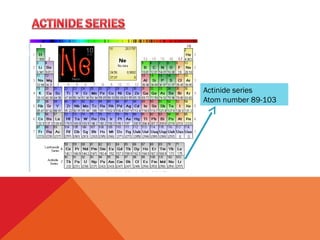
Actinide series 
Atom number 89-103
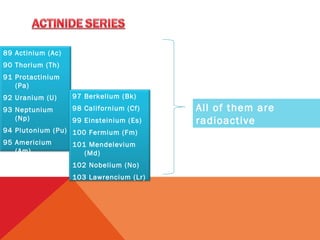
89 Actinium (Ac) 
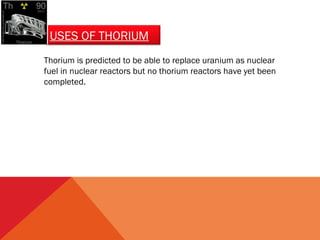
90 Thorium (Th) 
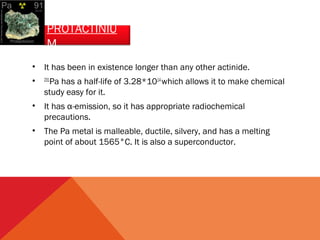
91 Protactinium 
(Pa) 
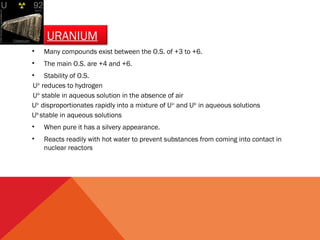
92 Uranium (U) 
93 Neptunium 
(Np) 
94 Plutonium (Pu) 
95 Americium 
(Am) 
96 Curium (Cm) 
97 Berkelium (Bk) 
98 Californium (Cf) 
99 Einsteinium (Es) 
100 Fermium (Fm) 
101 Mendelevium 
(Md) 
102 Nobelium (No) 
103 Lawrencium (Lr) 
All of them are 
radioactive
ACTINIUM 
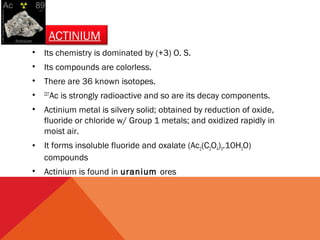
• Its chemistry is dominated by (+3) O. S. 
• Its compounds are colorless. 
• There are 36 known isotopes. 
• 227Ac is strongly radioactive and so are its decay components. 
• Actinium metal is silvery solid; obtained by reduction of oxide, 
fluoride or chloride w/ Group 1 metals; and oxidized rapidly in 
moist air. 
• It forms insoluble fluoride and oxalate (Ac2(C2O4)3.10H2O) 
compounds 
• Actinium is found in uranium ores
USES OF ACTINIUM 
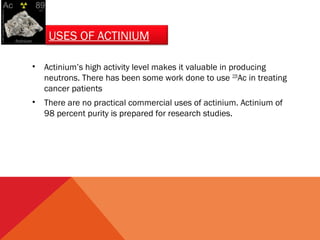
• Actinium’s high activity level makes it valuable in producing 
neutrons. There has been some work done to use 225Ac in treating 
cancer patients 
• There are no practical commercial uses of actinium. Actinium of 
98 percent purity is prepared for research studies.
HEALTH EFFECTS OF ACTINIUM 
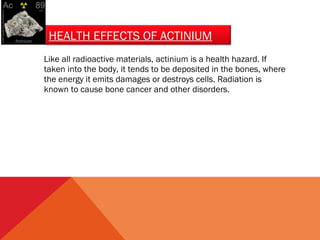
Like all radioactive materials, actinium is a health hazard. If 
taken into the body, it tends to be deposited in the bones, where 
the energy it emits damages or destroys cells. Radiation is 
known to cause bone cancer and other disorders.
THORIUM 
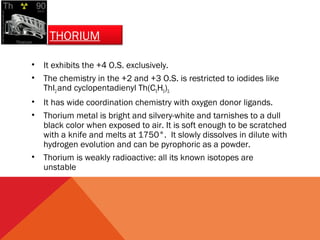
• It exhibits the +4 O.S. exclusively. 
• The chemistry in the +2 and +3 O.S. is restricted to iodides like 
ThI2 and cyclopentadienyl Th(C5H5)3. 
• It has wide coordination chemistry with oxygen donor ligands. 
• Thorium metal is bright and silvery-white and tarnishes to a dull 
black color when exposed to air. It is soft enough to be scratched 
with a knife and melts at 1750°. It slowly dissolves in dilute with 
hydrogen evolution and can be pyrophoric as a powder. 
• Thorium is weakly radioactive: all its known isotopes are 
unstable
USES OF THORIUM 
Thorium is predicted to be able to replace uranium as nuclear 
fuel in nuclear reactors but no thorium reactors have yet been 
completed.
PROTACTINIU 
M 
• It has been in existence longer than any other actinide. 
• 231Pa has a half-life of 3.28*1014 which allows it to make chemical 
study easy for it. 
• It has α-emission, so it has appropriate radiochemical 
precautions. 
• The Pa metal is malleable, ductile, silvery, and has a melting 
point of about 1565°C. It is also a superconductor.
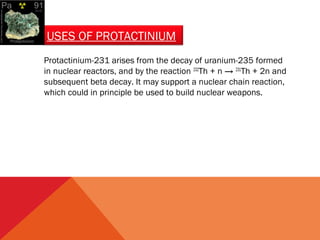
USES OF PROTACTINIUM 
Protactinium-231 arises from the decay of uranium-235 formed 
in nuclear reactors, and by the reaction 232Th + n → 231Th + 2n and 
subsequent beta decay. It may support a nuclear chain reaction, 
which could in principle be used to build nuclear weapons.
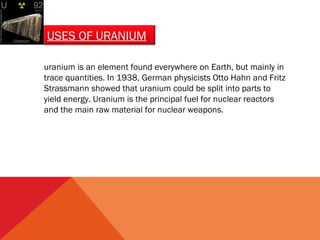
URANIUM 
• Many compounds exist between the O.S. of +3 to +6. 
• The main O.S. are +4 and +6. 
• Stability of O.S. 
U3+ reduces to hydrogen 
U4+ stable in aqueous solution in the absence of air 
U5+ disproportionates rapidly into a mixture of U4+ and U6+ in aqueous solutions 
U6+ stable in aqueous solutions 
• When pure it has a silvery appearance. 
• Reacts readily with hot water to prevent substances from coming into contact in 
nuclear reactors
USES OF URANIUM 
uranium is an element found everywhere on Earth, but mainly in 
trace quantities. In 1938, German physicists Otto Hahn and Fritz 
Strassmann showed that uranium could be split into parts to 
yield energy. Uranium is the principal fuel for nuclear reactors 
and the main raw material for nuclear weapons.
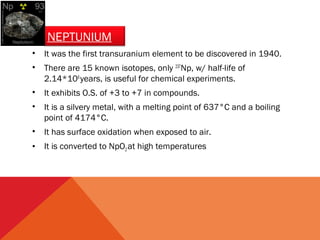
NEPTUNIUM 
• It was the first transuranium element to be discovered in 1940. 
• There are 15 known isotopes, only 237Np, w/ half-life of 
2.14*106 years, is useful for chemical experiments. 
• It exhibits O.S. of +3 to +7 in compounds. 
• It is a silvery metal, with a melting point of 637°C and a boiling 
point of 4174°C. 
• It has surface oxidation when exposed to air. 
• It is converted to NpO2 at high temperatures
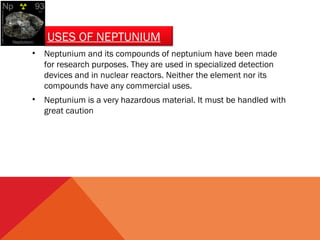
USES OF NEPTUNIUM 
• Neptunium and its compounds of neptunium have been made 
for research purposes. They are used in specialized detection 
devices and in nuclear reactors. Neither the element nor its 
compounds have any commercial uses. 
• Neptunium is a very hazardous material. It must be handled with 
great caution
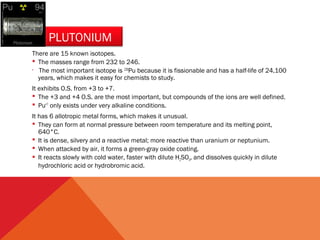
PLUTONIUM 
There are 15 known isotopes. 
 The masses range from 232 to 246. 
 
The most important isotope is 239Pu because it is fissionable and has a half-life of 24,100 
years, which makes it easy for chemists to study. 
It exhibits O.S. from +3 to +7. 
 The +3 and +4 O.S. are the most important, but compounds of the ions are well defined. 
 Pu+7 only exists under very alkaline conditions. 
It has 6 allotropic metal forms, which makes it unusual. 
 They can form at normal pressure between room temperature and its melting point, 
640°C. 
 It is dense, silvery and a reactive metal; more reactive than uranium or neptunium. 
 When attacked by air, it forms a green-gray oxide coating. 
 It reacts slowly with cold water, faster with dilute H2SO4, and dissolves quickly in dilute 
hydrochloric acid or hydrobromic acid.
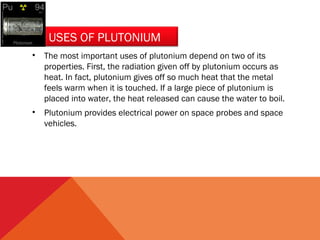
USES OF PLUTONIUM 
• The most important uses of plutonium depend on two of its 
properties. First, the radiation given off by plutonium occurs as 
heat. In fact, plutonium gives off so much heat that the metal 
feels warm when it is touched. If a large piece of plutonium is 
placed into water, the heat released can cause the water to boil. 
• Plutonium provides electrical power on space probes and space 
vehicles.
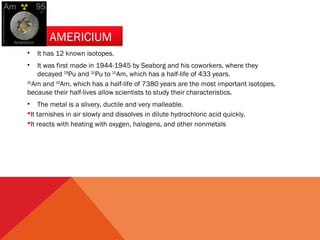
AMERICIUM 
• It has 12 known isotopes. 
• It was first made in 1944-1945 by Seaborg and his coworkers, where they 
decayed 239Pu and 241Pu to 241Am, which has a half-life of 433 years. 
241Am and 243Am, which has a half-life of 7380 years are the most important isotopes, 
because their half-lives allow scientists to study their characteristics. 
• The metal is a slivery, ductile and very malleable. 
It tarnishes in air slowly and dissolves in dilute hydrochloric acid quickly. 
It reacts with heating with oxygen, halogens, and other nonmetals
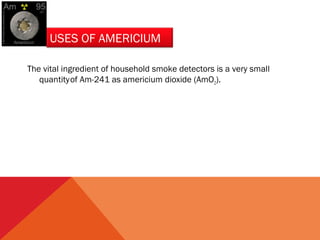
USES OF AMERICIUM 
The vital ingredient of household smoke detectors is a very small 
quantity of Am-241 as americium dioxide (AmO2).
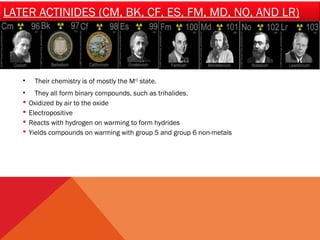
LATER ACTINIDES (CM, BK, CF, ES, FM, MD, NO, AND LR) 
• Their chemistry is of mostly the M+3 state. 
• They all form binary compounds, such as trihalides. 
 Oxidized by air to the oxide 
 Electropositive 
 Reacts with hydrogen on warming to form hydrides 
 Yields compounds on warming with group 5 and group 6 non-metals

Actinide series

  • 1.
    INORGANIC CHEMISTRY ACTINIDESERIES OF PERIODIC TABLE Presented by : Pujiati (06121010018) Binti Uswatin (06121010021) Chemistry Education Department Sriwijaya University Indralaya 2012
  • 2.
    Actinide series Atomnumber 89-103
  • 3.
    89 Actinium (Ac) 90 Thorium (Th) 91 Protactinium (Pa) 92 Uranium (U) 93 Neptunium (Np) 94 Plutonium (Pu) 95 Americium (Am) 96 Curium (Cm) 97 Berkelium (Bk) 98 Californium (Cf) 99 Einsteinium (Es) 100 Fermium (Fm) 101 Mendelevium (Md) 102 Nobelium (No) 103 Lawrencium (Lr) All of them are radioactive
  • 4.
    ACTINIUM • Itschemistry is dominated by (+3) O. S. • Its compounds are colorless. • There are 36 known isotopes. • 227Ac is strongly radioactive and so are its decay components. • Actinium metal is silvery solid; obtained by reduction of oxide, fluoride or chloride w/ Group 1 metals; and oxidized rapidly in moist air. • It forms insoluble fluoride and oxalate (Ac2(C2O4)3.10H2O) compounds • Actinium is found in uranium ores
  • 5.
    USES OF ACTINIUM • Actinium’s high activity level makes it valuable in producing neutrons. There has been some work done to use 225Ac in treating cancer patients • There are no practical commercial uses of actinium. Actinium of 98 percent purity is prepared for research studies.
  • 6.
    HEALTH EFFECTS OFACTINIUM Like all radioactive materials, actinium is a health hazard. If taken into the body, it tends to be deposited in the bones, where the energy it emits damages or destroys cells. Radiation is known to cause bone cancer and other disorders.
  • 7.
    THORIUM • Itexhibits the +4 O.S. exclusively. • The chemistry in the +2 and +3 O.S. is restricted to iodides like ThI2 and cyclopentadienyl Th(C5H5)3. • It has wide coordination chemistry with oxygen donor ligands. • Thorium metal is bright and silvery-white and tarnishes to a dull black color when exposed to air. It is soft enough to be scratched with a knife and melts at 1750°. It slowly dissolves in dilute with hydrogen evolution and can be pyrophoric as a powder. • Thorium is weakly radioactive: all its known isotopes are unstable
  • 8.
    USES OF THORIUM Thorium is predicted to be able to replace uranium as nuclear fuel in nuclear reactors but no thorium reactors have yet been completed.
  • 9.
    PROTACTINIU M •It has been in existence longer than any other actinide. • 231Pa has a half-life of 3.28*1014 which allows it to make chemical study easy for it. • It has α-emission, so it has appropriate radiochemical precautions. • The Pa metal is malleable, ductile, silvery, and has a melting point of about 1565°C. It is also a superconductor.
  • 10.
    USES OF PROTACTINIUM Protactinium-231 arises from the decay of uranium-235 formed in nuclear reactors, and by the reaction 232Th + n → 231Th + 2n and subsequent beta decay. It may support a nuclear chain reaction, which could in principle be used to build nuclear weapons.
  • 11.
    URANIUM • Manycompounds exist between the O.S. of +3 to +6. • The main O.S. are +4 and +6. • Stability of O.S. U3+ reduces to hydrogen U4+ stable in aqueous solution in the absence of air U5+ disproportionates rapidly into a mixture of U4+ and U6+ in aqueous solutions U6+ stable in aqueous solutions • When pure it has a silvery appearance. • Reacts readily with hot water to prevent substances from coming into contact in nuclear reactors
  • 12.
    USES OF URANIUM uranium is an element found everywhere on Earth, but mainly in trace quantities. In 1938, German physicists Otto Hahn and Fritz Strassmann showed that uranium could be split into parts to yield energy. Uranium is the principal fuel for nuclear reactors and the main raw material for nuclear weapons.
  • 13.
    NEPTUNIUM • Itwas the first transuranium element to be discovered in 1940. • There are 15 known isotopes, only 237Np, w/ half-life of 2.14*106 years, is useful for chemical experiments. • It exhibits O.S. of +3 to +7 in compounds. • It is a silvery metal, with a melting point of 637°C and a boiling point of 4174°C. • It has surface oxidation when exposed to air. • It is converted to NpO2 at high temperatures
  • 14.
    USES OF NEPTUNIUM • Neptunium and its compounds of neptunium have been made for research purposes. They are used in specialized detection devices and in nuclear reactors. Neither the element nor its compounds have any commercial uses. • Neptunium is a very hazardous material. It must be handled with great caution
  • 15.
    PLUTONIUM There are15 known isotopes.  The masses range from 232 to 246.  The most important isotope is 239Pu because it is fissionable and has a half-life of 24,100 years, which makes it easy for chemists to study. It exhibits O.S. from +3 to +7.  The +3 and +4 O.S. are the most important, but compounds of the ions are well defined.  Pu+7 only exists under very alkaline conditions. It has 6 allotropic metal forms, which makes it unusual.  They can form at normal pressure between room temperature and its melting point, 640°C.  It is dense, silvery and a reactive metal; more reactive than uranium or neptunium.  When attacked by air, it forms a green-gray oxide coating.  It reacts slowly with cold water, faster with dilute H2SO4, and dissolves quickly in dilute hydrochloric acid or hydrobromic acid.
  • 16.
    USES OF PLUTONIUM • The most important uses of plutonium depend on two of its properties. First, the radiation given off by plutonium occurs as heat. In fact, plutonium gives off so much heat that the metal feels warm when it is touched. If a large piece of plutonium is placed into water, the heat released can cause the water to boil. • Plutonium provides electrical power on space probes and space vehicles.
  • 17.
    AMERICIUM • Ithas 12 known isotopes. • It was first made in 1944-1945 by Seaborg and his coworkers, where they decayed 239Pu and 241Pu to 241Am, which has a half-life of 433 years. 241Am and 243Am, which has a half-life of 7380 years are the most important isotopes, because their half-lives allow scientists to study their characteristics. • The metal is a slivery, ductile and very malleable. It tarnishes in air slowly and dissolves in dilute hydrochloric acid quickly. It reacts with heating with oxygen, halogens, and other nonmetals
  • 18.
    USES OF AMERICIUM The vital ingredient of household smoke detectors is a very small quantity of Am-241 as americium dioxide (AmO2).
  • 19.
    LATER ACTINIDES (CM,BK, CF, ES, FM, MD, NO, AND LR) • Their chemistry is of mostly the M+3 state. • They all form binary compounds, such as trihalides.  Oxidized by air to the oxide  Electropositive  Reacts with hydrogen on warming to form hydrides  Yields compounds on warming with group 5 and group 6 non-metals