Iron-carbon phase
 diagram & basic
    definitions
Muhammad Umair Bukhari

   Engr.umair.bukhari@gmail.com
      www.bzuiam.webs.com
         03136050151
• Alloy: A metallic substance that is
  composed of two or more elements
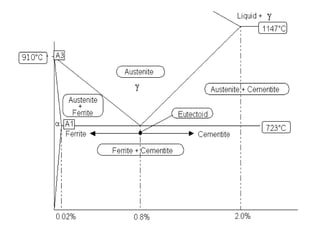
• Austenite: Face-centered cubic iron or an
  iron alloy based on this structure.
• Bainite: The product of the final
  transformation of austenite decomposition
• Binary Eutectic: In this context, it means
  a phase diagram that consists of two
  elemwnts that are not completely soluble
  in the solid state
• Binary Isomorphous: In this context, it
  means a phase diagram that consists of
  two elements that are completely soluble
  in both the liquid and solid states.
• Body-centered: A structure in which
  every atom is surrounded by eight
  adjacent atoms, whether the atom is
  located at a corner or at the center of a
  unit cell.
• Cementite: The second phase formed
  when carbon is in excess of the solubility
  limit.
• Component: Either a pure metal or a
  compound of which an alloy is composed.
• Compositions: The concentrations of all
  components or elements that are found in
  an alloy.
• Constituents: Severing to form, compose,
  or make up a unit or whole: component
• Critical point: Point where the densities
  of liquid and vapor become equal and the
  interface between the two vanishes.
  Above this point, only one phase can exist
• Delta iron: The body-centered cubic
  phase which results when austenite is no
  longer the most stable form of iron. Exists
  between 2802 and 2552 degrees F, has
  BCC lattice structure and is magnetic
• Dilatometer: An instrument used to
  measure thermal expansion in
  solids, liquids, and gases.
• Eutectic: A eutectic system occurs when
  a liquid phase tramsforms directly to a
  two-phase solid.
• Eutectoid: A eutectoid system occurs
  when a single-phase solid transforms
  directly to a two-phase solid
• Face-centered: A structure in which there
  is an atom at the corner of each unit cell
  and one in the center of each face, but no
  atom in the center of the cube.
• Ferrite: Body-centered cubic iron or an
  iron alloy based on this structure

Fine pearlite:Results from thin lamellae
  when cooling rates are accelerated and
  diffusion is limited to shorter distances
• Free Energy: A function of the internal
  energy of a system - a measure of entropy
  of a system

• Heterogeneous system: When a system
  is composed of multiple phases

• Homogeneous system: When only one
  phase is present in the system
• Hypereutectoid: Hypereutectoid systems
  exist below the eutectoid temperature.

• Hypoeutectoid: Hypoeutectoid systems
  exist above the eutectoid temperature

• Isomorphus: Having the same structure.
  In the phase diagram sense, isomorphicity
  means having the same crystal structure
  or complete solid solubility for all
  compositions.
• Incongruent phase transformation: This
  is a phase transformation where at least
  one of the phases involved undergoes a
  change in composition

• Lamellae: A thin scale, plate, or layer of
  phases
• Ledeburite: Eutectic of cast iron. It exists
  when the carbon content is greater than 2
  percent. It contains 4.3 percent carbon in
  combination with iron.
• Lever rule: A mathematical expression
  whereby the relative phase amounts in a
  two-phase alloy at equilibrium may be
  computed
• Liquidus Line: On a binary phase
  diagram, that line or boundary separating
  liquid and liquid + solid phase regions. For
  an alloy, the liquidus temperature is that
  temperature at which a solid phase first
  forms under conditions of equilibrium
  cooling
• Martensite: An unstable polymorphic phase
  of iron which forms at temperatures below
  the eutectoid because the face-centered
  cubic structure of austenite becomes
  unstable. It changes spontaneously to a
  body-centered structure by shearing action,
  not diffusion.
• Mass spectrometer: An instrument used to
  separate charged particles from a prepared
  beam by means of an electromagnetic field
  and to photograph the resulting distribution
  or spectrum of masses
• Microstructure: Structure of the phases
  in a material. Can only be seen with an
  optical or electron mircoscope.
• Pearlite: A lamellar mixture of ferrite and
  carbide formed by decomposing austenite
  of eutectoid composition.
• Phase: A homogeneous portion of a
  system that has uniform physical and
  chemical characteristics
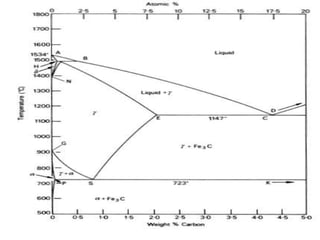
• Phase diagram: A graphical
  representation of the relationships
  between environmental
  constraints, composition, and regions of
  phase stability, ordinarily under conditions
  of equilibrium.
• Polymorphic: The ability of a solid
  material to exist in more than one form or
  crystal structure.
• Quench: To rapidly cool
• Reference State: Usually an elements
  most stable state at a given temperature
• Solidus Line: On a phase diagram, the
  locus of points at which solidification is
  complete upon equilibrium cooling, or at
  which melting begins upon equilibrium
  heating.
• Solubility: The amount of substance that
  will dissolve in a given amount of another
  substance.
• Tie line: A horizontal line constructed
  across a two phase region of a binary
  phase diagram; its intersections with the
  phase boundaries on either end represent
  the equilibrium conditions of the respective
  phases at the temperature in question.
• Xray diffraction: The scattering of x-rays
  by atoms in a crystal, producing a
  diffraction pattern that yields information
  about the structure of the crystal
• Xray flourescence: A method of
  determining the amount of an element
  present in a substance by bombarding it
  with electrons and measuring the intensity
  of the charicteristic x-rays that are given
  off by the sample.

Iron carbon phase diagram & basic definations

  • 1.
    Iron-carbon phase diagram& basic definitions
  • 2.
    Muhammad Umair Bukhari Engr.umair.bukhari@gmail.com www.bzuiam.webs.com 03136050151
  • 6.
    • Alloy: Ametallic substance that is composed of two or more elements • Austenite: Face-centered cubic iron or an iron alloy based on this structure. • Bainite: The product of the final transformation of austenite decomposition • Binary Eutectic: In this context, it means a phase diagram that consists of two elemwnts that are not completely soluble in the solid state
  • 7.
    • Binary Isomorphous:In this context, it means a phase diagram that consists of two elements that are completely soluble in both the liquid and solid states. • Body-centered: A structure in which every atom is surrounded by eight adjacent atoms, whether the atom is located at a corner or at the center of a unit cell.
  • 8.
    • Cementite: Thesecond phase formed when carbon is in excess of the solubility limit. • Component: Either a pure metal or a compound of which an alloy is composed. • Compositions: The concentrations of all components or elements that are found in an alloy.
  • 9.
    • Constituents: Severingto form, compose, or make up a unit or whole: component • Critical point: Point where the densities of liquid and vapor become equal and the interface between the two vanishes. Above this point, only one phase can exist • Delta iron: The body-centered cubic phase which results when austenite is no longer the most stable form of iron. Exists between 2802 and 2552 degrees F, has BCC lattice structure and is magnetic
  • 10.
    • Dilatometer: Aninstrument used to measure thermal expansion in solids, liquids, and gases. • Eutectic: A eutectic system occurs when a liquid phase tramsforms directly to a two-phase solid. • Eutectoid: A eutectoid system occurs when a single-phase solid transforms directly to a two-phase solid
  • 11.
    • Face-centered: Astructure in which there is an atom at the corner of each unit cell and one in the center of each face, but no atom in the center of the cube. • Ferrite: Body-centered cubic iron or an iron alloy based on this structure Fine pearlite:Results from thin lamellae when cooling rates are accelerated and diffusion is limited to shorter distances
  • 12.
    • Free Energy:A function of the internal energy of a system - a measure of entropy of a system • Heterogeneous system: When a system is composed of multiple phases • Homogeneous system: When only one phase is present in the system
  • 13.
    • Hypereutectoid: Hypereutectoidsystems exist below the eutectoid temperature. • Hypoeutectoid: Hypoeutectoid systems exist above the eutectoid temperature • Isomorphus: Having the same structure. In the phase diagram sense, isomorphicity means having the same crystal structure or complete solid solubility for all compositions.
  • 14.
    • Incongruent phasetransformation: This is a phase transformation where at least one of the phases involved undergoes a change in composition • Lamellae: A thin scale, plate, or layer of phases • Ledeburite: Eutectic of cast iron. It exists when the carbon content is greater than 2 percent. It contains 4.3 percent carbon in combination with iron.
  • 15.
    • Lever rule:A mathematical expression whereby the relative phase amounts in a two-phase alloy at equilibrium may be computed • Liquidus Line: On a binary phase diagram, that line or boundary separating liquid and liquid + solid phase regions. For an alloy, the liquidus temperature is that temperature at which a solid phase first forms under conditions of equilibrium cooling
  • 16.
    • Martensite: Anunstable polymorphic phase of iron which forms at temperatures below the eutectoid because the face-centered cubic structure of austenite becomes unstable. It changes spontaneously to a body-centered structure by shearing action, not diffusion. • Mass spectrometer: An instrument used to separate charged particles from a prepared beam by means of an electromagnetic field and to photograph the resulting distribution or spectrum of masses
  • 17.
    • Microstructure: Structureof the phases in a material. Can only be seen with an optical or electron mircoscope. • Pearlite: A lamellar mixture of ferrite and carbide formed by decomposing austenite of eutectoid composition. • Phase: A homogeneous portion of a system that has uniform physical and chemical characteristics
  • 18.
    • Phase diagram:A graphical representation of the relationships between environmental constraints, composition, and regions of phase stability, ordinarily under conditions of equilibrium. • Polymorphic: The ability of a solid material to exist in more than one form or crystal structure. • Quench: To rapidly cool
  • 19.
    • Reference State:Usually an elements most stable state at a given temperature • Solidus Line: On a phase diagram, the locus of points at which solidification is complete upon equilibrium cooling, or at which melting begins upon equilibrium heating. • Solubility: The amount of substance that will dissolve in a given amount of another substance.
  • 20.
    • Tie line:A horizontal line constructed across a two phase region of a binary phase diagram; its intersections with the phase boundaries on either end represent the equilibrium conditions of the respective phases at the temperature in question. • Xray diffraction: The scattering of x-rays by atoms in a crystal, producing a diffraction pattern that yields information about the structure of the crystal
  • 21.
    • Xray flourescence:A method of determining the amount of an element present in a substance by bombarding it with electrons and measuring the intensity of the charicteristic x-rays that are given off by the sample.