POWDER METALLURGYPOWDER METALLURGY
Material Science and Metallurgy
(2131904)
PROF. MAYURS MODI
Assistant professor
Mechanical engineering department
SSASIT, surat
12/28/18 PROF. Mayur S. Modi
Overview
• Introduction to Manufacturing.
• Introduction to Powder Metallurgy.
• Powder Metallurgy-A Competitive process.
• Process Detail.
• Economics and design consideration.
• Application, Advantages and Limitations.
12/28/18 PROF. Mayur S. Modi
INTRODUCTION
• Powder metallurgy is used for manufacturing products or
articles from powdered metals by placing these powders in
molds and are compacting the same using heavy compressive
force.
• Typical examples of such article or products are grinding
wheels, filament wire, magnets, welding rods, tungsten
carbide cutting tools, self-lubricating bearings electrical
contacts and turbines blades having high temperature
strength.
12/28/18 PROF. Mayur S. Modi
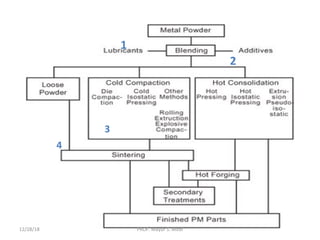
• The manufacture of parts by powder metallurgy process
involves the manufacture of powders, blending, compacting,
sintering and a number of secondary operations such as
sizing, coining, machining, plating, and heat treatment.
• The compressed articles are then heated to temperatures
much below their melting points to bind the particles
together and improve their strength and other properties.
Few non-metallic materials can also be added to the metallic
powders to provide adequate bond or impart some the
needed properties.
• The products made through this process are very costly on
account of the high cost of metal powders as well as of the
dies used.
12/28/18 PROF. Mayur S. Modi
• The powders of almost all metals and a large quantity of
alloys, and nonmetals may be used. The application of
powder metallurgy process is economically feasible only for
high mass production.
• Parts made by powder metallurgy process exhibit properties,
which cannot be produced by conventional methods. Simple
shaped parts can be made to size with high precision without
waste, and completely or almost ready for installation.
12/28/18 PROF. Mayur S. Modi
1
2
3
4
12/28/18 PROF. Mayur S. Modi
POWDER METALLURGY PROCESS
1. Formation of metallic powders.
2.Mixing or blending of the metallic powders in required
proportions.
3.Compressing and compacting the powders into desired
shapes and sizes in form of articles.
4.Sintering the compacted articles in a controlled furnace
atmosphere.
5.Subjecting the sintered articles to secondary processing if
needed so.
12/28/18 PROF. Mayur S. Modi
Production of Metal Powders
• Metallic powders possessing different properties can be produced
easily. The most commonly used powders are copper-base and
iron-base materials.
• But titanium, chromium, nickel, and stainless steel metal
powders are also used. In the majority of powders, the size of the
particle varies from several microns to 0.5 mm. The most
common particle size of powders falls into a range of 10 to 40
microns.
• The chemical and physical properties of metals depend upon the
size and shape of the powder particles. There are various
methods of manufacturing powders.
12/28/18 PROF. Mayur S. Modi
1. Atomization
2. Chemical reduction
3. Electrolytic process
4. Crushing
5. Milling
6. Condensation of metal vapors
7. Hydride and carbonyl processes.
12/28/18 PROF. Mayur S. Modi
Atomization
• In this process, the molten metal is forced
through an orifice and as it emerges, a
high pressure stream of gas or liquid
impinges on it causing it to atomize into
fine particles.
• The inert gas is then employed in order to
improve the purity of the powder.
• It is used mostly for low melting point
metals such as tin, zinc, lead, aluminum,
cadmium etc., because of the corrosive
action of the metal on the orifice at high
temperatures. Alloy powders are also
produced by this method.
12/28/18 PROF. Mayur S. Modi
Chemical Reduction Process
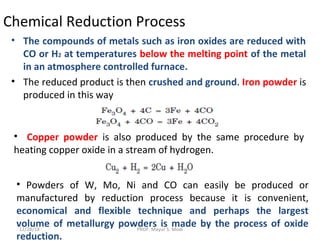
• The compounds of metals such as iron oxides are reduced with
CO or H2 at temperatures below the melting point of the metal
in an atmosphere controlled furnace.
• The reduced product is then crushed and ground. Iron powder is
produced in this way
• Copper powder is also produced by the same procedure by
heating copper oxide in a stream of hydrogen.
• Powders of W, Mo, Ni and CO can easily be produced or
manufactured by reduction process because it is convenient,
economical and flexible technique and perhaps the largest
volume of metallurgy powders is made by the process of oxide
reduction.
12/28/18 PROF. Mayur S. Modi
Electrolytic Process
• Electrolysis process is quite similar to electroplating and is
principally employed for the production of extremely pure,
powders of copper and iron.
• For making copper powder, copper plates are placed as
anodes in a tank of electrolyte, whereas, aluminum plates are
placed in to the electrolyte to act as cathodes.
• After a definite time period, the cathode plates are taken out
from the tank, rinsed to remove electrolyte and are then dried.
• The copper deposited on the cathode plates is then scraped off
and pulverized to produce copper powder of the desired grain
size.
12/28/18 PROF. Mayur S. Modi
Electrolytic Process
12/28/18 PROF. Mayur S. Modi
Crushing Process
• The crushing process requires
equipments such as stamps,
crushers or gyratory crushes.
• Various ferrous and non-ferrous
alloys can be heat-treated in order
to obtain a sufficiently brittle
material which can be easily
crushed into powder form.
12/28/18 PROF. Mayur S. Modi
Milling Process
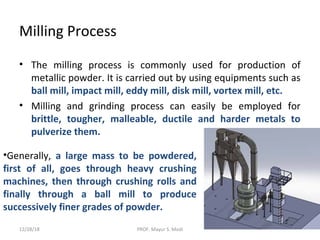
• The milling process is commonly used for production of
metallic powder. It is carried out by using equipments such as
ball mill, impact mill, eddy mill, disk mill, vortex mill, etc.
• Milling and grinding process can easily be employed for
brittle, tougher, malleable, ductile and harder metals to
pulverize them.
•Generally, a large mass to be powdered,
first of all, goes through heavy crushing
machines, then through crushing rolls and
finally through a ball mill to produce
successively finer grades of powder.
12/28/18 PROF. Mayur S. Modi
Condensation of Metal Powders
• This process can be applied in case of metals, such as Zn, Cd
and Mg, which can be boiled and the vapors are condensed
in a powder form.
• Generally a rod of metal say Zn is fed into a high
temperature flame and vaporized droplets of metal are then
allowed to condense on to a cool surface of a material to
which they will not adhere.
• This method is not highly suitable for large scale production
of powder.
12/28/18 PROF. Mayur S. Modi
Hydride and Carbonyl Processes
• High hardness oriented metals such as tantalum, niobium
and zirconium are made to combine with hydrogen form
hydrides that are stable at room temperature, but to begin
to dissociate into hydrogen and the pure metal when heated
to about 350°C.
• The carbonyl vapor is then decomposed in a cooled chamber
so that almost spherical particles of very pure metals are
deposited.
12/28/18 PROF. Mayur S. Modi
Characteristic of Metal Powders
• Most important characteristics of metal powders are powder
particle size, size distribution, particle shape, purity,
chemical composition, flow characteristics and particle
microstructure.
Particle shape
• There are various shapes of metal powders namely spherical,
sub-rounded, rounded, angular, sub-angular, flakes etc.
Particles shape influences the packing and flow
characteristics of the powders.
12/28/18 PROF. Mayur S. Modi
Powder particle size and size distribution
• Metal powders used in powder metallurgy usually vary in size
from 20 to 200 microns. Particle size influences density/porosity
of the compact, mold strength, permeability, flow and mixing
characteristics, dimensional stability, etc.
• Particle size distribution is specified in terms of a sieve analysis
i.e. the amount of powder passing through 20 or 40 mesh sieves.
• Flow characteristics
• Flow-ability of metal powders is most important in cases where
moulds have to be filled quickly. Metal powders with good flow
characteristics fill a mould cavity uniformly.
12/28/18 PROF. Mayur S. Modi
Chemical composition
• Chemical composition of metallic powder implies the type and
percentage of alloying elements and impurities. It usually
determines the particle hardness and compressibility. The
chemical composition of a powder can be determined by
chemical analysis methods.
Particle microstructure
• Particle microstructure reveals various phases, inclusions and
internal porosity.
Apparent density
• Apparent density is defined as the weight, of a loosely heated
quantity of powder necessary to fill a given die cavity
completely.
12/28/18 PROF. Mayur S. Modi
Mixing or Blending of Metallic
Powders
• Before powders are pressed into shape,
1. To add lubricants to reduce friction during the pressing
operation. Powder particles get coated with lubricants. This
reduces die wear and lowers the pressure required for
pressing.
2. To mix powders of different materials, in order to obtain
properties of heat resistance, friction, heavy weight and
hardness.
3. To obtain uniform distribution of particle sizes.
4. To add volatizing agents to give a desired amount of porosity.
12/28/18 PROF. Mayur S. Modi
Different powders in correct proportions are thoroughly
mixed either wet or dry, in a ball mill.
In wet mixing, water or a solvent is used to obtain better
mixing. Moreover wet mixing
1.Reduced dust,
2.Lessens explosion hazards which are present with some finely
divided powders, and
3.Prevents surface oxidation.
proper blending and mixing of the powders are
essential for uniformity of the finished products. However,
over-mixing should be avoided since it may decrease particle
size and work harden the particles.
12/28/18 PROF. Mayur S. Modi
Compacting of Powder
• Compacting is the technique of converting loose powder in
to compact accurately defined shape and size.
12/28/18 PROF. Mayur S. Modi
• This is carried out at room temperature in a die on press
machine. The press used for compacting may be either
mechanically or hydraulically operated.
• The die consists of a cavity of the shape of the desired part.
Metal powder is poured in the die cavity and pressure is
applied using punches, which usually work from the top and
bottom of the die as shown in Figure.
• Dies are usually made of high grade steel, but sometimes
carbide dies are used for long production runs.
• In compacting process, the pressure applied should be uniform
and applied simultaneously from above and below. The
pressure applied should be high enough to produce cold welding
of the powder. Cold welding imparts a green strength, which
holds the parts together and allows them to be handled.
• Roll pressing and extrusion methods also be utilized
12/28/18 PROF. Mayur S. Modi
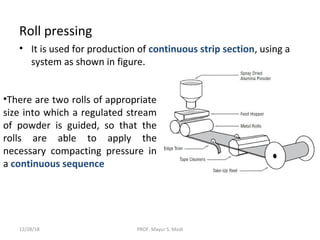
Roll pressing
• It is used for production of continuous strip section, using a
system as shown in figure.
•There are two rolls of appropriate
size into which a regulated stream
of powder is guided, so that the
rolls are able to apply the
necessary compacting pressure in
a continuous sequence
12/28/18 PROF. Mayur S. Modi
Extrusion method
•It is the method of
compacting does not give
such efficient control as
that given by pressing or
even by rolling. It is
difficult to obtain high
densities and some
porosity is always left.
•The metal parts obtained after compacting are not strong and dense.
To improve these properties, the parts should be sintered.
12/28/18 PROF. Mayur S. Modi
Sintering
• PRESINTERING
• Frequently, powder metallurgy is used to make parts from
materials that are very difficult to machine.
• When some machining is required on such parts, one goes
for. pre-sintering before the actual sintering operation.
• After presintering operation, the compacted part acquires
sufficient strength to be handled and machined without
difficulty. Moreover, very little dimensional change takes
place, then, in the final sintering temperature.
• For presintering, compacted parts are heated for a short time
at a temperature considerably below the final sintering
temp.
12/28/18 PROF. Mayur S. Modi
• Presintering is necessary when holes are to be drilled in hard
to machine parts.
• Presintering, in addition, removes lubrication and binders
added to the powders during the blending operation.
• Presintering, can be eliminated if no machining of the final
product is required.
12/28/18 PROF. Mayur S. Modi
Sintering
• Sintering is done to achieve all possible final strength and
hardness needed in the finished product.
• Sintering consist of heating pressed metal in batch or
continuous furnaces to a temperature below the melting
point of the major constituent in an inert or reducing
atmosphere, where time, temp., heating and cooling rate are
automatically controlled.
• Most metals are sintered at 70 to 80 % of the melting
temperature. Certain refractory materials may be sintered at
90 % of the melting point.
12/28/18 PROF. Mayur S. Modi
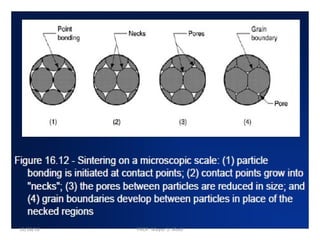
• Sintering is essentially a process of bonding solids bodies by
atomic forces. Bonding of powder particles during sintering
can take place in any of the three ways.
1. Melting of a minor constituent.
2. Volume diffusion, although surface diffusion, evaporation
and condensation also contribute to bonding.
3. Mechanical bonding or entrapment of non-metallic particles
in a metal matrix.
12/28/18 PROF. Mayur S. Modi
Hot Isostatic pressing
• Hot isostatic pressing involves applying pressure and
temperature simultaneously so that molding and sintering of
the powder takes place at the same time in the die.
• The effect of time is important, due to the viscous nature of
the compact material, and the higher the temperature the
shorter the time.
• Die materials include steels, graphite and ceramics. High
speed steels may be used for short times at 600°C and
graphite for 700-3000°C. However, graphite dies are limited
to pressures of 140 kg/cm2
and also react with metals to
produce carbides.
12/28/18 PROF. Mayur S. Modi
• Advantages of Hot pressing
1. Reduction in gas content and shrinkage effect.
2. Higher strength and hardness.
3. Higher density and sound compacts
4. Hot pressing breaks-down any oxide film and exposes fresh
surfaces.
• Disadvantages of Hot pressing
1. High cost of dies
2. Pressure takes a considerable time to complete.
• Application of Hot pressing
1. Hot pressing is used for the production of very hard
cemented carbide parts.
12/28/18 PROF. Mayur S. Modi
Secondary Operations
• Some powder metal parts may be used in the sintered condition while in
some other cases additional secondary operations have to be performed
to get the desired surface finish, close tolerance etc..
1. Annealing.
2. Repressing for greater density or closer dimensional control.
3. Machining.
4. Polishing.
5. Rolling, forging or drawing.
6. Surface treatments to protect against corrosion.
7. In some cases infiltration is needed to provide increased strength,
hardness, density obtainable by straight sintering.
8. The procedures for plating powdered metal parts are quite different from
those used for wrought or cast metal parts. In powdered metal parts,
porosity must be eliminated before the part is plated. After the porosity
has been eliminated regular plating procedures can be used.
12/28/18 PROF. Mayur S. Modi
ADVANTAGES OF POWDER
METALLURGY
• The processes of powder metallurgy are quite and clean.
• Articles of any intricate or complicated shape can be
manufactured.
• The dimensional accuracy and surface finish obtainable are
much better for many applications and hence machining can be
eliminated.
• Unlike casting, press forming machining, no material is being
wasted as scrap and the process makes utilizes full raw material
• Hard to process materials such as diamond can be converted
into usable components and tools through this process.
• High production rates can be easily achieved.
12/28/18 PROF. Mayur S. Modi
• This process facilitates production of many such parts, which
cannot be produced through other methods, such as sintered
carbides and self-lubricating bearings.
• The components produced by this process are highly pure and
bears longer life.
• It is possible to ensure uniformity of composition, since exact
proportions of constituent metal powders can be used.
• Simple shaped parts can be made to size with 100 micron
accuracy without waste
• Porous parts can be produced that could not be made in any
other way.
• Structure and properties can be controlled more closely than in
other fabricating processes.
12/28/18 PROF. Mayur S. Modi
• Highly qualified or skilled labour is not required. in powder
metallurgy process
• Super-hard cutting tool bits, which are impossible to produce
by other manufacturing processes, can be easily
manufactured using this process.
12/28/18 PROF. Mayur S. Modi
LIMITATIONS OF POWDER
METALLURGY
1. Powder metallurgy process is not economical for small-scale
production.
2. The cost of tool and die of powder metallurgical set-up is
relatively high.
3. The size of products as compared to casting is limited
because of the requirement of large presses and expensive
tools which would be required for compacting.
4. Metal powders are expensive and in some cases difficult to
store without some deterioration.
5. It may be difficult sometimes to obtain particular alloy
powders
12/28/18 PROF. Mayur S. Modi
6. Articles made by powder metallurgy in most cases do not
have as good physical properties as wrought or cast parts.
7. A completely deep structure cannot be produced through this
process.
8. The process is not found economical for small-scale
production.
9. It is not easy to convert brass, bronze and a numbers of
steels into powdered form.
12/28/18 PROF. Mayur S. Modi
APPLICATIONS OF POWDER
METALLURGY
• The powder metallurgy process has provided a practical
solution to the problem of producing refractory metals,
which have now become the basis of making heat-resistant
materials and cutting tools of extreme hardness.
• Another very important and useful item of the products made
from powdered metals is porous self-lubricating bearing.
12/28/18 PROF. Mayur S. Modi
1. Porous products such as bearings and filters.
2. Tungsten carbide, gauges, wire drawing dies, wire-guides,
stamping and blanking tools, stones, hammers, rock drilling
bits, etc.
3. Refractory parts such as components made out of tungsten,
tantalum and molybdenum are used in electric bulbs, radio
valves, oscillator valves, X-ray tubes in the form of filament,
cathode, anode, control grids, electric contact points etc.
12/28/18 PROF. Mayur S. Modi
5. Components used in automotive part assembly such as
electrical contacts, crankshaft drive or camshaft sprocket,
piston rings and rocker shaft brackets, door, mechanisms,
connecting rods and brake linings, clutch facings, welding
rods, etc.
6. Products where the combined properties of two metals or
metals and non-metals are desired such as non-porous
bearings, electric motor brushes, etc.
7. Porous metal bearings made which are later impregnated
with lubricants. Copper and graphite powders are used for
manufacturing automobile parts and brushes.
12/28/18 PROF. Mayur S. Modi

Chapter 8 powder metallurgy

  • 1.
    POWDER METALLURGYPOWDER METALLURGY MaterialScience and Metallurgy (2131904) PROF. MAYURS MODI Assistant professor Mechanical engineering department SSASIT, surat 12/28/18 PROF. Mayur S. Modi
  • 2.
    Overview • Introduction toManufacturing. • Introduction to Powder Metallurgy. • Powder Metallurgy-A Competitive process. • Process Detail. • Economics and design consideration. • Application, Advantages and Limitations. 12/28/18 PROF. Mayur S. Modi
  • 3.
    INTRODUCTION • Powder metallurgyis used for manufacturing products or articles from powdered metals by placing these powders in molds and are compacting the same using heavy compressive force. • Typical examples of such article or products are grinding wheels, filament wire, magnets, welding rods, tungsten carbide cutting tools, self-lubricating bearings electrical contacts and turbines blades having high temperature strength. 12/28/18 PROF. Mayur S. Modi
  • 4.
    • The manufactureof parts by powder metallurgy process involves the manufacture of powders, blending, compacting, sintering and a number of secondary operations such as sizing, coining, machining, plating, and heat treatment. • The compressed articles are then heated to temperatures much below their melting points to bind the particles together and improve their strength and other properties. Few non-metallic materials can also be added to the metallic powders to provide adequate bond or impart some the needed properties. • The products made through this process are very costly on account of the high cost of metal powders as well as of the dies used. 12/28/18 PROF. Mayur S. Modi
  • 5.
    • The powdersof almost all metals and a large quantity of alloys, and nonmetals may be used. The application of powder metallurgy process is economically feasible only for high mass production. • Parts made by powder metallurgy process exhibit properties, which cannot be produced by conventional methods. Simple shaped parts can be made to size with high precision without waste, and completely or almost ready for installation. 12/28/18 PROF. Mayur S. Modi
  • 6.
  • 7.
    POWDER METALLURGY PROCESS 1.Formation of metallic powders. 2.Mixing or blending of the metallic powders in required proportions. 3.Compressing and compacting the powders into desired shapes and sizes in form of articles. 4.Sintering the compacted articles in a controlled furnace atmosphere. 5.Subjecting the sintered articles to secondary processing if needed so. 12/28/18 PROF. Mayur S. Modi
  • 8.
    Production of MetalPowders • Metallic powders possessing different properties can be produced easily. The most commonly used powders are copper-base and iron-base materials. • But titanium, chromium, nickel, and stainless steel metal powders are also used. In the majority of powders, the size of the particle varies from several microns to 0.5 mm. The most common particle size of powders falls into a range of 10 to 40 microns. • The chemical and physical properties of metals depend upon the size and shape of the powder particles. There are various methods of manufacturing powders. 12/28/18 PROF. Mayur S. Modi
  • 9.
    1. Atomization 2. Chemicalreduction 3. Electrolytic process 4. Crushing 5. Milling 6. Condensation of metal vapors 7. Hydride and carbonyl processes. 12/28/18 PROF. Mayur S. Modi
  • 10.
    Atomization • In thisprocess, the molten metal is forced through an orifice and as it emerges, a high pressure stream of gas or liquid impinges on it causing it to atomize into fine particles. • The inert gas is then employed in order to improve the purity of the powder. • It is used mostly for low melting point metals such as tin, zinc, lead, aluminum, cadmium etc., because of the corrosive action of the metal on the orifice at high temperatures. Alloy powders are also produced by this method. 12/28/18 PROF. Mayur S. Modi
  • 11.
    Chemical Reduction Process •The compounds of metals such as iron oxides are reduced with CO or H2 at temperatures below the melting point of the metal in an atmosphere controlled furnace. • The reduced product is then crushed and ground. Iron powder is produced in this way • Copper powder is also produced by the same procedure by heating copper oxide in a stream of hydrogen. • Powders of W, Mo, Ni and CO can easily be produced or manufactured by reduction process because it is convenient, economical and flexible technique and perhaps the largest volume of metallurgy powders is made by the process of oxide reduction. 12/28/18 PROF. Mayur S. Modi
  • 12.
    Electrolytic Process • Electrolysisprocess is quite similar to electroplating and is principally employed for the production of extremely pure, powders of copper and iron. • For making copper powder, copper plates are placed as anodes in a tank of electrolyte, whereas, aluminum plates are placed in to the electrolyte to act as cathodes. • After a definite time period, the cathode plates are taken out from the tank, rinsed to remove electrolyte and are then dried. • The copper deposited on the cathode plates is then scraped off and pulverized to produce copper powder of the desired grain size. 12/28/18 PROF. Mayur S. Modi
  • 13.
  • 14.
    Crushing Process • Thecrushing process requires equipments such as stamps, crushers or gyratory crushes. • Various ferrous and non-ferrous alloys can be heat-treated in order to obtain a sufficiently brittle material which can be easily crushed into powder form. 12/28/18 PROF. Mayur S. Modi
  • 15.
    Milling Process • Themilling process is commonly used for production of metallic powder. It is carried out by using equipments such as ball mill, impact mill, eddy mill, disk mill, vortex mill, etc. • Milling and grinding process can easily be employed for brittle, tougher, malleable, ductile and harder metals to pulverize them. •Generally, a large mass to be powdered, first of all, goes through heavy crushing machines, then through crushing rolls and finally through a ball mill to produce successively finer grades of powder. 12/28/18 PROF. Mayur S. Modi
  • 16.
    Condensation of MetalPowders • This process can be applied in case of metals, such as Zn, Cd and Mg, which can be boiled and the vapors are condensed in a powder form. • Generally a rod of metal say Zn is fed into a high temperature flame and vaporized droplets of metal are then allowed to condense on to a cool surface of a material to which they will not adhere. • This method is not highly suitable for large scale production of powder. 12/28/18 PROF. Mayur S. Modi
  • 17.
    Hydride and CarbonylProcesses • High hardness oriented metals such as tantalum, niobium and zirconium are made to combine with hydrogen form hydrides that are stable at room temperature, but to begin to dissociate into hydrogen and the pure metal when heated to about 350°C. • The carbonyl vapor is then decomposed in a cooled chamber so that almost spherical particles of very pure metals are deposited. 12/28/18 PROF. Mayur S. Modi
  • 18.
    Characteristic of MetalPowders • Most important characteristics of metal powders are powder particle size, size distribution, particle shape, purity, chemical composition, flow characteristics and particle microstructure. Particle shape • There are various shapes of metal powders namely spherical, sub-rounded, rounded, angular, sub-angular, flakes etc. Particles shape influences the packing and flow characteristics of the powders. 12/28/18 PROF. Mayur S. Modi
  • 19.
    Powder particle sizeand size distribution • Metal powders used in powder metallurgy usually vary in size from 20 to 200 microns. Particle size influences density/porosity of the compact, mold strength, permeability, flow and mixing characteristics, dimensional stability, etc. • Particle size distribution is specified in terms of a sieve analysis i.e. the amount of powder passing through 20 or 40 mesh sieves. • Flow characteristics • Flow-ability of metal powders is most important in cases where moulds have to be filled quickly. Metal powders with good flow characteristics fill a mould cavity uniformly. 12/28/18 PROF. Mayur S. Modi
  • 20.
    Chemical composition • Chemicalcomposition of metallic powder implies the type and percentage of alloying elements and impurities. It usually determines the particle hardness and compressibility. The chemical composition of a powder can be determined by chemical analysis methods. Particle microstructure • Particle microstructure reveals various phases, inclusions and internal porosity. Apparent density • Apparent density is defined as the weight, of a loosely heated quantity of powder necessary to fill a given die cavity completely. 12/28/18 PROF. Mayur S. Modi
  • 21.
    Mixing or Blendingof Metallic Powders • Before powders are pressed into shape, 1. To add lubricants to reduce friction during the pressing operation. Powder particles get coated with lubricants. This reduces die wear and lowers the pressure required for pressing. 2. To mix powders of different materials, in order to obtain properties of heat resistance, friction, heavy weight and hardness. 3. To obtain uniform distribution of particle sizes. 4. To add volatizing agents to give a desired amount of porosity. 12/28/18 PROF. Mayur S. Modi
  • 22.
    Different powders incorrect proportions are thoroughly mixed either wet or dry, in a ball mill. In wet mixing, water or a solvent is used to obtain better mixing. Moreover wet mixing 1.Reduced dust, 2.Lessens explosion hazards which are present with some finely divided powders, and 3.Prevents surface oxidation. proper blending and mixing of the powders are essential for uniformity of the finished products. However, over-mixing should be avoided since it may decrease particle size and work harden the particles. 12/28/18 PROF. Mayur S. Modi
  • 23.
    Compacting of Powder •Compacting is the technique of converting loose powder in to compact accurately defined shape and size. 12/28/18 PROF. Mayur S. Modi
  • 24.
    • This iscarried out at room temperature in a die on press machine. The press used for compacting may be either mechanically or hydraulically operated. • The die consists of a cavity of the shape of the desired part. Metal powder is poured in the die cavity and pressure is applied using punches, which usually work from the top and bottom of the die as shown in Figure. • Dies are usually made of high grade steel, but sometimes carbide dies are used for long production runs. • In compacting process, the pressure applied should be uniform and applied simultaneously from above and below. The pressure applied should be high enough to produce cold welding of the powder. Cold welding imparts a green strength, which holds the parts together and allows them to be handled. • Roll pressing and extrusion methods also be utilized 12/28/18 PROF. Mayur S. Modi
  • 25.
    Roll pressing • Itis used for production of continuous strip section, using a system as shown in figure. •There are two rolls of appropriate size into which a regulated stream of powder is guided, so that the rolls are able to apply the necessary compacting pressure in a continuous sequence 12/28/18 PROF. Mayur S. Modi
  • 26.
    Extrusion method •It isthe method of compacting does not give such efficient control as that given by pressing or even by rolling. It is difficult to obtain high densities and some porosity is always left. •The metal parts obtained after compacting are not strong and dense. To improve these properties, the parts should be sintered. 12/28/18 PROF. Mayur S. Modi
  • 27.
    Sintering • PRESINTERING • Frequently,powder metallurgy is used to make parts from materials that are very difficult to machine. • When some machining is required on such parts, one goes for. pre-sintering before the actual sintering operation. • After presintering operation, the compacted part acquires sufficient strength to be handled and machined without difficulty. Moreover, very little dimensional change takes place, then, in the final sintering temperature. • For presintering, compacted parts are heated for a short time at a temperature considerably below the final sintering temp. 12/28/18 PROF. Mayur S. Modi
  • 28.
    • Presintering isnecessary when holes are to be drilled in hard to machine parts. • Presintering, in addition, removes lubrication and binders added to the powders during the blending operation. • Presintering, can be eliminated if no machining of the final product is required. 12/28/18 PROF. Mayur S. Modi
  • 29.
    Sintering • Sintering isdone to achieve all possible final strength and hardness needed in the finished product. • Sintering consist of heating pressed metal in batch or continuous furnaces to a temperature below the melting point of the major constituent in an inert or reducing atmosphere, where time, temp., heating and cooling rate are automatically controlled. • Most metals are sintered at 70 to 80 % of the melting temperature. Certain refractory materials may be sintered at 90 % of the melting point. 12/28/18 PROF. Mayur S. Modi
  • 30.
  • 31.
    • Sintering isessentially a process of bonding solids bodies by atomic forces. Bonding of powder particles during sintering can take place in any of the three ways. 1. Melting of a minor constituent. 2. Volume diffusion, although surface diffusion, evaporation and condensation also contribute to bonding. 3. Mechanical bonding or entrapment of non-metallic particles in a metal matrix. 12/28/18 PROF. Mayur S. Modi
  • 32.
    Hot Isostatic pressing •Hot isostatic pressing involves applying pressure and temperature simultaneously so that molding and sintering of the powder takes place at the same time in the die. • The effect of time is important, due to the viscous nature of the compact material, and the higher the temperature the shorter the time. • Die materials include steels, graphite and ceramics. High speed steels may be used for short times at 600°C and graphite for 700-3000°C. However, graphite dies are limited to pressures of 140 kg/cm2 and also react with metals to produce carbides. 12/28/18 PROF. Mayur S. Modi
  • 33.
    • Advantages ofHot pressing 1. Reduction in gas content and shrinkage effect. 2. Higher strength and hardness. 3. Higher density and sound compacts 4. Hot pressing breaks-down any oxide film and exposes fresh surfaces. • Disadvantages of Hot pressing 1. High cost of dies 2. Pressure takes a considerable time to complete. • Application of Hot pressing 1. Hot pressing is used for the production of very hard cemented carbide parts. 12/28/18 PROF. Mayur S. Modi
  • 34.
    Secondary Operations • Somepowder metal parts may be used in the sintered condition while in some other cases additional secondary operations have to be performed to get the desired surface finish, close tolerance etc.. 1. Annealing. 2. Repressing for greater density or closer dimensional control. 3. Machining. 4. Polishing. 5. Rolling, forging or drawing. 6. Surface treatments to protect against corrosion. 7. In some cases infiltration is needed to provide increased strength, hardness, density obtainable by straight sintering. 8. The procedures for plating powdered metal parts are quite different from those used for wrought or cast metal parts. In powdered metal parts, porosity must be eliminated before the part is plated. After the porosity has been eliminated regular plating procedures can be used. 12/28/18 PROF. Mayur S. Modi
  • 35.
    ADVANTAGES OF POWDER METALLURGY •The processes of powder metallurgy are quite and clean. • Articles of any intricate or complicated shape can be manufactured. • The dimensional accuracy and surface finish obtainable are much better for many applications and hence machining can be eliminated. • Unlike casting, press forming machining, no material is being wasted as scrap and the process makes utilizes full raw material • Hard to process materials such as diamond can be converted into usable components and tools through this process. • High production rates can be easily achieved. 12/28/18 PROF. Mayur S. Modi
  • 36.
    • This processfacilitates production of many such parts, which cannot be produced through other methods, such as sintered carbides and self-lubricating bearings. • The components produced by this process are highly pure and bears longer life. • It is possible to ensure uniformity of composition, since exact proportions of constituent metal powders can be used. • Simple shaped parts can be made to size with 100 micron accuracy without waste • Porous parts can be produced that could not be made in any other way. • Structure and properties can be controlled more closely than in other fabricating processes. 12/28/18 PROF. Mayur S. Modi
  • 37.
    • Highly qualifiedor skilled labour is not required. in powder metallurgy process • Super-hard cutting tool bits, which are impossible to produce by other manufacturing processes, can be easily manufactured using this process. 12/28/18 PROF. Mayur S. Modi
  • 38.
    LIMITATIONS OF POWDER METALLURGY 1.Powder metallurgy process is not economical for small-scale production. 2. The cost of tool and die of powder metallurgical set-up is relatively high. 3. The size of products as compared to casting is limited because of the requirement of large presses and expensive tools which would be required for compacting. 4. Metal powders are expensive and in some cases difficult to store without some deterioration. 5. It may be difficult sometimes to obtain particular alloy powders 12/28/18 PROF. Mayur S. Modi
  • 39.
    6. Articles madeby powder metallurgy in most cases do not have as good physical properties as wrought or cast parts. 7. A completely deep structure cannot be produced through this process. 8. The process is not found economical for small-scale production. 9. It is not easy to convert brass, bronze and a numbers of steels into powdered form. 12/28/18 PROF. Mayur S. Modi
  • 40.
    APPLICATIONS OF POWDER METALLURGY •The powder metallurgy process has provided a practical solution to the problem of producing refractory metals, which have now become the basis of making heat-resistant materials and cutting tools of extreme hardness. • Another very important and useful item of the products made from powdered metals is porous self-lubricating bearing. 12/28/18 PROF. Mayur S. Modi
  • 41.
    1. Porous productssuch as bearings and filters. 2. Tungsten carbide, gauges, wire drawing dies, wire-guides, stamping and blanking tools, stones, hammers, rock drilling bits, etc. 3. Refractory parts such as components made out of tungsten, tantalum and molybdenum are used in electric bulbs, radio valves, oscillator valves, X-ray tubes in the form of filament, cathode, anode, control grids, electric contact points etc. 12/28/18 PROF. Mayur S. Modi
  • 42.
    5. Components usedin automotive part assembly such as electrical contacts, crankshaft drive or camshaft sprocket, piston rings and rocker shaft brackets, door, mechanisms, connecting rods and brake linings, clutch facings, welding rods, etc. 6. Products where the combined properties of two metals or metals and non-metals are desired such as non-porous bearings, electric motor brushes, etc. 7. Porous metal bearings made which are later impregnated with lubricants. Copper and graphite powders are used for manufacturing automobile parts and brushes. 12/28/18 PROF. Mayur S. Modi

Editor's Notes