Naming Ionic Compounds
Ionic Compounds:
- Compounds formed by ionic bonds.
- They are usually formed with a metal ion and a non-metal ion
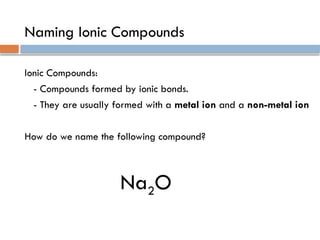
How do we name the following compound?
Na2O
Naming Ionic Compounds
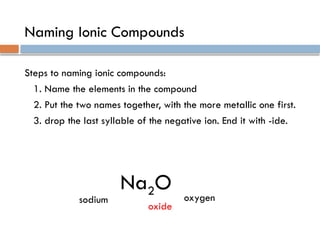
Steps to naming ionic compounds:
1. Name the elements in the compound
2. Put the two names together, with the more metallic one first.
3. drop the last syllable of the negative ion. End it with -ide.
Na2O
sodium oxygen
oxide
Naming Ionic Compounds
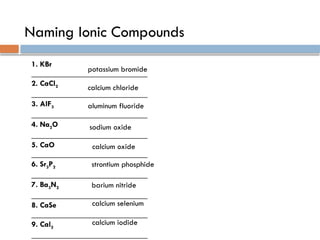
1. KBr
_____________________________
2. CaCl2
_____________________________
3. AlF3
_____________________________
4. Na2O
_____________________________
5. CaO
_____________________________
6. Sr3P2
_____________________________
7. Ba3N2
_____________________________
8. CaSe
_____________________________
9. Cal2
_____________________________
potassium bromide
calcium chloride
aluminum fluoride
sodium oxide
calcium oxide
strontium phosphide
barium nitride
calcium selenium
calcium iodide
Writing Ionic Compound Formulae
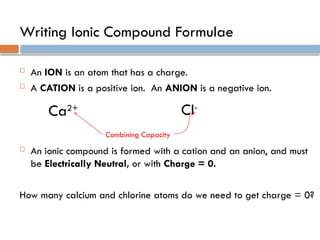
 An ION is an atom that has a charge.
 A CATION is a positive ion. An ANION is a negative ion.
 An ionic compound is formed with a cation and an anion, and must
be Electrically Neutral, or with Charge = 0.
How many calcium and chlorine atoms do we need to get charge = 0?
Ca2+ Cl-
Combining Capacity
Writing Ionic Compound Formulae
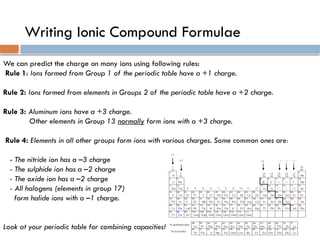
We can predict the charge on many ions using following rules:
Rule 1: Ions formed from Group 1 of the periodic table have a +1 charge.
Rule 2: Ions formed from elements in Groups 2 of the periodic table have a +2 charge.
Rule 3: Aluminum ions have a +3 charge.
Other elements in Group 13 normally form ions with a +3 charge.
Rule 4: Elements in all other groups form ions with various charges. Some common ones are:
- The nitride ion has a –3 charge
- The sulphide ion has a –2 charge
- The oxide ion has a –2 charge
- All halogens (elements in group 17)
form halide ions with a –1 charge.
Look at your periodic table for combining capacities!
Writing Ionic Compound Formulae
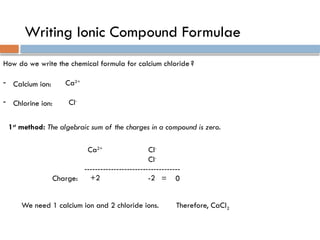
How do we write the chemical formula for calcium chloride ?
- Calcium ion:
- Chlorine ion: Cl-
Ca2+
1st
method: The algebraic sum of the charges in a compound is zero.
------------------------------------
Charge: = 0
Ca2+
+2
Cl-
Cl-
-2
We need 1 calcium ion and 2 chloride ions. Therefore, CaCl2
Writing Ionic Compound Formulae
How do we write the chemical formula for calcium chloride ?
- Calcium ion:
- Chlorine ion: Cl-
Ca2+
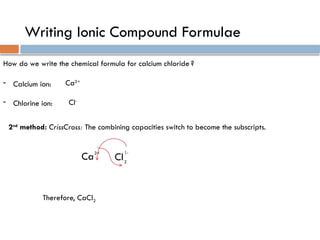
2nd
method: CrissCross: The combining capacities switch to become the subscripts.
Ca Cl
2+ 1-
2
Therefore, CaCl2
Writing Ionic Compound Formulae
How do we write the chemical formula for calcium chloride ?
- Calcium ion:
- Chlorine ion: Cl-
Ca2+
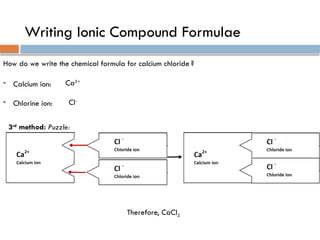
3rd
method: Puzzle:
Therefore, CaCl2
Writing Ionic Compound Formulae
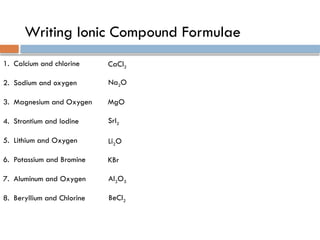
1. Calcium and chlorine
2. Sodium and oxygen
3. Magnesium and Oxygen
4. Strontium and Iodine
5. Lithium and Oxygen
6. Potassium and Bromine
7. Aluminum and Oxygen
8. Beryllium and Chlorine
CaCl2
Na2O
MgO
SrI2
Li2O
KBr
Al2O3
BeCl2
Lesson 2 Naming ionic compounds and writing formula.pptx

  • 1.
    Naming Ionic Compounds IonicCompounds: - Compounds formed by ionic bonds. - They are usually formed with a metal ion and a non-metal ion How do we name the following compound? Na2O
  • 2.
    Naming Ionic Compounds Stepsto naming ionic compounds: 1. Name the elements in the compound 2. Put the two names together, with the more metallic one first. 3. drop the last syllable of the negative ion. End it with -ide. Na2O sodium oxygen oxide
  • 3.
    Naming Ionic Compounds 1.KBr _____________________________ 2. CaCl2 _____________________________ 3. AlF3 _____________________________ 4. Na2O _____________________________ 5. CaO _____________________________ 6. Sr3P2 _____________________________ 7. Ba3N2 _____________________________ 8. CaSe _____________________________ 9. Cal2 _____________________________ potassium bromide calcium chloride aluminum fluoride sodium oxide calcium oxide strontium phosphide barium nitride calcium selenium calcium iodide
  • 4.
    Writing Ionic CompoundFormulae  An ION is an atom that has a charge.  A CATION is a positive ion. An ANION is a negative ion.  An ionic compound is formed with a cation and an anion, and must be Electrically Neutral, or with Charge = 0. How many calcium and chlorine atoms do we need to get charge = 0? Ca2+ Cl- Combining Capacity
  • 5.
    Writing Ionic CompoundFormulae We can predict the charge on many ions using following rules: Rule 1: Ions formed from Group 1 of the periodic table have a +1 charge. Rule 2: Ions formed from elements in Groups 2 of the periodic table have a +2 charge. Rule 3: Aluminum ions have a +3 charge. Other elements in Group 13 normally form ions with a +3 charge. Rule 4: Elements in all other groups form ions with various charges. Some common ones are: - The nitride ion has a –3 charge - The sulphide ion has a –2 charge - The oxide ion has a –2 charge - All halogens (elements in group 17) form halide ions with a –1 charge. Look at your periodic table for combining capacities!
  • 6.
    Writing Ionic CompoundFormulae How do we write the chemical formula for calcium chloride ? - Calcium ion: - Chlorine ion: Cl- Ca2+ 1st method: The algebraic sum of the charges in a compound is zero. ------------------------------------ Charge: = 0 Ca2+ +2 Cl- Cl- -2 We need 1 calcium ion and 2 chloride ions. Therefore, CaCl2
  • 7.
    Writing Ionic CompoundFormulae How do we write the chemical formula for calcium chloride ? - Calcium ion: - Chlorine ion: Cl- Ca2+ 2nd method: CrissCross: The combining capacities switch to become the subscripts. Ca Cl 2+ 1- 2 Therefore, CaCl2
  • 8.
    Writing Ionic CompoundFormulae How do we write the chemical formula for calcium chloride ? - Calcium ion: - Chlorine ion: Cl- Ca2+ 3rd method: Puzzle: Therefore, CaCl2
  • 9.
    Writing Ionic CompoundFormulae 1. Calcium and chlorine 2. Sodium and oxygen 3. Magnesium and Oxygen 4. Strontium and Iodine 5. Lithium and Oxygen 6. Potassium and Bromine 7. Aluminum and Oxygen 8. Beryllium and Chlorine CaCl2 Na2O MgO SrI2 Li2O KBr Al2O3 BeCl2