Slugs and SnailsASSIGNMENT
Submitted To :- Submitted By :-
Dr. O. P. Chaudhary Vaibhav
Dept. of Entomology
Phylum Mollusca
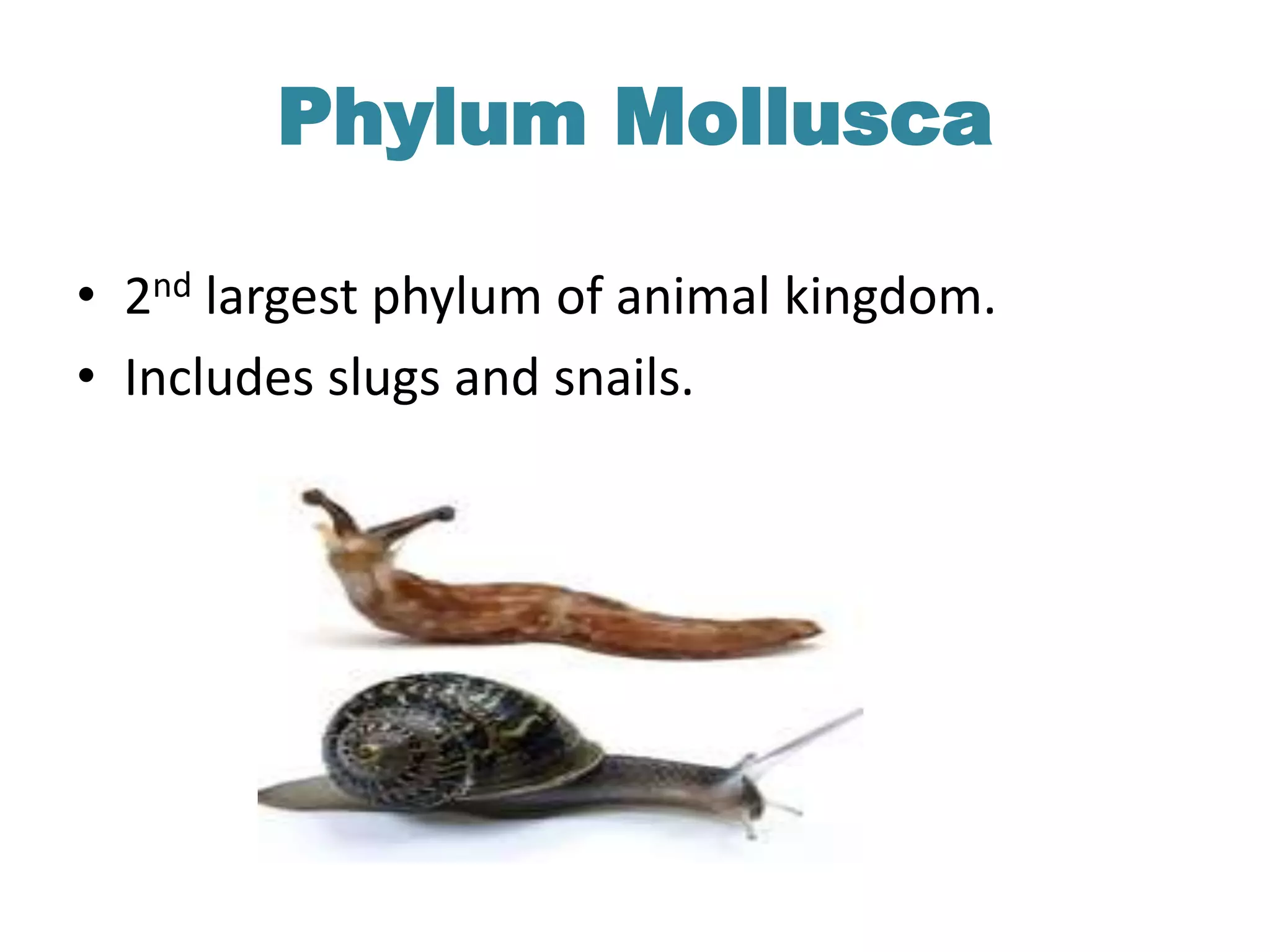
• 2nd largest phylum of animal kingdom.
• Includes slugs and snails.
Characteristics :-
• Unsegmented, without appandages.
• Mostly aquatic in habit.
• Respiration takes place through gills.
• Circulatory system is open.
• Development may be direct larvel.
• Snail posses a shell but slug doesn’t.
Mollusca
• Order : Stylommatophora
• Class : Gastropoda
• Without backbone.
• Asymmetrical, unsegmented and spirally coiled body.
• Hermaphrodite in nature.
• Lack of good protection against dehydration, hence
avoid direct sunlight.
• Mostly nocturnal.
• During day time, hide in moist place or under debris.
Slugs and snails :-
Snail secrete light
yellow SLIME and
Slugs secrete colourless
SLIME which become
Silvery after drying.
Slugs and snails :-
• In India, about 1500 species of land snails
occurs but the no. of species of slugs are
limited.
• Among these 9 species of snails and 12
species of slugs have been reported as pests
of ornamental plants, fruits, vegetables, and
field crops.
Slugs and snails (THE PESTS)
SNAILS -
• Found in different parts of world
including India and islands of the
Andaman and Nicobar group.
• Pests of paddy, vegetable, fruits and
plantation crops like banana and
papaya etc.
• Paddy crop is seriously damaged by
them in Kashmir and some parts of
U.P. and South India.
• They feed on leaves and stems of
plant.
Important species of snails -
• The common snail
(Helix spp.)
• Giant african snail
(Achatina fulica)
The common snail (Helix spp.)
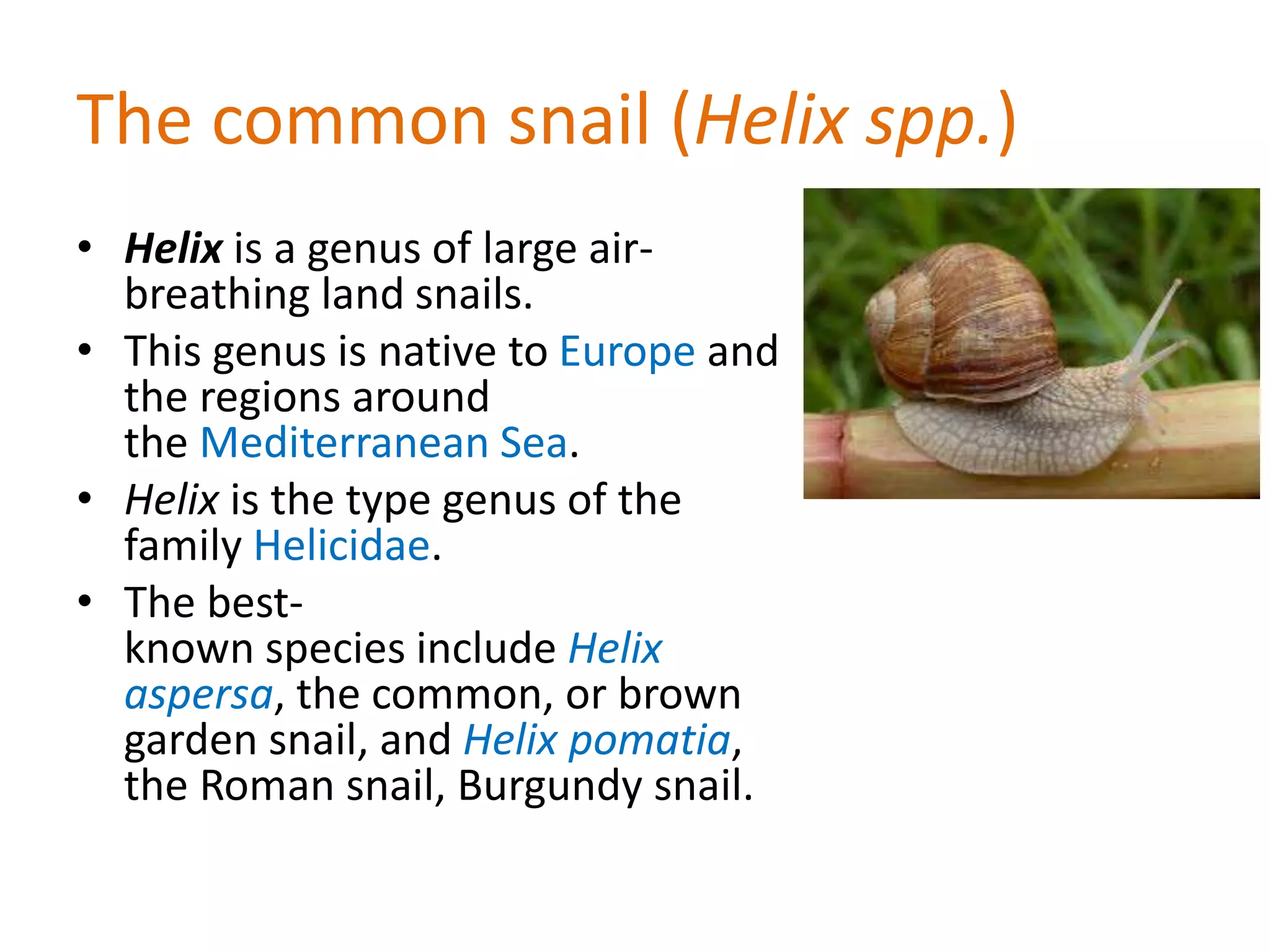
• Helix is a genus of large air-
breathing land snails.
• This genus is native to Europe and
the regions around
the Mediterranean Sea.
• Helix is the type genus of the
family Helicidae.
• The best-
known species include Helix
aspersa, the common, or brown
garden snail, and Helix pomatia,
the Roman snail, Burgundy snail.
Biology :
• A hard calcareous shell that covers and
protects the internal organs.
• The head and foot region can be observed
when the snails are fully extended.
• When they are active, the organs such as
the lung, heart, kidney and intestines remain
inside the shell, only the head and foot
emerge.
• The head of the snail has two pairs of
tentacles: the upper and larger pair contain the
eyes, and the lower pair are used to feel the
ground in front.
• The mouth is located just underneath the head.
• The mouth has a tongue called a "radula" that
is composed of many fine chitinous teeth. This
serves for rasping and cutting food.
Life cycle :
• The snails produce both eggs and sperm in
the ovotestis (also called the hermaphrodite
gland), but it is later separated into two
divisions, a sperm duct and oviduct.
• Mating takes several hours, sometimes a
day.
• The eggs are usually 4–6 mm in diameter.
• After snails hatch from the egg, they mature
in one or more years.
• The size of the adult snails slightly varies
with species. H. aspersa grows up to 35 mm
in height and width, whereas H.
pomatia grows up to 45 mm.
• The life span of snails in the wild is on
average two or three years.
• The garden snail is a relatively fast snail. It
has been observed to reach speeds of up to
1.3 cm/s.
Giant African snail (Achatina fulica)
• The giant African snail is native to East Africa.
• Each individual has both testes and ovaries and is
capable of producing both sperm and ova.
• Although both snails in a mating pair can
simultaneously transfer gametes to each other
(bilateral mating).
• Snails of similar size will reproduce in this way. Two
snails of differing sizes will mate unilaterally (one way),
with the larger individual acting as a female.
• The number of eggs per clutch averages around 200.
• A snail may lay five to six clutches per year with a
hatching viability of about 90%.
• Adult size is reached in about six months, after which
growth slows, but does not cease until death.
• The snails can live for up to ten years.
Slugs -
• Feed on either dead or living vegetation.
• Live in most damp places.
• They have been observed to damage
vegetable crops and banana etc. in U.P.,
Maharashtra, Assam, and M.P.
Important spp. Of Slugs -
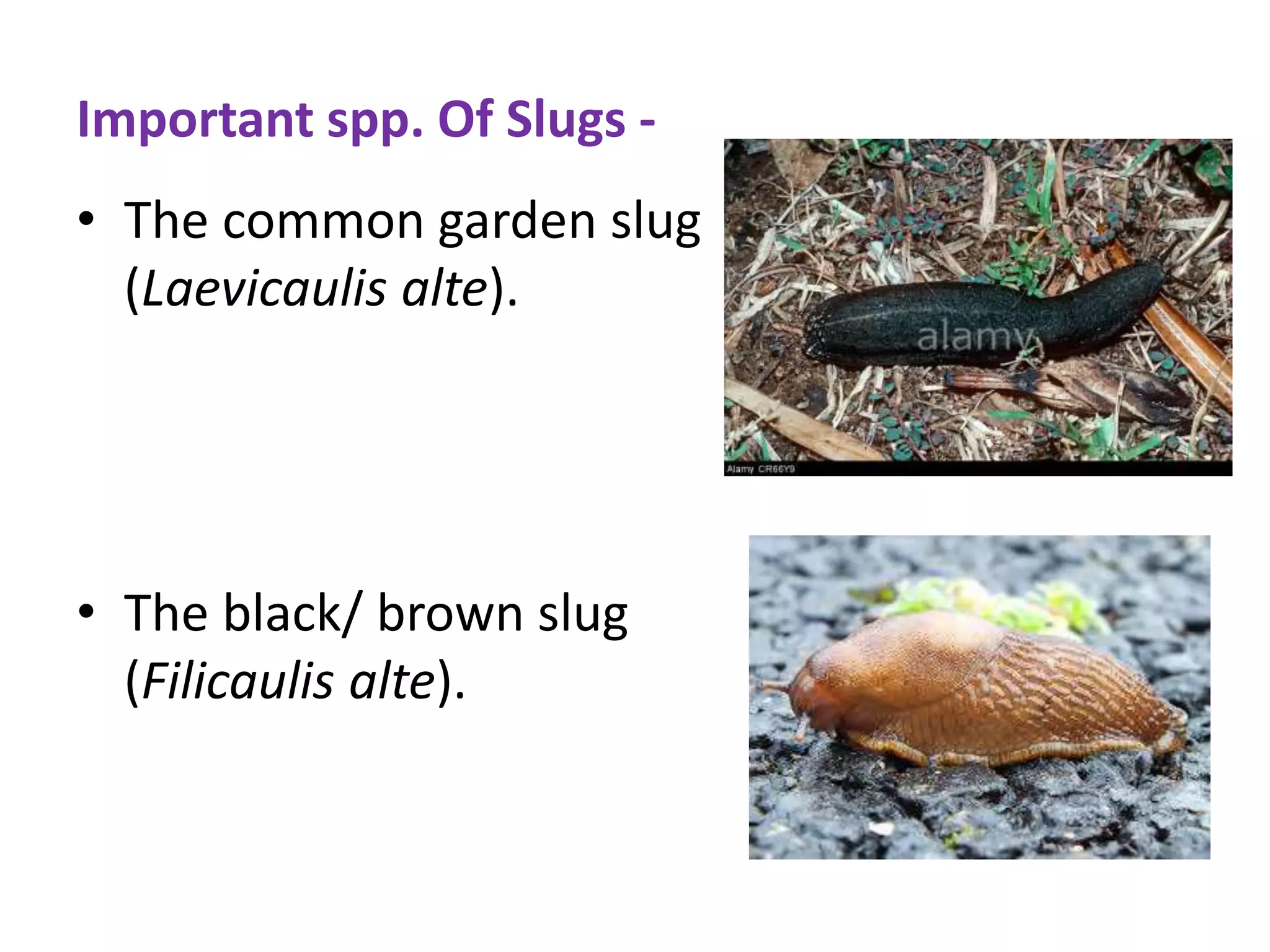
• The common garden slug
(Laevicaulis alte).
• The black/ brown slug
(Filicaulis alte).
The common garden slug (Laevicaulis alte)
• This species is probably indigenous
to Africa (western Africa and
eastern Africa).
• Laevicaulis alte is a round, dark-
coloured slug with no shell,
• 7 or 8 cm long.
• Skin is slightly tuberculated.
• The tentacles are small, 2 or 3 mm
long.
• Larger specimens are active during
the day sometimes.
• This slug can grow up from 0.5 cm
to approximately 4 cm in length in
7 months.
The common garden slug
The black/ brown slug (Filicaulis alte).
• Dirty, creamish, white, spongy eggs in
masses on damp soil.
• 74-80 eggs/ mass.
• Newly hatched juvenile resembling
adults in colour.
• Starts laying eggs at the age of about
8-9 months.
• Lay eggs twice a year.
• Adult is 8.0-8.5 cm in length, 1.5-2.0
cm in breadth, 7-8 g. in weight.
• Average life span of about 390 days.
Damage (Slugs and snails)
• They appear as sporadic pests in
those places where damp
conditions prevail.
• They may also appear on roads,
creating problem during taking
off or landing of the aircraft.
• Polyphagous in nature.
• Giant african snail is known to
feed on 227 host plants..
• They completely devour the small
leaves.
• Mature leaves show holes on
them.
• Mine like holes and tunnels are
bored in tubers, roots and bulbs.
• Sown seed of wheat in soil are
completely hollowed out startling
from embryo.
• Completely pericarp is eaten away
in case of tomato.
Act as carriers of propagules of plant pathogens -
• Spores of Alternaria sp.,
Phytopthora sp. and Fusarium sp.
found in SLIMES.
• Phytophthora palmivora (black rot
disease).
• Economic damage to crops of
cucurbitaceae(46%),
basellaceae(39%), by A. fulica.
• Damage to seedlings of
margild(97%), cabbage(75%),
brinjal(51%), spinach(48%).
Cabbage
Tomato
Management :
• Handpicking of snails during midnight and
both snails and slugs before dawn and after
dusk.
• Should be destroyed in 10% common salt
solution.
• Keep area free from weeds.
• Smooth copper or zinc sheets can be used as
mechanical barriers.
Chemical control
• Poison baits consists of 10% carbaryl 50WDP
in wheat bran.
• Spray copper sulphate (3%) @12 kg dissolved
in 400 ltrs. Of water/ ha.
• Dust 15% metaldehyde @ 50 kg/ha.
• Spray 50% metaldehyde powder @10 kg/ha.
Thank you 

Slugs and snails assignmen tviki

  • 1.
    Slugs and SnailsASSIGNMENT SubmittedTo :- Submitted By :- Dr. O. P. Chaudhary Vaibhav Dept. of Entomology
  • 2.
    Phylum Mollusca • 2ndlargest phylum of animal kingdom. • Includes slugs and snails.
  • 3.
    Characteristics :- • Unsegmented,without appandages. • Mostly aquatic in habit. • Respiration takes place through gills. • Circulatory system is open. • Development may be direct larvel. • Snail posses a shell but slug doesn’t. Mollusca
  • 4.
    • Order :Stylommatophora • Class : Gastropoda • Without backbone. • Asymmetrical, unsegmented and spirally coiled body. • Hermaphrodite in nature. • Lack of good protection against dehydration, hence avoid direct sunlight. • Mostly nocturnal. • During day time, hide in moist place or under debris. Slugs and snails :-
  • 5.
    Snail secrete light yellowSLIME and Slugs secrete colourless SLIME which become Silvery after drying. Slugs and snails :-
  • 6.
    • In India,about 1500 species of land snails occurs but the no. of species of slugs are limited. • Among these 9 species of snails and 12 species of slugs have been reported as pests of ornamental plants, fruits, vegetables, and field crops. Slugs and snails (THE PESTS)
  • 7.
    SNAILS - • Foundin different parts of world including India and islands of the Andaman and Nicobar group. • Pests of paddy, vegetable, fruits and plantation crops like banana and papaya etc. • Paddy crop is seriously damaged by them in Kashmir and some parts of U.P. and South India. • They feed on leaves and stems of plant.
  • 8.
    Important species ofsnails - • The common snail (Helix spp.) • Giant african snail (Achatina fulica)
  • 9.
    The common snail(Helix spp.) • Helix is a genus of large air- breathing land snails. • This genus is native to Europe and the regions around the Mediterranean Sea. • Helix is the type genus of the family Helicidae. • The best- known species include Helix aspersa, the common, or brown garden snail, and Helix pomatia, the Roman snail, Burgundy snail.
  • 10.
    Biology : • Ahard calcareous shell that covers and protects the internal organs. • The head and foot region can be observed when the snails are fully extended. • When they are active, the organs such as the lung, heart, kidney and intestines remain inside the shell, only the head and foot emerge. • The head of the snail has two pairs of tentacles: the upper and larger pair contain the eyes, and the lower pair are used to feel the ground in front. • The mouth is located just underneath the head. • The mouth has a tongue called a "radula" that is composed of many fine chitinous teeth. This serves for rasping and cutting food.
  • 11.
    Life cycle : •The snails produce both eggs and sperm in the ovotestis (also called the hermaphrodite gland), but it is later separated into two divisions, a sperm duct and oviduct. • Mating takes several hours, sometimes a day. • The eggs are usually 4–6 mm in diameter. • After snails hatch from the egg, they mature in one or more years. • The size of the adult snails slightly varies with species. H. aspersa grows up to 35 mm in height and width, whereas H. pomatia grows up to 45 mm. • The life span of snails in the wild is on average two or three years. • The garden snail is a relatively fast snail. It has been observed to reach speeds of up to 1.3 cm/s.
  • 12.
    Giant African snail(Achatina fulica) • The giant African snail is native to East Africa. • Each individual has both testes and ovaries and is capable of producing both sperm and ova. • Although both snails in a mating pair can simultaneously transfer gametes to each other (bilateral mating). • Snails of similar size will reproduce in this way. Two snails of differing sizes will mate unilaterally (one way), with the larger individual acting as a female. • The number of eggs per clutch averages around 200. • A snail may lay five to six clutches per year with a hatching viability of about 90%. • Adult size is reached in about six months, after which growth slows, but does not cease until death. • The snails can live for up to ten years.
  • 14.
    Slugs - • Feedon either dead or living vegetation. • Live in most damp places. • They have been observed to damage vegetable crops and banana etc. in U.P., Maharashtra, Assam, and M.P.
  • 15.
    Important spp. OfSlugs - • The common garden slug (Laevicaulis alte). • The black/ brown slug (Filicaulis alte).
  • 16.
    The common gardenslug (Laevicaulis alte) • This species is probably indigenous to Africa (western Africa and eastern Africa). • Laevicaulis alte is a round, dark- coloured slug with no shell, • 7 or 8 cm long. • Skin is slightly tuberculated. • The tentacles are small, 2 or 3 mm long.
  • 17.
    • Larger specimensare active during the day sometimes. • This slug can grow up from 0.5 cm to approximately 4 cm in length in 7 months. The common garden slug
  • 18.
    The black/ brownslug (Filicaulis alte). • Dirty, creamish, white, spongy eggs in masses on damp soil. • 74-80 eggs/ mass. • Newly hatched juvenile resembling adults in colour. • Starts laying eggs at the age of about 8-9 months. • Lay eggs twice a year. • Adult is 8.0-8.5 cm in length, 1.5-2.0 cm in breadth, 7-8 g. in weight. • Average life span of about 390 days.
  • 19.
    Damage (Slugs andsnails) • They appear as sporadic pests in those places where damp conditions prevail. • They may also appear on roads, creating problem during taking off or landing of the aircraft. • Polyphagous in nature. • Giant african snail is known to feed on 227 host plants..
  • 20.
    • They completelydevour the small leaves. • Mature leaves show holes on them. • Mine like holes and tunnels are bored in tubers, roots and bulbs. • Sown seed of wheat in soil are completely hollowed out startling from embryo. • Completely pericarp is eaten away in case of tomato.
  • 21.
    Act as carriersof propagules of plant pathogens - • Spores of Alternaria sp., Phytopthora sp. and Fusarium sp. found in SLIMES. • Phytophthora palmivora (black rot disease). • Economic damage to crops of cucurbitaceae(46%), basellaceae(39%), by A. fulica. • Damage to seedlings of margild(97%), cabbage(75%), brinjal(51%), spinach(48%). Cabbage Tomato
  • 22.
    Management : • Handpickingof snails during midnight and both snails and slugs before dawn and after dusk. • Should be destroyed in 10% common salt solution. • Keep area free from weeds. • Smooth copper or zinc sheets can be used as mechanical barriers.
  • 23.
    Chemical control • Poisonbaits consists of 10% carbaryl 50WDP in wheat bran. • Spray copper sulphate (3%) @12 kg dissolved in 400 ltrs. Of water/ ha. • Dust 15% metaldehyde @ 50 kg/ha. • Spray 50% metaldehyde powder @10 kg/ha.
  • 24.