EXOTERYGOTES
HEMIPTERA
Nizad Sultana Ch
Roll no 19012514-032
Msc 4
Section A
Hemiptera
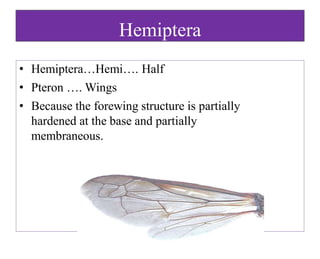
• Hemiptera…Hemi…. Half
• Pteron …. Wings
• Because the forewing structure is partially
hardened at the base and partially
membraneous.
Characteristics
o True Bugs
o Piercing or sucking mouth parts.
o 6000 described species
o Range in size fro 1mm to 110 mm
o Some species are wingless
o Some have two pair of wings
o Some have only forewings which me be hardened or
membranous
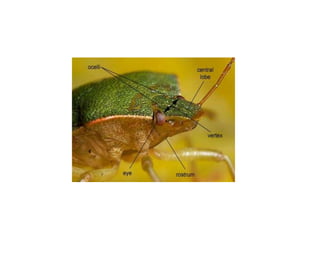
o Compound eyes..Upto 3 oceli..
o Piercing and sucking mouth parts …Pointed as rostrum or
proboscis.
HABITAT
Because of the diversity of the hemiptera family, true
bugs can be found in almost any habitat, including in
and around water.
A greater diversity of true bugs will be found in warm,
shallow waters that have lots of vegetation and slow-
moving or still water.
Many true bugs live mostly underwater, but will
periodically come up to the surface for air.
Habit
Diet and feeding
Aquatic and semi-aquatic true bugs are mainly predatory;
They use their beak-like mouthparts to pierce and penetrate prey,
injecting them with digestive enzymes.These enzymes break
down the tissue so that the prey's juices can be sucked out.
Both nymphs and adults are predaceous, feeding on a range of
aquatic insects and crustaceans.
Terrestrial true bugs are herbivores and use special mouth-parts to
suck sap from plants.
Reproduction
 Courtship is usually brief and involves flashing legs, wings, and antennae
that are brightly colored or distinctly hairy. Some species produce sounds.
 Males usually deposit sperm directly into the female's reproductive organs.
During mating the male may ride on the back of the female, or the pair will
become joined at the tips of their abdomens. They may remain together only
briefly or for several hours.
 Terrestrial species usually mate on the surfaces of plants, rocks, logs, or on
the ground. Water bugs mate above or below the water surface. Under water they
will perch on rocks, logs, or floating plants.
Parthenogenesis
 Nearly all species of true bugs must mate in order to reproduce. However,
some mealy bugs and scale insects reproduce by parthenogenesis a process
where the young develop from unfertilized eggs. Nearly all aphids reproduce
by switching back and forth between mating and parthenogenesis.
In spring and fall, winged males and females mate to produce eggs that hatch
into wingless females. These females reproduce by parthenogenesis, giving
live birth to more wingless females. At the end of summer the wingless
females lay eggs that hatch into winged males and females.
Some scale insects are hermaphrodites. Hermaphrodites are individual
animals that have both male and female reproductive organs. This means that
any two individuals, not just a male and female, can get together to mate to
produce offspring.
Life cycle of Hemiptera
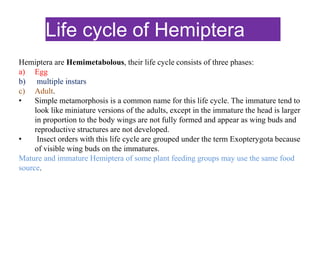
Hemiptera are Hemimetabolous, their life cycle consists of three phases:
a) Egg
b) multiple instars
c) Adult.
• Simple metamorphosis is a common name for this life cycle. The immature tend to
look like miniature versions of the adults, except in the immature the head is larger
in proportion to the body wings are not fully formed and appear as wing buds and
reproductive structures are not developed.
• Insect orders with this life cycle are grouped under the term Exopterygota because
of visible wing buds on the immatures.
Mature and immature Hemiptera of some plant feeding groups may use the same food
source.
Morphology
The insects in this order are extremely diverse in their size, shape and colour. There are
about 6000 described species in Australia.
Size
Ranging in size from 1 to 110 millimeters in length.
https://www.ento.csiro.au/education/insects/hemiptera.html
They range in size from 1 mm (0.04 in) to around 15 cm (6 in).
They range from minute, wingless scales to fish-eating giant water bugs, which may
reach a length of 11 cm.
the one thing they all have in common is a long slender beak shaped mouth part that
looks like a straw. They use this beak to poke through plants and occasionally animal
skin and suck out sap or blood.
Shape
Most species have a triangular scutellum (hardened plate) at the base of the wings.
Some have prominent shoulders (e.g., stink bugs) making the body shield-shaped;
others (e.g., ambush bugs) are wider at the rear with the sides of the abdomen extending
beyond the wings; and others are oval-shaped (e.g., milkweed bugs).
Color
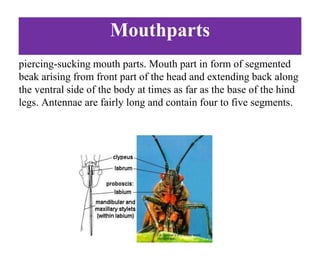
Mouthparts
piercing-sucking mouth parts. Mouth part in form of segmented
beak arising from front part of the head and extending back along
the ventral side of the body at times as far as the base of the hind
legs. Antennae are fairly long and contain four to five segments.
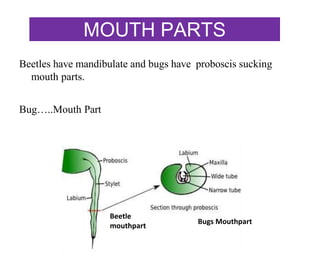
MOUTH PARTS
Beetles have mandibulate and bugs have proboscis sucking
mouth parts.
Bug…..Mouth Part
Beetle
mouthpart
Bugs Mouthpart
Anatomy and Physiology
Digestive system
The gross morphology of the alimentary canal consists of esophagus (foregut), midgut,
hindgut, and special filter chamber.
The esophagus, a narrow and slender tube, runs through the whole thorax extending
into the filter chamber and connecting with the anterior midgut The midgut consists
of three major regions, anterior, middle and posterior midgut.
a) The anterior midgut is composed of exceptionally thick epithelial cells surrounding
a large lumen. Numerous well-developed microvilli occur at the basal region of the
epithelium. A large number of electron-lucent and lipid-like vesicles are observed
under.
b) The posterior midgut is smaller than the anterior midgut in diameter. Numerous
different concentric circular bodies are characteristic of the posterior midgut.
 The hindgut arises from the posterior midgut at the boundary of the filter
chamber. It extends downward toward the anus where the hindgut enlarges to
form the rectum. The rectum is formed by various cells typical of epithelium,
whose nuclei are relatively smaller than those of the midgut. Relatively large
muscle cells are present at the well-defined and thick basement membrane.
Excretory system
Lower end of Malpighian tubes. A few millimeters above their
entry into the rectum, the Malpighian tubes change considerably
in appearance
The cells become thicker and the lumen reduced; and the striated
border is in the form of numerous long fine filaments like inactive
cilia which almost fill the lumen. The uratic granules are usually
rather scanty.
Ampullae. This condition continues until the tube ends abruptly
on the upper surface of the ampulla. The free borders of these
cells are drawn out into long processes which completely fill the
lumen and extend right into the rectum.
Nervous system
The central nervous system of Rhodnius has been studied in sections stained.
The single type of glial cell responsible for perineurium and axon sheaths in
the peripheral nerves becomes differentiated in the thoracic ganglia into four
types.
Type i cells form the layer of perineurium cells filled with filamentous
mitochondria. These cells which are rich in succinoxidase control the passage
of all substances to and from the ganglion.
Type ii cells produce the thick myelin-type sheaths for the lateral group of
motor axons.
Type iii cells, the giant glial cells in the ganglionic layer, have a very extensive
cytoplasm which sends deep tongue-like invaginations into the large ganglion
cells.
Respiratory system
Insects take in Oxygen and expel Carbon Dioxide using a series of internal
air tubes, the tracheae. These pass fine branches, the tracheoles, to all parts of
the body.
The cuticle lines the tracheae. These linings are shed with the rest of the
cuticle when the insect moults.
 There is a main pair of lateral tracheae running the length of the body, one
on each side. Some insects show two such pairs, one dorsal, the other ventral.
From the main trunks, tracheoles pass throughout the body. The tracheae open
to the air at the paired spiracles. There is one pair per segment in the thorax
and also in the first nine abdominal segments. This arrangement does vary with
different species. In most species the spiracles on the first segment of the
thorax are missing. The pair on the ninth abdominal segment is also missing.
Examples
Firebug
Lace Bug
Kingdom: Animalia
 Phylum: Aryhopoda
Class: Insecta
Order: Hemiptera
Family: Tigidae
Genus: Stephanitii
Species: S. pyrioides
Binomial name.Stephanitis pyrioides
Lace bug Stephanitis pyrioides
Photo: Rosetta, Oregon State University
Milkweed bug
Scientific name: Oncopeltus
Order: True bugs
Higher classification: Oncopeltus
Family: Lygaeidae
Class: Insecta
Kingdom: Animalia
Milkweed bug
Phil Myers (photographer; copyright holder), Museum of Zoology,
University of Michigan-Ann Arbor
Suborders of Hemiptera
There are three major suborders of Hemiptera:
1. Heteroptera (True Bugs)
2. Auchenorrhyncha (Cicadas, Hoppers)
3 Sternorrhyncha (Aphids, Whiteflies, Scales)
Suborder Heteroptera
• Land Bug and water Bug
• Herbivore …………..Feed on tiny plants and fungi
• Parasitic…………….. Bed bug
• Carnivores…………..Giant water Bug feed on Goldfish
Bed Bug
• Kingdom
• Phylum
Animalia
Arthropoda
• Subphylum Hexapoda
• Class
• Order
• Family
• Genus
• Species
Insecta
Hemiptera
Cimicidae
Cimex
lectularius
Bed Bug
Bed Bug
• Before meal of blood • After meal of
blood
Water Bug
Characteristics of water Bug
Scientific name
Lethocerus insulans
Size
Approx 7 cm
Feeding habit
Aquatic Predator ,,Feed on gold
fish,Tadpoles salamanders
Front legs are adapted for grasping prey..
Hind legs are adapted for swimming
Leaf-footed Bug
Characteristics of leaf footed Bug
 Large plant eating bugs
 Feed on plant juices.
 The lower leg may be shaped as
dried leaf,Irregular and flat.
 Have large prominent shoulders
resembles armor.
 Make loud noise when they fly..as a
means of defence when they are
threatened.
Suborder Auchenurrhyncha
• Leaf Hopper
• Spittle bugScales
• Short, bristle like antennae
• ovipositor well developed
• good fliers or jumpers
• Evolved towards increased wing
development jumping capacity.
Characteristics Of Leaf
hopper
Characteristics Of Leaf
Hopper
Plant feeders that suck plant juices.
Hind legs are modified for jumping, are covered
with hairs that facilitates the spreading of secrection
over their bodies that act as water repellent and
carrier of pheromones.
 Wings are held like tent over abdomen.
Oceli are present on the top of the head.
Suborder Sternorrhyncha
Soft bodies
Wingless
Cover their bodies with wax which prevent
their bodies from drying out.
Longer filiform antennae
ovipositor reduced.
Aphidoidea
Aphids
 Plant lice,, sap sucking .
 Destructive insects on cultivated plants
in temperate regions
 They are so small that wind can transport
them for long distance.
 Often green ,,might be brown and red
References
• Moreira, F. F. F., Rodrigues, H. D. D., Sites, R. W., Cordeiro,
I. D. R. S., & Magalhães, O. M. (2018). Order Hemiptera.
In Thorp and Covich's Freshwater Invertebrates (pp. 175-216).
Academic Press.
• Dolling, W. R. (1991). Hemiptera. Oxford University Press.
• Lytle, D. A. (2015). Order Hemiptera. In Thorp and Covich's
freshwater invertebrates (pp. 951-963). Academic Press.
Thank you everyone

Order hemiptera True bugs

  • 1.
    EXOTERYGOTES HEMIPTERA Nizad Sultana Ch Rollno 19012514-032 Msc 4 Section A
  • 2.
    Hemiptera • Hemiptera…Hemi…. Half •Pteron …. Wings • Because the forewing structure is partially hardened at the base and partially membraneous.
  • 3.
    Characteristics o True Bugs oPiercing or sucking mouth parts. o 6000 described species o Range in size fro 1mm to 110 mm o Some species are wingless o Some have two pair of wings o Some have only forewings which me be hardened or membranous o Compound eyes..Upto 3 oceli.. o Piercing and sucking mouth parts …Pointed as rostrum or proboscis.
  • 4.
    HABITAT Because of thediversity of the hemiptera family, true bugs can be found in almost any habitat, including in and around water. A greater diversity of true bugs will be found in warm, shallow waters that have lots of vegetation and slow- moving or still water. Many true bugs live mostly underwater, but will periodically come up to the surface for air.
  • 5.
    Habit Diet and feeding Aquaticand semi-aquatic true bugs are mainly predatory; They use their beak-like mouthparts to pierce and penetrate prey, injecting them with digestive enzymes.These enzymes break down the tissue so that the prey's juices can be sucked out. Both nymphs and adults are predaceous, feeding on a range of aquatic insects and crustaceans. Terrestrial true bugs are herbivores and use special mouth-parts to suck sap from plants.
  • 6.
    Reproduction  Courtship isusually brief and involves flashing legs, wings, and antennae that are brightly colored or distinctly hairy. Some species produce sounds.  Males usually deposit sperm directly into the female's reproductive organs. During mating the male may ride on the back of the female, or the pair will become joined at the tips of their abdomens. They may remain together only briefly or for several hours.  Terrestrial species usually mate on the surfaces of plants, rocks, logs, or on the ground. Water bugs mate above or below the water surface. Under water they will perch on rocks, logs, or floating plants.
  • 7.
    Parthenogenesis  Nearly allspecies of true bugs must mate in order to reproduce. However, some mealy bugs and scale insects reproduce by parthenogenesis a process where the young develop from unfertilized eggs. Nearly all aphids reproduce by switching back and forth between mating and parthenogenesis. In spring and fall, winged males and females mate to produce eggs that hatch into wingless females. These females reproduce by parthenogenesis, giving live birth to more wingless females. At the end of summer the wingless females lay eggs that hatch into winged males and females. Some scale insects are hermaphrodites. Hermaphrodites are individual animals that have both male and female reproductive organs. This means that any two individuals, not just a male and female, can get together to mate to produce offspring.
  • 8.
    Life cycle ofHemiptera Hemiptera are Hemimetabolous, their life cycle consists of three phases: a) Egg b) multiple instars c) Adult. • Simple metamorphosis is a common name for this life cycle. The immature tend to look like miniature versions of the adults, except in the immature the head is larger in proportion to the body wings are not fully formed and appear as wing buds and reproductive structures are not developed. • Insect orders with this life cycle are grouped under the term Exopterygota because of visible wing buds on the immatures. Mature and immature Hemiptera of some plant feeding groups may use the same food source.
  • 9.
    Morphology The insects inthis order are extremely diverse in their size, shape and colour. There are about 6000 described species in Australia. Size Ranging in size from 1 to 110 millimeters in length. https://www.ento.csiro.au/education/insects/hemiptera.html They range in size from 1 mm (0.04 in) to around 15 cm (6 in). They range from minute, wingless scales to fish-eating giant water bugs, which may reach a length of 11 cm. the one thing they all have in common is a long slender beak shaped mouth part that looks like a straw. They use this beak to poke through plants and occasionally animal skin and suck out sap or blood. Shape Most species have a triangular scutellum (hardened plate) at the base of the wings. Some have prominent shoulders (e.g., stink bugs) making the body shield-shaped; others (e.g., ambush bugs) are wider at the rear with the sides of the abdomen extending beyond the wings; and others are oval-shaped (e.g., milkweed bugs). Color
  • 10.
    Mouthparts piercing-sucking mouth parts.Mouth part in form of segmented beak arising from front part of the head and extending back along the ventral side of the body at times as far as the base of the hind legs. Antennae are fairly long and contain four to five segments.
  • 12.
    MOUTH PARTS Beetles havemandibulate and bugs have proboscis sucking mouth parts. Bug…..Mouth Part Beetle mouthpart Bugs Mouthpart
  • 13.
  • 14.
    Digestive system The grossmorphology of the alimentary canal consists of esophagus (foregut), midgut, hindgut, and special filter chamber. The esophagus, a narrow and slender tube, runs through the whole thorax extending into the filter chamber and connecting with the anterior midgut The midgut consists of three major regions, anterior, middle and posterior midgut. a) The anterior midgut is composed of exceptionally thick epithelial cells surrounding a large lumen. Numerous well-developed microvilli occur at the basal region of the epithelium. A large number of electron-lucent and lipid-like vesicles are observed under. b) The posterior midgut is smaller than the anterior midgut in diameter. Numerous different concentric circular bodies are characteristic of the posterior midgut.  The hindgut arises from the posterior midgut at the boundary of the filter chamber. It extends downward toward the anus where the hindgut enlarges to form the rectum. The rectum is formed by various cells typical of epithelium, whose nuclei are relatively smaller than those of the midgut. Relatively large muscle cells are present at the well-defined and thick basement membrane.
  • 15.
    Excretory system Lower endof Malpighian tubes. A few millimeters above their entry into the rectum, the Malpighian tubes change considerably in appearance The cells become thicker and the lumen reduced; and the striated border is in the form of numerous long fine filaments like inactive cilia which almost fill the lumen. The uratic granules are usually rather scanty. Ampullae. This condition continues until the tube ends abruptly on the upper surface of the ampulla. The free borders of these cells are drawn out into long processes which completely fill the lumen and extend right into the rectum.
  • 16.
    Nervous system The centralnervous system of Rhodnius has been studied in sections stained. The single type of glial cell responsible for perineurium and axon sheaths in the peripheral nerves becomes differentiated in the thoracic ganglia into four types. Type i cells form the layer of perineurium cells filled with filamentous mitochondria. These cells which are rich in succinoxidase control the passage of all substances to and from the ganglion. Type ii cells produce the thick myelin-type sheaths for the lateral group of motor axons. Type iii cells, the giant glial cells in the ganglionic layer, have a very extensive cytoplasm which sends deep tongue-like invaginations into the large ganglion cells.
  • 17.
    Respiratory system Insects takein Oxygen and expel Carbon Dioxide using a series of internal air tubes, the tracheae. These pass fine branches, the tracheoles, to all parts of the body. The cuticle lines the tracheae. These linings are shed with the rest of the cuticle when the insect moults.  There is a main pair of lateral tracheae running the length of the body, one on each side. Some insects show two such pairs, one dorsal, the other ventral. From the main trunks, tracheoles pass throughout the body. The tracheae open to the air at the paired spiracles. There is one pair per segment in the thorax and also in the first nine abdominal segments. This arrangement does vary with different species. In most species the spiracles on the first segment of the thorax are missing. The pair on the ninth abdominal segment is also missing.
  • 18.
  • 19.
  • 20.
    Lace Bug Kingdom: Animalia Phylum: Aryhopoda Class: Insecta Order: Hemiptera Family: Tigidae Genus: Stephanitii Species: S. pyrioides Binomial name.Stephanitis pyrioides
  • 21.
    Lace bug Stephanitispyrioides Photo: Rosetta, Oregon State University
  • 22.
    Milkweed bug Scientific name:Oncopeltus Order: True bugs Higher classification: Oncopeltus Family: Lygaeidae Class: Insecta Kingdom: Animalia
  • 23.
    Milkweed bug Phil Myers(photographer; copyright holder), Museum of Zoology, University of Michigan-Ann Arbor
  • 24.
    Suborders of Hemiptera Thereare three major suborders of Hemiptera: 1. Heteroptera (True Bugs) 2. Auchenorrhyncha (Cicadas, Hoppers) 3 Sternorrhyncha (Aphids, Whiteflies, Scales)
  • 25.
    Suborder Heteroptera • LandBug and water Bug • Herbivore …………..Feed on tiny plants and fungi • Parasitic…………….. Bed bug • Carnivores…………..Giant water Bug feed on Goldfish
  • 26.
    Bed Bug • Kingdom •Phylum Animalia Arthropoda • Subphylum Hexapoda • Class • Order • Family • Genus • Species Insecta Hemiptera Cimicidae Cimex lectularius
  • 27.
  • 28.
    Bed Bug • Beforemeal of blood • After meal of blood
  • 29.
  • 30.
    Characteristics of waterBug Scientific name Lethocerus insulans Size Approx 7 cm Feeding habit Aquatic Predator ,,Feed on gold fish,Tadpoles salamanders Front legs are adapted for grasping prey.. Hind legs are adapted for swimming
  • 31.
  • 32.
    Characteristics of leaffooted Bug  Large plant eating bugs  Feed on plant juices.  The lower leg may be shaped as dried leaf,Irregular and flat.  Have large prominent shoulders resembles armor.  Make loud noise when they fly..as a means of defence when they are threatened.
  • 33.
    Suborder Auchenurrhyncha • LeafHopper • Spittle bugScales • Short, bristle like antennae • ovipositor well developed • good fliers or jumpers • Evolved towards increased wing development jumping capacity.
  • 34.
  • 35.
    Characteristics Of Leaf Hopper Plantfeeders that suck plant juices. Hind legs are modified for jumping, are covered with hairs that facilitates the spreading of secrection over their bodies that act as water repellent and carrier of pheromones.  Wings are held like tent over abdomen. Oceli are present on the top of the head.
  • 36.
    Suborder Sternorrhyncha Soft bodies Wingless Covertheir bodies with wax which prevent their bodies from drying out. Longer filiform antennae ovipositor reduced.
  • 38.
  • 39.
    Aphids  Plant lice,,sap sucking .  Destructive insects on cultivated plants in temperate regions  They are so small that wind can transport them for long distance.  Often green ,,might be brown and red
  • 40.
    References • Moreira, F.F. F., Rodrigues, H. D. D., Sites, R. W., Cordeiro, I. D. R. S., & Magalhães, O. M. (2018). Order Hemiptera. In Thorp and Covich's Freshwater Invertebrates (pp. 175-216). Academic Press. • Dolling, W. R. (1991). Hemiptera. Oxford University Press. • Lytle, D. A. (2015). Order Hemiptera. In Thorp and Covich's freshwater invertebrates (pp. 951-963). Academic Press.
  • 41.