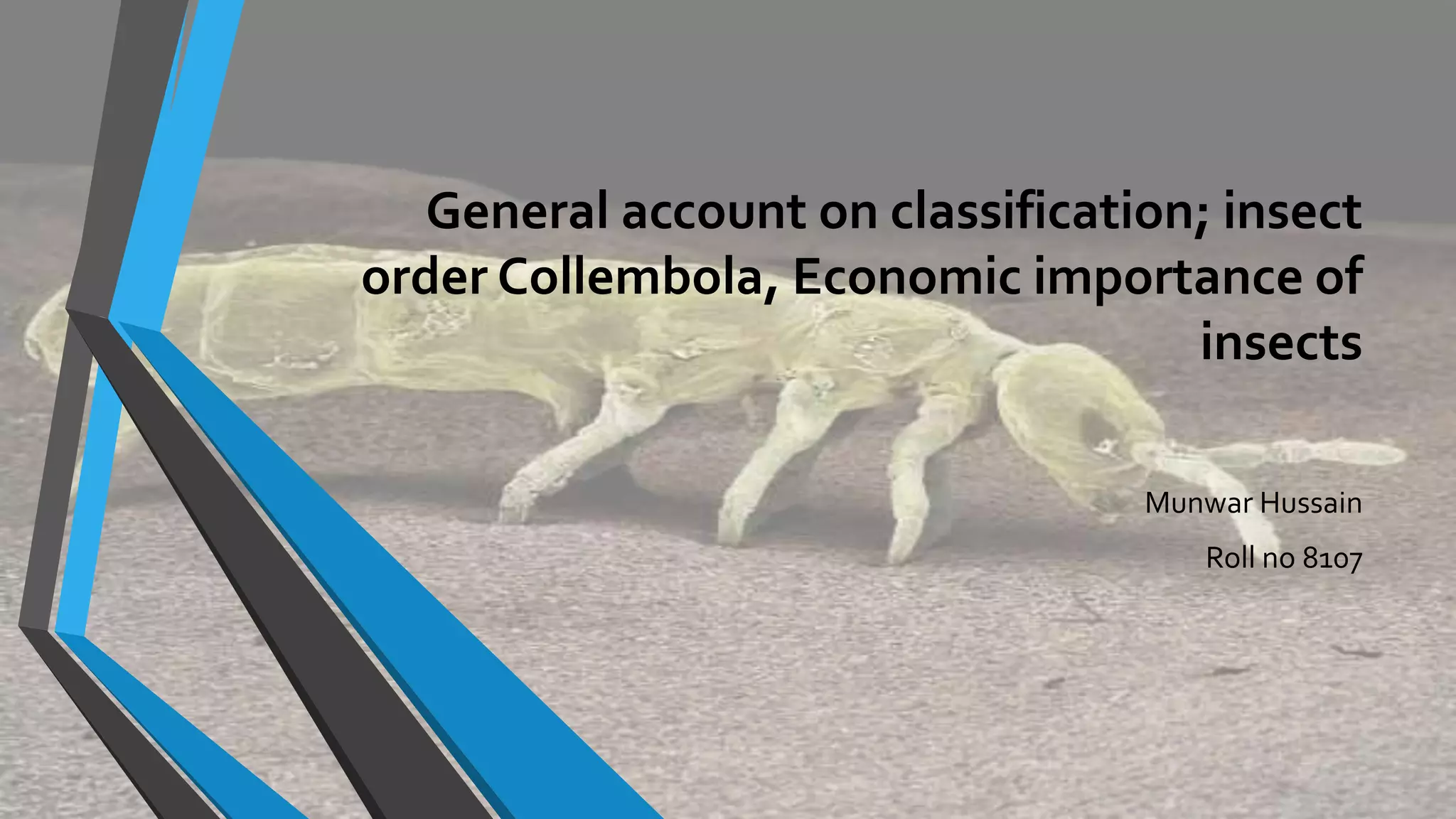
General account on classification; insect
order Collembola, Economic importance of
insects
Munwar Hussain
Roll no 8107
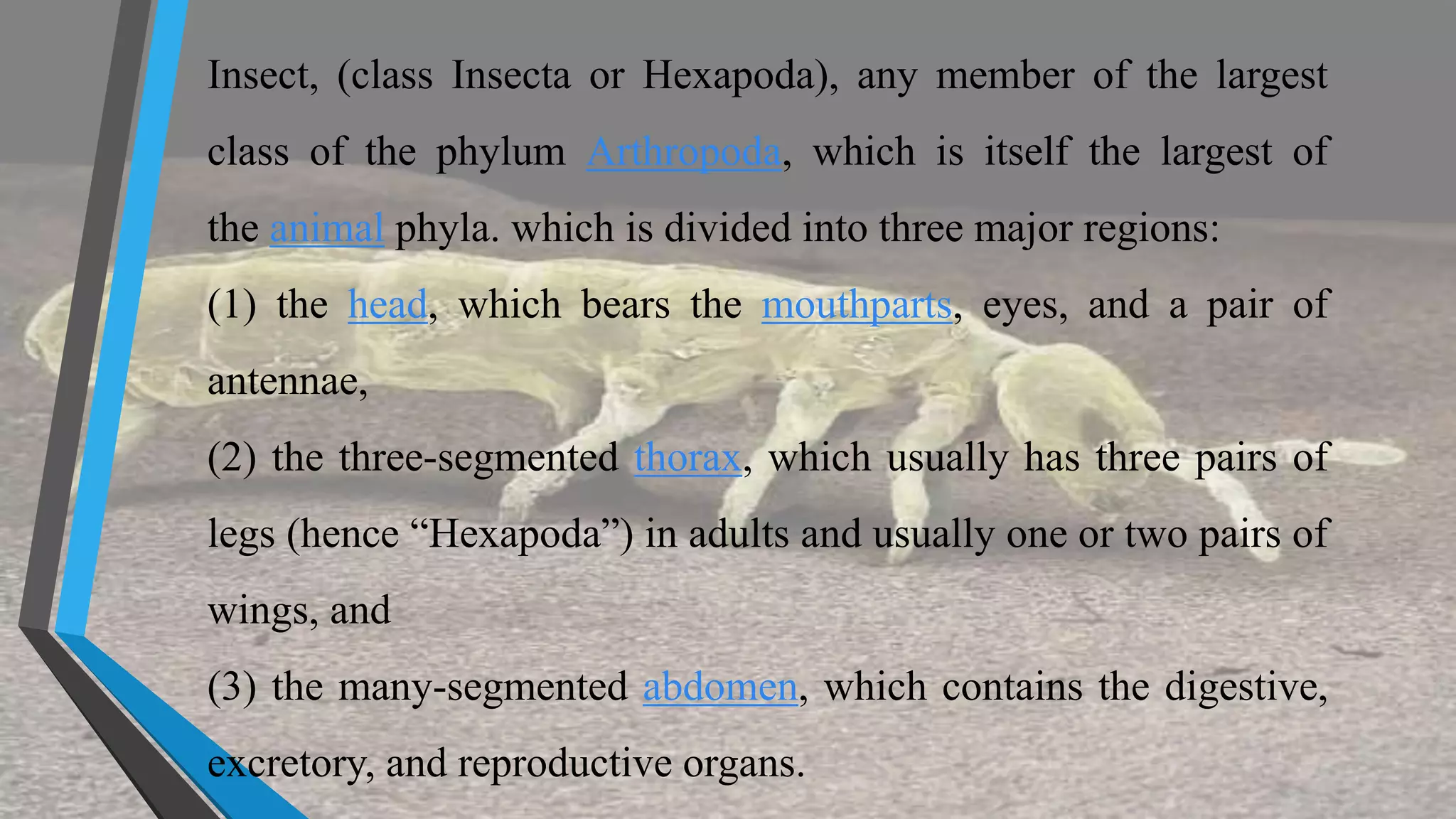
Insect, (class Insecta or Hexapoda), any member of the largest
class of the phylum Arthropoda, which is itself the largest of
the animal phyla. which is divided into three major regions:
(1) the head, which bears the mouthparts, eyes, and a pair of
antennae,
(2) the three-segmented thorax, which usually has three pairs of
legs (hence “Hexapoda”) in adults and usually one or two pairs of
wings, and
(3) the many-segmented abdomen, which contains the digestive,
excretory, and reproductive organs.
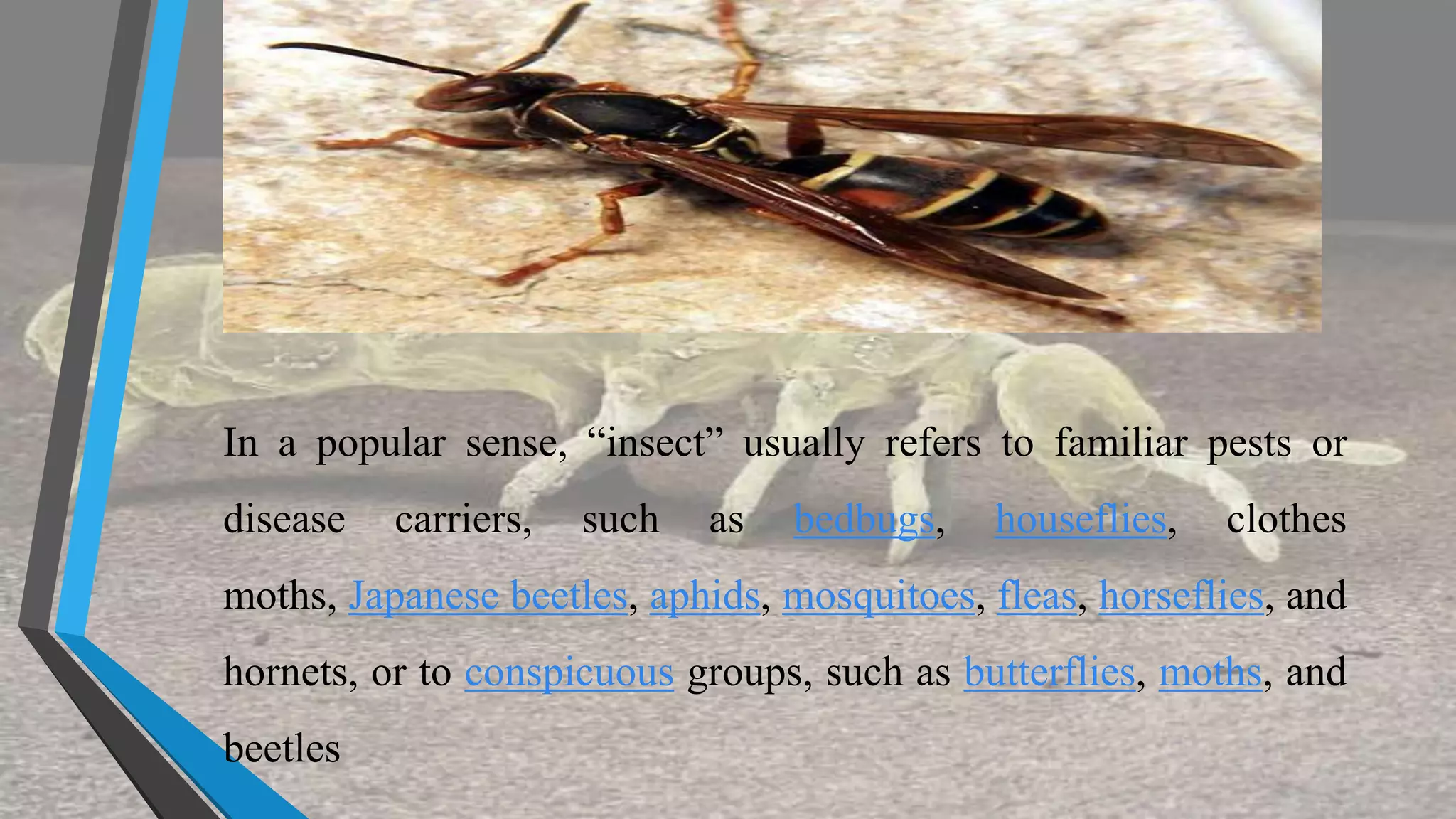
In a popular sense, “insect” usually refers to familiar pests or
disease carriers, such as bedbugs, houseflies, clothes
moths, Japanese beetles, aphids, mosquitoes, fleas, horseflies, and
hornets, or to conspicuous groups, such as butterflies, moths, and
beetles
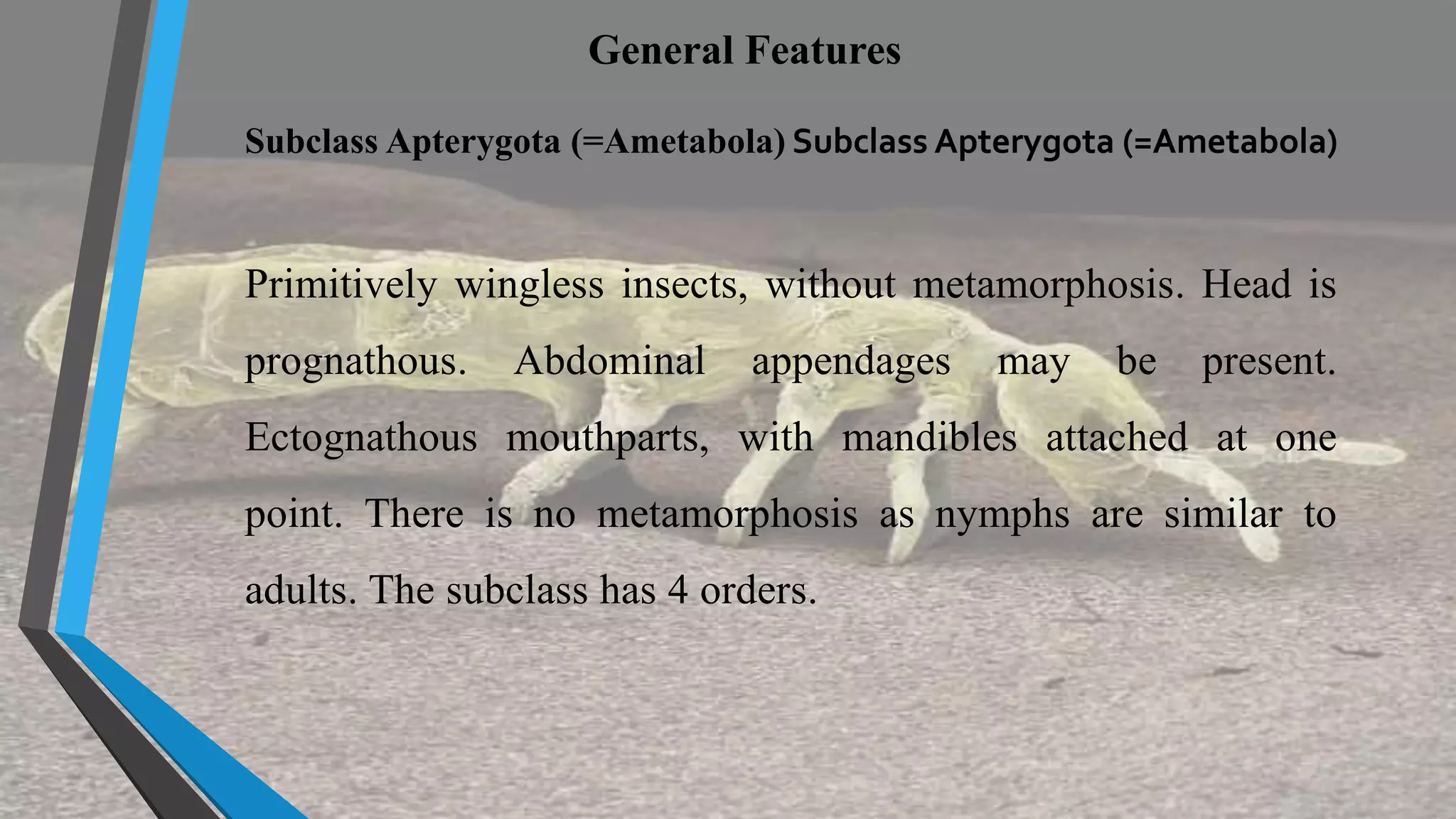
General Features
Subclass Apterygota (=Ametabola) Subclass Apterygota (=Ametabola)
Primitively wingless insects, without metamorphosis. Head is
prognathous. Abdominal appendages may be present.
Ectognathous mouthparts, with mandibles attached at one
point. There is no metamorphosis as nymphs are similar to
adults. The subclass has 4 orders.
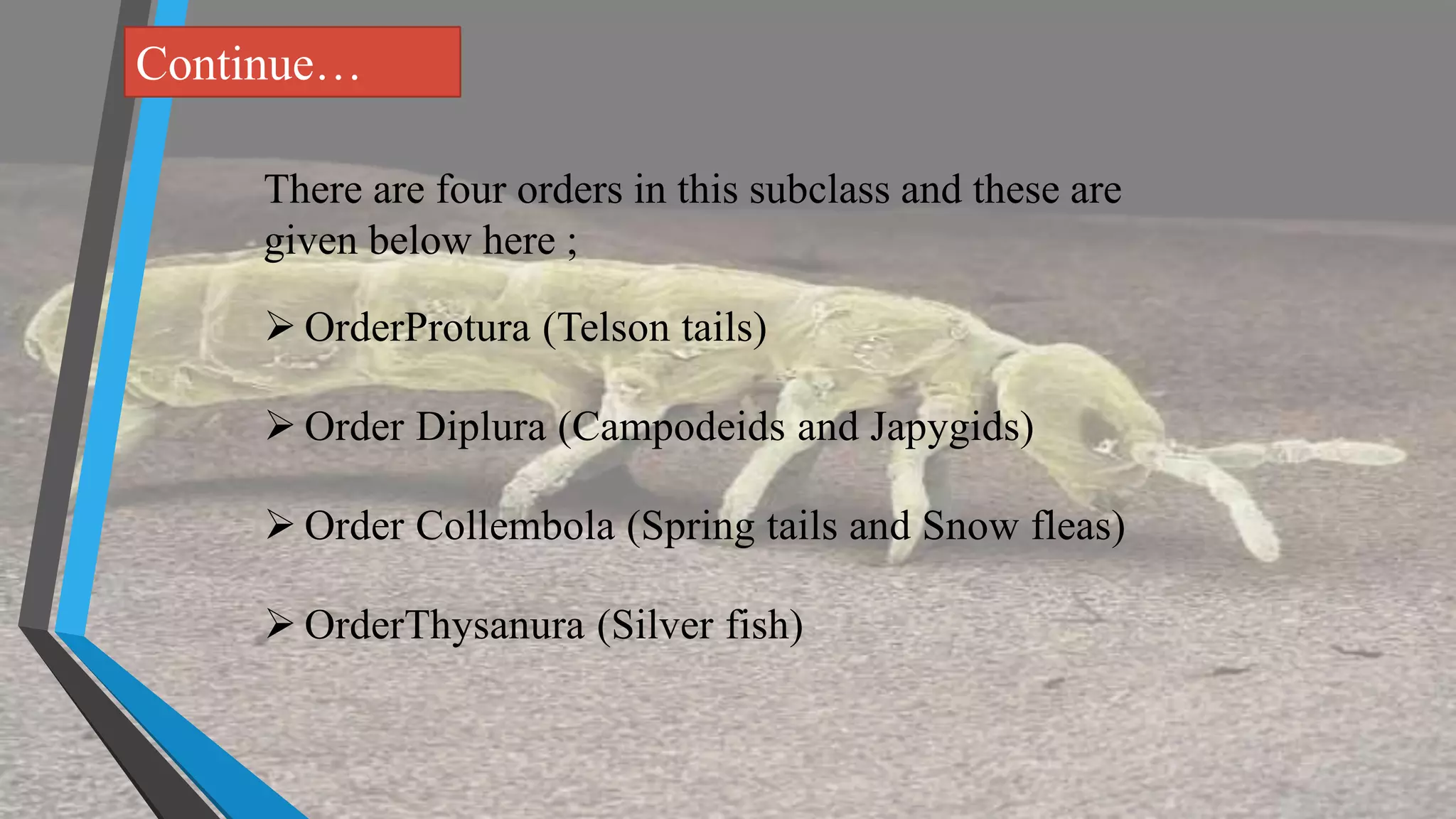
 OrderProtura (Telson tails)
 Order Diplura (Campodeids and Japygids)
 Order Collembola (Spring tails and Snow fleas)
 OrderThysanura (Silver fish)
There are four orders in this subclass and these are
given below here ;
Continue…
Subclass Pterygota (=Metabola) Subclass Pterygota (=Metabola)
Winged or secondarily wingless insects, with prognathous or
hypognathous head. Mouthparts endognathous. Metamorphosis
either incomplete without a pupal stage or complete with a pupal
stage. This subclass is divided into two superorders or divisions,
namely,
A.Exopterygota
B.Endopterygota.
Insect order Collembola
Scientific Classification;
Kingdom: Animalia
Phylum: Arthropoda
Subphylum: Hexapoda
Class: Entognatha
The name Collembola, derived from the Greek "coll" meaning glue and "embol" meaning a wedge,
refers to a peg-shaped structure, the collophore, on the underside of the first abdominal segment.
Distribution
North America Worldwide
Number of
Families
7 20
Number of
Species
677 >6000
Springtails have a global distribution, including parts of Antarctica.
They are widespread throughout Australia with the highest numbers
found in organic rich, humid environments, such as soil and leaf litter of
forests, and the lowest densities in arid regions.
Life History & Ecology
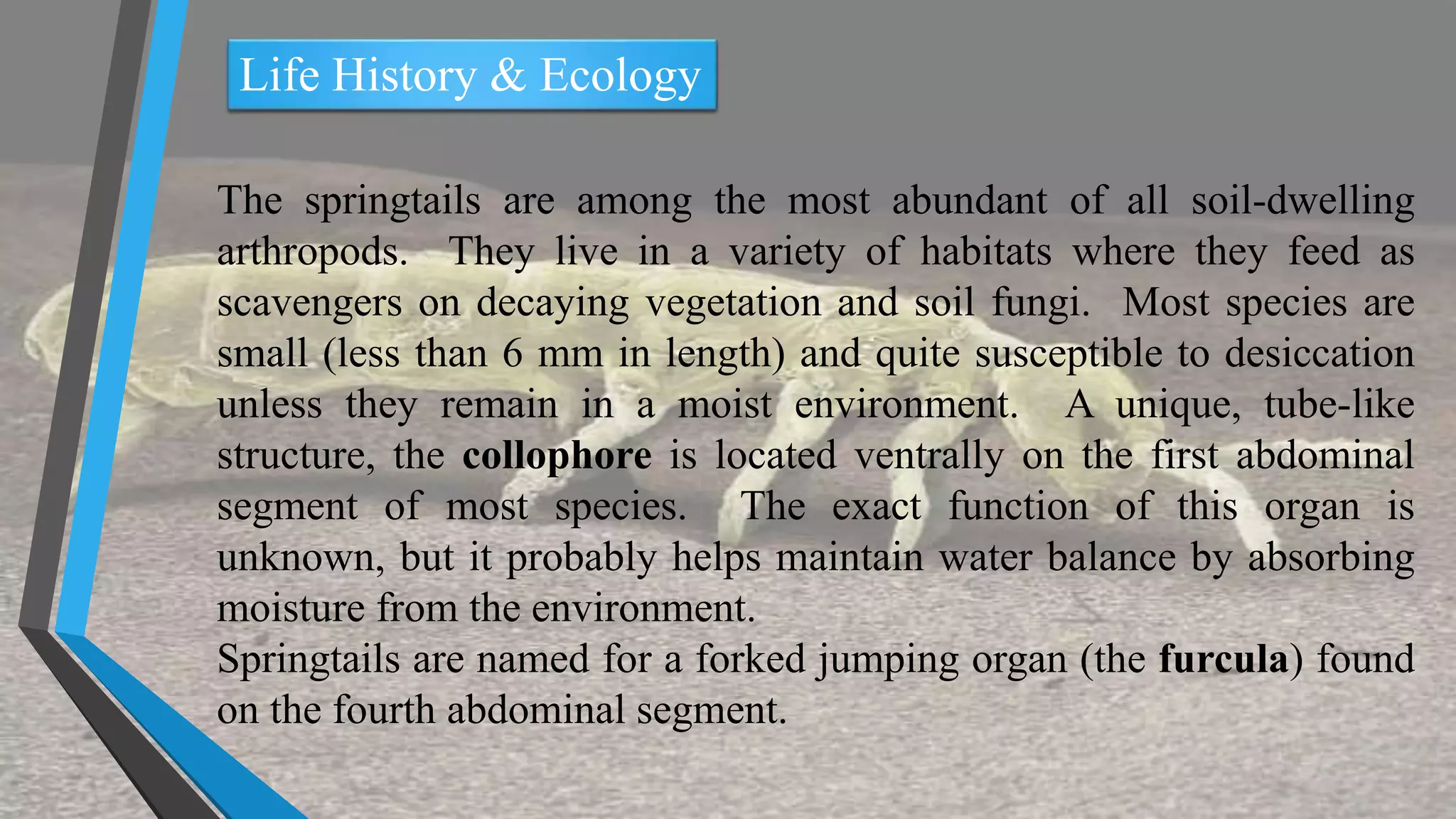
The springtails are among the most abundant of all soil-dwelling
arthropods. They live in a variety of habitats where they feed as
scavengers on decaying vegetation and soil fungi. Most species are
small (less than 6 mm in length) and quite susceptible to desiccation
unless they remain in a moist environment. A unique, tube-like
structure, the collophore is located ventrally on the first abdominal
segment of most species. The exact function of this organ is
unknown, but it probably helps maintain water balance by absorbing
moisture from the environment.
Springtails are named for a forked jumping organ (the furcula) found
on the fourth abdominal segment.
Physical Features
Adults and Immatures
 Compound eyes absent or reduced to
a cluster of not more than 8
ommatidia
 Antennae 4- to 6-segmented
 Abdomen 6-segmented
 Ventral tube (collophore) (4) present
on first abdominal segment
 Tenaculum located ventrally on third
abdominal segment
 Furcula (springtail) (6) attached
ventrally to fourth abdominal segment
 Genital opening on fifth abdominal
segment
 Body frequently clothed with scales
Life Cycle
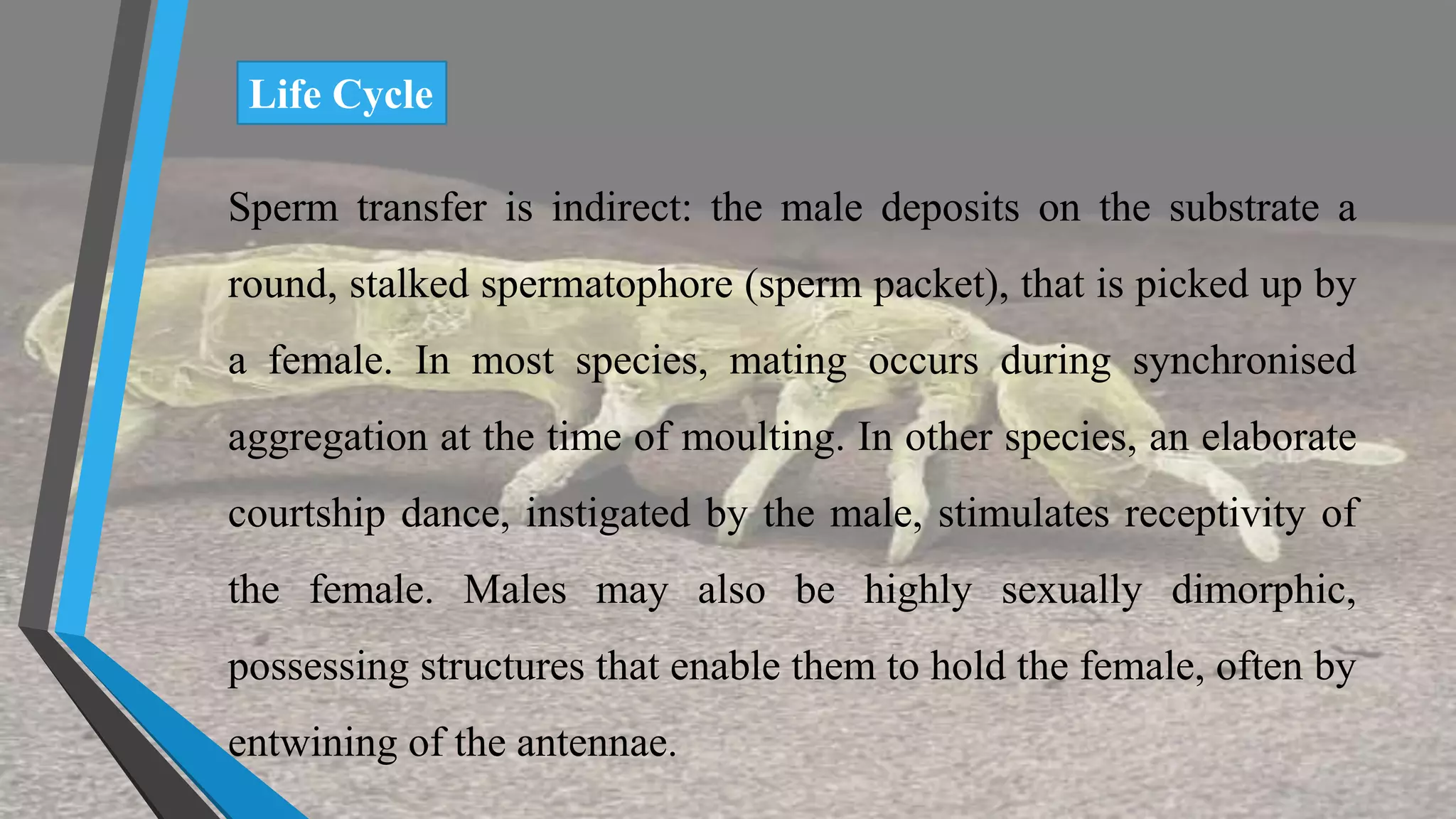
Sperm transfer is indirect: the male deposits on the substrate a
round, stalked spermatophore (sperm packet), that is picked up by
a female. In most species, mating occurs during synchronised
aggregation at the time of moulting. In other species, an elaborate
courtship dance, instigated by the male, stimulates receptivity of
the female. Males may also be highly sexually dimorphic,
possessing structures that enable them to hold the female, often by
entwining of the antennae.
Economic Importance
Springtails are part of the community of decomposers that break
down and recycle organic wastes. A few species feed on living
plants and are occasionally regarded as pests: Bourletiella
hortensis (the garden springtail) may damage seedlings in early
spring, Sminthurus viridis (the lucerne flea) is a pest of alfalfa in
Australia, and Hypogastrura armata has been a frequent pest of
commercial mushrooms.
Conservation status
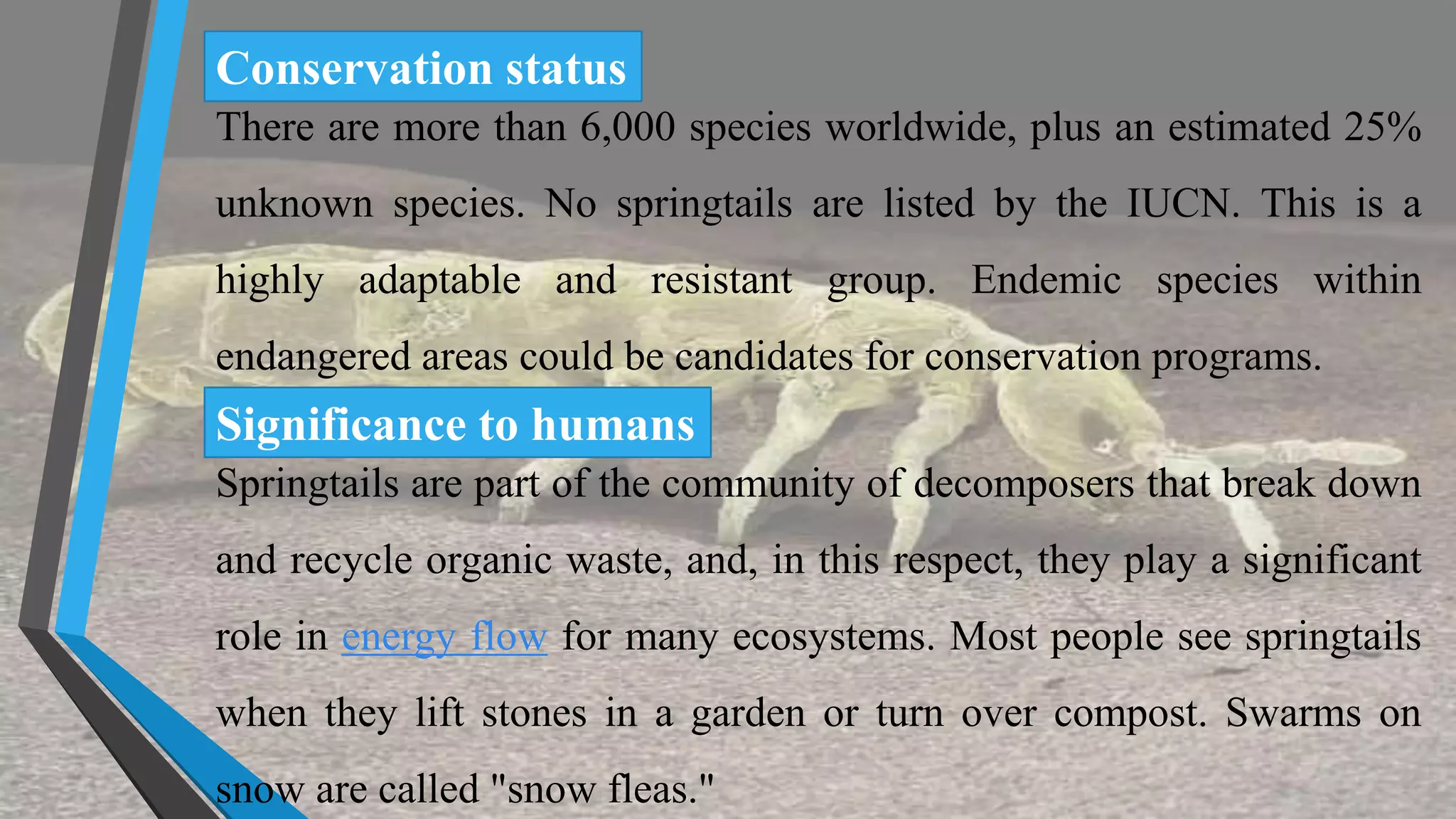
There are more than 6,000 species worldwide, plus an estimated 25%
unknown species. No springtails are listed by the IUCN. This is a
highly adaptable and resistant group. Endemic species within
endangered areas could be candidates for conservation programs.
Significance to humans
Springtails are part of the community of decomposers that break down
and recycle organic waste, and, in this respect, they play a significant
role in energy flow for many ecosystems. Most people see springtails
when they lift stones in a garden or turn over compost. Swarms on
snow are called "snow fleas."
Economic Importance
 Insects as Food:
Insects, of course, are not just eaten by people. Insects are the sole
food source for many amphibians, reptiles, birds, and mammals,
making their roles in food chains and food webs extremely important.
It is possible that food webs could collapse if insect populations
decline.
In some parts of the world, insects are used for food by humans.
Insects are a rich source of protein, vitamins, and minerals, and are
prized as delicacies in many third-world countries. In fact, it is difficult
to find an insect that is not eaten in one form or another by people.
 Insects in Medicine:
Insects have also been used in medicine. In the past, fly
larvae (maggots) were used to treat wounds to prevent or
stop gangrene. Gangrene is caused by infection of dead
flesh. Maggots only eat dead flesh, so when they are placed
on the dead flesh of humans, they actually clean the wound
and can prevent infection. Some hospitals still use this type
of treatment.
 Commercial Products:
Apis, the honeybees produce millions of tons of honey every year, it
also gives bees wax from its combs.
Benefits of bees are cosmopolitan, not only in producing honey and
wax, but also in bringing about cross-pollination of many fruits and
flowers without which these plants could not exist. Tachardia, the lac
insect secretes commercial lac produced from integumentary glands
as a protective covering by females, shellac is made from lac in
India.
 Useful Predaceous Insects:
Some insects are predaceous, they feed upon and destroy a large
number of injurious insects. Stagomantis, a mantis is voracious, it
feeds on flies, grasshoppers and caterpillars, some of which are
injurious to crops. The larvae and adults of Chilomenes, a lady-bird
beetle, feed on aphids which infect cotton plants. Novius, a lady-bird
bettle, destroys scale worms which are pests of orange and lemon
trees. Epicauta is a blister beetle, it deposits eggs where locusts occur,
the larvae on hatching enter egg capsules of locusts and eat up masses
of eggs.
 Beneficial Parasitic Insects:
Some insects parasitise injurious insects, they usually lay eggs in the
bodies of larvae and adults of harmful insects; the young on hatching
from eggs finally kill their hosts. The larvae of Tachina and related flies
are parasites of injurious lepidopterous larvae, such as army-worms
which are injurious to cereals. Larvae of hymenopteran flies and
carnivorous wasps devour aphids in large numbers. Chalcids and
ichneumon flies are parasitic, laying eggs in cocoon and larvae of
phytophagous Lepidoptera.
 Pollination:
Most higher plants need pollination in order to produce seed
for propagation. Plant propagation occurs in two main ways:
vegetative (or asexual) and sexual. Some plants use one
method to the exclusion of the other, but many species rely
on a combination of the two types for maximum
effectiveness. Vegetative reproduction relies upon the use of
rhizomes, stolons, tubers, corms, bulbs, suckers, etc., and
the young plants are genetically identical to the parent.
Insect order Collembola | Springtails

Insect order Collembola | Springtails

  • 1.
    General account onclassification; insect order Collembola, Economic importance of insects Munwar Hussain Roll no 8107
  • 2.
    Insect, (class Insectaor Hexapoda), any member of the largest class of the phylum Arthropoda, which is itself the largest of the animal phyla. which is divided into three major regions: (1) the head, which bears the mouthparts, eyes, and a pair of antennae, (2) the three-segmented thorax, which usually has three pairs of legs (hence “Hexapoda”) in adults and usually one or two pairs of wings, and (3) the many-segmented abdomen, which contains the digestive, excretory, and reproductive organs.
  • 3.
    In a popularsense, “insect” usually refers to familiar pests or disease carriers, such as bedbugs, houseflies, clothes moths, Japanese beetles, aphids, mosquitoes, fleas, horseflies, and hornets, or to conspicuous groups, such as butterflies, moths, and beetles
  • 4.
    General Features Subclass Apterygota(=Ametabola) Subclass Apterygota (=Ametabola) Primitively wingless insects, without metamorphosis. Head is prognathous. Abdominal appendages may be present. Ectognathous mouthparts, with mandibles attached at one point. There is no metamorphosis as nymphs are similar to adults. The subclass has 4 orders.
  • 5.
     OrderProtura (Telsontails)  Order Diplura (Campodeids and Japygids)  Order Collembola (Spring tails and Snow fleas)  OrderThysanura (Silver fish) There are four orders in this subclass and these are given below here ; Continue…
  • 6.
    Subclass Pterygota (=Metabola)Subclass Pterygota (=Metabola) Winged or secondarily wingless insects, with prognathous or hypognathous head. Mouthparts endognathous. Metamorphosis either incomplete without a pupal stage or complete with a pupal stage. This subclass is divided into two superorders or divisions, namely, A.Exopterygota B.Endopterygota.
  • 7.
    Insect order Collembola ScientificClassification; Kingdom: Animalia Phylum: Arthropoda Subphylum: Hexapoda Class: Entognatha The name Collembola, derived from the Greek "coll" meaning glue and "embol" meaning a wedge, refers to a peg-shaped structure, the collophore, on the underside of the first abdominal segment.
  • 8.
    Distribution North America Worldwide Numberof Families 7 20 Number of Species 677 >6000 Springtails have a global distribution, including parts of Antarctica. They are widespread throughout Australia with the highest numbers found in organic rich, humid environments, such as soil and leaf litter of forests, and the lowest densities in arid regions.
  • 9.
    Life History &Ecology The springtails are among the most abundant of all soil-dwelling arthropods. They live in a variety of habitats where they feed as scavengers on decaying vegetation and soil fungi. Most species are small (less than 6 mm in length) and quite susceptible to desiccation unless they remain in a moist environment. A unique, tube-like structure, the collophore is located ventrally on the first abdominal segment of most species. The exact function of this organ is unknown, but it probably helps maintain water balance by absorbing moisture from the environment. Springtails are named for a forked jumping organ (the furcula) found on the fourth abdominal segment.
  • 10.
    Physical Features Adults andImmatures  Compound eyes absent or reduced to a cluster of not more than 8 ommatidia  Antennae 4- to 6-segmented  Abdomen 6-segmented  Ventral tube (collophore) (4) present on first abdominal segment  Tenaculum located ventrally on third abdominal segment  Furcula (springtail) (6) attached ventrally to fourth abdominal segment  Genital opening on fifth abdominal segment  Body frequently clothed with scales
  • 11.
    Life Cycle Sperm transferis indirect: the male deposits on the substrate a round, stalked spermatophore (sperm packet), that is picked up by a female. In most species, mating occurs during synchronised aggregation at the time of moulting. In other species, an elaborate courtship dance, instigated by the male, stimulates receptivity of the female. Males may also be highly sexually dimorphic, possessing structures that enable them to hold the female, often by entwining of the antennae.
  • 12.
    Economic Importance Springtails arepart of the community of decomposers that break down and recycle organic wastes. A few species feed on living plants and are occasionally regarded as pests: Bourletiella hortensis (the garden springtail) may damage seedlings in early spring, Sminthurus viridis (the lucerne flea) is a pest of alfalfa in Australia, and Hypogastrura armata has been a frequent pest of commercial mushrooms.
  • 13.
    Conservation status There aremore than 6,000 species worldwide, plus an estimated 25% unknown species. No springtails are listed by the IUCN. This is a highly adaptable and resistant group. Endemic species within endangered areas could be candidates for conservation programs. Significance to humans Springtails are part of the community of decomposers that break down and recycle organic waste, and, in this respect, they play a significant role in energy flow for many ecosystems. Most people see springtails when they lift stones in a garden or turn over compost. Swarms on snow are called "snow fleas."
  • 14.
    Economic Importance  Insectsas Food: Insects, of course, are not just eaten by people. Insects are the sole food source for many amphibians, reptiles, birds, and mammals, making their roles in food chains and food webs extremely important. It is possible that food webs could collapse if insect populations decline. In some parts of the world, insects are used for food by humans. Insects are a rich source of protein, vitamins, and minerals, and are prized as delicacies in many third-world countries. In fact, it is difficult to find an insect that is not eaten in one form or another by people.
  • 15.
     Insects inMedicine: Insects have also been used in medicine. In the past, fly larvae (maggots) were used to treat wounds to prevent or stop gangrene. Gangrene is caused by infection of dead flesh. Maggots only eat dead flesh, so when they are placed on the dead flesh of humans, they actually clean the wound and can prevent infection. Some hospitals still use this type of treatment.
  • 16.
     Commercial Products: Apis,the honeybees produce millions of tons of honey every year, it also gives bees wax from its combs. Benefits of bees are cosmopolitan, not only in producing honey and wax, but also in bringing about cross-pollination of many fruits and flowers without which these plants could not exist. Tachardia, the lac insect secretes commercial lac produced from integumentary glands as a protective covering by females, shellac is made from lac in India.
  • 17.
     Useful PredaceousInsects: Some insects are predaceous, they feed upon and destroy a large number of injurious insects. Stagomantis, a mantis is voracious, it feeds on flies, grasshoppers and caterpillars, some of which are injurious to crops. The larvae and adults of Chilomenes, a lady-bird beetle, feed on aphids which infect cotton plants. Novius, a lady-bird bettle, destroys scale worms which are pests of orange and lemon trees. Epicauta is a blister beetle, it deposits eggs where locusts occur, the larvae on hatching enter egg capsules of locusts and eat up masses of eggs.
  • 18.
     Beneficial ParasiticInsects: Some insects parasitise injurious insects, they usually lay eggs in the bodies of larvae and adults of harmful insects; the young on hatching from eggs finally kill their hosts. The larvae of Tachina and related flies are parasites of injurious lepidopterous larvae, such as army-worms which are injurious to cereals. Larvae of hymenopteran flies and carnivorous wasps devour aphids in large numbers. Chalcids and ichneumon flies are parasitic, laying eggs in cocoon and larvae of phytophagous Lepidoptera.
  • 19.
     Pollination: Most higherplants need pollination in order to produce seed for propagation. Plant propagation occurs in two main ways: vegetative (or asexual) and sexual. Some plants use one method to the exclusion of the other, but many species rely on a combination of the two types for maximum effectiveness. Vegetative reproduction relies upon the use of rhizomes, stolons, tubers, corms, bulbs, suckers, etc., and the young plants are genetically identical to the parent.