Psychological Disorders I:
        Anxiety

      Brian J. Piper, Ph.D., M.S.

                                    1
Goals
• History of Psychological Disorders
• Anxiety Disorders


                                       2
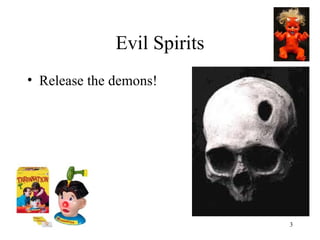
Evil Spirits
• Release the demons!


                             3
The Moral Model
Philippe Pinel from France insisted that madness
   was not due to demonic possession but an
              ailment of the mind.

Philosophy:
•Treat each patient as an individual
•Employ former patients
•Use psychological interventions before
  biological ones.
                                                                      1745-1826
 “the treatment of insanity (l’aliénation mentale) without
 considering the differentiating characteristics of the patients
 [la distinction des espèces] has been at times superfluous, rarely
 useful, and often harmful”
Medical Model
 When physicians discovered that syphilis led to
mental disorders, they started using medical models
 to review the physical causes of these disorders.

   •   Etiology: Cause and development of the
       disorder.
   •   Diagnosis: Identifying (symptoms) and
       distinguishing one disease from another.
   •   Treatment: Treating a disorder in a psychiatric
       hospital.
   •   Prognosis: Forecast about the disorder.
                                                         5
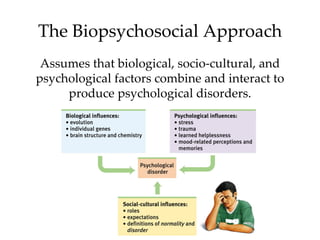
The Biopsychosocial Approach
 Assumes that biological, socio-cultural, and
psychological factors combine and interact to
     produce psychological disorders.
International
    Classification of
      Diseases-10

• Published by the World Health Organization to
  provide uniformity.
• International Statistical Classification of Diseases
  and Related Problems uses 6 digit codes.
• Started in 1900, included mental disorders in 1949
Diagnostic & Statistical Manual
                (DSM)

•   Published by American Psychiatric Association
•   DSM-I: 1952: consists of 106 mental disorders
•   DSM-II: 1968: psychodynamic
•   DSM-III: 1980: responds to Rosenhan
    criticisms

                                               8
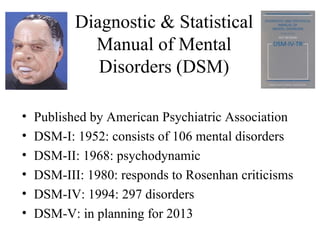
Diagnostic & Statistical
             Manual of Mental
              Disorders (DSM)

•   Published by American Psychiatric Association
•   DSM-I: 1952: consists of 106 mental disorders
•   DSM-II: 1968: psychodynamic
•   DSM-III: 1980: responds to Rosenhan criticisms
•   DSM-IV: 1994: 297 disorders
•   DSM-V: in planning for 2013
Example: ADHD: Inattentive
• Symptoms present at school/work and home
• 6+ symptoms that have persisted 6+ months
  and are inconsistent with developmental
  level
  – Often fails to give close attention or makes careless
    mistakes at school or at work.
  – Has difficulty sustaining attention in tasks or play.
  – Does not listen when spoken to directly.
  – Often does not follow through on instructions.
  – Has difficulty organizing activities.
  – Is easily distracted.
  – Is often forgetful in daily activities.                 10
ADHD: Hyperactive-Impulsive
• Symptoms present at school/work and home
• 6+ symptoms that have persisted 6+ months
  and are inconsistent with developmental
  level
  – Often fidgets with hands or feet, leaves seat
    when staying seated is expected, runs or climbs
    excessively
  – Often acts as “driven by a motor”
  – Often blurts answer before ? Completed
  – Has difficulty waiting turn
  – Often interrupts others                       11
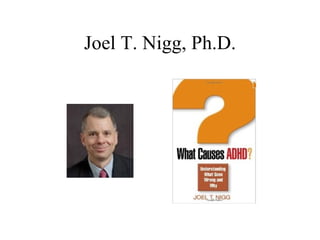
Joel T. Nigg, Ph.D.
Labels
Anxiety
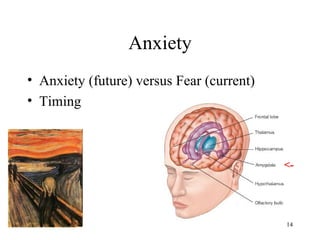
• Anxiety (future) versus Fear (current)
• Timing


                                           <-


                                           14
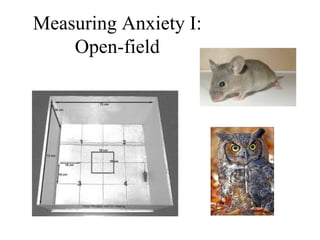
Measuring Anxiety I:
    Open-field
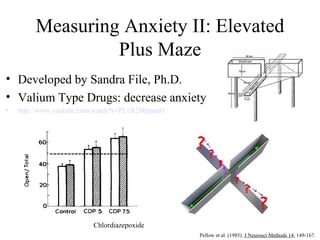
Measuring Anxiety II: Elevated
                  Plus Maze
• Developed by Sandra File, Ph.D.
• Valium Type Drugs: decrease anxiety
•   http://www.youtube.com/watch?v=PLcX2MbpmdY


            ----------------------


                         Chlordiazepoxide
                                                 Pellow et al. (1985). J Neurosci Methods 14, 149-167.
Anxiety Disorders


 Panic Disorder
 Phobias
 Generalized Anxiety Disorder
 Obsessive-Compulsive Disorder
 Post-Traumatic Stress Disorder
Panic Disorder
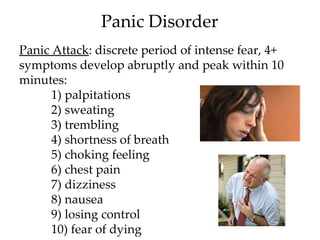
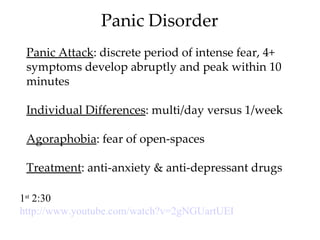
Panic Attack: discrete period of intense fear, 4+
symptoms develop abruptly and peak within 10
minutes:
      1) palpitations
      2) sweating
      3) trembling
      4) shortness of breath
      5) choking feeling
      6) chest pain
      7) dizziness
      8) nausea
      9) losing control
      10) fear of dying
Panic Disorder
 Panic Attack: discrete period of intense fear, 4+
 symptoms develop abruptly and peak within 10
 minutes

 Individual Differences: multi/day versus 1/week

 Agoraphobia: fear of open-spaces

 Treatment: anti-anxiety & anti-depressant drugs

1st 2:30
http://www.youtube.com/watch?v=2gNGUartUEI
Phobia
• Marked & persistent fear that is excessive
  or unreasonable, cued by presence or
  anticipation of object/situation
• The avoidance interferes significantly with
  normal routine, occupational or social
  activities.


                                                20
Kinds of Phobias

Arachonophobia   Phobia of spiders.

   Acrophobia    Phobia of heights.

Claustrophobia   Phobia of closed spaces.

  Hemophobia     Phobia of blood.
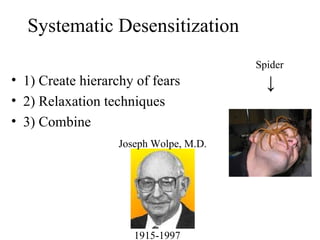
Systematic Desensitization
                                        Spider
• 1) Create hierarchy of fears            ↓
• 2) Relaxation techniques
• 3) Combine
                   Joseph Wolpe, M.D.


                      1915-1997
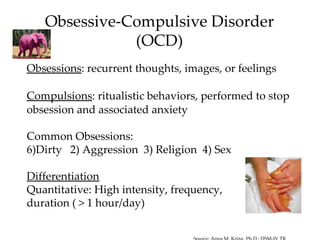
Obsessive-Compulsive Disorder
              (OCD)
Obsessions: recurrent thoughts, images, or feelings

Compulsions: ritualistic behaviors, performed to stop
obsession and associated anxiety

Common Obsessions:
6)Dirty 2) Aggression 3) Religion 4) Sex

Differentiation
Quantitative: High intensity, frequency,
duration ( > 1 hour/day)
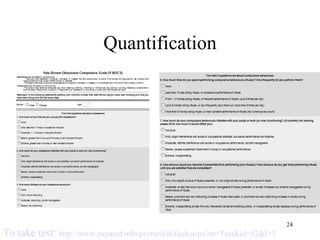
Quantification


                                                                            24
To take test: http://www.psymed.info/psymed/default.aspx?m=Test&id=52&l=3
OCD
• 1st Two Minutes:
• http://www.youtube.com/watch?v=44DCWslbsN


                                     25
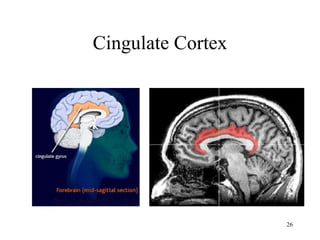
Cingulate Cortex


                   26
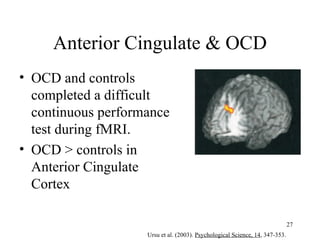
Anterior Cingulate & OCD
• OCD and controls
  completed a difficult
  continuous performance
  test during fMRI.
• OCD > controls in
  Anterior Cingulate
  Cortex

                                                                              27
                    Ursu et al. (2003). Psychological Science, 14, 347-353.
Generalized Anxiety Disorder
                   DSM-IV-TR Criteria

A. Excessive anxiety and worry (apprehensive
expectation), occurring more-days-than-not for at least
6 months.
B. The person finds it difficult to control the worry.
C. three (or more) of the following six symptoms:
2.   Restlessness
3.   Being easily fatigued
4.   Difficulty concentrating
5.   Irritability
6.   Muscle tension
7.   Sleep disturbance
Post-Traumatic Stress
                       Disorder
    Four or more weeks of the following symptoms
   constitute Post-Traumatic Stress Disorder (PTSD):

Re-experiencing: nightmares, flashbacks, intrusive
thoughts

Avoidance: situation & associated

Physical Arousal: sleep, concentration, irritability

     Significant social or occupational impairment
     :
3 min http://www.youtube.com/watch?v=7aFs6695VyQ
PTSD
• Lifetime Prevalence: 5% men, 10%
  women


                                     30
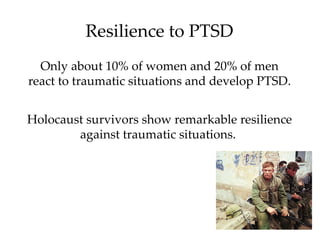
Resilience to PTSD
  Only about 10% of women and 20% of men
react to traumatic situations and develop PTSD.


Holocaust survivors show remarkable resilience
        against traumatic situations.
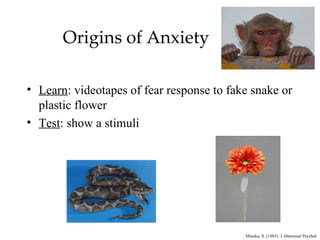
Origins of Anxiety

• Learn: videotapes of fear response to fake snake or
  plastic flower
• Test: show a stimuli


                                           Mineka, S. (1985). J Abnormal Psychol
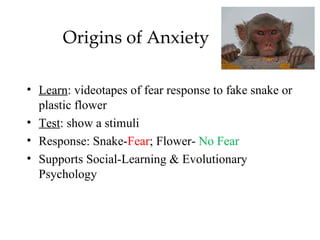
Origins of Anxiety

• Learn: videotapes of fear response to fake snake or
  plastic flower
• Test: show a stimuli
• Response: Snake-Fear; Flower- No Fear
• Supports Social-Learning & Evolutionary
  Psychology
Summary
• Psychological Disorders & ICD/DSM
• Anxiety Disorders
  –   Panic Disorder
  –   Phobias
  –   GAD
  –   OCD
  –   PTSD


                                      34

Introductory Psychology: Anxiety

  • 1.
    Psychological Disorders I: Anxiety Brian J. Piper, Ph.D., M.S. 1
  • 2.
    Goals • History ofPsychological Disorders • Anxiety Disorders 2
  • 3.
  • 4.
    The Moral Model PhilippePinel from France insisted that madness was not due to demonic possession but an ailment of the mind. Philosophy: •Treat each patient as an individual •Employ former patients •Use psychological interventions before biological ones. 1745-1826 “the treatment of insanity (l’aliénation mentale) without considering the differentiating characteristics of the patients [la distinction des espèces] has been at times superfluous, rarely useful, and often harmful”
  • 5.
    Medical Model Whenphysicians discovered that syphilis led to mental disorders, they started using medical models to review the physical causes of these disorders. • Etiology: Cause and development of the disorder. • Diagnosis: Identifying (symptoms) and distinguishing one disease from another. • Treatment: Treating a disorder in a psychiatric hospital. • Prognosis: Forecast about the disorder. 5
  • 6.
    The Biopsychosocial Approach Assumes that biological, socio-cultural, and psychological factors combine and interact to produce psychological disorders.
  • 7.
    International Classification of Diseases-10 • Published by the World Health Organization to provide uniformity. • International Statistical Classification of Diseases and Related Problems uses 6 digit codes. • Started in 1900, included mental disorders in 1949
  • 8.
    Diagnostic & StatisticalManual (DSM) • Published by American Psychiatric Association • DSM-I: 1952: consists of 106 mental disorders • DSM-II: 1968: psychodynamic • DSM-III: 1980: responds to Rosenhan criticisms 8
  • 9.
    Diagnostic & Statistical Manual of Mental Disorders (DSM) • Published by American Psychiatric Association • DSM-I: 1952: consists of 106 mental disorders • DSM-II: 1968: psychodynamic • DSM-III: 1980: responds to Rosenhan criticisms • DSM-IV: 1994: 297 disorders • DSM-V: in planning for 2013
  • 10.
    Example: ADHD: Inattentive •Symptoms present at school/work and home • 6+ symptoms that have persisted 6+ months and are inconsistent with developmental level – Often fails to give close attention or makes careless mistakes at school or at work. – Has difficulty sustaining attention in tasks or play. – Does not listen when spoken to directly. – Often does not follow through on instructions. – Has difficulty organizing activities. – Is easily distracted. – Is often forgetful in daily activities. 10
  • 11.
    ADHD: Hyperactive-Impulsive • Symptomspresent at school/work and home • 6+ symptoms that have persisted 6+ months and are inconsistent with developmental level – Often fidgets with hands or feet, leaves seat when staying seated is expected, runs or climbs excessively – Often acts as “driven by a motor” – Often blurts answer before ? Completed – Has difficulty waiting turn – Often interrupts others 11
  • 12.
  • 13.
  • 14.
    Anxiety • Anxiety (future)versus Fear (current) • Timing <- 14
  • 15.
  • 16.
    Measuring Anxiety II:Elevated Plus Maze • Developed by Sandra File, Ph.D. • Valium Type Drugs: decrease anxiety • http://www.youtube.com/watch?v=PLcX2MbpmdY ---------------------- Chlordiazepoxide Pellow et al. (1985). J Neurosci Methods 14, 149-167.
  • 17.
    Anxiety Disorders  PanicDisorder  Phobias  Generalized Anxiety Disorder  Obsessive-Compulsive Disorder  Post-Traumatic Stress Disorder
  • 18.
    Panic Disorder Panic Attack:discrete period of intense fear, 4+ symptoms develop abruptly and peak within 10 minutes: 1) palpitations 2) sweating 3) trembling 4) shortness of breath 5) choking feeling 6) chest pain 7) dizziness 8) nausea 9) losing control 10) fear of dying
  • 19.
    Panic Disorder PanicAttack: discrete period of intense fear, 4+ symptoms develop abruptly and peak within 10 minutes Individual Differences: multi/day versus 1/week Agoraphobia: fear of open-spaces Treatment: anti-anxiety & anti-depressant drugs 1st 2:30 http://www.youtube.com/watch?v=2gNGUartUEI
  • 20.
    Phobia • Marked &persistent fear that is excessive or unreasonable, cued by presence or anticipation of object/situation • The avoidance interferes significantly with normal routine, occupational or social activities. 20
  • 21.
    Kinds of Phobias Arachonophobia Phobia of spiders. Acrophobia Phobia of heights. Claustrophobia Phobia of closed spaces. Hemophobia Phobia of blood.
  • 22.
    Systematic Desensitization Spider • 1) Create hierarchy of fears ↓ • 2) Relaxation techniques • 3) Combine Joseph Wolpe, M.D. 1915-1997
  • 23.
    Obsessive-Compulsive Disorder (OCD) Obsessions: recurrent thoughts, images, or feelings Compulsions: ritualistic behaviors, performed to stop obsession and associated anxiety Common Obsessions: 6)Dirty 2) Aggression 3) Religion 4) Sex Differentiation Quantitative: High intensity, frequency, duration ( > 1 hour/day)
  • 24.
    Quantification 24 To take test: http://www.psymed.info/psymed/default.aspx?m=Test&id=52&l=3
  • 25.
    OCD • 1st TwoMinutes: • http://www.youtube.com/watch?v=44DCWslbsN 25
  • 26.
  • 27.
    Anterior Cingulate &OCD • OCD and controls completed a difficult continuous performance test during fMRI. • OCD > controls in Anterior Cingulate Cortex 27 Ursu et al. (2003). Psychological Science, 14, 347-353.
  • 28.
    Generalized Anxiety Disorder DSM-IV-TR Criteria A. Excessive anxiety and worry (apprehensive expectation), occurring more-days-than-not for at least 6 months. B. The person finds it difficult to control the worry. C. three (or more) of the following six symptoms: 2. Restlessness 3. Being easily fatigued 4. Difficulty concentrating 5. Irritability 6. Muscle tension 7. Sleep disturbance
  • 29.
    Post-Traumatic Stress Disorder Four or more weeks of the following symptoms constitute Post-Traumatic Stress Disorder (PTSD): Re-experiencing: nightmares, flashbacks, intrusive thoughts Avoidance: situation & associated Physical Arousal: sleep, concentration, irritability Significant social or occupational impairment : 3 min http://www.youtube.com/watch?v=7aFs6695VyQ
  • 30.
    PTSD • Lifetime Prevalence:5% men, 10% women 30
  • 31.
    Resilience to PTSD Only about 10% of women and 20% of men react to traumatic situations and develop PTSD. Holocaust survivors show remarkable resilience against traumatic situations.
  • 32.
    Origins of Anxiety •Learn: videotapes of fear response to fake snake or plastic flower • Test: show a stimuli Mineka, S. (1985). J Abnormal Psychol
  • 33.
    Origins of Anxiety •Learn: videotapes of fear response to fake snake or plastic flower • Test: show a stimuli • Response: Snake-Fear; Flower- No Fear • Supports Social-Learning & Evolutionary Psychology
  • 34.
    Summary • Psychological Disorders& ICD/DSM • Anxiety Disorders – Panic Disorder – Phobias – GAD – OCD – PTSD 34

Editor's Notes

  • #33 Preview Question 2: What produces the thoughts and feelings that mark anxiety disorders?
  • #34 Preview Question 2: What produces the thoughts and feelings that mark anxiety disorders?