ANXIETY DISORDER
Presented By :-
Chetan Sharma
Department of Social work
Kurukshetra University, Kurukshetra
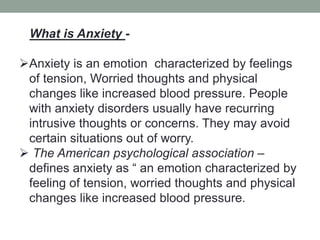
What is Anxiety -
Anxiety is an emotion characterized by feelings
of tension, Worried thoughts and physical
changes like increased blood pressure. People
with anxiety disorders usually have recurring
intrusive thoughts or concerns. They may avoid
certain situations out of worry.
 The American psychological association –
defines anxiety as “ an emotion characterized by
feeling of tension, worried thoughts and physical
changes like increased blood pressure.
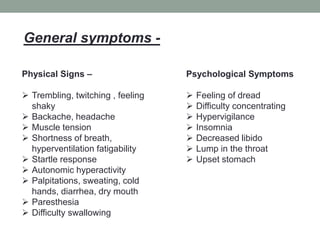
Physical Signs –
 Trembling, twitching , feeling
shaky
 Backache, headache
 Muscle tension
 Shortness of breath,
hyperventilation fatigability
 Startle response
 Autonomic hyperactivity
 Palpitations, sweating, cold
hands, diarrhea, dry mouth
 Paresthesia
 Difficulty swallowing
Psychological Symptoms
 Feeling of dread
 Difficulty concentrating
 Hypervigilance
 Insomnia
 Decreased libido
 Lump in the throat
 Upset stomach
General symptoms -
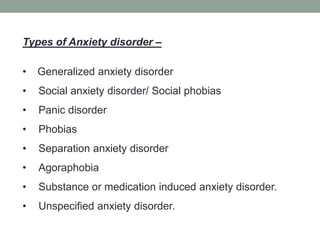
Types of Anxiety disorder –
• Generalized anxiety disorder
• Social anxiety disorder/ Social phobias
• Panic disorder
• Phobias
• Separation anxiety disorder
• Agoraphobia
• Substance or medication induced anxiety disorder.
• Unspecified anxiety disorder.
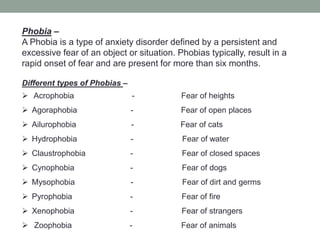
Phobia –
A Phobia is a type of anxiety disorder defined by a persistent and
excessive fear of an object or situation. Phobias typically, result in a
rapid onset of fear and are present for more than six months.
Different types of Phobias –
 Acrophobia - Fear of heights
 Agoraphobia - Fear of open places
 Ailurophobia - Fear of cats
 Hydrophobia - Fear of water
 Claustrophobia - Fear of closed spaces
 Cynophobia - Fear of dogs
 Mysophobia - Fear of dirt and germs
 Pyrophobia - Fear of fire
 Xenophobia - Fear of strangers
 Zoophobia - Fear of animals
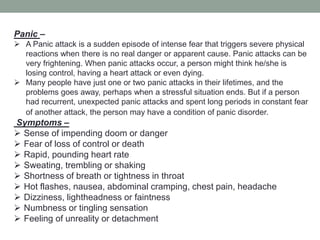
Panic –
 A Panic attack is a sudden episode of intense fear that triggers severe physical
reactions when there is no real danger or apparent cause. Panic attacks can be
very frightening. When panic attacks occur, a person might think he/she is
losing control, having a heart attack or even dying.
 Many people have just one or two panic attacks in their lifetimes, and the
problems goes away, perhaps when a stressful situation ends. But if a person
had recurrent, unexpected panic attacks and spent long periods in constant fear
of another attack, the person may have a condition of panic disorder.
Symptoms –
 Sense of impending doom or danger
 Fear of loss of control or death
 Rapid, pounding heart rate
 Sweating, trembling or shaking
 Shortness of breath or tightness in throat
 Hot flashes, nausea, abdominal cramping, chest pain, headache
 Dizziness, lightheadness or faintness
 Numbness or tingling sensation
 Feeling of unreality or detachment
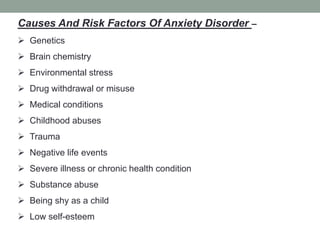
Causes And Risk Factors Of Anxiety Disorder –
 Genetics
 Brain chemistry
 Environmental stress
 Drug withdrawal or misuse
 Medical conditions
 Childhood abuses
 Trauma
 Negative life events
 Severe illness or chronic health condition
 Substance abuse
 Being shy as a child
 Low self-esteem
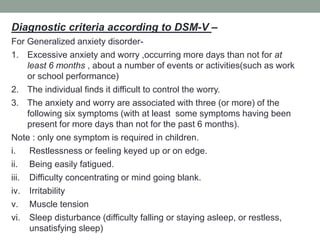
Diagnostic criteria according to DSM-V –
For Generalized anxiety disorder-
1. Excessive anxiety and worry ,occurring more days than not for at
least 6 months , about a number of events or activities(such as work
or school performance)
2. The individual finds it difficult to control the worry.
3. The anxiety and worry are associated with three (or more) of the
following six symptoms (with at least some symptoms having been
present for more days than not for the past 6 months).
Note : only one symptom is required in children.
i. Restlessness or feeling keyed up or on edge.
ii. Being easily fatigued.
iii. Difficulty concentrating or mind going blank.
iv. Irritability
v. Muscle tension
vi. Sleep disturbance (difficulty falling or staying asleep, or restless,
unsatisfying sleep)
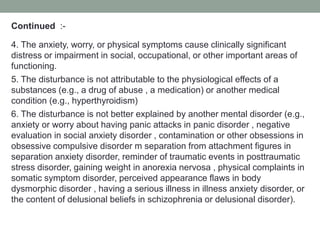
Continued :-
4. The anxiety, worry, or physical symptoms cause clinically significant
distress or impairment in social, occupational, or other important areas of
functioning.
5. The disturbance is not attributable to the physiological effects of a
substances (e.g., a drug of abuse , a medication) or another medical
condition (e.g., hyperthyroidism)
6. The disturbance is not better explained by another mental disorder (e.g.,
anxiety or worry about having panic attacks in panic disorder , negative
evaluation in social anxiety disorder , contamination or other obsessions in
obsessive compulsive disorder m separation from attachment figures in
separation anxiety disorder, reminder of traumatic events in posttraumatic
stress disorder, gaining weight in anorexia nervosa , physical complaints in
somatic symptom disorder, perceived appearance flaws in body
dysmorphic disorder , having a serious illness in illness anxiety disorder, or
the content of delusional beliefs in schizophrenia or delusional disorder).
Diagnostic criteria According to ICD -10 –
 F40 Phobic anxiety disorders
 F40.0 Agoraphobia .
.00 Without panic disorder
.01 With panic disorder
 F40.1 Social phobias
 F40.2 Specific (isolated) phobias
 F40.8 Other phobic anxiety disorders
 F40.9 Phobic anxiety disorder, unspecified
 F41 Other anxiety disorders
 F41.0 Panic disorder [episodic paroxysmal anxiety] .
 F41.1 Generalized anxiety disorder
 F41.2 Mixed anxiety and depressive disorder
 F41.3 Other mixed anxiety disorders
 F41.8 Other specified anxiety disorders
 F41.9 Anxiety disorder, unspecified
F41.1 Generalized anxiety disorder
Note: For children different criteria may be applied
A. A period of at least six months with prominent tension, worry and feelings
of apprehension, about every-day events and problems.
B. At least four symptoms out of the following list of items must be present, of
which at least one from items
(1) Palpitations or pounding heart, or accelerated heart rate.
(2) Sweating, Trembling or shaking.
(3) Dry mouth (not due to medication or dehydration).
Symptoms concerning chest and abdomen
(4) Difficulty breathing. (5) Feeling of choking. (6) Chest pain or discomfort.
(7) Nausea or abdominal distress (e.g. churning in stomach).
Symptoms concerning brain and mind
(8) Feeling dizzy, unsteady, faint or light-headed. (9) Feelings that objects are
unreal (derealization), or that one's self is distant or "not really here"
(depersonalization). (10) Fear of losing control, going crazy, or passing out.
(11) Fear of dying.
General symptoms
(12) Hot flushes or cold chills.
(13) Numbness or tingling sensations..
Symptoms of tension
(14) Muscle tension or aches and pains.
(15) Restlessness and inability to relax.
(16) Feeling keyed up, or on edge, or of mental tension.
(17) A sensation of a lump in the throat, or difficulty with swallowing.
Other non-specific symptoms
(18) Exaggerated response to minor surprises or being startled.
(19) Difficulty in concentrating, or mind going blank, because of worrying or
anxiety.
(20) Persistent irritability.
(21) Difficulty getting to sleep because of worrying.
C. The disorder does not meet the criteria for panic disorder
(F41.0), phobic anxiety disorders (F40.-), obsessive-compulsive disorder (F42.-)
or hypochondriacal disorder (F45.2).
D. Most commonly used exclusion criteria: not sustained by a physical disorder,
such as hyperthyroidism, an organic mental disorder (F0) or psychoactive
substance-related disorder (F1), such as excess consumption of amphetamine-
like substances, or withdrawal from benzodiazepines
Treatment –
1. Through pharmacologic; benzodiazepines, selective serotonin
reuptake inhibitors, tricyclics, monoamine oxidase inhibitors etc.
2. Through psychological therapies;
• Supportive psychotherapy
• Insight oriented psychotherapy
• Behavior therapy
• Cognitive therapy
• Group therapy
Anxiety disorder

Anxiety disorder

  • 1.
    ANXIETY DISORDER Presented By:- Chetan Sharma Department of Social work Kurukshetra University, Kurukshetra
  • 2.
    What is Anxiety- Anxiety is an emotion characterized by feelings of tension, Worried thoughts and physical changes like increased blood pressure. People with anxiety disorders usually have recurring intrusive thoughts or concerns. They may avoid certain situations out of worry.  The American psychological association – defines anxiety as “ an emotion characterized by feeling of tension, worried thoughts and physical changes like increased blood pressure.
  • 3.
    Physical Signs – Trembling, twitching , feeling shaky  Backache, headache  Muscle tension  Shortness of breath, hyperventilation fatigability  Startle response  Autonomic hyperactivity  Palpitations, sweating, cold hands, diarrhea, dry mouth  Paresthesia  Difficulty swallowing Psychological Symptoms  Feeling of dread  Difficulty concentrating  Hypervigilance  Insomnia  Decreased libido  Lump in the throat  Upset stomach General symptoms -
  • 4.
    Types of Anxietydisorder – • Generalized anxiety disorder • Social anxiety disorder/ Social phobias • Panic disorder • Phobias • Separation anxiety disorder • Agoraphobia • Substance or medication induced anxiety disorder. • Unspecified anxiety disorder.
  • 5.
    Phobia – A Phobiais a type of anxiety disorder defined by a persistent and excessive fear of an object or situation. Phobias typically, result in a rapid onset of fear and are present for more than six months. Different types of Phobias –  Acrophobia - Fear of heights  Agoraphobia - Fear of open places  Ailurophobia - Fear of cats  Hydrophobia - Fear of water  Claustrophobia - Fear of closed spaces  Cynophobia - Fear of dogs  Mysophobia - Fear of dirt and germs  Pyrophobia - Fear of fire  Xenophobia - Fear of strangers  Zoophobia - Fear of animals
  • 6.
    Panic –  APanic attack is a sudden episode of intense fear that triggers severe physical reactions when there is no real danger or apparent cause. Panic attacks can be very frightening. When panic attacks occur, a person might think he/she is losing control, having a heart attack or even dying.  Many people have just one or two panic attacks in their lifetimes, and the problems goes away, perhaps when a stressful situation ends. But if a person had recurrent, unexpected panic attacks and spent long periods in constant fear of another attack, the person may have a condition of panic disorder. Symptoms –  Sense of impending doom or danger  Fear of loss of control or death  Rapid, pounding heart rate  Sweating, trembling or shaking  Shortness of breath or tightness in throat  Hot flashes, nausea, abdominal cramping, chest pain, headache  Dizziness, lightheadness or faintness  Numbness or tingling sensation  Feeling of unreality or detachment
  • 7.
    Causes And RiskFactors Of Anxiety Disorder –  Genetics  Brain chemistry  Environmental stress  Drug withdrawal or misuse  Medical conditions  Childhood abuses  Trauma  Negative life events  Severe illness or chronic health condition  Substance abuse  Being shy as a child  Low self-esteem
  • 8.
    Diagnostic criteria accordingto DSM-V – For Generalized anxiety disorder- 1. Excessive anxiety and worry ,occurring more days than not for at least 6 months , about a number of events or activities(such as work or school performance) 2. The individual finds it difficult to control the worry. 3. The anxiety and worry are associated with three (or more) of the following six symptoms (with at least some symptoms having been present for more days than not for the past 6 months). Note : only one symptom is required in children. i. Restlessness or feeling keyed up or on edge. ii. Being easily fatigued. iii. Difficulty concentrating or mind going blank. iv. Irritability v. Muscle tension vi. Sleep disturbance (difficulty falling or staying asleep, or restless, unsatisfying sleep)
  • 9.
    Continued :- 4. Theanxiety, worry, or physical symptoms cause clinically significant distress or impairment in social, occupational, or other important areas of functioning. 5. The disturbance is not attributable to the physiological effects of a substances (e.g., a drug of abuse , a medication) or another medical condition (e.g., hyperthyroidism) 6. The disturbance is not better explained by another mental disorder (e.g., anxiety or worry about having panic attacks in panic disorder , negative evaluation in social anxiety disorder , contamination or other obsessions in obsessive compulsive disorder m separation from attachment figures in separation anxiety disorder, reminder of traumatic events in posttraumatic stress disorder, gaining weight in anorexia nervosa , physical complaints in somatic symptom disorder, perceived appearance flaws in body dysmorphic disorder , having a serious illness in illness anxiety disorder, or the content of delusional beliefs in schizophrenia or delusional disorder).
  • 10.
    Diagnostic criteria Accordingto ICD -10 –  F40 Phobic anxiety disorders  F40.0 Agoraphobia . .00 Without panic disorder .01 With panic disorder  F40.1 Social phobias  F40.2 Specific (isolated) phobias  F40.8 Other phobic anxiety disorders  F40.9 Phobic anxiety disorder, unspecified  F41 Other anxiety disorders  F41.0 Panic disorder [episodic paroxysmal anxiety] .  F41.1 Generalized anxiety disorder  F41.2 Mixed anxiety and depressive disorder  F41.3 Other mixed anxiety disorders  F41.8 Other specified anxiety disorders  F41.9 Anxiety disorder, unspecified
  • 11.
    F41.1 Generalized anxietydisorder Note: For children different criteria may be applied A. A period of at least six months with prominent tension, worry and feelings of apprehension, about every-day events and problems. B. At least four symptoms out of the following list of items must be present, of which at least one from items (1) Palpitations or pounding heart, or accelerated heart rate. (2) Sweating, Trembling or shaking. (3) Dry mouth (not due to medication or dehydration). Symptoms concerning chest and abdomen (4) Difficulty breathing. (5) Feeling of choking. (6) Chest pain or discomfort. (7) Nausea or abdominal distress (e.g. churning in stomach). Symptoms concerning brain and mind (8) Feeling dizzy, unsteady, faint or light-headed. (9) Feelings that objects are unreal (derealization), or that one's self is distant or "not really here" (depersonalization). (10) Fear of losing control, going crazy, or passing out. (11) Fear of dying. General symptoms (12) Hot flushes or cold chills. (13) Numbness or tingling sensations..
  • 12.
    Symptoms of tension (14)Muscle tension or aches and pains. (15) Restlessness and inability to relax. (16) Feeling keyed up, or on edge, or of mental tension. (17) A sensation of a lump in the throat, or difficulty with swallowing. Other non-specific symptoms (18) Exaggerated response to minor surprises or being startled. (19) Difficulty in concentrating, or mind going blank, because of worrying or anxiety. (20) Persistent irritability. (21) Difficulty getting to sleep because of worrying. C. The disorder does not meet the criteria for panic disorder (F41.0), phobic anxiety disorders (F40.-), obsessive-compulsive disorder (F42.-) or hypochondriacal disorder (F45.2). D. Most commonly used exclusion criteria: not sustained by a physical disorder, such as hyperthyroidism, an organic mental disorder (F0) or psychoactive substance-related disorder (F1), such as excess consumption of amphetamine- like substances, or withdrawal from benzodiazepines
  • 13.
    Treatment – 1. Throughpharmacologic; benzodiazepines, selective serotonin reuptake inhibitors, tricyclics, monoamine oxidase inhibitors etc. 2. Through psychological therapies; • Supportive psychotherapy • Insight oriented psychotherapy • Behavior therapy • Cognitive therapy • Group therapy