ANXIETY


Hongbiao (Hank) Liu MD PhD

Luna Medical Care PC
Overview
• What is Anxiety?
• What are the different types of anxiety
  disorders?
• What are the causes?
• What are the symptoms?
• What are the treatments?
• Professional Resources available.
Definition of Anxiety
• Anxiety is a feeling of apprehension or fear. The
  source of this uneasiness is not always known or
  recognized, which can add to the distress you
  feel.
• Anxiety disorders are a group of psychiatric
  conditions that involve excessive anxiety.
Anxiety Facts
•   Most common mental illness in the U.S. with 19 million of the adult
    (ages 18-54) U.S. population affected.

•   Anxiety disorders cost more than $42 billion a year.
•   More than $22 billion are associated with the repeated use of healthcare
    services, as those with anxiety disorders seek relief for symptoms that
    mimic physical illnesses.

•   Anxiety is highly treatable (up to 90% of cases), but only one-third of
    those who suffer from it receive treatment

•   People with an anxiety disorder are three-to-five times more likely to go
    to the doctor and six times more likely to be hospitalized for psychiatric
    disorders than non-sufferers.

•   Depression often accompanies anxiety disorders

                  2003 Anxiety Disorders Association of America
Types of Anxiety Disorders
•   Panic Disorder
•   Obsessive-Compulsive Disorder
•   Post-Traumatic Stress Disorder
•   Phobias
•   Generalized Anxiety Disorder
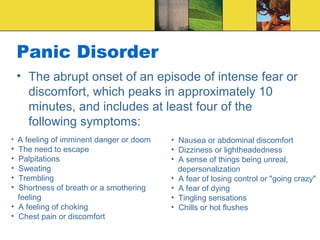
Panic Disorder
    • The abrupt onset of an episode of intense fear or
      discomfort, which peaks in approximately 10
      minutes, and includes at least four of the
      following symptoms:
• A feeling of imminent danger or doom   • Nausea or abdominal discomfort
• The need to escape                     • Dizziness or lightheadedness
• Palpitations                           • A sense of things being unreal,
• Sweating                                 depersonalization
• Trembling                              • A fear of losing control or "going crazy"
• Shortness of breath or a smothering    • A fear of dying
  feeling                                • Tingling sensations
• A feeling of choking                   • Chills or hot flushes
• Chest pain or discomfort
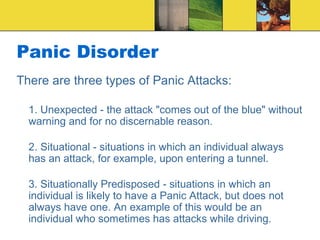
Panic Disorder
There are three types of Panic Attacks:

  1. Unexpected - the attack "comes out of the blue" without
  warning and for no discernable reason.

  2. Situational - situations in which an individual always
  has an attack, for example, upon entering a tunnel.

  3. Situationally Predisposed - situations in which an
  individual is likely to have a Panic Attack, but does not
  always have one. An example of this would be an
  individual who sometimes has attacks while driving.
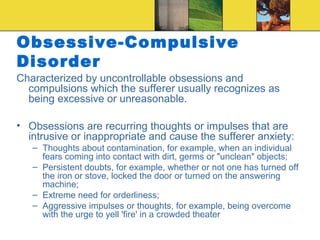
Obsessive-Compulsive
Disorder
Characterized by uncontrollable obsessions and
  compulsions which the sufferer usually recognizes as
  being excessive or unreasonable.

• Obsessions are recurring thoughts or impulses that are
  intrusive or inappropriate and cause the sufferer anxiety:
   – Thoughts about contamination, for example, when an individual
     fears coming into contact with dirt, germs or "unclean" objects;
   – Persistent doubts, for example, whether or not one has turned off
     the iron or stove, locked the door or turned on the answering
     machine;
   – Extreme need for orderliness;
   – Aggressive impulses or thoughts, for example, being overcome
     with the urge to yell 'fire' in a crowded theater
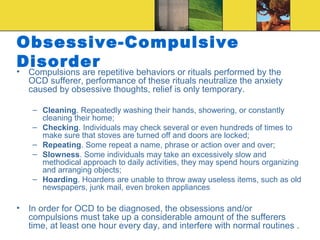
Obsessive-Compulsive
Disorder
•   Compulsions are repetitive behaviors or rituals performed by the
    OCD sufferer, performance of these rituals neutralize the anxiety
    caused by obsessive thoughts, relief is only temporary.

     – Cleaning. Repeatedly washing their hands, showering, or constantly
       cleaning their home;
     – Checking. Individuals may check several or even hundreds of times to
       make sure that stoves are turned off and doors are locked;
     – Repeating. Some repeat a name, phrase or action over and over;
     – Slowness. Some individuals may take an excessively slow and
       methodical approach to daily activities, they may spend hours organizing
       and arranging objects;
     – Hoarding. Hoarders are unable to throw away useless items, such as old
       newspapers, junk mail, even broken appliances

•   In order for OCD to be diagnosed, the obsessions and/or
    compulsions must take up a considerable amount of the sufferers
    time, at least one hour every day, and interfere with normal routines .
Post-Traumatic Stress
Disorder
• Exposure to traumas such as a serious accident, a natural
  disaster, or criminal assault can result in PTSD. When the
  aftermath of a traumatic experience interferes with normal
  functioning, the person may be suffering from PTSD.

• Symptoms of PTSD are:
   – Reexperiencing the event, which can take the form of intrusive thoughts
     and recollections, or recurrent dreams;
   – Avoidance behavior in which the sufferer avoids activities, situations,
     people,and/or conversations which he/she associates with the trauma;
   – A general numbness and loss of interest in surroundings;
   – Hypersensitivity, including: inability to sleep, anxious feelings, overactive
     startle response, hypervigilance, irritability and outbursts of anger.
Social Phobia/Anxiety
• Social anxiety disorder, also known as social phobia, is an
  intense fear of social situations. This fear arises when the
  individual believes that they may be judged, scrutinized or
  humiliated by others.
• Individuals with the disorder are acutely aware of the
  physical signs of their anxiety and fear that others will
  notice, judge them, and think poorly of them.

• In extreme cases this intense uneasiness can progress
  into a full blown panic attack.
Social Phobia/Anxiety
• Common anxiety provoking social situations include:
   –   public speaking
   –   talking with people in authority
   –   dating and developing close relationships
   –   making a phone call or answering the phone
   –   interviewing
   –   attending and participating in class
   –   speaking with strangers
   –   meeting new people
   –   eating, drinking, or writing in public
   –   using public bathrooms
   –   driving
   –   shopping
Generalized Anxiety
Disorder
• Excessive uncontrollable worry about
  everyday things. This constant worry
  affects daily functioning and can cause
  physical symptoms.

• GAD can occur with other anxiety
  disorders, depressive disorders, or
  substance abuse.
Generalized Anxiety
Disorder
• The focus of GAD worry can shift, usually
  focusing on issues like job, finances, health
  of both self and family; but it can also
  include more mundane issues such as,
  chores, car repairs and being late for
  appointments.
• The intensity, duration and frequency of the
  worry are disproportionate to the issue
Specific Disorder Facts
• Generalized Anxiety Disorder
  – Women are twice as likely to be afflicted than men.
  – Very likely to exist along with other disorders.

• Obsessive Compulsive Disorder
  – It is equally common among men and women.
  – One third of afflicted adults had their first symptoms in childhood.

• Panic Disorder
  – Women are twice as likely to be afflicted than men.
  – Occurs with major depression in very high rates.


               2003 Anxiety Disorders Association of America
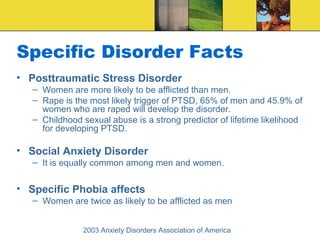
Specific Disorder Facts
• Posttraumatic Stress Disorder
   – Women are more likely to be afflicted than men.
   – Rape is the most likely trigger of PTSD, 65% of men and 45.9% of
     women who are raped will develop the disorder.
   – Childhood sexual abuse is a strong predictor of lifetime likelihood
     for developing PTSD.

• Social Anxiety Disorder
   – It is equally common among men and women.


• Specific Phobia affects
   – Women are twice as likely to be afflicted as men


               2003 Anxiety Disorders Association of America
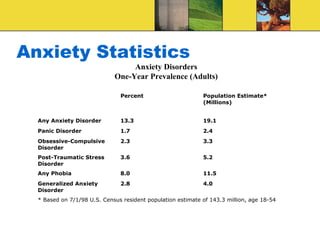
Anxiety Statistics
                                  Anxiety Disorders
                             One-Year Prevalence (Adults)

                               Percent                       Population Estimate*
                                                             (Millions)


  Any Anxiety Disorder         13.3                          19.1
  Panic Disorder               1.7                           2.4
  Obsessive-Compulsive         2.3                           3.3
  Disorder
  Post-Traumatic Stress        3.6                           5.2
  Disorder
  Any Phobia                   8.0                           11.5
  Generalized Anxiety          2.8                           4.0
  Disorder
  * Based on 7/1/98 U.S. Census resident population estimate of 143.3 million, age 18-54
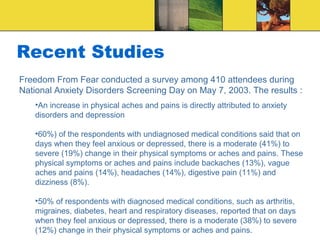
Recent Studies
Freedom From Fear conducted a survey among 410 attendees during
National Anxiety Disorders Screening Day on May 7, 2003. The results :
   •An increase in physical aches and pains is directly attributed to anxiety
   disorders and depression

   •60%) of the respondents with undiagnosed medical conditions said that on
   days when they feel anxious or depressed, there is a moderate (41%) to
   severe (19%) change in their physical symptoms or aches and pains. These
   physical symptoms or aches and pains include backaches (13%), vague
   aches and pains (14%), headaches (14%), digestive pain (11%) and
   dizziness (8%).

   •50% of respondents with diagnosed medical conditions, such as arthritis,
   migraines, diabetes, heart and respiratory diseases, reported that on days
   when they feel anxious or depressed, there is a moderate (38%) to severe
   (12%) change in their physical symptoms or aches and pains.
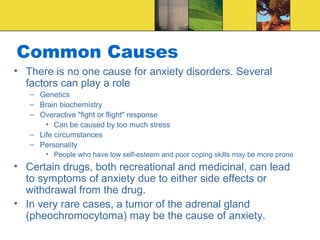
Common Causes
• There is no one cause for anxiety disorders. Several
  factors can play a role
   – Genetics
   – Brain biochemistry
   – Overactive "fight or flight" response
       • Can be caused by too much stress
   – Life circumstances
   – Personality
       • People who have low self-esteem and poor coping skills may be more prone
• Certain drugs, both recreational and medicinal, can lead
  to symptoms of anxiety due to either side effects or
  withdrawal from the drug.
• In very rare cases, a tumor of the adrenal gland
  (pheochromocytoma) may be the cause of anxiety.
Symptoms of Anxiety
Anxiety is an emotion often accompanied by
various physical symptoms, including:
•   Twitching or trembling
•   Muscle tension
•   Headaches
•   Sweating
•   Dry mouth
•   Difficulty swallowing
•   Abdominal pain (may be the only symptom of stress
    especially in a child)
Additional Symptoms of Anxiety
Sometimes other symptoms accompany
anxiety:
•   Dizziness
•   Rapid or irregular heart rate
•   Rapid breathing
•   Diarrhea or frequent need to urinate
•   Fatigue
•   Irritability, including loss of your temper
•   Sleeping difficulties and nightmares
•   Decreased concentration
•   Sexual problems
Physical Reaction to Anxiety
                  Auditory and Visual Stimuli:
                  sights and sounds are processed
                  first by the thalamus, which filters
                  the incoming cues and shunts
                  them either directly to the
                  amygdala or to the other parts of
                  the cortex.

                  Olfactory and tactile stimuli:
                  Smells and touch sensations
                  Bypass the thalamus altogether,
                  Taking a shortcut directly to the
                  Amygdala. Smells, therefore,
                  Often evoke stronger memories
                  Or feelings than do sights or
                  Sounds.
Physical Reaction to Anxiety
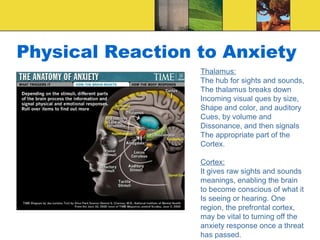
                  Thalamus:
                  The hub for sights and sounds,
                  The thalamus breaks down
                  Incoming visual ques by size,
                  Shape and color, and auditory
                  Cues, by volume and
                  Dissonance, and then signals
                  The appropriate part of the
                  Cortex.

                  Cortex:
                  It gives raw sights and sounds
                  meanings, enabling the brain
                  to become conscious of what it
                  Is seeing or hearing. One
                  region, the prefrontal cortex,
                  may be vital to turning off the
                  anxiety response once a threat
                  has passed.
Physical Reaction to Anxiety
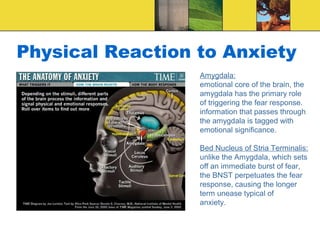
                  Amygdala:
                  emotional core of the brain, the
                  amygdala has the primary role
                  of triggering the fear response.
                  information that passes through
                  the amygdala is tagged with
                  emotional significance.

                  Bed Nucleus of Stria Terminalis:
                  unlike the Amygdala, which sets
                  off an immediate burst of fear,
                  the BNST perpetuates the fear
                  response, causing the longer
                  term unease typical of
                  anxiety.
Physical Reaction to Anxiety
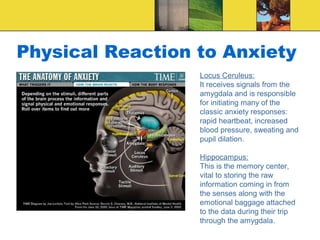
                  Locus Ceruleus:
                  It receives signals from the
                  amygdala and is responsible
                  for initiating many of the
                  classic anxiety responses:
                  rapid heartbeat, increased
                  blood pressure, sweating and
                  pupil dilation.

                  Hippocampus:
                  This is the memory center,
                  vital to storing the raw
                  information coming in from
                  the senses along with the
                  emotional baggage attached
                  to the data during their trip
                  through the amygdala.
Social Effects of Anxiety
• Depression
  – Not as involved with family and friends the way you
    used to be
  – Lowered quality of relationships
  – Low energy
  – Lack of motivation to do the things you once looked
    forward to doing
• Unable to convey the person that you are
• Fear and avoidance of situations where previous
  attacks occurred
Allopathic Treatments
•   Medications (Drug Therapy):
•   Behavioral Therapy
•   Cognitive Behavioral Therapy
•   Psychodynamic Psychotherapy
Alternative Treatments
•   Acupuncture
•   Aromatherapy
•   Breathing Exercises
•   Exercise
•   Meditation
•   Nutrition and Diet Therapy
•   Vitamins
•   Self Love
Medications
• Buspirone: shown to be effective but usually
  takes 3-4 weeks, particularly useful in elderly
  patients
• Benzodiazepines: include Xanax and Valium, act
  rapidly and successfully but can be addictive and
  loses effectiveness over time
• Side Effects: dizziness, headaches, nausea,
  impaired memory
Behavioral and Cognitive
Therapy
• Teaches patient to react differently to situations and
  bodily sensations that trigger anxiety
• Teaches patient to understand how thinking patterns that
  contribute to symptoms
• Patients learn that by changing how they perceive
  feelings of anxiety, the less likely they are to have them
• Examples: Hyperventilating, writing down list of top fears
  and doing one of them once a week, spinning in a chair
  until dizzy; after awhile patients learned to cope with the
  negative feelings associated with them and replace them
  with positive ones
Psychodynamic
Psychotherapy
• Psychodynamic therapy is a general name for therapeutic
  approaches which try to get the patient to bring to the surface
  their true feelings, so that they can experience them and
  understand them. Psychodynamic Psychotherapy uses the
  basic assumption that everyone has feelings held in the
  subconscious which are too painful to be faced. We then come
  up with defenses (such as denial) to protect us knowing about
  these painful feelings.
• Psychodynamic psychotherapy assumes that these defenses
  have gone wrong and are causing more harm than good,
  making you seek help. It tries to subdue them, with the
  intention that once you are aware of what is really going on in
  your mind the feelings will not be as painful.
• Takes an extremely long time and is labor intensive
Acupuncture
• Caused by the imbalance of chi coming about by
  keeping emotions in for too long
• Emotion effects the chi to move in an abnormal
  way: when fearful it goes to the floor, when angry
  the neck and shoulders tighten
• Redirects the chi into a balanced flow, releases
  tension in the muscles, increases flow of blood,
  lymph, and nerve impulses to affected areas
• Takes 10-12 weekly sessions
Aromatherapy
• Calming Effect: vanilla, orange blossom, rose,
  chamomile, and lavender
• Reducing Stress: Lavender, sandalwood, and
  nutmeg
• Uplifting Oils: Bergamot, geranium, juniper, and
  lavender
• Essential Oil Combination: 3 parts lavender, 2
  parts bergamot, and 1 part sandalwood
Exercise
•   Benefits: symbolic meaning of the activity, the
    distraction from worries, mastery of a sport,
    effects on self image, biochemical and
    physiological changes associated with exercise,
    symbolic meaning of the sport
•   Helps by expelling negative emotions and
    adrenaline out of your body in order to enter a
    more relaxed, calm state to deal with issues
    and conflicts
Meditation
• Cultivates calmness to create a sense of control
  over life
• Practice: Sit quietly in a position comfortable to
  you and take a few deep breaths to relax your
  muscles, next choose a calming phrase (such as
  “om” or that with great significance to you),
  silently repeat the word or phrase for 20 minutes
Nutrition and Diet Therapy
• Foods to Eat: whole grains, bananas, asparagus,
  garlic, brown rice, green and leafy veggies, soy
  products, yogurt
• Foods to Avoid: coffee, alcohol, sugar, strong
  spices, highly acidic foods, foods with white flour
• Keep a diary of the foods you eat and your
  anxiety attacks; after awhile you may be able to
  see a correlation
• East small, frequent meals
Vitamins
• B-Vitamins stabilize the body’s lactate levels
  which cause anxiety attacks (B-6, B-1, B-3)
• Calcium (a natural tranquilizer) and magnesium
  relax the nervous system; taken in combination
  before bed improves sleep
• Vitamin C taken in large doses also has a
  tranquilizing effect
• Potassium helps with proper functioning of
  adrenal glands
• Zinc has a calming effect on the nervous system
Self Love
• The most important holistic treatment of all
• Laugh: be able to laugh at yourself and with
  others; increases endorphin levels and decreases
  stress hormones
• Let go of frustrations
• Do not judge self harshly: don’t expect more from
  yourself than you do others
• Accept your faults
Where to Get Help
•   SFSU Health Center - The services of the Center are open to
    regularly enrolled (matriculated) undergraduate and graduate
    students.
    Office hours are 8AM to Noon and 1PM to 7PM Monday through
    Thursday and until 5PM on Friday. Appointments may be made by
    phone (415) 338-2208 or in person at Student Services Building
    Room 208.
•   Any licensed psychologist or psychiatrist
•   U.S. Dept. of Health & Human Services – Substance Abuse &
    Mental Health Services Administration – find resources in your area
    http://www.mentalhealth.samhsa.gov/databases
Additional Links
• Anxiety Screening Tools
• Anxiety Disorders Association of America (ADAA)
• Freedom From Fear (www.freedomfromfear.org)
• National Institute of Mental Health (
  www.nimh.nih.gov)
• U.S. Dept. of Health & Human Services (
  http://www.mentalhealth.samhsa.gov/topics/explore/s
  )
The End

Dr liu 10 20-2012 anxiety

  • 1.
    ANXIETY Hongbiao (Hank) LiuMD PhD Luna Medical Care PC
  • 2.
    Overview • What isAnxiety? • What are the different types of anxiety disorders? • What are the causes? • What are the symptoms? • What are the treatments? • Professional Resources available.
  • 3.
    Definition of Anxiety •Anxiety is a feeling of apprehension or fear. The source of this uneasiness is not always known or recognized, which can add to the distress you feel. • Anxiety disorders are a group of psychiatric conditions that involve excessive anxiety.
  • 4.
    Anxiety Facts • Most common mental illness in the U.S. with 19 million of the adult (ages 18-54) U.S. population affected. • Anxiety disorders cost more than $42 billion a year. • More than $22 billion are associated with the repeated use of healthcare services, as those with anxiety disorders seek relief for symptoms that mimic physical illnesses. • Anxiety is highly treatable (up to 90% of cases), but only one-third of those who suffer from it receive treatment • People with an anxiety disorder are three-to-five times more likely to go to the doctor and six times more likely to be hospitalized for psychiatric disorders than non-sufferers. • Depression often accompanies anxiety disorders 2003 Anxiety Disorders Association of America
  • 5.
    Types of AnxietyDisorders • Panic Disorder • Obsessive-Compulsive Disorder • Post-Traumatic Stress Disorder • Phobias • Generalized Anxiety Disorder
  • 6.
    Panic Disorder • The abrupt onset of an episode of intense fear or discomfort, which peaks in approximately 10 minutes, and includes at least four of the following symptoms: • A feeling of imminent danger or doom • Nausea or abdominal discomfort • The need to escape • Dizziness or lightheadedness • Palpitations • A sense of things being unreal, • Sweating depersonalization • Trembling • A fear of losing control or "going crazy" • Shortness of breath or a smothering • A fear of dying feeling • Tingling sensations • A feeling of choking • Chills or hot flushes • Chest pain or discomfort
  • 7.
    Panic Disorder There arethree types of Panic Attacks: 1. Unexpected - the attack "comes out of the blue" without warning and for no discernable reason. 2. Situational - situations in which an individual always has an attack, for example, upon entering a tunnel. 3. Situationally Predisposed - situations in which an individual is likely to have a Panic Attack, but does not always have one. An example of this would be an individual who sometimes has attacks while driving.
  • 8.
    Obsessive-Compulsive Disorder Characterized by uncontrollableobsessions and compulsions which the sufferer usually recognizes as being excessive or unreasonable. • Obsessions are recurring thoughts or impulses that are intrusive or inappropriate and cause the sufferer anxiety: – Thoughts about contamination, for example, when an individual fears coming into contact with dirt, germs or "unclean" objects; – Persistent doubts, for example, whether or not one has turned off the iron or stove, locked the door or turned on the answering machine; – Extreme need for orderliness; – Aggressive impulses or thoughts, for example, being overcome with the urge to yell 'fire' in a crowded theater
  • 9.
    Obsessive-Compulsive Disorder • Compulsions are repetitive behaviors or rituals performed by the OCD sufferer, performance of these rituals neutralize the anxiety caused by obsessive thoughts, relief is only temporary. – Cleaning. Repeatedly washing their hands, showering, or constantly cleaning their home; – Checking. Individuals may check several or even hundreds of times to make sure that stoves are turned off and doors are locked; – Repeating. Some repeat a name, phrase or action over and over; – Slowness. Some individuals may take an excessively slow and methodical approach to daily activities, they may spend hours organizing and arranging objects; – Hoarding. Hoarders are unable to throw away useless items, such as old newspapers, junk mail, even broken appliances • In order for OCD to be diagnosed, the obsessions and/or compulsions must take up a considerable amount of the sufferers time, at least one hour every day, and interfere with normal routines .
  • 10.
    Post-Traumatic Stress Disorder • Exposureto traumas such as a serious accident, a natural disaster, or criminal assault can result in PTSD. When the aftermath of a traumatic experience interferes with normal functioning, the person may be suffering from PTSD. • Symptoms of PTSD are: – Reexperiencing the event, which can take the form of intrusive thoughts and recollections, or recurrent dreams; – Avoidance behavior in which the sufferer avoids activities, situations, people,and/or conversations which he/she associates with the trauma; – A general numbness and loss of interest in surroundings; – Hypersensitivity, including: inability to sleep, anxious feelings, overactive startle response, hypervigilance, irritability and outbursts of anger.
  • 11.
    Social Phobia/Anxiety • Socialanxiety disorder, also known as social phobia, is an intense fear of social situations. This fear arises when the individual believes that they may be judged, scrutinized or humiliated by others. • Individuals with the disorder are acutely aware of the physical signs of their anxiety and fear that others will notice, judge them, and think poorly of them. • In extreme cases this intense uneasiness can progress into a full blown panic attack.
  • 12.
    Social Phobia/Anxiety • Commonanxiety provoking social situations include: – public speaking – talking with people in authority – dating and developing close relationships – making a phone call or answering the phone – interviewing – attending and participating in class – speaking with strangers – meeting new people – eating, drinking, or writing in public – using public bathrooms – driving – shopping
  • 13.
    Generalized Anxiety Disorder • Excessiveuncontrollable worry about everyday things. This constant worry affects daily functioning and can cause physical symptoms. • GAD can occur with other anxiety disorders, depressive disorders, or substance abuse.
  • 14.
    Generalized Anxiety Disorder • Thefocus of GAD worry can shift, usually focusing on issues like job, finances, health of both self and family; but it can also include more mundane issues such as, chores, car repairs and being late for appointments. • The intensity, duration and frequency of the worry are disproportionate to the issue
  • 15.
    Specific Disorder Facts •Generalized Anxiety Disorder – Women are twice as likely to be afflicted than men. – Very likely to exist along with other disorders. • Obsessive Compulsive Disorder – It is equally common among men and women. – One third of afflicted adults had their first symptoms in childhood. • Panic Disorder – Women are twice as likely to be afflicted than men. – Occurs with major depression in very high rates. 2003 Anxiety Disorders Association of America
  • 16.
    Specific Disorder Facts •Posttraumatic Stress Disorder – Women are more likely to be afflicted than men. – Rape is the most likely trigger of PTSD, 65% of men and 45.9% of women who are raped will develop the disorder. – Childhood sexual abuse is a strong predictor of lifetime likelihood for developing PTSD. • Social Anxiety Disorder – It is equally common among men and women. • Specific Phobia affects – Women are twice as likely to be afflicted as men 2003 Anxiety Disorders Association of America
  • 17.
    Anxiety Statistics Anxiety Disorders One-Year Prevalence (Adults) Percent Population Estimate* (Millions) Any Anxiety Disorder 13.3 19.1 Panic Disorder 1.7 2.4 Obsessive-Compulsive 2.3 3.3 Disorder Post-Traumatic Stress 3.6 5.2 Disorder Any Phobia 8.0 11.5 Generalized Anxiety 2.8 4.0 Disorder * Based on 7/1/98 U.S. Census resident population estimate of 143.3 million, age 18-54
  • 18.
    Recent Studies Freedom FromFear conducted a survey among 410 attendees during National Anxiety Disorders Screening Day on May 7, 2003. The results : •An increase in physical aches and pains is directly attributed to anxiety disorders and depression •60%) of the respondents with undiagnosed medical conditions said that on days when they feel anxious or depressed, there is a moderate (41%) to severe (19%) change in their physical symptoms or aches and pains. These physical symptoms or aches and pains include backaches (13%), vague aches and pains (14%), headaches (14%), digestive pain (11%) and dizziness (8%). •50% of respondents with diagnosed medical conditions, such as arthritis, migraines, diabetes, heart and respiratory diseases, reported that on days when they feel anxious or depressed, there is a moderate (38%) to severe (12%) change in their physical symptoms or aches and pains.
  • 19.
    Common Causes • Thereis no one cause for anxiety disorders. Several factors can play a role – Genetics – Brain biochemistry – Overactive "fight or flight" response • Can be caused by too much stress – Life circumstances – Personality • People who have low self-esteem and poor coping skills may be more prone • Certain drugs, both recreational and medicinal, can lead to symptoms of anxiety due to either side effects or withdrawal from the drug. • In very rare cases, a tumor of the adrenal gland (pheochromocytoma) may be the cause of anxiety.
  • 20.
    Symptoms of Anxiety Anxietyis an emotion often accompanied by various physical symptoms, including: • Twitching or trembling • Muscle tension • Headaches • Sweating • Dry mouth • Difficulty swallowing • Abdominal pain (may be the only symptom of stress especially in a child)
  • 21.
    Additional Symptoms ofAnxiety Sometimes other symptoms accompany anxiety: • Dizziness • Rapid or irregular heart rate • Rapid breathing • Diarrhea or frequent need to urinate • Fatigue • Irritability, including loss of your temper • Sleeping difficulties and nightmares • Decreased concentration • Sexual problems
  • 22.
    Physical Reaction toAnxiety Auditory and Visual Stimuli: sights and sounds are processed first by the thalamus, which filters the incoming cues and shunts them either directly to the amygdala or to the other parts of the cortex. Olfactory and tactile stimuli: Smells and touch sensations Bypass the thalamus altogether, Taking a shortcut directly to the Amygdala. Smells, therefore, Often evoke stronger memories Or feelings than do sights or Sounds.
  • 23.
    Physical Reaction toAnxiety Thalamus: The hub for sights and sounds, The thalamus breaks down Incoming visual ques by size, Shape and color, and auditory Cues, by volume and Dissonance, and then signals The appropriate part of the Cortex. Cortex: It gives raw sights and sounds meanings, enabling the brain to become conscious of what it Is seeing or hearing. One region, the prefrontal cortex, may be vital to turning off the anxiety response once a threat has passed.
  • 24.
    Physical Reaction toAnxiety Amygdala: emotional core of the brain, the amygdala has the primary role of triggering the fear response. information that passes through the amygdala is tagged with emotional significance. Bed Nucleus of Stria Terminalis: unlike the Amygdala, which sets off an immediate burst of fear, the BNST perpetuates the fear response, causing the longer term unease typical of anxiety.
  • 25.
    Physical Reaction toAnxiety Locus Ceruleus: It receives signals from the amygdala and is responsible for initiating many of the classic anxiety responses: rapid heartbeat, increased blood pressure, sweating and pupil dilation. Hippocampus: This is the memory center, vital to storing the raw information coming in from the senses along with the emotional baggage attached to the data during their trip through the amygdala.
  • 26.
    Social Effects ofAnxiety • Depression – Not as involved with family and friends the way you used to be – Lowered quality of relationships – Low energy – Lack of motivation to do the things you once looked forward to doing • Unable to convey the person that you are • Fear and avoidance of situations where previous attacks occurred
  • 27.
    Allopathic Treatments • Medications (Drug Therapy): • Behavioral Therapy • Cognitive Behavioral Therapy • Psychodynamic Psychotherapy
  • 28.
    Alternative Treatments • Acupuncture • Aromatherapy • Breathing Exercises • Exercise • Meditation • Nutrition and Diet Therapy • Vitamins • Self Love
  • 29.
    Medications • Buspirone: shownto be effective but usually takes 3-4 weeks, particularly useful in elderly patients • Benzodiazepines: include Xanax and Valium, act rapidly and successfully but can be addictive and loses effectiveness over time • Side Effects: dizziness, headaches, nausea, impaired memory
  • 30.
    Behavioral and Cognitive Therapy •Teaches patient to react differently to situations and bodily sensations that trigger anxiety • Teaches patient to understand how thinking patterns that contribute to symptoms • Patients learn that by changing how they perceive feelings of anxiety, the less likely they are to have them • Examples: Hyperventilating, writing down list of top fears and doing one of them once a week, spinning in a chair until dizzy; after awhile patients learned to cope with the negative feelings associated with them and replace them with positive ones
  • 31.
    Psychodynamic Psychotherapy • Psychodynamic therapyis a general name for therapeutic approaches which try to get the patient to bring to the surface their true feelings, so that they can experience them and understand them. Psychodynamic Psychotherapy uses the basic assumption that everyone has feelings held in the subconscious which are too painful to be faced. We then come up with defenses (such as denial) to protect us knowing about these painful feelings. • Psychodynamic psychotherapy assumes that these defenses have gone wrong and are causing more harm than good, making you seek help. It tries to subdue them, with the intention that once you are aware of what is really going on in your mind the feelings will not be as painful. • Takes an extremely long time and is labor intensive
  • 32.
    Acupuncture • Caused bythe imbalance of chi coming about by keeping emotions in for too long • Emotion effects the chi to move in an abnormal way: when fearful it goes to the floor, when angry the neck and shoulders tighten • Redirects the chi into a balanced flow, releases tension in the muscles, increases flow of blood, lymph, and nerve impulses to affected areas • Takes 10-12 weekly sessions
  • 33.
    Aromatherapy • Calming Effect:vanilla, orange blossom, rose, chamomile, and lavender • Reducing Stress: Lavender, sandalwood, and nutmeg • Uplifting Oils: Bergamot, geranium, juniper, and lavender • Essential Oil Combination: 3 parts lavender, 2 parts bergamot, and 1 part sandalwood
  • 34.
    Exercise • Benefits: symbolic meaning of the activity, the distraction from worries, mastery of a sport, effects on self image, biochemical and physiological changes associated with exercise, symbolic meaning of the sport • Helps by expelling negative emotions and adrenaline out of your body in order to enter a more relaxed, calm state to deal with issues and conflicts
  • 35.
    Meditation • Cultivates calmnessto create a sense of control over life • Practice: Sit quietly in a position comfortable to you and take a few deep breaths to relax your muscles, next choose a calming phrase (such as “om” or that with great significance to you), silently repeat the word or phrase for 20 minutes
  • 36.
    Nutrition and DietTherapy • Foods to Eat: whole grains, bananas, asparagus, garlic, brown rice, green and leafy veggies, soy products, yogurt • Foods to Avoid: coffee, alcohol, sugar, strong spices, highly acidic foods, foods with white flour • Keep a diary of the foods you eat and your anxiety attacks; after awhile you may be able to see a correlation • East small, frequent meals
  • 37.
    Vitamins • B-Vitamins stabilizethe body’s lactate levels which cause anxiety attacks (B-6, B-1, B-3) • Calcium (a natural tranquilizer) and magnesium relax the nervous system; taken in combination before bed improves sleep • Vitamin C taken in large doses also has a tranquilizing effect • Potassium helps with proper functioning of adrenal glands • Zinc has a calming effect on the nervous system
  • 38.
    Self Love • Themost important holistic treatment of all • Laugh: be able to laugh at yourself and with others; increases endorphin levels and decreases stress hormones • Let go of frustrations • Do not judge self harshly: don’t expect more from yourself than you do others • Accept your faults
  • 39.
    Where to GetHelp • SFSU Health Center - The services of the Center are open to regularly enrolled (matriculated) undergraduate and graduate students. Office hours are 8AM to Noon and 1PM to 7PM Monday through Thursday and until 5PM on Friday. Appointments may be made by phone (415) 338-2208 or in person at Student Services Building Room 208. • Any licensed psychologist or psychiatrist • U.S. Dept. of Health & Human Services – Substance Abuse & Mental Health Services Administration – find resources in your area http://www.mentalhealth.samhsa.gov/databases
  • 40.
    Additional Links • AnxietyScreening Tools • Anxiety Disorders Association of America (ADAA) • Freedom From Fear (www.freedomfromfear.org) • National Institute of Mental Health ( www.nimh.nih.gov) • U.S. Dept. of Health & Human Services ( http://www.mentalhealth.samhsa.gov/topics/explore/s )
  • 41.