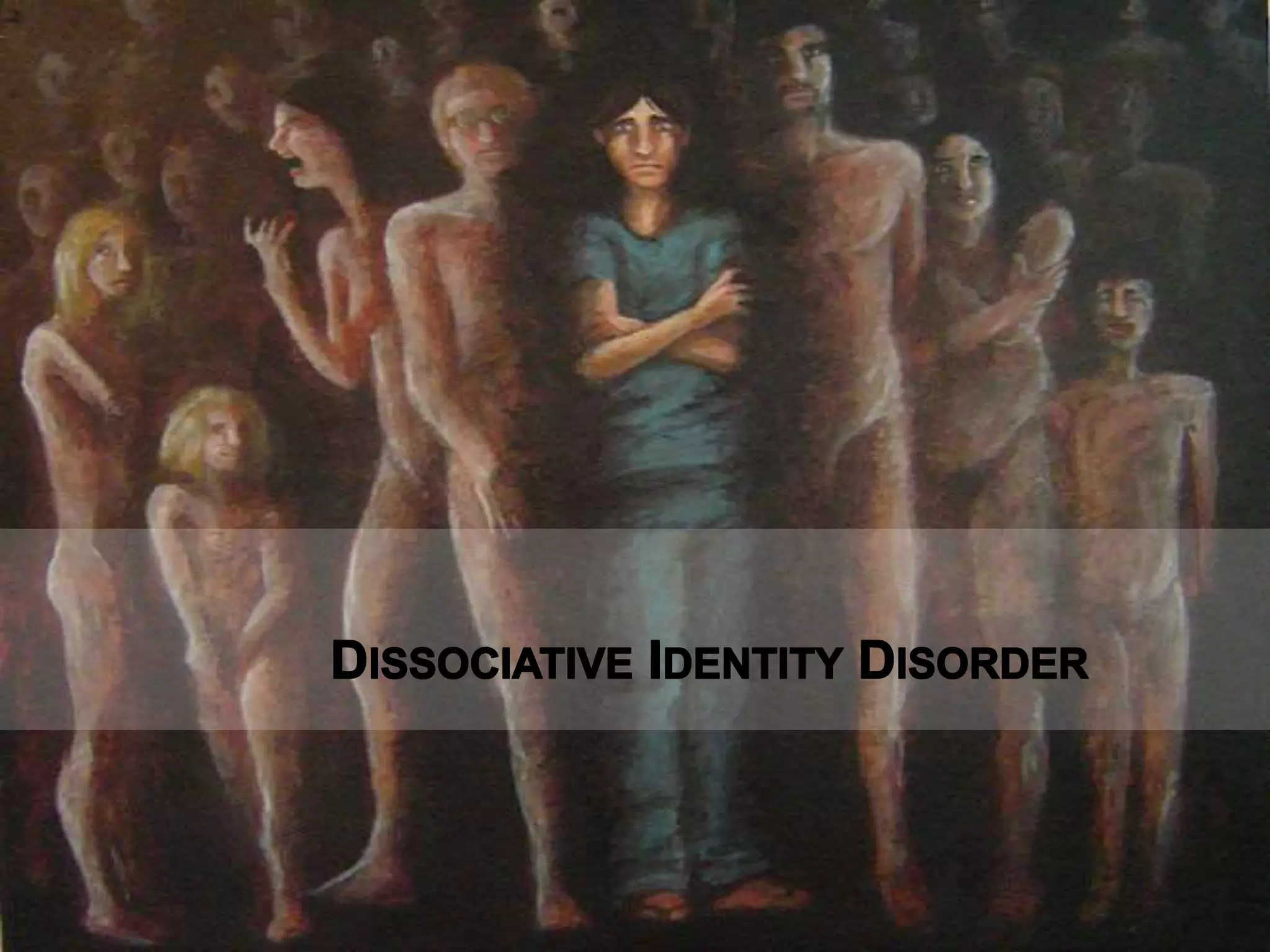
DISSOCIATIVE IDENTITY DISORDER (DID)
 Multiple personality disorder
 Most extreme dissociative disorder
 Contains elements of:
 Depersonalization
 Derealization
 Amnesia
 Identity confusion
 Identity alteration
 Diagnostic criteria:
 Switching between 2+ distinct personality states (alters)
 Recurrent dissociative (amnesiac) boundaries between alters
 Symptoms clinically significant cause of distress/dysfunction & not
due to imaginative play, religious practices, culture, substance use,
or another condition
DISPELLING MYTHS AND MISCONCEPTIONS
 NOT schizophrenia, bipolar disorder, or borderline
personality disorder
 Affects 0.1-1.5% of population
 Worldwide phenomena
 Only overt/florid in 5-6% of cases
 Traumagenic- caused by repeated or long-term
childhood trauma
 Not sociocognitive/iatrogenic
 Must form before ages 6-9
 Individuals with DID can be co-conscious (aware of
alters and capable of using body at same time as
one or more alters)
SYMPTOMS
 Depersonalized/ego-dystonic , unpredictable, uncontrollable actions
and speech
 Internal voices or streams of thought not owned by individual
 Intruding depersonalized/ego-dystonic emotions, sensations, thoughts,
urges
 Perceptions, memories, skills, preferences changing between sets
 Depersonalization; seeing body as different age, sex, race, build; not
recognizing self in mirror
 Disconnection from name, physical attributes, history, memories
 Amnesia
 Finding unfamiliar possessions, art, writing
 Being called unknown name by familiar stranger
 Being confronted about unremembered actions
 Dissociative fugue/unremembered travel
 Inability to recall past, especially traumatic history
 Flashbacks of traumatic events (may or may not be re-repressed once
done)
PREVALENCE
 0.1-1.5%
 Some estimates high as 3-5%, others low as 0.01%
 6-10% of inpatients
 Gender disparity:
 Some studies say 1:9 M:F, others say equal
 Equal for children and adolescents diagnosed
 Disparity may be due to males with disorder not entering
therapy or entering prison system instead
 Has been found in:
 India; the Netherlands; China; the United Kingdom; Belgium;
Russia; Norway; Israel; Germany; Canada; South Africa;
Australia; Puerto Rico; Japan; Switzerland; Turkey; Scotland;
Spain; Argentina; Sweden; New Zealand; Brazil; Finland;
Taiwan; Singapore; Slovakia
 Present in other countries as possession-form
ALTERS
 Differentiated/dissociated self states
 Structural dissociation: emotional/apparently normal parts
 Have unique perception as self as individual
 Can take recurrent control of body with some degree of
recurrent amnesia
 Can have different:
 Natures and characters
 Ways of perceiving and reacting to the world
 Affect and expressiveness
 Internal perceptions of appearances, ages, genders, species
 Preferences, sexualities, opinions, desires, needs, memories
 Knowledge, skills, abilities, sensory-motor functioning
 Reactions to stress, allergens, medications
 Psychological or physiological disorders
 True alters only present in DID or OSDD-1
TYPES OF ALTERS
 Core/original
 First alter within system/body
 Host/fronter(s)
 Handles some or most aspects of daily life
 Protectors
 Protects body, system, other alters, host, core
 Persecutors
 Harms body, system, other alters, host, core to retain control, avoid future or
worsening of abuse, express internalized negative messages or feelings
 Introjects
 Based off of outside people (fictional, historical, family, abusers)
 Memory holders
 Usually hold memories of trauma but can also hold happy/innocent memories
 Gatekeepers
 Control switching or access to certain areas inside, memories, other alters
 Internal self helper
 Holds knowledge about system, other alters, trauma, history, internal workings
 Fragment
 Not fully differentiated alters; hold single or simple emotions, memories, actions or
reactions, purpose
SWITCHING AND PASSIVE INFLUENCE
 Switching
 Change in alter(s) in control of body/fronting
 Consensual (wanted by both alters), forced (wanted by one
alter), or triggered (caused by alter better suited to handle
stimuli being forced to front)
 Can involve co-fronting (2+ alters using body at same time),
co-consciousness (2+ alters aware of outside world at same
time), black out (1+ alters no longer aware of outside world),
or time loss (1+ alters no longer aware of passing of time)
 Can be slow, quick, or uncontrollably rapid
 Can involve blending (temporary merging of alters)
 Passive influence
 Intrusive thoughts, feelings, emotions, opinions, preferences,
urges, actions
 Changes in skills, abilities, memories, emotional range
ETIOLOGY AND DEVELOPMENT
 Long term childhood trauma often combined with
disorganized attachment
 90% - childhood abuse and neglect
 10% - medical/surgical procedures, war, human
trafficking, terrorism
 Forms before ages 6-9
 Either splitting of self due to denial of trauma or
failure to integrate due to trauma (theory of
structural dissociation)
STRUCTURAL DISSOCIATION
 Theory of formation of dissociative disorders
 All children born as collection of ego states
 Most naturally integrate into one stable self
 Trauma disrupts this integration
 PTSD: one central self state with trauma-
associated ego state separate (1 ANP+1 EP)
 C-PTSD/BPD/OSDD: one central self state with
multiple trauma associated ego states separate (1
ANP+EPs)
 DID: many self states, some associated with
trauma and some with daily life (ANPs+EPs)
CO-MORBID CONDITIONS
 DID often associated with:
 Posttraumatic stress disorder
 Depressive and bipolar disorders
 Anxiety disorders
 Personality disorders
 Somatic symptom and related disorders
 Feeding and eating disorders
 Substance-related disorders
 Obsessive compulsive disorder
 Sleep disorders
 Self injury
TREATMENT
 Therapy
 Talk and behavioral therapies (CBT/DBT)
 Art, music, and play therapy
 Eye movement desensitization and reprocessing
 Family therapy
 Medication for co-morbid conditions
 Hypnotherapy NOT appropriate for treating DID
 Risk of memory contamination, creation of new alters or
strengthening of existing alters, flooding with memories
 Integration or cooperation
 Integration: fusion of two or more alters into one
 Choice of individual/system; many therapists no longer push
or even advise integration
PERSONAL EXPERIENCES: ALTERS
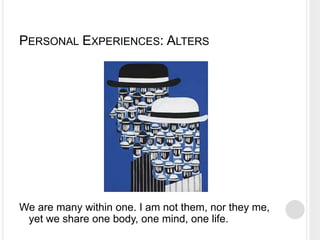
We are many within one. I am not them, nor they me,
yet we share one body, one mind, one life.
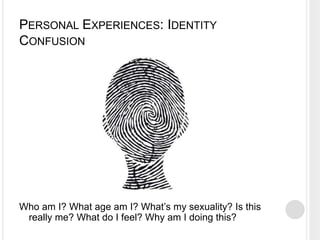
PERSONAL EXPERIENCES: IDENTITY
CONFUSION
Who am I? What age am I? What’s my sexuality? Is this
really me? What do I feel? Why am I doing this?
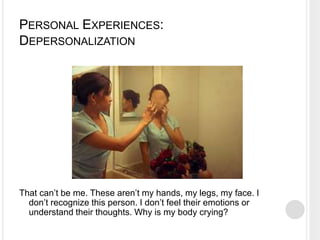
PERSONAL EXPERIENCES:
DEPERSONALIZATION
That can’t be me. These aren’t my hands, my legs, my face. I
don’t recognize this person. I don’t feel their emotions or
understand their thoughts. Why is my body crying?
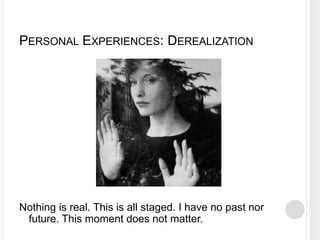
PERSONAL EXPERIENCES: DEREALIZATION
Nothing is real. This is all staged. I have no past nor
future. This moment does not matter.
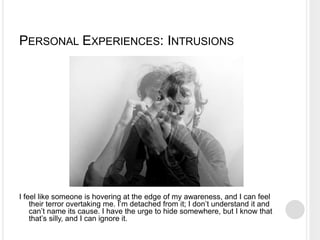
PERSONAL EXPERIENCES: INTRUSIONS
I feel like someone is hovering at the edge of my awareness, and I can feel
their terror overtaking me. I’m detached from it; I don’t understand it and
can’t name its cause. I have the urge to hide somewhere, but I know that
that’s silly, and I can ignore it.
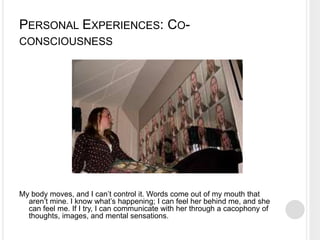
PERSONAL EXPERIENCES: CO-
CONSCIOUSNESS
My body moves, and I can’t control it. Words come out of my mouth that
aren’t mine. I know what’s happening; I can feel her behind me, and she
can feel me. If I try, I can communicate with her through a cacophony of
thoughts, images, and mental sensations.
PERSONAL EXPERIENCES: AMNESIA
I don’t remember my childhood. I don’t remember last week.
When I try to remember, I feel pressure in my head as if my
consciousness is limited by a glass cage. I’m not sure that I
mind. What I do know of my past is too painful for me to face.
PERSONAL EXPERIENCES: FLASHBACKS
I feel sick. Every muscle in my body is tense and prepared to fight. I know
that I’m safe; I know that. But I feel his hands on my body, and I have to
resist the urge to gag. I’m not a child anymore, but I feel small and
helpless. I can almost hear his voice in my ears, taunting me. There are
no words for this. I won’t remember this. I’d rather die.

Dissociative identity disorder

  • 2.
    DISSOCIATIVE IDENTITY DISORDER(DID)  Multiple personality disorder  Most extreme dissociative disorder  Contains elements of:  Depersonalization  Derealization  Amnesia  Identity confusion  Identity alteration  Diagnostic criteria:  Switching between 2+ distinct personality states (alters)  Recurrent dissociative (amnesiac) boundaries between alters  Symptoms clinically significant cause of distress/dysfunction & not due to imaginative play, religious practices, culture, substance use, or another condition
  • 3.
    DISPELLING MYTHS ANDMISCONCEPTIONS  NOT schizophrenia, bipolar disorder, or borderline personality disorder  Affects 0.1-1.5% of population  Worldwide phenomena  Only overt/florid in 5-6% of cases  Traumagenic- caused by repeated or long-term childhood trauma  Not sociocognitive/iatrogenic  Must form before ages 6-9  Individuals with DID can be co-conscious (aware of alters and capable of using body at same time as one or more alters)
  • 4.
    SYMPTOMS  Depersonalized/ego-dystonic ,unpredictable, uncontrollable actions and speech  Internal voices or streams of thought not owned by individual  Intruding depersonalized/ego-dystonic emotions, sensations, thoughts, urges  Perceptions, memories, skills, preferences changing between sets  Depersonalization; seeing body as different age, sex, race, build; not recognizing self in mirror  Disconnection from name, physical attributes, history, memories  Amnesia  Finding unfamiliar possessions, art, writing  Being called unknown name by familiar stranger  Being confronted about unremembered actions  Dissociative fugue/unremembered travel  Inability to recall past, especially traumatic history  Flashbacks of traumatic events (may or may not be re-repressed once done)
  • 5.
    PREVALENCE  0.1-1.5%  Someestimates high as 3-5%, others low as 0.01%  6-10% of inpatients  Gender disparity:  Some studies say 1:9 M:F, others say equal  Equal for children and adolescents diagnosed  Disparity may be due to males with disorder not entering therapy or entering prison system instead  Has been found in:  India; the Netherlands; China; the United Kingdom; Belgium; Russia; Norway; Israel; Germany; Canada; South Africa; Australia; Puerto Rico; Japan; Switzerland; Turkey; Scotland; Spain; Argentina; Sweden; New Zealand; Brazil; Finland; Taiwan; Singapore; Slovakia  Present in other countries as possession-form
  • 6.
    ALTERS  Differentiated/dissociated selfstates  Structural dissociation: emotional/apparently normal parts  Have unique perception as self as individual  Can take recurrent control of body with some degree of recurrent amnesia  Can have different:  Natures and characters  Ways of perceiving and reacting to the world  Affect and expressiveness  Internal perceptions of appearances, ages, genders, species  Preferences, sexualities, opinions, desires, needs, memories  Knowledge, skills, abilities, sensory-motor functioning  Reactions to stress, allergens, medications  Psychological or physiological disorders  True alters only present in DID or OSDD-1
  • 7.
    TYPES OF ALTERS Core/original  First alter within system/body  Host/fronter(s)  Handles some or most aspects of daily life  Protectors  Protects body, system, other alters, host, core  Persecutors  Harms body, system, other alters, host, core to retain control, avoid future or worsening of abuse, express internalized negative messages or feelings  Introjects  Based off of outside people (fictional, historical, family, abusers)  Memory holders  Usually hold memories of trauma but can also hold happy/innocent memories  Gatekeepers  Control switching or access to certain areas inside, memories, other alters  Internal self helper  Holds knowledge about system, other alters, trauma, history, internal workings  Fragment  Not fully differentiated alters; hold single or simple emotions, memories, actions or reactions, purpose
  • 8.
    SWITCHING AND PASSIVEINFLUENCE  Switching  Change in alter(s) in control of body/fronting  Consensual (wanted by both alters), forced (wanted by one alter), or triggered (caused by alter better suited to handle stimuli being forced to front)  Can involve co-fronting (2+ alters using body at same time), co-consciousness (2+ alters aware of outside world at same time), black out (1+ alters no longer aware of outside world), or time loss (1+ alters no longer aware of passing of time)  Can be slow, quick, or uncontrollably rapid  Can involve blending (temporary merging of alters)  Passive influence  Intrusive thoughts, feelings, emotions, opinions, preferences, urges, actions  Changes in skills, abilities, memories, emotional range
  • 9.
    ETIOLOGY AND DEVELOPMENT Long term childhood trauma often combined with disorganized attachment  90% - childhood abuse and neglect  10% - medical/surgical procedures, war, human trafficking, terrorism  Forms before ages 6-9  Either splitting of self due to denial of trauma or failure to integrate due to trauma (theory of structural dissociation)
  • 10.
    STRUCTURAL DISSOCIATION  Theoryof formation of dissociative disorders  All children born as collection of ego states  Most naturally integrate into one stable self  Trauma disrupts this integration  PTSD: one central self state with trauma- associated ego state separate (1 ANP+1 EP)  C-PTSD/BPD/OSDD: one central self state with multiple trauma associated ego states separate (1 ANP+EPs)  DID: many self states, some associated with trauma and some with daily life (ANPs+EPs)
  • 11.
    CO-MORBID CONDITIONS  DIDoften associated with:  Posttraumatic stress disorder  Depressive and bipolar disorders  Anxiety disorders  Personality disorders  Somatic symptom and related disorders  Feeding and eating disorders  Substance-related disorders  Obsessive compulsive disorder  Sleep disorders  Self injury
  • 12.
    TREATMENT  Therapy  Talkand behavioral therapies (CBT/DBT)  Art, music, and play therapy  Eye movement desensitization and reprocessing  Family therapy  Medication for co-morbid conditions  Hypnotherapy NOT appropriate for treating DID  Risk of memory contamination, creation of new alters or strengthening of existing alters, flooding with memories  Integration or cooperation  Integration: fusion of two or more alters into one  Choice of individual/system; many therapists no longer push or even advise integration
  • 13.
    PERSONAL EXPERIENCES: ALTERS Weare many within one. I am not them, nor they me, yet we share one body, one mind, one life.
  • 14.
    PERSONAL EXPERIENCES: IDENTITY CONFUSION Whoam I? What age am I? What’s my sexuality? Is this really me? What do I feel? Why am I doing this?
  • 15.
    PERSONAL EXPERIENCES: DEPERSONALIZATION That can’tbe me. These aren’t my hands, my legs, my face. I don’t recognize this person. I don’t feel their emotions or understand their thoughts. Why is my body crying?
  • 16.
    PERSONAL EXPERIENCES: DEREALIZATION Nothingis real. This is all staged. I have no past nor future. This moment does not matter.
  • 17.
    PERSONAL EXPERIENCES: INTRUSIONS Ifeel like someone is hovering at the edge of my awareness, and I can feel their terror overtaking me. I’m detached from it; I don’t understand it and can’t name its cause. I have the urge to hide somewhere, but I know that that’s silly, and I can ignore it.
  • 18.
    PERSONAL EXPERIENCES: CO- CONSCIOUSNESS Mybody moves, and I can’t control it. Words come out of my mouth that aren’t mine. I know what’s happening; I can feel her behind me, and she can feel me. If I try, I can communicate with her through a cacophony of thoughts, images, and mental sensations.
  • 19.
    PERSONAL EXPERIENCES: AMNESIA Idon’t remember my childhood. I don’t remember last week. When I try to remember, I feel pressure in my head as if my consciousness is limited by a glass cage. I’m not sure that I mind. What I do know of my past is too painful for me to face.
  • 20.
    PERSONAL EXPERIENCES: FLASHBACKS Ifeel sick. Every muscle in my body is tense and prepared to fight. I know that I’m safe; I know that. But I feel his hands on my body, and I have to resist the urge to gag. I’m not a child anymore, but I feel small and helpless. I can almost hear his voice in my ears, taunting me. There are no words for this. I won’t remember this. I’d rather die.