SOCIOLOGICAL PERSPECTIVES
FOR HEALTH & SOCIAL CARE
Unit 7
Lesson 1
Introduction to Sociology
Learning Objectives
• To define the term ‘sociology’
• To identify key concepts in
sociology
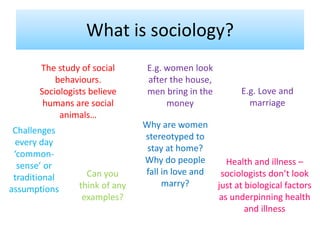
What is sociology?
The study of social
behaviours.
Sociologists believe
humans are social
animals…
Challenges
every day
‘common-
sense’ or
traditional
assumptions
Can you
think of any
examples?
E.g. Love and
marriage
E.g. women look
after the house,
men bring in the
money
Why are women
stereotyped to
stay at home?
Why do people
fall in love and
marry?
Health and illness –
sociologists don’t look
just at biological factors
as underpinning health
and illness
What do sociologists explore?
Sociology explores the human processes of social
interactions through studying the relationship
between:
Individuals
Groups
Social institutions
Social Structures
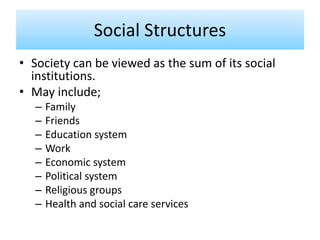
• Society can be viewed as the sum of its social
institutions.
• May include;
– Family
– Friends
– Education system
– Work
– Economic system
– Political system
– Religious groups
– Health and social care services
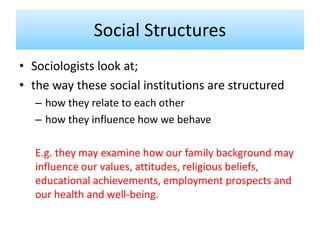
• Sociologists look at;
• the way these social institutions are structured
– how they relate to each other
– how they influence how we behave
E.g. they may examine how our family background may
influence our values, attitudes, religious beliefs,
educational achievements, employment prospects and
our health and well-being.
Social Structures
• Draw a personal spider diagram identifying
the social institutions to which you belong.
• Identify how to or three of these institutions
have influenced your behaviour.
• In the groups on your table, discuss why you
think these particular institutions have
influenced you, and how.
ACTIVITY
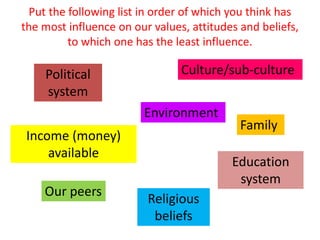
Put the following list in order of which you think has
the most influence on our values, attitudes and beliefs,
to which one has the least influence.
Family
Environment
Culture/sub-culturePolitical
system
Education
system
Income (money)
available
Our peers
Religious
beliefs
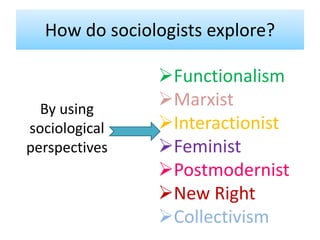
How do sociologists explore?
By using
sociological
perspectives
Functionalism
Marxist
Interactionist
Feminist
Postmodernist
New Right
Collectivism
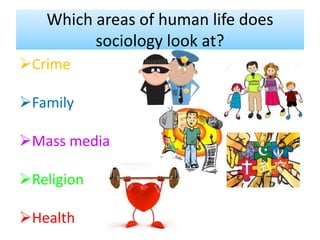
Which areas of human life does
sociology look at?
Crime
Family
Mass media
Religion
Health
Socialisation
• Our language, values, beliefs, customs, and behaviour
surround us from birth and we take them as ‘truth’ when
we are a small, weak and vulnerable child, totally
dependent upon our adult carers for survival.
• Socialisation is the process of learning the skills and
attitudes which enable individuals to live easily with other
members of the community. It is the process through which
people learn the norms and values of society.
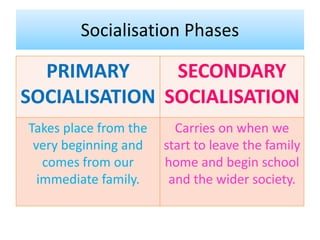
• This socialisation process can be broken down into two
distinct phases:
Socialisation Phases
PRIMARY
SOCIALISATION
SECONDARY
SOCIALISATION
Takes place from the
very beginning and
comes from our
immediate family.
Carries on when we
start to leave the family
home and begin school
and the wider society.
Norms and Values
• What do you think a norm is?
• Norms are social rules that define correct
behaviour in society.
• Can you think of any examples of a norm?
• What do you think a value is?
• Values are what are important to an
individual or social group.
• Can you think of any examples of values?
Values
Norms
e.g. monogamy.
e.g. marriage, making
a fuss of cheaters.
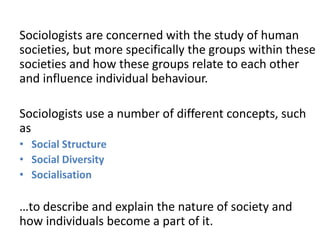
Sociologists are concerned with the study of human
societies, but more specifically the groups within these
societies and how these groups relate to each other
and influence individual behaviour.
Sociologists use a number of different concepts, such
as
• Social Structure
• Social Diversity
• Socialisation
…to describe and explain the nature of society and
how individuals become a part of it.
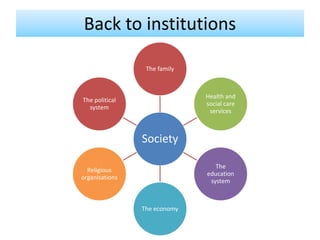
Back to institutions
Society
The family
Health and
social care
services
The
education
system
The economy
Religious
organisations
The political
system
Social Diversity
What do you think ‘Social Diversity’ refers to?
Differences of people within groups.
Can you think of any examples?
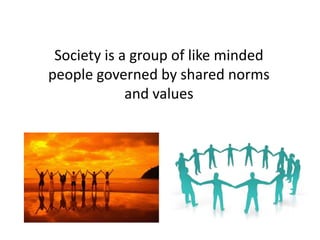
Society is a group of like minded
people governed by shared norms
and values
Social Diversity
How are people socially diverse?
• Age
• Gender
• Culture
• Ethnicity
• Social class
• Location
What do you think the
benefits of having a
diverse society are?
Structural Approaches
• Sometimes called social systems or
structuralistic approaches.
• Emphasise the power of society over the
individual.
• Believe the individual is largely controlled by
society.
• Think that society is in us, moulding our
thoughts and directing our actions.
• Argue that we are socialised in terms of the
culture of society.
• Say that our behaviour is shaped by the social
structure:
– We are kept in line by mechanisms of social
control.
– We learn roles, norms and values and act
accordingly.
Structural Approaches
Link to Health and Social Care
• This socialisation can vary from country to
country, each with a very different way of
seeing how a society should run.
• Hence in Britain we are seen as a
‘multicultural’ society in which there is very
different socialisation processes at work.
Link to Health and Social Care
• Each of these will have both serious and
subtle difference in their beliefs and
behaviours so the professional health and
social care worker must understand this basic
sociological process in order to meet the
different needs.
• WHERE DO YOU THINK PERSONAL BELIEFS/
VALUES COULD CAUSE CONFLICT IN HSC
CONTINUED
• ROCK STRATIFICATION
CONTINUED
• This stratification is seen as hierarchical with
those at the top having considerably more
advantages over those at the bottom and this
greatly effects health and lifestyle.
• There have been various attempts to make
society more ‘egalitarian’ where all members
are equal but in general this has not yet
worked very well.
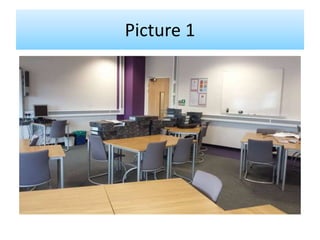
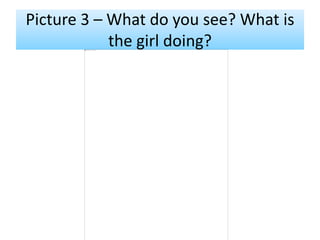
• Look at the picture placed on your table and
say what you see
What is a perspective?
Picture 1
Picture 2
Picture 3 – What do you see? What is
the girl doing?
Sociology
Structural Theory Action Theory
Consensus Conflict
Functionalism Marxism Feminism
Symbolic
interactionism
(Interpretivism)
Theory can be said to be like looking at
society through different lenses – each
give it a different perspective or
appearance.

Lesson One - Introduction into sociology

  • 1.
    SOCIOLOGICAL PERSPECTIVES FOR HEALTH& SOCIAL CARE Unit 7 Lesson 1 Introduction to Sociology
  • 2.
    Learning Objectives • Todefine the term ‘sociology’ • To identify key concepts in sociology
  • 3.
    What is sociology? Thestudy of social behaviours. Sociologists believe humans are social animals… Challenges every day ‘common- sense’ or traditional assumptions Can you think of any examples? E.g. Love and marriage E.g. women look after the house, men bring in the money Why are women stereotyped to stay at home? Why do people fall in love and marry? Health and illness – sociologists don’t look just at biological factors as underpinning health and illness
  • 4.
    What do sociologistsexplore? Sociology explores the human processes of social interactions through studying the relationship between: Individuals Groups Social institutions
  • 5.
    Social Structures • Societycan be viewed as the sum of its social institutions. • May include; – Family – Friends – Education system – Work – Economic system – Political system – Religious groups – Health and social care services
  • 6.
    • Sociologists lookat; • the way these social institutions are structured – how they relate to each other – how they influence how we behave E.g. they may examine how our family background may influence our values, attitudes, religious beliefs, educational achievements, employment prospects and our health and well-being. Social Structures
  • 7.
    • Draw apersonal spider diagram identifying the social institutions to which you belong. • Identify how to or three of these institutions have influenced your behaviour. • In the groups on your table, discuss why you think these particular institutions have influenced you, and how. ACTIVITY
  • 8.
    Put the followinglist in order of which you think has the most influence on our values, attitudes and beliefs, to which one has the least influence. Family Environment Culture/sub-culturePolitical system Education system Income (money) available Our peers Religious beliefs
  • 9.
    How do sociologistsexplore? By using sociological perspectives Functionalism Marxist Interactionist Feminist Postmodernist New Right Collectivism
  • 10.
    Which areas ofhuman life does sociology look at? Crime Family Mass media Religion Health
  • 11.
    Socialisation • Our language,values, beliefs, customs, and behaviour surround us from birth and we take them as ‘truth’ when we are a small, weak and vulnerable child, totally dependent upon our adult carers for survival. • Socialisation is the process of learning the skills and attitudes which enable individuals to live easily with other members of the community. It is the process through which people learn the norms and values of society. • This socialisation process can be broken down into two distinct phases:
  • 12.
    Socialisation Phases PRIMARY SOCIALISATION SECONDARY SOCIALISATION Takes placefrom the very beginning and comes from our immediate family. Carries on when we start to leave the family home and begin school and the wider society.
  • 13.
    Norms and Values •What do you think a norm is? • Norms are social rules that define correct behaviour in society. • Can you think of any examples of a norm? • What do you think a value is? • Values are what are important to an individual or social group. • Can you think of any examples of values?
  • 14.
  • 15.
    Sociologists are concernedwith the study of human societies, but more specifically the groups within these societies and how these groups relate to each other and influence individual behaviour. Sociologists use a number of different concepts, such as • Social Structure • Social Diversity • Socialisation …to describe and explain the nature of society and how individuals become a part of it.
  • 16.
    Back to institutions Society Thefamily Health and social care services The education system The economy Religious organisations The political system
  • 17.
    Social Diversity What doyou think ‘Social Diversity’ refers to? Differences of people within groups. Can you think of any examples?
  • 18.
    Society is agroup of like minded people governed by shared norms and values
  • 19.
    Social Diversity How arepeople socially diverse? • Age • Gender • Culture • Ethnicity • Social class • Location What do you think the benefits of having a diverse society are?
  • 20.
    Structural Approaches • Sometimescalled social systems or structuralistic approaches. • Emphasise the power of society over the individual. • Believe the individual is largely controlled by society. • Think that society is in us, moulding our thoughts and directing our actions.
  • 21.
    • Argue thatwe are socialised in terms of the culture of society. • Say that our behaviour is shaped by the social structure: – We are kept in line by mechanisms of social control. – We learn roles, norms and values and act accordingly. Structural Approaches
  • 22.
    Link to Healthand Social Care • This socialisation can vary from country to country, each with a very different way of seeing how a society should run. • Hence in Britain we are seen as a ‘multicultural’ society in which there is very different socialisation processes at work.
  • 23.
    Link to Healthand Social Care • Each of these will have both serious and subtle difference in their beliefs and behaviours so the professional health and social care worker must understand this basic sociological process in order to meet the different needs. • WHERE DO YOU THINK PERSONAL BELIEFS/ VALUES COULD CAUSE CONFLICT IN HSC
  • 24.
  • 25.
    CONTINUED • This stratificationis seen as hierarchical with those at the top having considerably more advantages over those at the bottom and this greatly effects health and lifestyle. • There have been various attempts to make society more ‘egalitarian’ where all members are equal but in general this has not yet worked very well.
  • 26.
    • Look atthe picture placed on your table and say what you see What is a perspective?
  • 27.
  • 28.
  • 29.
    Picture 3 –What do you see? What is the girl doing?
  • 30.
    Sociology Structural Theory ActionTheory Consensus Conflict Functionalism Marxism Feminism Symbolic interactionism (Interpretivism) Theory can be said to be like looking at society through different lenses – each give it a different perspective or appearance.

Editor's Notes

  • #11 There are animations on this slide to make the pictures appear before the words. I have done this as a little activity… put up a picture and ask learners what they think the picture represents and if they can use the picture to answer the question in the title. Do this with all 5 pictures and key words.
  • #25 As well as the obvious different socialisation process between very different cultures, there are within one culture sub – cultures. This refers to there being different layers, tiers, or stratas within one society, each with a slightly different view on society and thus a different socialisation process for their children This sub-division of a society is referred to in sociology as ‘stratification’ which comes from the way layers of rock, soil and earth are stratified (layered) in geology. Obviously in such a system there is always going to be a top, a middle, and a bottom. In Britain this stratification is based on social class, income and occupation. Across the world different societies have different forms of stratification; these could be based on the following: Gender Race and Skin colour Religion Age In our society it is based more upon class, income and occupation
  • #31 This slide does not need to be explained in detail. It is just to give the learners the idea that the perspectives are, in essence, looking at something through a different lens and that is how all perspectives differ. Explain that each perspective will be covered in more detail so they don’t need to worry too much all of them just now.