Anxiety Disorders
Chapter 4
Nature of Anxiety and Fear
• Fear – present-oriented,
fight or flight response to
danger or threat
– Activates sympathetic
nervous system
– Hypothalamus triggers
adrenaline release 
optimal physical
functioning
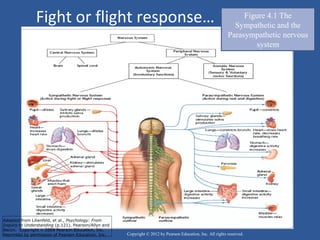
Fight or flight response…
Copyright © 2012 by Pearson Education, Inc. All rights reserved.
Figure 4.1 The
Sympathetic and the
Parasympathetic nervous
system
Adapted from Lilienfeld, et al., Psychology: From
Inquiry to Understanding (p.121). Pearson/Allyn and
Bacon. Copyright © 2009 Pearson Education, Inc.
Reprinted by permission of Pearson Education, Inc.
Nature of Anxiety and Fear
• Anxiety – future-oriented
apprehension
– Often when no real danger is present
– Somatic symptoms of tension, decreased
physical reactivity
– Characterized by negative
affect, negative thought
pattern, and
escape/avoidance
behaviors
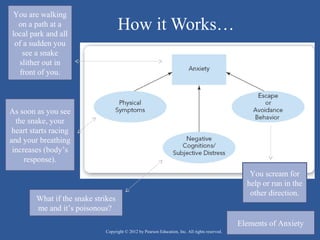
How it Works…
What if the snake strikes
me and it’s poisonous?
You are walking
on a path at a
local park and all
of a sudden you
see a snake
slither out in
front of you.
Elements of Anxiety
As soon as you see
the snake, your
heart starts racing
and your breathing
increases (body’s
response).
You scream for
help or run in the
other direction.
Copyright © 2012 by Pearson Education, Inc. All rights reserved.
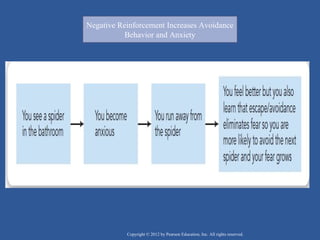
Negative Reinforcement Increases Avoidance
Behavior and Anxiety
Copyright © 2012 by Pearson Education, Inc. All rights reserved.
Anxiety Disorders
• Occasional anxiety = normal
• Most common class of disorders
– 31.2% of US adults
• Avg. age onset = 11 yrs
• 57% have comorbid second
anxiety disorder or depression
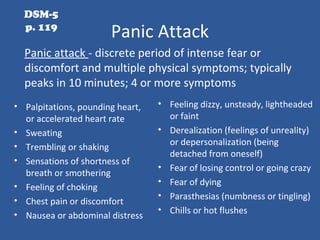
Panic Attack
• Palpitations, pounding heart,
or accelerated heart rate
• Sweating
• Trembling or shaking
• Sensations of shortness of
breath or smothering
• Feeling of choking
• Chest pain or discomfort
• Nausea or abdominal distress
• Feeling dizzy, unsteady, lightheaded
or faint
• Derealization (feelings of unreality)
or depersonalization (being
detached from oneself)
• Fear of losing control or going crazy
• Fear of dying
• Parasthesias (numbness or tingling)
• Chills or hot flushes
Panic attack - discrete period of intense fear or
discomfort and multiple physical symptoms; typically
peaks in 10 minutes; 4 or more symptoms
DSM-5
p. 119
Panic Attacks
• Expected
• Unexpected
• Often mistaken for heart attack
• Can occur in any disorder
• 28% of adults have had a panic attack;
5% have panic disorder
• Types:
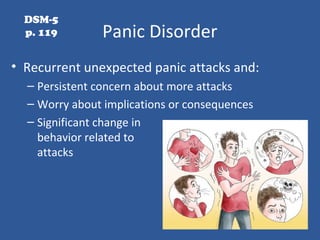
Panic Disorder
• Recurrent unexpected panic attacks and:
– Persistent concern about more attacks
– Worry about implications or consequences
– Significant change in
behavior related to
attacks
DSM-5
p. 119
Panic Disorder
• Typically begins in early adulthood
• Women > men
• 94% seek treatment
• Few symptom-free periods w/o treatment
• Medications - short-term solution
Agoraphobia
• Agoraphobia - fear of
being in public places or
situations where escape
might be difficult
– Avoid going out or require
a trusted companion or
safety objects
– > 6 mos.
Generalized Anxiety Disorder
• Excessive anxiety and uncontrollable worry about
many events and activities
• ≥ 3 symptoms present for 6 months
– Restlessness, feeling on edge
– Easily fatigued
– Difficulty concentrating or mind
going blank
– Irritability
– Muscle tension
– Sleep disturbance
Generalized Anxiety Disorder
• Difficulty tolerating uncertainty
• Believe worrying may help to prevent
negative consequences
• Onset often associated with unexpected,
negative, or very important
life events
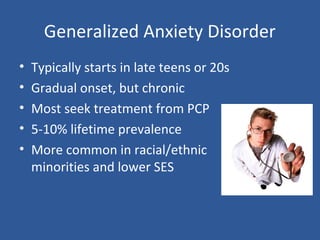
Generalized Anxiety Disorder
• Typically starts in late teens or 20s
• Gradual onset, but chronic
• Most seek treatment from PCP
• 5-10% lifetime prevalence
• More common in racial/ethnic
minorities and lower SES
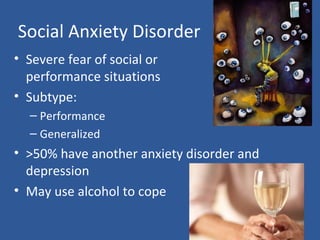
Social Anxiety Disorder
• Severe fear of social or
performance situations
• Subtype:
– Performance
– Generalized
• >50% have another anxiety disorder and
depression
• May use alcohol to cope
Social Anxiety Disorder
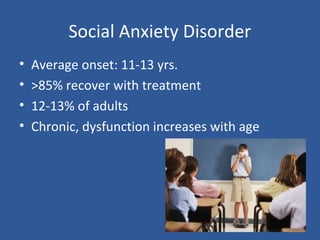
• Average onset: 11-13 yrs.
• >85% recover with treatment
• 12-13% of adults
• Chronic, dysfunction increases with age
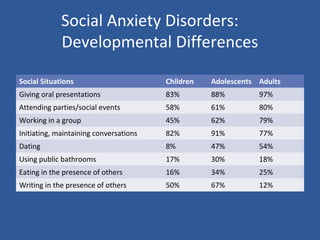
Social Anxiety Disorders:
Developmental Differences
Social Situations Children Adolescents Adults
Giving oral presentations 83% 88% 97%
Attending parties/social events 58% 61% 80%
Working in a group 45% 62% 79%
Initiating, maintaining conversations 82% 91% 77%
Dating 8% 47% 54%
Using public bathrooms 17% 30% 18%
Eating in the presence of others 16% 34% 25%
Writing in the presence of others 50% 67% 12%
Specific Phobia
• Severe and persistent fears of specific objects
or situations
• 5 Types:
– Animal phobias
– Natural Environment phobias
– Blood/injection/injury phobia
– Situational Phobias
– Other
• >6 mos.
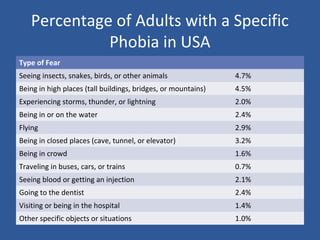
Percentage of Adults with a Specific
Phobia in USA
Type of Fear
Seeing insects, snakes, birds, or other animals 4.7%
Being in high places (tall buildings, bridges, or mountains) 4.5%
Experiencing storms, thunder, or lightning 2.0%
Being in or on the water 2.4%
Flying 2.9%
Being in closed places (cave, tunnel, or elevator) 3.2%
Being in crowd 1.6%
Traveling in buses, cars, or trains 0.7%
Seeing blood or getting an injection 2.1%
Going to the dentist 2.4%
Visiting or being in the hospital 1.4%
Other specific objects or situations 1.0%
Specific Phobia
• Often multiple phobias
• Few seek treatment
• 12.5% of adults, 3.5% of kids
• Avg. onset = 7 years
• More common among girls and younger
children
• Women: situational, animal, and natural
environment phobias
• Men and women: heights and B-I-I situations
OBSESSIVE-COMPULSIVE AND
RELATED DISORDERS
Obsessive-Compulsive Disorder
Obsessions – recurrent, persistent, intrusive, and
distressing thoughts
• Attempts to ignore, suppress, or neutralize them
with a thought or action
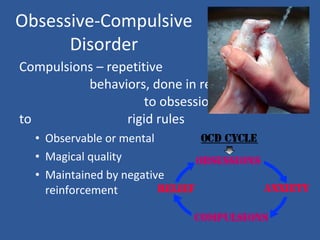
Compulsions – repetitive
behaviors, done in response
to obsessions or according
to rigid rules
• Observable or mental
• Magical quality
• Maintained by negative
reinforcement
Obsessive-Compulsive
Disorder
Obsessive-Compulsive
Disorder
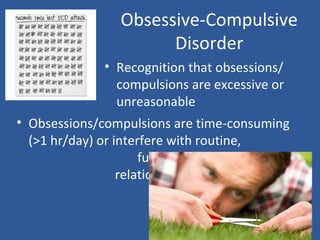
• Obsessions/compulsions are time-consuming
(>1 hr/day) or interfere with routine,
functioning, or
relationships
• Recognition that obsessions/
compulsions are excessive or
unreasonable
Obsessive-Compulsive Disorder
• Usually does not remit without treatment
• Lifetime prevalence – 1.6%
• Onset in late teens or early adulthood, but
signs present earlier
• Equal rates across genders
– Boys develop earlier and
have more family members
with disorder
Hoarding
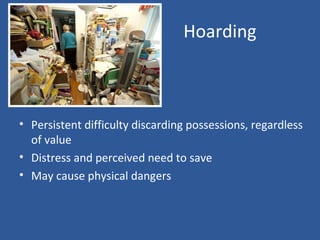
• Persistent difficulty discarding possessions, regardless
of value
• Distress and perceived need to save
• May cause physical dangers
Body Dysmorphic Disorder
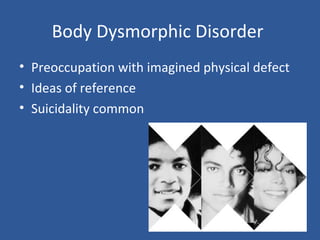
• Preoccupation with imagined physical defect
• Ideas of reference
• Suicidality common
Body Dysmorphic Disorder
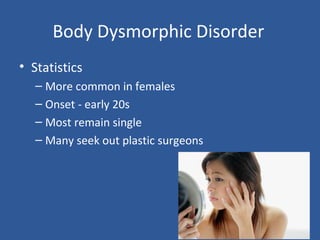
• Statistics
– More common in females
– Onset - early 20s
– Most remain single
– Many seek out plastic surgeons
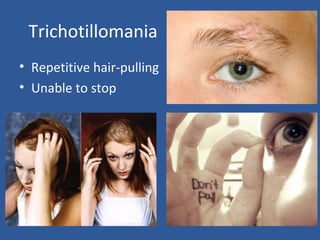
Trichotillomania
• Repetitive hair-pulling
• Unable to stop
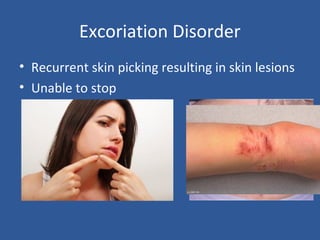
Excoriation Disorder
• Recurrent skin picking resulting in skin lesions
• Unable to stop
TRAUMA AND STRESSOR-RELATED
DISORDERS
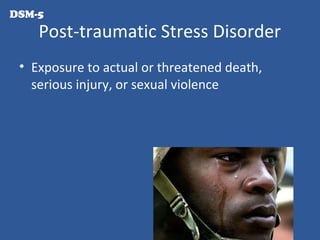
Post-traumatic Stress Disorder
• Exposure to actual or threatened death,
serious injury, or sexual violence
DSM-5
Post-traumatic Stress Disorder
• Intrusion symptom (1):
– Recurrent, involuntary, intrusive, and distressing
memories
– Recurrent, distressing dreams
– Acting or feeling if event recurring
– Intense distress at exposure to
internal or external cues of the event
– Physiological reactivity to cues
DSM-5
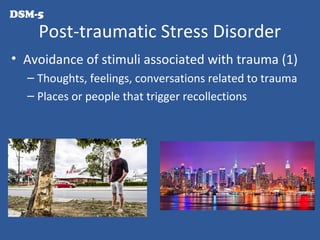
Post-traumatic Stress Disorder
• Avoidance of stimuli associated with trauma (1)
– Thoughts, feelings, conversations related to trauma
– Places or people that trigger recollections
DSM-5
– Negative changes in mood and cognitions (2)
– Inability to recall important aspect
– Negative beliefs about self, others, or the world
– Distorted cognitions about cause or consequences
leading to misplaced blame
– Persistent negative emotional state
– Diminished interest/participation in significant
activities
– Feeling detached from others
– Unable to experience positive emotions
Post-traumatic Stress Disorder
DSM-5
Post-traumatic Stress Disorder
• Increased arousal (2)
– Irritability/outbursts of anger
– Reckless or self-destructive behavior
– Sleep disturbance
– Difficulty concentrating
– Hypervigilance
– Exaggerated startle response
• > 1 month
DSM-5
Post-traumatic Stress Disorder
• Onset - any age
• Symptoms of civilian trauma decline with time
• Combat-related less responsive to treatment
Post-traumatic Stress Disorder
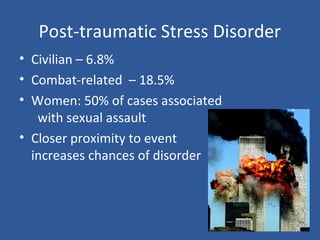
• Civilian – 6.8%
• Combat-related – 18.5%
• Women: 50% of cases associated
with sexual assault
• Closer proximity to event
increases chances of disorder
Etiology of Anxiety Disorders
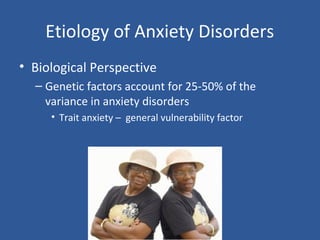
• Biological Perspective
– Genetic factors account for 25-50% of the
variance in anxiety disorders
• Trait anxiety – general vulnerability factor
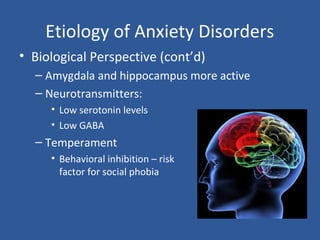
Etiology of Anxiety Disorders
• Biological Perspective (cont’d)
– Amygdala and hippocampus more active
– Neurotransmitters:
• Low serotonin levels
• Low GABA
– Temperament
• Behavioral inhibition – risk
factor for social phobia
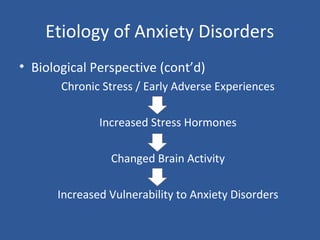
Etiology of Anxiety Disorders
• Biological Perspective (cont’d)
Chronic Stress / Early Adverse Experiences
Increased Stress Hormones
Changed Brain Activity
Increased Vulnerability to Anxiety Disorders
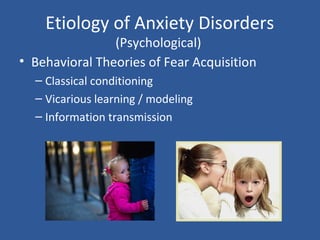
Etiology of Anxiety Disorders
(Psychological)
• Behavioral Theories of Fear Acquisition
– Classical conditioning
– Vicarious learning / modeling
– Information transmission
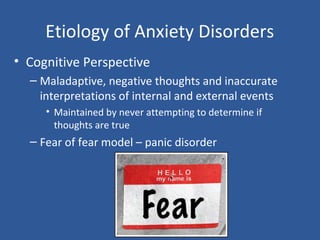
Etiology of Anxiety Disorders
• Cognitive Perspective
– Maladaptive, negative thoughts and inaccurate
interpretations of internal and external events
• Maintained by never attempting to determine if
thoughts are true
– Fear of fear model – panic disorder
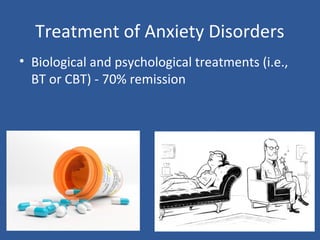
Treatment of Anxiety Disorders
• Biological and psychological treatments (i.e.,
BT or CBT) - 70% remission
Biological Treatments
• Medication
– Disorders associated with
low serotonin
– Stimulates neuron to release more serotonin, OR
– Blocks reuptake of serotonin (SSRI’s)
• Prozac, Luvox, Zoloft, Paxil
• Biological treatment of choice
• Relapse common when withdrawn
• Caution needed with kids and young adults
Biological Treatments
• Medication
– Benzodiazepines (e.g., Valium and Xanax) affect
GABA
• For panic, GAD, and social phobia
• May cause physical and psychological dependence
• Withdrawal effects more risky – seizures possible
• Psychosurgery – last resort for OCD
– Cingulotomy
Psychological Treatments
• Behavioral and Cognitive-Behavioral Therapy
– Psychosocial treatments of choice
– All incorporate some form of exposure
• In vivo vs.
Imaginal vs.
Interoceptive
• Graduated vs.
flooding
– Enhance w/ cognitive
restructuring
Psychological Treatments
–Combining exposure w/ other treatments may
enhance efficacy
• Social phobia – training in social skills and
assertiveness
• Relaxation training – decreases general physical
arousal; esp. beneficial for GAD
• Biofeedback – monitoring autonomic nervous
system behaviors with relaxation training
– Combining CBT w/ medication typically does NOT
enhance treatment

Ch.4. anxiety disorders.canvas

  • 1.
  • 2.
    Nature of Anxietyand Fear • Fear – present-oriented, fight or flight response to danger or threat – Activates sympathetic nervous system – Hypothalamus triggers adrenaline release  optimal physical functioning
  • 3.
    Fight or flightresponse… Copyright © 2012 by Pearson Education, Inc. All rights reserved. Figure 4.1 The Sympathetic and the Parasympathetic nervous system Adapted from Lilienfeld, et al., Psychology: From Inquiry to Understanding (p.121). Pearson/Allyn and Bacon. Copyright © 2009 Pearson Education, Inc. Reprinted by permission of Pearson Education, Inc.
  • 4.
    Nature of Anxietyand Fear • Anxiety – future-oriented apprehension – Often when no real danger is present – Somatic symptoms of tension, decreased physical reactivity – Characterized by negative affect, negative thought pattern, and escape/avoidance behaviors
  • 5.
    How it Works… Whatif the snake strikes me and it’s poisonous? You are walking on a path at a local park and all of a sudden you see a snake slither out in front of you. Elements of Anxiety As soon as you see the snake, your heart starts racing and your breathing increases (body’s response). You scream for help or run in the other direction. Copyright © 2012 by Pearson Education, Inc. All rights reserved.
  • 6.
    Negative Reinforcement IncreasesAvoidance Behavior and Anxiety Copyright © 2012 by Pearson Education, Inc. All rights reserved.
  • 7.
    Anxiety Disorders • Occasionalanxiety = normal • Most common class of disorders – 31.2% of US adults • Avg. age onset = 11 yrs • 57% have comorbid second anxiety disorder or depression
  • 8.
    Panic Attack • Palpitations,pounding heart, or accelerated heart rate • Sweating • Trembling or shaking • Sensations of shortness of breath or smothering • Feeling of choking • Chest pain or discomfort • Nausea or abdominal distress • Feeling dizzy, unsteady, lightheaded or faint • Derealization (feelings of unreality) or depersonalization (being detached from oneself) • Fear of losing control or going crazy • Fear of dying • Parasthesias (numbness or tingling) • Chills or hot flushes Panic attack - discrete period of intense fear or discomfort and multiple physical symptoms; typically peaks in 10 minutes; 4 or more symptoms DSM-5 p. 119
  • 9.
    Panic Attacks • Expected •Unexpected • Often mistaken for heart attack • Can occur in any disorder • 28% of adults have had a panic attack; 5% have panic disorder • Types:
  • 10.
    Panic Disorder • Recurrentunexpected panic attacks and: – Persistent concern about more attacks – Worry about implications or consequences – Significant change in behavior related to attacks DSM-5 p. 119
  • 11.
    Panic Disorder • Typicallybegins in early adulthood • Women > men • 94% seek treatment • Few symptom-free periods w/o treatment • Medications - short-term solution
  • 12.
    Agoraphobia • Agoraphobia -fear of being in public places or situations where escape might be difficult – Avoid going out or require a trusted companion or safety objects – > 6 mos.
  • 13.
    Generalized Anxiety Disorder •Excessive anxiety and uncontrollable worry about many events and activities • ≥ 3 symptoms present for 6 months – Restlessness, feeling on edge – Easily fatigued – Difficulty concentrating or mind going blank – Irritability – Muscle tension – Sleep disturbance
  • 14.
    Generalized Anxiety Disorder •Difficulty tolerating uncertainty • Believe worrying may help to prevent negative consequences • Onset often associated with unexpected, negative, or very important life events
  • 15.
    Generalized Anxiety Disorder •Typically starts in late teens or 20s • Gradual onset, but chronic • Most seek treatment from PCP • 5-10% lifetime prevalence • More common in racial/ethnic minorities and lower SES
  • 16.
    Social Anxiety Disorder •Severe fear of social or performance situations • Subtype: – Performance – Generalized • >50% have another anxiety disorder and depression • May use alcohol to cope
  • 17.
    Social Anxiety Disorder •Average onset: 11-13 yrs. • >85% recover with treatment • 12-13% of adults • Chronic, dysfunction increases with age
  • 18.
    Social Anxiety Disorders: DevelopmentalDifferences Social Situations Children Adolescents Adults Giving oral presentations 83% 88% 97% Attending parties/social events 58% 61% 80% Working in a group 45% 62% 79% Initiating, maintaining conversations 82% 91% 77% Dating 8% 47% 54% Using public bathrooms 17% 30% 18% Eating in the presence of others 16% 34% 25% Writing in the presence of others 50% 67% 12%
  • 19.
    Specific Phobia • Severeand persistent fears of specific objects or situations • 5 Types: – Animal phobias – Natural Environment phobias – Blood/injection/injury phobia – Situational Phobias – Other • >6 mos.
  • 20.
    Percentage of Adultswith a Specific Phobia in USA Type of Fear Seeing insects, snakes, birds, or other animals 4.7% Being in high places (tall buildings, bridges, or mountains) 4.5% Experiencing storms, thunder, or lightning 2.0% Being in or on the water 2.4% Flying 2.9% Being in closed places (cave, tunnel, or elevator) 3.2% Being in crowd 1.6% Traveling in buses, cars, or trains 0.7% Seeing blood or getting an injection 2.1% Going to the dentist 2.4% Visiting or being in the hospital 1.4% Other specific objects or situations 1.0%
  • 21.
    Specific Phobia • Oftenmultiple phobias • Few seek treatment • 12.5% of adults, 3.5% of kids • Avg. onset = 7 years • More common among girls and younger children • Women: situational, animal, and natural environment phobias • Men and women: heights and B-I-I situations
  • 22.
  • 23.
    Obsessive-Compulsive Disorder Obsessions –recurrent, persistent, intrusive, and distressing thoughts • Attempts to ignore, suppress, or neutralize them with a thought or action
  • 24.
    Compulsions – repetitive behaviors,done in response to obsessions or according to rigid rules • Observable or mental • Magical quality • Maintained by negative reinforcement Obsessive-Compulsive Disorder
  • 25.
    Obsessive-Compulsive Disorder • Obsessions/compulsions aretime-consuming (>1 hr/day) or interfere with routine, functioning, or relationships • Recognition that obsessions/ compulsions are excessive or unreasonable
  • 26.
    Obsessive-Compulsive Disorder • Usuallydoes not remit without treatment • Lifetime prevalence – 1.6% • Onset in late teens or early adulthood, but signs present earlier • Equal rates across genders – Boys develop earlier and have more family members with disorder
  • 27.
    Hoarding • Persistent difficultydiscarding possessions, regardless of value • Distress and perceived need to save • May cause physical dangers
  • 28.
    Body Dysmorphic Disorder •Preoccupation with imagined physical defect • Ideas of reference • Suicidality common
  • 29.
    Body Dysmorphic Disorder •Statistics – More common in females – Onset - early 20s – Most remain single – Many seek out plastic surgeons
  • 30.
  • 31.
    Excoriation Disorder • Recurrentskin picking resulting in skin lesions • Unable to stop
  • 32.
  • 33.
    Post-traumatic Stress Disorder •Exposure to actual or threatened death, serious injury, or sexual violence DSM-5
  • 34.
    Post-traumatic Stress Disorder •Intrusion symptom (1): – Recurrent, involuntary, intrusive, and distressing memories – Recurrent, distressing dreams – Acting or feeling if event recurring – Intense distress at exposure to internal or external cues of the event – Physiological reactivity to cues DSM-5
  • 35.
    Post-traumatic Stress Disorder •Avoidance of stimuli associated with trauma (1) – Thoughts, feelings, conversations related to trauma – Places or people that trigger recollections DSM-5
  • 36.
    – Negative changesin mood and cognitions (2) – Inability to recall important aspect – Negative beliefs about self, others, or the world – Distorted cognitions about cause or consequences leading to misplaced blame – Persistent negative emotional state – Diminished interest/participation in significant activities – Feeling detached from others – Unable to experience positive emotions Post-traumatic Stress Disorder DSM-5
  • 37.
    Post-traumatic Stress Disorder •Increased arousal (2) – Irritability/outbursts of anger – Reckless or self-destructive behavior – Sleep disturbance – Difficulty concentrating – Hypervigilance – Exaggerated startle response • > 1 month DSM-5
  • 38.
    Post-traumatic Stress Disorder •Onset - any age • Symptoms of civilian trauma decline with time • Combat-related less responsive to treatment
  • 39.
    Post-traumatic Stress Disorder •Civilian – 6.8% • Combat-related – 18.5% • Women: 50% of cases associated with sexual assault • Closer proximity to event increases chances of disorder
  • 40.
    Etiology of AnxietyDisorders • Biological Perspective – Genetic factors account for 25-50% of the variance in anxiety disorders • Trait anxiety – general vulnerability factor
  • 41.
    Etiology of AnxietyDisorders • Biological Perspective (cont’d) – Amygdala and hippocampus more active – Neurotransmitters: • Low serotonin levels • Low GABA – Temperament • Behavioral inhibition – risk factor for social phobia
  • 42.
    Etiology of AnxietyDisorders • Biological Perspective (cont’d) Chronic Stress / Early Adverse Experiences Increased Stress Hormones Changed Brain Activity Increased Vulnerability to Anxiety Disorders
  • 43.
    Etiology of AnxietyDisorders (Psychological) • Behavioral Theories of Fear Acquisition – Classical conditioning – Vicarious learning / modeling – Information transmission
  • 44.
    Etiology of AnxietyDisorders • Cognitive Perspective – Maladaptive, negative thoughts and inaccurate interpretations of internal and external events • Maintained by never attempting to determine if thoughts are true – Fear of fear model – panic disorder
  • 45.
    Treatment of AnxietyDisorders • Biological and psychological treatments (i.e., BT or CBT) - 70% remission
  • 46.
    Biological Treatments • Medication –Disorders associated with low serotonin – Stimulates neuron to release more serotonin, OR – Blocks reuptake of serotonin (SSRI’s) • Prozac, Luvox, Zoloft, Paxil • Biological treatment of choice • Relapse common when withdrawn • Caution needed with kids and young adults
  • 47.
    Biological Treatments • Medication –Benzodiazepines (e.g., Valium and Xanax) affect GABA • For panic, GAD, and social phobia • May cause physical and psychological dependence • Withdrawal effects more risky – seizures possible • Psychosurgery – last resort for OCD – Cingulotomy
  • 48.
    Psychological Treatments • Behavioraland Cognitive-Behavioral Therapy – Psychosocial treatments of choice – All incorporate some form of exposure • In vivo vs. Imaginal vs. Interoceptive • Graduated vs. flooding – Enhance w/ cognitive restructuring
  • 49.
    Psychological Treatments –Combining exposurew/ other treatments may enhance efficacy • Social phobia – training in social skills and assertiveness • Relaxation training – decreases general physical arousal; esp. beneficial for GAD • Biofeedback – monitoring autonomic nervous system behaviors with relaxation training – Combining CBT w/ medication typically does NOT enhance treatment