
TRANSPORTATION PLANNING AND
ENGINEERING – I
L E C T U R E N o . 1
ENGR. TAHIR
LECTURER, ABASYN UNIVERSITY, PESHAWAR
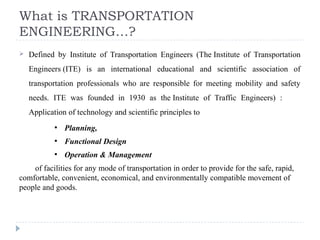
What is TRANSPORTATION
ENGINEERING…?
 Defined by Institute of Transportation Engineers (The Institute of Transportation
Engineers (ITE) is an international educational and scientific association of
transportation professionals who are responsible for meeting mobility and safety
needs. ITE was founded in 1930 as the Institute of Traffic Engineers) :
Application of technology and scientific principles to
●
Planning,
●
Functional Design
●
Operation & Management
of facilities for any mode of transportation in order to provide for the safe, rapid,
comfortable, convenient, economical, and environmentally compatible movement of
people and goods.
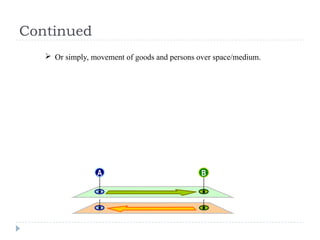
A B
 Or simply, movement of goods and persons over space/medium.
Continued
ROLE OF TRANSPORTATION
 The importance of Transportation in the development of a country is
multidimensional. A country’s economic status depends on how well served the
country is by different modes of Transport.
 Contributes in the development of
– Economy
– Industry
– Culture
 Its importance is comparable to the veins in the human body.
 Every commodity needs transport facilities, both at the production as well as
distribution stage.
DEVELOPING FACILITIES
 Planning (initial planning)
 Preliminary design (Screen alternatives and best is selected)
 Detailed design (Detail Engineering design)
 Construction
 Operations (Facility constructed, used by people and for goods)
 Planning…. (Demand grows and process is repeated)
 So development is not a one time job but essentially a cyclic process
 Again and again demand increases after some time and process is repeated
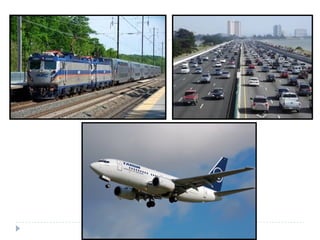
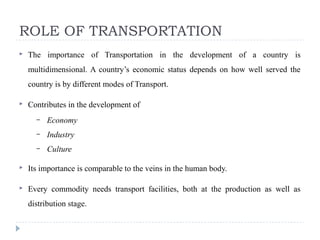
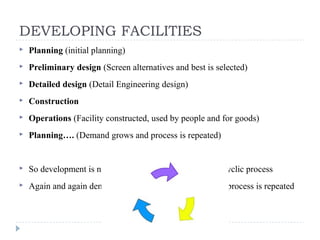
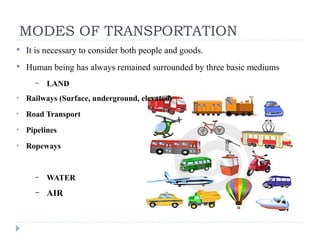
MODES OF TRANSPORTATION
 It is necessary to consider both people and goods.
 Human being has always remained surrounded by three basic mediums
– LAND
• Railways (Surface, underground, elevated)
• Road Transport
• Pipelines
• Ropeways
– WATER
– AIR
CHARATERISTICS OF ROADS TRANSPORT
 Among all modes of transportation road transportation is nearest to people for
various reasons
i. Low capital investment (general comparison with other modes but it very a lot
on type of road for example high speed facility requiring high quality of road)
ii. Flexible services
iii. More freedom to users while travelling (you can stop, go)
iv. Ability to accommodate various types of vehicles at a time
v. Quick and assured door to door service (rail and air transport are faster but they
cant provide door to door service)
vi. Faster and cheaper service particularly for short distance travel (for long
distances say within two countries or within same big country air and rail
transport will be fast as compared to road transport)
 Mode of transportation on land
 Not only includes highways but also
– City streets
– Feeder roads
– Village roads
 The only mode which can give maximum service to one and all.
 It has the maximum flexibility for travel with respect to route, direction,
time and speed of travel etc.
 In this mode it is possible to provide door to door service.
ROADWAYS
RAILWAYS
 Railways are steel tracks laid on the grounds.
 Developed both for long as well as short distances.
 Advantageous for longer distances.
 Railway could serve as arteries while roadway as feeder for transportation system.
 A train could move at much higher speeds than pneumatic tier vehicles.
 Steel track can also take heavy axle load about three to four times heavier than the road.
 Cheapest mode of transport.
 Safe in comparison to road transport.
WATERWAYS
 In waterways ships and boats are used to transport people and materials.
 Transportation by this system is possible between the ports on the sea route or along
the rivers or canals where ever inland navigation facilities are available.
 Speed of this system is the lowest among the four modes.
 It needs minimum energy to haul unit load through unit distance.
AIRWAYS
 In airways aircrafts and helicopters are used.
 In old days gas filled airships and balloons were used.
 The fastest and more comfortable system apart from saving time.
 But costliest among all the modes.
 Confined to government officials and rich peoples.
OTHERS
 Apart from these four systems pipelines are also used for transportation of
– Water
– Gas
– Crude oil etc.
 As minor transportation system following are also used,
– Elevators
– Cable cars
– Monorails
– Aerial rope ways
– Conveyers belts
– Electric transmission lines
SCOPE OF HIGHWAY ENGINEERING
 Planning and location of facilities
 Alignment selection and geometric design
 Pavement design
 Material, construction and maintenance (type of material conventional any new type,
how to construct road to produce better quality of roads, faster construction, whatever
you construct, over a period of time it will require maintenance, maintenance strategy,
process of maintenance
 Traffic operations and its control ( we want to create a facility but at the same time
we want our facility to operate at maximum efficiency, how best we can make use of
the available facility through efficient control and management system
 Economics, finance and administration (where from the funding will come)
 Environmental and social impact (not at cost of environment)
CHOICE OF MODE OF TRANSPORTATION
 The choice of mode of transportation depends upon,
– Length of the haul
– Weight and size of consignment
– Traffic density
– Nature of route
– Quality of service
CHARACTERISTICS OF ROAD TRANSPORT
 Passengers and goods have to be transported first by road.
 Can serve the remotest places of a vast country.
 Road transport is closest to people of all modes.
 Can briefly be described as follow,
1. USES
2. Used by different kinds of vehicles like animal drawn carts and carriages, pedal cycles, rickshaws, motor cycles, cars, buses, trucks etc.
3. INVESTMENT
4. Less investment is required by the government.
5. FREEDOM OF USERS
6. Roadway offers complete freedom to its users.
7. Flexibility of changes in direction, speed and timings of travel.
8. SAVING IN TIME AND MONEY
9. Road transport is cheaper and time, in particular for short distance travel.
10. DEGREE OF ACCIDENTS
11. Subjected to high degree of accidents. WHY?
END

introduction to Transportation

  • 1.
    TRANSPORTATION PLANNING AND ENGINEERING– I L E C T U R E N o . 1 ENGR. TAHIR LECTURER, ABASYN UNIVERSITY, PESHAWAR
  • 2.
    What is TRANSPORTATION ENGINEERING…? Defined by Institute of Transportation Engineers (The Institute of Transportation Engineers (ITE) is an international educational and scientific association of transportation professionals who are responsible for meeting mobility and safety needs. ITE was founded in 1930 as the Institute of Traffic Engineers) : Application of technology and scientific principles to ● Planning, ● Functional Design ● Operation & Management of facilities for any mode of transportation in order to provide for the safe, rapid, comfortable, convenient, economical, and environmentally compatible movement of people and goods.
  • 3.
    A B  Orsimply, movement of goods and persons over space/medium. Continued
  • 5.
    ROLE OF TRANSPORTATION The importance of Transportation in the development of a country is multidimensional. A country’s economic status depends on how well served the country is by different modes of Transport.  Contributes in the development of – Economy – Industry – Culture  Its importance is comparable to the veins in the human body.  Every commodity needs transport facilities, both at the production as well as distribution stage.
  • 6.
    DEVELOPING FACILITIES  Planning(initial planning)  Preliminary design (Screen alternatives and best is selected)  Detailed design (Detail Engineering design)  Construction  Operations (Facility constructed, used by people and for goods)  Planning…. (Demand grows and process is repeated)  So development is not a one time job but essentially a cyclic process  Again and again demand increases after some time and process is repeated
  • 7.
    MODES OF TRANSPORTATION It is necessary to consider both people and goods.  Human being has always remained surrounded by three basic mediums – LAND • Railways (Surface, underground, elevated) • Road Transport • Pipelines • Ropeways – WATER – AIR
  • 8.
    CHARATERISTICS OF ROADSTRANSPORT  Among all modes of transportation road transportation is nearest to people for various reasons i. Low capital investment (general comparison with other modes but it very a lot on type of road for example high speed facility requiring high quality of road) ii. Flexible services iii. More freedom to users while travelling (you can stop, go) iv. Ability to accommodate various types of vehicles at a time v. Quick and assured door to door service (rail and air transport are faster but they cant provide door to door service) vi. Faster and cheaper service particularly for short distance travel (for long distances say within two countries or within same big country air and rail transport will be fast as compared to road transport)
  • 9.
     Mode oftransportation on land  Not only includes highways but also – City streets – Feeder roads – Village roads  The only mode which can give maximum service to one and all.  It has the maximum flexibility for travel with respect to route, direction, time and speed of travel etc.  In this mode it is possible to provide door to door service. ROADWAYS
  • 10.
    RAILWAYS  Railways aresteel tracks laid on the grounds.  Developed both for long as well as short distances.  Advantageous for longer distances.  Railway could serve as arteries while roadway as feeder for transportation system.  A train could move at much higher speeds than pneumatic tier vehicles.  Steel track can also take heavy axle load about three to four times heavier than the road.  Cheapest mode of transport.  Safe in comparison to road transport.
  • 11.
    WATERWAYS  In waterwaysships and boats are used to transport people and materials.  Transportation by this system is possible between the ports on the sea route or along the rivers or canals where ever inland navigation facilities are available.  Speed of this system is the lowest among the four modes.  It needs minimum energy to haul unit load through unit distance.
  • 12.
    AIRWAYS  In airwaysaircrafts and helicopters are used.  In old days gas filled airships and balloons were used.  The fastest and more comfortable system apart from saving time.  But costliest among all the modes.  Confined to government officials and rich peoples.
  • 13.
    OTHERS  Apart fromthese four systems pipelines are also used for transportation of – Water – Gas – Crude oil etc.  As minor transportation system following are also used, – Elevators – Cable cars – Monorails – Aerial rope ways – Conveyers belts – Electric transmission lines
  • 14.
    SCOPE OF HIGHWAYENGINEERING  Planning and location of facilities  Alignment selection and geometric design  Pavement design  Material, construction and maintenance (type of material conventional any new type, how to construct road to produce better quality of roads, faster construction, whatever you construct, over a period of time it will require maintenance, maintenance strategy, process of maintenance  Traffic operations and its control ( we want to create a facility but at the same time we want our facility to operate at maximum efficiency, how best we can make use of the available facility through efficient control and management system  Economics, finance and administration (where from the funding will come)  Environmental and social impact (not at cost of environment)
  • 15.
    CHOICE OF MODEOF TRANSPORTATION  The choice of mode of transportation depends upon, – Length of the haul – Weight and size of consignment – Traffic density – Nature of route – Quality of service
  • 16.
    CHARACTERISTICS OF ROADTRANSPORT  Passengers and goods have to be transported first by road.  Can serve the remotest places of a vast country.  Road transport is closest to people of all modes.  Can briefly be described as follow, 1. USES 2. Used by different kinds of vehicles like animal drawn carts and carriages, pedal cycles, rickshaws, motor cycles, cars, buses, trucks etc. 3. INVESTMENT 4. Less investment is required by the government. 5. FREEDOM OF USERS 6. Roadway offers complete freedom to its users. 7. Flexibility of changes in direction, speed and timings of travel. 8. SAVING IN TIME AND MONEY 9. Road transport is cheaper and time, in particular for short distance travel. 10. DEGREE OF ACCIDENTS 11. Subjected to high degree of accidents. WHY?
  • 17.

Editor's Notes

  • #3 <number>