2/27/2014

1










2/27/2014

2
GROUP NO:6
GROUP MEMBERS:

TAWFIQ RAHMAN
RAIHAN MANNAN
SADIA MANNAN
MD.TANVIR ALAM
IKHTIAR KHAN
IFAT HASAN
MD.ASIF RAHMAN
SARANI REZA

2/27/2014

ID NO.

10.01.03.080
10.01.03.101
10.01.03.102
10.01.03.104
10.01.03.106
10.01.03.107
10.01.03.108
10.01.03.110

3
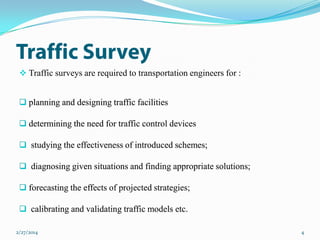
 Traffic surveys are required to transportation engineers for :
 planning and designing traffic facilities
 determining the need for traffic control devices

 studying the effectiveness of introduced schemes;
 diagnosing given situations and finding appropriate solutions;
 forecasting the effects of projected strategies;
 calibrating and validating traffic models etc.
2/27/2014

4
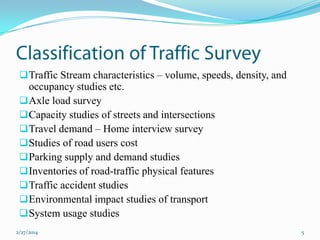
 Traffic Stream characteristics – volume, speeds, density, and

occupancy studies etc.
 Axle load survey
 Capacity studies of streets and intersections
 Travel demand – Home interview survey
 Studies of road users cost
 Parking supply and demand studies
 Inventories of road-traffic physical features
 Traffic accident studies
 Environmental impact studies of transport
 System usage studies
2/27/2014

5
2/27/2014

6
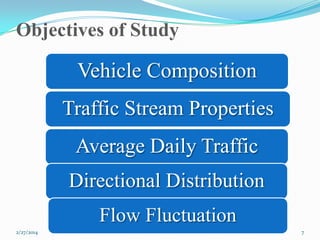
Objectives of Study

Vehicle Composition
Traffic Stream Properties

Average Daily Traffic
Directional Distribution
Flow Fluctuation
2/27/2014

7
 Traffic volume studies are conducted to determine the volume of

traffic moving on the roads and classifications of roadway
vehicles at a particular section during a particular time.
 Volumes of a day or an hour can vary greatly, depending on the
different day of the week or different time period of a day.
 Traffic Volume survey is the determination of the number,

movement and classifications of roadway vehicles at a given
location.

2/27/2014

8
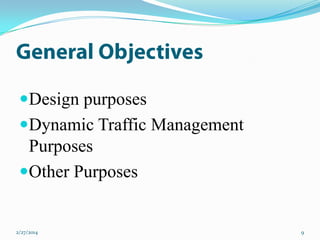
Design purposes
Dynamic Traffic Management

Purposes
Other Purposes

2/27/2014

9
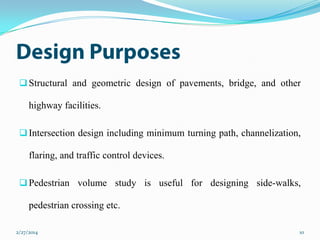
 Structural and geometric design of pavements, bridge, and other

highway facilities.
 Intersection design including minimum turning path, channelization,

flaring, and traffic control devices.
 Pedestrian volume study is useful for designing side-walks,

pedestrian crossing etc.
2/27/2014

10
Dynamic Traffic Management
Purposes
Up to date and continuous flow/congestion information is essential
for optimizing - Traffic signal design and thereby improving junction
performance and Network productivity by providing information to
the road user.

2/27/2014

11
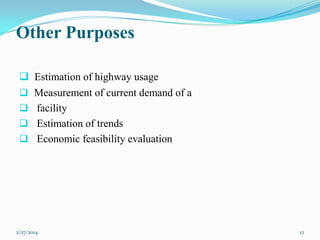
Other Purposes
 Estimation of highway usage
 Measurement of current demand of a
 facility
 Estimation of trends
 Economic feasibility evaluation

2/27/2014

12
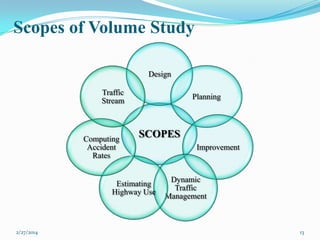
Scopes of Volume Study
Design
Traffic
Stream

Computing
Accident
Rates

Planning

SCOPES

Estimating
Highway Use

2/27/2014

Improvement

Dynamic
Traffic
Management

13
Volume/flow

Rate of flow
Average Daily Traffic (ADT )
Average Annual Daily Traffic (AADT)
Design Hourly Volume
Service flow rate

Directional Distribution
2/27/2014

14
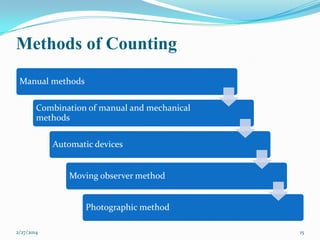
Methods of Counting
Manual methods
Combination of manual and mechanical
methods
Automatic devices

Moving observer method

Photographic method
2/27/2014

15
Manual Count Recording
Method

2/27/2014

16
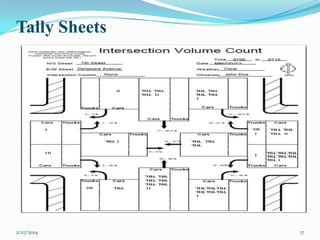
Tally Sheets

2/27/2014

17
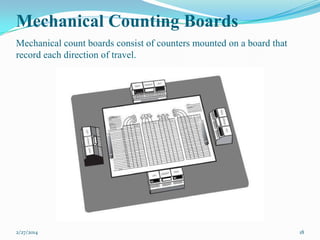
Mechanical Counting Boards
Mechanical count boards consist of counters mounted on a board that
record each direction of travel.

2/27/2014

18
 Electronic counting boards are battery-operated, hand-held

devices used in collecting traffic count data.

2/27/2014

19
 Prepare :
 Determine the type of equipment to use, the field procedures to follow, and the

number of observers required.
 Label and organize tally sheets
 Select observer location(s) :

Observers (data collectors) should be positioned where they have a clear view of
traffic and are safely away from the edge of the roadway.
 Record observations on site.
2/27/2014

20
Automatic Counting Methods
 An automatic survey involves placing a tube or loop across a road which is

connected to a box containing the means for storing the information.
 In this method, vehicles are counted automatically without any human

involvement.
 There are two techniques of automatic counting: a) Contact system based on

pneumatic, mechanical, magnetic or piezo-electric method and b)
Contactless

system

based

on

electrical/optical,

ultrasound/infrared

radar, micro wave, CCTV/video image processing method etc.
2/27/2014

21
2/27/2014

22
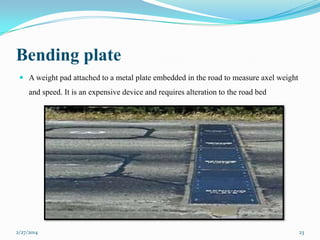
Bending plate
 A weight pad attached to a metal plate embedded in the road to measure axel weight

and speed. It is an expensive device and requires alteration to the road bed

2/27/2014

23
Pneumatic road tube

Figure : Pneumatic Road Tube
2/27/2014

24
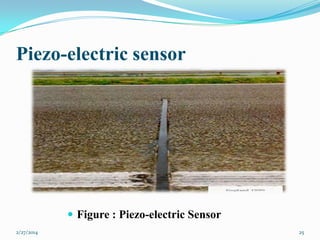
Piezo-electric sensor

 Figure : Piezo-electric Sensor
2/27/2014

25
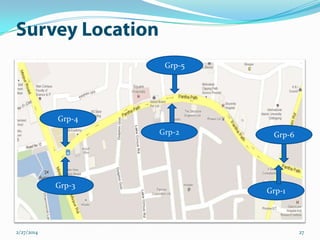
Data Collection

2/27/2014

26
Grp-5

Grp-4
Grp-2

Grp-3

2/27/2014

Grp-6

Grp-1

27
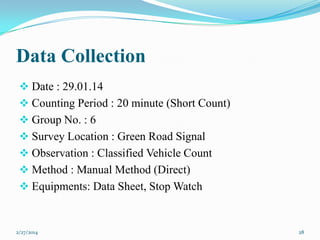
Data Collection
 Date : 29.01.14
 Counting Period : 20 minute (Short Count)
 Group No. : 6

 Survey Location : Green Road Signal
 Observation : Classified Vehicle Count
 Method : Manual Method (Direct)
 Equipments: Data Sheet, Stop Watch

2/27/2014

28
2/27/2014

29
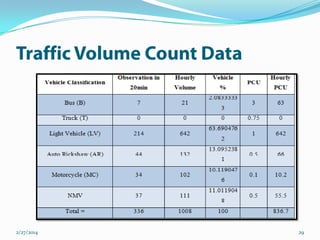
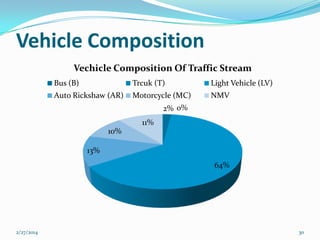
Vehicle Composition
Vechicle Composition Of Traffic Stream
Bus (B)

Trcuk (T)

Light Vehicle (LV)

Auto Rickshaw (AR)

Motorcycle (MC)

NMV

2% 0%
11%
10%
13%
64%

2/27/2014

30
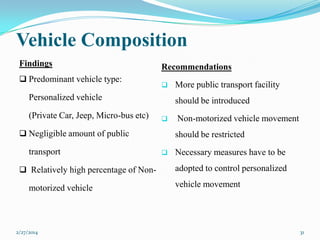
Vehicle Composition
Findings
 Predominant vehicle type:

Recommendations


Personalized vehicle
(Private Car, Jeep, Micro-bus etc)

should be introduced


 Negligible amount of public

transport
 Relatively high percentage of Non-

motorized vehicle

2/27/2014

More public transport facility

Non-motorized vehicle movement
should be restricted



Necessary measures have to be
adopted to control personalized
vehicle movement

31
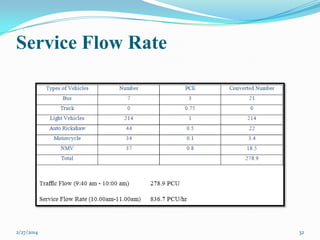
Service Flow Rate

2/27/2014

32
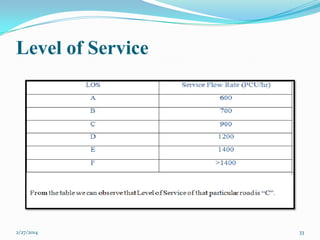
Level of Service

2/27/2014

33
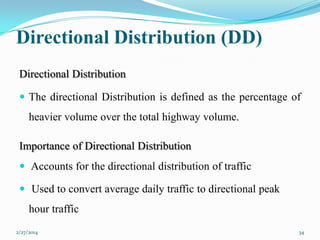
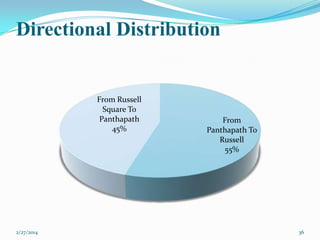
Directional Distribution (DD)
Directional Distribution
 The directional Distribution is defined as the percentage of

heavier volume over the total highway volume.
Importance of Directional Distribution
 Accounts for the directional distribution of traffic
 Used to convert average daily traffic to directional peak

hour traffic
2/27/2014

34
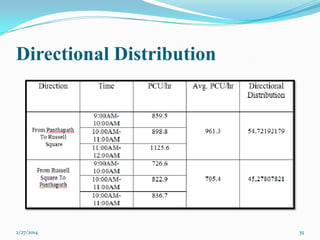
Directional Distribution

2/27/2014

35
Directional Distribution

From Russell
Square To
Panthapath
45%

2/27/2014

From
Panthapath To
Russell
55%

36
Flow Fluctuation Curve
Flow Fluctuation Curve(PCU/hr ve Time

1200

1000

PCU/hr

800

600

400

200

0
1

2/27/2014

2

3

37
Discussion on Flow Fluctuation
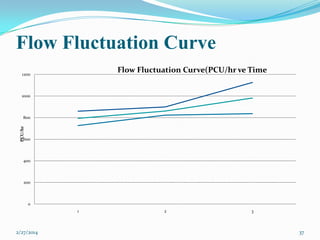
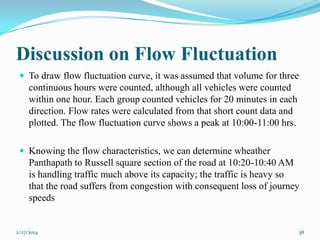
 To draw flow fluctuation curve, it was assumed that volume for three

continuous hours were counted, although all vehicles were counted
within one hour. Each group counted vehicles for 20 minutes in each
direction. Flow rates were calculated from that short count data and
plotted. The flow fluctuation curve shows a peak at 10:00-11:00 hrs.
 Knowing the flow characteristics, we can determine wheather

Panthapath to Russell square section of the road at 10:20-10:40 AM
is handling traffic much above its capacity; the traffic is heavy so
that the road suffers from congestion with consequent loss of journey
speeds

2/27/2014

38
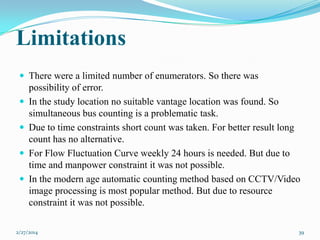
Limitations
 There were a limited number of enumerators. So there was





possibility of error.
In the study location no suitable vantage location was found. So
simultaneous bus counting is a problematic task.
Due to time constraints short count was taken. For better result long
count has no alternative.
For Flow Fluctuation Curve weekly 24 hours is needed. But due to
time and manpower constraint it was not possible.
In the modern age automatic counting method based on CCTV/Video
image processing is most popular method. But due to resource
constraint it was not possible.

2/27/2014

39
Recommendations










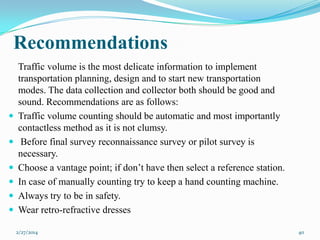
Traffic volume is the most delicate information to implement
transportation planning, design and to start new transportation
modes. The data collection and collector both should be good and
sound. Recommendations are as follows:
Traffic volume counting should be automatic and most importantly
contactless method as it is not clumsy.
Before final survey reconnaissance survey or pilot survey is
necessary.
Choose a vantage point; if don’t have then select a reference station.
In case of manually counting try to keep a hand counting machine.
Always try to be in safety.
Wear retro-refractive dresses
2/27/2014

40
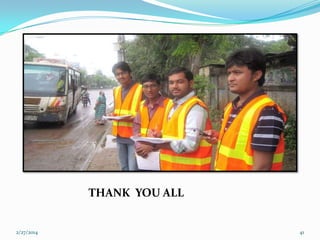
THANK YOU ALL

2/27/2014

41

Traffic Volume Studies

  • 1.
  • 2.
  • 3.
    GROUP NO:6 GROUP MEMBERS: TAWFIQRAHMAN RAIHAN MANNAN SADIA MANNAN MD.TANVIR ALAM IKHTIAR KHAN IFAT HASAN MD.ASIF RAHMAN SARANI REZA 2/27/2014 ID NO. 10.01.03.080 10.01.03.101 10.01.03.102 10.01.03.104 10.01.03.106 10.01.03.107 10.01.03.108 10.01.03.110 3
  • 4.
     Traffic surveysare required to transportation engineers for :  planning and designing traffic facilities  determining the need for traffic control devices  studying the effectiveness of introduced schemes;  diagnosing given situations and finding appropriate solutions;  forecasting the effects of projected strategies;  calibrating and validating traffic models etc. 2/27/2014 4
  • 5.
     Traffic Streamcharacteristics – volume, speeds, density, and occupancy studies etc.  Axle load survey  Capacity studies of streets and intersections  Travel demand – Home interview survey  Studies of road users cost  Parking supply and demand studies  Inventories of road-traffic physical features  Traffic accident studies  Environmental impact studies of transport  System usage studies 2/27/2014 5
  • 6.
  • 7.
    Objectives of Study VehicleComposition Traffic Stream Properties Average Daily Traffic Directional Distribution Flow Fluctuation 2/27/2014 7
  • 8.
     Traffic volumestudies are conducted to determine the volume of traffic moving on the roads and classifications of roadway vehicles at a particular section during a particular time.  Volumes of a day or an hour can vary greatly, depending on the different day of the week or different time period of a day.  Traffic Volume survey is the determination of the number, movement and classifications of roadway vehicles at a given location. 2/27/2014 8
  • 9.
    Design purposes Dynamic TrafficManagement Purposes Other Purposes 2/27/2014 9
  • 10.
     Structural andgeometric design of pavements, bridge, and other highway facilities.  Intersection design including minimum turning path, channelization, flaring, and traffic control devices.  Pedestrian volume study is useful for designing side-walks, pedestrian crossing etc. 2/27/2014 10
  • 11.
    Dynamic Traffic Management Purposes Upto date and continuous flow/congestion information is essential for optimizing - Traffic signal design and thereby improving junction performance and Network productivity by providing information to the road user. 2/27/2014 11
  • 12.
    Other Purposes  Estimationof highway usage  Measurement of current demand of a  facility  Estimation of trends  Economic feasibility evaluation 2/27/2014 12
  • 13.
    Scopes of VolumeStudy Design Traffic Stream Computing Accident Rates Planning SCOPES Estimating Highway Use 2/27/2014 Improvement Dynamic Traffic Management 13
  • 14.
    Volume/flow Rate of flow AverageDaily Traffic (ADT ) Average Annual Daily Traffic (AADT) Design Hourly Volume Service flow rate Directional Distribution 2/27/2014 14
  • 15.
    Methods of Counting Manualmethods Combination of manual and mechanical methods Automatic devices Moving observer method Photographic method 2/27/2014 15
  • 16.
  • 17.
  • 18.
    Mechanical Counting Boards Mechanicalcount boards consist of counters mounted on a board that record each direction of travel. 2/27/2014 18
  • 19.
     Electronic countingboards are battery-operated, hand-held devices used in collecting traffic count data. 2/27/2014 19
  • 20.
     Prepare : Determine the type of equipment to use, the field procedures to follow, and the number of observers required.  Label and organize tally sheets  Select observer location(s) : Observers (data collectors) should be positioned where they have a clear view of traffic and are safely away from the edge of the roadway.  Record observations on site. 2/27/2014 20
  • 21.
    Automatic Counting Methods An automatic survey involves placing a tube or loop across a road which is connected to a box containing the means for storing the information.  In this method, vehicles are counted automatically without any human involvement.  There are two techniques of automatic counting: a) Contact system based on pneumatic, mechanical, magnetic or piezo-electric method and b) Contactless system based on electrical/optical, ultrasound/infrared radar, micro wave, CCTV/video image processing method etc. 2/27/2014 21
  • 22.
  • 23.
    Bending plate  Aweight pad attached to a metal plate embedded in the road to measure axel weight and speed. It is an expensive device and requires alteration to the road bed 2/27/2014 23
  • 24.
    Pneumatic road tube Figure: Pneumatic Road Tube 2/27/2014 24
  • 25.
    Piezo-electric sensor  Figure: Piezo-electric Sensor 2/27/2014 25
  • 26.
  • 27.
  • 28.
    Data Collection  Date: 29.01.14  Counting Period : 20 minute (Short Count)  Group No. : 6  Survey Location : Green Road Signal  Observation : Classified Vehicle Count  Method : Manual Method (Direct)  Equipments: Data Sheet, Stop Watch 2/27/2014 28
  • 29.
  • 30.
    Vehicle Composition Vechicle CompositionOf Traffic Stream Bus (B) Trcuk (T) Light Vehicle (LV) Auto Rickshaw (AR) Motorcycle (MC) NMV 2% 0% 11% 10% 13% 64% 2/27/2014 30
  • 31.
    Vehicle Composition Findings  Predominantvehicle type: Recommendations  Personalized vehicle (Private Car, Jeep, Micro-bus etc) should be introduced   Negligible amount of public transport  Relatively high percentage of Non- motorized vehicle 2/27/2014 More public transport facility Non-motorized vehicle movement should be restricted  Necessary measures have to be adopted to control personalized vehicle movement 31
  • 32.
  • 33.
  • 34.
    Directional Distribution (DD) DirectionalDistribution  The directional Distribution is defined as the percentage of heavier volume over the total highway volume. Importance of Directional Distribution  Accounts for the directional distribution of traffic  Used to convert average daily traffic to directional peak hour traffic 2/27/2014 34
  • 35.
  • 36.
    Directional Distribution From Russell SquareTo Panthapath 45% 2/27/2014 From Panthapath To Russell 55% 36
  • 37.
    Flow Fluctuation Curve FlowFluctuation Curve(PCU/hr ve Time 1200 1000 PCU/hr 800 600 400 200 0 1 2/27/2014 2 3 37
  • 38.
    Discussion on FlowFluctuation  To draw flow fluctuation curve, it was assumed that volume for three continuous hours were counted, although all vehicles were counted within one hour. Each group counted vehicles for 20 minutes in each direction. Flow rates were calculated from that short count data and plotted. The flow fluctuation curve shows a peak at 10:00-11:00 hrs.  Knowing the flow characteristics, we can determine wheather Panthapath to Russell square section of the road at 10:20-10:40 AM is handling traffic much above its capacity; the traffic is heavy so that the road suffers from congestion with consequent loss of journey speeds 2/27/2014 38
  • 39.
    Limitations  There werea limited number of enumerators. So there was     possibility of error. In the study location no suitable vantage location was found. So simultaneous bus counting is a problematic task. Due to time constraints short count was taken. For better result long count has no alternative. For Flow Fluctuation Curve weekly 24 hours is needed. But due to time and manpower constraint it was not possible. In the modern age automatic counting method based on CCTV/Video image processing is most popular method. But due to resource constraint it was not possible. 2/27/2014 39
  • 40.
    Recommendations       Traffic volume isthe most delicate information to implement transportation planning, design and to start new transportation modes. The data collection and collector both should be good and sound. Recommendations are as follows: Traffic volume counting should be automatic and most importantly contactless method as it is not clumsy. Before final survey reconnaissance survey or pilot survey is necessary. Choose a vantage point; if don’t have then select a reference station. In case of manually counting try to keep a hand counting machine. Always try to be in safety. Wear retro-refractive dresses 2/27/2014 40
  • 41.