.
Transportation Engineering
A sub-specialty of Civil
Engineering, which deals with the
application of scientific principles
to the planning, design,
construction, operation and
management, and maintenance
of transportation systems.
.
Transportation
The movement of people
and goods to meet the
basic needs of society that
require mobility and
access.
.
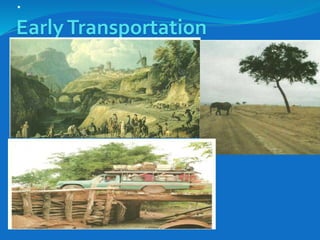
EarlyTransportation
.
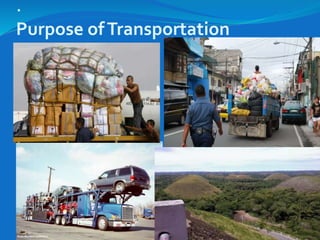
Purpose ofTransportation
 To provide mechanism for the exchange of
goods, people, information, and to support
economic improvements for society.
 Provide means to travel for purposes of
employment, exploration, or personal
fulfillment and is a necessary condition for
human activities such as commerce,
recreation, and defense.
 Provide opportunities for global economic
activities for the nation’s development and
.
Purpose ofTransportation
.
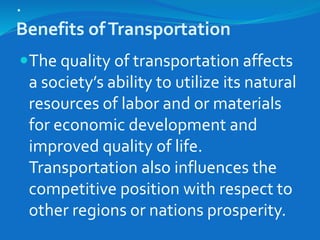
Benefits ofTransportation
The quality of transportation affects
a society’s ability to utilize its natural
resources of labor and or materials
for economic development and
improved quality of life.
Transportation also influences the
competitive position with respect to
other regions or nations prosperity.
.
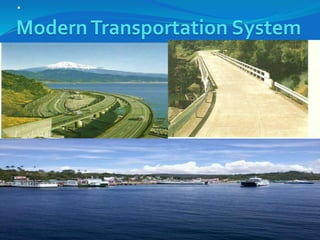
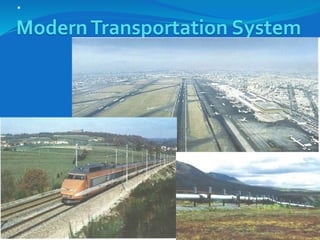
ModernTransportation System
.
ModernTransportation System
.
Benefits ofTransportation
Contributes to economic growth of a
region or a nation.
Expansion of opportunities in the
pursuit of happiness.
Improved health care services
evidenced by quick movement of
medicines and patients and access to
specialized medical facilities.
.
Benefits ofTransportation
 Air and sea lifts have declined hunger due to
food shortages brought about by famine, war,
and weather.
 Extension of life expectancy, enhanced
opportunities for advanced education and
technical training, increased incomes and
standards of living, broader recreational
options, reduction of inequality in education
and employment, and wider participation in
worldwide multicultural experiences.
.
Costs of ImprovedTransportation
 Direct Costs
Direct costs of improved transportation can be
divided into two categories namely: capital costs
which includes costs of right of way, facilities and
maintenance. Operating costs which covers day to
day expenditures like labor, fuel tires and batteries
and maintenance for the modes of transportation.
 Indirect Costs
Indirect costs cover environmental effects,
congestion, property damage, injuries and death.
.
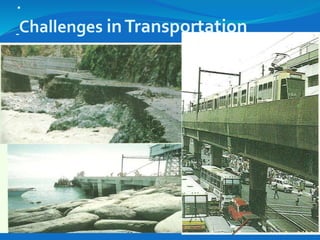
Challenges inTransportation
Transportation has played a major role in every
aspect of ancient and modern civilization.The
growth and decline of nations in history has been
related to their ability to move on and protect their
trade and military routes, harbors, and navigated
rivers.The need to link activities taking place in
various locations and to convey persons and goods
over these links has increased as society has become
more complex. Success in meeting this need has
been a major contributor to increased standards of
living around the world.
.
Challenges inTransportation
.
Disciplines Involved inTransportation
Civil Engineers - responsible for the
development, structural design, construction,
and maintenance of the fixed facilities of
transportation systems
Automotive, mechanical, and aeronautical
engineers as well as naval architects - responsible
for the development and design of various modes, in
transportation.
Electrical engineers and electronics engineers
develop power, communications, and control
systems
.
Disciplines Involved inTransportation
 Human factor specialists - study the
complexities of human performance as vehicle
operators and passengers. Other fields include
economics, geography, city planning, public
administration, and political science.
“The broad approach to transportation
engineering is essential for the provision of
safe, efficient, and convenient movement of
people and goods.”
.
TheTransportation Engineer
The increasing complexities and rapid changes
in the transportation field require personnel
qualified in the most modern analytic skills
and technical subjects, the transportation
must have the following qualifications:
Must be a total system oriented, able to
analyze the relationship of networks, terminal
requirements, and the relations of each
system of transportation to the other modes
of transportation.
.
TheTransportation Engineer
The engineer must have a well-developed
concern for the public interest and a thorough
knowledge of political processes.
Up to the challenge of direct, meaningful
public service having a working knowledge of
the many ways in which transportation serves
the society while influencing community
development.
.
TRANSPORTATION SYSTEMS AND CHARACTERISTICS
I. Highway System –The most accessible
among transportation systems and built to
the highest construction standards.
 Mode Trucks, buses, automobiles, bicycle.
 Passenger Service Intercity and local,
recreational.
 Freight Service Intercity and local; all
commodities generally small shipments;
containers, packages on an intercity service
.
TRANSPORTATION SYSTEMS AND CHARACTERISTICS
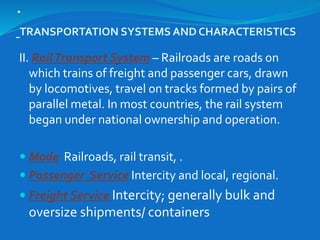
II. RailTransport System – Railroads are roads on
which trains of freight and passenger cars, drawn
by locomotives, travel on tracks formed by pairs of
parallel metal. In most countries, the rail system
began under national ownership and operation.
 Mode Railroads, rail transit, .
 Passenger Service Intercity and local, regional.
 Freight Service Intercity; generally bulk and
oversize shipments/ containers
.
TRANSPORTATION SYSTEMS AND CHARACTERISTICS
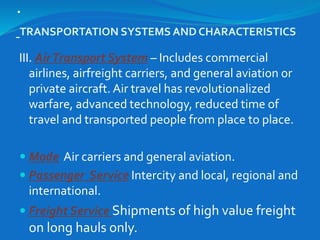
III. AirTransport System – Includes commercial
airlines, airfreight carriers, and general aviation or
private aircraft. Air travel has revolutionalized
warfare, advanced technology, reduced time of
travel and transported people from place to place.
 Mode Air carriers and general aviation.
 Passenger Service Intercity and local, regional and
international.
 Freight Service Shipments of high value freight
on long hauls only.
.
TRANSPORTATION SYSTEMS AND CHARACTERISTICS
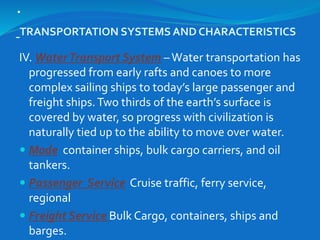
IV. WaterTransport System –Water transportation has
progressed from early rafts and canoes to more
complex sailing ships to today’s large passenger and
freight ships.Two thirds of the earth’s surface is
covered by water, so progress with civilization is
naturally tied up to the ability to move over water.
 Mode container ships, bulk cargo carriers, and oil
tankers.
 Passenger Service Cruise traffic, ferry service,
regional
 Freight Service Bulk Cargo, containers, ships and
barges.
.
TRANSPORTATION SYSTEMS AND CHARACTERISTICS
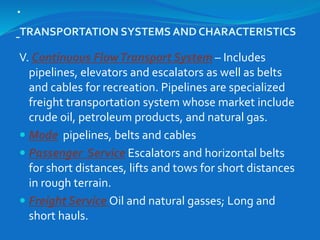
V. Continuous FlowTransport System – Includes
pipelines, elevators and escalators as well as belts
and cables for recreation. Pipelines are specialized
freight transportation system whose market include
crude oil, petroleum products, and natural gas.
 Mode pipelines, belts and cables
 Passenger Service Escalators and horizontal belts
for short distances, lifts and tows for short distances
in rough terrain.
 Freight Service Oil and natural gasses; Long and
short hauls.

Introduction Transportation

  • 2.
    . Transportation Engineering A sub-specialtyof Civil Engineering, which deals with the application of scientific principles to the planning, design, construction, operation and management, and maintenance of transportation systems.
  • 3.
    . Transportation The movement ofpeople and goods to meet the basic needs of society that require mobility and access.
  • 4.
  • 5.
    . Purpose ofTransportation  Toprovide mechanism for the exchange of goods, people, information, and to support economic improvements for society.  Provide means to travel for purposes of employment, exploration, or personal fulfillment and is a necessary condition for human activities such as commerce, recreation, and defense.  Provide opportunities for global economic activities for the nation’s development and
  • 6.
  • 7.
    . Benefits ofTransportation The qualityof transportation affects a society’s ability to utilize its natural resources of labor and or materials for economic development and improved quality of life. Transportation also influences the competitive position with respect to other regions or nations prosperity.
  • 8.
  • 9.
  • 10.
    . Benefits ofTransportation Contributes toeconomic growth of a region or a nation. Expansion of opportunities in the pursuit of happiness. Improved health care services evidenced by quick movement of medicines and patients and access to specialized medical facilities.
  • 11.
    . Benefits ofTransportation  Airand sea lifts have declined hunger due to food shortages brought about by famine, war, and weather.  Extension of life expectancy, enhanced opportunities for advanced education and technical training, increased incomes and standards of living, broader recreational options, reduction of inequality in education and employment, and wider participation in worldwide multicultural experiences.
  • 12.
    . Costs of ImprovedTransportation Direct Costs Direct costs of improved transportation can be divided into two categories namely: capital costs which includes costs of right of way, facilities and maintenance. Operating costs which covers day to day expenditures like labor, fuel tires and batteries and maintenance for the modes of transportation.  Indirect Costs Indirect costs cover environmental effects, congestion, property damage, injuries and death.
  • 13.
    . Challenges inTransportation Transportation hasplayed a major role in every aspect of ancient and modern civilization.The growth and decline of nations in history has been related to their ability to move on and protect their trade and military routes, harbors, and navigated rivers.The need to link activities taking place in various locations and to convey persons and goods over these links has increased as society has become more complex. Success in meeting this need has been a major contributor to increased standards of living around the world.
  • 14.
  • 15.
    . Disciplines Involved inTransportation CivilEngineers - responsible for the development, structural design, construction, and maintenance of the fixed facilities of transportation systems Automotive, mechanical, and aeronautical engineers as well as naval architects - responsible for the development and design of various modes, in transportation. Electrical engineers and electronics engineers develop power, communications, and control systems
  • 16.
    . Disciplines Involved inTransportation Human factor specialists - study the complexities of human performance as vehicle operators and passengers. Other fields include economics, geography, city planning, public administration, and political science. “The broad approach to transportation engineering is essential for the provision of safe, efficient, and convenient movement of people and goods.”
  • 17.
    . TheTransportation Engineer The increasingcomplexities and rapid changes in the transportation field require personnel qualified in the most modern analytic skills and technical subjects, the transportation must have the following qualifications: Must be a total system oriented, able to analyze the relationship of networks, terminal requirements, and the relations of each system of transportation to the other modes of transportation.
  • 18.
    . TheTransportation Engineer The engineermust have a well-developed concern for the public interest and a thorough knowledge of political processes. Up to the challenge of direct, meaningful public service having a working knowledge of the many ways in which transportation serves the society while influencing community development.
  • 19.
    . TRANSPORTATION SYSTEMS ANDCHARACTERISTICS I. Highway System –The most accessible among transportation systems and built to the highest construction standards.  Mode Trucks, buses, automobiles, bicycle.  Passenger Service Intercity and local, recreational.  Freight Service Intercity and local; all commodities generally small shipments; containers, packages on an intercity service
  • 20.
    . TRANSPORTATION SYSTEMS ANDCHARACTERISTICS II. RailTransport System – Railroads are roads on which trains of freight and passenger cars, drawn by locomotives, travel on tracks formed by pairs of parallel metal. In most countries, the rail system began under national ownership and operation.  Mode Railroads, rail transit, .  Passenger Service Intercity and local, regional.  Freight Service Intercity; generally bulk and oversize shipments/ containers
  • 21.
    . TRANSPORTATION SYSTEMS ANDCHARACTERISTICS III. AirTransport System – Includes commercial airlines, airfreight carriers, and general aviation or private aircraft. Air travel has revolutionalized warfare, advanced technology, reduced time of travel and transported people from place to place.  Mode Air carriers and general aviation.  Passenger Service Intercity and local, regional and international.  Freight Service Shipments of high value freight on long hauls only.
  • 22.
    . TRANSPORTATION SYSTEMS ANDCHARACTERISTICS IV. WaterTransport System –Water transportation has progressed from early rafts and canoes to more complex sailing ships to today’s large passenger and freight ships.Two thirds of the earth’s surface is covered by water, so progress with civilization is naturally tied up to the ability to move over water.  Mode container ships, bulk cargo carriers, and oil tankers.  Passenger Service Cruise traffic, ferry service, regional  Freight Service Bulk Cargo, containers, ships and barges.
  • 23.
    . TRANSPORTATION SYSTEMS ANDCHARACTERISTICS V. Continuous FlowTransport System – Includes pipelines, elevators and escalators as well as belts and cables for recreation. Pipelines are specialized freight transportation system whose market include crude oil, petroleum products, and natural gas.  Mode pipelines, belts and cables  Passenger Service Escalators and horizontal belts for short distances, lifts and tows for short distances in rough terrain.  Freight Service Oil and natural gasses; Long and short hauls.