INTRODUCTION TO TRANSPORTATION
ENGINEERING
Engr. Adrian M. Reyes
WHAT IS TRANSPORTATION?
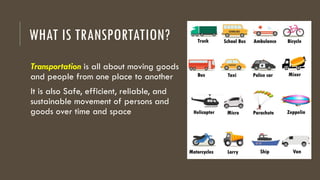
Transportation is all about moving goods
and people from one place to another
It is also Safe, efficient, reliable, and
sustainable movement of persons and
goods over time and space
WHAT IS TRANSPORTATION ENGINEERING?
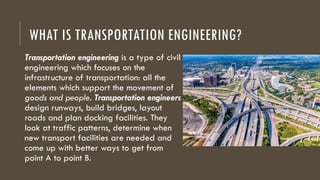
Transportation engineering is a type of civil
engineering which focuses on the
infrastructure of transportation: all the
elements which support the movement of
goods and people. Transportation engineers
design runways, build bridges, layout
roads and plan docking facilities. They
look at traffic patterns, determine when
new transport facilities are needed and
come up with better ways to get from
point A to point B.
WHAT IS TRANSPORTATION ENGINEERING?
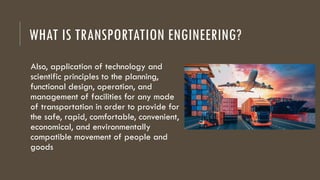
Also, application of technology and
scientific principles to the planning,
functional design, operation, and
management of facilities for any mode
of transportation in order to provide for
the safe, rapid, comfortable, convenient,
economical, and environmentally
compatible movement of people and
goods
Mobility is a basic human need. From the times immemorial,
everyone travels either for food or leisure. A closely associated
need is the transport of raw materials to a manufacturing unit or
finished goods for consumption.
Transportation fulfils these basic needs of humanity.
Transportation plays a major role in the development of the human
civilization. For instance, one could easily observe the strong
correlation between the evolution of human settlement and the
proximity of transport facilities.
Also, there is a strong correlation between the quality of
transport facilities and standard of living, because of which
society places a great expectation from transportation
facilities.
In other words, the solution to transportation problems must be
analytically based, economically sound, socially credible,
environmentally sensitive, and practically acceptable and
sustainable.
Alternatively, the transportation solution should be safe,
rapid, comfortable, convenient, economical, and eco friendly
for both men and material.
THE CHARACTERISTICS OF TRANSPORTATION
SYSTEM
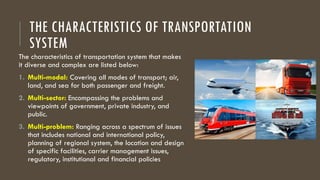
The characteristics of transportation system that makes
it diverse and complex are listed below:
1. Multi-modal: Covering all modes of transport; air,
land, and sea for both passenger and freight.
2. Multi-sector: Encompassing the problems and
viewpoints of government, private industry, and
public.
3. Multi-problem: Ranging across a spectrum of issues
that includes national and international policy,
planning of regional system, the location and design
of specific facilities, carrier management issues,
regulatory, institutional and financial policies
THE CHARACTERISTICS OF TRANSPORTATION
SYSTEM
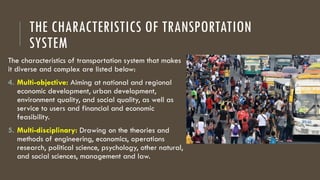
The characteristics of transportation system that makes
it diverse and complex are listed below:
4. Multi-objective: Aiming at national and regional
economic development, urban development,
environment quality, and social quality, as well as
service to users and financial and economic
feasibility.
5. Multi-disciplinary: Drawing on the theories and
methods of engineering, economics, operations
research, political science, psychology, other natural,
and social sciences, management and law.
THE CONTEXT IN WHICH TRANSPORTATION SYSTEM IS STUDIED IS ALSO VERY
DIVERSE AND ARE MENTIONED BELOW:
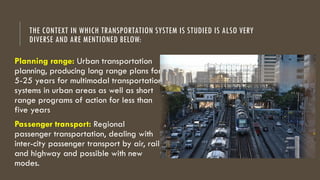
Planning range: Urban transportation
planning, producing long range plans for
5-25 years for multimodal transportation
systems in urban areas as well as short
range programs of action for less than
five years
Passenger transport: Regional
passenger transportation, dealing with
inter-city passenger transport by air, rail,
and highway and possible with new
modes.
THE CONTEXT IN WHICH TRANSPORTATION SYSTEM IS STUDIED IS ALSO VERY
DIVERSE AND ARE MENTIONED BELOW:
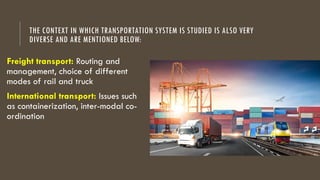
Freight transport: Routing and
management, choice of different
modes of rail and truck
International transport: Issues such
as containerization, inter-modal co-
ordination
Therefore as we understand from above Transportation engineering
is a very diverse and multidisciplinary field, which deals with the
planning, design, operation and maintenance of transportation
systems. Good transportation is that which provides safe, rapid,
comfortable, convenient, economical, and environmentally
compatible movement of both goods and people. This profession
carries a distinct societal responsibility.
3 ELEMENTS OF TRANSPORTATION SYSTEM
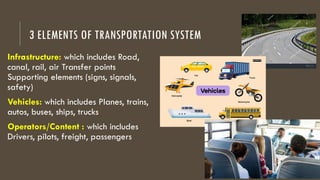
Infrastructure: which includes Road,
canal, rail, air Transfer points
Supporting elements (signs, signals,
safety)
Vehicles: which includes Planes, trains,
autos, buses, ships, trucks
Operators/Content : which includes
Drivers, pilots, freight, passengers
HISTORY OF TRANSPORTATION ENGINEERING
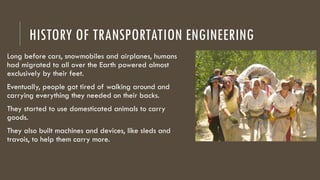
Long before cars, snowmobiles and airplanes, humans
had migrated to all over the Earth powered almost
exclusively by their feet.
Eventually, people got tired of walking around and
carrying everything they needed on their backs.
They started to use domesticated animals to carry
goods.
They also built machines and devices, like sleds and
travois, to help them carry more.
HISTORY OF TRANSPORTATION ENGINEERING
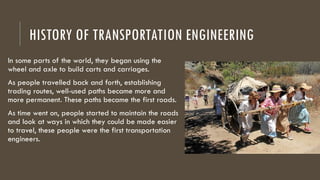
In some parts of the world, they began using the
wheel and axle to build carts and carriages.
As people travelled back and forth, establishing
trading routes, well-used paths became more and
more permanent. These paths became the first roads.
As time went on, people started to maintain the roads
and look at ways in which they could be made easier
to travel, these people were the first transportation
engineers.
FOUR CRITICAL DIMENSIONS OF CHANGE IN
TRANSPORTATION SYSTEM
Change in the demand: When the population,
income, and land-use pattern changes, the
pattern of demand changes; both in the amount
and spatial distribution of that demand.
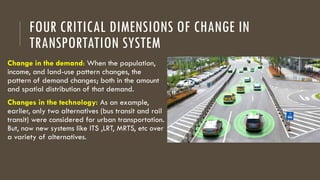
Changes in the technology: As an example,
earlier, only two alternatives (bus transit and rail
transit) were considered for urban transportation.
But, now new systems like ITS ,LRT, MRTS, etc over
a variety of alternatives.
FOUR CRITICAL DIMENSIONS OF CHANGE IN
TRANSPORTATION SYSTEM
Change in operational policy: Variety of policy
options designed to improve the efficiency, such
as incentive for car-pooling, bus fare, road tolls
etc.
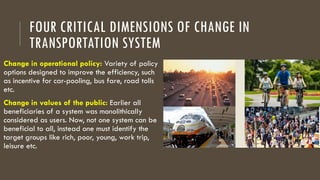
Change in values of the public: Earlier all
beneficiaries of a system was monolithically
considered as users. Now, not one system can be
beneficial to all, instead one must identify the
target groups like rich, poor, young, work trip,
leisure etc.
MAJOR DISCIPLINES OF TRANSPORTATION
Transportation engineering can be broadly
consisting of the four major parts:
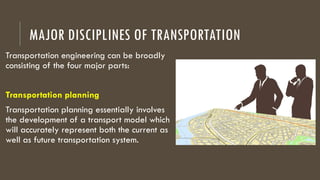
Transportation planning
Transportation planning essentially involves
the development of a transport model which
will accurately represent both the current as
well as future transportation system.
MAJOR DISCIPLINES OF TRANSPORTATION
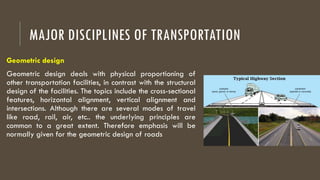
Geometric design
Geometric design deals with physical proportioning of
other transportation facilities, in contrast with the structural
design of the facilities. The topics include the cross-sectional
features, horizontal alignment, vertical alignment and
intersections. Although there are several modes of travel
like road, rail, air, etc.. the underlying principles are
common to a great extent. Therefore emphasis will be
normally given for the geometric design of roads
MAJOR DISCIPLINES OF TRANSPORTATION
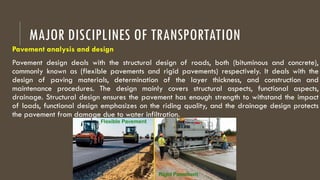
Pavement analysis and design
Pavement design deals with the structural design of roads, both (bituminous and concrete),
commonly known as (flexible pavements and rigid pavements) respectively. It deals with the
design of paving materials, determination of the layer thickness, and construction and
maintenance procedures. The design mainly covers structural aspects, functional aspects,
drainage. Structural design ensures the pavement has enough strength to withstand the impact
of loads, functional design emphasizes on the riding quality, and the drainage design protects
the pavement from damage due to water infiltration.
MAJOR DISCIPLINES OF TRANSPORTATION
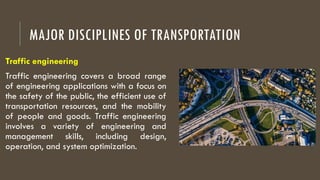
Traffic engineering
Traffic engineering covers a broad range
of engineering applications with a focus on
the safety of the public, the efficient use of
transportation resources, and the mobility
of people and goods. Traffic engineering
involves a variety of engineering and
management skills, including design,
operation, and system optimization.
OTHER IMPORTANT DISCIPLINES
Public transportation: Public transportation or mass transportation deals with study of
the transportation system that meets the travel need of several people by sharing a
vehicle. Generally, this focuses on the urban travel by bus and rail transit. The major
topics include characteristics of various modes; planning, management and operations;
and policies for promoting public transportation.
Financial and economic analysis: Transportation facilities require large capital
investments. Therefore, it is imperative that whoever invests money should get the returns.
When government invests in transportation, its objective is not often monetary returns; but
social benefits. The economic analysis of transportation project tries to quantify the
economic benefit which includes saving in travel time, fuel consumption, etc. This will help
the planner in evaluating various projects and to optimally allocate funds. On the
contrary, private sector investments require monetary profits from the projects. Financial
evaluation tries to quantify the return from a project.
OTHER IMPORTANT DISCIPLINES
Environmental impact assessment : The depletion of fossil fuels and the degradation of the
environment has been a severe concern of the planners in the past few decades.
Transportation; in spite of its benefits to the society is a major contributor to the above
concern.
Accident analysis and reduction: One of the silent killers of humanity is transportation.
Several statistics evaluates that more people are killed due to transportation than great wars
and natural disasters. This discipline of transportation looks at the causes of accidents, from
the perspective of human, road, and vehicle and formulate plans for the reduction.
Intelligent transport system: With advent to computers, communication, and vehicle
technology, it is possible in these days to operate transportation system much effectively with
significant reduction in the adverse impacts of transportation. Intelligent transportation system
offers better mobility, efficiency, and safety with the help of the state-of-the-art-technology.
FACTORS IN TRANSPORTATION DEVELOPMENT
Transportation develops because of several and frequently overlapping
factors. From the many, the following are important:
Economic Factors
Almost all transport development is economic in origin. The chief
preoccupation of the first human was the procurement of food, shelter and
sometimes clothing. As they become more highly developed their needs
increased, often beyond what their local economy could supply
FACTORS IN TRANSPORTATION DEVELOPMENT
Geographical Factor
Geography is closely related to economics. The geographical location of
natural resources determines the transport routes that gives access to those
resources and create economic utility, that is, time and place utility, by taking
them from a location where they have little values to processing and consuming
areas where their values is vastly increased.
FACTORS IN TRANSPORTATION DEVELOPMENT
Political Policies
Political policies frequently play a deciding role in transport development.
Basically, is in a way to form integrated political system and control.
Military
The military might of a nation is primarily intended to support its political
polices and to provide for national defense. Consequently, often it has direct
influence on transport development.
FACTORS IN TRANSPORTATION DEVELOPMENT
Technological Factor
Progress in direct and supporting technologies has played an obvious role in
transportation, for instance introduction of new economical transportation mode
to the exist system calls for the development of transportation
Competition
The competitive urges have given a powerful impetus to transport development.
Railroads compete with railroad also with trucks, barges, pipelines and airlines.
Airlines have counted heavily on speed but have also been forced to greater
safety and dependability to meet ground transport competition.
FACTORS IN TRANSPORTATION DEVELOPMENT
Urbanization
The rapid growth of urban areas by an even more rapidly expanding
population is a phenomenon that cannot be overlooked among transport
development factors. Accessibility to land and the intensity of land use are
closely related to transport availability.
ROLE OF TRANSPORTATION IN SOCIETY
Transportation is a non separable part of any society. It exhibits a
very close relation to the style of life, the range and location of
activities and the goods and services which will be available for
consumption. Advances in transportation has made possible
changes in the way of living and the way in which societies are
organized and therefore have a great influence in the
development of civilizations. This topic conveys an understanding of
the importance of transportation in the modern society by
presenting selected characteristics of existing transportation
systems, their use and relationships to other human activities.
ROLE OF TRANSPORTATION IN SOCIETY
Transportation is responsible for the development of civilizations
from very old times by meeting travel requirement of people and
transport requirement of goods. Such movement has changed the
way people live and travel. In developed and developing nations,
a large fraction of people travel daily for work, shopping and
social reasons. But transport also consumes a lot of resources like
time, fuel, materials and land.
ROLE OF TRANSPORTATION IN SOCIETY
Economic role of transportation
Economics involves production, distribution and consumption of goods and
services. People depend upon the natural resources to satisfy the needs of life
but due to non uniform surface of earth and due to difference in local resources,
there is a lot of difference in standard of living in different societies. So, there is
an immense requirement of transport of resources from one particular society to
other. These resources can range from material things to knowledge and skills
like movement of doctors and technicians to the places where there is need of
them. Without the ability to transport manufactured goods, raw materials, and
technical know-how, a country is simply unable to maximize the comparative
advantage it may have in the form of natural or human resources.
ROLE OF TRANSPORTATION IN SOCIETY
Social role of transportation
Transportation has always played an important role in influencing the
formation of urban societies. Although other facilities like availability of food
and water, played a major role, the contribution of transportation can be seen
clearly from the formation, size and pattern, and the development of societies,
especially urban centers.
Formation of settlements: From the beginning of civilization, the man is living in
settlements which existed near banks of major river junctions, a port, or an
intersection of trade routes.
ROLE OF TRANSPORTATION IN SOCIETY
Social role of transportation
Transportation has always played an important role in influencing the
formation of urban societies. Although other facilities like availability of food
and water, played a major role, the contribution of transportation can be seen
clearly from the formation, size and pattern, and the development of societies,
especially urban centers.
Size and Pattern of Settlement: the initial settlements were relatively small
developments but with due course of time, they grew in population and
developed into big cities and major trade centers. The size of settlements is
not only limited by the size of the area by which the settlement can obtain
food and other necessities, but also by considerations of personal travels
especially the journey to and from work. The increased speed of transport
and reduction in the cost of transport has resulted in variety of spatial
patterns.
ROLE OF TRANSPORTATION IN SOCIETY
Social role of transportation
Transportation has always played an important role in influencing the
formation of urban societies. Although other facilities like availability of food
and water, played a major role, the contribution of transportation can be seen
clearly from the formation, size and pattern, and the development of societies,
especially urban centers.
Growth of Urban Centers: When the cities grow beyond normal walking
distance, then transportation technology plays a role in the formation of the
city. For example, many cities in the plains developed as a circular city with
radial routes, where as the cities beside a river developed linearly. The
development of automobiles and other factors like increase in personal
income, and construction of paved road network, the settlements were
transformed into urban centers of intense travel activity.
ROLE OF TRANSPORTATION IN SOCIETY
Environmental role of transportation
The negative effects of transportation are more dominating than its useful
aspects as far as transportation is concerned. There are numerous categories
into which the environmental effects have been categorized. They are
explained in the following sections.
Safety
Present indications are that about half a million killed and about 15 million injured on the
road accidents annually. Increased variation in the speeds and vehicle density resulted in a
high exposure to accidents. Accidents result in loss of life and permanent disability, injury, and
damage to property. Accidents also causes numerous non-quantifiable impacts like loss of
time, grief to the near ones of the victim, and inconvenience to the public. The loss of life and
damage from natural disasters, industrial accidents, or epidemic often receive significant
attention from both government and public. This is because their occurrence is concentrated
but sparse. On the other hand, accidents from transport sector are widespread and occurs
with high frequency.
ROLE OF TRANSPORTATION IN SOCIETY
Environmental role of transportation
The negative effects of transportation are more dominating than its useful
aspects as far as transportation is concerned. There are numerous categories
into which the environmental effects have been categorized. They are
explained in the following sections.
Air Pollution
All transport modes consume energy and the most common source of energy is from the
burning of fossil fuels like coal, petrol, diesel, etc. The relation between air pollution and
respiratory disease has been demonstrated by various studies and the detrimental effects on
the planet earth are widely recognized recently. The combustion of the fuels releases several
contaminants into the atmosphere, including carbon monoxide, hydrocarbons, oxides of
nitrogen, and other particulate matter. Hydrocarbons are the result of incomplete combustion
of fuels. Particulate matters are minute solid or liquid particles that are suspended in the
atmosphere. They include aerosols, smoke, and dust particles. These air pollutants once
emitted into the atmosphere, undergo mixing and disperse into the surroundings.
ROLE OF TRANSPORTATION IN SOCIETY
Environmental role of transportation
The negative effects of transportation are more dominating than its useful
aspects as far as transportation is concerned. There are numerous categories
into which the environmental effects have been categorized. They are
explained in the following sections.
Noise pollution
Sound is acoustical energy released into atmosphere by vibrating or moving bodies where as
noise is unwanted sound produced. Transportation is a major contributor of noise pollution,
especially in urban areas. Noise is generated during both construction and operation. During
construction, operation of large equipments causes considerable noise to the neighborhood.
During the operation, noise is generated by the engine and exhaust systems of vehicle,
aerodynamic friction, and the interaction between the vehicle and the support system (road-
tire, rail-wheel). Extended exposure to excessive sound has been shown to produce physical
and psychological damage. Further, because of its annoyance and disturbance, noise adds to
mental stress and fatigue
ROLE OF TRANSPORTATION IN SOCIETY
Environmental role of transportation
The negative effects of transportation are more dominating than its useful
aspects as far as transportation is concerned. There are numerous categories
into which the environmental effects have been categorized. They are
explained in the following sections.
Energy consumption
The spectacular growths in industrial and economic growth during the past century have been
closely related to an abundant supply of inexpensive energy from fossil fuels. Transportation
sector is unbelieved to consume more than half of the petroleum products. The compact of the
shortage of fuel was experienced during major wars when strict rationing was imposed in
many countries. The impact of this had cascading effects on many factors of society, especially
in the price escalation of essential commodities.
ROLE OF TRANSPORTATION IN SOCIETY
Environmental role of transportation
The negative effects of transportation are more dominating than its useful
aspects as far as transportation is concerned. There are numerous categories
into which the environmental effects have been categorized. They are
explained in the following sections.
Other impacts
Transportation directly or indirectly affects many other areas of society and few of then are
listed below: Increased travel requirement also require additional land for transport facilities.
A good transportation system takes considerable amount of land from the society.
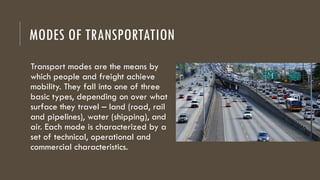
MODES OF TRANSPORTATION
Transport modes are the means by
which people and freight achieve
mobility. They fall into one of three
basic types, depending on over what
surface they travel – land (road, rail
and pipelines), water (shipping), and
air. Each mode is characterized by a
set of technical, operational and
commercial characteristics.
MODES OF TRANSPORTATION
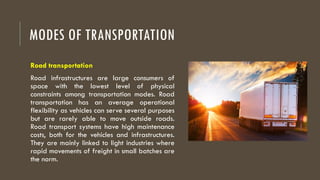
Road transportation
Road infrastructures are large consumers of
space with the lowest level of physical
constraints among transportation modes. Road
transportation has an average operational
flexibility as vehicles can serve several purposes
but are rarely able to move outside roads.
Road transport systems have high maintenance
costs, both for the vehicles and infrastructures.
They are mainly linked to light industries where
rapid movements of freight in small batches are
the norm.
MODES OF TRANSPORTATION
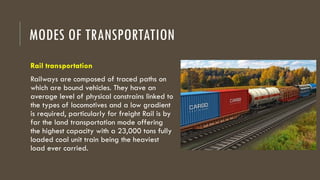
Rail transportation
Railways are composed of traced paths on
which are bound vehicles. They have an
average level of physical constrains linked to
the types of locomotives and a low gradient
is required, particularly for freight Rail is by
far the land transportation mode offering
the highest capacity with a 23,000 tons fully
loaded coal unit train being the heaviest
load ever carried.
MODES OF TRANSPORTATION
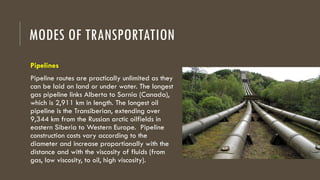
Pipelines
Pipeline routes are practically unlimited as they
can be laid on land or under water. The longest
gas pipeline links Alberta to Sarnia (Canada),
which is 2,911 km in length. The longest oil
pipeline is the Transiberian, extending over
9,344 km from the Russian arctic oilfields in
eastern Siberia to Western Europe. Pipeline
construction costs vary according to the
diameter and increase proportionally with the
distance and with the viscosity of fluids (from
gas, low viscosity, to oil, high viscosity).
MODES OF TRANSPORTATION
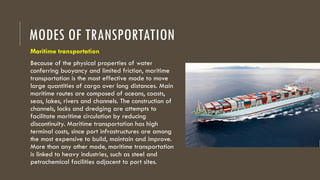
Maritime transportation
Because of the physical properties of water
conferring buoyancy and limited friction, maritime
transportation is the most effective mode to move
large quantities of cargo over long distances. Main
maritime routes are composed of oceans, coasts,
seas, lakes, rivers and channels. The construction of
channels, locks and dredging are attempts to
facilitate maritime circulation by reducing
discontinuity. Maritime transportation has high
terminal costs, since port infrastructures are among
the most expensive to build, maintain and improve.
More than any other mode, maritime transportation
is linked to heavy industries, such as steel and
petrochemical facilities adjacent to port sites.
MODES OF TRANSPORTATION
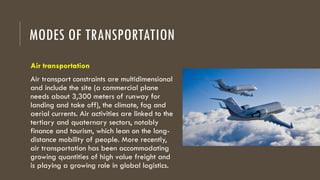
Air transportation
Air transport constraints are multidimensional
and include the site (a commercial plane
needs about 3,300 meters of runway for
landing and take off), the climate, fog and
aerial currents. Air activities are linked to the
tertiary and quaternary sectors, notably
finance and tourism, which lean on the long-
distance mobility of people. More recently,
air transportation has been accommodating
growing quantities of high value freight and
is playing a growing role in global logistics.
MODES OF TRANSPORTATION
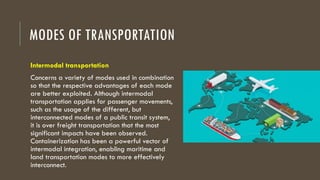
Intermodal transportation
Concerns a variety of modes used in combination
so that the respective advantages of each mode
are better exploited. Although intermodal
transportation applies for passenger movements,
such as the usage of the different, but
interconnected modes of a public transit system,
it is over freight transportation that the most
significant impacts have been observed.
Containerization has been a powerful vector of
intermodal integration, enabling maritime and
land transportation modes to more effectively
interconnect.

Introduction to Transportation Engineering.pptx

  • 1.
  • 2.
    WHAT IS TRANSPORTATION? Transportationis all about moving goods and people from one place to another It is also Safe, efficient, reliable, and sustainable movement of persons and goods over time and space
  • 3.
    WHAT IS TRANSPORTATIONENGINEERING? Transportation engineering is a type of civil engineering which focuses on the infrastructure of transportation: all the elements which support the movement of goods and people. Transportation engineers design runways, build bridges, layout roads and plan docking facilities. They look at traffic patterns, determine when new transport facilities are needed and come up with better ways to get from point A to point B.
  • 4.
    WHAT IS TRANSPORTATIONENGINEERING? Also, application of technology and scientific principles to the planning, functional design, operation, and management of facilities for any mode of transportation in order to provide for the safe, rapid, comfortable, convenient, economical, and environmentally compatible movement of people and goods
  • 5.
    Mobility is abasic human need. From the times immemorial, everyone travels either for food or leisure. A closely associated need is the transport of raw materials to a manufacturing unit or finished goods for consumption. Transportation fulfils these basic needs of humanity. Transportation plays a major role in the development of the human civilization. For instance, one could easily observe the strong correlation between the evolution of human settlement and the proximity of transport facilities.
  • 6.
    Also, there isa strong correlation between the quality of transport facilities and standard of living, because of which society places a great expectation from transportation facilities. In other words, the solution to transportation problems must be analytically based, economically sound, socially credible, environmentally sensitive, and practically acceptable and sustainable. Alternatively, the transportation solution should be safe, rapid, comfortable, convenient, economical, and eco friendly for both men and material.
  • 7.
    THE CHARACTERISTICS OFTRANSPORTATION SYSTEM The characteristics of transportation system that makes it diverse and complex are listed below: 1. Multi-modal: Covering all modes of transport; air, land, and sea for both passenger and freight. 2. Multi-sector: Encompassing the problems and viewpoints of government, private industry, and public. 3. Multi-problem: Ranging across a spectrum of issues that includes national and international policy, planning of regional system, the location and design of specific facilities, carrier management issues, regulatory, institutional and financial policies
  • 8.
    THE CHARACTERISTICS OFTRANSPORTATION SYSTEM The characteristics of transportation system that makes it diverse and complex are listed below: 4. Multi-objective: Aiming at national and regional economic development, urban development, environment quality, and social quality, as well as service to users and financial and economic feasibility. 5. Multi-disciplinary: Drawing on the theories and methods of engineering, economics, operations research, political science, psychology, other natural, and social sciences, management and law.
  • 9.
    THE CONTEXT INWHICH TRANSPORTATION SYSTEM IS STUDIED IS ALSO VERY DIVERSE AND ARE MENTIONED BELOW: Planning range: Urban transportation planning, producing long range plans for 5-25 years for multimodal transportation systems in urban areas as well as short range programs of action for less than five years Passenger transport: Regional passenger transportation, dealing with inter-city passenger transport by air, rail, and highway and possible with new modes.
  • 10.
    THE CONTEXT INWHICH TRANSPORTATION SYSTEM IS STUDIED IS ALSO VERY DIVERSE AND ARE MENTIONED BELOW: Freight transport: Routing and management, choice of different modes of rail and truck International transport: Issues such as containerization, inter-modal co- ordination
  • 11.
    Therefore as weunderstand from above Transportation engineering is a very diverse and multidisciplinary field, which deals with the planning, design, operation and maintenance of transportation systems. Good transportation is that which provides safe, rapid, comfortable, convenient, economical, and environmentally compatible movement of both goods and people. This profession carries a distinct societal responsibility.
  • 12.
    3 ELEMENTS OFTRANSPORTATION SYSTEM Infrastructure: which includes Road, canal, rail, air Transfer points Supporting elements (signs, signals, safety) Vehicles: which includes Planes, trains, autos, buses, ships, trucks Operators/Content : which includes Drivers, pilots, freight, passengers
  • 13.
    HISTORY OF TRANSPORTATIONENGINEERING Long before cars, snowmobiles and airplanes, humans had migrated to all over the Earth powered almost exclusively by their feet. Eventually, people got tired of walking around and carrying everything they needed on their backs. They started to use domesticated animals to carry goods. They also built machines and devices, like sleds and travois, to help them carry more.
  • 14.
    HISTORY OF TRANSPORTATIONENGINEERING In some parts of the world, they began using the wheel and axle to build carts and carriages. As people travelled back and forth, establishing trading routes, well-used paths became more and more permanent. These paths became the first roads. As time went on, people started to maintain the roads and look at ways in which they could be made easier to travel, these people were the first transportation engineers.
  • 15.
    FOUR CRITICAL DIMENSIONSOF CHANGE IN TRANSPORTATION SYSTEM Change in the demand: When the population, income, and land-use pattern changes, the pattern of demand changes; both in the amount and spatial distribution of that demand. Changes in the technology: As an example, earlier, only two alternatives (bus transit and rail transit) were considered for urban transportation. But, now new systems like ITS ,LRT, MRTS, etc over a variety of alternatives.
  • 16.
    FOUR CRITICAL DIMENSIONSOF CHANGE IN TRANSPORTATION SYSTEM Change in operational policy: Variety of policy options designed to improve the efficiency, such as incentive for car-pooling, bus fare, road tolls etc. Change in values of the public: Earlier all beneficiaries of a system was monolithically considered as users. Now, not one system can be beneficial to all, instead one must identify the target groups like rich, poor, young, work trip, leisure etc.
  • 17.
    MAJOR DISCIPLINES OFTRANSPORTATION Transportation engineering can be broadly consisting of the four major parts: Transportation planning Transportation planning essentially involves the development of a transport model which will accurately represent both the current as well as future transportation system.
  • 18.
    MAJOR DISCIPLINES OFTRANSPORTATION Geometric design Geometric design deals with physical proportioning of other transportation facilities, in contrast with the structural design of the facilities. The topics include the cross-sectional features, horizontal alignment, vertical alignment and intersections. Although there are several modes of travel like road, rail, air, etc.. the underlying principles are common to a great extent. Therefore emphasis will be normally given for the geometric design of roads
  • 19.
    MAJOR DISCIPLINES OFTRANSPORTATION Pavement analysis and design Pavement design deals with the structural design of roads, both (bituminous and concrete), commonly known as (flexible pavements and rigid pavements) respectively. It deals with the design of paving materials, determination of the layer thickness, and construction and maintenance procedures. The design mainly covers structural aspects, functional aspects, drainage. Structural design ensures the pavement has enough strength to withstand the impact of loads, functional design emphasizes on the riding quality, and the drainage design protects the pavement from damage due to water infiltration.
  • 20.
    MAJOR DISCIPLINES OFTRANSPORTATION Traffic engineering Traffic engineering covers a broad range of engineering applications with a focus on the safety of the public, the efficient use of transportation resources, and the mobility of people and goods. Traffic engineering involves a variety of engineering and management skills, including design, operation, and system optimization.
  • 21.
    OTHER IMPORTANT DISCIPLINES Publictransportation: Public transportation or mass transportation deals with study of the transportation system that meets the travel need of several people by sharing a vehicle. Generally, this focuses on the urban travel by bus and rail transit. The major topics include characteristics of various modes; planning, management and operations; and policies for promoting public transportation. Financial and economic analysis: Transportation facilities require large capital investments. Therefore, it is imperative that whoever invests money should get the returns. When government invests in transportation, its objective is not often monetary returns; but social benefits. The economic analysis of transportation project tries to quantify the economic benefit which includes saving in travel time, fuel consumption, etc. This will help the planner in evaluating various projects and to optimally allocate funds. On the contrary, private sector investments require monetary profits from the projects. Financial evaluation tries to quantify the return from a project.
  • 22.
    OTHER IMPORTANT DISCIPLINES Environmentalimpact assessment : The depletion of fossil fuels and the degradation of the environment has been a severe concern of the planners in the past few decades. Transportation; in spite of its benefits to the society is a major contributor to the above concern. Accident analysis and reduction: One of the silent killers of humanity is transportation. Several statistics evaluates that more people are killed due to transportation than great wars and natural disasters. This discipline of transportation looks at the causes of accidents, from the perspective of human, road, and vehicle and formulate plans for the reduction. Intelligent transport system: With advent to computers, communication, and vehicle technology, it is possible in these days to operate transportation system much effectively with significant reduction in the adverse impacts of transportation. Intelligent transportation system offers better mobility, efficiency, and safety with the help of the state-of-the-art-technology.
  • 23.
    FACTORS IN TRANSPORTATIONDEVELOPMENT Transportation develops because of several and frequently overlapping factors. From the many, the following are important: Economic Factors Almost all transport development is economic in origin. The chief preoccupation of the first human was the procurement of food, shelter and sometimes clothing. As they become more highly developed their needs increased, often beyond what their local economy could supply
  • 24.
    FACTORS IN TRANSPORTATIONDEVELOPMENT Geographical Factor Geography is closely related to economics. The geographical location of natural resources determines the transport routes that gives access to those resources and create economic utility, that is, time and place utility, by taking them from a location where they have little values to processing and consuming areas where their values is vastly increased.
  • 25.
    FACTORS IN TRANSPORTATIONDEVELOPMENT Political Policies Political policies frequently play a deciding role in transport development. Basically, is in a way to form integrated political system and control. Military The military might of a nation is primarily intended to support its political polices and to provide for national defense. Consequently, often it has direct influence on transport development.
  • 26.
    FACTORS IN TRANSPORTATIONDEVELOPMENT Technological Factor Progress in direct and supporting technologies has played an obvious role in transportation, for instance introduction of new economical transportation mode to the exist system calls for the development of transportation Competition The competitive urges have given a powerful impetus to transport development. Railroads compete with railroad also with trucks, barges, pipelines and airlines. Airlines have counted heavily on speed but have also been forced to greater safety and dependability to meet ground transport competition.
  • 27.
    FACTORS IN TRANSPORTATIONDEVELOPMENT Urbanization The rapid growth of urban areas by an even more rapidly expanding population is a phenomenon that cannot be overlooked among transport development factors. Accessibility to land and the intensity of land use are closely related to transport availability.
  • 28.
    ROLE OF TRANSPORTATIONIN SOCIETY Transportation is a non separable part of any society. It exhibits a very close relation to the style of life, the range and location of activities and the goods and services which will be available for consumption. Advances in transportation has made possible changes in the way of living and the way in which societies are organized and therefore have a great influence in the development of civilizations. This topic conveys an understanding of the importance of transportation in the modern society by presenting selected characteristics of existing transportation systems, their use and relationships to other human activities.
  • 29.
    ROLE OF TRANSPORTATIONIN SOCIETY Transportation is responsible for the development of civilizations from very old times by meeting travel requirement of people and transport requirement of goods. Such movement has changed the way people live and travel. In developed and developing nations, a large fraction of people travel daily for work, shopping and social reasons. But transport also consumes a lot of resources like time, fuel, materials and land.
  • 30.
    ROLE OF TRANSPORTATIONIN SOCIETY Economic role of transportation Economics involves production, distribution and consumption of goods and services. People depend upon the natural resources to satisfy the needs of life but due to non uniform surface of earth and due to difference in local resources, there is a lot of difference in standard of living in different societies. So, there is an immense requirement of transport of resources from one particular society to other. These resources can range from material things to knowledge and skills like movement of doctors and technicians to the places where there is need of them. Without the ability to transport manufactured goods, raw materials, and technical know-how, a country is simply unable to maximize the comparative advantage it may have in the form of natural or human resources.
  • 31.
    ROLE OF TRANSPORTATIONIN SOCIETY Social role of transportation Transportation has always played an important role in influencing the formation of urban societies. Although other facilities like availability of food and water, played a major role, the contribution of transportation can be seen clearly from the formation, size and pattern, and the development of societies, especially urban centers. Formation of settlements: From the beginning of civilization, the man is living in settlements which existed near banks of major river junctions, a port, or an intersection of trade routes.
  • 32.
    ROLE OF TRANSPORTATIONIN SOCIETY Social role of transportation Transportation has always played an important role in influencing the formation of urban societies. Although other facilities like availability of food and water, played a major role, the contribution of transportation can be seen clearly from the formation, size and pattern, and the development of societies, especially urban centers. Size and Pattern of Settlement: the initial settlements were relatively small developments but with due course of time, they grew in population and developed into big cities and major trade centers. The size of settlements is not only limited by the size of the area by which the settlement can obtain food and other necessities, but also by considerations of personal travels especially the journey to and from work. The increased speed of transport and reduction in the cost of transport has resulted in variety of spatial patterns.
  • 33.
    ROLE OF TRANSPORTATIONIN SOCIETY Social role of transportation Transportation has always played an important role in influencing the formation of urban societies. Although other facilities like availability of food and water, played a major role, the contribution of transportation can be seen clearly from the formation, size and pattern, and the development of societies, especially urban centers. Growth of Urban Centers: When the cities grow beyond normal walking distance, then transportation technology plays a role in the formation of the city. For example, many cities in the plains developed as a circular city with radial routes, where as the cities beside a river developed linearly. The development of automobiles and other factors like increase in personal income, and construction of paved road network, the settlements were transformed into urban centers of intense travel activity.
  • 34.
    ROLE OF TRANSPORTATIONIN SOCIETY Environmental role of transportation The negative effects of transportation are more dominating than its useful aspects as far as transportation is concerned. There are numerous categories into which the environmental effects have been categorized. They are explained in the following sections. Safety Present indications are that about half a million killed and about 15 million injured on the road accidents annually. Increased variation in the speeds and vehicle density resulted in a high exposure to accidents. Accidents result in loss of life and permanent disability, injury, and damage to property. Accidents also causes numerous non-quantifiable impacts like loss of time, grief to the near ones of the victim, and inconvenience to the public. The loss of life and damage from natural disasters, industrial accidents, or epidemic often receive significant attention from both government and public. This is because their occurrence is concentrated but sparse. On the other hand, accidents from transport sector are widespread and occurs with high frequency.
  • 35.
    ROLE OF TRANSPORTATIONIN SOCIETY Environmental role of transportation The negative effects of transportation are more dominating than its useful aspects as far as transportation is concerned. There are numerous categories into which the environmental effects have been categorized. They are explained in the following sections. Air Pollution All transport modes consume energy and the most common source of energy is from the burning of fossil fuels like coal, petrol, diesel, etc. The relation between air pollution and respiratory disease has been demonstrated by various studies and the detrimental effects on the planet earth are widely recognized recently. The combustion of the fuels releases several contaminants into the atmosphere, including carbon monoxide, hydrocarbons, oxides of nitrogen, and other particulate matter. Hydrocarbons are the result of incomplete combustion of fuels. Particulate matters are minute solid or liquid particles that are suspended in the atmosphere. They include aerosols, smoke, and dust particles. These air pollutants once emitted into the atmosphere, undergo mixing and disperse into the surroundings.
  • 36.
    ROLE OF TRANSPORTATIONIN SOCIETY Environmental role of transportation The negative effects of transportation are more dominating than its useful aspects as far as transportation is concerned. There are numerous categories into which the environmental effects have been categorized. They are explained in the following sections. Noise pollution Sound is acoustical energy released into atmosphere by vibrating or moving bodies where as noise is unwanted sound produced. Transportation is a major contributor of noise pollution, especially in urban areas. Noise is generated during both construction and operation. During construction, operation of large equipments causes considerable noise to the neighborhood. During the operation, noise is generated by the engine and exhaust systems of vehicle, aerodynamic friction, and the interaction between the vehicle and the support system (road- tire, rail-wheel). Extended exposure to excessive sound has been shown to produce physical and psychological damage. Further, because of its annoyance and disturbance, noise adds to mental stress and fatigue
  • 37.
    ROLE OF TRANSPORTATIONIN SOCIETY Environmental role of transportation The negative effects of transportation are more dominating than its useful aspects as far as transportation is concerned. There are numerous categories into which the environmental effects have been categorized. They are explained in the following sections. Energy consumption The spectacular growths in industrial and economic growth during the past century have been closely related to an abundant supply of inexpensive energy from fossil fuels. Transportation sector is unbelieved to consume more than half of the petroleum products. The compact of the shortage of fuel was experienced during major wars when strict rationing was imposed in many countries. The impact of this had cascading effects on many factors of society, especially in the price escalation of essential commodities.
  • 38.
    ROLE OF TRANSPORTATIONIN SOCIETY Environmental role of transportation The negative effects of transportation are more dominating than its useful aspects as far as transportation is concerned. There are numerous categories into which the environmental effects have been categorized. They are explained in the following sections. Other impacts Transportation directly or indirectly affects many other areas of society and few of then are listed below: Increased travel requirement also require additional land for transport facilities. A good transportation system takes considerable amount of land from the society.
  • 39.
    MODES OF TRANSPORTATION Transportmodes are the means by which people and freight achieve mobility. They fall into one of three basic types, depending on over what surface they travel – land (road, rail and pipelines), water (shipping), and air. Each mode is characterized by a set of technical, operational and commercial characteristics.
  • 40.
    MODES OF TRANSPORTATION Roadtransportation Road infrastructures are large consumers of space with the lowest level of physical constraints among transportation modes. Road transportation has an average operational flexibility as vehicles can serve several purposes but are rarely able to move outside roads. Road transport systems have high maintenance costs, both for the vehicles and infrastructures. They are mainly linked to light industries where rapid movements of freight in small batches are the norm.
  • 41.
    MODES OF TRANSPORTATION Railtransportation Railways are composed of traced paths on which are bound vehicles. They have an average level of physical constrains linked to the types of locomotives and a low gradient is required, particularly for freight Rail is by far the land transportation mode offering the highest capacity with a 23,000 tons fully loaded coal unit train being the heaviest load ever carried.
  • 42.
    MODES OF TRANSPORTATION Pipelines Pipelineroutes are practically unlimited as they can be laid on land or under water. The longest gas pipeline links Alberta to Sarnia (Canada), which is 2,911 km in length. The longest oil pipeline is the Transiberian, extending over 9,344 km from the Russian arctic oilfields in eastern Siberia to Western Europe. Pipeline construction costs vary according to the diameter and increase proportionally with the distance and with the viscosity of fluids (from gas, low viscosity, to oil, high viscosity).
  • 43.
    MODES OF TRANSPORTATION Maritimetransportation Because of the physical properties of water conferring buoyancy and limited friction, maritime transportation is the most effective mode to move large quantities of cargo over long distances. Main maritime routes are composed of oceans, coasts, seas, lakes, rivers and channels. The construction of channels, locks and dredging are attempts to facilitate maritime circulation by reducing discontinuity. Maritime transportation has high terminal costs, since port infrastructures are among the most expensive to build, maintain and improve. More than any other mode, maritime transportation is linked to heavy industries, such as steel and petrochemical facilities adjacent to port sites.
  • 44.
    MODES OF TRANSPORTATION Airtransportation Air transport constraints are multidimensional and include the site (a commercial plane needs about 3,300 meters of runway for landing and take off), the climate, fog and aerial currents. Air activities are linked to the tertiary and quaternary sectors, notably finance and tourism, which lean on the long- distance mobility of people. More recently, air transportation has been accommodating growing quantities of high value freight and is playing a growing role in global logistics.
  • 45.
    MODES OF TRANSPORTATION Intermodaltransportation Concerns a variety of modes used in combination so that the respective advantages of each mode are better exploited. Although intermodal transportation applies for passenger movements, such as the usage of the different, but interconnected modes of a public transit system, it is over freight transportation that the most significant impacts have been observed. Containerization has been a powerful vector of intermodal integration, enabling maritime and land transportation modes to more effectively interconnect.