BY
ABDURRASHID ALHAJI DADA
CIV8330 TRAFFIC MANAGEMENT AND CONTROL
PRESENTED TO
Dr.H.M.Alhassan, BEng, MEng, PhD, MNSE, COREN
Department of Civil Engineering, Bayero University Kano.
 ROAD NETWORK
 LITERATURE REVIEW
 DESIGN
 CHARACTERISTICS
 ASSESMENT AND ANALYSIS
 OPERATION AND CONTROL
INTRODUCTION
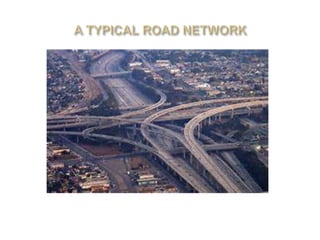
 The road network is the system of interconnected roads
designed to accommodate wheeled road going vehicles and
pedestrian traffic.
 The road network consists of a system of interconnected
paved carriageways which are designed to carry buses, cars
and goods vehicles; the road network generally forms the
most basic level of transport infrastructure within urban
areas, and will link with all other areas, both within and
beyond the boundaries of the urban area.
A road network can be divided into parts such as:
 intersections
 urban roads
 rural roads
 motorways
 bicycle lanes
 footpaths and pedestrian areas
 pedestrian crossings
 bridges, tunnels
By used
 several road-side systems (or Intelligent Transportation Systems, ITS)
 monitoring systems
such as
 intersection control with traffic lights
 Variable Message Signs (VMS)
 Dynamic Road Information Panels (DRIPs)
 loop detectors
SIGNIFICANT FUNCTIONS
 Social: The road network facilitates the movement of people
allowing for social interaction. Roads connect remote
communities with the areas where employment options are
more concentrated and services and facilities more
 Economic: By connecting geographic locations, road
networks facilitate the transport and movement of people,
goods, and services, creating welfare. Road networks played
a crucial role in the economic development of the 20th
century.
 Mobility: The function of a road network is to facilitate
movement from one area to another. As such, it has an
important role to play in the urban environment to facilitate
mobility.
 Safety: Safety of road users is typically focused on road
safety (prevention of accidents through speed control,
seatbelt enforcement, etc).
 Security Issues: The presence or absence of routes from one
place to another can influence the mobility of the public, but
also of criminals. This can have a direct effect on the
perceived attractiveness of a location to criminals. Security
issues influence by the pervasiveness of the road network
because an easy escape adds to the attractiveness of targets.
LITERATURE REWIEW
ROAD NETWORK CONCEPTS
VISION 2040
 The seeds of tomorrow’s European road networks are sown today. The
lengthy time span between planning infrastructure objects and its actual
completion force policy makers and road engineers to take long views.
 Neglecting the future can result in disinvestments because of the
increased risk that the functionality of the planned new infrastructure
becomes outdated soon after completion.
 Although nobody is capable of predicting the future exactly, it becomes
less mysterious by means of spotting, interpreting and extrapolating
social, economical and mobility related trends and technical advances.
 A confrontation of these trends with the general generic developments,
which will emerge in all European countries sooner or later, will help to
give still more clarity of the potential image of the future.
European Commission within the Seventh Research Framework Programme (2007-2013)
VISION 2040 WITH RESPECT TO ROAD TRANSPORT.
A brief impression of this vision with its typical characteristics listed in bold type is given below.
High priority will be attached to the
 environmental friendliness of road transport. New transport systems such as road trains
combined with advanced traffic management systems
 provide efficient, smooth and low energy transport of goods.
 Zero emission vehicles with silent tyres, combined with new noise absorbing road surfaces
will reduce air and noise pollution.
 Underground or covered roads will improve the aesthetic features of the infrastructure and
create space for new, non-transport related functions.
 Multi functional use
 public security.
 reliable and available
 durable
The economic interest of road transport will be served by infrastructure that is reliable and
available around the clock. New construction and maintenance techniques have been
introduced to upgrade and rehabilitate the old (existing) network and to build new roads to
complete the networks fast and cost-effectively. Roads are built to high quality and durable
standards, resulting in low maintenance
Based on today’s expectations, the vision 2040 reflects
society in the year 2040 with the emphasis on the use and
perception of road infrastructure. The vision represents the
demands and requirements made by society in 2040 on the
road infrastructure. Amongst other things, the infrastructure
must be reliable and environmentally-friendly in use, durable
and sustainable of construction and available and accessible
to all categories of users around the clock. Such demands
and requirements for the future are ambitious and challenge
the sector to fulfil expectations. At the same time, these
demands and requirements are important to enable policy
makers to make the right choices and decisions today,
because the seeds of tomorrow’s infrastructure must be sown
today.
The society of 2040 expects:
• Reliable Infrastructure, standing for optimising the availability of
infrastructure,
• Green (environmentally-friendly) Infrastructure, standing for
reducing the environmental impact of traffic and infrastructure on
the sustainable society,
• Safe and Smart Infrastructure, standing for optimising flows of
traffic of all categories of road users and safe road construction
working,
• Human (-friendly) Infrastructure, standing for harmonising
infrastructure with the human
dimensions. These four concepts apply to the three fields of the NR2C
project: urban and interurban roads and constructions. Society
demands reliable, green, human, safe and smart infrastructure in a
stable composition.
The UK Manual for Streets (2007) illustrates this relationship as a simple
graph depicting some well known scenarios.
Key to the successful implementation of responsive design solutions is
the issue of speed, particularly so with regard to pedestrian and cyclist
safety, comfort and convenience.
 Designer must balance speed management, the values of place and
reasonable expectations of appropriate speed according to Context and
Function.
 Design speed is the maximum speed at which it is envisaged/intended
that the majority of Vehicles will travel under normal conditions.
Table 4.1 illustrates the broader application of design speeds according to
Context and Function.
Design Principle 1:
To support the creation of integrated street networks which promote higher levels of
permeability and legibility for all users, and in particular more sustainable forms of
transport.
Design Principle 2:
The promotion of multi-functional, place based streets that balance the needs of all users
within a self-regulating environment.
Design Principle 3:
The quality of the street is measured by the quality of the pedestrian environment.
Design Principle 4:
Greater communication and co-operation between design professionals through the
promotion of a plan-led, multidisciplinary approach to design.
 Roads and bridges infrastructure assets are drivers of economic
development and social equity.
 They also have a significant impact on the natural and man-made
environment.
 Transport system forms the backbone of local, regional, national, and
international trade, making most economic activities critically dependent
upon this resource.
 The infrastructure objects are complex engineering facilities and their
construction and use require much special scientific knowledge.
Transportation plays a vital role in enhancing
 the productivity and the quality of life
 private sector development, generates business activities,
 creates jobs, boosts property values and tax earnings, and connects
employers and workers.
The complex nature of decision-making requires
practitioners to select investment options based on a wider
variety of policy considerations in addition to cost benefit
analysis and pure technical considerations.
The goals of bridges and road quality management can be
generalized as to
 promote national and regional economic growth
 improve access to service
 improve bridges and road safety;
 improve movement of people and freight
 responsibly manage environment
 Integrate with other transportation modes.
Economic, financial, organisational, social, technical and other
attributes can be used to assess quality of the bridges and
roads. Evaluation of bridges and road design and
construction has been recognized as a particularly complex
task due to its ambiguity and difficult formalisation.
 Functional efficiency, the adaptation of the road to the
activities for which it is to be used
 durability, the physical qualities of the road, which
determine, how long the road can continue to render useful
services; attractiveness, the aesthetic qualities of the road.
Road Network Operations (RNO) cover all traffic
monitoring, traffic management and road user
support activities intended to permit, improve or
facilitate the use of an existing road network,
whatever its conditions of use.
Main areas of activity can be identified in Road
Network Operations:
 Network monitoring
 Network operations
 Traffic control
 Demand management
 Traveller and road user services
 Increase of road traffic is closely related to a region’s
economic prosperity.
 Increased economic activity stimulates transport demand for
individuals, goods and freight, which puts pressure on the
road network. However, the problems of traffic jams have
become a serious social issue throughout the world.
 It is simply impossible to accommodate all vehicular traffic
demand through the construction of new roads. Moreover,
 the construction and improvement of roads themselves
invite further economic development, leading to more
vehicles on the network, which may exceed the added
capacity and worsen the situation.
 Increased numbers of vehicles also have negative side effects
other than congestion. Therefore, network operations have to
include ways to manage and control traffic on the network,
rather than forever playing catch-up with traffic demand.
ROAD NETWORK PLAY A VITAL ROLE IN HUMAN
ENDEAVOUR
 The road network facilitates the movement of people
allowing for social interaction.
 Road networks played a crucial role in the economic
development of the 20th century.
 The function of a road network is to facilitate movement
from one area to another. As such, it has an important
role to play in the urban environment to facilitate
mobility.
Urban Securipedia is developed as part of the
Vitruv project, co-funded by the European
Commission within the Seventh Research
Framework Programme (2007-2013).
1.Rodrique, J.P. and T. Notteboom (2013): The
Geography of Transport Systems. 3rd
Edition.
2. Different people and organisations value travel
time in different ways, depending on many
factors such as income, goal of the trip,
social background, etc.)
3. Miller, T., M. Galbraith, and B Lawrence
(1998): Costs and Benefits of a Community
Sobriety Checkpoint Program. Journal of
Studies on Alcohol and Drugs, 59(4), 462-
468. In: Rose, A. & S. Chatterjee (2011):
Benefits and Costs of Counter-Terrorism
Security Measures in Urban Areas. Research
sponsor: Department of Homeland Security,
p.10
4. Security of Road Transport Networks
(FP7/2007-2013)
5. Sharpe, L. (2012): Highway security measures
are hardly ever cost-effective. Engineering &
Technology Magazine. Online:
http://eandt.theiet.org/news/2012/oct/highwa
y-security.cfm
6 Department of Environment, Community and
Local Government (2012) ‘Spatial Planning
and National Roads’ [Internet] Available at:
7. Road network characteristics and orientation –
design leads in urban areas Mirza Vilayath
Ali Baig1, Professor Dr. K. M. Lakshmana
Rao2 1Assistant Professor, Department of
Civil Engineering, Maulana Azad National
Urdu University, Gachibowli, Hyderabad,
Telangana, (India) 2Professor and Head
Department of Civil Engineering, Jawaharlal
Nehru Technological University, Kukatpally,
Hyderabad, Telangana, (India)

Road network

  • 1.
    BY ABDURRASHID ALHAJI DADA CIV8330TRAFFIC MANAGEMENT AND CONTROL PRESENTED TO Dr.H.M.Alhassan, BEng, MEng, PhD, MNSE, COREN Department of Civil Engineering, Bayero University Kano.
  • 2.
     ROAD NETWORK LITERATURE REVIEW  DESIGN  CHARACTERISTICS  ASSESMENT AND ANALYSIS  OPERATION AND CONTROL
  • 3.
    INTRODUCTION  The roadnetwork is the system of interconnected roads designed to accommodate wheeled road going vehicles and pedestrian traffic.  The road network consists of a system of interconnected paved carriageways which are designed to carry buses, cars and goods vehicles; the road network generally forms the most basic level of transport infrastructure within urban areas, and will link with all other areas, both within and beyond the boundaries of the urban area.
  • 5.
    A road networkcan be divided into parts such as:  intersections  urban roads  rural roads  motorways  bicycle lanes  footpaths and pedestrian areas  pedestrian crossings  bridges, tunnels
  • 6.
    By used  severalroad-side systems (or Intelligent Transportation Systems, ITS)  monitoring systems such as  intersection control with traffic lights  Variable Message Signs (VMS)  Dynamic Road Information Panels (DRIPs)  loop detectors
  • 7.
    SIGNIFICANT FUNCTIONS  Social:The road network facilitates the movement of people allowing for social interaction. Roads connect remote communities with the areas where employment options are more concentrated and services and facilities more  Economic: By connecting geographic locations, road networks facilitate the transport and movement of people, goods, and services, creating welfare. Road networks played a crucial role in the economic development of the 20th century.  Mobility: The function of a road network is to facilitate movement from one area to another. As such, it has an important role to play in the urban environment to facilitate mobility.
  • 8.
     Safety: Safetyof road users is typically focused on road safety (prevention of accidents through speed control, seatbelt enforcement, etc).  Security Issues: The presence or absence of routes from one place to another can influence the mobility of the public, but also of criminals. This can have a direct effect on the perceived attractiveness of a location to criminals. Security issues influence by the pervasiveness of the road network because an easy escape adds to the attractiveness of targets.
  • 9.
    LITERATURE REWIEW ROAD NETWORKCONCEPTS VISION 2040  The seeds of tomorrow’s European road networks are sown today. The lengthy time span between planning infrastructure objects and its actual completion force policy makers and road engineers to take long views.  Neglecting the future can result in disinvestments because of the increased risk that the functionality of the planned new infrastructure becomes outdated soon after completion.  Although nobody is capable of predicting the future exactly, it becomes less mysterious by means of spotting, interpreting and extrapolating social, economical and mobility related trends and technical advances.  A confrontation of these trends with the general generic developments, which will emerge in all European countries sooner or later, will help to give still more clarity of the potential image of the future. European Commission within the Seventh Research Framework Programme (2007-2013)
  • 10.
    VISION 2040 WITHRESPECT TO ROAD TRANSPORT. A brief impression of this vision with its typical characteristics listed in bold type is given below. High priority will be attached to the  environmental friendliness of road transport. New transport systems such as road trains combined with advanced traffic management systems  provide efficient, smooth and low energy transport of goods.  Zero emission vehicles with silent tyres, combined with new noise absorbing road surfaces will reduce air and noise pollution.  Underground or covered roads will improve the aesthetic features of the infrastructure and create space for new, non-transport related functions.  Multi functional use  public security.  reliable and available  durable The economic interest of road transport will be served by infrastructure that is reliable and available around the clock. New construction and maintenance techniques have been introduced to upgrade and rehabilitate the old (existing) network and to build new roads to complete the networks fast and cost-effectively. Roads are built to high quality and durable standards, resulting in low maintenance
  • 11.
    Based on today’sexpectations, the vision 2040 reflects society in the year 2040 with the emphasis on the use and perception of road infrastructure. The vision represents the demands and requirements made by society in 2040 on the road infrastructure. Amongst other things, the infrastructure must be reliable and environmentally-friendly in use, durable and sustainable of construction and available and accessible to all categories of users around the clock. Such demands and requirements for the future are ambitious and challenge the sector to fulfil expectations. At the same time, these demands and requirements are important to enable policy makers to make the right choices and decisions today, because the seeds of tomorrow’s infrastructure must be sown today.
  • 12.
    The society of2040 expects: • Reliable Infrastructure, standing for optimising the availability of infrastructure, • Green (environmentally-friendly) Infrastructure, standing for reducing the environmental impact of traffic and infrastructure on the sustainable society, • Safe and Smart Infrastructure, standing for optimising flows of traffic of all categories of road users and safe road construction working, • Human (-friendly) Infrastructure, standing for harmonising infrastructure with the human dimensions. These four concepts apply to the three fields of the NR2C project: urban and interurban roads and constructions. Society demands reliable, green, human, safe and smart infrastructure in a stable composition.
  • 13.
    The UK Manualfor Streets (2007) illustrates this relationship as a simple graph depicting some well known scenarios. Key to the successful implementation of responsive design solutions is the issue of speed, particularly so with regard to pedestrian and cyclist safety, comfort and convenience.  Designer must balance speed management, the values of place and reasonable expectations of appropriate speed according to Context and Function.  Design speed is the maximum speed at which it is envisaged/intended that the majority of Vehicles will travel under normal conditions. Table 4.1 illustrates the broader application of design speeds according to Context and Function.
  • 15.
    Design Principle 1: Tosupport the creation of integrated street networks which promote higher levels of permeability and legibility for all users, and in particular more sustainable forms of transport. Design Principle 2: The promotion of multi-functional, place based streets that balance the needs of all users within a self-regulating environment. Design Principle 3: The quality of the street is measured by the quality of the pedestrian environment. Design Principle 4: Greater communication and co-operation between design professionals through the promotion of a plan-led, multidisciplinary approach to design.
  • 16.
     Roads andbridges infrastructure assets are drivers of economic development and social equity.  They also have a significant impact on the natural and man-made environment.  Transport system forms the backbone of local, regional, national, and international trade, making most economic activities critically dependent upon this resource.  The infrastructure objects are complex engineering facilities and their construction and use require much special scientific knowledge. Transportation plays a vital role in enhancing  the productivity and the quality of life  private sector development, generates business activities,  creates jobs, boosts property values and tax earnings, and connects employers and workers.
  • 17.
    The complex natureof decision-making requires practitioners to select investment options based on a wider variety of policy considerations in addition to cost benefit analysis and pure technical considerations. The goals of bridges and road quality management can be generalized as to  promote national and regional economic growth  improve access to service  improve bridges and road safety;  improve movement of people and freight  responsibly manage environment  Integrate with other transportation modes.
  • 18.
    Economic, financial, organisational,social, technical and other attributes can be used to assess quality of the bridges and roads. Evaluation of bridges and road design and construction has been recognized as a particularly complex task due to its ambiguity and difficult formalisation.  Functional efficiency, the adaptation of the road to the activities for which it is to be used  durability, the physical qualities of the road, which determine, how long the road can continue to render useful services; attractiveness, the aesthetic qualities of the road.
  • 20.
    Road Network Operations(RNO) cover all traffic monitoring, traffic management and road user support activities intended to permit, improve or facilitate the use of an existing road network, whatever its conditions of use. Main areas of activity can be identified in Road Network Operations:  Network monitoring  Network operations  Traffic control  Demand management  Traveller and road user services
  • 22.
     Increase ofroad traffic is closely related to a region’s economic prosperity.  Increased economic activity stimulates transport demand for individuals, goods and freight, which puts pressure on the road network. However, the problems of traffic jams have become a serious social issue throughout the world.  It is simply impossible to accommodate all vehicular traffic demand through the construction of new roads. Moreover,  the construction and improvement of roads themselves invite further economic development, leading to more vehicles on the network, which may exceed the added capacity and worsen the situation.  Increased numbers of vehicles also have negative side effects other than congestion. Therefore, network operations have to include ways to manage and control traffic on the network, rather than forever playing catch-up with traffic demand.
  • 23.
    ROAD NETWORK PLAYA VITAL ROLE IN HUMAN ENDEAVOUR  The road network facilitates the movement of people allowing for social interaction.  Road networks played a crucial role in the economic development of the 20th century.  The function of a road network is to facilitate movement from one area to another. As such, it has an important role to play in the urban environment to facilitate mobility.
  • 24.
    Urban Securipedia isdeveloped as part of the Vitruv project, co-funded by the European Commission within the Seventh Research Framework Programme (2007-2013). 1.Rodrique, J.P. and T. Notteboom (2013): The Geography of Transport Systems. 3rd Edition. 2. Different people and organisations value travel time in different ways, depending on many factors such as income, goal of the trip, social background, etc.) 3. Miller, T., M. Galbraith, and B Lawrence (1998): Costs and Benefits of a Community Sobriety Checkpoint Program. Journal of Studies on Alcohol and Drugs, 59(4), 462- 468. In: Rose, A. & S. Chatterjee (2011): Benefits and Costs of Counter-Terrorism Security Measures in Urban Areas. Research sponsor: Department of Homeland Security, p.10 4. Security of Road Transport Networks (FP7/2007-2013) 5. Sharpe, L. (2012): Highway security measures are hardly ever cost-effective. Engineering & Technology Magazine. Online: http://eandt.theiet.org/news/2012/oct/highwa y-security.cfm 6 Department of Environment, Community and Local Government (2012) ‘Spatial Planning and National Roads’ [Internet] Available at: 7. Road network characteristics and orientation – design leads in urban areas Mirza Vilayath Ali Baig1, Professor Dr. K. M. Lakshmana Rao2 1Assistant Professor, Department of Civil Engineering, Maulana Azad National Urdu University, Gachibowli, Hyderabad, Telangana, (India) 2Professor and Head Department of Civil Engineering, Jawaharlal Nehru Technological University, Kukatpally, Hyderabad, Telangana, (India)