TRANSPORTATION
PLANNING
TORSHA DATTA CHOUDHURI-110
TOUSIF JAMAN-111
TUHIN MAJUMDAR-112
TULIKA BARMAN-113
VED PRAKASH MANDAL-114
MENTORED BY
PROF. SUMIT NARAYAN BOSE
TECHNO INDIA COLLEGE OF
TECHNOLOGY
CIVIL ENGINEERING
28/04/2016
TRANSPORTATION PLANNING
 TRAFFIC FLOW
CHARACTERISTIC
 ACCIDENT STUDY
 TRAFFIC VOLUME STIDIES
 SPEED STUDY
 FAQS
 FUNCTIONS
 METHODOLOGY
 ORIGIN-DESTINATION
STUDIES
 PARKING STUDIES
OVERVIEW
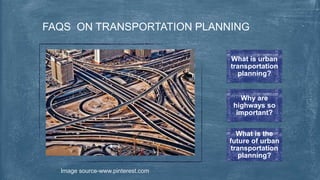
FAQS ON TRANSPORTATION PLANNING
What is urban
transportation
planning?
Why are
highways so
important?
What is the
future of urban
transportation
planning?
Image source-www.pinterest.com
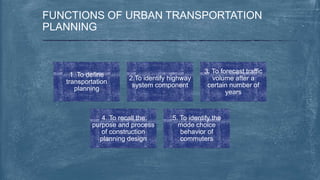
FUNCTIONS OF URBAN TRANSPORTATION
PLANNING
1. To define
transportation
planning
2.To identify highway
system component
3. To forecast traffic
volume after a
certain number of
years
4. To recall the
purpose and process
of construction
planning design
5. To identify the
mode choice
behavior of
commuters
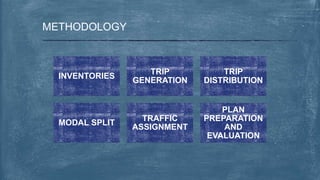
METHODOLOGY
INVENTORIES
TRIP
GENERATION
TRIP
DISTRIBUTION
MODAL SPLIT
TRAFFIC
ASSIGNMENT
PLAN
PREPARATION
AND
EVALUATION
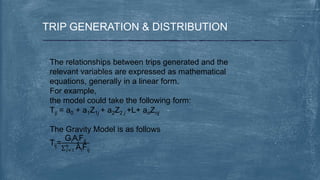
TRIP GENERATION & DISTRIBUTION
The relationships between trips generated and the
relevant variables are expressed as mathematical
equations, generally in a linear form.
For example,
the model could take the following form:
Tij = a0 + a1Z1j + a2Z2 j +L+ anZnj
The Gravity Model is as follows
Tij=
GiAjFij
𝑗=1
𝑛 AiFij
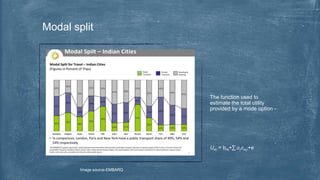
The function used to
estimate the total utility
provided by a mode option -
Um = bm+ 𝑎𝑗 𝑧 𝑚𝑗+e
Modal split
Image source-EMBARQ
ORIGIN-DESTINATION STUDIES
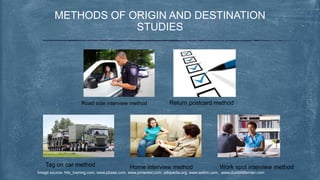
METHODS OF ORIGIN AND DESTINATION
STUDIES
Road side interview method Return postcard method
Tag on car method Home interview method Work spot interview method
Image source- hits_training.com, www.pbase.com, www.pinterest.com, wikipedia.org, www.wahm.com, www.dumblittleman.com
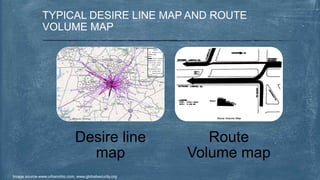
TYPICAL DESIRE LINE MAP AND ROUTE
VOLUME MAP
Desire line
map
Route
Volume map
Image source-www.urbanohio.com, www.globalsecurity.org
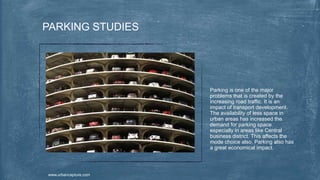
Parking is one of the major
problems that is created by the
increasing road traffic. It is an
impact of transport development.
The availability of less space in
urban areas has increased the
demand for parking space
especially in areas like Central
business district. This affects the
mode choice also. Parking also has
a great economical impact.
PARKING STUDIES
www.urbancapture.com
OBJECTIVE OF PARKING STUDIES
Parking studies are used to evaluate the
facilities available like
• Parking demand-The parking demand varies during
the day and reaches a peak value during heavy
parking demand time
• Parking characteristics – It refers to the practices
prevalent in the area under consideration, mainly
whether the vehicles are parked on street or off street
• Parking space inventory- the area under study is
surveyed and kerb parking and off street parking
facilities are plotted on a map
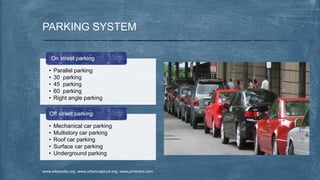
PARKING SYSTEM
• Parallel parking
• 30 parking
• 45 parking
• 60 parking
• Right angle parking
On street parking
• Mechanical car parking
• Multistory car parking
• Roof car parking
• Surface car parking
• Underground parking
Off street parking
www.wikipedia.org, www.urbancapture.org, www.pinterest.com
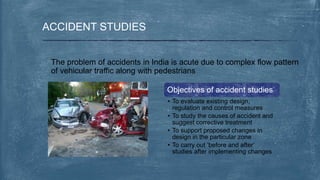
ACCIDENT STUDIES
The problem of accidents in India is acute due to complex flow pattern
of vehicular traffic along with pedestrians
Objectives of accident studies
• To evaluate existing design,
regulation and control measures
• To study the causes of accident and
suggest corrective treatment
• To support proposed changes in
design in the particular zone
• To carry out ‘before and after’
studies after implementing changes
CAUSES OF ACCIDENTS
Road user Vehicle
Road and
its condition
Traffic
Road
design
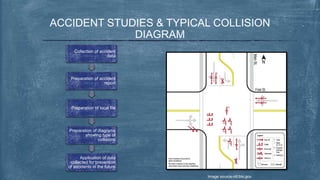
ACCIDENT STUDIES & TYPICAL COLLISION
DIAGRAM
Collection of accident
data
Preparation of accident
report
Preparation of local file
Preparation of diagrams
showing type of
collisions
Application of data
collected for prevention
of accidents in the future
Image source-ntl.bts.gov
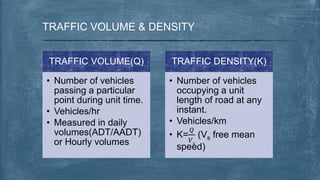
TRAFFIC VOLUME & DENSITY
TRAFFIC VOLUME(Q)
• Number of vehicles
passing a particular
point during unit time.
• Vehicles/hr
• Measured in daily
volumes(ADT/AADT)
or Hourly volumes
TRAFFIC DENSITY(K)
• Number of vehicles
occupying a unit
length of road at any
instant.
• Vehicles/km
• K=
𝑄
𝑉 𝑠
(Vs free mean
speed)
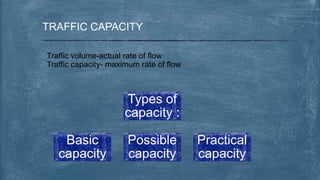
TRAFFIC CAPACITY
Traffic volume-actual rate of flow
Traffic capacity- maximum rate of flow
Types of
capacity :
Basic
capacity
Possible
capacity
Practical
capacity
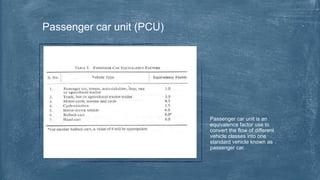
Passenger car unit is an
equivalence factor use to
convert the flow of different
vehicle classes into one
standard vehicle known as
passenger car.
Passenger car unit (PCU)
FACTOR AFFECTING TRAFFIC CAPACITY
Lane width
Lateral
clearance
Width of
shoulders
Alignment
Presence of
intersections
Road
geometrics
SPEED STUDIES
Speed studies are the studies which are carried out to know the
general trends in speeds of different vehicles over a particular route
depending on various factors
Classified into
two groups:
Spot speed
study
Speed and
delay study
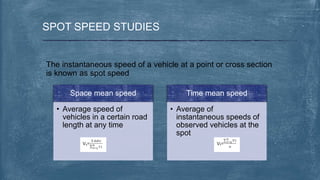
SPOT SPEED STUDIES
The instantaneous speed of a vehicle at a point or cross section
is known as spot speed
Space mean speed
• Average speed of
vehicles in a certain road
length at any time
Time mean speed
• Average of
instantaneous speeds of
observed vehicles at the
spot
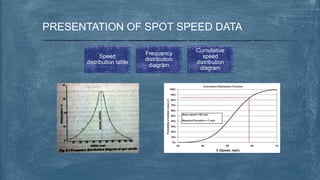
PRESENTATION OF SPOT SPEED DATA
Speed
distribution table
Frequency
distribution
diagram
Cumulative
speed
distribution
diagram
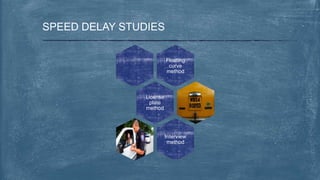
SPEED DELAY STUDIES
Floating
curve
method
License
plate
method
Interview
method
Conclusion
We would like to express our gratitude to the following people-
Professor Sumit Narayan Bose
Dr Indranil Mukherjee,
And the entire Faculty of Department of Civil Engineering, Techno India College of
Technology
Acknowledgement
REFERENCES
1. Road accidents in India, 2009.
2. V F Babkov. Road Condition and traffic safety. MIR Publishers, Moscow, 2019.
3. J Stannard Baker. Traffic Accident Investigation Manual. The traffic Institute Northwestern University,
2019.
4. Milan Batista. On the mutual coefficient of restitution in two car collinear collisions, 2006.
5. S K Khanna C E G Justo. Highway Engineering. Nem Chand and Bros, Roorkee, 2001.
6. K W Ogden, S Y Taylor. Traffic Engineering, and Australia. Management. Monash
University. Melbourne. Traffic Engineering and Management. Monash University Melbourne,
Australia, 2019. Louis J Pignataro. Traffic Engineering. USA, 2019
7. Highway Engineering by S.K.Khanna and C.E.G.Justo (NemChand and Bros.)
8. Highway engineering by Martin Roger
www.nptel.ac.in
www.wikipedia.org
www.in.pinterest.com

Transportation planning

  • 1.
  • 2.
    TORSHA DATTA CHOUDHURI-110 TOUSIFJAMAN-111 TUHIN MAJUMDAR-112 TULIKA BARMAN-113 VED PRAKASH MANDAL-114 MENTORED BY PROF. SUMIT NARAYAN BOSE TECHNO INDIA COLLEGE OF TECHNOLOGY CIVIL ENGINEERING 28/04/2016 TRANSPORTATION PLANNING
  • 3.
     TRAFFIC FLOW CHARACTERISTIC ACCIDENT STUDY  TRAFFIC VOLUME STIDIES  SPEED STUDY  FAQS  FUNCTIONS  METHODOLOGY  ORIGIN-DESTINATION STUDIES  PARKING STUDIES OVERVIEW
  • 4.
    FAQS ON TRANSPORTATIONPLANNING What is urban transportation planning? Why are highways so important? What is the future of urban transportation planning? Image source-www.pinterest.com
  • 5.
    FUNCTIONS OF URBANTRANSPORTATION PLANNING 1. To define transportation planning 2.To identify highway system component 3. To forecast traffic volume after a certain number of years 4. To recall the purpose and process of construction planning design 5. To identify the mode choice behavior of commuters
  • 6.
  • 7.
    TRIP GENERATION &DISTRIBUTION The relationships between trips generated and the relevant variables are expressed as mathematical equations, generally in a linear form. For example, the model could take the following form: Tij = a0 + a1Z1j + a2Z2 j +L+ anZnj The Gravity Model is as follows Tij= GiAjFij 𝑗=1 𝑛 AiFij
  • 8.
    The function usedto estimate the total utility provided by a mode option - Um = bm+ 𝑎𝑗 𝑧 𝑚𝑗+e Modal split Image source-EMBARQ
  • 9.
  • 10.
    METHODS OF ORIGINAND DESTINATION STUDIES Road side interview method Return postcard method Tag on car method Home interview method Work spot interview method Image source- hits_training.com, www.pbase.com, www.pinterest.com, wikipedia.org, www.wahm.com, www.dumblittleman.com
  • 11.
    TYPICAL DESIRE LINEMAP AND ROUTE VOLUME MAP Desire line map Route Volume map Image source-www.urbanohio.com, www.globalsecurity.org
  • 12.
    Parking is oneof the major problems that is created by the increasing road traffic. It is an impact of transport development. The availability of less space in urban areas has increased the demand for parking space especially in areas like Central business district. This affects the mode choice also. Parking also has a great economical impact. PARKING STUDIES www.urbancapture.com
  • 13.
    OBJECTIVE OF PARKINGSTUDIES Parking studies are used to evaluate the facilities available like • Parking demand-The parking demand varies during the day and reaches a peak value during heavy parking demand time • Parking characteristics – It refers to the practices prevalent in the area under consideration, mainly whether the vehicles are parked on street or off street • Parking space inventory- the area under study is surveyed and kerb parking and off street parking facilities are plotted on a map
  • 14.
    PARKING SYSTEM • Parallelparking • 30 parking • 45 parking • 60 parking • Right angle parking On street parking • Mechanical car parking • Multistory car parking • Roof car parking • Surface car parking • Underground parking Off street parking www.wikipedia.org, www.urbancapture.org, www.pinterest.com
  • 15.
    ACCIDENT STUDIES The problemof accidents in India is acute due to complex flow pattern of vehicular traffic along with pedestrians Objectives of accident studies • To evaluate existing design, regulation and control measures • To study the causes of accident and suggest corrective treatment • To support proposed changes in design in the particular zone • To carry out ‘before and after’ studies after implementing changes
  • 16.
    CAUSES OF ACCIDENTS Roaduser Vehicle Road and its condition Traffic Road design
  • 17.
    ACCIDENT STUDIES &TYPICAL COLLISION DIAGRAM Collection of accident data Preparation of accident report Preparation of local file Preparation of diagrams showing type of collisions Application of data collected for prevention of accidents in the future Image source-ntl.bts.gov
  • 18.
    TRAFFIC VOLUME &DENSITY TRAFFIC VOLUME(Q) • Number of vehicles passing a particular point during unit time. • Vehicles/hr • Measured in daily volumes(ADT/AADT) or Hourly volumes TRAFFIC DENSITY(K) • Number of vehicles occupying a unit length of road at any instant. • Vehicles/km • K= 𝑄 𝑉 𝑠 (Vs free mean speed)
  • 19.
    TRAFFIC CAPACITY Traffic volume-actualrate of flow Traffic capacity- maximum rate of flow Types of capacity : Basic capacity Possible capacity Practical capacity
  • 20.
    Passenger car unitis an equivalence factor use to convert the flow of different vehicle classes into one standard vehicle known as passenger car. Passenger car unit (PCU)
  • 21.
    FACTOR AFFECTING TRAFFICCAPACITY Lane width Lateral clearance Width of shoulders Alignment Presence of intersections Road geometrics
  • 22.
    SPEED STUDIES Speed studiesare the studies which are carried out to know the general trends in speeds of different vehicles over a particular route depending on various factors Classified into two groups: Spot speed study Speed and delay study
  • 23.
    SPOT SPEED STUDIES Theinstantaneous speed of a vehicle at a point or cross section is known as spot speed Space mean speed • Average speed of vehicles in a certain road length at any time Time mean speed • Average of instantaneous speeds of observed vehicles at the spot
  • 24.
    PRESENTATION OF SPOTSPEED DATA Speed distribution table Frequency distribution diagram Cumulative speed distribution diagram
  • 25.
  • 26.
  • 27.
    We would liketo express our gratitude to the following people- Professor Sumit Narayan Bose Dr Indranil Mukherjee, And the entire Faculty of Department of Civil Engineering, Techno India College of Technology Acknowledgement
  • 28.
    REFERENCES 1. Road accidentsin India, 2009. 2. V F Babkov. Road Condition and traffic safety. MIR Publishers, Moscow, 2019. 3. J Stannard Baker. Traffic Accident Investigation Manual. The traffic Institute Northwestern University, 2019. 4. Milan Batista. On the mutual coefficient of restitution in two car collinear collisions, 2006. 5. S K Khanna C E G Justo. Highway Engineering. Nem Chand and Bros, Roorkee, 2001. 6. K W Ogden, S Y Taylor. Traffic Engineering, and Australia. Management. Monash University. Melbourne. Traffic Engineering and Management. Monash University Melbourne, Australia, 2019. Louis J Pignataro. Traffic Engineering. USA, 2019 7. Highway Engineering by S.K.Khanna and C.E.G.Justo (NemChand and Bros.) 8. Highway engineering by Martin Roger www.nptel.ac.in www.wikipedia.org www.in.pinterest.com