Role of Transportation Planning in
Physical Planning
Sub: Transportation Planning
Piter Biswas
piterbiswas11@gmail.com
INTRODUCTION
 In today’s world with the ever increasing traffic it
is inherent that we immediately find an optimum
solution for it so that we can move on from being a
developing nation to a super power.
 There is a great need to resolve our transportation
issues at the earliest as connectivity is of grave
importance. Finding a systematic and organized way
around the current situation is only going to benefit
us in the long run. Better connectivity reduces
transportation costs immensely and saves time in
traveling.
• A sustainable transport system must meet the mobility and
accessibility needs of people by providing safe and
environmentally friendly modes of transportation.
• Transportation is the indispensable link which aids us from
not feeling imprisoned in one place.
• Cities have come up around areas with good connectivity to
places where facilities are available.
• No new township or development cannot come up on its
own with no connection to other settlements.
• Means of reaching a destination must be defined before
any development comes into being.
• Even when we design a housing or any other development
we first analyze the approach i.e. how to get there cause one
cannot have a settlement in a remote area with no
connection to the rest of the places.
CONTINUED.....
PHYSICAL PLANNING
Physical planning refers to the methods used
by the public sector to influence the
distribution of people and activities in spaces
of various scales. Physical planning includes all
levels of land use planning including urban
planning, regional planning, environmental
planning, national spatial plans, and in the
European Union international levels.
ASPECTS OF PHYSICAL PLANNING
• Aesthetics
• Safety
• Slums
• Decay
• Reconstruction and renewal
• Transport
• Suburbanization
• Environmental factors
• Light and sound Transport
TRANSPORTATION THUS FORMS
ONE IMPORTANT ASPECT OF
PHYSICAL PLANNING
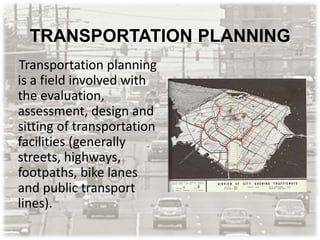
TRANSPORTATION PLANNING
Transportation planning
is a field involved with
the evaluation,
assessment, design and
sitting of transportation
facilities (generally
streets, highways,
footpaths, bike lanes
and public transport
lines).
ROLE OF TRANSPORTATION
PLANNING IN PHYSICAL PLANNING
Urban, city, and town planning integrates land use
planning and transportation planning to improve
the built, economic and social environments of
communities
Physical planning involves-
• integration within and between different modes
of transport
• integration with the environment
• integration with land use planning
• integration with policies for education, health
and wealth creation
TRANSPORTATION FACTORS INFLUENCING
URBAN DEVELOPMENT (AND VICE VERSA)
• Although an important factor, there is a complex relationship
between urban densities and car use .Transport within urbanized
areas presents unique problems. The density of an urban
environment increases traffic, which can harm businesses and
increase pollution unless properly managed. Parking space for
private vehicles requires the construction of large parking garages in
high density areas. This space could often be more valuable for
other development.
• Good planning uses transit oriented development, which attempts
to place higher densities of jobs or residents near high-volume
transportation. For example, some cities permit commerce and
multi-story apartment buildings only within one block of train
stations and multilane boulevards, and accept single-family
dwellings and parks farther away.
CONTINUED.....
• Floor area ratio is often used to measure density. This is the floor area of
buildings divided by the land area. Ratios below 1.5 are low density. Ratios
above five very high density. Most exurbs are below two, while most city
centres are well above five. Walk-up apartments with basement garages
can easily achieve a density of three. Skyscrapers easily achieve densities
of thirty or more.
• Increasing development density has the advantage of making mass
transport systems, district heating and other community facilities
(schools, health centres, etc.) more viable. However critics of this
approach dub the densification of development as 'town cramming' and
claim that it lowers quality of life and restricts market-led choice.
• Problems can often occur at residential densities between about two
and five. These densities can cause traffic jams for automobiles, yet are
too low to be commercially served by trains or light rail systems. The
conventional solution is to use buses, but these and light rail systems may
fail where automobiles and excess road network capacity are both
available, achieving less than 2% ridership.
STEPS TO BE FOLLOWED BY TRANSPORT
PLANNERS FOR OVERALL RELATED PHYSICAL
DEVELOPMENT
 take account of the social, economic and environmental context of their work
 understand the legal, regulatory policy and resource framework within which they
work
 understand and create transport policies, strategies and plans that contribute to
meeting social, economic and environmental needs
 design the necessary transport projects, systems and services
 understand the commercial aspects of operating transport systems and services
 know about and apply the relevant tools and techniques
 must be competent in all aspects of management, in particular communications,
personal skills and project management.
 Planners should strive to understand factors that will affect the future. For example,
rather than simply showing how traffic congestion has grown in recent years and
extrapolating that trend into the future, a better analysis identifies specific factors that
increased vehicle travel (population growth, rising incomes, declining real fuel prices,
etc.), projects their future, and considers public policies that may change them.
 As a result, rather than simply saying, “Traffic is growing 4% annually,” an astute
planner might say, “Vehicle traffic grew 4% annually during the last decade but this is
likely to decline somewhat in the future due to aging population and higher future fuel
prices, and could be avoided altogether if we implement certain mobility management
strategies.”
ACCESSIBILITY
Accessibility (also called access or convenience) refers to
the ability to reach desired goods, services, activities
and destinations (together called opportunities). For
example, a stepladder provides access to a high shelf, a
store provides access to goods, and a library or
telecommunications device provide access to
information. Walking, cycling, ridesharing and public
transit provide access to jobs, services and other
activities. Access is the ultimate goal of most
transportation, excepting the small portion of travel in
which movement is an end in itself, (e.g., cruising, historic
train rides, horseback riding, jogging). Even recreational
travel usually has a destination, such as a resort or a
campsite.
FACTORS affecting physical
accessibility
1. Mobility, that is, physical movement. Mobility can be provided by walking, cycling,
public transit, ridesharing, taxi, automobiles, trucks and other modes.
2. Transportation System Connectivity, which refers to the directness of links and the
density of connections in path or road network.
3. Mobility Substitutes, such as telecommunications and delivery services. These can
provide access to some types of goods and activities, particularly those involving
information.
4. Land Use, that is, the geographic distribution of activities and destinations. When
real estate experts say “location, location, location” they mean “accessibility,
accessibility, accessibility.
STEPS TO BE FOLLOWED TO
IMPROVE ACCESSIBILITY
1. Restore connectivity.
2. Restoration of the social and economic linkages is
important for revival of communities.
3. Transportation, communication, and road networks must
be priority items in reconstruction so that they can
transport labour and material for reconstruction.
4. Connectivity at the local level will make mobility easy for
all means of transportation, including walking and bicycles,
and will support livelihood activities
EFFICIENT TRANSPORTATION
FOR PHYSICAL PLANNING
CASE STUDY AREA – CURITIBA
 Problem Overview-
 Curitiba, the capital city of the State of Paraná, experienced
some of the highest growth in the country with population
increases reaching an estimated 5.7% a year during 1950-
1980.
 This demanded effective city planning in areas ranging from
social services, housing and sanitation, to the environment
and transportation.
 Thus, urban planners in Curitiba began the process of creating
an urban Master Plan , part which included constructing a
consolidated public transportation system.
Continued…
 Background-
 With the approval of Curitiba’s Master Plan in 1966, guidelines were
established that restructured the city’s radial configuration into a linear
model of urban expansion.
 Accordingly, urban planners realized that transportation land use and road
systems can be used as integrative tools of development in compliance with
these guidelines.
 Hence, zoning laws were set in place and Structural Avenues were
designed to direct linear growth by attracting residential and commercial
density along a mass transportation lane.
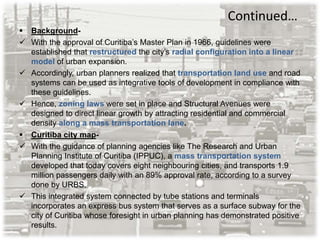
 Curitiba city map-
 With the guidance of planning agencies like The Research and Urban
Planning Institute of Curitiba (IPPUC), a mass transportation system
developed that today covers eight neighbouring cities, and transports 1.9
million passengers daily with an 89% approval rate, according to a survey
done by URBS.
 This integrated system connected by tube stations and terminals
incorporates an express bus system that serves as a surface subway for the
city of Curitiba whose foresight in urban planning has demonstrated positive
results.
Continued…
 Curitiba city map-
 In Curitiba’s case, its planners recognized that transportation systems can
serve as the backbone for the development and growth of the city in the
future.
 Instead of addressing transportation as a service that caters to an ever
prevalent and pressing demand, they essentially planned their system with
the intention of dictating the growth of the city.
 Curitiba used busses as its primary means of public transport because, it
was also the most cost effective means of transport.
 The Preliminary Urban Plan and The Master Plan-
 Planner Alfredo Agache who was commissioned to create an urban plan for
Curitiba, designed a development scheme that gave priority to public
services such as sanitation, easing traffic congestion and creating centres
that enabled the growth of both social life and commerce.
 With the approval of the Master Plan in 1966, the first step was taken with
the creation of the Institute for Research and Urban Planning in Curitiba
(IPPUC). The institute introduced zoning laws and design for the city in
compliance with the urban plan.
Continued…
 Curitiba’s Transportation System-
 The most significant changes in the transportation system were taken in
1974 with the creation of the road hierarchy and land control system.
 Parallel to the express bus lanes were two local roads running in opposite
directions. They allowed local traffic to pass through the city.
 In 1982, all five structural corridors were completed with inter-district and
feeder lines. In accordance with these structural roads, zoning laws were
set in place to structure the growth of the city.
 Solving The Fare Problem-
 A new system to avoid bus service delays was created in which the city
eliminated transfer payments and substituted them with transfer tokens
made of paper.
 Realizing the social imbalance imposed by this fare mode, the city
dropped the feeder fare and allowed passengers to ride the feeder busses
for free.
 In 1980, the city finally developed and constructed transfer terminals that
operated like subway stations. The terminals, constructed with telephone
accessibility, attracted news stands and flower shops and became
aesthetically attractive and user friendly.
 Solving The Problem-
 The city introduced automatic ticketing to the system. This form of
payment allowed passengers to purchase metal tokens at terminals and use
them at the bus stations.
 Traditionally the city was partitioned in different zones that were serviced by
individual bus companies. But, with the creation of the inter-district routes
and the implementation of the Integrated Transportation Network along
with the unified fare, passengers could pay one company at a terminal
located in a particular zone.
Continued…
 Bus and Station Design-
 After the construction of terminals and the implementation of the unified
fare, the city wanted to develop busses and stations designed with the
intention of avoiding fare evaders. For this reason, busses are designed
with three doors, two doors for exiting and a front door for boarding.
 The city also developed boarding tube stations that were placed along
direct routes and express lanes. To increase convenience, the tubes elevate
passengers to the bus platform level.
 Each tube station is equipped with station and route maps to help
disabled passengers, strollers, and passengers carrying heavy bags enter
the tubes with agility.
PRESENT SYSTEM OF
TRANSPORTATION
The transportation system is made up of three
complementary levels of service that include-
• the feeder lines,
• express lines and
• inter-district routes
THE FEEDER LINES
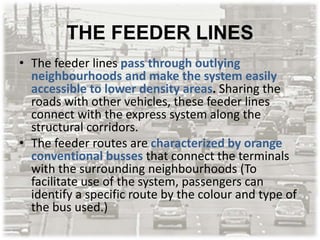
• The feeder lines pass through outlying
neighbourhoods and make the system easily
accessible to lower density areas. Sharing the
roads with other vehicles, these feeder lines
connect with the express system along the
structural corridors.
• The feeder routes are characterized by orange
conventional busses that connect the terminals
with the surrounding neighbourhoods (To
facilitate use of the system, passengers can
identify a specific route by the colour and type of
the bus used.)
THE EXPRESS SYSTEM
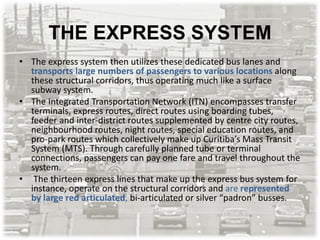
• The express system then utilizes these dedicated bus lanes and
transports large numbers of passengers to various locations along
these structural corridors, thus operating much like a surface
subway system.
• The Integrated Transportation Network (ITN) encompasses transfer
terminals, express routes, direct routes using boarding tubes,
feeder and inter-district routes supplemented by centre city routes,
neighbourhood routes, night routes, special education routes, and
pro-park routes which collectively make up Curitiba’s Mass Transit
System (MTS). Through carefully planned tube or terminal
connections, passengers can pay one fare and travel throughout the
system.
• The thirteen express lines that make up the express bus system for
instance, operate on the structural corridors and are represented
by large red articulated, bi-articulated or silver “padron” busses.
INTER DISTRICT ROUTES
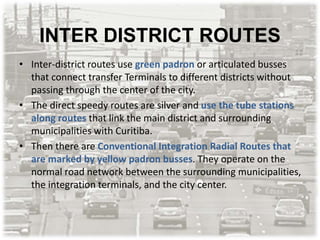
• Inter-district routes use green padron or articulated busses
that connect transfer Terminals to different districts without
passing through the center of the city.
• The direct speedy routes are silver and use the tube stations
along routes that link the main district and surrounding
municipalities with Curitiba.
• Then there are Conventional Integration Radial Routes that
are marked by yellow padron busses. They operate on the
normal road network between the surrounding municipalities,
the integration terminals, and the city center.
CONCLUSIONS
 Curitiba’s system of transportation is an example of effective urban planning.
The city’s urban planners recognized that even if growth in population cannot be
controlled, the development of infrastructure in the city can guide the city’s expansion.
 By approaching transportation as tool used to attain a greater solution rather than
as a solution to an advancing problem, they were able to implement an efficiently
constructed, cost-effective transportation system that finances itself.
 The city used busses because it had a tradition of using busses. While this
system is powered by diesel, the reduction of the number of cars used compensates,
if not surpasses, the difference in carbon monoxide emissions.
 Like every city, Curitiba’s transportation system is plagued by overcrowded
peak hours and untimely busses. But, this is a relatively minor inconvenience in
comparison to the service provided and the proximity served.
 In comparison with transportation systems in Rio de Janiero, where passengers have
to flag down and run after a number of private busses that provide service to the
same destination using different routes and New York City were busses are often
caught in unrelenting city congestion for a good part of the working day, Curitiba's
integrative bus system with its express lanes and bus expediency, essentially
works.
THANK YOU

Transportation planning

  • 1.
    Role of TransportationPlanning in Physical Planning Sub: Transportation Planning Piter Biswas piterbiswas11@gmail.com
  • 2.
    INTRODUCTION  In today’sworld with the ever increasing traffic it is inherent that we immediately find an optimum solution for it so that we can move on from being a developing nation to a super power.  There is a great need to resolve our transportation issues at the earliest as connectivity is of grave importance. Finding a systematic and organized way around the current situation is only going to benefit us in the long run. Better connectivity reduces transportation costs immensely and saves time in traveling.
  • 3.
    • A sustainabletransport system must meet the mobility and accessibility needs of people by providing safe and environmentally friendly modes of transportation. • Transportation is the indispensable link which aids us from not feeling imprisoned in one place. • Cities have come up around areas with good connectivity to places where facilities are available. • No new township or development cannot come up on its own with no connection to other settlements. • Means of reaching a destination must be defined before any development comes into being. • Even when we design a housing or any other development we first analyze the approach i.e. how to get there cause one cannot have a settlement in a remote area with no connection to the rest of the places. CONTINUED.....
  • 4.
    PHYSICAL PLANNING Physical planningrefers to the methods used by the public sector to influence the distribution of people and activities in spaces of various scales. Physical planning includes all levels of land use planning including urban planning, regional planning, environmental planning, national spatial plans, and in the European Union international levels.
  • 5.
    ASPECTS OF PHYSICALPLANNING • Aesthetics • Safety • Slums • Decay • Reconstruction and renewal • Transport • Suburbanization • Environmental factors • Light and sound Transport TRANSPORTATION THUS FORMS ONE IMPORTANT ASPECT OF PHYSICAL PLANNING
  • 6.
    TRANSPORTATION PLANNING Transportation planning isa field involved with the evaluation, assessment, design and sitting of transportation facilities (generally streets, highways, footpaths, bike lanes and public transport lines).
  • 7.
    ROLE OF TRANSPORTATION PLANNINGIN PHYSICAL PLANNING Urban, city, and town planning integrates land use planning and transportation planning to improve the built, economic and social environments of communities Physical planning involves- • integration within and between different modes of transport • integration with the environment • integration with land use planning • integration with policies for education, health and wealth creation
  • 8.
    TRANSPORTATION FACTORS INFLUENCING URBANDEVELOPMENT (AND VICE VERSA) • Although an important factor, there is a complex relationship between urban densities and car use .Transport within urbanized areas presents unique problems. The density of an urban environment increases traffic, which can harm businesses and increase pollution unless properly managed. Parking space for private vehicles requires the construction of large parking garages in high density areas. This space could often be more valuable for other development. • Good planning uses transit oriented development, which attempts to place higher densities of jobs or residents near high-volume transportation. For example, some cities permit commerce and multi-story apartment buildings only within one block of train stations and multilane boulevards, and accept single-family dwellings and parks farther away.
  • 9.
    CONTINUED..... • Floor arearatio is often used to measure density. This is the floor area of buildings divided by the land area. Ratios below 1.5 are low density. Ratios above five very high density. Most exurbs are below two, while most city centres are well above five. Walk-up apartments with basement garages can easily achieve a density of three. Skyscrapers easily achieve densities of thirty or more. • Increasing development density has the advantage of making mass transport systems, district heating and other community facilities (schools, health centres, etc.) more viable. However critics of this approach dub the densification of development as 'town cramming' and claim that it lowers quality of life and restricts market-led choice. • Problems can often occur at residential densities between about two and five. These densities can cause traffic jams for automobiles, yet are too low to be commercially served by trains or light rail systems. The conventional solution is to use buses, but these and light rail systems may fail where automobiles and excess road network capacity are both available, achieving less than 2% ridership.
  • 10.
    STEPS TO BEFOLLOWED BY TRANSPORT PLANNERS FOR OVERALL RELATED PHYSICAL DEVELOPMENT  take account of the social, economic and environmental context of their work  understand the legal, regulatory policy and resource framework within which they work  understand and create transport policies, strategies and plans that contribute to meeting social, economic and environmental needs  design the necessary transport projects, systems and services  understand the commercial aspects of operating transport systems and services  know about and apply the relevant tools and techniques  must be competent in all aspects of management, in particular communications, personal skills and project management.  Planners should strive to understand factors that will affect the future. For example, rather than simply showing how traffic congestion has grown in recent years and extrapolating that trend into the future, a better analysis identifies specific factors that increased vehicle travel (population growth, rising incomes, declining real fuel prices, etc.), projects their future, and considers public policies that may change them.  As a result, rather than simply saying, “Traffic is growing 4% annually,” an astute planner might say, “Vehicle traffic grew 4% annually during the last decade but this is likely to decline somewhat in the future due to aging population and higher future fuel prices, and could be avoided altogether if we implement certain mobility management strategies.”
  • 11.
    ACCESSIBILITY Accessibility (also calledaccess or convenience) refers to the ability to reach desired goods, services, activities and destinations (together called opportunities). For example, a stepladder provides access to a high shelf, a store provides access to goods, and a library or telecommunications device provide access to information. Walking, cycling, ridesharing and public transit provide access to jobs, services and other activities. Access is the ultimate goal of most transportation, excepting the small portion of travel in which movement is an end in itself, (e.g., cruising, historic train rides, horseback riding, jogging). Even recreational travel usually has a destination, such as a resort or a campsite.
  • 12.
    FACTORS affecting physical accessibility 1.Mobility, that is, physical movement. Mobility can be provided by walking, cycling, public transit, ridesharing, taxi, automobiles, trucks and other modes. 2. Transportation System Connectivity, which refers to the directness of links and the density of connections in path or road network. 3. Mobility Substitutes, such as telecommunications and delivery services. These can provide access to some types of goods and activities, particularly those involving information. 4. Land Use, that is, the geographic distribution of activities and destinations. When real estate experts say “location, location, location” they mean “accessibility, accessibility, accessibility.
  • 13.
    STEPS TO BEFOLLOWED TO IMPROVE ACCESSIBILITY 1. Restore connectivity. 2. Restoration of the social and economic linkages is important for revival of communities. 3. Transportation, communication, and road networks must be priority items in reconstruction so that they can transport labour and material for reconstruction. 4. Connectivity at the local level will make mobility easy for all means of transportation, including walking and bicycles, and will support livelihood activities
  • 14.
    EFFICIENT TRANSPORTATION FOR PHYSICALPLANNING CASE STUDY AREA – CURITIBA  Problem Overview-  Curitiba, the capital city of the State of Paraná, experienced some of the highest growth in the country with population increases reaching an estimated 5.7% a year during 1950- 1980.  This demanded effective city planning in areas ranging from social services, housing and sanitation, to the environment and transportation.  Thus, urban planners in Curitiba began the process of creating an urban Master Plan , part which included constructing a consolidated public transportation system.
  • 15.
    Continued…  Background-  Withthe approval of Curitiba’s Master Plan in 1966, guidelines were established that restructured the city’s radial configuration into a linear model of urban expansion.  Accordingly, urban planners realized that transportation land use and road systems can be used as integrative tools of development in compliance with these guidelines.  Hence, zoning laws were set in place and Structural Avenues were designed to direct linear growth by attracting residential and commercial density along a mass transportation lane.  Curitiba city map-  With the guidance of planning agencies like The Research and Urban Planning Institute of Curitiba (IPPUC), a mass transportation system developed that today covers eight neighbouring cities, and transports 1.9 million passengers daily with an 89% approval rate, according to a survey done by URBS.  This integrated system connected by tube stations and terminals incorporates an express bus system that serves as a surface subway for the city of Curitiba whose foresight in urban planning has demonstrated positive results.
  • 16.
    Continued…  Curitiba citymap-  In Curitiba’s case, its planners recognized that transportation systems can serve as the backbone for the development and growth of the city in the future.  Instead of addressing transportation as a service that caters to an ever prevalent and pressing demand, they essentially planned their system with the intention of dictating the growth of the city.  Curitiba used busses as its primary means of public transport because, it was also the most cost effective means of transport.  The Preliminary Urban Plan and The Master Plan-  Planner Alfredo Agache who was commissioned to create an urban plan for Curitiba, designed a development scheme that gave priority to public services such as sanitation, easing traffic congestion and creating centres that enabled the growth of both social life and commerce.  With the approval of the Master Plan in 1966, the first step was taken with the creation of the Institute for Research and Urban Planning in Curitiba (IPPUC). The institute introduced zoning laws and design for the city in compliance with the urban plan.
  • 17.
    Continued…  Curitiba’s TransportationSystem-  The most significant changes in the transportation system were taken in 1974 with the creation of the road hierarchy and land control system.  Parallel to the express bus lanes were two local roads running in opposite directions. They allowed local traffic to pass through the city.  In 1982, all five structural corridors were completed with inter-district and feeder lines. In accordance with these structural roads, zoning laws were set in place to structure the growth of the city.  Solving The Fare Problem-  A new system to avoid bus service delays was created in which the city eliminated transfer payments and substituted them with transfer tokens made of paper.  Realizing the social imbalance imposed by this fare mode, the city dropped the feeder fare and allowed passengers to ride the feeder busses for free.  In 1980, the city finally developed and constructed transfer terminals that operated like subway stations. The terminals, constructed with telephone accessibility, attracted news stands and flower shops and became aesthetically attractive and user friendly.
  • 18.
     Solving TheProblem-  The city introduced automatic ticketing to the system. This form of payment allowed passengers to purchase metal tokens at terminals and use them at the bus stations.  Traditionally the city was partitioned in different zones that were serviced by individual bus companies. But, with the creation of the inter-district routes and the implementation of the Integrated Transportation Network along with the unified fare, passengers could pay one company at a terminal located in a particular zone. Continued…  Bus and Station Design-  After the construction of terminals and the implementation of the unified fare, the city wanted to develop busses and stations designed with the intention of avoiding fare evaders. For this reason, busses are designed with three doors, two doors for exiting and a front door for boarding.  The city also developed boarding tube stations that were placed along direct routes and express lanes. To increase convenience, the tubes elevate passengers to the bus platform level.  Each tube station is equipped with station and route maps to help disabled passengers, strollers, and passengers carrying heavy bags enter the tubes with agility.
  • 19.
    PRESENT SYSTEM OF TRANSPORTATION Thetransportation system is made up of three complementary levels of service that include- • the feeder lines, • express lines and • inter-district routes
  • 20.
    THE FEEDER LINES •The feeder lines pass through outlying neighbourhoods and make the system easily accessible to lower density areas. Sharing the roads with other vehicles, these feeder lines connect with the express system along the structural corridors. • The feeder routes are characterized by orange conventional busses that connect the terminals with the surrounding neighbourhoods (To facilitate use of the system, passengers can identify a specific route by the colour and type of the bus used.)
  • 21.
    THE EXPRESS SYSTEM •The express system then utilizes these dedicated bus lanes and transports large numbers of passengers to various locations along these structural corridors, thus operating much like a surface subway system. • The Integrated Transportation Network (ITN) encompasses transfer terminals, express routes, direct routes using boarding tubes, feeder and inter-district routes supplemented by centre city routes, neighbourhood routes, night routes, special education routes, and pro-park routes which collectively make up Curitiba’s Mass Transit System (MTS). Through carefully planned tube or terminal connections, passengers can pay one fare and travel throughout the system. • The thirteen express lines that make up the express bus system for instance, operate on the structural corridors and are represented by large red articulated, bi-articulated or silver “padron” busses.
  • 22.
    INTER DISTRICT ROUTES •Inter-district routes use green padron or articulated busses that connect transfer Terminals to different districts without passing through the center of the city. • The direct speedy routes are silver and use the tube stations along routes that link the main district and surrounding municipalities with Curitiba. • Then there are Conventional Integration Radial Routes that are marked by yellow padron busses. They operate on the normal road network between the surrounding municipalities, the integration terminals, and the city center.
  • 23.
    CONCLUSIONS  Curitiba’s systemof transportation is an example of effective urban planning. The city’s urban planners recognized that even if growth in population cannot be controlled, the development of infrastructure in the city can guide the city’s expansion.  By approaching transportation as tool used to attain a greater solution rather than as a solution to an advancing problem, they were able to implement an efficiently constructed, cost-effective transportation system that finances itself.  The city used busses because it had a tradition of using busses. While this system is powered by diesel, the reduction of the number of cars used compensates, if not surpasses, the difference in carbon monoxide emissions.  Like every city, Curitiba’s transportation system is plagued by overcrowded peak hours and untimely busses. But, this is a relatively minor inconvenience in comparison to the service provided and the proximity served.  In comparison with transportation systems in Rio de Janiero, where passengers have to flag down and run after a number of private busses that provide service to the same destination using different routes and New York City were busses are often caught in unrelenting city congestion for a good part of the working day, Curitiba's integrative bus system with its express lanes and bus expediency, essentially works.
  • 24.