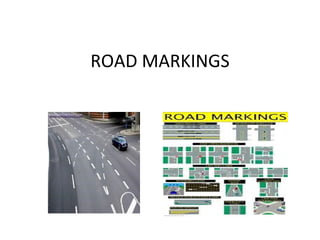
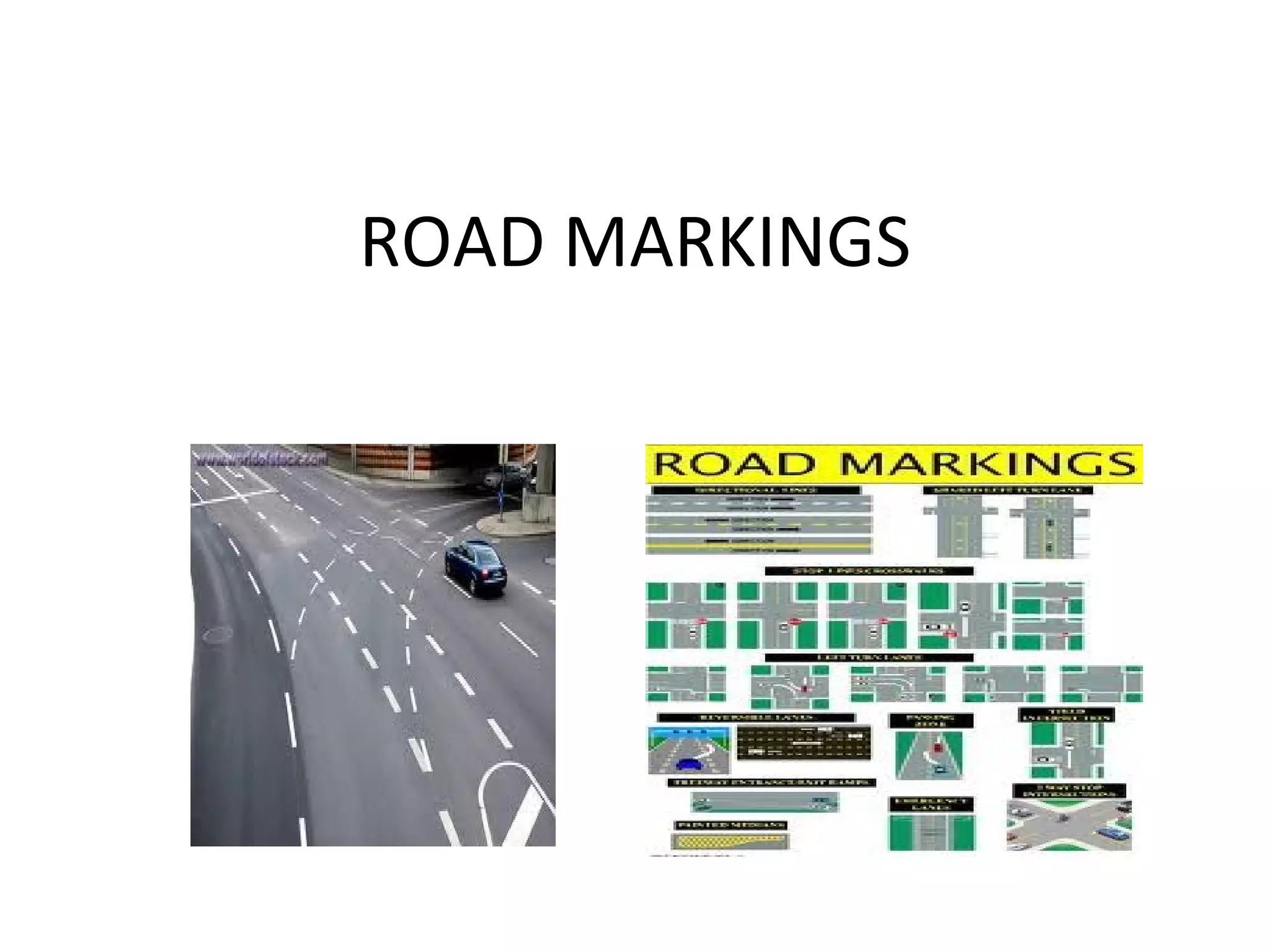
ROAD MARKINGS
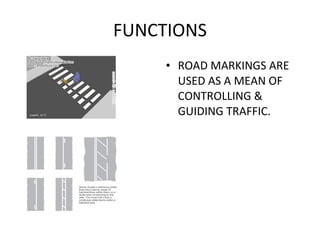
FUNCTIONS ROAD MARKINGS ARE USED AS A MEAN OF CONTROLLING & GUIDING TRAFFIC.
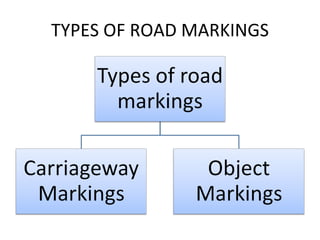
TYPES OF ROAD MARKINGS
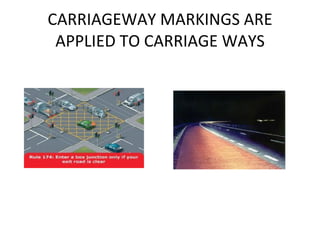
CARRIAGEWAY MARKINGS ARE APPLIED TO CARRIAGE WAYS
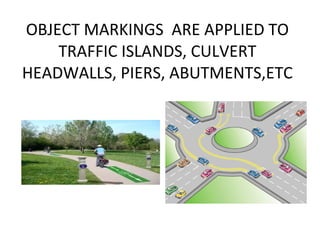
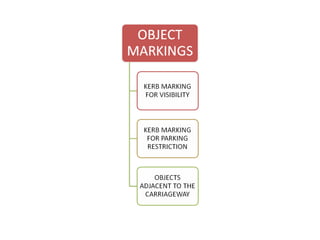
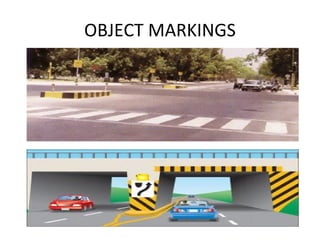
OBJECT MARKINGS  ARE APPLIED TO TRAFFIC ISLANDS, CULVERT HEADWALLS, PIERS, ABUTMENTS,ETC
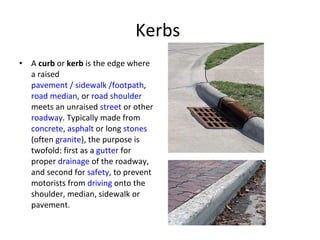
Kerbs  A  curb  or  kerb  is the edge where a raised  pavement / sidewalk /footpath ,  road median , or  road shoulder  meets an unraised  street  or other  roadway . Typically made from  concrete ,  asphalt  or long  stones  (often  granite ), the purpose is twofold: first as a  gutter  for proper  drainage  of the roadway, and second for  safety , to prevent motorists from  driving  onto the shoulder, median, sidewalk or pavement.
 
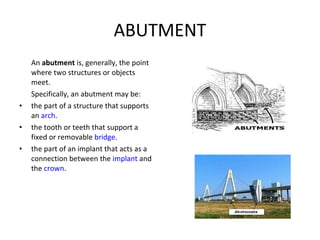
ABUTMENT An  abutment  is, generally, the point where two structures or objects meet. Specifically, an abutment may be: the part of a structure that supports an  arch . the tooth or teeth that support a fixed or removable  bridge . the part of an implant that acts as a connection between the  implant  and the  crown .
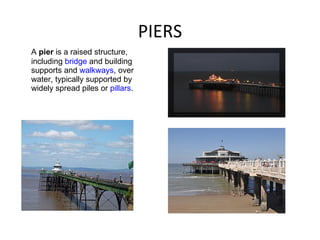
PIERS A  pier  is a raised structure, including  bridge  and building supports and  walkways , over water, typically supported by widely spread piles or  pillars .
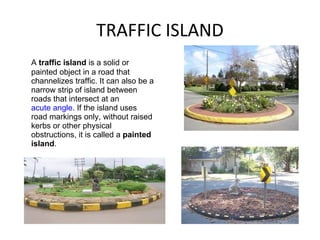
TRAFFIC ISLAND A  traffic island  is a solid or painted object in a road that channelizes traffic. It can also be a narrow strip of island between roads that intersect at an  acute angle . If the island uses road markings only, without raised kerbs or other physical obstructions, it is called a  painted island .
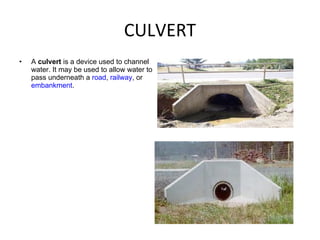
CULVERT A  culvert  is a device used to channel water. It may be used to allow water to pass underneath a  road ,  railway , or  embankment .
 
 
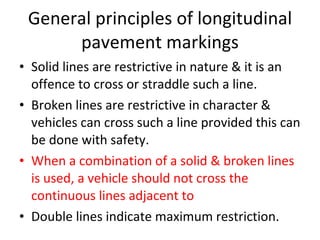
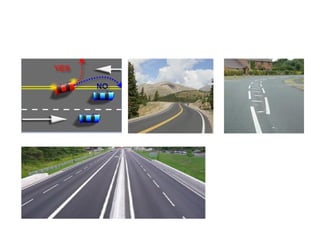
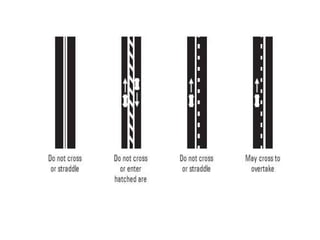
General principles of longitudinal pavement markings Solid lines are restrictive in nature & it is an offence to cross or straddle such a line. Broken lines are restrictive in character & vehicles can cross such a line provided this can be done with safety. When a combination of a solid & broken lines is used, a vehicle should not cross the continuous lines adjacent to  Double lines indicate maximum restriction.
 
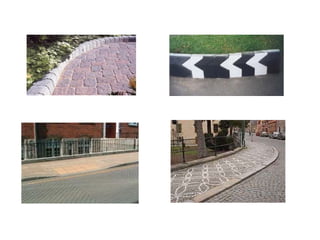
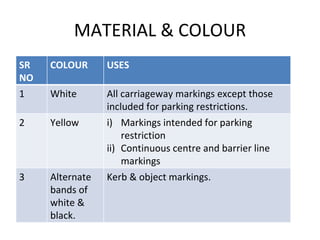
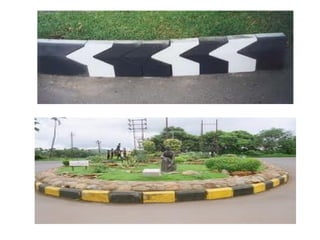
MATERIAL & COLOUR SR NO COLOUR USES 1 White All carriageway markings except those included for parking restrictions. 2 Yellow Markings intended for parking restriction Continuous centre and barrier line markings 3 Alternate bands of white & black. Kerb & object markings.
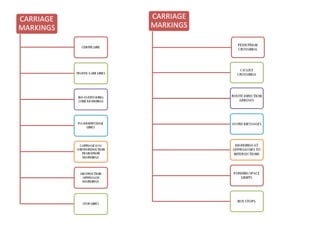
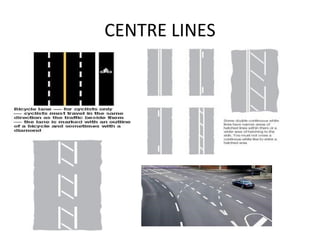
CENTRE LINES
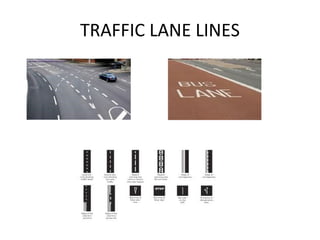
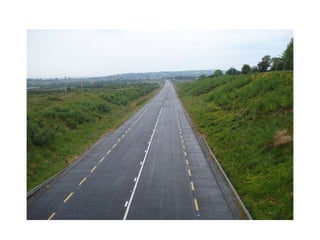
TRAFFIC LANE LINES
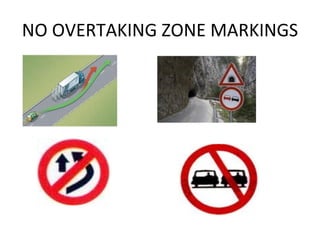
NO OVERTAKING ZONE MARKINGS
 
 
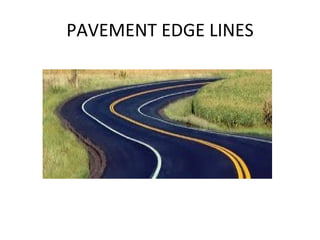
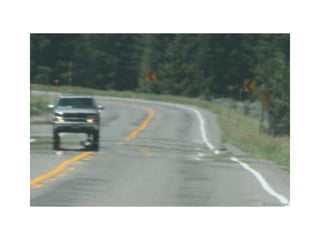
PAVEMENT EDGE LINES
 
 
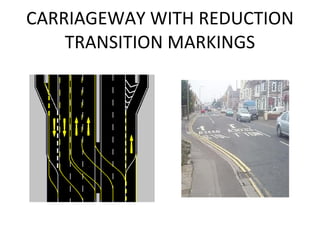
CARRIAGEWAY WITH REDUCTION TRANSITION MARKINGS
 
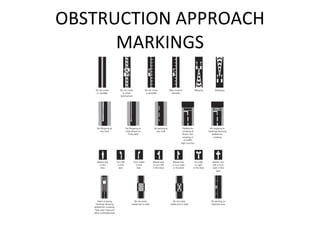
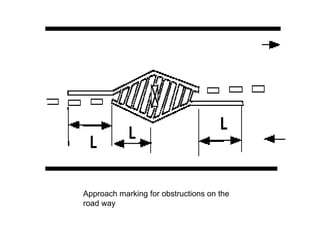
OBSTRUCTION APPROACH MARKINGS
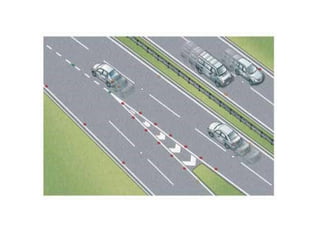
Approach marking for obstructions on the road way
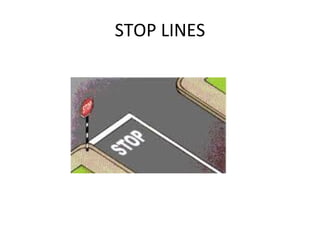
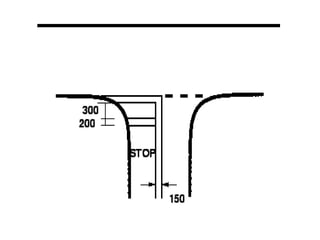
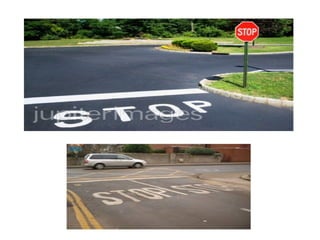
STOP LINES
 
 
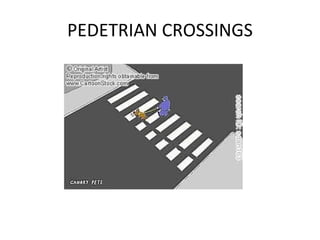
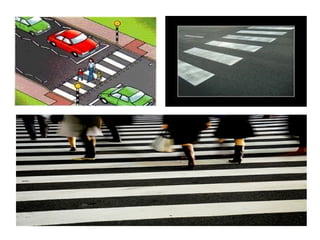
PEDETRIAN CROSSINGS
 
 
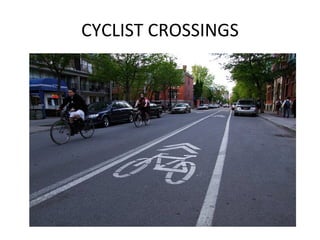
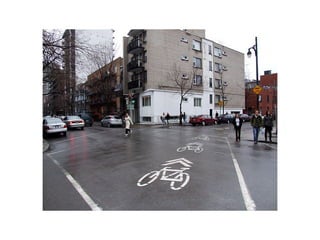
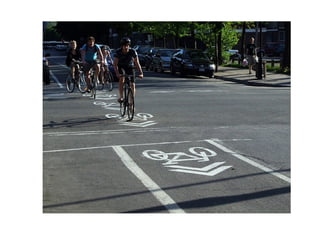
CYCLIST CROSSINGS
 
 
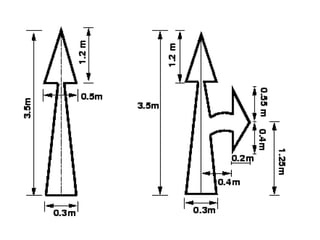
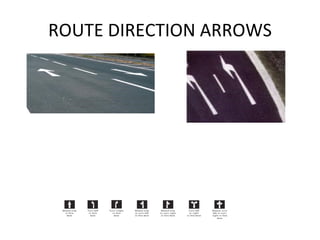
ROUTE DIRECTION ARROWS


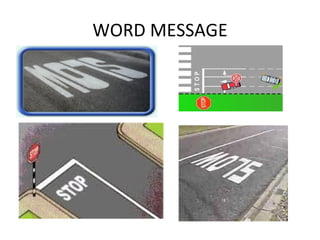
WORD MESSAGE
 
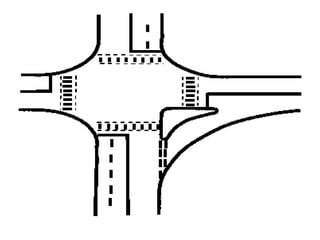
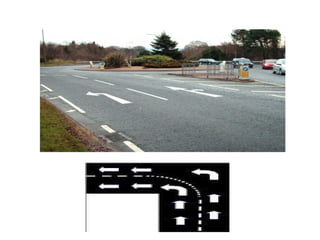
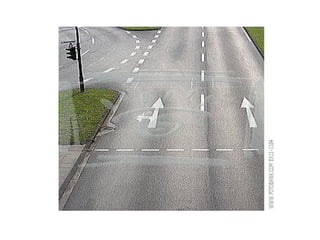
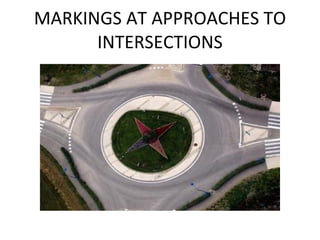
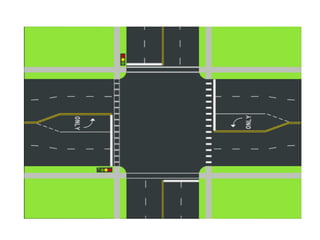
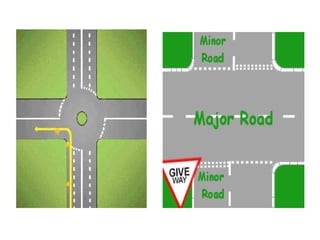
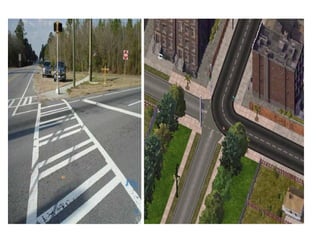
MARKINGS AT APPROACHES TO INTERSECTIONS


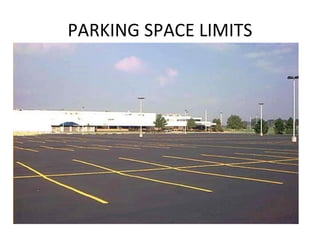
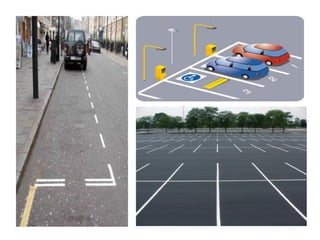
PARKING SPACE LIMITS
 
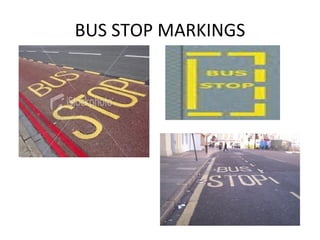
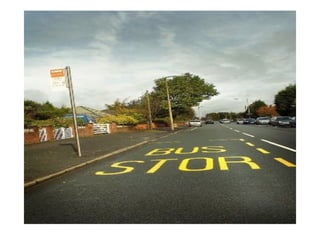
BUS STOP MARKINGS
 
OBJECT MARKINGS
 
END OF CHAPTER 2

road markings

  • 1.
  • 2.
    FUNCTIONS ROAD MARKINGSARE USED AS A MEAN OF CONTROLLING & GUIDING TRAFFIC.
  • 3.
    TYPES OF ROADMARKINGS
  • 4.
    CARRIAGEWAY MARKINGS AREAPPLIED TO CARRIAGE WAYS
  • 5.
    OBJECT MARKINGS ARE APPLIED TO TRAFFIC ISLANDS, CULVERT HEADWALLS, PIERS, ABUTMENTS,ETC
  • 6.
    Kerbs A curb or kerb is the edge where a raised pavement / sidewalk /footpath , road median , or road shoulder meets an unraised street or other roadway . Typically made from concrete , asphalt or long stones (often granite ), the purpose is twofold: first as a gutter for proper drainage of the roadway, and second for safety , to prevent motorists from driving onto the shoulder, median, sidewalk or pavement.
  • 7.
  • 8.
    ABUTMENT An abutment is, generally, the point where two structures or objects meet. Specifically, an abutment may be: the part of a structure that supports an arch . the tooth or teeth that support a fixed or removable bridge . the part of an implant that acts as a connection between the implant and the crown .
  • 9.
    PIERS A pier is a raised structure, including bridge and building supports and walkways , over water, typically supported by widely spread piles or pillars .
  • 10.
    TRAFFIC ISLAND A traffic island is a solid or painted object in a road that channelizes traffic. It can also be a narrow strip of island between roads that intersect at an acute angle . If the island uses road markings only, without raised kerbs or other physical obstructions, it is called a painted island .
  • 11.
    CULVERT A culvert is a device used to channel water. It may be used to allow water to pass underneath a road , railway , or embankment .
  • 12.
  • 13.
  • 14.
    General principles oflongitudinal pavement markings Solid lines are restrictive in nature & it is an offence to cross or straddle such a line. Broken lines are restrictive in character & vehicles can cross such a line provided this can be done with safety. When a combination of a solid & broken lines is used, a vehicle should not cross the continuous lines adjacent to Double lines indicate maximum restriction.
  • 15.
  • 16.
    MATERIAL & COLOURSR NO COLOUR USES 1 White All carriageway markings except those included for parking restrictions. 2 Yellow Markings intended for parking restriction Continuous centre and barrier line markings 3 Alternate bands of white & black. Kerb & object markings.
  • 17.
  • 18.
  • 19.
  • 20.
  • 21.
  • 22.
  • 23.
  • 24.
  • 25.
    CARRIAGEWAY WITH REDUCTIONTRANSITION MARKINGS
  • 26.
  • 27.
  • 28.
    Approach marking forobstructions on the road way
  • 29.
  • 30.
  • 31.
  • 32.
  • 33.
  • 34.
  • 35.
  • 36.
  • 37.
  • 38.
  • 39.
  • 40.
  • 41.
  • 42.
  • 43.
  • 44.
    MARKINGS AT APPROACHESTO INTERSECTIONS
  • 45.
  • 46.
  • 47.
  • 48.
  • 49.
  • 50.
  • 51.
  • 52.
  • 53.
  • 54.