INTRODUCTION TO
DISASTER
DR. MAHESWARI JAIKUMAR
maheswarijaikumar2103@gmail.com
DISASTER
• DISASTER is “Any occurrence that
causes damage, ecological
disruption, loss of human life or
deterioration of health & health
related services on a scale sufficient
to warrant an extraordinary
response from outside the affected
community area”
HAZARD
• “Any phenomenon that has the
potential to cause disruption or
damage to people & their
environment”
CAUSES
1.High birth rate.
2.Problems of land tenure.
3.Problems of economic
opportunity.
4.Lack or misallocation of
resources to meet human
needs.
5.Population explosion.
6.Rapid urbanization.
7.Deforestation.
8.Invasion of the ecology.
9.Global warming.
10.Expansion of industries.
Wrath of God
LIST OF DISASTER
1.Earth quakes.
2.Cyclones.
3.Floods.
4.Tidal waves.
5.Land slides.
6.Volcanic eruptions.
7.Tornadoes.
8.Fires.
9.Hurricanes.
10.Severe air pollution.(smog)
11.Heat waves.
12.Famines.
13.Epidemics.
14.Building collapse.
15.Toxicologic accidents.
16.Nuclear accidents.
17.Warfare
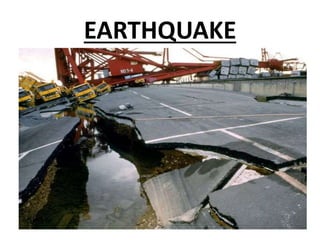
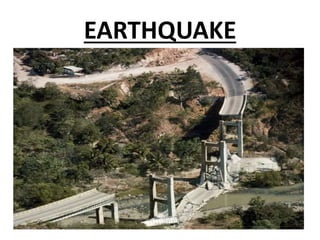
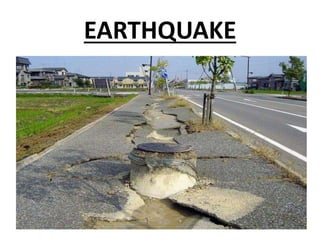
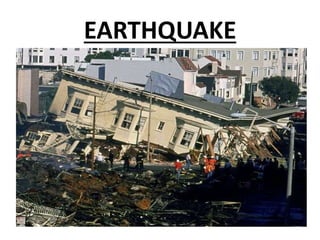
EARTHQUAKE
• a sudden violent shaking of the
ground, typically causing great
destruction, as a result of
movements within the earth's
crust or volcanic action.
EARTHQUAKE
EARTHQUAKE
LAND SLIDE
• A landslide is the movement of
rock, debris or earth down a slope.
They result from the failure of the
materials which make up the hill
slope and are driven by the force
of gravity. Landslides are known
also as landslips, slumps or slope
failure.
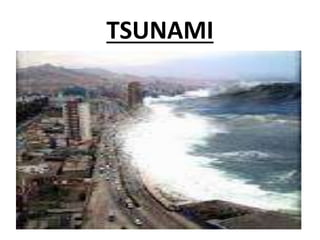
TSUNAMI
• A long, high sea wave caused by
an earthquake or other
disturbance.
• “The loss of human lives from
this latest tsunami is staggering"
TSUNAMI
FLOOD
• An overflow of a large amount of
water beyond its normal limits,
especially over what is normally
dry land.
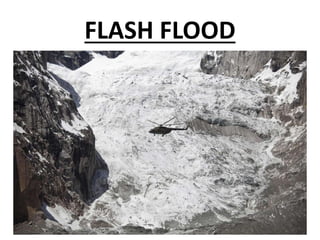
FLASH FLOOD
• A sudden local flood, typically
due to heavy rain.
FLASH FLOOD
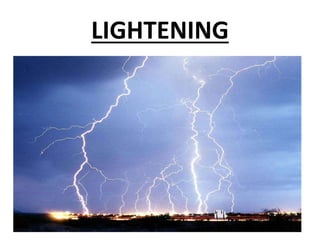
LIGHTENING
• The occurrence of a natural
electrical discharge of very short
duration and high voltage
between a cloud and the ground
or within a cloud, accompanied
by a bright flash and typically
also thunder.
• “A tremendous flash of
lightning"
LIGHTENING
HURRICANE
• A hurricane is a huge storm! It
can be up to 600 miles across
and have strong winds spiraling
inward and upward at speeds of
75 to 200 mph.
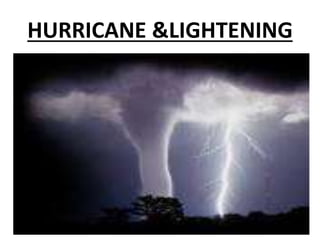
HURRICANE &LIGHTENING
• Each hurricane usually lasts for
over a week, moving 10-20 miles
per hour over the open
ocean. Hurricanes gather heat
and energy through contact with
warm ocean waters.
TORNADOE
• A mobile, destructive vortex of
violently rotating winds having
the appearance of a funnel-
shaped cloud and advancing
beneath a large storm system.
• Synonyms:whirlwind, windstorm,
Cyclone, typhoon, tropical
storm/cyclone, tempest,dust
devil, storm, superstorm, hurricane,
gale, squall; informal twister
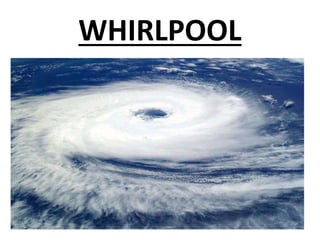
WHIRLPOOL
TIDAL WAVE
• An exceptionally large ocean
wave, especially one caused by
an underwater earthquake or
volcanic eruption.
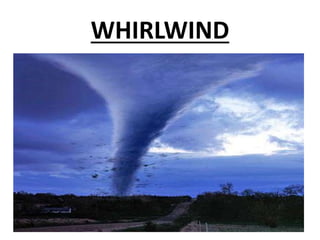
WHIRL WIND
• A column of air moving rapidly
round and round in a cylindrical
or funnel shape.
• Synonyms:tornado, hurricane, ty
phoon, cyclone, tropical
storm, tropical cyclone,vortex;
WHIRLWIND
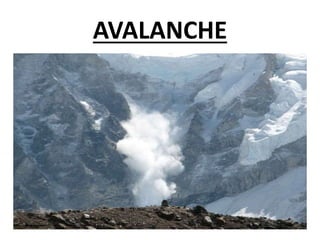
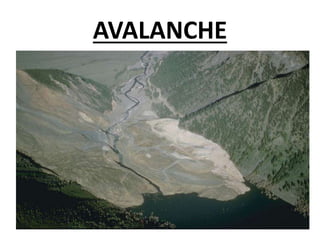
AVALANCHE
• A mass of snow, ice, and rocks
falling rapidly down a
mountainside.
AVALANCHE
AVALANCHE
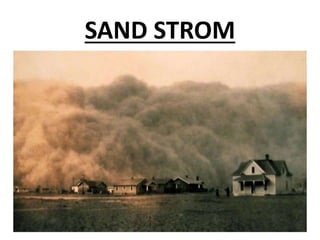
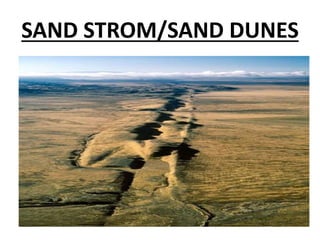
SAND STORM
• A dust storm or sand storm is a
meteorological phenomenon
common in arid and semi-arid
regions.
SAND STROM
SAND STROM/SAND DUNES
• Dust storms arise when a gust
front or other strong wind blows
loose sand and dirt from a dry
surface.
SMOG
• Fog or haze intensified by smoke
or other atmospheric pollutants.
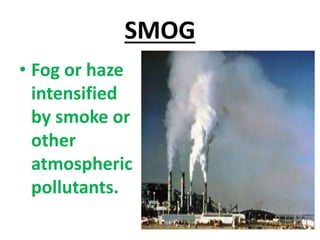
SMOG
• Fog or haze
intensified
by smoke or
other
atmospheric
pollutants.
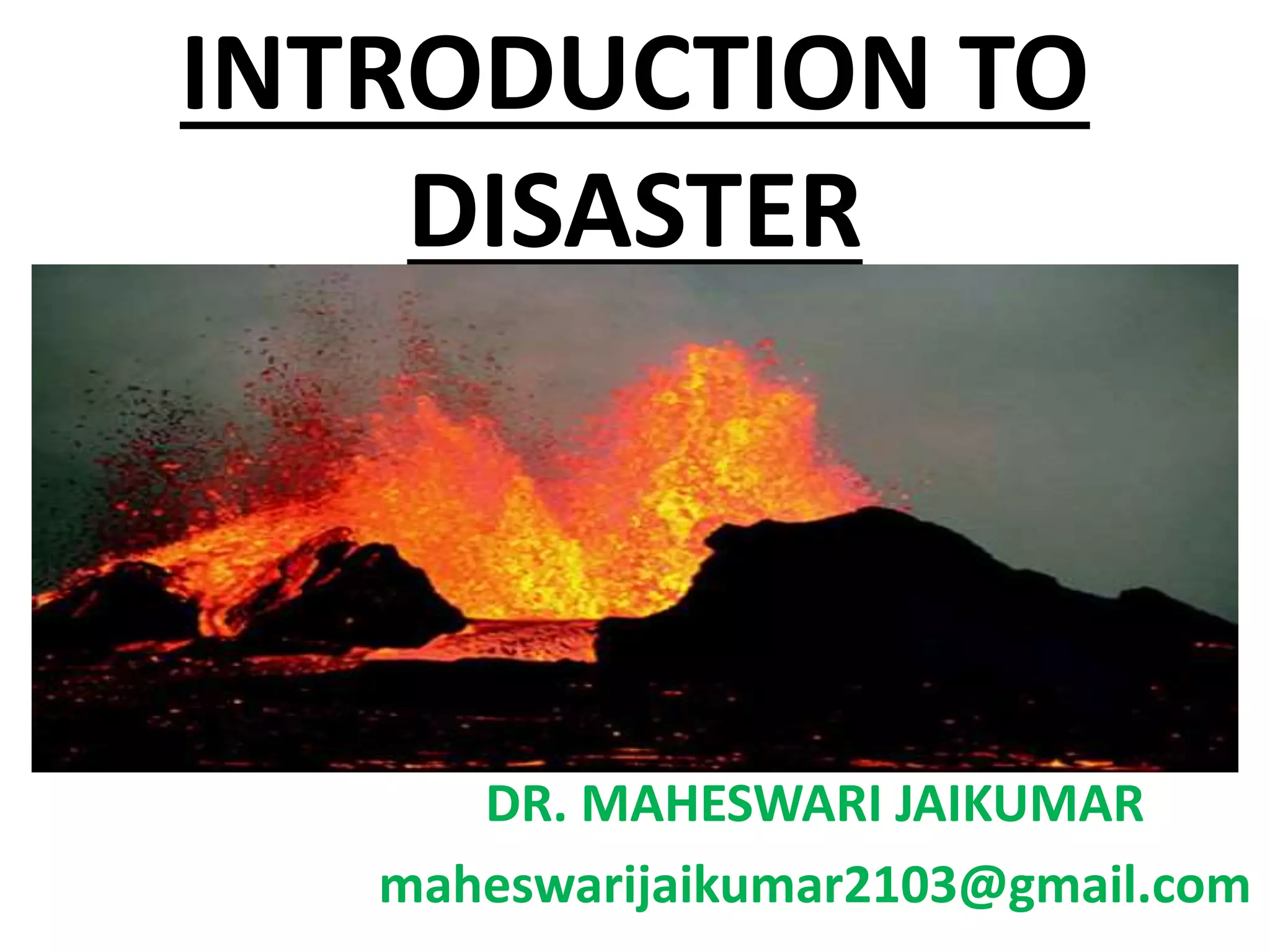
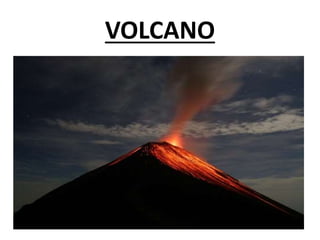
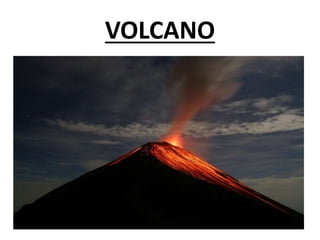
VOLCANO
• Volcanic Eruptions. A volcanic
eruption occurs when molten
rock, ash and steam pour
through a vent in the earth's
crust.
VOLCANO
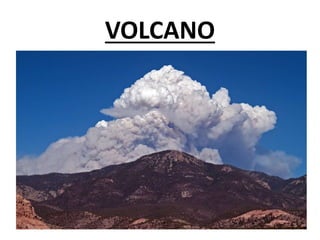
• Volcanoes are described as
active (in eruption), dormant
(not erupting at the present
time), or extinct (having
ceased eruption; no longer
active).
VOLCANO
HEAT WAVES
• A prolonged period of
abnormally hot weather.
CLOUD BURST
• A cloudburst is an extreme
amount of precipitation,
sometimes accompanied by hail
and thunder, that normally lasts
no longer than a few minutes
but is capable of creating flood
conditions
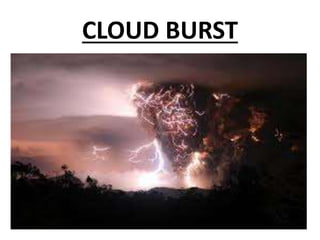
CLOUD BURST
• A cloudburstcan suddenly dump
72,300 tons of water over one
acre.
CRATER
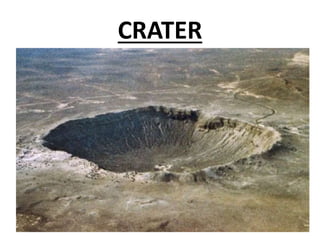
• A large bowl-shaped cavity in the
ground or on a celestial object,
typically one caused by an
explosion or the impact of a
meteorite.
CRATER
FOREST FIRE
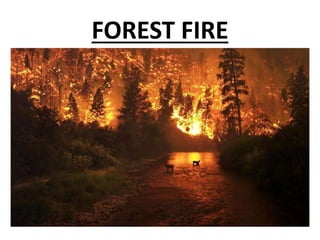
• A forest fire is an
uncontrolled fire occurring in
nature. Sometimes, the forest
fire is so large that it takes a long
time for the fire fighting crews to
gain control over the situation.
This could result in massive
destruction.
FOREST FIRE
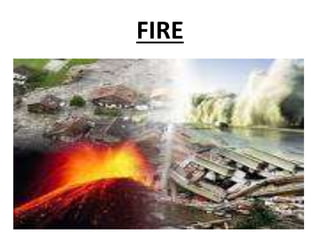
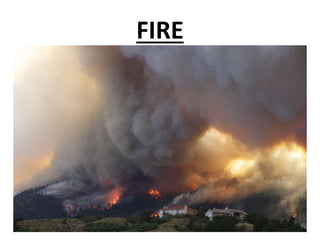
FIRE
FIRE
FAMINE
• Extreme scarcity of food.
EPIDEMIC
• A widespread occurrence of an
infectious disease in a
community at a particular time.
NUCLEAR WARFARE
• A nuclear war is a war in which
countries fight
with nuclear weapons. A nuclear
war has never happened.
• Because nuclear weapons are
extremely powerful and could
cause destruction throughout
the world, the possibility
of nuclear war has had a great
effect on international politics.
VOLCANO
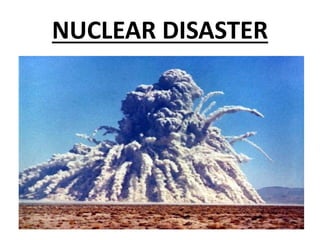
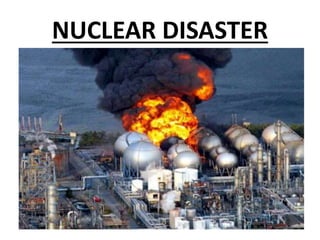
NUCLEAR DISASTER
• A nuclear and
radiation accident is defined by
the International Atomic Energy
Agency (IAEA) as "an event that
has led to significant
consequences to people, the
environment or the facility."
• Examples include lethal effects
to individuals, large radioactivity
release to the environment, or
reactor core melt."
NUCLEAR DISASTER
NUCLEAR DISASTER
CLASSIFICATION OF
DISASTERS
• 1. WATER & CLIMATE RELATED
DISASTERS
• 2. GEOLOGICAL RELATED
DISASTERS.
• 3. CHEMICAL, INDUSTRIAL &
NUCLEAR RELATED DISASTERS.
• 4. ACCIDENT RELATED
DISASTERS.
• 5. BIOLOGICAL RELATED
DISASTERS.
WATER & CLIMATE RELATED
DISASTERS
• Flood, Cyclone, Tornadoes,
Hurricanes, Hailstorm, Cloud
burst, Heat waves, Snow
avalanches, Droughts, Sea
erosion, Thunder & lightening.
GEOLOGICAL RELATED
DISASTERS
Land slides & mudflows,
Earthquakes, dam failures/Dam
burst, Minor fires, Tsunami.
CHEMICAL, INDUSTRIAL &
NUCLEAR RELATED DISASTERS
Chemical and industrial
disasters, Nuclear disasters.
ACCIDENT RELATED
DISASTERS.
Forest fires, Urban fires, Mine
flooding, Oil spills, Major
building collapse, Serial bomb
blast, Festival related disasters,
Electrical disasters & fires, Air,
road & rail accidents, Boat
capsizing, village fire, Stampede.
BIOLOGICAL RELATED
DISASTERS.
Biological disasters &
epidemics, Pest attacks,
Cattle epidemics, Food
poisoning.
RESULTS &CONSEQUENCES
OF DISASTER
1. Affect health & well being of
people.
2. Large number of people are
affected & displaced.
3. People are killed or injured.
EARTHQUAKE
4. Subjected to a greater risk of
diseases.
5. Results in considerable
economic harm.
6. Harm to existing infrastructure.
EARTHQUAKE
ULTIMATE EFFECT
1.Injuries.
2.Emotional stress.
3.Epidemic of disease.
4.Increase in indigenous
disease.
FACTORS DECIDING THE
CONSEQUENCES
1.Type of disaster.
2.Density & distribution of
population.
3.Condition of the warning.
4.Degree of preparedness.
THNANK YOU

INTRODUCTION TO NATURAL DISASTER