
NATURAL
DISASTERS
English Integrated
Project
What are natural disasters?
• A natural disaster is a major adverse event resulting
from natural processes of the Earth ; examples
include floods ,volcanic
eruptions,earthquakes,tsunamis,and other geologic
processes.
• A natural disaster can cause loss of life or property
damage and typically leaves some economic
damage in its wake, the severity of which depends
on the affected population'sresilience, or ability to
recover.An adverse event will not rise to the level of
a disaster if it occurs in an area without vulnerable
population.In a vulnerable area, however, such
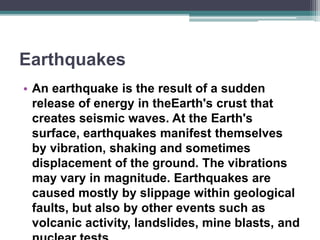
Floods
• A flood is an overflow of water that "submerges"
land. The EU Floods Directive defines a flood as
a temporary covering by water of land not
normally covered by water.In the sense of
"flowing water", the word may also be applied to
the inflow of the tides. Flooding may result from
the volume of water within a body of water, such
as a river or lake, which overflows causing the
result that some of the water escapes its usual
boundaries.While the size of a lake or other
body of water will vary with seasonal changes in
precipitation and snow melt, it is not a
significant flood unless the water covers land
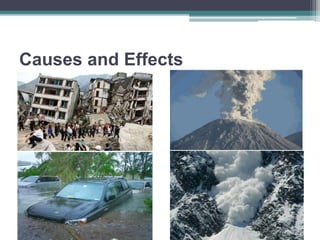
Causes and Effects
Natural disasters happen all over the world, and
they can be utterly devastating for people’s lives and
the environments in which they live. Although
natural disasters are caused by nature and there is
nothing that we can do to prevent them happening,
there are many different natural causes that lead to
natural disasters, and being aware of these causes
enables us to be better prepared when such
disasters do arrive.One common natural disaster is
flooding, which occurs when a river bursts its banks
and the water spills out onto the floodplain. This is
far more likely to happen when there is a great deal
Causes and Effects
There are other risk factors for flooding too: steep-
sided channels cause fast surface run-off, while a
lack of vegetation or woodland to both break the
flow of water and drink the water means that there is
little to slow the floodwater down. Drainage basins
of impermeable rock also cause the water to run
faster over the surface. Earthquakes are another
common natural disaster that can cause many
fatalities. The movements of the plates in the earth’s
crust cause them. These plates do not always move
smoothly and can get stuck, causing a build-up of
pressure. It is when this pressure is released that an
Causes and Effects
Tsunamis can also be caused by underwater
volcanic eruptions. Volcanic eruptions are another
natural disaster, and they are caused by magma
escaping from inside the earth. An explosion takes
place, releasing the magma from a confined space,
which is why there are often also huge quantities of
gas and dust released during a volcanic eruption.
The magma travels up the inside of the volcano, and
pours out over the surrounding area as lava. One of
the most common natural disasters, but also one of
the most commonly forgotten, is wildfires. These
take place in many different countries all over the
Causes and Effects
Examples
Epidemics
• An epidemicis an outbreak of a contractible disease
that spreads through a human population. A
pandemic is an epidemic whose spread is global.
There have been many epidemics throughout
history, such as theBlack Death. In the last hundred
years, significant pandemics include:
• The 1918 Spanish flupandemic, killing an estimated
50 million people worldwide
• The 1957–58 Asian flupandemic, which killed an
estimated 1 million people
• The 1968–69Hong Kong water flupandemic
• The 2002-3SARSpandemic
• The AIDS pandemic, beginning in 1959
• The H1N1 Influenza(Swine Flu) Pandemic 2009–2010
• Other diseases that spread more slowly, but are still
considered to be global health emergencies by
theWHO, include: XDR TB, a strain of tuberculosis
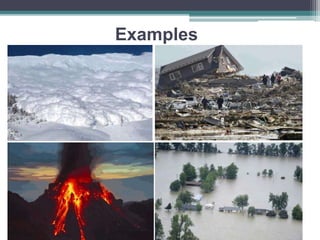
Avalanches
• During World War I, an estimated 40,000 to 80,000
soldiers died as a result of avalanches during the
mountain campaign in the Alpsat the Austrian-Italian
front. Many of the avalanches were caused by
artillery fire.
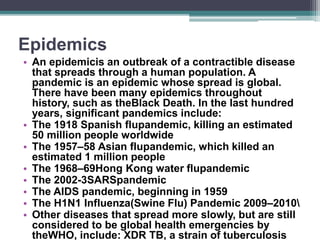
Earthquakes
• An earthquake is the result of a sudden
release of energy in theEarth's crust that
creates seismic waves. At the Earth's
surface, earthquakes manifest themselves
by vibration, shaking and sometimes
displacement of the ground. The vibrations
may vary in magnitude. Earthquakes are
caused mostly by slippage within geological
faults, but also by other events such as
volcanic activity, landslides, mine blasts, and
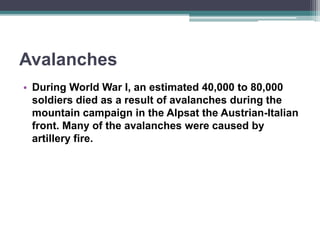
Volcanic Eruptions
• Volcanoes can cause widespread destruction
and consequent disaster in several ways.
The effects include the volcanic eruption
itself that may cause harm following the
explosion of the volcano or the fall of rock.
Second, lava may be produced during the
eruption of a volcano. As it leaves the
volcano, the lava destroys many buildings,
plants and animals it encounters.
Third,volcanic ash generally meaning the
By Vimal
Kumar

natural disaster

  • 1.
  • 2.
    What are naturaldisasters? • A natural disaster is a major adverse event resulting from natural processes of the Earth ; examples include floods ,volcanic eruptions,earthquakes,tsunamis,and other geologic processes. • A natural disaster can cause loss of life or property damage and typically leaves some economic damage in its wake, the severity of which depends on the affected population'sresilience, or ability to recover.An adverse event will not rise to the level of a disaster if it occurs in an area without vulnerable population.In a vulnerable area, however, such
  • 3.
    Floods • A floodis an overflow of water that "submerges" land. The EU Floods Directive defines a flood as a temporary covering by water of land not normally covered by water.In the sense of "flowing water", the word may also be applied to the inflow of the tides. Flooding may result from the volume of water within a body of water, such as a river or lake, which overflows causing the result that some of the water escapes its usual boundaries.While the size of a lake or other body of water will vary with seasonal changes in precipitation and snow melt, it is not a significant flood unless the water covers land
  • 4.
    Causes and Effects Naturaldisasters happen all over the world, and they can be utterly devastating for people’s lives and the environments in which they live. Although natural disasters are caused by nature and there is nothing that we can do to prevent them happening, there are many different natural causes that lead to natural disasters, and being aware of these causes enables us to be better prepared when such disasters do arrive.One common natural disaster is flooding, which occurs when a river bursts its banks and the water spills out onto the floodplain. This is far more likely to happen when there is a great deal
  • 5.
    Causes and Effects Thereare other risk factors for flooding too: steep- sided channels cause fast surface run-off, while a lack of vegetation or woodland to both break the flow of water and drink the water means that there is little to slow the floodwater down. Drainage basins of impermeable rock also cause the water to run faster over the surface. Earthquakes are another common natural disaster that can cause many fatalities. The movements of the plates in the earth’s crust cause them. These plates do not always move smoothly and can get stuck, causing a build-up of pressure. It is when this pressure is released that an
  • 6.
    Causes and Effects Tsunamiscan also be caused by underwater volcanic eruptions. Volcanic eruptions are another natural disaster, and they are caused by magma escaping from inside the earth. An explosion takes place, releasing the magma from a confined space, which is why there are often also huge quantities of gas and dust released during a volcanic eruption. The magma travels up the inside of the volcano, and pours out over the surrounding area as lava. One of the most common natural disasters, but also one of the most commonly forgotten, is wildfires. These take place in many different countries all over the
  • 7.
  • 8.
  • 9.
    Epidemics • An epidemicisan outbreak of a contractible disease that spreads through a human population. A pandemic is an epidemic whose spread is global. There have been many epidemics throughout history, such as theBlack Death. In the last hundred years, significant pandemics include: • The 1918 Spanish flupandemic, killing an estimated 50 million people worldwide • The 1957–58 Asian flupandemic, which killed an estimated 1 million people • The 1968–69Hong Kong water flupandemic • The 2002-3SARSpandemic • The AIDS pandemic, beginning in 1959 • The H1N1 Influenza(Swine Flu) Pandemic 2009–2010 • Other diseases that spread more slowly, but are still considered to be global health emergencies by theWHO, include: XDR TB, a strain of tuberculosis
  • 10.
    Avalanches • During WorldWar I, an estimated 40,000 to 80,000 soldiers died as a result of avalanches during the mountain campaign in the Alpsat the Austrian-Italian front. Many of the avalanches were caused by artillery fire.
  • 11.
    Earthquakes • An earthquakeis the result of a sudden release of energy in theEarth's crust that creates seismic waves. At the Earth's surface, earthquakes manifest themselves by vibration, shaking and sometimes displacement of the ground. The vibrations may vary in magnitude. Earthquakes are caused mostly by slippage within geological faults, but also by other events such as volcanic activity, landslides, mine blasts, and
  • 12.
    Volcanic Eruptions • Volcanoescan cause widespread destruction and consequent disaster in several ways. The effects include the volcanic eruption itself that may cause harm following the explosion of the volcano or the fall of rock. Second, lava may be produced during the eruption of a volcano. As it leaves the volcano, the lava destroys many buildings, plants and animals it encounters. Third,volcanic ash generally meaning the
  • 13.