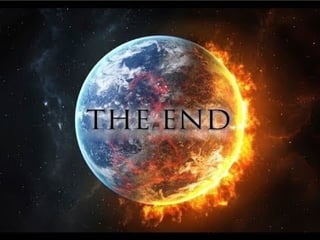
NATURAL DISASTER'S
Submitted By:
Amit Kumar
B.TECH(Student)
KIIT UNIVERSITY
NATURAL DISASTER'S
Natural Disaster:
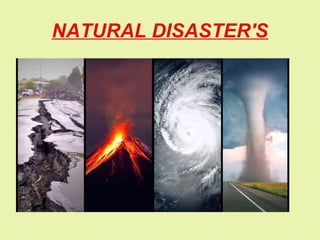
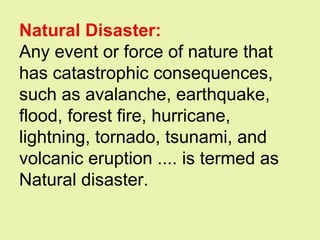
Any event or force of nature that
has catastrophic consequences,
such as avalanche, earthquake,
flood, forest fire, hurricane,
lightning, tornado, tsunami, and
volcanic eruption .... is termed as
Natural disaster.
Type's Of Natural Disaster:
• 1) Geological disasters
• 2 )Hydrological disasters
• 3) Meteorological disasters
• 4) Wildfires
• 5 )Health disasters
• 6 )Space disasters
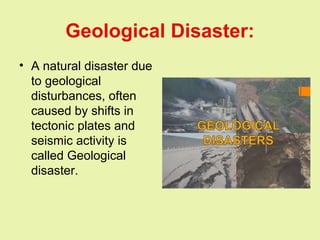
Geological Disaster:
• A natural disaster due
to geological
disturbances, often
caused by shifts in
tectonic plates and
seismic activity is
called Geological
disaster.
Type's Of Geological Disaster:
• =>Avalanches and landslides
• => Earthquakes
• =>Sinkholes
• => Volcanic eruptions
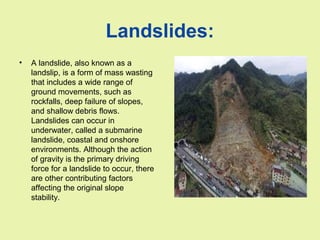
Landslides:
• A landslide, also known as a
landslip, is a form of mass wasting
that includes a wide range of
ground movements, such as
rockfalls, deep failure of slopes,
and shallow debris flows.
Landslides can occur in
underwater, called a submarine
landslide, coastal and onshore
environments. Although the action
of gravity is the primary driving
force for a landslide to occur, there
are other contributing factors
affecting the original slope
stability.
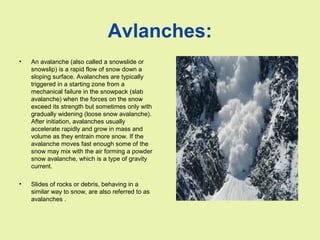
Avlanches:
• An avalanche (also called a snowslide or
snowslip) is a rapid flow of snow down a
sloping surface. Avalanches are typically
triggered in a starting zone from a
mechanical failure in the snowpack (slab
avalanche) when the forces on the snow
exceed its strength but sometimes only with
gradually widening (loose snow avalanche).
After initiation, avalanches usually
accelerate rapidly and grow in mass and
volume as they entrain more snow. If the
avalanche moves fast enough some of the
snow may mix with the air forming a powder
snow avalanche, which is a type of gravity
current.
• Slides of rocks or debris, behaving in a
similar way to snow, are also referred to as
avalanches .
Sinkholes:
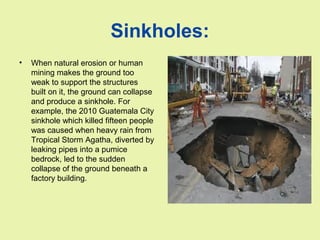
• When natural erosion or human
mining makes the ground too
weak to support the structures
built on it, the ground can collapse
and produce a sinkhole. For
example, the 2010 Guatemala City
sinkhole which killed fifteen people
was caused when heavy rain from
Tropical Storm Agatha, diverted by
leaking pipes into a pumice
bedrock, led to the sudden
collapse of the ground beneath a
factory building.
Volcanic Erruption:
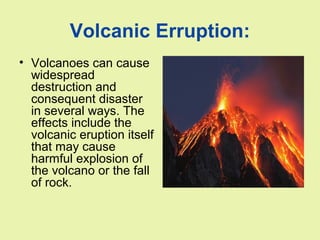
• Volcanoes can cause
widespread
destruction and
consequent disaster
in several ways. The
effects include the
volcanic eruption itself
that may cause
harmful explosion of
the volcano or the fall
of rock.
Earthquake:
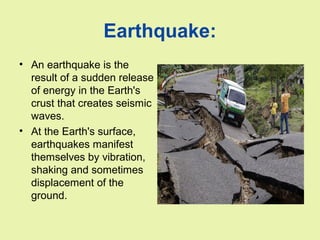
• An earthquake is the
result of a sudden release
of energy in the Earth's
crust that creates seismic
waves.
• At the Earth's surface,
earthquakes manifest
themselves by vibration,
shaking and sometimes
displacement of the
ground.
Hydrological Disaster:
• Hydrological disasters is a violent, sharp
and harmful amendment either in quality
of earth's water or in distribution or
movement of water ashore below the
surface or in atmosphere. A flood is
associate overflow of associate expanse
of water that submerges land.
Types Of Hydrological
disaster:
• 1 Floods
• 2 Limnic eruptions
• 3 Tsunami
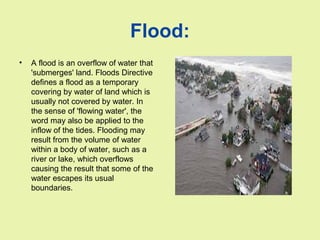
Flood:
• A flood is an overflow of water that
'submerges' land. Floods Directive
defines a flood as a temporary
covering by water of land which is
usually not covered by water. In
the sense of 'flowing water', the
word may also be applied to the
inflow of the tides. Flooding may
result from the volume of water
within a body of water, such as a
river or lake, which overflows
causing the result that some of the
water escapes its usual
boundaries.
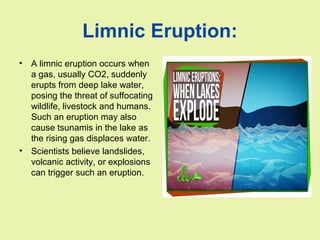
Limnic Eruption:
• A limnic eruption occurs when
a gas, usually CO2, suddenly
erupts from deep lake water,
posing the threat of suffocating
wildlife, livestock and humans.
Such an eruption may also
cause tsunamis in the lake as
the rising gas displaces water.
• Scientists believe landslides,
volcanic activity, or explosions
can trigger such an eruption.
Tsunami:
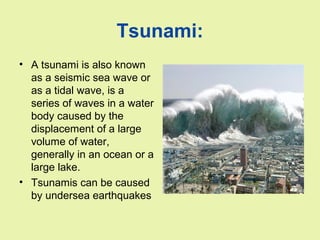
• A tsunami is also known
as a seismic sea wave or
as a tidal wave, is a
series of waves in a water
body caused by the
displacement of a large
volume of water,
generally in an ocean or a
large lake.
• Tsunamis can be caused
by undersea earthquakes
Meteorological disasters:
• Meteorological disasters are caused by
extreme weather, e.g. rain, drought, snow,
extreme heat or cold, ice, or wind. Violent,
sudden and destructive change to the
environment related to, produced by, or
affecting the earth's atmosphere, especially
the weather-forming processes.
Types Of Metrological
disaster:
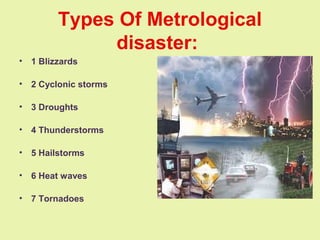
• 1 Blizzards
• 2 Cyclonic storms
• 3 Droughts
• 4 Thunderstorms
• 5 Hailstorms
• 6 Heat waves
• 7 Tornadoes
Blizzards:
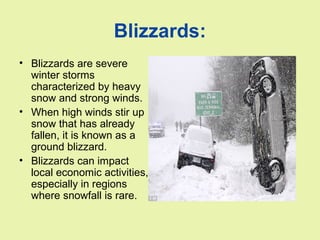
• Blizzards are severe
winter storms
characterized by heavy
snow and strong winds.
• When high winds stir up
snow that has already
fallen, it is known as a
ground blizzard.
• Blizzards can impact
local economic activities,
especially in regions
where snowfall is rare.
Cyclonic Storms:
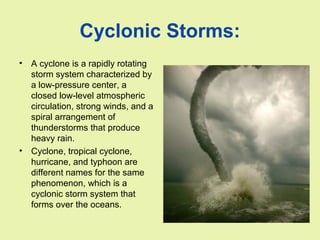
• A cyclone is a rapidly rotating
storm system characterized by
a low-pressure center, a
closed low-level atmospheric
circulation, strong winds, and a
spiral arrangement of
thunderstorms that produce
heavy rain.
• Cyclone, tropical cyclone,
hurricane, and typhoon are
different names for the same
phenomenon, which is a
cyclonic storm system that
forms over the oceans.
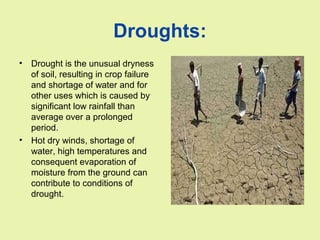
Droughts:
• Drought is the unusual dryness
of soil, resulting in crop failure
and shortage of water and for
other uses which is caused by
significant low rainfall than
average over a prolonged
period.
• Hot dry winds, shortage of
water, high temperatures and
consequent evaporation of
moisture from the ground can
contribute to conditions of
drought.
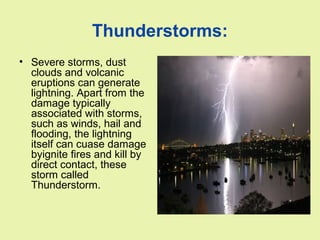
Thunderstorms:
• Severe storms, dust
clouds and volcanic
eruptions can generate
lightning. Apart from the
damage typically
associated with storms,
such as winds, hail and
flooding, the lightning
itself can cuase damage
byignite fires and kill by
direct contact, these
storm called
Thunderstorm.
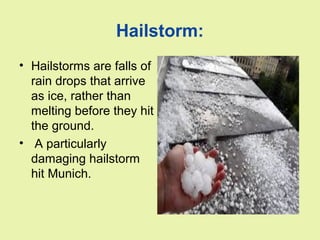
Hailstorm:
• Hailstorms are falls of
rain drops that arrive
as ice, rather than
melting before they hit
the ground.
• A particularly
damaging hailstorm
hit Munich.
Heat Waves:
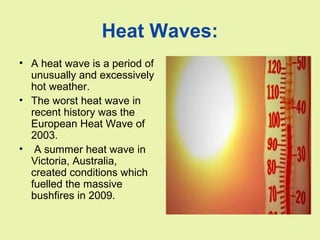
• A heat wave is a period of
unusually and excessively
hot weather.
• The worst heat wave in
recent history was the
European Heat Wave of
2003.
• A summer heat wave in
Victoria, Australia,
created conditions which
fuelled the massive
bushfires in 2009.
Tornado:
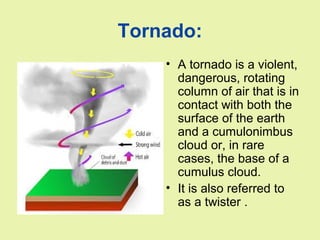
• A tornado is a violent,
dangerous, rotating
column of air that is in
contact with both the
surface of the earth
and a cumulonimbus
cloud or, in rare
cases, the base of a
cumulus cloud.
• It is also referred to
as a twister .
Wildfires:
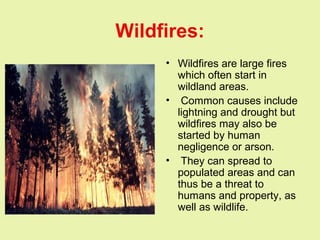
• Wildfires are large fires
which often start in
wildland areas.
• Common causes include
lightning and drought but
wildfires may also be
started by human
negligence or arson.
• They can spread to
populated areas and can
thus be a threat to
humans and property, as
well as wildlife.
Epidemics(Health Disaster):
• An epidemic is an outbreak of a
contractible disease that spreads
through a human population.
• A pandemic is an epidemic that has
spread globally.
• There have been many epidemics
throughout history, such as the Black
Death. In the last hundred years,
significant pandemics include the 1918
Spanish flu pandemic (killing an
estimated 50 million people
worldwide), the 1957–58 Asian flu
pandemic, and the AIDS pandemic,
which began in 1959. The 1968–69
Hong Kong water flu pandemic, the
2002-3 SARS pandemic, and the
H1N1 Influenza (Swine Flu) Pandemic
in 2009–2010 were also significant
cases.
Space disasters:
• The disaster happen in the universe due
to collapsing of two asteroids or throgh
more heat of the sun or some unknown
bodies which came from space entered in
earth's atmosphere and cause disaster
are termed as Space disaster.
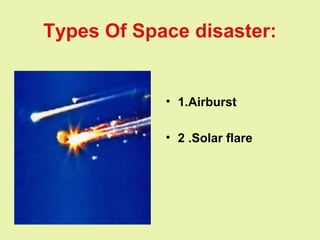
Types Of Space disaster:
• 1.Airburst
• 2 .Solar flare
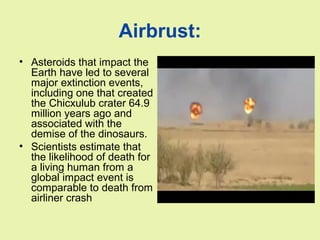
Airbrust:
• Asteroids that impact the
Earth have led to several
major extinction events,
including one that created
the Chicxulub crater 64.9
million years ago and
associated with the
demise of the dinosaurs.
• Scientists estimate that
the likelihood of death for
a living human from a
global impact event is
comparable to death from
airliner crash
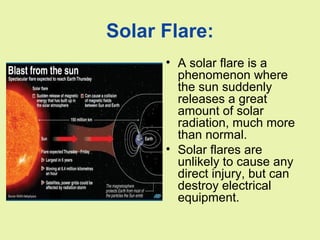
Solar Flare:
• A solar flare is a
phenomenon where
the sun suddenly
releases a great
amount of solar
radiation, much more
than normal.
• Solar flares are
unlikely to cause any
direct injury, but can
destroy electrical
equipment.
If you have any query
regarding this
you can contact me on this
email id :
amitsingh29sep@gmail.com
Amit Kumar

Natural disaster

  • 1.
    NATURAL DISASTER'S Submitted By: AmitKumar B.TECH(Student) KIIT UNIVERSITY
  • 2.
  • 3.
    Natural Disaster: Any eventor force of nature that has catastrophic consequences, such as avalanche, earthquake, flood, forest fire, hurricane, lightning, tornado, tsunami, and volcanic eruption .... is termed as Natural disaster.
  • 4.
    Type's Of NaturalDisaster: • 1) Geological disasters • 2 )Hydrological disasters • 3) Meteorological disasters • 4) Wildfires • 5 )Health disasters • 6 )Space disasters
  • 5.
    Geological Disaster: • Anatural disaster due to geological disturbances, often caused by shifts in tectonic plates and seismic activity is called Geological disaster.
  • 6.
    Type's Of GeologicalDisaster: • =>Avalanches and landslides • => Earthquakes • =>Sinkholes • => Volcanic eruptions
  • 7.
    Landslides: • A landslide,also known as a landslip, is a form of mass wasting that includes a wide range of ground movements, such as rockfalls, deep failure of slopes, and shallow debris flows. Landslides can occur in underwater, called a submarine landslide, coastal and onshore environments. Although the action of gravity is the primary driving force for a landslide to occur, there are other contributing factors affecting the original slope stability.
  • 8.
    Avlanches: • An avalanche(also called a snowslide or snowslip) is a rapid flow of snow down a sloping surface. Avalanches are typically triggered in a starting zone from a mechanical failure in the snowpack (slab avalanche) when the forces on the snow exceed its strength but sometimes only with gradually widening (loose snow avalanche). After initiation, avalanches usually accelerate rapidly and grow in mass and volume as they entrain more snow. If the avalanche moves fast enough some of the snow may mix with the air forming a powder snow avalanche, which is a type of gravity current. • Slides of rocks or debris, behaving in a similar way to snow, are also referred to as avalanches .
  • 9.
    Sinkholes: • When naturalerosion or human mining makes the ground too weak to support the structures built on it, the ground can collapse and produce a sinkhole. For example, the 2010 Guatemala City sinkhole which killed fifteen people was caused when heavy rain from Tropical Storm Agatha, diverted by leaking pipes into a pumice bedrock, led to the sudden collapse of the ground beneath a factory building.
  • 10.
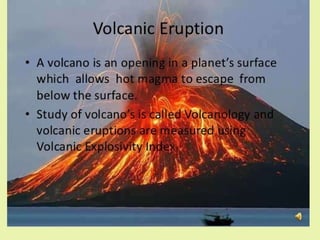
    Volcanic Erruption: • Volcanoescan cause widespread destruction and consequent disaster in several ways. The effects include the volcanic eruption itself that may cause harmful explosion of the volcano or the fall of rock.
  • 12.
    Earthquake: • An earthquakeis the result of a sudden release of energy in the Earth's crust that creates seismic waves. • At the Earth's surface, earthquakes manifest themselves by vibration, shaking and sometimes displacement of the ground.
  • 13.
    Hydrological Disaster: • Hydrologicaldisasters is a violent, sharp and harmful amendment either in quality of earth's water or in distribution or movement of water ashore below the surface or in atmosphere. A flood is associate overflow of associate expanse of water that submerges land.
  • 14.
    Types Of Hydrological disaster: •1 Floods • 2 Limnic eruptions • 3 Tsunami
  • 15.
    Flood: • A floodis an overflow of water that 'submerges' land. Floods Directive defines a flood as a temporary covering by water of land which is usually not covered by water. In the sense of 'flowing water', the word may also be applied to the inflow of the tides. Flooding may result from the volume of water within a body of water, such as a river or lake, which overflows causing the result that some of the water escapes its usual boundaries.
  • 16.
    Limnic Eruption: • Alimnic eruption occurs when a gas, usually CO2, suddenly erupts from deep lake water, posing the threat of suffocating wildlife, livestock and humans. Such an eruption may also cause tsunamis in the lake as the rising gas displaces water. • Scientists believe landslides, volcanic activity, or explosions can trigger such an eruption.
  • 17.
    Tsunami: • A tsunamiis also known as a seismic sea wave or as a tidal wave, is a series of waves in a water body caused by the displacement of a large volume of water, generally in an ocean or a large lake. • Tsunamis can be caused by undersea earthquakes
  • 18.
    Meteorological disasters: • Meteorologicaldisasters are caused by extreme weather, e.g. rain, drought, snow, extreme heat or cold, ice, or wind. Violent, sudden and destructive change to the environment related to, produced by, or affecting the earth's atmosphere, especially the weather-forming processes.
  • 19.
    Types Of Metrological disaster: •1 Blizzards • 2 Cyclonic storms • 3 Droughts • 4 Thunderstorms • 5 Hailstorms • 6 Heat waves • 7 Tornadoes
  • 20.
    Blizzards: • Blizzards aresevere winter storms characterized by heavy snow and strong winds. • When high winds stir up snow that has already fallen, it is known as a ground blizzard. • Blizzards can impact local economic activities, especially in regions where snowfall is rare.
  • 21.
    Cyclonic Storms: • Acyclone is a rapidly rotating storm system characterized by a low-pressure center, a closed low-level atmospheric circulation, strong winds, and a spiral arrangement of thunderstorms that produce heavy rain. • Cyclone, tropical cyclone, hurricane, and typhoon are different names for the same phenomenon, which is a cyclonic storm system that forms over the oceans.
  • 22.
    Droughts: • Drought isthe unusual dryness of soil, resulting in crop failure and shortage of water and for other uses which is caused by significant low rainfall than average over a prolonged period. • Hot dry winds, shortage of water, high temperatures and consequent evaporation of moisture from the ground can contribute to conditions of drought.
  • 23.
    Thunderstorms: • Severe storms,dust clouds and volcanic eruptions can generate lightning. Apart from the damage typically associated with storms, such as winds, hail and flooding, the lightning itself can cuase damage byignite fires and kill by direct contact, these storm called Thunderstorm.
  • 24.
    Hailstorm: • Hailstorms arefalls of rain drops that arrive as ice, rather than melting before they hit the ground. • A particularly damaging hailstorm hit Munich.
  • 25.
    Heat Waves: • Aheat wave is a period of unusually and excessively hot weather. • The worst heat wave in recent history was the European Heat Wave of 2003. • A summer heat wave in Victoria, Australia, created conditions which fuelled the massive bushfires in 2009.
  • 26.
    Tornado: • A tornadois a violent, dangerous, rotating column of air that is in contact with both the surface of the earth and a cumulonimbus cloud or, in rare cases, the base of a cumulus cloud. • It is also referred to as a twister .
  • 27.
    Wildfires: • Wildfires arelarge fires which often start in wildland areas. • Common causes include lightning and drought but wildfires may also be started by human negligence or arson. • They can spread to populated areas and can thus be a threat to humans and property, as well as wildlife.
  • 28.
    Epidemics(Health Disaster): • Anepidemic is an outbreak of a contractible disease that spreads through a human population. • A pandemic is an epidemic that has spread globally. • There have been many epidemics throughout history, such as the Black Death. In the last hundred years, significant pandemics include the 1918 Spanish flu pandemic (killing an estimated 50 million people worldwide), the 1957–58 Asian flu pandemic, and the AIDS pandemic, which began in 1959. The 1968–69 Hong Kong water flu pandemic, the 2002-3 SARS pandemic, and the H1N1 Influenza (Swine Flu) Pandemic in 2009–2010 were also significant cases.
  • 29.
    Space disasters: • Thedisaster happen in the universe due to collapsing of two asteroids or throgh more heat of the sun or some unknown bodies which came from space entered in earth's atmosphere and cause disaster are termed as Space disaster.
  • 30.
    Types Of Spacedisaster: • 1.Airburst • 2 .Solar flare
  • 31.
    Airbrust: • Asteroids thatimpact the Earth have led to several major extinction events, including one that created the Chicxulub crater 64.9 million years ago and associated with the demise of the dinosaurs. • Scientists estimate that the likelihood of death for a living human from a global impact event is comparable to death from airliner crash
  • 32.
    Solar Flare: • Asolar flare is a phenomenon where the sun suddenly releases a great amount of solar radiation, much more than normal. • Solar flares are unlikely to cause any direct injury, but can destroy electrical equipment.
  • 34.
    If you haveany query regarding this you can contact me on this email id : amitsingh29sep@gmail.com Amit Kumar