Natural Disasters
Volcanoes, Earthquakes and
Tsunamis
When nature causes harm
it is a natural disaster.
Copyright 2016
Kella Randolph
Earth and Environmental Science
What is a natural disaster?
Definition of natural disaster: a sudden and
terrible event in nature (such as a hurricane,
tornado, or flood) that usually results in serious
damage and many deaths
What events are natural
disasters?
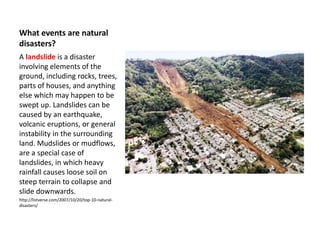
A landslide is a disaster
involving elements of the
ground, including rocks, trees,
parts of houses, and anything
else which may happen to be
swept up. Landslides can be
caused by an earthquake,
volcanic eruptions, or general
instability in the surrounding
land. Mudslides or mudflows,
are a special case of
landslides, in which heavy
rainfall causes loose soil on
steep terrain to collapse and
slide downwards.
http://listverse.com/2007/10/20/top-10-natural-
disasters/
Avalanche
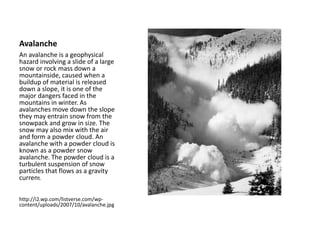
An avalanche is a geophysical
hazard involving a slide of a large
snow or rock mass down a
mountainside, caused when a
buildup of material is released
down a slope, it is one of the
major dangers faced in the
mountains in winter. As
avalanches move down the slope
they may entrain snow from the
snowpack and grow in size. The
snow may also mix with the air
and form a powder cloud. An
avalanche with a powder cloud is
known as a powder snow
avalanche. The powder cloud is a
turbulent suspension of snow
particles that flows as a gravity
current.
http://i2.wp.com/listverse.com/wp-
content/uploads/2007/10/avalanche.jpg
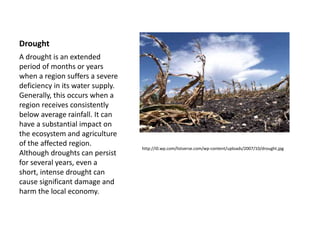
Drought
http://i0.wp.com/listverse.com/wp-content/uploads/2007/10/drought.jpg
A drought is an extended
period of months or years
when a region suffers a severe
deficiency in its water supply.
Generally, this occurs when a
region receives consistently
below average rainfall. It can
have a substantial impact on
the ecosystem and agriculture
of the affected region.
Although droughts can persist
for several years, even a
short, intense drought can
cause significant damage and
harm the local economy.
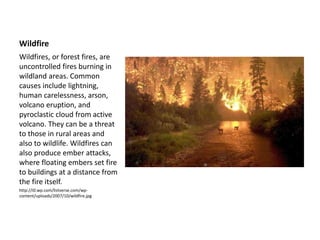
Wildfire
Wildfires, or forest fires, are
uncontrolled fires burning in
wildland areas. Common
causes include lightning,
human carelessness, arson,
volcano eruption, and
pyroclastic cloud from active
volcano. They can be a threat
to those in rural areas and
also to wildlife. Wildfires can
also produce ember attacks,
where floating embers set fire
to buildings at a distance from
the fire itself.
http://i0.wp.com/listverse.com/wp-
content/uploads/2007/10/wildfire.jpg
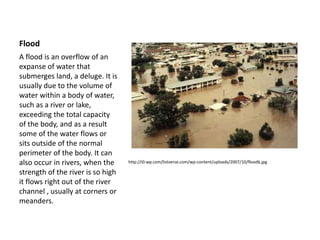
Flood
http://i0.wp.com/listverse.com/wp-content/uploads/2007/10/flood6.jpg
A flood is an overflow of an
expanse of water that
submerges land, a deluge. It is
usually due to the volume of
water within a body of water,
such as a river or lake,
exceeding the total capacity
of the body, and as a result
some of the water flows or
sits outside of the normal
perimeter of the body. It can
also occur in rivers, when the
strength of the river is so high
it flows right out of the river
channel , usually at corners or
meanders.
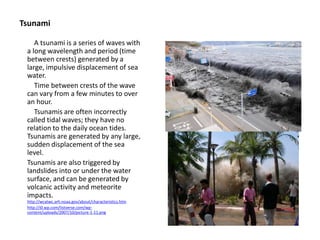
Tsunami
A tsunami is a series of waves with
a long wavelength and period (time
between crests) generated by a
large, impulsive displacement of sea
water.
Time between crests of the wave
can vary from a few minutes to over
an hour.
Tsunamis are often incorrectly
called tidal waves; they have no
relation to the daily ocean tides.
Tsunamis are generated by any large,
sudden displacement of the sea
level.
Tsunamis are also triggered by
landslides into or under the water
surface, and can be generated by
volcanic activity and meteorite
impacts.
http://wcatwc.arh.noaa.gov/about/characteristics.htm
http://i0.wp.com/listverse.com/wp-
content/uploads/2007/10/picture-1-11.png
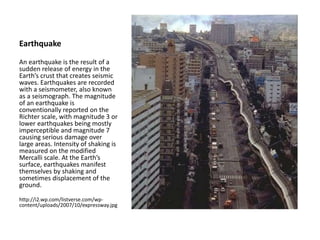
Earthquake
An earthquake is the result of a
sudden release of energy in the
Earth’s crust that creates seismic
waves. Earthquakes are recorded
with a seismometer, also known
as a seismograph. The magnitude
of an earthquake is
conventionally reported on the
Richter scale, with magnitude 3 or
lower earthquakes being mostly
imperceptible and magnitude 7
causing serious damage over
large areas. Intensity of shaking is
measured on the modified
Mercalli scale. At the Earth’s
surface, earthquakes manifest
themselves by shaking and
sometimes displacement of the
ground.
http://i2.wp.com/listverse.com/wp-
content/uploads/2007/10/expressway.jpg
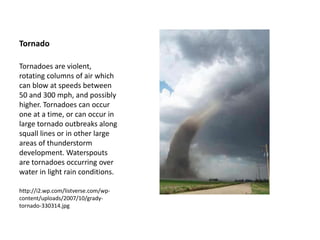
Tornado
Tornadoes are violent,
rotating columns of air which
can blow at speeds between
50 and 300 mph, and possibly
higher. Tornadoes can occur
one at a time, or can occur in
large tornado outbreaks along
squall lines or in other large
areas of thunderstorm
development. Waterspouts
are tornadoes occurring over
water in light rain conditions.
http://i2.wp.com/listverse.com/wp-
content/uploads/2007/10/grady-
tornado-330314.jpg
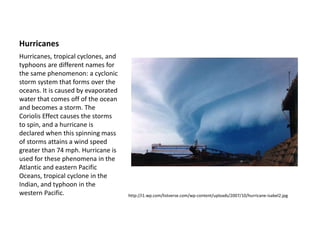
Hurricanes
http://i1.wp.com/listverse.com/wp-content/uploads/2007/10/hurricane-isabel2.jpg
Hurricanes, tropical cyclones, and
typhoons are different names for
the same phenomenon: a cyclonic
storm system that forms over the
oceans. It is caused by evaporated
water that comes off of the ocean
and becomes a storm. The
Coriolis Effect causes the storms
to spin, and a hurricane is
declared when this spinning mass
of storms attains a wind speed
greater than 74 mph. Hurricane is
used for these phenomena in the
Atlantic and eastern Pacific
Oceans, tropical cyclone in the
Indian, and typhoon in the
western Pacific.
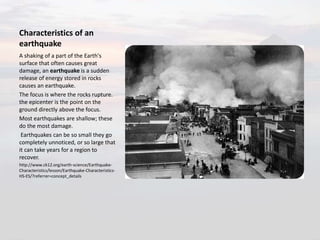
Characteristics of an
earthquake
A shaking of a part of the Earth's
surface that often causes great
damage, an earthquake is a sudden
release of energy stored in rocks
causes an earthquake.
The focus is where the rocks rupture.
the epicenter is the point on the
ground directly above the focus.
Most earthquakes are shallow; these
do the most damage.
Earthquakes can be so small they go
completely unnoticed, or so large that
it can take years for a region to
recover.
http://www.ck12.org/earth-science/Earthquake-
Characteristics/lesson/Earthquake-Characteristics-
HS-ES/?referrer=concept_details
Volcanic eruption
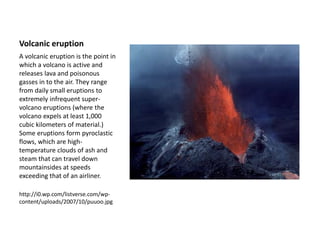
A volcanic eruption is the point in
which a volcano is active and
releases lava and poisonous
gasses in to the air. They range
from daily small eruptions to
extremely infrequent super-
volcano eruptions (where the
volcano expels at least 1,000
cubic kilometers of material.)
Some eruptions form pyroclastic
flows, which are high-
temperature clouds of ash and
steam that can travel down
mountainsides at speeds
exceeding that of an airliner.
http://i0.wp.com/listverse.com/wp-
content/uploads/2007/10/puuoo.jpg
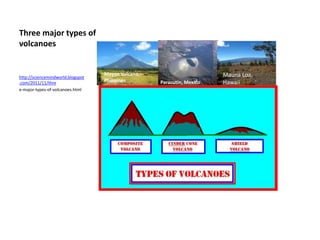
Three major types of
volcanoes
http://sciencemindworld.blogspot
.com/2011/11/thre
e-major-types-of-volcanoes.html
Mauna Loa,
HawaiiParacutin, Mexico
Mayon Volcano,
Philipines
Volcanoes
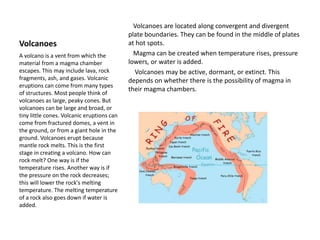
Volcanoes are located along convergent and divergent
plate boundaries. They can be found in the middle of plates
at hot spots.
Magma can be created when temperature rises, pressure
lowers, or water is added.
Volcanoes may be active, dormant, or extinct. This
depends on whether there is the possibility of magma in
their magma chambers.
A volcano is a vent from which the
material from a magma chamber
escapes. This may include lava, rock
fragments, ash, and gases. Volcanic
eruptions can come from many types
of structures. Most people think of
volcanoes as large, peaky cones. But
volcanoes can be large and broad, or
tiny little cones. Volcanic eruptions can
come from fractured domes, a vent in
the ground, or from a giant hole in the
ground. Volcanoes erupt because
mantle rock melts. This is the first
stage in creating a volcano. How can
rock melt? One way is if the
temperature rises. Another way is if
the pressure on the rock decreases;
this will lower the rock's melting
temperature. The melting temperature
of a rock also goes down if water is
added.
A volcano is a rupture in the
crust of a planetary-mass
object, such as Earth, that
allows hot lava volcanic
ash, and gases, to escape
from a magma chamber
below the surface. On Earth,
volcanoes are generally found
where tectonic plates are
diverging or converging.
There are more than 500
active volcanoes on Earth.
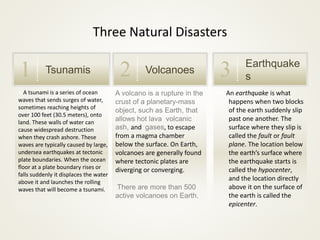
A A tsunami is a series of ocean
waves that sends surges of water,
sometimes reaching heights of
over 100 feet (30.5 meters), onto
land. These walls of water can
cause widespread destruction
when they crash ashore. These
waves are typically caused by large,
undersea earthquakes at tectonic
plate boundaries. When the ocean
floor at a plate boundary rises or
falls suddenly it displaces the water
above it and launches the rolling
waves that will become a tsunami.
Tsunamis1 Volcanoes2 Earthquake
s3
Three Natural Disasters
An An earthquake is what
happens when two blocks
of the earth suddenly slip
past one another. The
surface where they slip is
called the fault or fault
plane. The location below
the earth’s surface where
the earthquake starts is
called the hypocenter,
and the location directly
above it on the surface of
the earth is called the
epicenter.

Natural disasters

  • 1.
  • 2.
    When nature causesharm it is a natural disaster. Copyright 2016 Kella Randolph Earth and Environmental Science
  • 3.
    What is anatural disaster? Definition of natural disaster: a sudden and terrible event in nature (such as a hurricane, tornado, or flood) that usually results in serious damage and many deaths
  • 4.
    What events arenatural disasters? A landslide is a disaster involving elements of the ground, including rocks, trees, parts of houses, and anything else which may happen to be swept up. Landslides can be caused by an earthquake, volcanic eruptions, or general instability in the surrounding land. Mudslides or mudflows, are a special case of landslides, in which heavy rainfall causes loose soil on steep terrain to collapse and slide downwards. http://listverse.com/2007/10/20/top-10-natural- disasters/
  • 5.
    Avalanche An avalanche isa geophysical hazard involving a slide of a large snow or rock mass down a mountainside, caused when a buildup of material is released down a slope, it is one of the major dangers faced in the mountains in winter. As avalanches move down the slope they may entrain snow from the snowpack and grow in size. The snow may also mix with the air and form a powder cloud. An avalanche with a powder cloud is known as a powder snow avalanche. The powder cloud is a turbulent suspension of snow particles that flows as a gravity current. http://i2.wp.com/listverse.com/wp- content/uploads/2007/10/avalanche.jpg
  • 6.
    Drought http://i0.wp.com/listverse.com/wp-content/uploads/2007/10/drought.jpg A drought isan extended period of months or years when a region suffers a severe deficiency in its water supply. Generally, this occurs when a region receives consistently below average rainfall. It can have a substantial impact on the ecosystem and agriculture of the affected region. Although droughts can persist for several years, even a short, intense drought can cause significant damage and harm the local economy.
  • 7.
    Wildfire Wildfires, or forestfires, are uncontrolled fires burning in wildland areas. Common causes include lightning, human carelessness, arson, volcano eruption, and pyroclastic cloud from active volcano. They can be a threat to those in rural areas and also to wildlife. Wildfires can also produce ember attacks, where floating embers set fire to buildings at a distance from the fire itself. http://i0.wp.com/listverse.com/wp- content/uploads/2007/10/wildfire.jpg
  • 8.
    Flood http://i0.wp.com/listverse.com/wp-content/uploads/2007/10/flood6.jpg A flood isan overflow of an expanse of water that submerges land, a deluge. It is usually due to the volume of water within a body of water, such as a river or lake, exceeding the total capacity of the body, and as a result some of the water flows or sits outside of the normal perimeter of the body. It can also occur in rivers, when the strength of the river is so high it flows right out of the river channel , usually at corners or meanders.
  • 9.
    Tsunami A tsunami isa series of waves with a long wavelength and period (time between crests) generated by a large, impulsive displacement of sea water. Time between crests of the wave can vary from a few minutes to over an hour. Tsunamis are often incorrectly called tidal waves; they have no relation to the daily ocean tides. Tsunamis are generated by any large, sudden displacement of the sea level. Tsunamis are also triggered by landslides into or under the water surface, and can be generated by volcanic activity and meteorite impacts. http://wcatwc.arh.noaa.gov/about/characteristics.htm http://i0.wp.com/listverse.com/wp- content/uploads/2007/10/picture-1-11.png
  • 10.
    Earthquake An earthquake isthe result of a sudden release of energy in the Earth’s crust that creates seismic waves. Earthquakes are recorded with a seismometer, also known as a seismograph. The magnitude of an earthquake is conventionally reported on the Richter scale, with magnitude 3 or lower earthquakes being mostly imperceptible and magnitude 7 causing serious damage over large areas. Intensity of shaking is measured on the modified Mercalli scale. At the Earth’s surface, earthquakes manifest themselves by shaking and sometimes displacement of the ground. http://i2.wp.com/listverse.com/wp- content/uploads/2007/10/expressway.jpg
  • 11.
    Tornado Tornadoes are violent, rotatingcolumns of air which can blow at speeds between 50 and 300 mph, and possibly higher. Tornadoes can occur one at a time, or can occur in large tornado outbreaks along squall lines or in other large areas of thunderstorm development. Waterspouts are tornadoes occurring over water in light rain conditions. http://i2.wp.com/listverse.com/wp- content/uploads/2007/10/grady- tornado-330314.jpg
  • 12.
    Hurricanes http://i1.wp.com/listverse.com/wp-content/uploads/2007/10/hurricane-isabel2.jpg Hurricanes, tropical cyclones,and typhoons are different names for the same phenomenon: a cyclonic storm system that forms over the oceans. It is caused by evaporated water that comes off of the ocean and becomes a storm. The Coriolis Effect causes the storms to spin, and a hurricane is declared when this spinning mass of storms attains a wind speed greater than 74 mph. Hurricane is used for these phenomena in the Atlantic and eastern Pacific Oceans, tropical cyclone in the Indian, and typhoon in the western Pacific.
  • 13.
    Characteristics of an earthquake Ashaking of a part of the Earth's surface that often causes great damage, an earthquake is a sudden release of energy stored in rocks causes an earthquake. The focus is where the rocks rupture. the epicenter is the point on the ground directly above the focus. Most earthquakes are shallow; these do the most damage. Earthquakes can be so small they go completely unnoticed, or so large that it can take years for a region to recover. http://www.ck12.org/earth-science/Earthquake- Characteristics/lesson/Earthquake-Characteristics- HS-ES/?referrer=concept_details
  • 14.
    Volcanic eruption A volcaniceruption is the point in which a volcano is active and releases lava and poisonous gasses in to the air. They range from daily small eruptions to extremely infrequent super- volcano eruptions (where the volcano expels at least 1,000 cubic kilometers of material.) Some eruptions form pyroclastic flows, which are high- temperature clouds of ash and steam that can travel down mountainsides at speeds exceeding that of an airliner. http://i0.wp.com/listverse.com/wp- content/uploads/2007/10/puuoo.jpg
  • 15.
    Three major typesof volcanoes http://sciencemindworld.blogspot .com/2011/11/thre e-major-types-of-volcanoes.html Mauna Loa, HawaiiParacutin, Mexico Mayon Volcano, Philipines
  • 16.
    Volcanoes Volcanoes are locatedalong convergent and divergent plate boundaries. They can be found in the middle of plates at hot spots. Magma can be created when temperature rises, pressure lowers, or water is added. Volcanoes may be active, dormant, or extinct. This depends on whether there is the possibility of magma in their magma chambers. A volcano is a vent from which the material from a magma chamber escapes. This may include lava, rock fragments, ash, and gases. Volcanic eruptions can come from many types of structures. Most people think of volcanoes as large, peaky cones. But volcanoes can be large and broad, or tiny little cones. Volcanic eruptions can come from fractured domes, a vent in the ground, or from a giant hole in the ground. Volcanoes erupt because mantle rock melts. This is the first stage in creating a volcano. How can rock melt? One way is if the temperature rises. Another way is if the pressure on the rock decreases; this will lower the rock's melting temperature. The melting temperature of a rock also goes down if water is added.
  • 17.
    A volcano isa rupture in the crust of a planetary-mass object, such as Earth, that allows hot lava volcanic ash, and gases, to escape from a magma chamber below the surface. On Earth, volcanoes are generally found where tectonic plates are diverging or converging. There are more than 500 active volcanoes on Earth. A A tsunami is a series of ocean waves that sends surges of water, sometimes reaching heights of over 100 feet (30.5 meters), onto land. These walls of water can cause widespread destruction when they crash ashore. These waves are typically caused by large, undersea earthquakes at tectonic plate boundaries. When the ocean floor at a plate boundary rises or falls suddenly it displaces the water above it and launches the rolling waves that will become a tsunami. Tsunamis1 Volcanoes2 Earthquake s3 Three Natural Disasters An An earthquake is what happens when two blocks of the earth suddenly slip past one another. The surface where they slip is called the fault or fault plane. The location below the earth’s surface where the earthquake starts is called the hypocenter, and the location directly above it on the surface of the earth is called the epicenter.