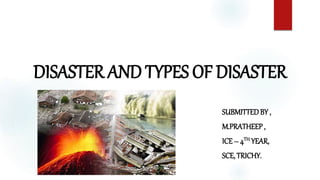

DISASTER AND TYPES OF DISASTER
SUBMITTEDBY ,
M.PRATHEEP,
ICE – 4TH YEAR,
SCE, TRICHY.
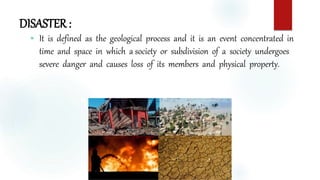
DISASTER :
 It is defined as the geological process and it is an event concentrated in
time and space in which a society or subdivision of a society undergoes
severe danger and causes loss of its members and physical property.
TYPES OF DISASTER :
• NATURALTYPES OF DISASTERS – Flood, Earthquake, Tsunami, Landslides,
Cyclone, Drought, Heat Waves, Cold Waves, Thunderstorms …..
• MAN-MADE TYPES OF DISASTERS – Hazardous Materials, Nuclear Blast,
Chemical Threat, Cyber Attacks…..
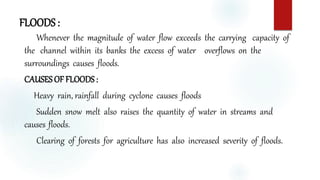
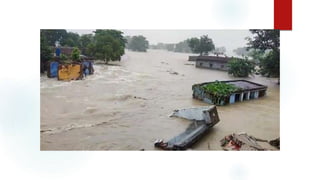
FLOODS :
Whenever the magnitude of water flow exceeds the carrying capacity of
the channel within its banks the excess of water overflows on the
surroundings causes floods.
CAUSES OF FLOODS :
Heavy rain, rainfall during cyclone causes floods
Sudden snow melt also raises the quantity of water in streams and
causes floods.
Clearing of forests for agriculture has also increased severity of floods.
FLOODMANAGEMENT :
 Encroachment of flood ways should be banned.
 Building walls prevent spilling out the flood water over flood plains.
 Diverting excess water through channels or canals to areas like lake, rivers
where water is not sufficient.
 Optical and microwave data from IRS is also used for flood management.
 Flood forecasts and flood warning are also given by the central water
commission
LAND SLIDES :
 The movement of earthy materials like coherent rock, mud, soil and
debris from higher to lower region to gravitational pull is called land
slides.
CAUSES :
1. Movement of heavy vehicles on the unstable sloppy regions.
2. Earthquake, shocks, vibrations and cyclone.
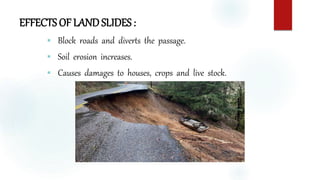
EFFECTS OF LAND SLIDES :
 Block roads and diverts the passage.
 Soil erosion increases.
 Causes damages to houses, crops and live stock.
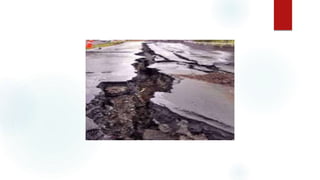
EATRHQUAKE :
 An earthquake is a sudden vibration caused on earth surface with
the sudden release of tremendous energy stored in rocks under the
earth’s crust.
CAUSES :
1. Disequilibrium in any part of the earth crust
2. Underground nuclear testing
3. Decrease of underground water level.
EFFECTS:
1. Damage the settlements and transport systems
2. Collapses houses and their structures
3. Deformation of ground surface
4. Tsunami
EARTHQUAKE MANAGEMENT:
1. Constructing earthquake resistant building
2. Wooden houses are preferred
3. Seismic hazard map should give the information about the magnitude
of intensity of anticipated earthquakes.
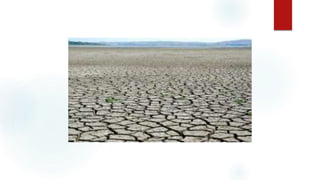
DROUGHT :
 A drought is a normal, reoccurring weather event that can vary in
intensity and duration by region of the country and even by location
within a state.
 Drought occurs when there is lower than average precipitation over a
significant period of time, usually a season or more.
 Other causes of drought can be a delay in the rainy season or the
timing of rain in relation to crop growth.
 Drought is a slow-moving hazardous event, so the psychological effects of
living through this type of disaster are more subtle and last longer than
with other natural disasters.
 Low water availability creates shortages in water supplies that impact
various activities and the environment.
 The impact is even greater as humans place demands on water supplies.
 Additionally, drought conditions increase the risk of other natural
disasters, such as wildfires, and landslides.
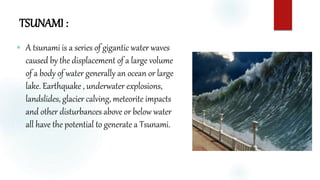
TSUNAMI :
 A tsunami is a series of gigantic water waves
caused by the displacement of a large volume
of a body of water generally an ocean or large
lake. Earthquake , underwater explosions,
landslides, glacier calving, meteorite impacts
and other disturbances above or below water
all have the potential to generate a Tsunami.
 Tsunami don’t resemble normal sea waves, because their wavelength is far
longer.
 Rather than appearing as a breaking wave , a tsunami may instead initially
resemble a rapidly rising tide and are often referred to as tidal waves.
 Tsunamis generally consist of a series of waves with periods ranging from
minutes to hours, arriving in a so called “wave train”.
 Wave heights of tens of metres can be generated by large events. Although the
impact of tsunamis is limited to coastal area, their destructive power can be
enormous and they can affect entire ocean basins
CYCLONE :
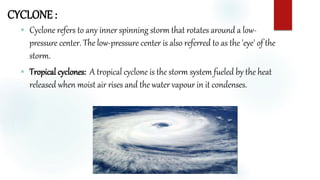
 Cyclone refers to any inner spinning storm that rotates around a low-
pressure center. The low-pressure center is also referred to as the 'eye' of the
storm.
 Tropical cyclones: A tropical cyclone is the storm system fueled by the heat
released when moist air rises and the water vapour in it condenses.
Destruction caused by Cyclones :
 Consequent strong winds. These, in turn, generate storm surges.
 Abnormal rise of sea level near the coast caused by a severe tropical
cyclone.
 Very strong winds may damage installations, dwellings, communication
systems, trees., Etc. Resulting in loss of life and property.
 Heavy rains due to cyclones
 May cause river floods
HEAT WAVES :
 It is a prolonged period of excessive heat, often accompanied by excessive
humidity.
 The weather is noticeably warmer than normal for the time of year and
climate.
 Develop slowly and kills(& injure many more) animals and people
nationwide in average year…more than any other disaster
 “silent disaster”
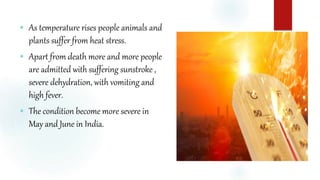
 As temperature rises people animals and
plants suffer from heat stress.
 Apart from death more and more people
are admitted with suffering sunstroke ,
severe dehydration, with vomiting and
high fever.
 The condition become more severe in
May and June in India.
COLD WAVES :
 A cold wave is an influx of unusually cold air into middle or lower latitudes.
 Cold waves affect much larger areas than blizzards, ice storms, and other
winter hazards.
 Meteorologists measure cold waves by the departure from the normal
temperature.
 A cold wave develops when cold air masses over large areas are brought
in.
 The cold air masses transport only little moisture. Precipitation occurs as
snow or sleet due to temperatures below freezing point.
 Cold waves can also be accompanied by strong wind. Such a phenomenon
is called winter storm.
 Cold polar or Arctic air masses are relatively shallow, extending one to
several km above the surface.
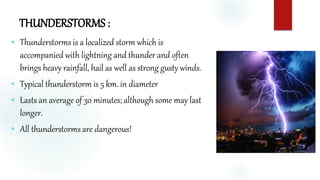
THUNDERSTORMS :
 Thunderstorms is a localized storm which is
accompanied with lightning and thunder and often
brings heavy rainfall, hail as well as strong gusty winds.
 Typical thunderstorm is 5 km. in diameter
 Lasts an average of 30 minutes; although some may last
longer.
 All thunderstorms are dangerous!
!...THANK YOU…!
Email ID : pratheepm2001@gmail.com

Disaster & Types of Disaster

  • 1.
    DISASTER AND TYPESOF DISASTER SUBMITTEDBY , M.PRATHEEP, ICE – 4TH YEAR, SCE, TRICHY.
  • 2.
    DISASTER :  Itis defined as the geological process and it is an event concentrated in time and space in which a society or subdivision of a society undergoes severe danger and causes loss of its members and physical property.
  • 3.
    TYPES OF DISASTER: • NATURALTYPES OF DISASTERS – Flood, Earthquake, Tsunami, Landslides, Cyclone, Drought, Heat Waves, Cold Waves, Thunderstorms ….. • MAN-MADE TYPES OF DISASTERS – Hazardous Materials, Nuclear Blast, Chemical Threat, Cyber Attacks…..
  • 4.
    FLOODS : Whenever themagnitude of water flow exceeds the carrying capacity of the channel within its banks the excess of water overflows on the surroundings causes floods. CAUSES OF FLOODS : Heavy rain, rainfall during cyclone causes floods Sudden snow melt also raises the quantity of water in streams and causes floods. Clearing of forests for agriculture has also increased severity of floods.
  • 6.
    FLOODMANAGEMENT :  Encroachmentof flood ways should be banned.  Building walls prevent spilling out the flood water over flood plains.  Diverting excess water through channels or canals to areas like lake, rivers where water is not sufficient.  Optical and microwave data from IRS is also used for flood management.  Flood forecasts and flood warning are also given by the central water commission
  • 7.
    LAND SLIDES : The movement of earthy materials like coherent rock, mud, soil and debris from higher to lower region to gravitational pull is called land slides. CAUSES : 1. Movement of heavy vehicles on the unstable sloppy regions. 2. Earthquake, shocks, vibrations and cyclone.
  • 8.
    EFFECTS OF LANDSLIDES :  Block roads and diverts the passage.  Soil erosion increases.  Causes damages to houses, crops and live stock.
  • 9.
    EATRHQUAKE :  Anearthquake is a sudden vibration caused on earth surface with the sudden release of tremendous energy stored in rocks under the earth’s crust. CAUSES : 1. Disequilibrium in any part of the earth crust 2. Underground nuclear testing 3. Decrease of underground water level.
  • 11.
    EFFECTS: 1. Damage thesettlements and transport systems 2. Collapses houses and their structures 3. Deformation of ground surface 4. Tsunami EARTHQUAKE MANAGEMENT: 1. Constructing earthquake resistant building 2. Wooden houses are preferred 3. Seismic hazard map should give the information about the magnitude of intensity of anticipated earthquakes.
  • 12.
    DROUGHT :  Adrought is a normal, reoccurring weather event that can vary in intensity and duration by region of the country and even by location within a state.  Drought occurs when there is lower than average precipitation over a significant period of time, usually a season or more.  Other causes of drought can be a delay in the rainy season or the timing of rain in relation to crop growth.
  • 14.
     Drought isa slow-moving hazardous event, so the psychological effects of living through this type of disaster are more subtle and last longer than with other natural disasters.  Low water availability creates shortages in water supplies that impact various activities and the environment.  The impact is even greater as humans place demands on water supplies.  Additionally, drought conditions increase the risk of other natural disasters, such as wildfires, and landslides.
  • 15.
    TSUNAMI :  Atsunami is a series of gigantic water waves caused by the displacement of a large volume of a body of water generally an ocean or large lake. Earthquake , underwater explosions, landslides, glacier calving, meteorite impacts and other disturbances above or below water all have the potential to generate a Tsunami.
  • 16.
     Tsunami don’tresemble normal sea waves, because their wavelength is far longer.  Rather than appearing as a breaking wave , a tsunami may instead initially resemble a rapidly rising tide and are often referred to as tidal waves.  Tsunamis generally consist of a series of waves with periods ranging from minutes to hours, arriving in a so called “wave train”.  Wave heights of tens of metres can be generated by large events. Although the impact of tsunamis is limited to coastal area, their destructive power can be enormous and they can affect entire ocean basins
  • 17.
    CYCLONE :  Cyclonerefers to any inner spinning storm that rotates around a low- pressure center. The low-pressure center is also referred to as the 'eye' of the storm.  Tropical cyclones: A tropical cyclone is the storm system fueled by the heat released when moist air rises and the water vapour in it condenses.
  • 18.
    Destruction caused byCyclones :  Consequent strong winds. These, in turn, generate storm surges.  Abnormal rise of sea level near the coast caused by a severe tropical cyclone.  Very strong winds may damage installations, dwellings, communication systems, trees., Etc. Resulting in loss of life and property.  Heavy rains due to cyclones  May cause river floods
  • 19.
    HEAT WAVES : It is a prolonged period of excessive heat, often accompanied by excessive humidity.  The weather is noticeably warmer than normal for the time of year and climate.  Develop slowly and kills(& injure many more) animals and people nationwide in average year…more than any other disaster  “silent disaster”
  • 20.
     As temperaturerises people animals and plants suffer from heat stress.  Apart from death more and more people are admitted with suffering sunstroke , severe dehydration, with vomiting and high fever.  The condition become more severe in May and June in India.
  • 21.
    COLD WAVES : A cold wave is an influx of unusually cold air into middle or lower latitudes.  Cold waves affect much larger areas than blizzards, ice storms, and other winter hazards.  Meteorologists measure cold waves by the departure from the normal temperature.
  • 22.
     A coldwave develops when cold air masses over large areas are brought in.  The cold air masses transport only little moisture. Precipitation occurs as snow or sleet due to temperatures below freezing point.  Cold waves can also be accompanied by strong wind. Such a phenomenon is called winter storm.  Cold polar or Arctic air masses are relatively shallow, extending one to several km above the surface.
  • 23.
    THUNDERSTORMS :  Thunderstormsis a localized storm which is accompanied with lightning and thunder and often brings heavy rainfall, hail as well as strong gusty winds.  Typical thunderstorm is 5 km. in diameter  Lasts an average of 30 minutes; although some may last longer.  All thunderstorms are dangerous!
  • 24.
    !...THANK YOU…! Email ID: pratheepm2001@gmail.com