1
Introduction to Nano-materials
2
Outline
• What is “nano-material” and why we are
interested in it?
• Ways lead to the realization of nano-materials
• Optical and electronic properties of nano-
materials
• Applications
3
What is “nano-material” ?
• Narrow definition: low dimension semiconductor
structures including quantum wells, quantum
wires, and quantum dots
• Unlike bulk semiconductor material, artificial
structure in nanometer scale (from a few nm’s to
a few tens of nm’s, 1nm is about 2 mono-
layers/lattices) must be introduced in addition to
the “naturally” given semiconductor crystalline
structure
4
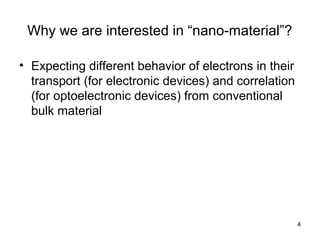
Why we are interested in “nano-material”?
• Expecting different behavior of electrons in their
transport (for electronic devices) and correlation
(for optoelectronic devices) from conventional
bulk material
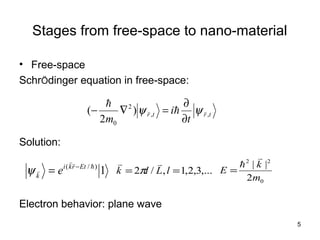
5
Stages from free-space to nano-material
• Free-space
SchrÖdinger equation in free-space:
Solution:
Electron behavior: plane wave
,...3,2,1,/2 == lLlk

π1)/( 

 Etrki
k
e −
=ψ
0
22
2
||
m
k
E


=
trtr
t
i
m
,,
2
0
)
2
(  

ψψ
∂
∂
=∇−
6
Stages from free-space to nano-material
• Bulk semiconductor
SchrÖdinger equation in bulk semiconductor:
Solution:
Electron behavior: Bloch wave
trtr
t
irV
m
,,0
2
0
)](
2
[  

ψψ
∂
∂
=+∇−
)()( 00 RlrVrV

+=
r
e
rV
ε
2
0 )( −=

kne Etrki
kn


 )/( −
=ψ
effm
k
E
2
|| 22


=
7
Stages from free-space to nano-material
• Nano-material
SchrÖdinger equation in nano-material:
with artificially generated extra potential contribution:
Solution:
trtrnano
t
irVrV
m
,,0
2
0
)]()(
2
[  

ψψ
∂
∂
=++∇−
)(rVnano

knrFe kn
iEt
kn
 )(,
/−
=ψ
8
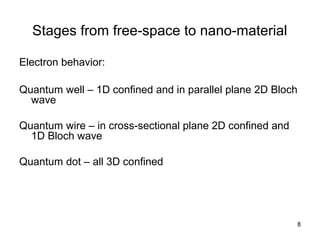
Stages from free-space to nano-material
Electron behavior:
Quantum well – 1D confined and in parallel plane 2D Bloch
wave
Quantum wire – in cross-sectional plane 2D confined and
1D Bloch wave
Quantum dot – all 3D confined
9
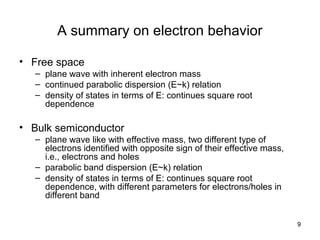
A summary on electron behavior
• Free space
– plane wave with inherent electron mass
– continued parabolic dispersion (E~k) relation
– density of states in terms of E: continues square root
dependence
• Bulk semiconductor
– plane wave like with effective mass, two different type of
electrons identified with opposite sign of their effective mass,
i.e., electrons and holes
– parabolic band dispersion (E~k) relation
– density of states in terms of E: continues square root
dependence, with different parameters for electrons/holes in
different band
10
A summary on electron behavior
• Quantum well
– discrete energy levels in 1D for both electrons and holes
– plane wave like with (different) effective masses in 2D parallel
plane for electrons and holes
– dispersion (E~k) relation: parabolic bands with discrete states
inside the stop-band
– density of states in terms of E: additive staircase functions, with
different parameters for electrons/holes in different band
• Quantum wire
– discrete energy levels in 2D cross-sectional plane for both
electrons and holes
– plane wave like with (different) effective masses in 1D for
electrons and holes
– dispersion (E~k) relation: parabolic bands with discrete states
inside the stop-band
– density of states in terms of E: additive staircase decayed
functions, with different parameters for electrons/holes in
different band
11
A summary on electron behavior
• Quantum dot
– discrete energy levels for both electrons and holes
– dispersion (E~k) relation: atomic-like k-independent discrete
energy states only
– density of states in terms of E: δ-functions for electrons/holes
12
Why we are interested in “nano-material”?
Electrons in semiconductors: highly mobile, easily
transportable and correlated, yet highly
scattered in terms of energy
Electrons in atomic systems: highly regulated in
terms of energy, but not mobile
13
Why we are interested in “nano-material”?
Electrons in semiconductors: easily controllable
and accessible, yet poor inherent performance
Electrons in atomic systems: excellent inherent
performance, yet hardly controllable or
accessible
14
Why we are interested in “nano-material”?
• Answer: take advantage of both semiconductors
and atomic systems – Semiconductor quantum
dot material
15
Why we are interested in “nano-material”?
• Detailed reasons:
– Geometrical dimensions in the artificial structure can be tuned to
change the confinement of electrons and holes, hence to tailor
the correlations (e.g., excitations, transitions and
recombinations)
– Relaxation and dephasing processes are slowed due to the
reduced probability of inelastic and elastic collisions (much
expected for quantum computing, could be a drawback for light
emitting devices)
– Definite polarization (spin of photons are regulated)
– (Coulomb) binding between electron and hole is increased due
to the localization
– Increased binding and confinement also gives increased
electron-hole overlap, which leads to larger dipole matrix
elements and larger transition rates
– Increased confinement reduces the extent of the electron and
hole states and thereby reduces the dipole moment
16
Ways lead to the realization of nano-
material
• Required nano-structure size:
Electron in fully confined structure (QD with edge size d), its allowed
(quantized) energy (E) scales as 1/d2
(infinite barrier assumed)
Coulomb interaction energy (V) between electron and other charged
particle scales as 1/d
If the confinement length is so large that V>>E, the Coulomb interaction
mixes all the quantized electron energy levels and the material
shows a bulk behavior, i.e., the quantization feature is not preserved
for the same type of electrons (with the same effective mass), but
still preserved among different type of electrons, hence we have
(discrete) energy bands
If the confinement length is so small that V<<E, the Coulomb
interaction has little effect on the quantized electron energy levels,
i.e., the quantization feature is preserved, hence we have discrete
energy levels
17
Ways lead to the realization of nano-
material
• Required nano-structure size:
Similar arguments can be made about the effects of
temperature, i.e., kBT ~ E?
But kBT doesn’t change the electron eigen states, instead,
it changes the excitation, or the filling of electrons into
the eigen energy structure
If kBT>E, even E is a discrete set, temperature effect still
distribute electrons over multiple energy levels and dilute
the concentration of the density of states provided by the
confinement, since E can never be a single energy level
Therefore, we also need kBT<E!
18
Ways lead to the realization of nano-
material
• Required nano-structure size:
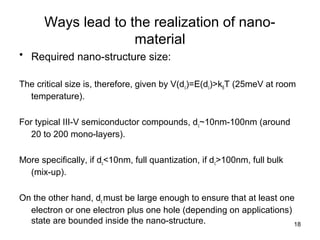
The critical size is, therefore, given by V(dc)=E(dc)>kBT (25meV at room
temperature).
For typical III-V semiconductor compounds, dc~10nm-100nm (around
20 to 200 mono-layers).
More specifically, if dc<10nm, full quantization, if dc>100nm, full bulk
(mix-up).
On the other hand, dc must be large enough to ensure that at least one
electron or one electron plus one hole (depending on applications)
state are bounded inside the nano-structure.
19
Ways lead to the realization of nano-
material
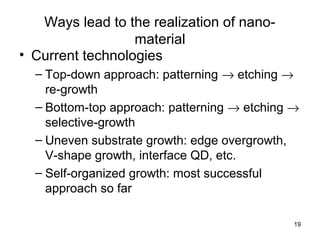
• Current technologies
– Top-down approach: patterning → etching →
re-growth
– Bottom-top approach: patterning → etching →
selective-growth
– Uneven substrate growth: edge overgrowth,
V-shape growth, interface QD, etc.
– Self-organized growth: most successful
approach so far
20
Electronic Properties
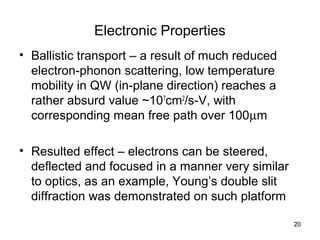
• Ballistic transport – a result of much reduced
electron-phonon scattering, low temperature
mobility in QW (in-plane direction) reaches a
rather absurd value ~107
cm2
/s-V, with
corresponding mean free path over 100µm
• Resulted effect – electrons can be steered,
deflected and focused in a manner very similar
to optics, as an example, Young’s double slit
diffraction was demonstrated on such platform
21
Electronic Properties
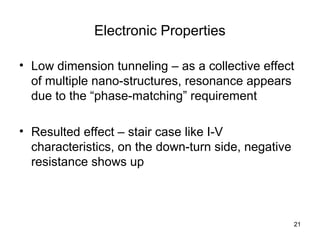
• Low dimension tunneling – as a collective effect
of multiple nano-structures, resonance appears
due to the “phase-matching” requirement
• Resulted effect – stair case like I-V
characteristics, on the down-turn side, negative
resistance shows up
22
Electronic Properties
• If excitation (charging) itself is also quantized
(through, e.g., Coulomb blockade), interaction
between the excitation quantization and the
quantized eigen states (i.e., the discrete energy
levels in nano-structure) brings us into a
completely discrete regime
• Resulted effect – a possible platform to
manipulate single electron to realize various
functionalities, e.g., single electron transistor
(SET) for logical gate or memory cell
23
Optical Properties
• Discretization of energy levels increases the
density of states
• Resulted effect – enhances narrow band
correlation, such as electron-hole recombination;
for QD lasers, the threshold will be greatly
reduced
24
Optical Properties
• Discretization of energy levels reduces
broadband correlation
• Resulted effect – reduces relaxation and
dephasing, reduces temperature dependence;
former keeps the electrons in coherence, which
is very much needed in quantum computing;
latter reduces device performance temperature
dependence (e.g., QD laser threshold and
efficiency, QD detector sensitivity, etc.)
25
Optical Properties
• Quantized energy level dependence on size
(geometric dimension)
• Resulted effect – tuning of optical
gain/absorption spectrum
26
Optical Properties
• Discretization of energy levels leads to zero
dispersion at the gain peak
• Resulted effect – reduces chirp, a very much
needed property in dynamic application of
optoelectronic devices (e.g., optical modulators
or directly modulated lasers)
27
Applications
• Light source - QD lasers, QC (Quantum
Cascade) lasers
• Light detector – QDIP (Quantum Dot Infrared
Photo-detector)
• Electromagnetic induced transparency (EIT) – to
obtain transparent highly dispersive materials
• Ballistic electron devices
• Tunneling electron devices
• Single electron devices
28
References
• Solid State Physics – C. Kittel, “Introduction to Solid State Physics”,
Springer, ISBN: 978-0-471-41526-8
• Basic Quantum Mechanics – L. Schiff, “Quantum Mechanics”, 3rd
Edition, McGraw Hill, 1967, ISBN-0070856435
• On nano-material electronic properties – W. Kirk and M. Reed,
“Nanostructures and Mesoscopic Systems”, Academic Press, 1991,
ISBN-0124096603
• On nano-material and device fabrication techniques – T. Steiner,
“Semiconductor Nanostructures for Optoelectronic Applications”,
Artech House, 2004, ISBN-1580537510
• On nano-material optical properties – G. Bryant and G. Solomon,
“Optics of Quantum Dots and Wires”, Artech House, 2005, ISBN-
1580537618

Introduction to nano materials

  • 1.
  • 2.
    2 Outline • What is“nano-material” and why we are interested in it? • Ways lead to the realization of nano-materials • Optical and electronic properties of nano- materials • Applications
  • 3.
    3 What is “nano-material”? • Narrow definition: low dimension semiconductor structures including quantum wells, quantum wires, and quantum dots • Unlike bulk semiconductor material, artificial structure in nanometer scale (from a few nm’s to a few tens of nm’s, 1nm is about 2 mono- layers/lattices) must be introduced in addition to the “naturally” given semiconductor crystalline structure
  • 4.
    4 Why we areinterested in “nano-material”? • Expecting different behavior of electrons in their transport (for electronic devices) and correlation (for optoelectronic devices) from conventional bulk material
  • 5.
    5 Stages from free-spaceto nano-material • Free-space SchrÖdinger equation in free-space: Solution: Electron behavior: plane wave ,...3,2,1,/2 == lLlk  π1)/(    Etrki k e − =ψ 0 22 2 || m k E   = trtr t i m ,, 2 0 ) 2 (    ψψ ∂ ∂ =∇−
  • 6.
    6 Stages from free-spaceto nano-material • Bulk semiconductor SchrÖdinger equation in bulk semiconductor: Solution: Electron behavior: Bloch wave trtr t irV m ,,0 2 0 )]( 2 [    ψψ ∂ ∂ =+∇− )()( 00 RlrVrV  += r e rV ε 2 0 )( −=  kne Etrki kn    )/( − =ψ effm k E 2 || 22   =
  • 7.
    7 Stages from free-spaceto nano-material • Nano-material SchrÖdinger equation in nano-material: with artificially generated extra potential contribution: Solution: trtrnano t irVrV m ,,0 2 0 )]()( 2 [    ψψ ∂ ∂ =++∇− )(rVnano  knrFe kn iEt kn  )(, /− =ψ
  • 8.
    8 Stages from free-spaceto nano-material Electron behavior: Quantum well – 1D confined and in parallel plane 2D Bloch wave Quantum wire – in cross-sectional plane 2D confined and 1D Bloch wave Quantum dot – all 3D confined
  • 9.
    9 A summary onelectron behavior • Free space – plane wave with inherent electron mass – continued parabolic dispersion (E~k) relation – density of states in terms of E: continues square root dependence • Bulk semiconductor – plane wave like with effective mass, two different type of electrons identified with opposite sign of their effective mass, i.e., electrons and holes – parabolic band dispersion (E~k) relation – density of states in terms of E: continues square root dependence, with different parameters for electrons/holes in different band
  • 10.
    10 A summary onelectron behavior • Quantum well – discrete energy levels in 1D for both electrons and holes – plane wave like with (different) effective masses in 2D parallel plane for electrons and holes – dispersion (E~k) relation: parabolic bands with discrete states inside the stop-band – density of states in terms of E: additive staircase functions, with different parameters for electrons/holes in different band • Quantum wire – discrete energy levels in 2D cross-sectional plane for both electrons and holes – plane wave like with (different) effective masses in 1D for electrons and holes – dispersion (E~k) relation: parabolic bands with discrete states inside the stop-band – density of states in terms of E: additive staircase decayed functions, with different parameters for electrons/holes in different band
  • 11.
    11 A summary onelectron behavior • Quantum dot – discrete energy levels for both electrons and holes – dispersion (E~k) relation: atomic-like k-independent discrete energy states only – density of states in terms of E: δ-functions for electrons/holes
  • 12.
    12 Why we areinterested in “nano-material”? Electrons in semiconductors: highly mobile, easily transportable and correlated, yet highly scattered in terms of energy Electrons in atomic systems: highly regulated in terms of energy, but not mobile
  • 13.
    13 Why we areinterested in “nano-material”? Electrons in semiconductors: easily controllable and accessible, yet poor inherent performance Electrons in atomic systems: excellent inherent performance, yet hardly controllable or accessible
  • 14.
    14 Why we areinterested in “nano-material”? • Answer: take advantage of both semiconductors and atomic systems – Semiconductor quantum dot material
  • 15.
    15 Why we areinterested in “nano-material”? • Detailed reasons: – Geometrical dimensions in the artificial structure can be tuned to change the confinement of electrons and holes, hence to tailor the correlations (e.g., excitations, transitions and recombinations) – Relaxation and dephasing processes are slowed due to the reduced probability of inelastic and elastic collisions (much expected for quantum computing, could be a drawback for light emitting devices) – Definite polarization (spin of photons are regulated) – (Coulomb) binding between electron and hole is increased due to the localization – Increased binding and confinement also gives increased electron-hole overlap, which leads to larger dipole matrix elements and larger transition rates – Increased confinement reduces the extent of the electron and hole states and thereby reduces the dipole moment
  • 16.
    16 Ways lead tothe realization of nano- material • Required nano-structure size: Electron in fully confined structure (QD with edge size d), its allowed (quantized) energy (E) scales as 1/d2 (infinite barrier assumed) Coulomb interaction energy (V) between electron and other charged particle scales as 1/d If the confinement length is so large that V>>E, the Coulomb interaction mixes all the quantized electron energy levels and the material shows a bulk behavior, i.e., the quantization feature is not preserved for the same type of electrons (with the same effective mass), but still preserved among different type of electrons, hence we have (discrete) energy bands If the confinement length is so small that V<<E, the Coulomb interaction has little effect on the quantized electron energy levels, i.e., the quantization feature is preserved, hence we have discrete energy levels
  • 17.
    17 Ways lead tothe realization of nano- material • Required nano-structure size: Similar arguments can be made about the effects of temperature, i.e., kBT ~ E? But kBT doesn’t change the electron eigen states, instead, it changes the excitation, or the filling of electrons into the eigen energy structure If kBT>E, even E is a discrete set, temperature effect still distribute electrons over multiple energy levels and dilute the concentration of the density of states provided by the confinement, since E can never be a single energy level Therefore, we also need kBT<E!
  • 18.
    18 Ways lead tothe realization of nano- material • Required nano-structure size: The critical size is, therefore, given by V(dc)=E(dc)>kBT (25meV at room temperature). For typical III-V semiconductor compounds, dc~10nm-100nm (around 20 to 200 mono-layers). More specifically, if dc<10nm, full quantization, if dc>100nm, full bulk (mix-up). On the other hand, dc must be large enough to ensure that at least one electron or one electron plus one hole (depending on applications) state are bounded inside the nano-structure.
  • 19.
    19 Ways lead tothe realization of nano- material • Current technologies – Top-down approach: patterning → etching → re-growth – Bottom-top approach: patterning → etching → selective-growth – Uneven substrate growth: edge overgrowth, V-shape growth, interface QD, etc. – Self-organized growth: most successful approach so far
  • 20.
    20 Electronic Properties • Ballistictransport – a result of much reduced electron-phonon scattering, low temperature mobility in QW (in-plane direction) reaches a rather absurd value ~107 cm2 /s-V, with corresponding mean free path over 100µm • Resulted effect – electrons can be steered, deflected and focused in a manner very similar to optics, as an example, Young’s double slit diffraction was demonstrated on such platform
  • 21.
    21 Electronic Properties • Lowdimension tunneling – as a collective effect of multiple nano-structures, resonance appears due to the “phase-matching” requirement • Resulted effect – stair case like I-V characteristics, on the down-turn side, negative resistance shows up
  • 22.
    22 Electronic Properties • Ifexcitation (charging) itself is also quantized (through, e.g., Coulomb blockade), interaction between the excitation quantization and the quantized eigen states (i.e., the discrete energy levels in nano-structure) brings us into a completely discrete regime • Resulted effect – a possible platform to manipulate single electron to realize various functionalities, e.g., single electron transistor (SET) for logical gate or memory cell
  • 23.
    23 Optical Properties • Discretizationof energy levels increases the density of states • Resulted effect – enhances narrow band correlation, such as electron-hole recombination; for QD lasers, the threshold will be greatly reduced
  • 24.
    24 Optical Properties • Discretizationof energy levels reduces broadband correlation • Resulted effect – reduces relaxation and dephasing, reduces temperature dependence; former keeps the electrons in coherence, which is very much needed in quantum computing; latter reduces device performance temperature dependence (e.g., QD laser threshold and efficiency, QD detector sensitivity, etc.)
  • 25.
    25 Optical Properties • Quantizedenergy level dependence on size (geometric dimension) • Resulted effect – tuning of optical gain/absorption spectrum
  • 26.
    26 Optical Properties • Discretizationof energy levels leads to zero dispersion at the gain peak • Resulted effect – reduces chirp, a very much needed property in dynamic application of optoelectronic devices (e.g., optical modulators or directly modulated lasers)
  • 27.
    27 Applications • Light source- QD lasers, QC (Quantum Cascade) lasers • Light detector – QDIP (Quantum Dot Infrared Photo-detector) • Electromagnetic induced transparency (EIT) – to obtain transparent highly dispersive materials • Ballistic electron devices • Tunneling electron devices • Single electron devices
  • 28.
    28 References • Solid StatePhysics – C. Kittel, “Introduction to Solid State Physics”, Springer, ISBN: 978-0-471-41526-8 • Basic Quantum Mechanics – L. Schiff, “Quantum Mechanics”, 3rd Edition, McGraw Hill, 1967, ISBN-0070856435 • On nano-material electronic properties – W. Kirk and M. Reed, “Nanostructures and Mesoscopic Systems”, Academic Press, 1991, ISBN-0124096603 • On nano-material and device fabrication techniques – T. Steiner, “Semiconductor Nanostructures for Optoelectronic Applications”, Artech House, 2004, ISBN-1580537510 • On nano-material optical properties – G. Bryant and G. Solomon, “Optics of Quantum Dots and Wires”, Artech House, 2005, ISBN- 1580537618