INTRODUCTION TO
INDUSTRIAL
INSTRUMENTATION
• Instrumentation is the science of automated
measurement and control.
• Applications of this science abound in modern research,
industry, and everyday living.
INSTRUMENTATION
• Fluid pressure
• Fluid flow rate
• The temperature of an object
• Fluid volume stored in a vessel
• Chemical concentration
• Machine position, motion, or acceleration
• Physical dimension(s) of an object
• Count (inventory) of objects
• Electrical voltage, current, or resistance
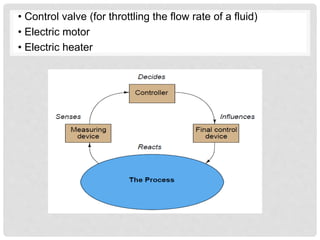
• Control valve (for throttling the flow rate of a fluid)
• Electric motor
• Electric heater
INSTRUMENTATION TERMS AND THEIR
DEFINITIONS:
• Process: The physical system we are attempting to
control or measure.
• Process Variable, or PV: The specific quantity we are
measuring in a process.
• Setpoint, or SP: The value at which we desire the
process variable to be maintained at.
• Primary Sensing Element, or PSE: A device that
directly senses the process variable and
• translates that sensed quantity into an analog
representation (electrical voltage, current, resistance;
• mechanical force, motion, etc.).
• Transducer: A device that converts one standardized
instrumentation signal into another standardized
instrumentation signal, and/or performs some sort of
processing on that signal.
• Transmitter: A device that translates the signal produced
by a primary sensing element (PSE) into a standardized
instrumentation signal
• Lower- and Upper-range values, abbreviated LRV and
URV, respectively: the values of process measurement
deemed to be 0% and 100% of a transmitter’s calibrated
range.
• Controller: A device that receives a process variable
(PV) signal from a primary sensing element(PSE) or
transmitter, compares that signal to the desired value for
that process variable (called the set point), and
calculates an appropriate output signal value to be sent
to a final control element
• Final Control Element, or FCE: A device that receives
the signal from a controller to directly influence the
process.
• Automatic mode: When the controller generates an
output signal based on the relationship of process
variable (PV) to the set point (SP).
• Manual mode: When the controller’s decision-making
ability is bypassed to let a human operator directly
determine the output signal sent to the final control
element.
5.1 EXAMPLE: BOILER WATER LEVEL
CONTROL SYSTEM
• Steam boilers are very common in industry, principally
because steam power is so useful.
• Common uses for steam in industry:
• mechanical work (e.g. a steam engine moving some sort of
machine)
• Heating
• producing vacuums (through the use of “steam eductors”)
• Augmenting chemical processes (e.g. reforming of natural gas
into hydrogen and carbon dioxide)
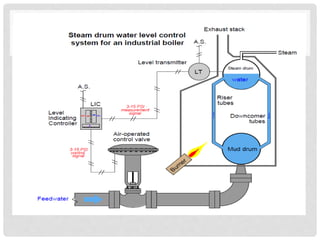
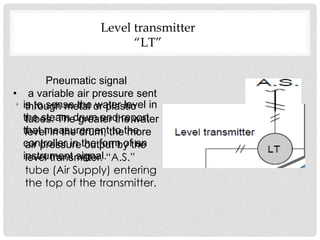
• is to sense the water level in
the steam drum and report
that measurement to the
controller in the form of an
instrument signal.
Pneumatic signal
• a variable air pressure sent
through metal or plastic
tubes. The greater the water
level in the drum, the more
air pressure output by the
level transmitter. “A.S.”
tube (Air Supply) entering
the top of the transmitter.
Level transmitter
“LT”
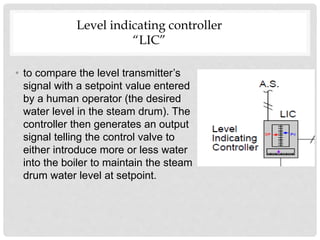
• to compare the level transmitter’s
signal with a setpoint value entered
by a human operator (the desired
water level in the steam drum). The
controller then generates an output
signal telling the control valve to
either introduce more or less water
into the boiler to maintain the steam
drum water level at setpoint.
Level indicating controller
“LIC”
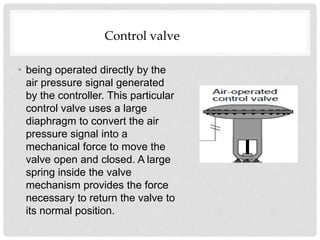
• being operated directly by the
air pressure signal generated
by the controller. This particular
control valve uses a large
diaphragm to convert the air
pressure signal into a
mechanical force to move the
valve open and closed. A large
spring inside the valve
mechanism provides the force
necessary to return the valve to
its normal position.
Control valve
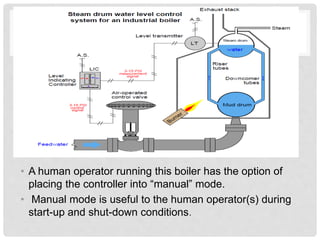
• A human operator running this boiler has the option of
placing the controller into “manual” mode.
• Manual mode is useful to the human operator(s) during
start-up and shut-down conditions.
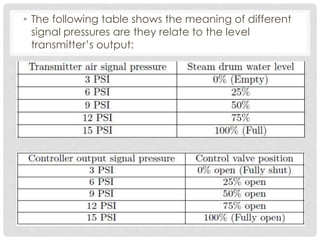
• The following table shows the meaning of different
signal pressures are they relate to the level
transmitter’s output:
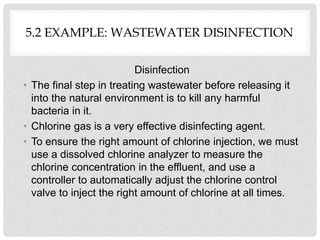
5.2 EXAMPLE: WASTEWATER DISINFECTION
Disinfection
• The final step in treating wastewater before releasing it
into the natural environment is to kill any harmful
bacteria in it.
• Chlorine gas is a very effective disinfecting agent.
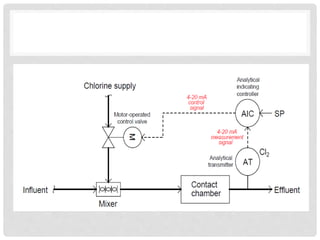
• To ensure the right amount of chlorine injection, we must
use a dissolved chlorine analyzer to measure the
chlorine concentration in the effluent, and use a
controller to automatically adjust the chlorine control
valve to inject the right amount of chlorine at all times.
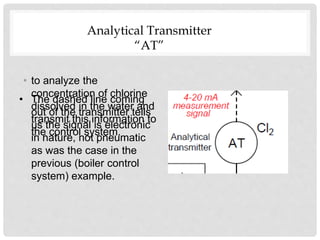
• to analyze the
concentration of chlorine
dissolved in the water and
transmit this information to
the control system.
• The dashed line coming
out of the transmitter tells
us the signal is electronic
in nature, not pneumatic
as was the case in the
previous (boiler control
system) example.
Analytical Transmitter
“AT”
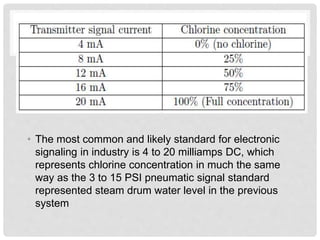
• The most common and likely standard for electronic
signaling in industry is 4 to 20 milliamps DC, which
represents chlorine concentration in much the same
way as the 3 to 15 PSI pneumatic signal standard
represented steam drum water level in the previous
system
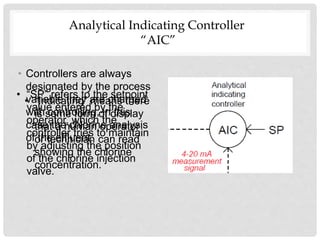
• Controllers are always
designated by the process
variable they are charged
with controlling, in this
case the chlorine analysis
of the effluent.
• “Indicating” means there
is some form of display
that a human operator
or technician can read
showing the chlorine
concentration.
• “SP” refers to the setpoint
value entered by the
operator, which the
controller tries to maintain
by adjusting the position
of the chlorine injection
valve.
Analytical Indicating Controller
“AIC”
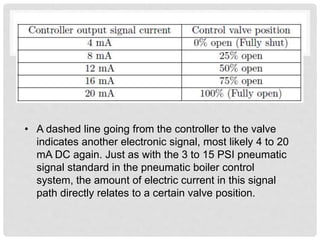
• A dashed line going from the controller to the valve
indicates another electronic signal, most likely 4 to 20
mA DC again. Just as with the 3 to 15 PSI pneumatic
signal standard in the pneumatic boiler control
system, the amount of electric current in this signal
path directly relates to a certain valve position.
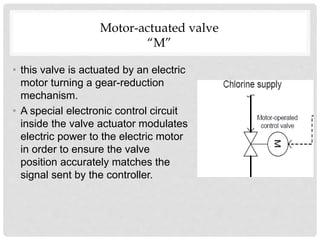
• this valve is actuated by an electric
motor turning a gear-reduction
mechanism.
• A special electronic control circuit
inside the valve actuator modulates
electric power to the electric motor
in order to ensure the valve
position accurately matches the
signal sent by the controller.
Motor-actuated valve
“M”
THANK YOU

Introduction to Industrial Instrumentation

  • 1.
  • 2.
    • Instrumentation isthe science of automated measurement and control. • Applications of this science abound in modern research, industry, and everyday living. INSTRUMENTATION • Fluid pressure • Fluid flow rate • The temperature of an object • Fluid volume stored in a vessel • Chemical concentration • Machine position, motion, or acceleration • Physical dimension(s) of an object • Count (inventory) of objects • Electrical voltage, current, or resistance
  • 3.
    • Control valve(for throttling the flow rate of a fluid) • Electric motor • Electric heater
  • 4.
    INSTRUMENTATION TERMS ANDTHEIR DEFINITIONS: • Process: The physical system we are attempting to control or measure. • Process Variable, or PV: The specific quantity we are measuring in a process. • Setpoint, or SP: The value at which we desire the process variable to be maintained at. • Primary Sensing Element, or PSE: A device that directly senses the process variable and • translates that sensed quantity into an analog representation (electrical voltage, current, resistance; • mechanical force, motion, etc.). • Transducer: A device that converts one standardized instrumentation signal into another standardized instrumentation signal, and/or performs some sort of processing on that signal. • Transmitter: A device that translates the signal produced by a primary sensing element (PSE) into a standardized instrumentation signal • Lower- and Upper-range values, abbreviated LRV and URV, respectively: the values of process measurement deemed to be 0% and 100% of a transmitter’s calibrated range.
  • 5.
    • Controller: Adevice that receives a process variable (PV) signal from a primary sensing element(PSE) or transmitter, compares that signal to the desired value for that process variable (called the set point), and calculates an appropriate output signal value to be sent to a final control element • Final Control Element, or FCE: A device that receives the signal from a controller to directly influence the process. • Automatic mode: When the controller generates an output signal based on the relationship of process variable (PV) to the set point (SP). • Manual mode: When the controller’s decision-making ability is bypassed to let a human operator directly determine the output signal sent to the final control element.
  • 6.
    5.1 EXAMPLE: BOILERWATER LEVEL CONTROL SYSTEM • Steam boilers are very common in industry, principally because steam power is so useful. • Common uses for steam in industry: • mechanical work (e.g. a steam engine moving some sort of machine) • Heating • producing vacuums (through the use of “steam eductors”) • Augmenting chemical processes (e.g. reforming of natural gas into hydrogen and carbon dioxide)
  • 8.
    • is tosense the water level in the steam drum and report that measurement to the controller in the form of an instrument signal. Pneumatic signal • a variable air pressure sent through metal or plastic tubes. The greater the water level in the drum, the more air pressure output by the level transmitter. “A.S.” tube (Air Supply) entering the top of the transmitter. Level transmitter “LT”
  • 9.
    • to comparethe level transmitter’s signal with a setpoint value entered by a human operator (the desired water level in the steam drum). The controller then generates an output signal telling the control valve to either introduce more or less water into the boiler to maintain the steam drum water level at setpoint. Level indicating controller “LIC”
  • 10.
    • being operateddirectly by the air pressure signal generated by the controller. This particular control valve uses a large diaphragm to convert the air pressure signal into a mechanical force to move the valve open and closed. A large spring inside the valve mechanism provides the force necessary to return the valve to its normal position. Control valve
  • 11.
    • A humanoperator running this boiler has the option of placing the controller into “manual” mode. • Manual mode is useful to the human operator(s) during start-up and shut-down conditions.
  • 12.
    • The followingtable shows the meaning of different signal pressures are they relate to the level transmitter’s output:
  • 13.
    5.2 EXAMPLE: WASTEWATERDISINFECTION Disinfection • The final step in treating wastewater before releasing it into the natural environment is to kill any harmful bacteria in it. • Chlorine gas is a very effective disinfecting agent. • To ensure the right amount of chlorine injection, we must use a dissolved chlorine analyzer to measure the chlorine concentration in the effluent, and use a controller to automatically adjust the chlorine control valve to inject the right amount of chlorine at all times.
  • 15.
    • to analyzethe concentration of chlorine dissolved in the water and transmit this information to the control system. • The dashed line coming out of the transmitter tells us the signal is electronic in nature, not pneumatic as was the case in the previous (boiler control system) example. Analytical Transmitter “AT”
  • 16.
    • The mostcommon and likely standard for electronic signaling in industry is 4 to 20 milliamps DC, which represents chlorine concentration in much the same way as the 3 to 15 PSI pneumatic signal standard represented steam drum water level in the previous system
  • 17.
    • Controllers arealways designated by the process variable they are charged with controlling, in this case the chlorine analysis of the effluent. • “Indicating” means there is some form of display that a human operator or technician can read showing the chlorine concentration. • “SP” refers to the setpoint value entered by the operator, which the controller tries to maintain by adjusting the position of the chlorine injection valve. Analytical Indicating Controller “AIC”
  • 18.
    • A dashedline going from the controller to the valve indicates another electronic signal, most likely 4 to 20 mA DC again. Just as with the 3 to 15 PSI pneumatic signal standard in the pneumatic boiler control system, the amount of electric current in this signal path directly relates to a certain valve position.
  • 19.
    • this valveis actuated by an electric motor turning a gear-reduction mechanism. • A special electronic control circuit inside the valve actuator modulates electric power to the electric motor in order to ensure the valve position accurately matches the signal sent by the controller. Motor-actuated valve “M”
  • 20.