INDUSTRIAL
INSTRUMENTATION
Introduction
ER. FARUK BIN POYEN
DEPT. OF AEIE, UIT, BU, BURDWAN, WB, INDIA
FARUK.POYEN@GMAIL.COM
Contents:
1. Functional Elements of Instruments
2. Performance Characteristics
1. Static Characteristics
2. Dynamic Characteristics
3. Static Errors
4. Dynamic Response
3. Statistical Analysis
4. Units of Measurement
5. Standards of Measurement
6. Signal Conditioning
7. Classification of Instruments
8. Measurement of Industrial Parameters
2
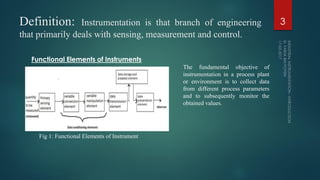
Definition: Instrumentation is that branch of engineering that
primarily deals with sensing, measurement and control.
Functional Elements of Instruments
3
The fundamental objective of
instrumentation in a process plant
or environment is to collect data
from different process parameters
and to subsequently monitor the
obtained values.
Fig 1: Functional Elements of Instrument
Industrial Instrumentation – Block Diagram 4
Industrial Automation – Scheme – Power Plant 5
Electrical Parameter Measuring Reference 6
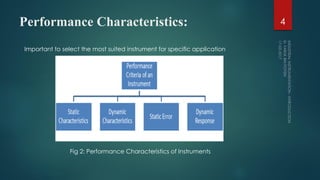
Performance Characteristics: 7
Fig 2: Performance Characteristics of Instruments
Important to select the most suited instrument for specific application
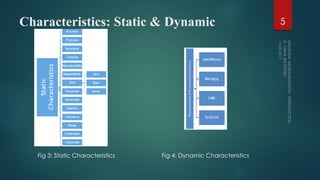
Characteristics: Static & Dynamic 8
Fig 3: Static Characteristics Fig 4: Dynamic Characteristics
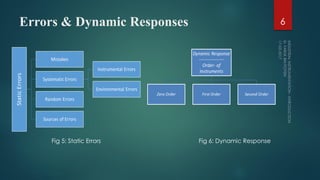
Errors & Dynamic Responses 9
Fig 5: Static Errors Fig 6: Dynamic Response
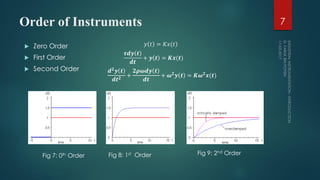
Order of Instruments
 Zero Order
 First Order
 Second Order
10
Fig 7: 0th Order Fig 8: 1st Order Fig 9: 2nd Order
𝑦 𝑡 = 𝐾𝑥(𝑡
𝝉𝒅𝒚 𝒕
𝒅𝒕
+ 𝒚 𝒕 = 𝑲𝒙(𝒕
𝒅 𝟐
𝒚 𝒕
𝒅𝒕 𝟐 +
𝟐𝝆𝝎𝒅𝒚 𝒕
𝒅𝒕
+ 𝝎 𝟐 𝒚 𝒕 = 𝑲𝝎 𝟐 𝒙(𝒕
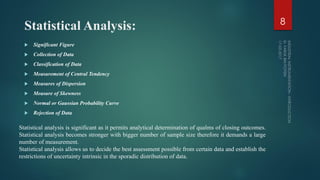
Statistical Analysis:
 Significant Figure
 Collection of Data
 Classification of Data
 Measurement of Central Tendency
 Measures of Dispersion
 Measure of Skewness
 Normal or Gaussian Probability Curve
 Rejection of Data
11
Statistical analysis is significant as it permits analytical determination of qualms of closing outcomes.
Statistical analysis becomes stronger with bigger number of sample size therefore it demands a large
number of measurement.
Statistical analysis allows us to decide the best assessment possible from certain data and establish the
restrictions of uncertainty intrinsic in the sporadic distribution of data.
Statistical Analysis - Terms
 Significant Figure: Each of the digits of a number that are used to express it to the required
degree of accuracy, starting from the first non-zero digit.
 Collection of Data: The process of gathering and measuring information on variables of
interest, in an established systematic fashion that enables one to answer stated research
questions, test hypotheses, and evaluate outcomes.
 Classification of Data: The process of organizing data into categories for its most effective
and efficient use.
 Measurement of Central Tendency: There are three main measures of central tendency: the
mode, the median and the mean. Each of these measures describes a different indication of
the typical or central value in the distribution. The mode is the most commonly occurring
value in a distribution.
 Measure of Dispersion: Common examples of measures of statistical dispersion are the
variance, standard deviation, and interquartile range. Dispersion is contrasted with location
or central tendency, and together they are the most used properties of distributions.
12
Statistical Analysis - Terms
 Measure of Skewness: Skewness is a measure of the asymmetry of the probability
distribution of a real-valued random variable about its mean. The skewness value can
be positive or negative, or undefined. The qualitative interpretation of the skew is
complicated and unintuitive.
𝑆 =
𝑀𝑒𝑎𝑛 − 𝑀𝑜𝑑𝑒
𝑆𝑡𝑎𝑛𝑑𝑎𝑟𝑑 𝐷𝑒𝑣𝑖𝑎𝑡𝑖𝑜𝑛
 Normal or Gaussian Distribution Curve: The mean, median, and mode of a normal
distribution are equal. The area under the normal curve is equal to 1.0. Normal
distributions are denser in the center and less dense in the tails. Normal distributions
are defined by two parameters, the mean (μ) and the standard deviation (σ).
 Rejection of Data: All data points should be retained that fall within a band around the
mean that corresponds to a probability of 1-1/(2N). In other words, data points can be
considered for rejection only if the probability of obtaining their deviation from the
mean is less than 1/(2N), where N is the sample size.
13
Units of Measurement 14
Fig 10: Measurement Units
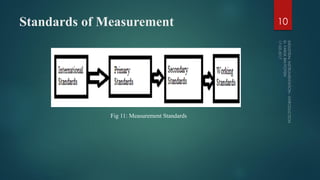
Standards of Measurement 15
Fig 11: Measurement Standards
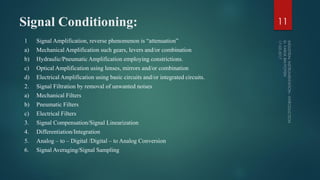
Signal Conditioning:
1 Signal Amplification, reverse phenomenon is “attenuation”
a) Mechanical Amplification such as gears, levers and/or combination
b) Hydraulic/Pneumatic Amplification employing constrictions.
c) Optical Amplification using lenses, mirrors and/or combination
d) Electrical Amplification using basic circuits and/or integrated circuits.
2. Signal Filtration by removal of unwanted noises
a) Mechanical Filters
b) Pneumatic Filters
c) Electrical Filters
3. Signal Compensation/Signal Linearization
4. Differentiation/Integration
5. Analog – to – Digital /Digital – to Analog Conversion
6. Signal Averaging/Signal Sampling
16
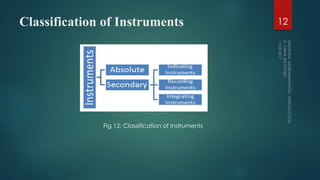
Classification of Instruments 17
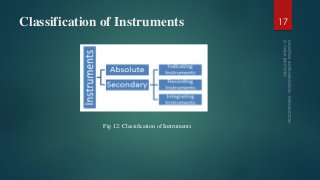
Fig 12: Classification of Instruments
Measurement of Industrial Parameters:
For proper understanding of any measurement system one must understand
and know these issues about that measurement system.
 Basic Principle of Operation,
 Block Diagram,
 Schematic Diagram,
 Range,
 Advantages
 Disadvantages
18
Measurement of Industrial Parameters: 19
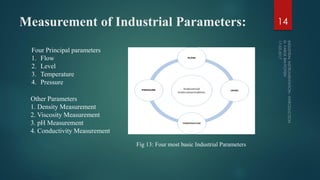
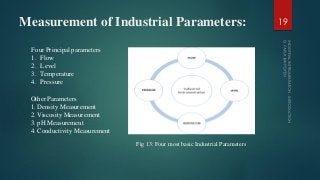
Fig 13: Four most basic Industrial Parameters
Four Principal parameters
1. Flow
2. Level
3. Temperature
4. Pressure
Other Parameters
1. Density Measurement
2. Viscosity Measurement
3. pH Measurement
4. Conductivity Measurement
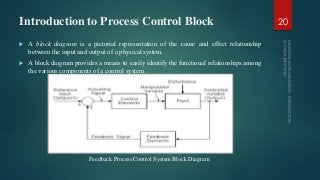
Introduction to Process Control Block
 A block diagram is a pictorial representation of the cause and effect relationship
between the input and output of a physical system.
 A block diagram provides a means to easily identify the functional relationships among
the various components of a control system.
20
Feedback Process Control System Block Diagram
Process Control Terms
 The plant is the system or process through which a particular quantity or condition is
controlled. This is also called the controlled system.
 Control elements: Components needed to generate the appropriate control signal
applied to the plant. These elements are also called the “controller.”
 Feedback elements: Components needed to identify the functional relationship between
the feedback signal and the controlled output.
 Reference point: External signal applied to the summing point of the control system to
cause the plant to produce a specified action. This signal represents the desired value of
a controlled variable and is also called the “set point.”
 Controlled output: Quantity or condition of the plant which is controlled. This signal
represents the controlled variable.
 Feedback signal: Function of the output signal. It is sent to the summing point and
algebraically added to the reference input signal to obtain the actuating signal.
21
Process Control Terms
 Actuating signal: The control action of the control loop and is equal to the algebraic
sum of the reference input signal and feedback signal. This is also called the “error
signal.”
 Manipulated variable: The variable of the process acted upon to maintain the plant
output (controlled variable) at the desired value.
 Disturbance: An undesirable input signal that upsets the value of the controlled output
of the plant.
 PID = Proportional, Integral, Derivative algorithm. This is not a P&ID, which is a
Piping (or Process) and Instrumentation Diagram.
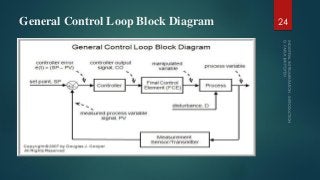
 PV = Process Variable - a quantity used as a feedback, typically measured by an
instrument. Also sometimes called "MV" - Measured Value.
 SP = Set Point - the desired value for the PV.
22
Process Control Terms
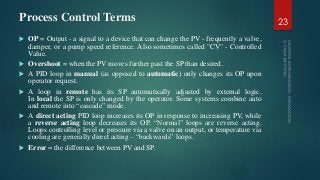
 OP = Output - a signal to a device that can change the PV - frequently a valve,
damper, or a pump speed reference. Also sometimes called "CV" - Controlled
Value.
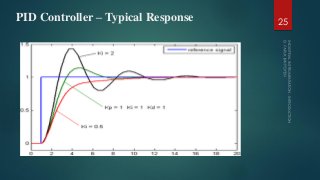
 Overshoot = when the PV moves further past the SP than desired.
 A PID loop in manual (as opposed to automatic) only changes its OP upon
operator request.
 A loop in remote has its SP automatically adjusted by external logic.
In local the SP is only changed by the operator. Some systems combine auto
and remote into “cascade” mode.
 A direct acting PID loop increases its OP in response to increasing PV, while
a reverse acting loop decreases its OP. “Normal” loops are reverse acting.
Loops controlling level or pressure via a valve on an output, or temperature via
cooling are generally direct acting – “backwards” loops.
 Error = the difference between PV and SP.
23
General Control Loop Block Diagram 24
PID Controller – Typical Response 25
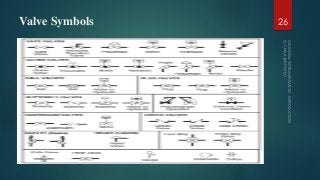
Valve Symbols 26
Electrical Switches
 Solid-state switch –
 Solid-state switches are electric devices that do not have moving parts to wear out.
 They are able to switch faster without sparking between contacts or problems with
contact corrosion.
 Their disadvantages include a high cost to build in very high current ratings.
27
Electrical Switches
 Electromechanical switch –
 Electromechanical switches have mechanical contacts or relays.
 These types of switches can control a wider range of current and voltage options. They
are not affected by dirt, mist, magnetic fields or temperature ranges from near absolute
zero to 1000°.
 Electromechanical switches can adapt to misalignment in installation/application to
ensure there is no leakage current and making it available in many circuitry, actuator,
and housing styles.
 Disadvantages include their price, limited contact life cycle, large size and slow
response.
28
Switch Configuration
 When selecting a level switch, the user needs to determine if the electric circuit
requires a normally open or normally closed switch.
 Normally open (NO) switches do not allow current to pass through in the free
position. They need to "make" a contact to be activated.
 Normally closed (NC) switches allow current to pass through in the free position and
need to "break" contact (open) to be activated.
29
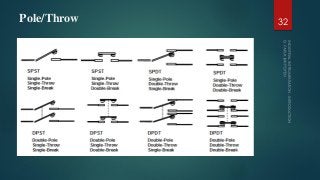
Pole/Throw
 Most switches have one or two poles and one or two throws, but some manufacturers
will produce custom level switches for special applications.
 The number of poles describes the number of separate circuits which can pass through
the switch at the same time.
 The number of throws describes the number of circuits each pole can control.
 This is noted by the configuration of the circuit (NO/NC).
 Breaks are interruptions to the circuit caused by the separated contacts the switch
introduces into each circuits it opens or interrupts in the circuit.
30
Pole/Throw
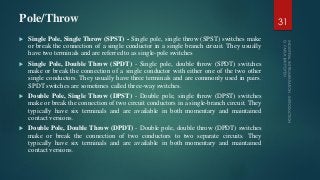
 Single Pole, Single Throw (SPST) - Single pole, single throw (SPST) switches make
or break the connection of a single conductor in a single branch circuit. They usually
have two terminals and are referred to as single-pole switches
 Single Pole, Double Throw (SPDT) - Single pole, double throw (SPDT) switches
make or break the connection of a single conductor with either one of the two other
single conductors. They usually have three terminals and are commonly used in pairs.
SPDT switches are sometimes called three-way switches.
 Double Pole, Single Throw (DPST) - Double pole, single throw (DPST) switches
make or break the connection of two circuit conductors in a single-branch circuit. They
typically have six terminals and are available in both momentary and maintained
contact versions.
 Double Pole, Double Throw (DPDT) - Double pole, double throw (DPDT) switches
make or break the connection of two conductors to two separate circuits. They
typically have six terminals and are available in both momentary and maintained
contact versions.
31
Pole/Throw 32
References:
 Chapter 1: Basic Concepts and Qualities of Measurement, “Industrial Instrumentation
and Control”, 3rd Edition, S K Singh, Tata McGaw Hill, New Delhi, 2009. ISBN-13:
978-0-07-026222-5.
 Chapter 2: Units and Standards of Measurement, “Industrial Instrumentation and
Control”, 3rd Edition, S K Singh, Tata McGaw Hill, New Delhi, 2009. ISBN-13: 978-0-
07-026222-5.
 Chapter 1: Introduction to Instruments and Their Representation, “Instrumentation,
Measurement and Analysis”, 2nd Edition, B C Nakra, K K Chaudhry, Tata McGraw-
Hill, New Delhi, 2005. ISBN: 0-07-048296-9.
 Chapter 2: Static Performance Characteristics of Instruments, “Instrumentation,
Measurement and Analysis”, 2nd Edition, B C Nakra, K K Chaudhry, Tata McGraw-
Hill, New Delhi, 2005. ISBN: 0-07-048296-9.
 Chapter 3: Dynamic Characteristics of Instruments, “Instrumentation, Measurement and
Analysis”, 2nd Edition, B C Nakra, K K Chaudhry, Tata McGraw-Hill, New Delhi,
2005. ISBN: 0-07-048296-9.
33
References:
 Chapter 20: Basic Statistical Concepts, “Instrumentation, Measurement and Analysis”,
2nd Edition, B C Nakra, K K Chaudhry, Tata McGraw-Hill, New Delhi, 2005. ISBN: 0-
07-048296-9.
 Chapter 21: Normal Distribution, “Instrumentation, Measurement and Analysis”, 2nd
Edition, B C Nakra, K K Chaudhry, Tata McGraw-Hill, New Delhi, 2005. ISBN: 0-07-
048296-9.
 Chapter 22: Graphical Representation and Curve Fitting of Data, “Instrumentation,
Measurement and Analysis”, 2nd Edition, B C Nakra, K K Chaudhry, Tata McGraw-
Hill, New Delhi, 2005. ISBN: 0-07-048296-9.
 Chapter 1: Introduction, “Fundamentals of Industrial Instrumentation”, 1st Edition,
Wiley India Pvt. Ltd. New Delhi, 2011. ISBN: 978-81-265-2882-0.
 Chapter 2: Introduction, “Dynamic Characteristics”, 1st Edition, Wiley India Pvt. Ltd.
New Delhi, 2011. ISBN: 978-81-265-2882-0.
 Chapter 1: Characteristics of Measurement System, “Principles of Industrial
Instrumentation”, D Patranabis, Tata McGraw-Hill, New Delhi, 2004, ISBN: 0-07-
462334-6.
 http://www.globalspec.com/learnmore/sensors_transducers_detectors/ Engineering 360
34

Industrial Instrumentation An Introduction

  • 1.
    INDUSTRIAL INSTRUMENTATION Introduction ER. FARUK BINPOYEN DEPT. OF AEIE, UIT, BU, BURDWAN, WB, INDIA FARUK.POYEN@GMAIL.COM
  • 2.
    Contents: 1. Functional Elementsof Instruments 2. Performance Characteristics 1. Static Characteristics 2. Dynamic Characteristics 3. Static Errors 4. Dynamic Response 3. Statistical Analysis 4. Units of Measurement 5. Standards of Measurement 6. Signal Conditioning 7. Classification of Instruments 8. Measurement of Industrial Parameters 2
  • 3.
    Definition: Instrumentation isthat branch of engineering that primarily deals with sensing, measurement and control. Functional Elements of Instruments 3 The fundamental objective of instrumentation in a process plant or environment is to collect data from different process parameters and to subsequently monitor the obtained values. Fig 1: Functional Elements of Instrument
  • 4.
  • 5.
    Industrial Automation –Scheme – Power Plant 5
  • 6.
  • 7.
    Performance Characteristics: 7 Fig2: Performance Characteristics of Instruments Important to select the most suited instrument for specific application
  • 8.
    Characteristics: Static &Dynamic 8 Fig 3: Static Characteristics Fig 4: Dynamic Characteristics
  • 9.
    Errors & DynamicResponses 9 Fig 5: Static Errors Fig 6: Dynamic Response
  • 10.
    Order of Instruments Zero Order  First Order  Second Order 10 Fig 7: 0th Order Fig 8: 1st Order Fig 9: 2nd Order 𝑦 𝑡 = 𝐾𝑥(𝑡 𝝉𝒅𝒚 𝒕 𝒅𝒕 + 𝒚 𝒕 = 𝑲𝒙(𝒕 𝒅 𝟐 𝒚 𝒕 𝒅𝒕 𝟐 + 𝟐𝝆𝝎𝒅𝒚 𝒕 𝒅𝒕 + 𝝎 𝟐 𝒚 𝒕 = 𝑲𝝎 𝟐 𝒙(𝒕
  • 11.
    Statistical Analysis:  SignificantFigure  Collection of Data  Classification of Data  Measurement of Central Tendency  Measures of Dispersion  Measure of Skewness  Normal or Gaussian Probability Curve  Rejection of Data 11 Statistical analysis is significant as it permits analytical determination of qualms of closing outcomes. Statistical analysis becomes stronger with bigger number of sample size therefore it demands a large number of measurement. Statistical analysis allows us to decide the best assessment possible from certain data and establish the restrictions of uncertainty intrinsic in the sporadic distribution of data.
  • 12.
    Statistical Analysis -Terms  Significant Figure: Each of the digits of a number that are used to express it to the required degree of accuracy, starting from the first non-zero digit.  Collection of Data: The process of gathering and measuring information on variables of interest, in an established systematic fashion that enables one to answer stated research questions, test hypotheses, and evaluate outcomes.  Classification of Data: The process of organizing data into categories for its most effective and efficient use.  Measurement of Central Tendency: There are three main measures of central tendency: the mode, the median and the mean. Each of these measures describes a different indication of the typical or central value in the distribution. The mode is the most commonly occurring value in a distribution.  Measure of Dispersion: Common examples of measures of statistical dispersion are the variance, standard deviation, and interquartile range. Dispersion is contrasted with location or central tendency, and together they are the most used properties of distributions. 12
  • 13.
    Statistical Analysis -Terms  Measure of Skewness: Skewness is a measure of the asymmetry of the probability distribution of a real-valued random variable about its mean. The skewness value can be positive or negative, or undefined. The qualitative interpretation of the skew is complicated and unintuitive. 𝑆 = 𝑀𝑒𝑎𝑛 − 𝑀𝑜𝑑𝑒 𝑆𝑡𝑎𝑛𝑑𝑎𝑟𝑑 𝐷𝑒𝑣𝑖𝑎𝑡𝑖𝑜𝑛  Normal or Gaussian Distribution Curve: The mean, median, and mode of a normal distribution are equal. The area under the normal curve is equal to 1.0. Normal distributions are denser in the center and less dense in the tails. Normal distributions are defined by two parameters, the mean (μ) and the standard deviation (σ).  Rejection of Data: All data points should be retained that fall within a band around the mean that corresponds to a probability of 1-1/(2N). In other words, data points can be considered for rejection only if the probability of obtaining their deviation from the mean is less than 1/(2N), where N is the sample size. 13
  • 14.
    Units of Measurement14 Fig 10: Measurement Units
  • 15.
    Standards of Measurement15 Fig 11: Measurement Standards
  • 16.
    Signal Conditioning: 1 SignalAmplification, reverse phenomenon is “attenuation” a) Mechanical Amplification such as gears, levers and/or combination b) Hydraulic/Pneumatic Amplification employing constrictions. c) Optical Amplification using lenses, mirrors and/or combination d) Electrical Amplification using basic circuits and/or integrated circuits. 2. Signal Filtration by removal of unwanted noises a) Mechanical Filters b) Pneumatic Filters c) Electrical Filters 3. Signal Compensation/Signal Linearization 4. Differentiation/Integration 5. Analog – to – Digital /Digital – to Analog Conversion 6. Signal Averaging/Signal Sampling 16
  • 17.
    Classification of Instruments17 Fig 12: Classification of Instruments
  • 18.
    Measurement of IndustrialParameters: For proper understanding of any measurement system one must understand and know these issues about that measurement system.  Basic Principle of Operation,  Block Diagram,  Schematic Diagram,  Range,  Advantages  Disadvantages 18
  • 19.
    Measurement of IndustrialParameters: 19 Fig 13: Four most basic Industrial Parameters Four Principal parameters 1. Flow 2. Level 3. Temperature 4. Pressure Other Parameters 1. Density Measurement 2. Viscosity Measurement 3. pH Measurement 4. Conductivity Measurement
  • 20.
    Introduction to ProcessControl Block  A block diagram is a pictorial representation of the cause and effect relationship between the input and output of a physical system.  A block diagram provides a means to easily identify the functional relationships among the various components of a control system. 20 Feedback Process Control System Block Diagram
  • 21.
    Process Control Terms The plant is the system or process through which a particular quantity or condition is controlled. This is also called the controlled system.  Control elements: Components needed to generate the appropriate control signal applied to the plant. These elements are also called the “controller.”  Feedback elements: Components needed to identify the functional relationship between the feedback signal and the controlled output.  Reference point: External signal applied to the summing point of the control system to cause the plant to produce a specified action. This signal represents the desired value of a controlled variable and is also called the “set point.”  Controlled output: Quantity or condition of the plant which is controlled. This signal represents the controlled variable.  Feedback signal: Function of the output signal. It is sent to the summing point and algebraically added to the reference input signal to obtain the actuating signal. 21
  • 22.
    Process Control Terms Actuating signal: The control action of the control loop and is equal to the algebraic sum of the reference input signal and feedback signal. This is also called the “error signal.”  Manipulated variable: The variable of the process acted upon to maintain the plant output (controlled variable) at the desired value.  Disturbance: An undesirable input signal that upsets the value of the controlled output of the plant.  PID = Proportional, Integral, Derivative algorithm. This is not a P&ID, which is a Piping (or Process) and Instrumentation Diagram.  PV = Process Variable - a quantity used as a feedback, typically measured by an instrument. Also sometimes called "MV" - Measured Value.  SP = Set Point - the desired value for the PV. 22
  • 23.
    Process Control Terms OP = Output - a signal to a device that can change the PV - frequently a valve, damper, or a pump speed reference. Also sometimes called "CV" - Controlled Value.  Overshoot = when the PV moves further past the SP than desired.  A PID loop in manual (as opposed to automatic) only changes its OP upon operator request.  A loop in remote has its SP automatically adjusted by external logic. In local the SP is only changed by the operator. Some systems combine auto and remote into “cascade” mode.  A direct acting PID loop increases its OP in response to increasing PV, while a reverse acting loop decreases its OP. “Normal” loops are reverse acting. Loops controlling level or pressure via a valve on an output, or temperature via cooling are generally direct acting – “backwards” loops.  Error = the difference between PV and SP. 23
  • 24.
    General Control LoopBlock Diagram 24
  • 25.
    PID Controller –Typical Response 25
  • 26.
  • 27.
    Electrical Switches  Solid-stateswitch –  Solid-state switches are electric devices that do not have moving parts to wear out.  They are able to switch faster without sparking between contacts or problems with contact corrosion.  Their disadvantages include a high cost to build in very high current ratings. 27
  • 28.
    Electrical Switches  Electromechanicalswitch –  Electromechanical switches have mechanical contacts or relays.  These types of switches can control a wider range of current and voltage options. They are not affected by dirt, mist, magnetic fields or temperature ranges from near absolute zero to 1000°.  Electromechanical switches can adapt to misalignment in installation/application to ensure there is no leakage current and making it available in many circuitry, actuator, and housing styles.  Disadvantages include their price, limited contact life cycle, large size and slow response. 28
  • 29.
    Switch Configuration  Whenselecting a level switch, the user needs to determine if the electric circuit requires a normally open or normally closed switch.  Normally open (NO) switches do not allow current to pass through in the free position. They need to "make" a contact to be activated.  Normally closed (NC) switches allow current to pass through in the free position and need to "break" contact (open) to be activated. 29
  • 30.
    Pole/Throw  Most switcheshave one or two poles and one or two throws, but some manufacturers will produce custom level switches for special applications.  The number of poles describes the number of separate circuits which can pass through the switch at the same time.  The number of throws describes the number of circuits each pole can control.  This is noted by the configuration of the circuit (NO/NC).  Breaks are interruptions to the circuit caused by the separated contacts the switch introduces into each circuits it opens or interrupts in the circuit. 30
  • 31.
    Pole/Throw  Single Pole,Single Throw (SPST) - Single pole, single throw (SPST) switches make or break the connection of a single conductor in a single branch circuit. They usually have two terminals and are referred to as single-pole switches  Single Pole, Double Throw (SPDT) - Single pole, double throw (SPDT) switches make or break the connection of a single conductor with either one of the two other single conductors. They usually have three terminals and are commonly used in pairs. SPDT switches are sometimes called three-way switches.  Double Pole, Single Throw (DPST) - Double pole, single throw (DPST) switches make or break the connection of two circuit conductors in a single-branch circuit. They typically have six terminals and are available in both momentary and maintained contact versions.  Double Pole, Double Throw (DPDT) - Double pole, double throw (DPDT) switches make or break the connection of two conductors to two separate circuits. They typically have six terminals and are available in both momentary and maintained contact versions. 31
  • 32.
  • 33.
    References:  Chapter 1:Basic Concepts and Qualities of Measurement, “Industrial Instrumentation and Control”, 3rd Edition, S K Singh, Tata McGaw Hill, New Delhi, 2009. ISBN-13: 978-0-07-026222-5.  Chapter 2: Units and Standards of Measurement, “Industrial Instrumentation and Control”, 3rd Edition, S K Singh, Tata McGaw Hill, New Delhi, 2009. ISBN-13: 978-0- 07-026222-5.  Chapter 1: Introduction to Instruments and Their Representation, “Instrumentation, Measurement and Analysis”, 2nd Edition, B C Nakra, K K Chaudhry, Tata McGraw- Hill, New Delhi, 2005. ISBN: 0-07-048296-9.  Chapter 2: Static Performance Characteristics of Instruments, “Instrumentation, Measurement and Analysis”, 2nd Edition, B C Nakra, K K Chaudhry, Tata McGraw- Hill, New Delhi, 2005. ISBN: 0-07-048296-9.  Chapter 3: Dynamic Characteristics of Instruments, “Instrumentation, Measurement and Analysis”, 2nd Edition, B C Nakra, K K Chaudhry, Tata McGraw-Hill, New Delhi, 2005. ISBN: 0-07-048296-9. 33
  • 34.
    References:  Chapter 20:Basic Statistical Concepts, “Instrumentation, Measurement and Analysis”, 2nd Edition, B C Nakra, K K Chaudhry, Tata McGraw-Hill, New Delhi, 2005. ISBN: 0- 07-048296-9.  Chapter 21: Normal Distribution, “Instrumentation, Measurement and Analysis”, 2nd Edition, B C Nakra, K K Chaudhry, Tata McGraw-Hill, New Delhi, 2005. ISBN: 0-07- 048296-9.  Chapter 22: Graphical Representation and Curve Fitting of Data, “Instrumentation, Measurement and Analysis”, 2nd Edition, B C Nakra, K K Chaudhry, Tata McGraw- Hill, New Delhi, 2005. ISBN: 0-07-048296-9.  Chapter 1: Introduction, “Fundamentals of Industrial Instrumentation”, 1st Edition, Wiley India Pvt. Ltd. New Delhi, 2011. ISBN: 978-81-265-2882-0.  Chapter 2: Introduction, “Dynamic Characteristics”, 1st Edition, Wiley India Pvt. Ltd. New Delhi, 2011. ISBN: 978-81-265-2882-0.  Chapter 1: Characteristics of Measurement System, “Principles of Industrial Instrumentation”, D Patranabis, Tata McGraw-Hill, New Delhi, 2004, ISBN: 0-07- 462334-6.  http://www.globalspec.com/learnmore/sensors_transducers_detectors/ Engineering 360 34