MINI PROJECT
GROUP MEMBERS:
• Aqeel Ur Rehman
• Naseem khan
• Aqib Ahmad
• Asmat Ullah
• Ubaid Ullah
TOPICS
• Pressure measuring devices
• Piston gauge
• Manometers
• Bourdon pressure gauge
• McLeod gauge
PRESSURE MEASURING DEVICES
• Instruments used to measure pressure are called pressure gauges or
vacuum gauges
• The oldest type is the liquid column (a vertical tube filled with mercury)
manometer invented by Evangelista Torricelli in 1643.
• The U-Tube was invented by Christian Huygens in 1661.
McLeod Gauge
Principle :
A known volume gas is compressed to a smaller volume whose final value provides an
indication of the applied pressure
• A McLeod gauge isolates a sample of gas and compresses it
• McLeod gauge reading is dependent on the composition of the gas
Useful range:
• Useful range is from 10−4Torr (roughly 10−2 Pa) to vacuums as high as 10−6 Torr
• McLeod gauge can measure lower pressure directly
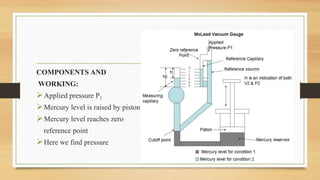
McLeod Gauge
COMPONENTS AND
WORKING:
Applied pressure P1
Mercury level is raised by piston
Mercury level reaches zero
reference point
Here we find pressure
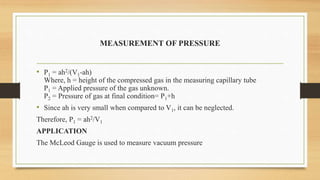
MEASUREMENT OF PRESSURE
• P1 = ah2/(V1-ah)
Where, h = height of the compressed gas in the measuring capillary tube
P1 = Applied pressure of the gas unknown.
P2 = Pressure of gas at final condition= P1+h
• Since ah is very small when compared to V1, it can be neglected.
Therefore, P1 = ah2/V1
APPLICATION
The McLeod Gauge is used to measure vacuum pressure
BOURDON PRESSURE GAUGE
• Bourdon patented his gauge in France in 1849
• Cheap, reliable and accurate
• Principle: flattened tube tends to straighten or regain its circular form in
cross section when pressurized
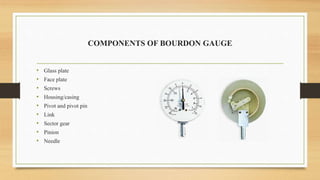
COMPONENTS OF BOURDON GAUGE
• Glass plate
• Face plate
• Screws
• Housing/casing
• Pivot and pivot pin
• Link
• Sector gear
• Pinion
• Needle
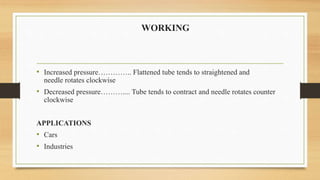
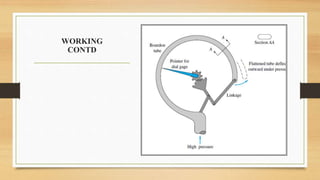
WORKING
• Increased pressure………….. Flattened tube tends to straightened and
needle rotates clockwise
• Decreased pressure……….... Tube tends to contract and needle rotates counter
clockwise
APPLICATIONS
• Cars
• Industries
WORKING
CONTD
PISTON GAUGE
• Piston-type gauges counterbalance the
pressure of a fluid with a spring (for example
tire-pressure gauges of comparatively
low accuracy) or a solid weight
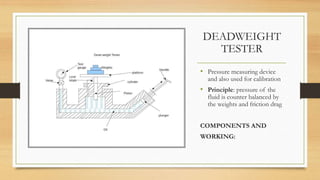
DEADWEIGHT
TESTER
• Pressure measuring device
and also used for calibration
• Principle: pressure of the
fluid is counter balanced by
the weights and friction drag
COMPONENTS AND
WORKING:
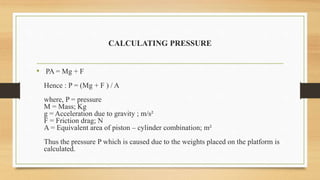
CALCULATING PRESSURE
• PA = Mg + F
Hence : P = (Mg + F ) / A
where, P = pressure
M = Mass; Kg
g = Acceleration due to gravity ; m/s²
F = Friction drag; N
A = Equivalent area of piston – cylinder combination; m²
Thus the pressure P which is caused due to the weights placed on the platform is
calculated.
APPLICATIONS
• It is used to calibrate all kinds of pressure gauges
such as industrial pressure gauges, engine
indicators and piezoelectric transducers
MANOMETERS
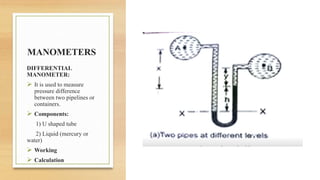
DIFFERENTIAL
MANOMETER:
 It is used to measure
pressure difference
between two pipelines or
containers.
 Components:
1) U shaped tube
2) Liquid (mercury or
water)
 Working
 Calculation
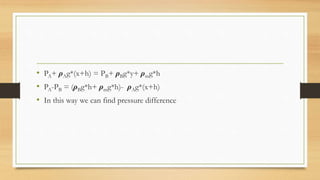
• PA+ ρAg*(x+h) = PB+ ρBg*y+ ρmg*h
• PA-PB = (ρBg*h+ ρmg*h)- ρAg*(x+h)
• In this way we can find pressure difference
MANOMETERS
CONTD
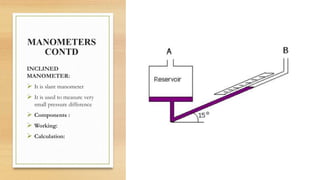
INCLINED
MANOMETER:
 It is slant manometer
 It is used to measure very
small pressure difference
 Components :
 Working:
 Calculation:
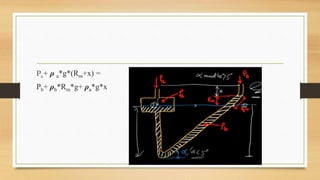
Pa+ ρ a*g*(Rm+x) =
Pb+ ρb*Rm*g+ ρa*g*x
AQIB AHMAD
CLASS NO 14
Aneroid Gauges
• Aneroid means “without fluids” and the term originally distinguished
these gauges can be used to measure the pressure of a liquid as well as
gas.
• Aneroid gauges are based on a metallic pressure-sensing element that
flexes elastically under the effect of a pressure difference across the
element.
• Aneroid gauges are often called mechanical gauges in modern languages.
• These are not dependent on the type o gas being measured , unlike thermal
and ionization gauges.
• Ionization gauges for measuring low pressure only .
• Thermal gauges are used by the phenomenon that
DENSITY INCREASES PRESSURE INCREASES
HEAT PRODUCED HEAT MEASURED BY WIRE FILAMENT
Bellow Pressure Gauge
WORKING:
• Bellows are tubular membranes which are present inside the bellow
pressure gauge.
• Here the pressure to be measured is applied outside the bellows.
• It contains an elastic element that is spring.
• Here the movements of the bellows can be converted into linear
displacement.
• The displacement can be converted in terms of pressure.
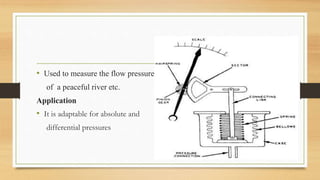
• Used to measure the flow pressure
of a peaceful river etc.
Application
• It is adaptable for absolute and
differential pressures
Spinning Rotor Gauge
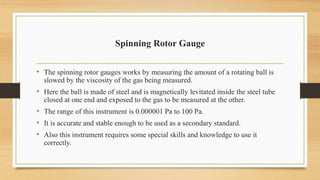
• The spinning rotor gauges works by measuring the amount of a rotating ball is
slowed by the viscosity of the gas being measured.
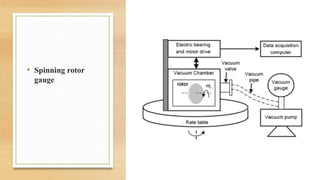
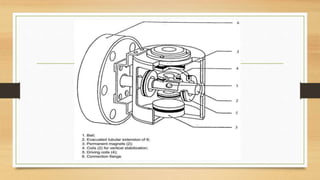
• Here the ball is made of steel and is magnetically levitated inside the steel tube
closed at one end and exposed to the gas to be measured at the other.
• The range of this instrument is 0.000001 Pa to 100 Pa.
• It is accurate and stable enough to be used as a secondary standard.
• Also this instrument requires some special skills and knowledge to use it
correctly.
• Spinning rotor
gauge
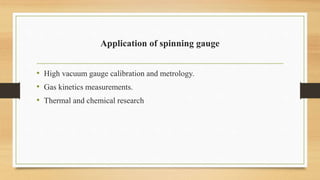
Application of spinning gauge
• High vacuum gauge calibration and metrology.
• Gas kinetics measurements.
• Thermal and chemical research
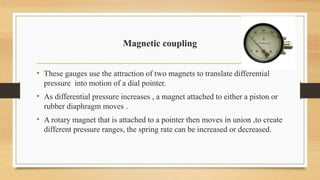
Magnetic coupling
• These gauges use the attraction of two magnets to translate differential
pressure into motion of a dial pointer.
• As differential pressure increases , a magnet attached to either a piston or
rubber diaphragm moves .
• A rotary magnet that is attached to a pointer then moves in union ,to create
different pressure ranges, the spring rate can be increased or decreased.

Pressure measuring devices

  • 1.
    MINI PROJECT GROUP MEMBERS: •Aqeel Ur Rehman • Naseem khan • Aqib Ahmad • Asmat Ullah • Ubaid Ullah
  • 2.
    TOPICS • Pressure measuringdevices • Piston gauge • Manometers • Bourdon pressure gauge • McLeod gauge
  • 3.
    PRESSURE MEASURING DEVICES •Instruments used to measure pressure are called pressure gauges or vacuum gauges • The oldest type is the liquid column (a vertical tube filled with mercury) manometer invented by Evangelista Torricelli in 1643. • The U-Tube was invented by Christian Huygens in 1661.
  • 4.
    McLeod Gauge Principle : Aknown volume gas is compressed to a smaller volume whose final value provides an indication of the applied pressure • A McLeod gauge isolates a sample of gas and compresses it • McLeod gauge reading is dependent on the composition of the gas Useful range: • Useful range is from 10−4Torr (roughly 10−2 Pa) to vacuums as high as 10−6 Torr • McLeod gauge can measure lower pressure directly
  • 5.
    McLeod Gauge COMPONENTS AND WORKING: Appliedpressure P1 Mercury level is raised by piston Mercury level reaches zero reference point Here we find pressure
  • 6.
    MEASUREMENT OF PRESSURE •P1 = ah2/(V1-ah) Where, h = height of the compressed gas in the measuring capillary tube P1 = Applied pressure of the gas unknown. P2 = Pressure of gas at final condition= P1+h • Since ah is very small when compared to V1, it can be neglected. Therefore, P1 = ah2/V1 APPLICATION The McLeod Gauge is used to measure vacuum pressure
  • 7.
    BOURDON PRESSURE GAUGE •Bourdon patented his gauge in France in 1849 • Cheap, reliable and accurate • Principle: flattened tube tends to straighten or regain its circular form in cross section when pressurized
  • 8.
    COMPONENTS OF BOURDONGAUGE • Glass plate • Face plate • Screws • Housing/casing • Pivot and pivot pin • Link • Sector gear • Pinion • Needle
  • 9.
    WORKING • Increased pressure…………..Flattened tube tends to straightened and needle rotates clockwise • Decreased pressure……….... Tube tends to contract and needle rotates counter clockwise APPLICATIONS • Cars • Industries
  • 10.
  • 11.
    PISTON GAUGE • Piston-typegauges counterbalance the pressure of a fluid with a spring (for example tire-pressure gauges of comparatively low accuracy) or a solid weight
  • 12.
    DEADWEIGHT TESTER • Pressure measuringdevice and also used for calibration • Principle: pressure of the fluid is counter balanced by the weights and friction drag COMPONENTS AND WORKING:
  • 13.
    CALCULATING PRESSURE • PA= Mg + F Hence : P = (Mg + F ) / A where, P = pressure M = Mass; Kg g = Acceleration due to gravity ; m/s² F = Friction drag; N A = Equivalent area of piston – cylinder combination; m² Thus the pressure P which is caused due to the weights placed on the platform is calculated.
  • 14.
    APPLICATIONS • It isused to calibrate all kinds of pressure gauges such as industrial pressure gauges, engine indicators and piezoelectric transducers
  • 15.
    MANOMETERS DIFFERENTIAL MANOMETER:  It isused to measure pressure difference between two pipelines or containers.  Components: 1) U shaped tube 2) Liquid (mercury or water)  Working  Calculation
  • 16.
    • PA+ ρAg*(x+h)= PB+ ρBg*y+ ρmg*h • PA-PB = (ρBg*h+ ρmg*h)- ρAg*(x+h) • In this way we can find pressure difference
  • 17.
    MANOMETERS CONTD INCLINED MANOMETER:  It isslant manometer  It is used to measure very small pressure difference  Components :  Working:  Calculation:
  • 18.
    Pa+ ρ a*g*(Rm+x)= Pb+ ρb*Rm*g+ ρa*g*x
  • 19.
  • 20.
    Aneroid Gauges • Aneroidmeans “without fluids” and the term originally distinguished these gauges can be used to measure the pressure of a liquid as well as gas. • Aneroid gauges are based on a metallic pressure-sensing element that flexes elastically under the effect of a pressure difference across the element. • Aneroid gauges are often called mechanical gauges in modern languages. • These are not dependent on the type o gas being measured , unlike thermal and ionization gauges.
  • 21.
    • Ionization gaugesfor measuring low pressure only . • Thermal gauges are used by the phenomenon that DENSITY INCREASES PRESSURE INCREASES HEAT PRODUCED HEAT MEASURED BY WIRE FILAMENT
  • 22.
    Bellow Pressure Gauge WORKING: •Bellows are tubular membranes which are present inside the bellow pressure gauge. • Here the pressure to be measured is applied outside the bellows. • It contains an elastic element that is spring. • Here the movements of the bellows can be converted into linear displacement. • The displacement can be converted in terms of pressure.
  • 23.
    • Used tomeasure the flow pressure of a peaceful river etc. Application • It is adaptable for absolute and differential pressures
  • 24.
    Spinning Rotor Gauge •The spinning rotor gauges works by measuring the amount of a rotating ball is slowed by the viscosity of the gas being measured. • Here the ball is made of steel and is magnetically levitated inside the steel tube closed at one end and exposed to the gas to be measured at the other. • The range of this instrument is 0.000001 Pa to 100 Pa. • It is accurate and stable enough to be used as a secondary standard. • Also this instrument requires some special skills and knowledge to use it correctly.
  • 25.
  • 27.
    Application of spinninggauge • High vacuum gauge calibration and metrology. • Gas kinetics measurements. • Thermal and chemical research
  • 28.
    Magnetic coupling • Thesegauges use the attraction of two magnets to translate differential pressure into motion of a dial pointer. • As differential pressure increases , a magnet attached to either a piston or rubber diaphragm moves . • A rotary magnet that is attached to a pointer then moves in union ,to create different pressure ranges, the spring rate can be increased or decreased.