FIELD INSTRUMENTATION
Level Measurement
LEVEL SENSOR ACCESSORIES IN PROCESS/INSTRUMENTATION
LEVEL TRANSMITTER1
LEVEL INDICATORS2
LEVEL SWITCHES3
There are several types of accessories in level sensor. they are
LEVEL TRANSMITTER
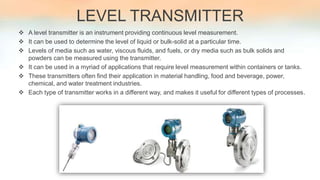
 A level transmitter is an instrument providing continuous level measurement.
 It can be used to determine the level of liquid or bulk-solid at a particular time.
 Levels of media such as water, viscous fluids, and fuels, or dry media such as bulk solids and
powders can be measured using the transmitter.
 It can be used in a myriad of applications that require level measurement within containers or tanks.
 These transmitters often find their application in material handling, food and beverage, power,
chemical, and water treatment industries.
 Each type of transmitter works in a different way, and makes it useful for different types of processes.
Types of Level Transmitters
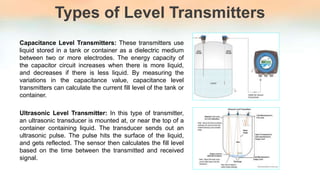
Capacitance Level Transmitters: These transmitters use
liquid stored in a tank or container as a dielectric medium
between two or more electrodes. The energy capacity of
the capacitor circuit increases when there is more liquid,
and decreases if there is less liquid. By measuring the
variations in the capacitance value, capacitance level
transmitters can calculate the current fill level of the tank or
container.
Ultrasonic Level Transmitter: In this type of transmitter,
an ultrasonic transducer is mounted at, or near the top of a
container containing liquid. The transducer sends out an
ultrasonic pulse. The pulse hits the surface of the liquid,
and gets reflected. The sensor then calculates the fill level
based on the time between the transmitted and received
signal.
Types of Level Transmitters
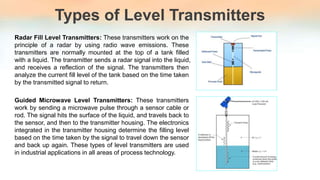
Radar Fill Level Transmitters: These transmitters work on the
principle of a radar by using radio wave emissions. These
transmitters are normally mounted at the top of a tank filled
with a liquid. The transmitter sends a radar signal into the liquid,
and receives a reflection of the signal. The transmitters then
analyze the current fill level of the tank based on the time taken
by the transmitted signal to return.
Guided Microwave Level Transmitters: These transmitters
work by sending a microwave pulse through a sensor cable or
rod. The signal hits the surface of the liquid, and travels back to
the sensor, and then to the transmitter housing. The electronics
integrated in the transmitter housing determine the filling level
based on the time taken by the signal to travel down the sensor
and back up again. These types of level transmitters are used
in industrial applications in all areas of process technology.
Types of Level Transmitters
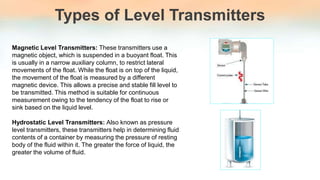
Magnetic Level Transmitters: These transmitters use a
magnetic object, which is suspended in a buoyant float. This
is usually in a narrow auxiliary column, to restrict lateral
movements of the float. While the float is on top of the liquid,
the movement of the float is measured by a different
magnetic device. This allows a precise and stable fill level to
be transmitted. This method is suitable for continuous
measurement owing to the tendency of the float to rise or
sink based on the liquid level.
Hydrostatic Level Transmitters: Also known as pressure
level transmitters, these transmitters help in determining fluid
contents of a container by measuring the pressure of resting
body of the fluid within it. The greater the force of liquid, the
greater the volume of fluid.
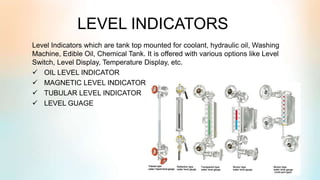
LEVEL INDICATORS
Level Indicators which are tank top mounted for coolant, hydraulic oil, Washing
Machine, Edible Oil, Chemical Tank. It is offered with various options like Level
Switch, Level Display, Temperature Display, etc.
 OIL LEVEL INDICATOR
 MAGNETIC LEVEL INDICATOR
 TUBULAR LEVEL INDICATOR
 LEVEL GUAGE
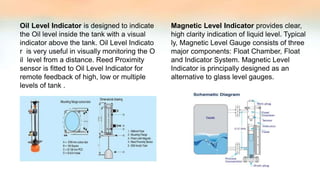
Oil Level Indicator is designed to indicate
the Oil level inside the tank with a visual
indicator above the tank. Oil Level Indicato
r is very useful in visually monitoring the O
il level from a distance. Reed Proximity
sensor is fitted to Oil Level Indicator for
remote feedback of high, low or multiple
levels of tank .
Magnetic Level Indicator provides clear,
high clarity indication of liquid level. Typical
ly, Magnetic Level Gauge consists of three
major components: Float Chamber, Float
and Indicator System. Magnetic Level
Indicator is principally designed as an
alternative to glass level gauges.
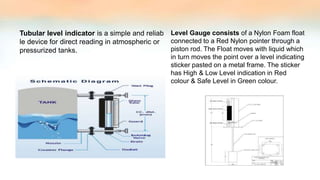
Tubular level indicator is a simple and reliab
le device for direct reading in atmospheric or
pressurized tanks.
Level Gauge consists of a Nylon Foam float
connected to a Red Nylon pointer through a
piston rod. The Float moves with liquid which
in turn moves the point over a level indicating
sticker pasted on a metal frame. The sticker
has High & Low Level indication in Red
colour & Safe Level in Green colour.
LEVEL SWITCHES
 Level sensors detect the level of liquids and other fluids and fluidized solids, including
slurries, granular materials, and powders that exhibit an upper free surface.
 Substances that flow become essentially horizontal in their containers (or other
physical boundaries) because of gravity whereas most bulk solids pile at an angle of
repose to a peak.
 The substance to be measured can be inside a container or can be in its natural form
 Level Switches are sensors with an electrical contact output at a specific liquid,
powder or bulk level.
 Capacitive, conductive, diaphragm, displacer, float, inductive, optical,paddle,vibrating
rod, tilt, and tuning fork models are the different types of level switches available.
 The level measurement can be either continuous or point values. Continuous level
sensors measure level within a specified range and determine the exact amount of
substance in a certain place, while point-level sensors only indicate whether the
substance is above or below the sensing point.
Capacitive level switches are sensors with an electrical contact
output at a specific liquid, powder, or bulk level. Their traditional u
se is for non-metallic materials such as: plastics industry, chemic
al industry, wood industry, ceramic and glass industry, and packin
g industry. A few models are no maintenance.
Conductivity level switches are sensors with an electrical conta
ct output at a specific liquid level. Applications include ponds, res
ervoirs, sumps, pharmaceuticals, closed vessels and open tanks.
Diaphragm level switches are sensors with an electrical contact
output. The dry Level Switch is sensitive and very economical. Ap
plications include mining, silos, hoppers, and food & beverage. A
wide variety of diaphragms is available to match product bulk den
sity, flow ability, abrasiveness and temperature requirements.
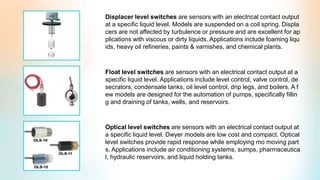
Displacer level switches are sensors with an electrical contact output
at a specific liquid level. Models are suspended on a coil spring. Displa
cers are not affected by turbulence or pressure and are excellent for ap
plications with viscous or dirty liquids. Applications include foaming liqu
ids, heavy oil refineries, paints & varnishes, and chemical plants.
Float level switches are sensors with an electrical contact output at a
specific liquid level. Applications include level control, valve control, de
secrators, condensate tanks, oil level control, drip legs, and boilers. A f
ew models are designed for the automation of pumps, specifically fillin
g and draining of tanks, wells, and reservoirs.
Optical level switches are sensors with an electrical contact output at
a specific liquid level. Dwyer models are low cost and compact. Optical
level switches provide rapid response while employing mo moving part
s. Applications include air conditioning systems, sumps, pharmaceutica
l, hydraulic reservoirs, and liquid holding tanks.
Rotating paddle level switches are sensors with an electrical contact
output at a specific powder or bulk level. Applications include mining,
silos, hoppers, food & beverage, and grain silos. The models within
this category have either top or side mounting.
Tuning Fork level switches are sensors with an electrical contact out
put at a specific level. Cost effective models are an ideal choice for lev
el control of powders and fine grained solids. Models are easy to use
and applications include mining, chemical processing, and food & bev
erage.
Rod level switches are sensors with an electrical contact output at a
specific powder or bulk level. The Vibrating Rod Level Switch is econo
mical in level detection of powders and bulk solids. Perfect for silo or
hopper applications. The probe design allows for self-cleaning, ensuri
ng no build-up or bridging of material and accurate detection.
Thank You

Level measurement

  • 1.
  • 2.
    LEVEL SENSOR ACCESSORIESIN PROCESS/INSTRUMENTATION LEVEL TRANSMITTER1 LEVEL INDICATORS2 LEVEL SWITCHES3 There are several types of accessories in level sensor. they are
  • 3.
    LEVEL TRANSMITTER  Alevel transmitter is an instrument providing continuous level measurement.  It can be used to determine the level of liquid or bulk-solid at a particular time.  Levels of media such as water, viscous fluids, and fuels, or dry media such as bulk solids and powders can be measured using the transmitter.  It can be used in a myriad of applications that require level measurement within containers or tanks.  These transmitters often find their application in material handling, food and beverage, power, chemical, and water treatment industries.  Each type of transmitter works in a different way, and makes it useful for different types of processes.
  • 4.
    Types of LevelTransmitters Capacitance Level Transmitters: These transmitters use liquid stored in a tank or container as a dielectric medium between two or more electrodes. The energy capacity of the capacitor circuit increases when there is more liquid, and decreases if there is less liquid. By measuring the variations in the capacitance value, capacitance level transmitters can calculate the current fill level of the tank or container. Ultrasonic Level Transmitter: In this type of transmitter, an ultrasonic transducer is mounted at, or near the top of a container containing liquid. The transducer sends out an ultrasonic pulse. The pulse hits the surface of the liquid, and gets reflected. The sensor then calculates the fill level based on the time between the transmitted and received signal.
  • 5.
    Types of LevelTransmitters Radar Fill Level Transmitters: These transmitters work on the principle of a radar by using radio wave emissions. These transmitters are normally mounted at the top of a tank filled with a liquid. The transmitter sends a radar signal into the liquid, and receives a reflection of the signal. The transmitters then analyze the current fill level of the tank based on the time taken by the transmitted signal to return. Guided Microwave Level Transmitters: These transmitters work by sending a microwave pulse through a sensor cable or rod. The signal hits the surface of the liquid, and travels back to the sensor, and then to the transmitter housing. The electronics integrated in the transmitter housing determine the filling level based on the time taken by the signal to travel down the sensor and back up again. These types of level transmitters are used in industrial applications in all areas of process technology.
  • 6.
    Types of LevelTransmitters Magnetic Level Transmitters: These transmitters use a magnetic object, which is suspended in a buoyant float. This is usually in a narrow auxiliary column, to restrict lateral movements of the float. While the float is on top of the liquid, the movement of the float is measured by a different magnetic device. This allows a precise and stable fill level to be transmitted. This method is suitable for continuous measurement owing to the tendency of the float to rise or sink based on the liquid level. Hydrostatic Level Transmitters: Also known as pressure level transmitters, these transmitters help in determining fluid contents of a container by measuring the pressure of resting body of the fluid within it. The greater the force of liquid, the greater the volume of fluid.
  • 7.
    LEVEL INDICATORS Level Indicatorswhich are tank top mounted for coolant, hydraulic oil, Washing Machine, Edible Oil, Chemical Tank. It is offered with various options like Level Switch, Level Display, Temperature Display, etc.  OIL LEVEL INDICATOR  MAGNETIC LEVEL INDICATOR  TUBULAR LEVEL INDICATOR  LEVEL GUAGE
  • 8.
    Oil Level Indicatoris designed to indicate the Oil level inside the tank with a visual indicator above the tank. Oil Level Indicato r is very useful in visually monitoring the O il level from a distance. Reed Proximity sensor is fitted to Oil Level Indicator for remote feedback of high, low or multiple levels of tank . Magnetic Level Indicator provides clear, high clarity indication of liquid level. Typical ly, Magnetic Level Gauge consists of three major components: Float Chamber, Float and Indicator System. Magnetic Level Indicator is principally designed as an alternative to glass level gauges.
  • 9.
    Tubular level indicatoris a simple and reliab le device for direct reading in atmospheric or pressurized tanks. Level Gauge consists of a Nylon Foam float connected to a Red Nylon pointer through a piston rod. The Float moves with liquid which in turn moves the point over a level indicating sticker pasted on a metal frame. The sticker has High & Low Level indication in Red colour & Safe Level in Green colour.
  • 10.
    LEVEL SWITCHES  Levelsensors detect the level of liquids and other fluids and fluidized solids, including slurries, granular materials, and powders that exhibit an upper free surface.  Substances that flow become essentially horizontal in their containers (or other physical boundaries) because of gravity whereas most bulk solids pile at an angle of repose to a peak.  The substance to be measured can be inside a container or can be in its natural form  Level Switches are sensors with an electrical contact output at a specific liquid, powder or bulk level.  Capacitive, conductive, diaphragm, displacer, float, inductive, optical,paddle,vibrating rod, tilt, and tuning fork models are the different types of level switches available.  The level measurement can be either continuous or point values. Continuous level sensors measure level within a specified range and determine the exact amount of substance in a certain place, while point-level sensors only indicate whether the substance is above or below the sensing point.
  • 11.
    Capacitive level switchesare sensors with an electrical contact output at a specific liquid, powder, or bulk level. Their traditional u se is for non-metallic materials such as: plastics industry, chemic al industry, wood industry, ceramic and glass industry, and packin g industry. A few models are no maintenance. Conductivity level switches are sensors with an electrical conta ct output at a specific liquid level. Applications include ponds, res ervoirs, sumps, pharmaceuticals, closed vessels and open tanks. Diaphragm level switches are sensors with an electrical contact output. The dry Level Switch is sensitive and very economical. Ap plications include mining, silos, hoppers, and food & beverage. A wide variety of diaphragms is available to match product bulk den sity, flow ability, abrasiveness and temperature requirements.
  • 12.
    Displacer level switchesare sensors with an electrical contact output at a specific liquid level. Models are suspended on a coil spring. Displa cers are not affected by turbulence or pressure and are excellent for ap plications with viscous or dirty liquids. Applications include foaming liqu ids, heavy oil refineries, paints & varnishes, and chemical plants. Float level switches are sensors with an electrical contact output at a specific liquid level. Applications include level control, valve control, de secrators, condensate tanks, oil level control, drip legs, and boilers. A f ew models are designed for the automation of pumps, specifically fillin g and draining of tanks, wells, and reservoirs. Optical level switches are sensors with an electrical contact output at a specific liquid level. Dwyer models are low cost and compact. Optical level switches provide rapid response while employing mo moving part s. Applications include air conditioning systems, sumps, pharmaceutica l, hydraulic reservoirs, and liquid holding tanks.
  • 13.
    Rotating paddle levelswitches are sensors with an electrical contact output at a specific powder or bulk level. Applications include mining, silos, hoppers, food & beverage, and grain silos. The models within this category have either top or side mounting. Tuning Fork level switches are sensors with an electrical contact out put at a specific level. Cost effective models are an ideal choice for lev el control of powders and fine grained solids. Models are easy to use and applications include mining, chemical processing, and food & bev erage. Rod level switches are sensors with an electrical contact output at a specific powder or bulk level. The Vibrating Rod Level Switch is econo mical in level detection of powders and bulk solids. Perfect for silo or hopper applications. The probe design allows for self-cleaning, ensuri ng no build-up or bridging of material and accurate detection.
  • 14.