COMMUNICATION
Communication
It is the process of meaning-making through a
channel or a medium.
It comes from the Latin communicares, meaning to
share or to make ideas common.
Components of the Communication Process
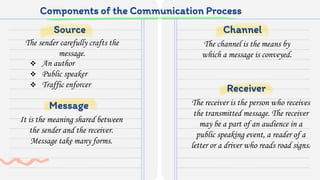
The sender carefully crafts the
message.
The channel is the means by
which a message is conveyed.
It is the meaning shared between
the sender and the receiver.
Message take many forms.
The receiver is the person who receives
the transmitted message. The receiver
may be a part of an audience in a
public speaking event, a reader of a
letter or a driver who reads road signs.
Message
Receiver
Source Channel
❖ An author
❖ Public speaker
❖ Traffic enforcer
Components of the Communication Process
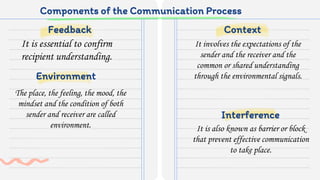
It is essential to confirm
recipient understanding.
It involves the expectations of the
sender and the receiver and the
common or shared understanding
through the environmental signals.
The place, the feeling, the mood, the
mindset and the condition of both
sender and receiver are called
environment. It is also known as barrier or block
that prevent effective communication
to take place.
Environment
Interference
Feedback Context
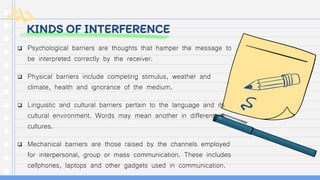
KINDS OF INTERFERENCE
❑ Psychological barriers are thoughts that hamper the message to
be interpreted correctly by the receiver.
❑ Physical barriers include competing stimulus, weather and
climate, health and ignorance of the medium.
❑ Linguistic and cultural barriers pertain to the language and its
cultural environment. Words may mean another in different
cultures.
❑ Mechanical barriers are those raised by the channels employed
for interpersonal, group or mass communication. These includes
cellphones, laptops and other gadgets used in communication.
The Nine
Principles of
Effective
Communication
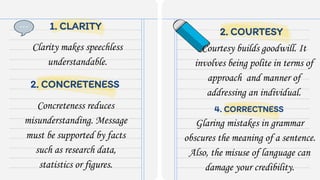
Clarity makes speechless
understandable.
1. CLARITY
4. CORRECTNESS
2. CONCRETENESS
Concreteness reduces
misunderstanding. Message
must be supported by facts
such as research data,
statistics or figures.
2. COURTESY
Courtesy builds goodwill. It
involves being polite in terms of
approach and manner of
addressing an individual.
Glaring mistakes in grammar
obscures the meaning of a sentence.
Also, the misuse of language can
damage your credibility.
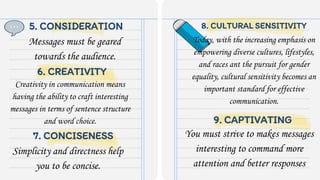
Messages must be geared
towards the audience.
5. CONSIDERATION 8. CULTURAL SENSITIVITY
6. CREATIVITY
Creativity in communication means
having the ability to craft interesting
messages in terms of sentence structure
and word choice.
7. CONCISENESS
Simplicity and directness help
you to be concise.
Today, with the increasing emphasis on
empowering diverse cultures, lifestyles,
and races ant the pursuit for gender
equality, cultural sensitivity becomes an
important standard for effective
communication.
9. CAPTIVATING
You must strive to makes messages
interesting to command more
attention and better responses
ETHICAL
CONSIDERATIONS IN
COMMUNICATION
Ethics is a branch of
philosophy that focuses
on issues of right and
wrong in human affairs.
ETHICAL COMMUNICATORS:
1. Respect audience.
2. Consider the result of
communication.
3. Value truth.
4. Use information correctly.
5. Do not falsify information.
Activity: 2
“Why do
miscommunications and
misunderstandings
happen?

Communication

  • 1.
  • 2.
    Communication It is theprocess of meaning-making through a channel or a medium. It comes from the Latin communicares, meaning to share or to make ideas common.
  • 3.
    Components of theCommunication Process The sender carefully crafts the message. The channel is the means by which a message is conveyed. It is the meaning shared between the sender and the receiver. Message take many forms. The receiver is the person who receives the transmitted message. The receiver may be a part of an audience in a public speaking event, a reader of a letter or a driver who reads road signs. Message Receiver Source Channel ❖ An author ❖ Public speaker ❖ Traffic enforcer
  • 4.
    Components of theCommunication Process It is essential to confirm recipient understanding. It involves the expectations of the sender and the receiver and the common or shared understanding through the environmental signals. The place, the feeling, the mood, the mindset and the condition of both sender and receiver are called environment. It is also known as barrier or block that prevent effective communication to take place. Environment Interference Feedback Context
  • 5.
    KINDS OF INTERFERENCE ❑Psychological barriers are thoughts that hamper the message to be interpreted correctly by the receiver. ❑ Physical barriers include competing stimulus, weather and climate, health and ignorance of the medium. ❑ Linguistic and cultural barriers pertain to the language and its cultural environment. Words may mean another in different cultures. ❑ Mechanical barriers are those raised by the channels employed for interpersonal, group or mass communication. These includes cellphones, laptops and other gadgets used in communication.
  • 6.
  • 7.
    Clarity makes speechless understandable. 1.CLARITY 4. CORRECTNESS 2. CONCRETENESS Concreteness reduces misunderstanding. Message must be supported by facts such as research data, statistics or figures. 2. COURTESY Courtesy builds goodwill. It involves being polite in terms of approach and manner of addressing an individual. Glaring mistakes in grammar obscures the meaning of a sentence. Also, the misuse of language can damage your credibility.
  • 8.
    Messages must begeared towards the audience. 5. CONSIDERATION 8. CULTURAL SENSITIVITY 6. CREATIVITY Creativity in communication means having the ability to craft interesting messages in terms of sentence structure and word choice. 7. CONCISENESS Simplicity and directness help you to be concise. Today, with the increasing emphasis on empowering diverse cultures, lifestyles, and races ant the pursuit for gender equality, cultural sensitivity becomes an important standard for effective communication. 9. CAPTIVATING You must strive to makes messages interesting to command more attention and better responses
  • 9.
  • 10.
    Ethics is abranch of philosophy that focuses on issues of right and wrong in human affairs.
  • 11.
    ETHICAL COMMUNICATORS: 1. Respectaudience. 2. Consider the result of communication. 3. Value truth. 4. Use information correctly. 5. Do not falsify information.
  • 12.
    Activity: 2 “Why do miscommunicationsand misunderstandings happen?