PRESENTATION
ON
ROLE & IMPORTANCE
OF
COMMUNICATION
Management is the art of getting things done through others. A
manager passes messages or orders to subordinates or employees
and inform them about the work to be executed and the
subordinates execute orders and inform the manager about than
the same. Such an exchange of message is known as
communication.
The ordinary sense of communication is that , one person passes
clear information to another person so that the latter understands
the objective of the communicator and acts on it.
INTRODUCTION
Meaning
Communication is a mean of linking people to achieve
a common purpose by transferring information from
one person to the other.
It includes not only transfer of information but also
transfer of understanding. The information has to be
understood in the same way it is intended by the
Sender of information.
Definition
ď‚— According to Koontz and Weihrich:
“Communication is the transfer of information
from a sender to a receiver, with the information
being understood by the receiver”
ď‚— According to Newman and Summer:
“Communication is an exchange of facts, ideas,
opinions or emotions by two or more persons.”
ď‚— According to Stoner and Wankel:
“Communication is the transfer of information,
ideas, understanding or feelings between people.”
 But in simple words if we say…
“Communication means exchanging information
among individuals working in any organization.”
Features
ď‚— Goals-oriented Activity- Its aim is to convey or receive
information only. Rather its purpose is to realize the basic
objective of the business unit. Communication is indispensable
for realization of objectives.
ď‚— Two-way process- communication is a two way process. It
includes both the acts of giving and receiving information. The
manager after issuing orders, try to know the reaction of the
subordinates and also whether they have fully understood the
orders or not.
ď‚— Internal process- Communication is internal to the
organization in the sense that it is confined to only members
to the organization who use it.
ď‚— Perpetual process- communication is a perpetual process. The
exchange of views and opinions goes on continuously among
the employees of a business enterprise. Communication begins
as a business is launched and it ends only when the business is
wound up.
Importance
The implementation of policies and programmers of
management is possible only through effective
communication. We can understand the importance of
communication from the following point:
ď‚— Smoothing running of the enterprise-
ď‚— Maximum productivity:
ď‚— Assist other function:
ď‚— Job satisfaction:
ď‚— Basis of leadership:
ď‚— Establishment of Human Relations:
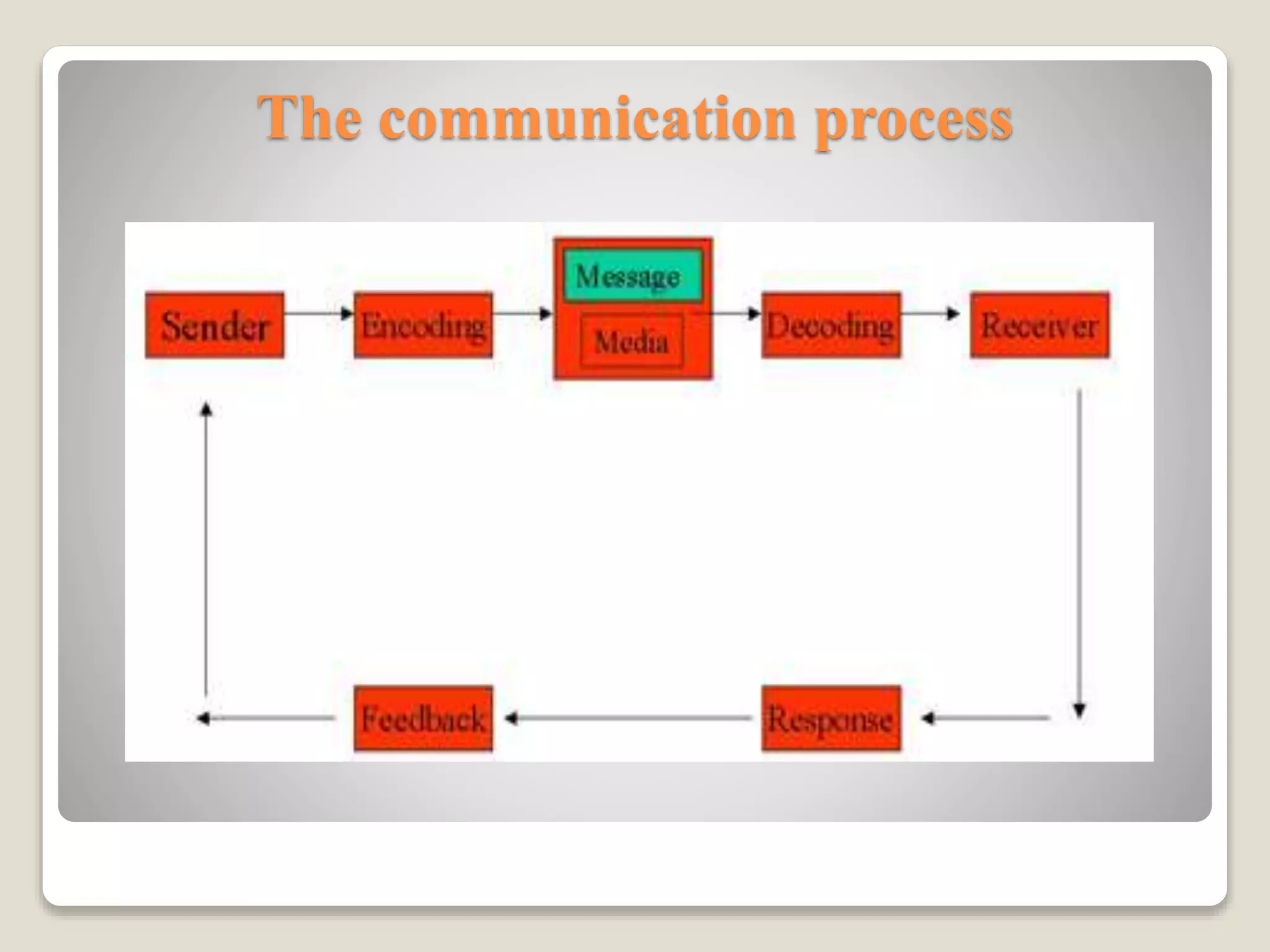
The communication process
Communication skills for
managers as senders
ď‚— Send clear and complete messages.
ď‚— Encode messages.
ď‚— Select a medium appropriate for the
message and monitor by the receiver.
ď‚— Avoid filtering and distortion.
ď‚— Ensure a feedback
ď‚— Provide accurate information
Communication skills for
managers as Receivers
ď‚— Pay attention
ď‚— Be a good listener
ď‚— Be empathetic
ď‚— Understand linguistic style
Advantages
ď‚— Speedy flow:
ď‚— Clear words and Language:
ď‚— Flexibility
ď‚— Proper co-ordination
ď‚— A leadership quality:
Disadvantages
ď‚— Lack of Planning:
ď‚— Faulty Translation
ď‚— Badly Expressed Messages
ď‚— Unqualified Assumption:
ď‚— Poor Listening and Premature evaluation :
Conclusion
Communication is very important in every place of
business. Communication is exchanging
information among individuals working in any
organization. Communication is the process of
passing information and understanding from one
person to another. At every place of business
and firm where is large production and various
departments, communication is of very much
help in getting maximum production, increasing
business and building good relationship between
all in the company. Thus, communication plays
vital role in all areas of management and
business.
communication  and its importance

communication and its importance

  • 1.
  • 2.
    Management is theart of getting things done through others. A manager passes messages or orders to subordinates or employees and inform them about the work to be executed and the subordinates execute orders and inform the manager about than the same. Such an exchange of message is known as communication. The ordinary sense of communication is that , one person passes clear information to another person so that the latter understands the objective of the communicator and acts on it. INTRODUCTION
  • 3.
    Meaning Communication is amean of linking people to achieve a common purpose by transferring information from one person to the other. It includes not only transfer of information but also transfer of understanding. The information has to be understood in the same way it is intended by the Sender of information.
  • 4.
    Definition  According toKoontz and Weihrich: “Communication is the transfer of information from a sender to a receiver, with the information being understood by the receiver”  According to Newman and Summer: “Communication is an exchange of facts, ideas, opinions or emotions by two or more persons.”  According to Stoner and Wankel: “Communication is the transfer of information, ideas, understanding or feelings between people.”  But in simple words if we say… “Communication means exchanging information among individuals working in any organization.”
  • 5.
    Features ď‚— Goals-oriented Activity-Its aim is to convey or receive information only. Rather its purpose is to realize the basic objective of the business unit. Communication is indispensable for realization of objectives. ď‚— Two-way process- communication is a two way process. It includes both the acts of giving and receiving information. The manager after issuing orders, try to know the reaction of the subordinates and also whether they have fully understood the orders or not. ď‚— Internal process- Communication is internal to the organization in the sense that it is confined to only members to the organization who use it. ď‚— Perpetual process- communication is a perpetual process. The exchange of views and opinions goes on continuously among the employees of a business enterprise. Communication begins as a business is launched and it ends only when the business is wound up.
  • 6.
    Importance The implementation ofpolicies and programmers of management is possible only through effective communication. We can understand the importance of communication from the following point: ď‚— Smoothing running of the enterprise- ď‚— Maximum productivity: ď‚— Assist other function: ď‚— Job satisfaction: ď‚— Basis of leadership: ď‚— Establishment of Human Relations:
  • 7.
  • 8.
    Communication skills for managersas senders ď‚— Send clear and complete messages. ď‚— Encode messages. ď‚— Select a medium appropriate for the message and monitor by the receiver. ď‚— Avoid filtering and distortion. ď‚— Ensure a feedback ď‚— Provide accurate information
  • 9.
    Communication skills for managersas Receivers ď‚— Pay attention ď‚— Be a good listener ď‚— Be empathetic ď‚— Understand linguistic style
  • 10.
    Advantages ď‚— Speedy flow: ď‚—Clear words and Language: ď‚— Flexibility ď‚— Proper co-ordination ď‚— A leadership quality:
  • 11.
    Disadvantages ď‚— Lack ofPlanning: ď‚— Faulty Translation ď‚— Badly Expressed Messages ď‚— Unqualified Assumption: ď‚— Poor Listening and Premature evaluation :
  • 12.
    Conclusion Communication is veryimportant in every place of business. Communication is exchanging information among individuals working in any organization. Communication is the process of passing information and understanding from one person to another. At every place of business and firm where is large production and various departments, communication is of very much help in getting maximum production, increasing business and building good relationship between all in the company. Thus, communication plays vital role in all areas of management and business.