COMMUNICATION
BY: Shipra Chaudhary
012BIM50
1
31/01/2016
Outline
Meaning & definition of
communication
Types of communication
Process of communication
Barriers to effective
communication
2
31/01/2016
Meaning
 The word communication has originated from a Latin word
commūnicāre, meaning “to share”.
 In general, communication refers to the process of sharing
information, ideas & attitudes between individual.
 It is the process of imparting or exchanging of information,
ideas, facts, opinions, beliefs, feelings & attitudes through
verbal or nonverbal means between two people or within a
group of people, usually with the intent to motivate or influence
behavior.
 The means of making the transfer of information from the
sender to the receiver so that it is understood in the right
context.
3
31/01/2016
Definition
 According to Webster’s Dictionary ,
 “Communication is a process by which information is exchanged
between individuals through a common system of symbols & signs of
behavior.”
 According to Herbert Simon ,
 “Without communication there can be no organization, for there is no
possibility then of the group influencing the behavior of the individual.”
 According to Fred Luthans,
 “Communication involves more than just linear information flows; it is a
dynamic, interpersonal process that involves behavioral exchanges.”
 According to Moorhead and Griffin,
 “Communication is the process in which two or more parties exchange
information and share meaning.”
4
31/01/2016
Types of communication
 Formal Communication
 Formal communication flows along prescribed channels which all
members desirous of communicating with one another are obliged to
follow.
 This type of communication follows a hierarchical chain of command
which is established by the organization itself.
 Examples of formal communication are: Meetings, requests,
commands, orders, reports etc.
 Classification into:
o Vertical Communication
 Upward Communication
 Downward Communication
o Horizontal Communication
o Diagonal Communication 5
31/01/2016
Downward Communication
 It is used to:
 Assign goals to subordinates
 Provide job instructions and
rationale
 Inform about policies,
procedures and practices
 Provide performance
feedback
 Point out problems related
to job
 Indoctrination
• Messages flow downward
through the chain of
command—i.e., from
manager to employee.
Downward
Most familiar and obvious flow
of formal communication.
6
31/01/2016
Upward Communication
It is used to:
 Provide feedback to
superiors
 Provide suggestions for
improvement
 Relay current problem
 Inform progress towards
goal
 Provide performance
reports, financial and
accounting information
• Messages flow upward
through the chain of
command—i.e., from
employee to boss.
Upward
Widely used and an important
source of information for
business decisions.
7
31/01/2016
Horizontal Communication
 Lateral exchange of
messages among peers or
coworkers
 Horizontal communications
categories:
 Intradepartmental problem
solving
 Interdepartmental
coordination
 Change initiatives and
improvement
 Particularly important in
learning organizations
Horizontal
• Messages flow laterally
between people of the same
rank—i.e., from production
to marketing departments.
Inform and request support as
well as coordinate activities.
8
31/01/2016
Diagonal Communication
 The exchange of
information among
employees in different work
units who are neither
subordinate nor superior to
one another.
 The concept of diagonal
communication was
introduced to capture the
new communication
challenges associated with
new organizational forms,
such as matrix and project-
based organizations.
• Messages flow crosswise
between people of the
different rank.
Diagonal
Most flexible which allows
faster communication of
information in both directions.
9
31/01/2016
Informal Communication
 Informal communication is the flow of information without
regard for the formal organizational structure, hierarchical or
reporting relationship.
 This is commonly known as “The Grapevine”.
 It does not follow line of authority.
 It is very fast & usually takes place in social groups like friends,
family, peer groups, etc.
 This type of communication is very natural as people interact
with each other about their professional life, personal life and
other matter.
 Examples of informal communication are: sharing of feelings,
casual discussion, gossip, chitchat, etc.
10
31/01/2016
Verbal Communication
 Verbal communication refers to the form of communication in
which message is transmitted verbally or orally.
 Communication is done by word of mouth and a piece of
writing.
 This type of communication is easy to use and quicker in
transmitting the message.
 Examples of verbal communication are: face to face
conversation, group discussion, meetings, speeches, job related
exchanges, and telephone calls, etc.
 Verbal Communication is divided into:
 Oral Communication
 Written Communication
11
31/01/2016
Non-verbal Communication
 Nonverbal communication is the sending or receiving of
wordless messages.
 Nonverbal communication is all about the body language, facial
expression, gestures, postures, intonation of speaker.
 This type of communication is a more accurate way of
communication because it convey the true & intended meaning
of the message.
 Examples of nonverbal communication are: shaking hands,
patting the back, hugging, pushing, or other kinds of touch.
12
31/01/2016
Process of communication
Sender Encoding
Message
Channel Decoding Receiver
M
E
A
N
I
N
G
M
E
S
S
A
G
E
Noise
Feedback
13
31/01/2016
Process of communication
 Message: Messages is what is to be communicating before
communication can take place, a purpose, expressed, as a
message to be conveyed, must exist. It passes between a
source (the sender) and a receiver.
 Sender: It is source of communication. The sender conveys
the message to the receiver. And are to be an individual, group
or organization.
 Encoding: The message is converted to symbolic from is
called Encoding. The symbols can be word, sound, number,
picture and gesture etc.
 Message Channel: It is the medium of message transmission
from sender to receiver. Channels are audio-visual, print
media, mechanical, face to face contact etc.
31/01/2016
14
Process of communication
 Decoding: The receiver retranslates the sender's message. But
before the message on be received, the symbols in it must be
translated in to a form that can be understood by the receiver.
This step is the decoding of the message.
 Receiver: The Receiver is the target point or location of
communication. It is the object to whom the message is
directed.
 Noise: Any disturbances that interfere and disturb the message
distortion come from external factors and it reduces
effectiveness of communication.
 Feedback: It is the check on how successful we have been in
transferring the message as originally intended. It determines
whether understanding has been achieved.
31/01/2016
15
Barriers to effective
communication
 No matter how good the communication system in an organization
is, unfortunately barriers can and do often occur.
 Communication of barriers are the difficulties involved in the
process of communication which distort the message being properly
understand by the receiver.
 “Barriers prevent the communication from being effective” and
result in undesirable reaction and unfavorable response.
 The barriers to effective communication can be classified in to four
groups. They are as follows:
 Physical Barriers
 Psychological Barriers
 Organizational Barriers
 Semantic Barriers
16
31/01/2016
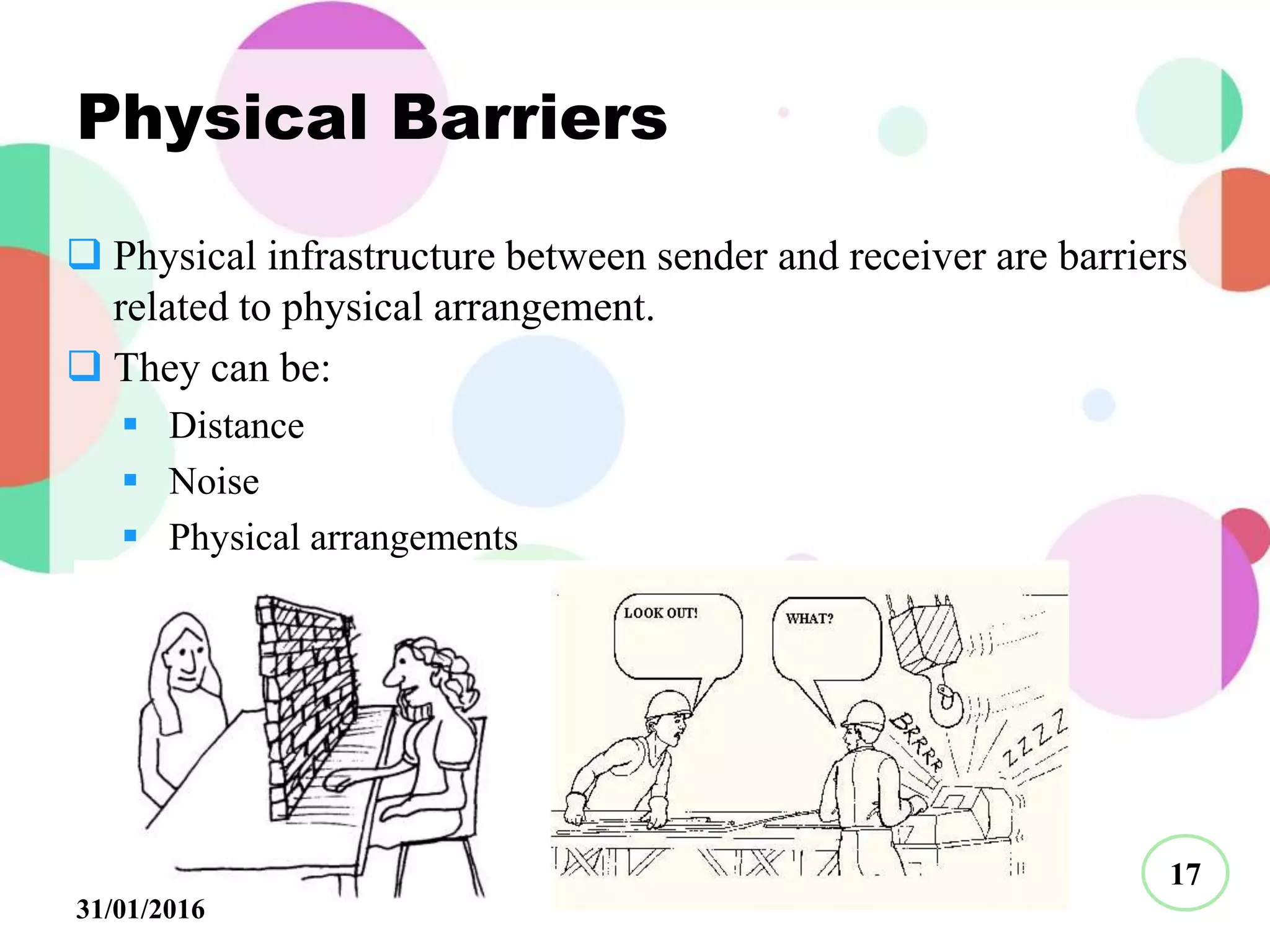
Physical Barriers
 Physical infrastructure between sender and receiver are barriers
related to physical arrangement.
 They can be:
 Distance
 Noise
 Physical arrangements
17
31/01/2016
Psychological Barriers
 The influence of psychological state of the communicators
(sender and receiver) which creates an obstacle for effective
communication.
 They can be:
 Selective Perception
 Filtering
 Distrust
 Viewpoint
 Defensiveness
18
31/01/2016
Organizational Barriers
 The barriers that generate form within the organization are
known as organizational barriers
 They can be:
 Information overload
 Poor planning
 Complex structure
 Status difference
 Timing
 Lack of feedback
19
31/01/2016
Semantic Barriers
 A common barrier to effective communication is semantic
distortion, which can be deliberate or accidental.
 Semantic problem arises when words and symbols have
different meanings for different people that lead to a
misunderstanding.
 They can be:
 Language
 Jargon
20
31/01/2016
THANK YOU !!!
21
31/01/2016

Communication

  • 1.
  • 2.
    Outline Meaning & definitionof communication Types of communication Process of communication Barriers to effective communication 2 31/01/2016
  • 3.
    Meaning  The wordcommunication has originated from a Latin word commūnicāre, meaning “to share”.  In general, communication refers to the process of sharing information, ideas & attitudes between individual.  It is the process of imparting or exchanging of information, ideas, facts, opinions, beliefs, feelings & attitudes through verbal or nonverbal means between two people or within a group of people, usually with the intent to motivate or influence behavior.  The means of making the transfer of information from the sender to the receiver so that it is understood in the right context. 3 31/01/2016
  • 4.
    Definition  According toWebster’s Dictionary ,  “Communication is a process by which information is exchanged between individuals through a common system of symbols & signs of behavior.”  According to Herbert Simon ,  “Without communication there can be no organization, for there is no possibility then of the group influencing the behavior of the individual.”  According to Fred Luthans,  “Communication involves more than just linear information flows; it is a dynamic, interpersonal process that involves behavioral exchanges.”  According to Moorhead and Griffin,  “Communication is the process in which two or more parties exchange information and share meaning.” 4 31/01/2016
  • 5.
    Types of communication Formal Communication  Formal communication flows along prescribed channels which all members desirous of communicating with one another are obliged to follow.  This type of communication follows a hierarchical chain of command which is established by the organization itself.  Examples of formal communication are: Meetings, requests, commands, orders, reports etc.  Classification into: o Vertical Communication  Upward Communication  Downward Communication o Horizontal Communication o Diagonal Communication 5 31/01/2016
  • 6.
    Downward Communication  Itis used to:  Assign goals to subordinates  Provide job instructions and rationale  Inform about policies, procedures and practices  Provide performance feedback  Point out problems related to job  Indoctrination • Messages flow downward through the chain of command—i.e., from manager to employee. Downward Most familiar and obvious flow of formal communication. 6 31/01/2016
  • 7.
    Upward Communication It isused to:  Provide feedback to superiors  Provide suggestions for improvement  Relay current problem  Inform progress towards goal  Provide performance reports, financial and accounting information • Messages flow upward through the chain of command—i.e., from employee to boss. Upward Widely used and an important source of information for business decisions. 7 31/01/2016
  • 8.
    Horizontal Communication  Lateralexchange of messages among peers or coworkers  Horizontal communications categories:  Intradepartmental problem solving  Interdepartmental coordination  Change initiatives and improvement  Particularly important in learning organizations Horizontal • Messages flow laterally between people of the same rank—i.e., from production to marketing departments. Inform and request support as well as coordinate activities. 8 31/01/2016
  • 9.
    Diagonal Communication  Theexchange of information among employees in different work units who are neither subordinate nor superior to one another.  The concept of diagonal communication was introduced to capture the new communication challenges associated with new organizational forms, such as matrix and project- based organizations. • Messages flow crosswise between people of the different rank. Diagonal Most flexible which allows faster communication of information in both directions. 9 31/01/2016
  • 10.
    Informal Communication  Informalcommunication is the flow of information without regard for the formal organizational structure, hierarchical or reporting relationship.  This is commonly known as “The Grapevine”.  It does not follow line of authority.  It is very fast & usually takes place in social groups like friends, family, peer groups, etc.  This type of communication is very natural as people interact with each other about their professional life, personal life and other matter.  Examples of informal communication are: sharing of feelings, casual discussion, gossip, chitchat, etc. 10 31/01/2016
  • 11.
    Verbal Communication  Verbalcommunication refers to the form of communication in which message is transmitted verbally or orally.  Communication is done by word of mouth and a piece of writing.  This type of communication is easy to use and quicker in transmitting the message.  Examples of verbal communication are: face to face conversation, group discussion, meetings, speeches, job related exchanges, and telephone calls, etc.  Verbal Communication is divided into:  Oral Communication  Written Communication 11 31/01/2016
  • 12.
    Non-verbal Communication  Nonverbalcommunication is the sending or receiving of wordless messages.  Nonverbal communication is all about the body language, facial expression, gestures, postures, intonation of speaker.  This type of communication is a more accurate way of communication because it convey the true & intended meaning of the message.  Examples of nonverbal communication are: shaking hands, patting the back, hugging, pushing, or other kinds of touch. 12 31/01/2016
  • 13.
    Process of communication SenderEncoding Message Channel Decoding Receiver M E A N I N G M E S S A G E Noise Feedback 13 31/01/2016
  • 14.
    Process of communication Message: Messages is what is to be communicating before communication can take place, a purpose, expressed, as a message to be conveyed, must exist. It passes between a source (the sender) and a receiver.  Sender: It is source of communication. The sender conveys the message to the receiver. And are to be an individual, group or organization.  Encoding: The message is converted to symbolic from is called Encoding. The symbols can be word, sound, number, picture and gesture etc.  Message Channel: It is the medium of message transmission from sender to receiver. Channels are audio-visual, print media, mechanical, face to face contact etc. 31/01/2016 14
  • 15.
    Process of communication Decoding: The receiver retranslates the sender's message. But before the message on be received, the symbols in it must be translated in to a form that can be understood by the receiver. This step is the decoding of the message.  Receiver: The Receiver is the target point or location of communication. It is the object to whom the message is directed.  Noise: Any disturbances that interfere and disturb the message distortion come from external factors and it reduces effectiveness of communication.  Feedback: It is the check on how successful we have been in transferring the message as originally intended. It determines whether understanding has been achieved. 31/01/2016 15
  • 16.
    Barriers to effective communication No matter how good the communication system in an organization is, unfortunately barriers can and do often occur.  Communication of barriers are the difficulties involved in the process of communication which distort the message being properly understand by the receiver.  “Barriers prevent the communication from being effective” and result in undesirable reaction and unfavorable response.  The barriers to effective communication can be classified in to four groups. They are as follows:  Physical Barriers  Psychological Barriers  Organizational Barriers  Semantic Barriers 16 31/01/2016
  • 17.
    Physical Barriers  Physicalinfrastructure between sender and receiver are barriers related to physical arrangement.  They can be:  Distance  Noise  Physical arrangements 17 31/01/2016
  • 18.
    Psychological Barriers  Theinfluence of psychological state of the communicators (sender and receiver) which creates an obstacle for effective communication.  They can be:  Selective Perception  Filtering  Distrust  Viewpoint  Defensiveness 18 31/01/2016
  • 19.
    Organizational Barriers  Thebarriers that generate form within the organization are known as organizational barriers  They can be:  Information overload  Poor planning  Complex structure  Status difference  Timing  Lack of feedback 19 31/01/2016
  • 20.
    Semantic Barriers  Acommon barrier to effective communication is semantic distortion, which can be deliberate or accidental.  Semantic problem arises when words and symbols have different meanings for different people that lead to a misunderstanding.  They can be:  Language  Jargon 20 31/01/2016
  • 21.