COMMUNICATION AND IT`SCOMMUNICATION AND IT`S
MODELMODEL
PREPARED BYPREPARED BY
SACHIN SAHUSACHIN SAHU
B.F.Sc. 3B.F.Sc. 3rdrd
yearyear
College of fisheries kawardha, ChhattisgarhCollege of fisheries kawardha, Chhattisgarh
What is CommunicationWhat is Communication??
It is a dynamic process of sending and receivingIt is a dynamic process of sending and receiving
messages to share meanings.messages to share meanings.
 exchange of idea, information, feelings andexchange of idea, information, feelings and
knowledge.knowledge.
 originated from Latin word “communis” that meansoriginated from Latin word “communis” that means
common.common.
DefinitionDefinition
According to Leagan's (1961)According to Leagan's (1961)
communication is a process by whichcommunication is a process by which
two or more peoples exchange theirtwo or more peoples exchange their
ideas ,facts, feelings or impressions inideas ,facts, feelings or impressions in
such a way that each gains a commonsuch a way that each gains a common
understanding of the meaning, intentunderstanding of the meaning, intent
and use of message.and use of message.
According to Rogers and ShoemakerAccording to Rogers and Shoemaker
(1971)(1971)
communication is a process in whichcommunication is a process in which
the message is transformed from athe message is transformed from a
source to receiver.source to receiver.
TYPES OFTYPES OF
COMMUNICATIONCOMMUNICATION
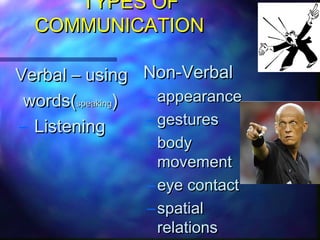
Verbal – usingVerbal – using
words(words(speakingspeaking))
– ListeningListening
Non-VerbalNon-Verbal
– appearanceappearance
– gesturesgestures
– bodybody
movementmovement
– eye contacteye contact
– spatialspatial
relationsrelations
PRINCIPLES OFPRINCIPLES OF
COMMUNICTIONCOMMUNICTION
There are 5 principles of communication –There are 5 principles of communication –
a)a) Communication is transactional because it involvesCommunication is transactional because it involves
an exchange.an exchange.
b)b) Communication is complex process.Communication is complex process.
c)c) it is unavoidable because it is impossible to notit is unavoidable because it is impossible to not
communicate.communicate.
d)d) It is a continuous process.It is a continuous process.

e)e) Communication skill can be learned because it canCommunication skill can be learned because it can
always be improved.always be improved.
Level of communicationLevel of communication
1.1. Extra personal communication-Extra personal communication-
communication between human beings andcommunication between human beings and
non-human entities.non-human entities.
example- your parrot responding yourexample- your parrot responding your
greeting.greeting.
In this type of communication understandingIn this type of communication understanding
is required between sender and receiver.is required between sender and receiver.
Receiver responds in sign language.Receiver responds in sign language.
2.2. Intrapersonal communicationIntrapersonal communication
Communication takes place within theCommunication takes place within the
individuals.individuals.
Shelf talk, inner speech, mentalShelf talk, inner speech, mental
conversation.conversation.
It is the basis on our feelings, andIt is the basis on our feelings, and
beliefsbeliefs
Example-when we make decision.Example-when we make decision.
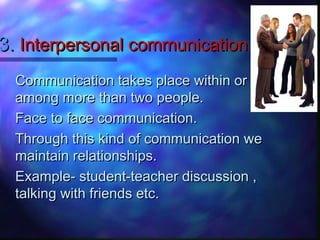
3.3. Interpersonal communicationInterpersonal communication
Communication takes place within orCommunication takes place within or
among more than two people.among more than two people.
Face to face communication.Face to face communication.
Through this kind of communication weThrough this kind of communication we
maintain relationships.maintain relationships.
Example- student-teacher discussion ,Example- student-teacher discussion ,
talking with friends etc.talking with friends etc.
4.4. Organizational communicationOrganizational communication
Communication takes place in anCommunication takes place in an
organization at different hierarchicalorganization at different hierarchical
level.level.
Example- familyExample- family
5.5. Mass communicationMass communication
Communication through mass media. ItCommunication through mass media. It
covers no. of people at a time.covers no. of people at a time.
A mediator is required to transmit theA mediator is required to transmit the
information.information.
Example- TV, radio, newspaper,Example- TV, radio, newspaper,
journals etc.journals etc.
AIMS of good communicationAIMS of good communication
AA= attracts the receiver and holds their= attracts the receiver and holds their
attention.attention.
II= informs the people in simple= informs the people in simple
language.language.
MM= motivate the people to do= motivate the people to do
something.something.
SS= satisfy the needs of receiver.= satisfy the needs of receiver.
Elements of communicationElements of communication
Sender - SpeakerSender - Speaker
Receiver - ListenerReceiver - Listener
MessagesMessages
FeedbackFeedback
EncodingEncoding
DecodingDecoding
InterferenceInterference
Channels ofChannels of CommunicationCommunication
Channels are the senses we use inChannels are the senses we use in
communication. Eg.communication. Eg. Hear ,See ,Touch.Hear ,See ,Touch.
channels are the communicationchannels are the communication
mediummedium..
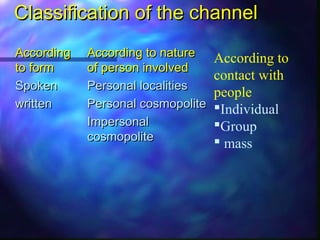
Classification of the channelClassification of the channel
AccordingAccording
to formto form
SpokenSpoken
writtenwritten
According to natureAccording to nature
of person involvedof person involved
Personal localitiesPersonal localities
Personal cosmopolitePersonal cosmopolite
ImpersonalImpersonal
cosmopolitecosmopolite
According to
contact with
people
Individual
Group
 mass
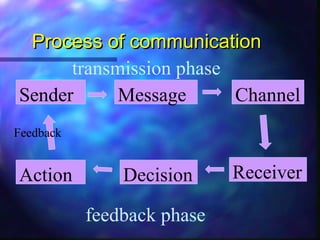
Process of communicationProcess of communication
Sender
ReceiverDecisionAction
ChannelMessage
feedback phase
Feedback
transmission phase
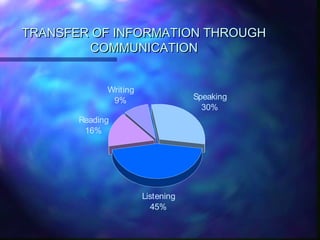
TRANSFER OF INFORMATION THROUGHTRANSFER OF INFORMATION THROUGH
COMMUNICATIONCOMMUNICATION
Reading
16%
Writing
9% Speaking
30%
Listening
45%
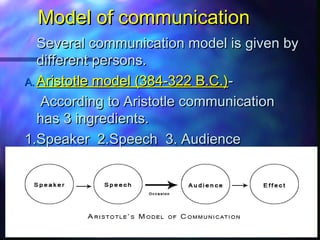
Model of communicationModel of communication
Several communication model is given bySeveral communication model is given by
different persons.different persons.
A.A. Aristotle model (384-322 B.C.)Aristotle model (384-322 B.C.)--
According to Aristotle communicationAccording to Aristotle communication
has 3 ingredients.has 3 ingredients.
1.Speaker 2.Speech 3. Audience1.Speaker 2.Speech 3. Audience
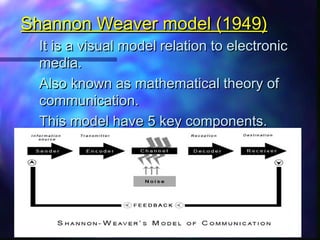
Shannon Weaver model (1949)Shannon Weaver model (1949)
It is a visual model relation to electronicIt is a visual model relation to electronic
media.media.
Also known as mathematical theory ofAlso known as mathematical theory of
communication.communication.
This model have 5 key components.This model have 5 key components.
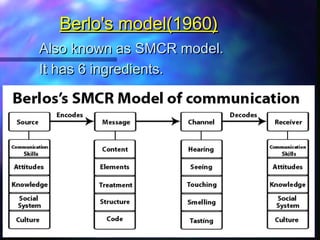
Berlo's model(1960)Berlo's model(1960)
Also known as SMCR model.Also known as SMCR model.
It has 6 ingredients.It has 6 ingredients.
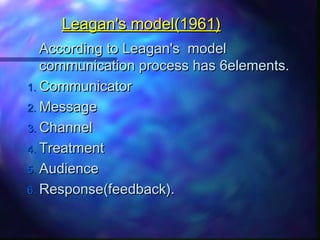
Leagan's model(1961)Leagan's model(1961)
According to Leagan's modelAccording to Leagan's model
communication process has 6elements.communication process has 6elements.
1.1. CommunicatorCommunicator
2.2. MessageMessage
3.3. ChannelChannel
4.4. TreatmentTreatment
5.5. AudienceAudience
6.6. Response(feedback).Response(feedback).
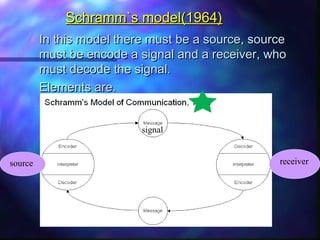
Schramm`s model(1964)Schramm`s model(1964)
In this model there must be a source, sourceIn this model there must be a source, source
must be encode a signal and a receiver, whomust be encode a signal and a receiver, who
must decode the signal.must decode the signal.
Elements are.Elements are.
receiversource
signal
This model is particularly relevant to theThis model is particularly relevant to the
mass media.mass media.
In human communication it is the mostIn human communication it is the most
important whether people can properimportant whether people can proper
encode or decode the signals, and howencode or decode the signals, and how
they interpret it into their own situation.they interpret it into their own situation.
Feedback in communicationFeedback in communication
Communication is never completeCommunication is never complete
without feedback.without feedback.
Feedback should be a continuousFeedback should be a continuous
process. it is essential for purposefulprocess. it is essential for purposeful
communication.communication.
Characteristics of feedbackCharacteristics of feedback
1.1. Source orientedSource oriented
2.2. It varies in different communicationIt varies in different communication
situationsituation
3.3. It affects the source or communicator.It affects the source or communicator.
4.4. It exerts control over future message.It exerts control over future message.
We also get feedback from our ownWe also get feedback from our own
message and most of time ourselvesmessage and most of time ourselves
correct the mispronunciationscorrect the mispronunciations
Barriers in CommunicationBarriers in Communication
((that have to do with thethat have to do with the COMMUNICATORCOMMUNICATOR ))
Unwillingness to say things differentlyUnwillingness to say things differently
Unwillingness to relate to othersUnwillingness to relate to others
differentlydifferently
Unwillingness to learn newUnwillingness to learn new
approachesapproaches
Lack of Self-ConfidenceLack of Self-Confidence
Lack of EnthusiasmLack of Enthusiasm
Voice qualityVoice quality
Prejudice Negative Self ImagePrejudice Negative Self Image
Lack of FeedbackLack of Feedback
Lack of Motivation and TrainingLack of Motivation and Training
Language and Vocabulary LevelLanguage and Vocabulary Level
Lack of Self AwarenessLack of Self Awareness
Barriers in CommunicationBarriers in Communication
(that have to do with the(that have to do with the RECEIVERRECEIVER))
Selective PerceptionSelective Perception
Unwillingness to ChangeUnwillingness to Change
Lack of Interest in the Topic/SubjectLack of Interest in the Topic/Subject
Prejudice & Belief SystemPrejudice & Belief System
Rebuttal InstinctsRebuttal Instincts
Personal Value SystemPersonal Value System
Here-and-Now internal & externalHere-and-Now internal & external
factorsfactors
Barriers in CommunicationBarriers in Communication
(that have to do with the(that have to do with the MESSAGEMESSAGE))
Wrong Handling Of ChannelWrong Handling Of Channel
Wrong selection of channel.Wrong selection of channel.
External Barriers in CommunicationExternal Barriers in Communication
1.1. EnvironmentEnvironment
– The venueThe venue
– The effect of noiseThe effect of noise
– Temperature in the roomTemperature in the room
2. Other People – Status, Education2. Other People – Status, Education
3. Time3. Time
Overcome from barriersOvercome from barriers
The 7 Cs of communication help to overcomeThe 7 Cs of communication help to overcome
from barriers.from barriers.
1.1. ClarityClarity
2.2. CredibilityCredibility
3.3. ContentContent
4.4. ContextContext
5.5. ContinuityContinuity
6.6. CapabilityCapability
7.7. channelschannels
Communication and its model

Communication and its model

  • 1.
    COMMUNICATION AND IT`SCOMMUNICATIONAND IT`S MODELMODEL PREPARED BYPREPARED BY SACHIN SAHUSACHIN SAHU B.F.Sc. 3B.F.Sc. 3rdrd yearyear College of fisheries kawardha, ChhattisgarhCollege of fisheries kawardha, Chhattisgarh
  • 2.
    What is CommunicationWhatis Communication?? It is a dynamic process of sending and receivingIt is a dynamic process of sending and receiving messages to share meanings.messages to share meanings.  exchange of idea, information, feelings andexchange of idea, information, feelings and knowledge.knowledge.  originated from Latin word “communis” that meansoriginated from Latin word “communis” that means common.common.
  • 3.
    DefinitionDefinition According to Leagan's(1961)According to Leagan's (1961) communication is a process by whichcommunication is a process by which two or more peoples exchange theirtwo or more peoples exchange their ideas ,facts, feelings or impressions inideas ,facts, feelings or impressions in such a way that each gains a commonsuch a way that each gains a common understanding of the meaning, intentunderstanding of the meaning, intent and use of message.and use of message.
  • 4.
    According to Rogersand ShoemakerAccording to Rogers and Shoemaker (1971)(1971) communication is a process in whichcommunication is a process in which the message is transformed from athe message is transformed from a source to receiver.source to receiver.
  • 5.
    TYPES OFTYPES OF COMMUNICATIONCOMMUNICATION Verbal– usingVerbal – using words(words(speakingspeaking)) – ListeningListening Non-VerbalNon-Verbal – appearanceappearance – gesturesgestures – bodybody movementmovement – eye contacteye contact – spatialspatial relationsrelations
  • 6.
    PRINCIPLES OFPRINCIPLES OF COMMUNICTIONCOMMUNICTION Thereare 5 principles of communication –There are 5 principles of communication – a)a) Communication is transactional because it involvesCommunication is transactional because it involves an exchange.an exchange. b)b) Communication is complex process.Communication is complex process. c)c) it is unavoidable because it is impossible to notit is unavoidable because it is impossible to not communicate.communicate. d)d) It is a continuous process.It is a continuous process. e)e) Communication skill can be learned because it canCommunication skill can be learned because it can always be improved.always be improved.
  • 7.
    Level of communicationLevelof communication 1.1. Extra personal communication-Extra personal communication- communication between human beings andcommunication between human beings and non-human entities.non-human entities. example- your parrot responding yourexample- your parrot responding your greeting.greeting. In this type of communication understandingIn this type of communication understanding is required between sender and receiver.is required between sender and receiver. Receiver responds in sign language.Receiver responds in sign language.
  • 8.
    2.2. Intrapersonal communicationIntrapersonalcommunication Communication takes place within theCommunication takes place within the individuals.individuals. Shelf talk, inner speech, mentalShelf talk, inner speech, mental conversation.conversation. It is the basis on our feelings, andIt is the basis on our feelings, and beliefsbeliefs Example-when we make decision.Example-when we make decision.
  • 9.
    3.3. Interpersonal communicationInterpersonalcommunication Communication takes place within orCommunication takes place within or among more than two people.among more than two people. Face to face communication.Face to face communication. Through this kind of communication weThrough this kind of communication we maintain relationships.maintain relationships. Example- student-teacher discussion ,Example- student-teacher discussion , talking with friends etc.talking with friends etc.
  • 10.
    4.4. Organizational communicationOrganizationalcommunication Communication takes place in anCommunication takes place in an organization at different hierarchicalorganization at different hierarchical level.level. Example- familyExample- family
  • 11.
    5.5. Mass communicationMasscommunication Communication through mass media. ItCommunication through mass media. It covers no. of people at a time.covers no. of people at a time. A mediator is required to transmit theA mediator is required to transmit the information.information. Example- TV, radio, newspaper,Example- TV, radio, newspaper, journals etc.journals etc.
  • 12.
    AIMS of goodcommunicationAIMS of good communication AA= attracts the receiver and holds their= attracts the receiver and holds their attention.attention. II= informs the people in simple= informs the people in simple language.language. MM= motivate the people to do= motivate the people to do something.something. SS= satisfy the needs of receiver.= satisfy the needs of receiver.
  • 13.
    Elements of communicationElementsof communication Sender - SpeakerSender - Speaker Receiver - ListenerReceiver - Listener MessagesMessages FeedbackFeedback EncodingEncoding DecodingDecoding InterferenceInterference
  • 14.
    Channels ofChannels ofCommunicationCommunication Channels are the senses we use inChannels are the senses we use in communication. Eg.communication. Eg. Hear ,See ,Touch.Hear ,See ,Touch. channels are the communicationchannels are the communication mediummedium..
  • 15.
    Classification of thechannelClassification of the channel AccordingAccording to formto form SpokenSpoken writtenwritten According to natureAccording to nature of person involvedof person involved Personal localitiesPersonal localities Personal cosmopolitePersonal cosmopolite ImpersonalImpersonal cosmopolitecosmopolite According to contact with people Individual Group  mass
  • 16.
    Process of communicationProcessof communication Sender ReceiverDecisionAction ChannelMessage feedback phase Feedback transmission phase
  • 17.
    TRANSFER OF INFORMATIONTHROUGHTRANSFER OF INFORMATION THROUGH COMMUNICATIONCOMMUNICATION Reading 16% Writing 9% Speaking 30% Listening 45%
  • 18.
    Model of communicationModelof communication Several communication model is given bySeveral communication model is given by different persons.different persons. A.A. Aristotle model (384-322 B.C.)Aristotle model (384-322 B.C.)-- According to Aristotle communicationAccording to Aristotle communication has 3 ingredients.has 3 ingredients. 1.Speaker 2.Speech 3. Audience1.Speaker 2.Speech 3. Audience
  • 19.
    Shannon Weaver model(1949)Shannon Weaver model (1949) It is a visual model relation to electronicIt is a visual model relation to electronic media.media. Also known as mathematical theory ofAlso known as mathematical theory of communication.communication. This model have 5 key components.This model have 5 key components.
  • 20.
    Berlo's model(1960)Berlo's model(1960) Alsoknown as SMCR model.Also known as SMCR model. It has 6 ingredients.It has 6 ingredients.
  • 21.
    Leagan's model(1961)Leagan's model(1961) Accordingto Leagan's modelAccording to Leagan's model communication process has 6elements.communication process has 6elements. 1.1. CommunicatorCommunicator 2.2. MessageMessage 3.3. ChannelChannel 4.4. TreatmentTreatment 5.5. AudienceAudience 6.6. Response(feedback).Response(feedback).
  • 22.
    Schramm`s model(1964)Schramm`s model(1964) Inthis model there must be a source, sourceIn this model there must be a source, source must be encode a signal and a receiver, whomust be encode a signal and a receiver, who must decode the signal.must decode the signal. Elements are.Elements are. receiversource signal
  • 23.
    This model isparticularly relevant to theThis model is particularly relevant to the mass media.mass media. In human communication it is the mostIn human communication it is the most important whether people can properimportant whether people can proper encode or decode the signals, and howencode or decode the signals, and how they interpret it into their own situation.they interpret it into their own situation.
  • 24.
    Feedback in communicationFeedbackin communication Communication is never completeCommunication is never complete without feedback.without feedback. Feedback should be a continuousFeedback should be a continuous process. it is essential for purposefulprocess. it is essential for purposeful communication.communication. Characteristics of feedbackCharacteristics of feedback 1.1. Source orientedSource oriented 2.2. It varies in different communicationIt varies in different communication situationsituation 3.3. It affects the source or communicator.It affects the source or communicator. 4.4. It exerts control over future message.It exerts control over future message.
  • 25.
    We also getfeedback from our ownWe also get feedback from our own message and most of time ourselvesmessage and most of time ourselves correct the mispronunciationscorrect the mispronunciations
  • 26.
    Barriers in CommunicationBarriersin Communication ((that have to do with thethat have to do with the COMMUNICATORCOMMUNICATOR )) Unwillingness to say things differentlyUnwillingness to say things differently Unwillingness to relate to othersUnwillingness to relate to others differentlydifferently Unwillingness to learn newUnwillingness to learn new approachesapproaches Lack of Self-ConfidenceLack of Self-Confidence Lack of EnthusiasmLack of Enthusiasm
  • 27.
    Voice qualityVoice quality PrejudiceNegative Self ImagePrejudice Negative Self Image Lack of FeedbackLack of Feedback Lack of Motivation and TrainingLack of Motivation and Training Language and Vocabulary LevelLanguage and Vocabulary Level Lack of Self AwarenessLack of Self Awareness
  • 28.
    Barriers in CommunicationBarriersin Communication (that have to do with the(that have to do with the RECEIVERRECEIVER)) Selective PerceptionSelective Perception Unwillingness to ChangeUnwillingness to Change Lack of Interest in the Topic/SubjectLack of Interest in the Topic/Subject Prejudice & Belief SystemPrejudice & Belief System Rebuttal InstinctsRebuttal Instincts Personal Value SystemPersonal Value System Here-and-Now internal & externalHere-and-Now internal & external factorsfactors
  • 29.
    Barriers in CommunicationBarriersin Communication (that have to do with the(that have to do with the MESSAGEMESSAGE)) Wrong Handling Of ChannelWrong Handling Of Channel Wrong selection of channel.Wrong selection of channel. External Barriers in CommunicationExternal Barriers in Communication 1.1. EnvironmentEnvironment – The venueThe venue – The effect of noiseThe effect of noise – Temperature in the roomTemperature in the room 2. Other People – Status, Education2. Other People – Status, Education 3. Time3. Time
  • 30.
    Overcome from barriersOvercomefrom barriers The 7 Cs of communication help to overcomeThe 7 Cs of communication help to overcome from barriers.from barriers. 1.1. ClarityClarity 2.2. CredibilityCredibility 3.3. ContentContent 4.4. ContextContext 5.5. ContinuityContinuity 6.6. CapabilityCapability 7.7. channelschannels