COMMUNICATION
Ms. May Francisco
Communication
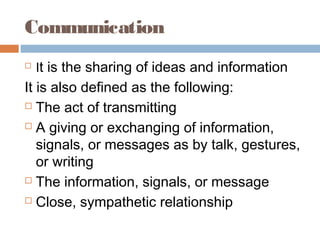
 It is the sharing of ideas and information
It is also defined as the following:
 The act of transmitting
 A giving or exchanging of information,
signals, or messages as by talk, gestures,
or writing
 The information, signals, or message
 Close, sympathetic relationship
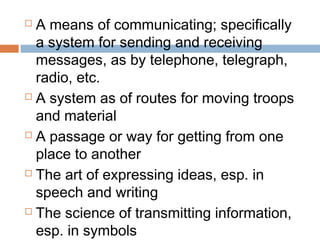
 A means of communicating; specifically
a system for sending and receiving
messages, as by telephone, telegraph,
radio, etc.
 A system as of routes for moving troops
and material
 A passage or way for getting from one
place to another
 The art of expressing ideas, esp. in
speech and writing
 The science of transmitting information,
esp. in symbols
 Transmission of message via verbal
and non-verbal cues
 Communication is a transaction in
which the participants are mutually
engaged in the process
Basic Functions of
Communication

For interaction
 For increasing the store of information
 For better understanding of our self
and the world we live
 For changing people’s attitudes,
beliefs, opinions and actions
 For making decisions
Two Categories of Communication
 Verbal
- Uses words, dialects, and languages
 Non- Verbal
- transmitting data without the use of
words
Components of Communication
 Context – setting or place the
communication took place
 Climate – feeling or tone of the
communication
 Source – sender of the message
 Message – can be verbal or non-verbal
 Channel – the means which message is
sent
 Feedback loop – occurs when the sender
cont.
 Receiver – decodes the message sent
 Interference – may occur from
physiological or physical distractions
 Timing
Characteristics of Human
Communication
 The process of communication is
continuous, ongoing, and dynamic.
 Communication begins with the self.
 Communication is irreversible or
unerasable.
 Communication is reciprocal.
 Communication is unrepeatable.
 Communication is transactional.
Non- Verbal Communication
Types of Non-Verbal Communication
 Facial Expressions
Ex. smile or frown
 Gestures
Ex. pointing or waving
 Paralinguistic
Ex. tone of voice, inflection, pitch, and
loudness
 Body language and posture
 Proxemics – personal space
 Eye gaze
Ex. looking, staring, glaring, blinking
 Appearance
Ex. clothing, hairstyles
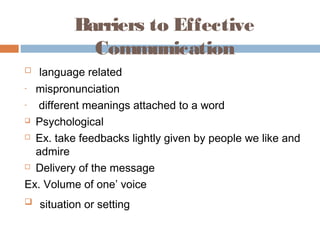
Barriers to Effective
Communication
 language related
- mispronunciation
- different meanings attached to a word
 Psychological
 Ex. take feedbacks lightly given by people we like and
admire
 Delivery of the message
Ex. Volume of one’ voice
 situation or setting
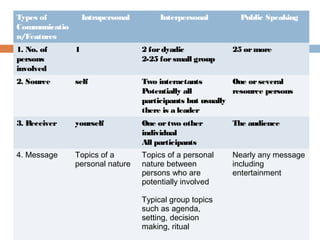
Types of
Communicatio
n/Features
Intrapersonal Interpersonal Public Speaking
1. No. of
persons
involved
1 2 fordyadic
2-25 forsmall group
25 ormore
2. Source self Two interactants
Potentially all
participants but usually
there is a leader
One orseveral
resource persons
3. Receiver yourself One ortwo other
individual
All participants
The audience
4. Message Topics of a
personal nature
Topics of a personal
nature between
persons who are
potentially involved
Typical group topics
such as agenda,
setting, decision
making, ritual
Nearly any message
including
entertainment
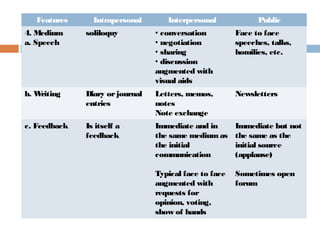
Features Intrapersonal Interpersonal Public
4. Medium
a. Speech
soliloquy • conversation
• negotiation
• sharing
• discussion
augmented with
visual aids
Face to face
speeches, talks,
homilies, etc.
b. Writing Diary orjournal
entries
Letters, memos,
notes
Note exchange
Newsletters
c. Feedback Is itself a
feedback
Immediate and in
the same mediumas
the initial
communication
Typical face to face
augmented with
requests for
opinion, voting,
show of hands
Immediate but not
the same as the
initial source
(applause)
Sometimes open
forum
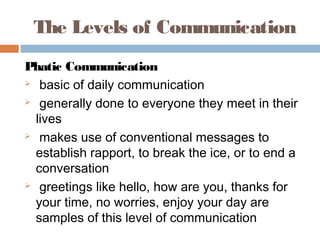
The Levels of Communication
Phatic Communication
 basic of daily communication
 generally done to everyone they meet in their
lives
 makes use of conventional messages to
establish rapport, to break the ice, or to end a
conversation
 greetings like hello, how are you, thanks for
your time, no worries, enjoy your day are
samples of this level of communication
Factual Communication
 offers knowledge to others about anything
under the sun
 can be in a form of small talk with the use of
events and observations
 relatively safe level of communication and
used by every individual
 biographical information is also an example of
this
Evaluative Communication
 level of communication which offers opinions,
ideas and judgments to others
 requires critical thinking since you have to
give opinion based on the presented ideas
Gut- Level Communication
 opening up the content of our hearts to
people
 it puts our emotional intelligence into action
 allows us to practice self-awareness, self-
control, flexibility and empathy
PeakCommunication
 highest and rarely achieved communication
 the point where two persons extraordinarily
communicate beyond gut level and who share
the same emotion
 this is usually seen between husband and
wife and among family members
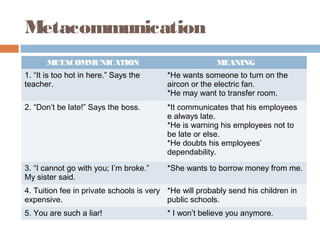
Metacommunication
METACOMMUNICATION MEANING
1. “It is too hot in here.” Says the
teacher.
*He wants someone to turn on the
aircon or the electric fan.
*He may want to transfer room.
2. “Don’t be late!” Says the boss. *It communicates that his employees
e always late.
*He is warning his employees not to
be late or else.
*He doubts his employees’
dependability.
3. “I cannot go with you; I’m broke.”
My sister said.
*She wants to borrow money from me.
4. Tuition fee in private schools is very
expensive.
*He will probably send his children in
public schools.
5. You are such a liar! * I won’t believe you anymore.
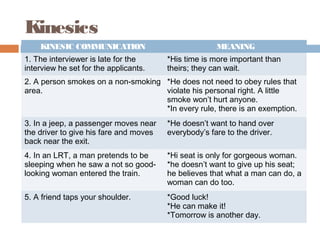
Kinesics
KINESIC COMMUNICATION MEANING
1. The interviewer is late for the
interview he set for the applicants.
*His time is more important than
theirs; they can wait.
2. A person smokes on a non-smoking
area.
*He does not need to obey rules that
violate his personal right. A little
smoke won’t hurt anyone.
*In every rule, there is an exemption.
3. In a jeep, a passenger moves near
the driver to give his fare and moves
back near the exit.
*He doesn’t want to hand over
everybody’s fare to the driver.
4. In an LRT, a man pretends to be
sleeping when he saw a not so good-
looking woman entered the train.
*Hi seat is only for gorgeous woman.
*he doesn’t want to give up his seat;
he believes that what a man can do, a
woman can do too.
5. A friend taps your shoulder. *Good luck!
*He can make it!
*Tomorrow is another day.

Introduction to Communication Process

  • 1.
  • 2.
    Communication  It isthe sharing of ideas and information It is also defined as the following:  The act of transmitting  A giving or exchanging of information, signals, or messages as by talk, gestures, or writing  The information, signals, or message  Close, sympathetic relationship
  • 3.
     A meansof communicating; specifically a system for sending and receiving messages, as by telephone, telegraph, radio, etc.  A system as of routes for moving troops and material  A passage or way for getting from one place to another  The art of expressing ideas, esp. in speech and writing  The science of transmitting information, esp. in symbols
  • 4.
     Transmission ofmessage via verbal and non-verbal cues  Communication is a transaction in which the participants are mutually engaged in the process
  • 5.
    Basic Functions of Communication  Forinteraction  For increasing the store of information  For better understanding of our self and the world we live  For changing people’s attitudes, beliefs, opinions and actions  For making decisions
  • 6.
    Two Categories ofCommunication  Verbal - Uses words, dialects, and languages  Non- Verbal - transmitting data without the use of words
  • 7.
    Components of Communication Context – setting or place the communication took place  Climate – feeling or tone of the communication  Source – sender of the message  Message – can be verbal or non-verbal  Channel – the means which message is sent  Feedback loop – occurs when the sender
  • 8.
    cont.  Receiver –decodes the message sent  Interference – may occur from physiological or physical distractions  Timing
  • 9.
    Characteristics of Human Communication The process of communication is continuous, ongoing, and dynamic.  Communication begins with the self.  Communication is irreversible or unerasable.  Communication is reciprocal.  Communication is unrepeatable.  Communication is transactional.
  • 10.
    Non- Verbal Communication Typesof Non-Verbal Communication  Facial Expressions Ex. smile or frown  Gestures Ex. pointing or waving  Paralinguistic Ex. tone of voice, inflection, pitch, and loudness
  • 11.
     Body languageand posture  Proxemics – personal space  Eye gaze Ex. looking, staring, glaring, blinking  Appearance Ex. clothing, hairstyles
  • 12.
    Barriers to Effective Communication language related - mispronunciation - different meanings attached to a word  Psychological  Ex. take feedbacks lightly given by people we like and admire  Delivery of the message Ex. Volume of one’ voice  situation or setting
  • 13.
    Types of Communicatio n/Features Intrapersonal InterpersonalPublic Speaking 1. No. of persons involved 1 2 fordyadic 2-25 forsmall group 25 ormore 2. Source self Two interactants Potentially all participants but usually there is a leader One orseveral resource persons 3. Receiver yourself One ortwo other individual All participants The audience 4. Message Topics of a personal nature Topics of a personal nature between persons who are potentially involved Typical group topics such as agenda, setting, decision making, ritual Nearly any message including entertainment
  • 14.
    Features Intrapersonal InterpersonalPublic 4. Medium a. Speech soliloquy • conversation • negotiation • sharing • discussion augmented with visual aids Face to face speeches, talks, homilies, etc. b. Writing Diary orjournal entries Letters, memos, notes Note exchange Newsletters c. Feedback Is itself a feedback Immediate and in the same mediumas the initial communication Typical face to face augmented with requests for opinion, voting, show of hands Immediate but not the same as the initial source (applause) Sometimes open forum
  • 15.
    The Levels ofCommunication Phatic Communication  basic of daily communication  generally done to everyone they meet in their lives  makes use of conventional messages to establish rapport, to break the ice, or to end a conversation  greetings like hello, how are you, thanks for your time, no worries, enjoy your day are samples of this level of communication
  • 16.
    Factual Communication  offersknowledge to others about anything under the sun  can be in a form of small talk with the use of events and observations  relatively safe level of communication and used by every individual  biographical information is also an example of this
  • 17.
    Evaluative Communication  levelof communication which offers opinions, ideas and judgments to others  requires critical thinking since you have to give opinion based on the presented ideas
  • 18.
    Gut- Level Communication opening up the content of our hearts to people  it puts our emotional intelligence into action  allows us to practice self-awareness, self- control, flexibility and empathy
  • 19.
    PeakCommunication  highest andrarely achieved communication  the point where two persons extraordinarily communicate beyond gut level and who share the same emotion  this is usually seen between husband and wife and among family members
  • 20.
    Metacommunication METACOMMUNICATION MEANING 1. “Itis too hot in here.” Says the teacher. *He wants someone to turn on the aircon or the electric fan. *He may want to transfer room. 2. “Don’t be late!” Says the boss. *It communicates that his employees e always late. *He is warning his employees not to be late or else. *He doubts his employees’ dependability. 3. “I cannot go with you; I’m broke.” My sister said. *She wants to borrow money from me. 4. Tuition fee in private schools is very expensive. *He will probably send his children in public schools. 5. You are such a liar! * I won’t believe you anymore.
  • 21.
    Kinesics KINESIC COMMUNICATION MEANING 1.The interviewer is late for the interview he set for the applicants. *His time is more important than theirs; they can wait. 2. A person smokes on a non-smoking area. *He does not need to obey rules that violate his personal right. A little smoke won’t hurt anyone. *In every rule, there is an exemption. 3. In a jeep, a passenger moves near the driver to give his fare and moves back near the exit. *He doesn’t want to hand over everybody’s fare to the driver. 4. In an LRT, a man pretends to be sleeping when he saw a not so good- looking woman entered the train. *Hi seat is only for gorgeous woman. *he doesn’t want to give up his seat; he believes that what a man can do, a woman can do too. 5. A friend taps your shoulder. *Good luck! *He can make it! *Tomorrow is another day.