COMMUNICATION
IN THE
TWENTY- FIRST CENTURY
CHAPTER 1:
DEFINITION OF COMMUNICATION
Communication is the act of conveying
meanings from one entity or group to another
through the use of mutually understood signs,
symbols, and semiotic rules.
 Nonverbal communication - describes the
processes of conveying a type of information
in a form of non-linguistic representations.
Examples; gestures, body language, facial
expressions, eye contact etc.
 Verbal Communication - is the spoken or
written conveyance of a message.
THE MAIN STEPS INHERENT TO
ALL COMMUNICATION ARE :
 Message composition (further internal or technical elaboration on
what exactly to The formation of
communicative motivation or reason.
 express).
 Message encoding (for example, into digital data, written
text, speech, pictures, gestures and so on).
 Transmission of the encoded message as a sequence of signals
using a specific channel or medium.
 Noise sources such as natural forces and in some cases human
activity (both intentional and accidental) begin influencing the
quality of signals propagating from the sender to one or more
receivers.
 Reception of signals and reassembling of the encoded message
from a sequence of received signals.
 Decoding of the reassembled encoded message.
 Interpretation and making sense of the presumed original
message.
THE PROCESS OF
COMMUNICATION
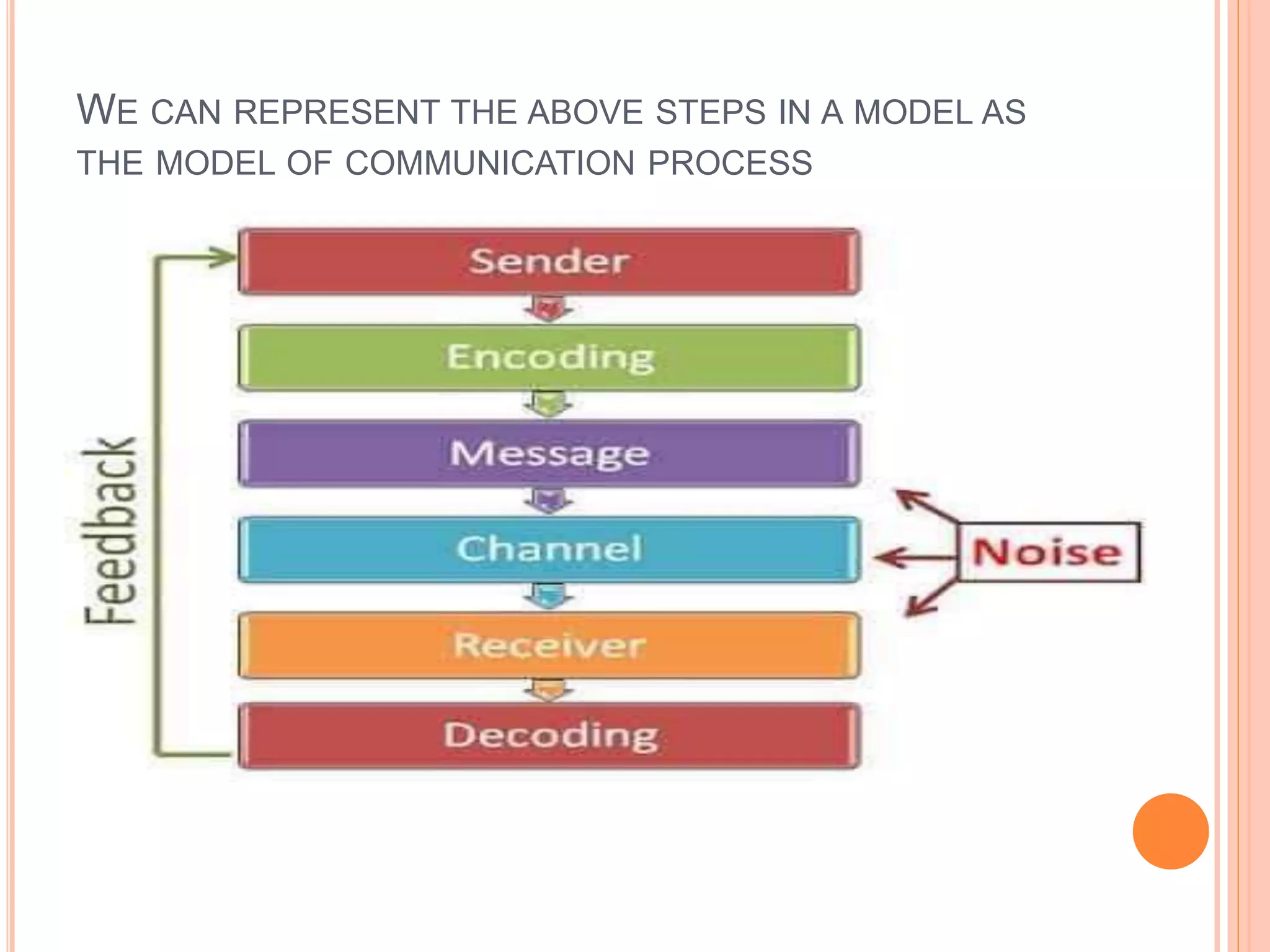
 The communication process is the guide
toward realizing effective communication. It
is through the communication process that
the sharing of a common meaning between
the sender and the receiver takes place.
Individuals that follow the communication
process will have the opportunity to become
more productive in every aspect of their
profession. Effective communication leads
to understanding.
SENDER - The sender is therefore the
initiator of the message that need to
be transmitted.
MESSAGE - Message is referred to
as the information conveyed by words
as in speech and write-ups, signs,
pictures or symbols.
Components of Communication Process
ENCODING - Encoding is putting the
targeted message into appropriate medium
which may be verbal or non-verbal.
CHANNEL-The manner which the idea or
information is being conveyed.
DECODING – Decoding refers to
interpreting or converting the sent message
into intelligible language.
RECEIVER - the person or the group
of people who will get your message.
FEEDBACK - It refers to the
response of the receiver as to the
message sent to him/her by the
sender.
CONTEXT - this refers to the situation
in which the communication takes
place.
CONSIDER THE FOLLOWING POINTS RELATED TO THE
FEEDBACK INVOLVED IN THE PROCESS OF
COMMUNICATION
 It enhances the effectiveness of the
communication as it permits the sender to
know the efficacy of his message.
 It enables the sender to know if his/her
message has been properly comprehended.
The analysis of feedbacks helps improve future
messages. Feedback, like the message, can be
verbal or nonverbal and transmitted through
carefully chosen channel of communication.
WE CAN REPRESENT THE ABOVE STEPS IN A MODEL AS
THE MODEL OF COMMUNICATION PROCESS
ELEMENTS OF
COMMUNICATION
The five elements named by LASSWELL (1948)
based on his experience (as cited in Public Health
Action Support Team [PHAST], 2017).
1. Sender (who the source is)
2. Message (what the idea being
communicated says)
3. Channel (through what medium
the message is relayed)
4. Receiver (to whom it is directed)
5. Effect (what the desired result of
the communication is)
DIFFERENCE BETWEEN
INTRAPERSONAL AND
INTERPERSONAL
COMMUNICATION
Interpersonal communication is
the process of exchange of
information, ideas, and feelings
etc., while intrapersonal
communication can be defined as
communication with one’s self .
KEY PRINCIPLE OF
COMMUNICATION
The Principle is based on the real-life functioning of
interpersonal communication (King,2000)
 1. Interpersonal communication is
inescapable. It is not possible for humans
like you and me not to communicate. You
always communicate and receive
communicate from others not only
through words, but also in body
movements. Because of this fact, since
people are not mind readers, you are
often judged through your behavior, not
your intention or purpose.
 2. Interpersonal communication is
irreversible. Words are powerful; they
can either heal or harm others. This
principle of communication is best
expressed in a Russian proverb which
says, "Once a word goes out of your
mouth, you can never swallow it
again."
3. Interpersonal communication is
complicated. Whenever you
communicate with anyone, you
simultaneously interpret both his
verbal and non verbal language, and
that is often both confounding and
demanding.
4. Interpersonal communication is
contextual., Communication is affected
by several factors; it does not happen
in isolation. There are many things that
need to be considered, such as the
ones given below (King, 2000).
 a. Psychological context, which is who you are, and what you as
sender or receiver brings to the interaction-- your needs, desire,
values, beliefs, personality, and so on.
 b. Relational context, which concern your reactions to the other
person based on relationships--as boss, colleague, friend, sibling,
parent, and the like.
 c. Situational context, which deals with the psycho-social "where'
you are communicating. An interaction that takes place in a
classroom, which is quite formal, will be very different from one that
takes place in a bar, which is very informal-- where communicators
do not need to be guarded in their speech.
 d. Environmental context, which has to do with the physical
"where" you are communicating--- objects in the room and their
arrangement, location, noise level, temperature, season, time of
day
 e. Cultural context, which includes all the learned behaviors and
rules that affect the interaction.
COMMUNICATION
MODELS
 Communication models are systematic
representations of the process which helps in
understanding how communication works can be
done. Models show the process metaphorically and
in symbols. They form general perspectives on
communication by breaking communication from
complex to simple and keeps the components in
order.
 The earliest model comes from Aristotle of at around 5 B.C, In
this model, Aristotle explains that speaker should adjust their
messages according to their audience and occasion to
achieve a particular effect. Let us apply this to a modern
example.
Aristotle advises speakers to build speech for different audience
on different time (occasion) and for different effects.
Example: Alexander gave brave speech to his soldiers in the war
field to defeat Persian Empire.
 Speaker – Alexander
 Speech – about his invasion
 Occasion – War field
 Audience – Soldiers
 Effect – To defeat Persia
SHANNON WEAVER’S MODEL OF
COMMUNICATION
In 1948, Shannon was an American mathematician,
Electronic engineer and Weaver was an American
scientist both of them join together to write an article
in “Bell System Technical Journal” called “A
Mathematical Theory of Communication” and also
called as “Shannon-Weaver model of
communication”.
The model deals with various concepts like
Information source, transmitter, Noise, channel,
message, receiver, channel, information destination,
encode and decode.
 Practical Example of Shannon-Weaver model of
communication :
 Thomson made call to his assistant “come here I want to see
you”. During his call, noise appeared (transmission error) and
his assistant received “I want” only. Again Assistant asked
Thomson (feedback) “what do you want Thomson”.
 Sender : Thomson
 Encoder : Telephone (Thomson)
 Channel : Cable
 Noise : Distraction in voice
 Reception : Telephone (Assistant)
 Receiver : Assistant.
 Due to transmission error or noise, Assistant can’t able to
understand Thomson’s messages.
 *The noise which affect the communication flow between
them.
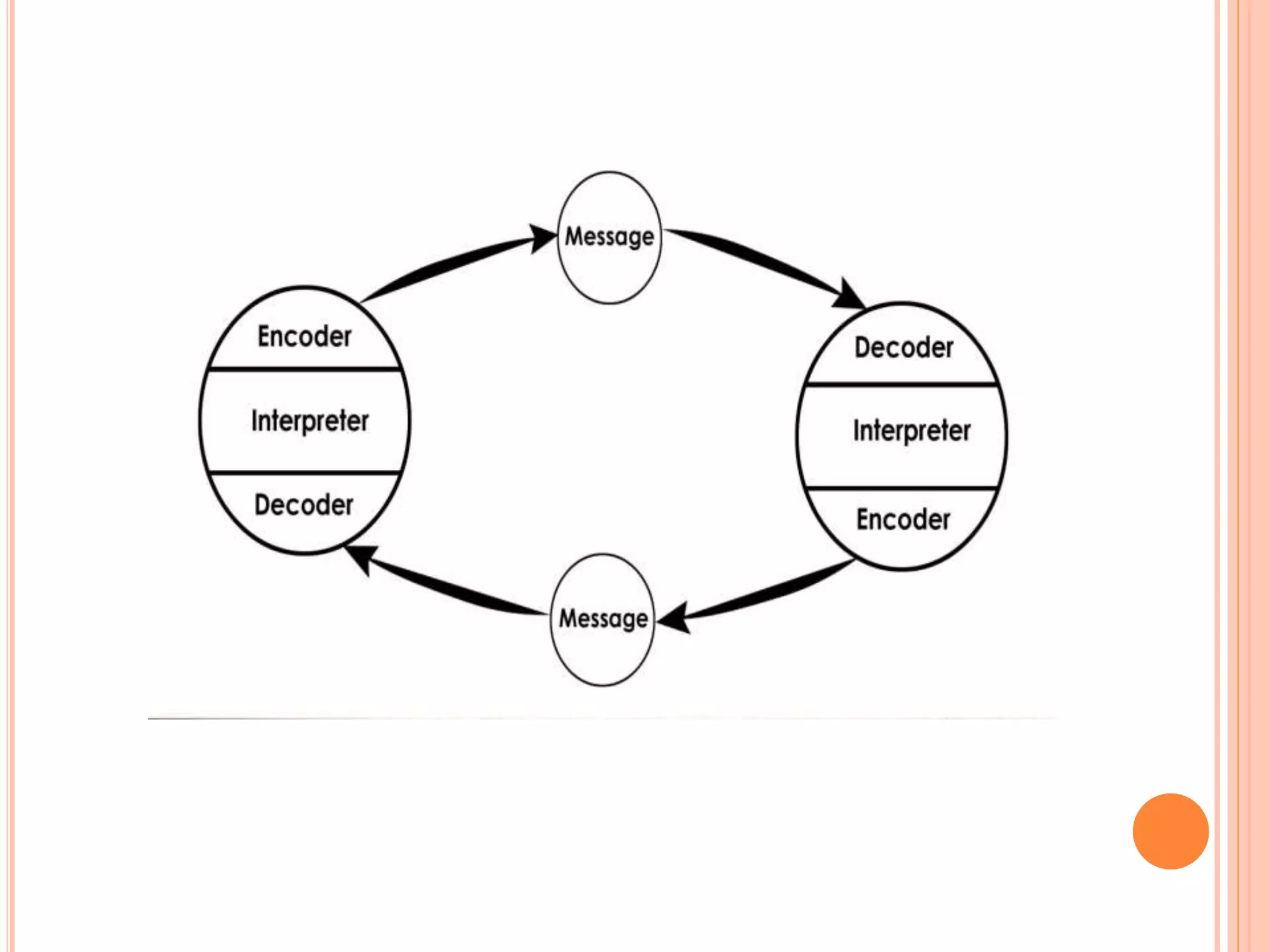
OSGOOD SCHRAMM’S MODEL OF COMMUNICATION
 Wilbur Schramm's models presents a
complete treatment of the fundamentals of
communication. This model offers a classic general
explanation of the nature of communication.
It is a Circular Model, so that communication is something circular
in nature
 Encoder – Who does encoding or Sends the message (message
originates)
 Decoder – Who receives the message
 Interpreter – Person trying to understand (analyses, perceive) or
interpret
Note: From the message starting to ending, there is an
interpretation goes on. Based on this
interpretation only the message is received.
This model breaks the sender and receiver model it seems
communication in a practical way. It is not a traditional model.
It can happen within our self or two people; each person acts as
both sender and receiver and hence use interpretation. It is
simultaneously take place e.g. encoding, interpret and decoding.
WHITE'S MODEL OF COMMUNICATION
The Eugene White model implies a step-by-step
sequence of events that starts with thinking in the mind
of the speaker and ends with monitoring also by the
speaker.
DIFFERENCE BETWEEN
MORALS AND ETHICS
Morals refer mainly to guiding
principles, and ethics refer to specific
rules and actions, or behaviors.
What does morals mean?
A person’s idea of morals tends to be
shaped by their surrounding
environment (and sometimes their
belief system). Moral values shape a
person’s ideas about right and wrong.
What does ethics mean?
Ethics are distinct from morals in that
they’re much more practical.
An ethical code doesn’t have to be
moral. It’s just a set of rules for people
to follow.
ETHICS IN
COMMUNICATION
 Mutuality - Pay attentions to the
needs of others, as well as yours.
Individual dignity - Do not cause
another person embarrassment or a
loss of dignity.
Accuracy - Ensure that others have
accurate information. Tell them
everything they have a right and need
to know, not just what is true.
Deirdre D. Johnston (1994) pointed out ten
ethics in communication (as cited in Chase
&Shamo, 2013 pp. 140-141).
 Access to information - Never
bolster the impact of information by
preventing people from communicating
with one another or by hindering
access to the supporting information.
Accountability - Be responsible and
accountable for the consequences of
your relationship and communication.
Audience - As audience or receiver of
the information, you also have ethical
responsibilities.
 Relative truth - As either sender or
receiver of information, remember that your
point of view may not be shared by others
and that your conclusions are relative to
your perspective, so allow others to
respectfully disagree or see it differently.
 Ends vs. means - Be sure that the end goal
of your communication and the means of
getting to that end are both ethical although
no rule can be applied without reservation to
any situation.
 Use of power - In situation where you have
more power than others (e.g., a teacher with
a student, a boss with a subordinate and a
parent with a child, you also have more
responsibility for the outcome.
 Right vs. responsibilities - Balance your
rights against your responsibilities even if
you live in a wonderful society where your
rights are protected by law; not everything
you have a right to do is ethical.
COMMUNICATION
AND GLOBALIZATION
 Globalization has affected us in numerous
ways. One can travel internationally more
than one can do in the past.
 Also, the free trade of goods and services
all over the world is brought multinational
companies and foreign investors to our
shores. So, people are united as one
through globalization.
 World English (or World Englishes) refers to
the English language as it is variously used
throughout the world. It's also known as
international English and global English.
World Englishes
Examples of Globalization through
World Englishes
Newspapers and periodicals -
English-language broadsheet
newspapers and magazine-style
periodicals, in which the texts are
tightly edited.
Cultural Sensitive
 Just as important as awareness of the
existence of World Englishes is that of
practicing CULTURAL SENSITIVE.
 To write in a culturally sensitive way means
to be aware that cultural differences and
similarities between people exist and that
these should not be assigned a positive or
negative value via words and descriptions
selected in writing.
CULTURALLY SENSITIVE AND BIAS-
FREE LANGUAGE
Bias-free language
"Bias-free language means using terms that
treat people with respect. Sometimes it
means leaving out certain kinds of words
altogether, such as not describing someone
'physical characteristics when doing so
serves no purpose."

PC-GROUP1.pptx

  • 1.
  • 2.
    DEFINITION OF COMMUNICATION Communicationis the act of conveying meanings from one entity or group to another through the use of mutually understood signs, symbols, and semiotic rules.  Nonverbal communication - describes the processes of conveying a type of information in a form of non-linguistic representations. Examples; gestures, body language, facial expressions, eye contact etc.  Verbal Communication - is the spoken or written conveyance of a message.
  • 3.
    THE MAIN STEPSINHERENT TO ALL COMMUNICATION ARE :  Message composition (further internal or technical elaboration on what exactly to The formation of communicative motivation or reason.  express).  Message encoding (for example, into digital data, written text, speech, pictures, gestures and so on).  Transmission of the encoded message as a sequence of signals using a specific channel or medium.  Noise sources such as natural forces and in some cases human activity (both intentional and accidental) begin influencing the quality of signals propagating from the sender to one or more receivers.  Reception of signals and reassembling of the encoded message from a sequence of received signals.  Decoding of the reassembled encoded message.  Interpretation and making sense of the presumed original message.
  • 4.
  • 5.
     The communicationprocess is the guide toward realizing effective communication. It is through the communication process that the sharing of a common meaning between the sender and the receiver takes place. Individuals that follow the communication process will have the opportunity to become more productive in every aspect of their profession. Effective communication leads to understanding.
  • 6.
    SENDER - Thesender is therefore the initiator of the message that need to be transmitted. MESSAGE - Message is referred to as the information conveyed by words as in speech and write-ups, signs, pictures or symbols. Components of Communication Process
  • 7.
    ENCODING - Encodingis putting the targeted message into appropriate medium which may be verbal or non-verbal. CHANNEL-The manner which the idea or information is being conveyed. DECODING – Decoding refers to interpreting or converting the sent message into intelligible language.
  • 8.
    RECEIVER - theperson or the group of people who will get your message. FEEDBACK - It refers to the response of the receiver as to the message sent to him/her by the sender. CONTEXT - this refers to the situation in which the communication takes place.
  • 9.
    CONSIDER THE FOLLOWINGPOINTS RELATED TO THE FEEDBACK INVOLVED IN THE PROCESS OF COMMUNICATION  It enhances the effectiveness of the communication as it permits the sender to know the efficacy of his message.  It enables the sender to know if his/her message has been properly comprehended. The analysis of feedbacks helps improve future messages. Feedback, like the message, can be verbal or nonverbal and transmitted through carefully chosen channel of communication.
  • 10.
    WE CAN REPRESENTTHE ABOVE STEPS IN A MODEL AS THE MODEL OF COMMUNICATION PROCESS
  • 11.
  • 12.
    The five elementsnamed by LASSWELL (1948) based on his experience (as cited in Public Health Action Support Team [PHAST], 2017). 1. Sender (who the source is) 2. Message (what the idea being communicated says) 3. Channel (through what medium the message is relayed) 4. Receiver (to whom it is directed) 5. Effect (what the desired result of the communication is)
  • 13.
  • 14.
    Interpersonal communication is theprocess of exchange of information, ideas, and feelings etc., while intrapersonal communication can be defined as communication with one’s self .
  • 15.
  • 16.
    The Principle isbased on the real-life functioning of interpersonal communication (King,2000)  1. Interpersonal communication is inescapable. It is not possible for humans like you and me not to communicate. You always communicate and receive communicate from others not only through words, but also in body movements. Because of this fact, since people are not mind readers, you are often judged through your behavior, not your intention or purpose.
  • 17.
     2. Interpersonalcommunication is irreversible. Words are powerful; they can either heal or harm others. This principle of communication is best expressed in a Russian proverb which says, "Once a word goes out of your mouth, you can never swallow it again."
  • 18.
    3. Interpersonal communicationis complicated. Whenever you communicate with anyone, you simultaneously interpret both his verbal and non verbal language, and that is often both confounding and demanding.
  • 19.
    4. Interpersonal communicationis contextual., Communication is affected by several factors; it does not happen in isolation. There are many things that need to be considered, such as the ones given below (King, 2000).
  • 20.
     a. Psychologicalcontext, which is who you are, and what you as sender or receiver brings to the interaction-- your needs, desire, values, beliefs, personality, and so on.  b. Relational context, which concern your reactions to the other person based on relationships--as boss, colleague, friend, sibling, parent, and the like.  c. Situational context, which deals with the psycho-social "where' you are communicating. An interaction that takes place in a classroom, which is quite formal, will be very different from one that takes place in a bar, which is very informal-- where communicators do not need to be guarded in their speech.  d. Environmental context, which has to do with the physical "where" you are communicating--- objects in the room and their arrangement, location, noise level, temperature, season, time of day  e. Cultural context, which includes all the learned behaviors and rules that affect the interaction.
  • 21.
  • 22.
     Communication modelsare systematic representations of the process which helps in understanding how communication works can be done. Models show the process metaphorically and in symbols. They form general perspectives on communication by breaking communication from complex to simple and keeps the components in order.
  • 23.
     The earliestmodel comes from Aristotle of at around 5 B.C, In this model, Aristotle explains that speaker should adjust their messages according to their audience and occasion to achieve a particular effect. Let us apply this to a modern example.
  • 24.
    Aristotle advises speakersto build speech for different audience on different time (occasion) and for different effects. Example: Alexander gave brave speech to his soldiers in the war field to defeat Persian Empire.  Speaker – Alexander  Speech – about his invasion  Occasion – War field  Audience – Soldiers  Effect – To defeat Persia
  • 25.
    SHANNON WEAVER’S MODELOF COMMUNICATION In 1948, Shannon was an American mathematician, Electronic engineer and Weaver was an American scientist both of them join together to write an article in “Bell System Technical Journal” called “A Mathematical Theory of Communication” and also called as “Shannon-Weaver model of communication”. The model deals with various concepts like Information source, transmitter, Noise, channel, message, receiver, channel, information destination, encode and decode.
  • 26.
     Practical Exampleof Shannon-Weaver model of communication :  Thomson made call to his assistant “come here I want to see you”. During his call, noise appeared (transmission error) and his assistant received “I want” only. Again Assistant asked Thomson (feedback) “what do you want Thomson”.  Sender : Thomson  Encoder : Telephone (Thomson)  Channel : Cable  Noise : Distraction in voice  Reception : Telephone (Assistant)  Receiver : Assistant.  Due to transmission error or noise, Assistant can’t able to understand Thomson’s messages.  *The noise which affect the communication flow between them.
  • 28.
    OSGOOD SCHRAMM’S MODELOF COMMUNICATION  Wilbur Schramm's models presents a complete treatment of the fundamentals of communication. This model offers a classic general explanation of the nature of communication.
  • 29.
    It is aCircular Model, so that communication is something circular in nature  Encoder – Who does encoding or Sends the message (message originates)  Decoder – Who receives the message  Interpreter – Person trying to understand (analyses, perceive) or interpret Note: From the message starting to ending, there is an interpretation goes on. Based on this interpretation only the message is received. This model breaks the sender and receiver model it seems communication in a practical way. It is not a traditional model. It can happen within our self or two people; each person acts as both sender and receiver and hence use interpretation. It is simultaneously take place e.g. encoding, interpret and decoding.
  • 31.
    WHITE'S MODEL OFCOMMUNICATION The Eugene White model implies a step-by-step sequence of events that starts with thinking in the mind of the speaker and ends with monitoring also by the speaker.
  • 32.
  • 33.
    Morals refer mainlyto guiding principles, and ethics refer to specific rules and actions, or behaviors.
  • 34.
    What does moralsmean? A person’s idea of morals tends to be shaped by their surrounding environment (and sometimes their belief system). Moral values shape a person’s ideas about right and wrong. What does ethics mean? Ethics are distinct from morals in that they’re much more practical. An ethical code doesn’t have to be moral. It’s just a set of rules for people to follow.
  • 35.
  • 36.
     Mutuality -Pay attentions to the needs of others, as well as yours. Individual dignity - Do not cause another person embarrassment or a loss of dignity. Accuracy - Ensure that others have accurate information. Tell them everything they have a right and need to know, not just what is true. Deirdre D. Johnston (1994) pointed out ten ethics in communication (as cited in Chase &Shamo, 2013 pp. 140-141).
  • 37.
     Access toinformation - Never bolster the impact of information by preventing people from communicating with one another or by hindering access to the supporting information. Accountability - Be responsible and accountable for the consequences of your relationship and communication. Audience - As audience or receiver of the information, you also have ethical responsibilities.
  • 38.
     Relative truth- As either sender or receiver of information, remember that your point of view may not be shared by others and that your conclusions are relative to your perspective, so allow others to respectfully disagree or see it differently.  Ends vs. means - Be sure that the end goal of your communication and the means of getting to that end are both ethical although no rule can be applied without reservation to any situation.  Use of power - In situation where you have more power than others (e.g., a teacher with a student, a boss with a subordinate and a parent with a child, you also have more responsibility for the outcome.
  • 39.
     Right vs.responsibilities - Balance your rights against your responsibilities even if you live in a wonderful society where your rights are protected by law; not everything you have a right to do is ethical.
  • 40.
  • 41.
     Globalization hasaffected us in numerous ways. One can travel internationally more than one can do in the past.  Also, the free trade of goods and services all over the world is brought multinational companies and foreign investors to our shores. So, people are united as one through globalization.
  • 42.
     World English(or World Englishes) refers to the English language as it is variously used throughout the world. It's also known as international English and global English. World Englishes
  • 43.
    Examples of Globalizationthrough World Englishes Newspapers and periodicals - English-language broadsheet newspapers and magazine-style periodicals, in which the texts are tightly edited.
  • 44.
    Cultural Sensitive  Justas important as awareness of the existence of World Englishes is that of practicing CULTURAL SENSITIVE.  To write in a culturally sensitive way means to be aware that cultural differences and similarities between people exist and that these should not be assigned a positive or negative value via words and descriptions selected in writing. CULTURALLY SENSITIVE AND BIAS- FREE LANGUAGE
  • 45.
    Bias-free language "Bias-free languagemeans using terms that treat people with respect. Sometimes it means leaving out certain kinds of words altogether, such as not describing someone 'physical characteristics when doing so serves no purpose."