Head and Neck
Lower four cranial nerves
Professor Dr. Mohamed El Fiky
Professor of anatomy and embryology
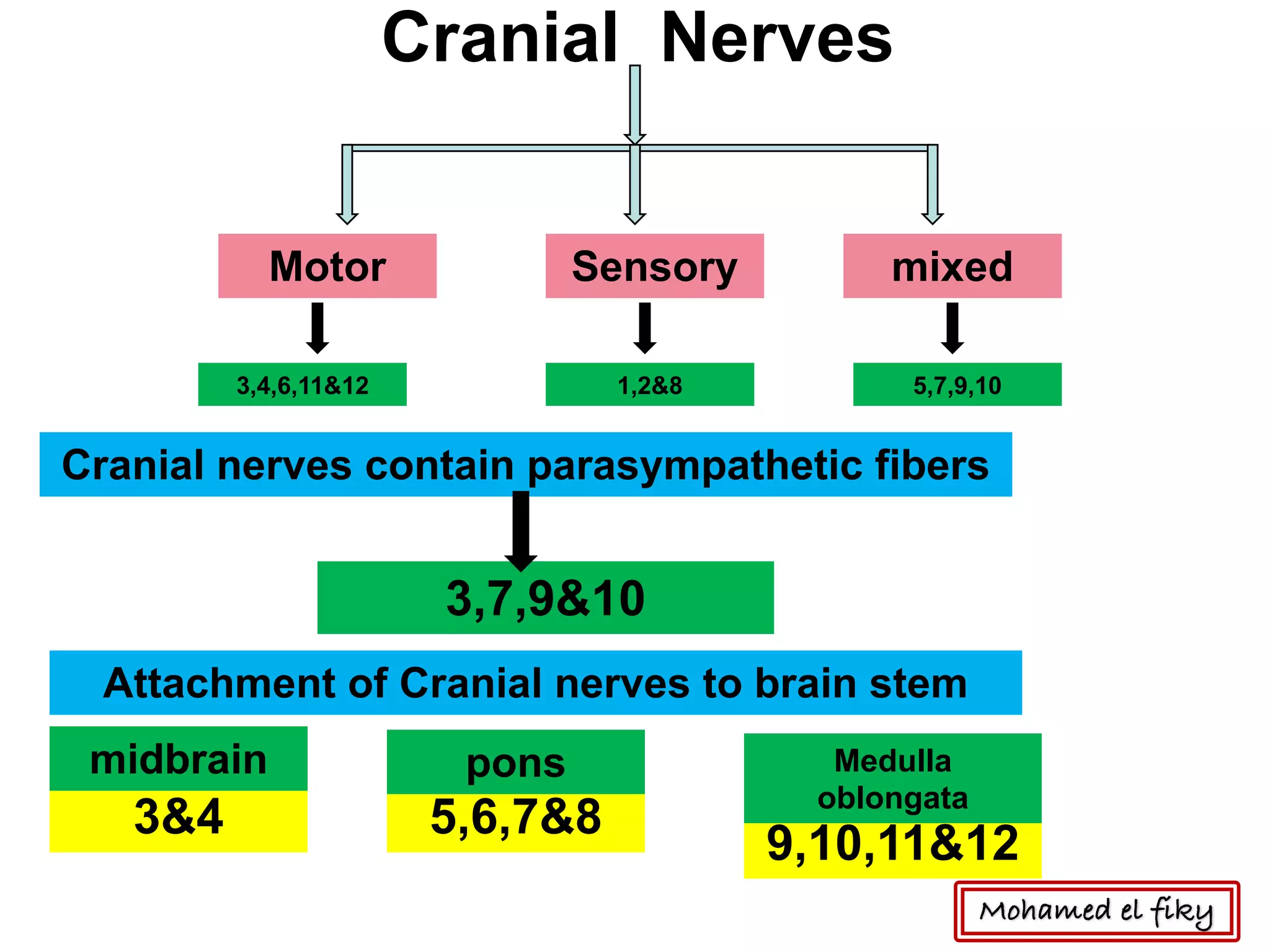
Cranial Nerves
Motor Sensory mixed
3,4,6,11&12 1,2&8 5,7,9,10
Cranial nerves contain parasympathetic fibers
3,7,9&10
Attachment of Cranial nerves to brain stem
3&4
midbrain
5,6,7&8
pons
9,10,11&12
Medulla
oblongata
Mohamed el fiky
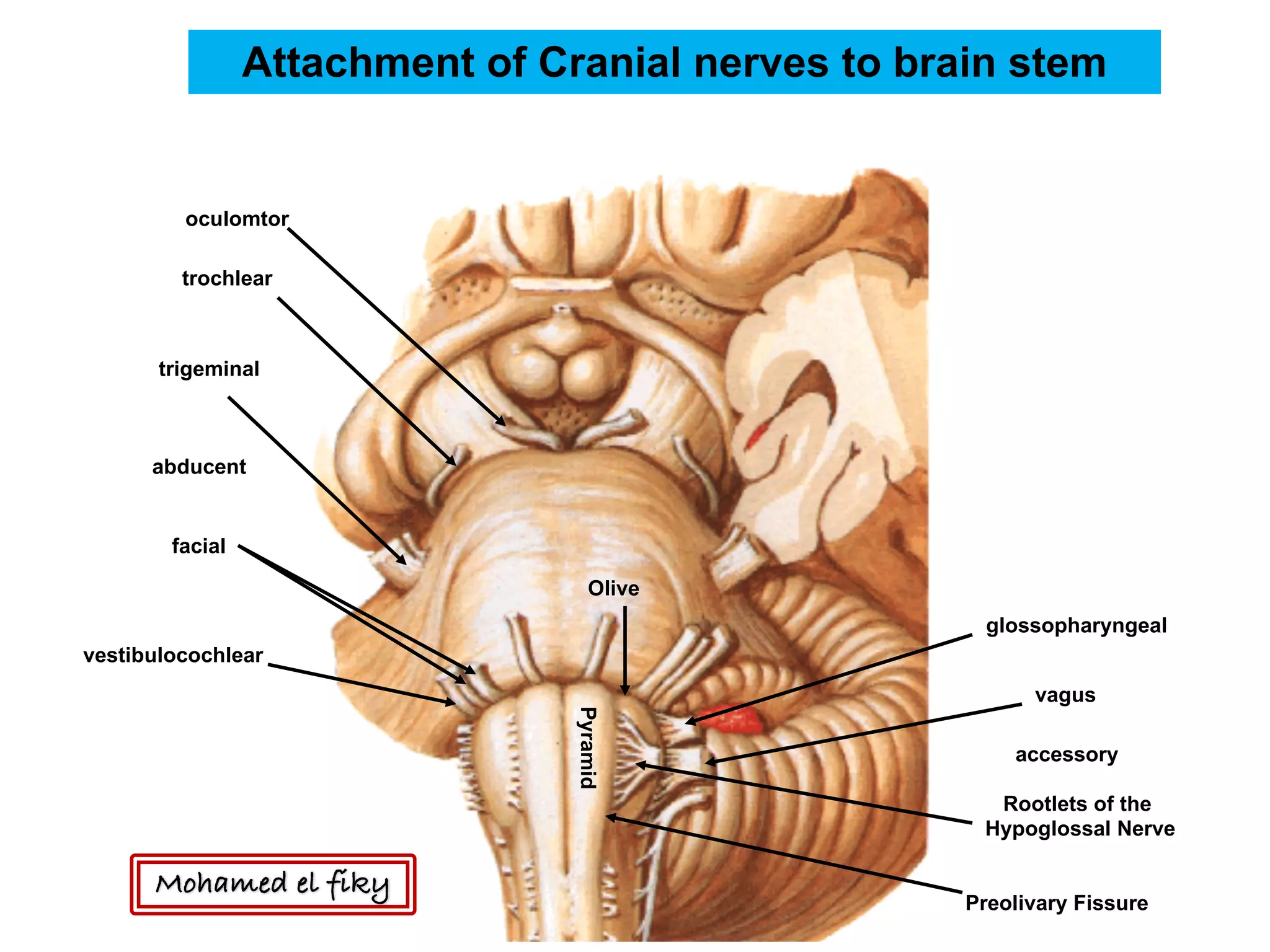
Rootlets of the
Hypoglossal Nerve
Olive
Preolivary Fissure
Pyramid
oculomtor
trochlear
abducent
facial
vestibulocochlear
glossopharyngeal
vagus
accessory
trigeminal
Attachment of Cranial nerves to brain stem
Mohamed el fiky
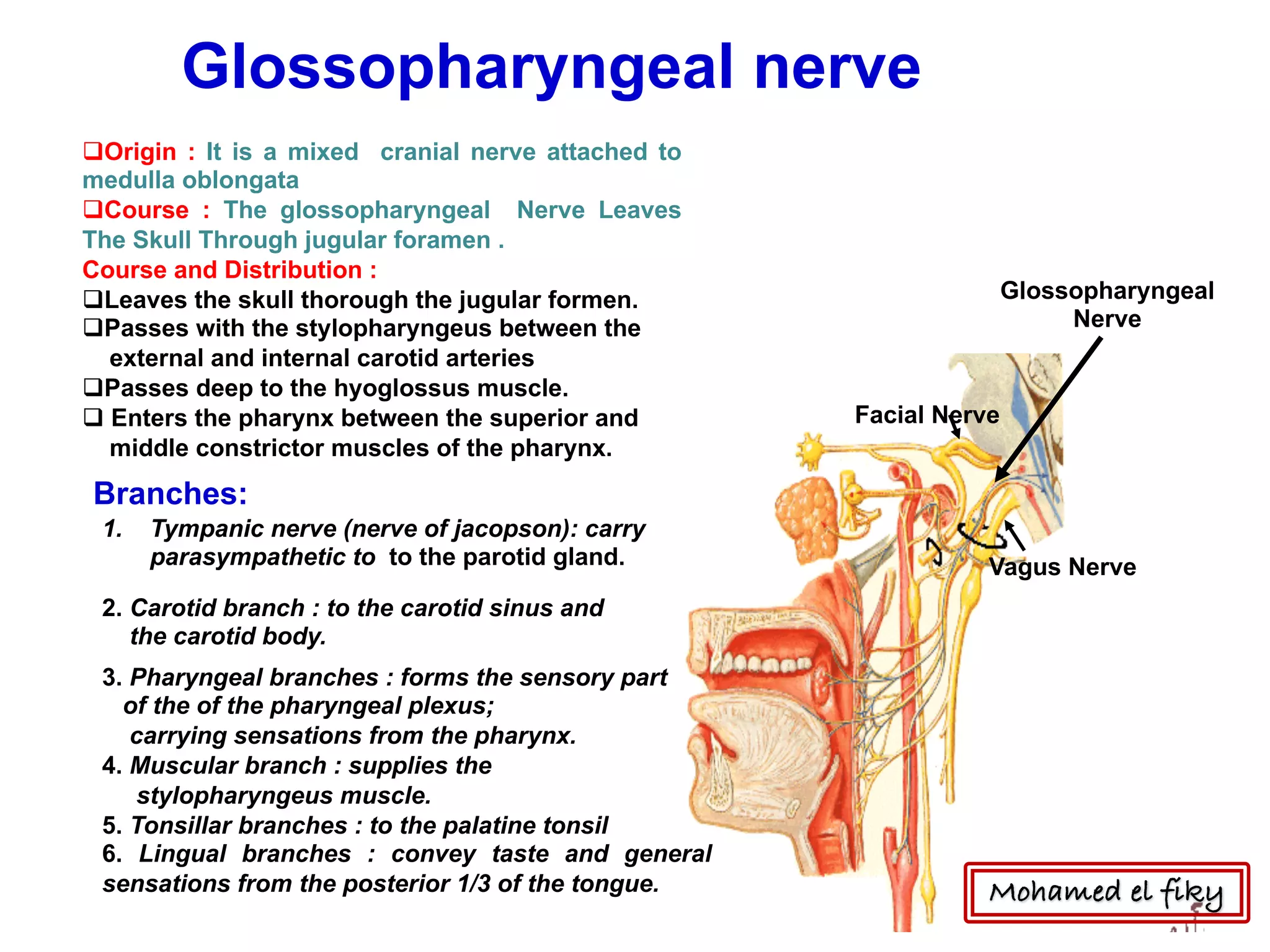
Vagus Nerve
Facial Nerve
Glossopharyngeal
Nerve
qOrigin : It is a mixed cranial nerve attached to
medulla oblongata
qCourse : The glossopharyngeal Nerve Leaves
The Skull Through jugular foramen .
Course and Distribution :
qLeaves the skull thorough the jugular formen.
qPasses with the stylopharyngeus between the
external and internal carotid arteries
qPasses deep to the hyoglossus muscle.
q Enters the pharynx between the superior and
middle constrictor muscles of the pharynx.
Branches:
1. Tympanic nerve (nerve of jacopson): carry
parasympathetic to to the parotid gland.
2. Carotid branch : to the carotid sinus and
the carotid body.
3. Pharyngeal branches : forms the sensory part
of the of the pharyngeal plexus;
carrying sensations from the pharynx.
4. Muscular branch : supplies the
stylopharyngeus muscle.
5. Tonsillar branches : to the palatine tonsil
6. Lingual branches : convey taste and general
sensations from the posterior 1/3 of the tongue.
Glossopharyngeal nerve
Mohamed el fiky
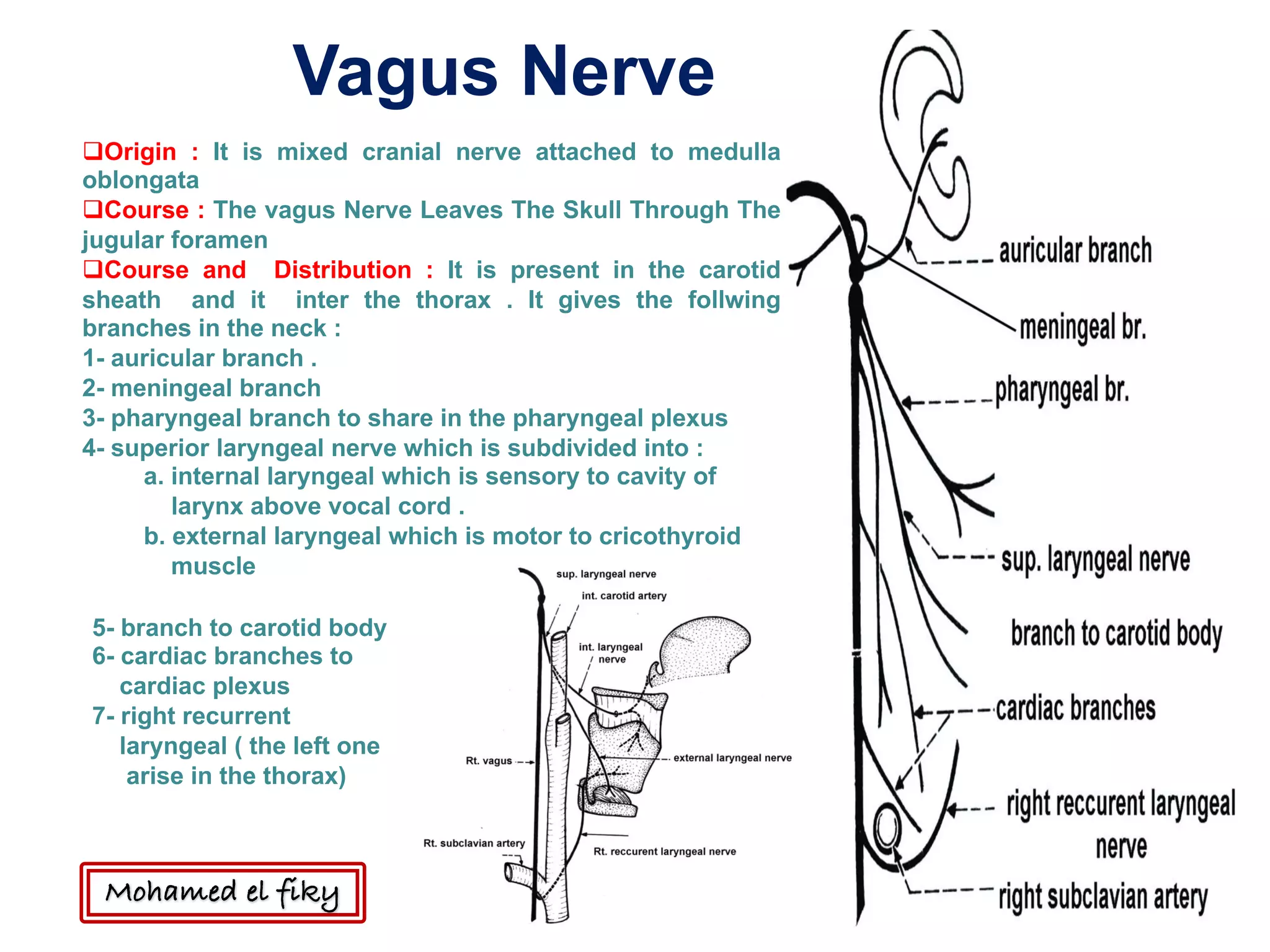
qOrigin : It is mixed cranial nerve attached to medulla
oblongata
qCourse : The vagus Nerve Leaves The Skull Through The
jugular foramen
qCourse and Distribution : It is present in the carotid
sheath and it inter the thorax . It gives the follwing
branches in the neck :
1- auricular branch .
2- meningeal branch
3- pharyngeal branch to share in the pharyngeal plexus
4- superior laryngeal nerve which is subdivided into :
a. internal laryngeal which is sensory to cavity of
larynx above vocal cord .
b. external laryngeal which is motor to cricothyroid
muscle
Vagus Nerve
5- branch to carotid body
6- cardiac branches to
cardiac plexus
7- right recurrent
laryngeal ( the left one
arise in the thorax)
Mohamed el fiky
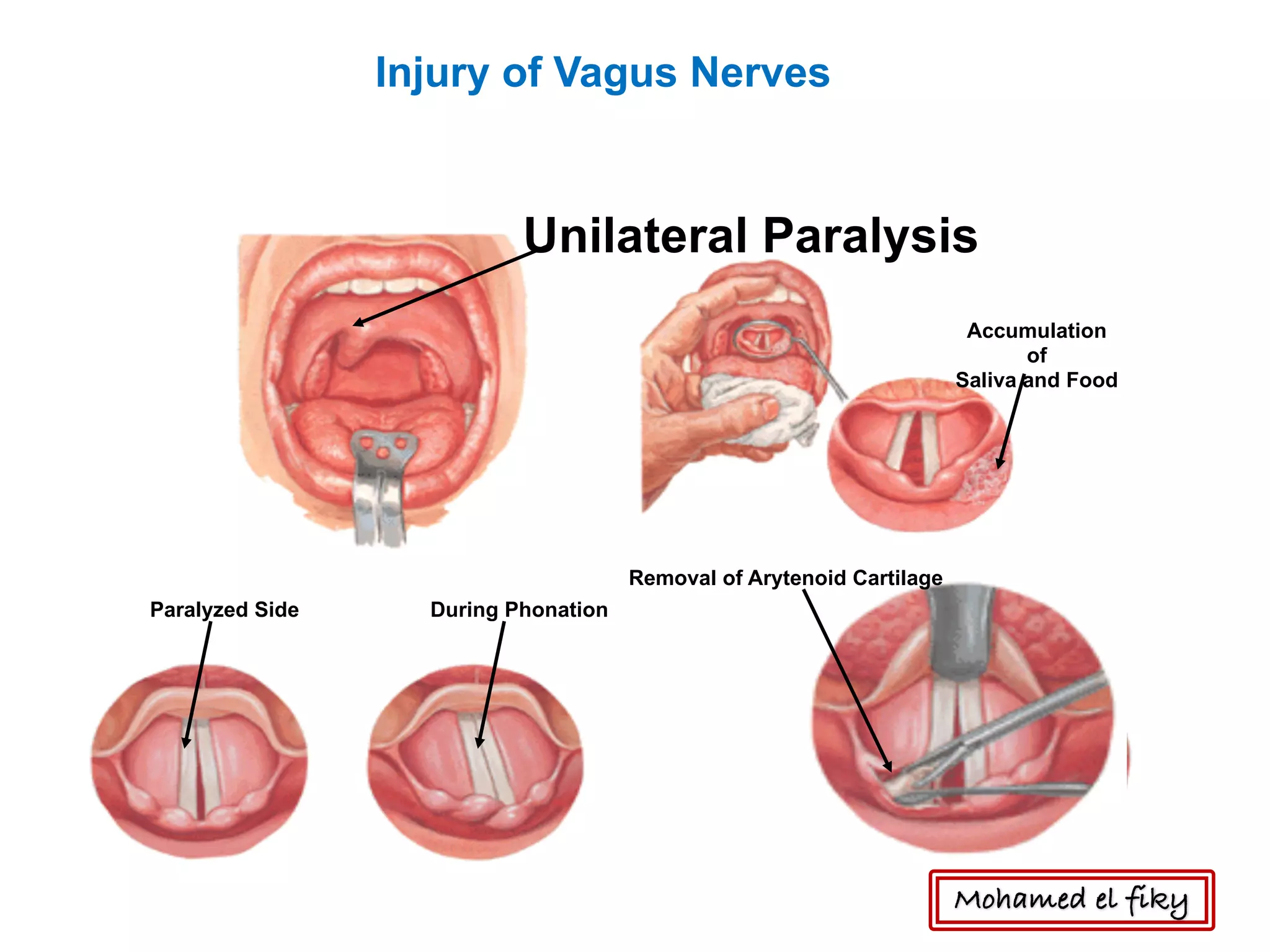
Unilateral Paralysis
Accumulation
of
Saliva and Food
Paralyzed Side During Phonation
Removal of Arytenoid Cartilage
Injury of Vagus Nerves
Mohamed el fiky
Accessory nerve
Accessory Nerve
Cranial Part
C1
C2
C3
C4
C5
Nucleus Ambiguous
Spinal Part
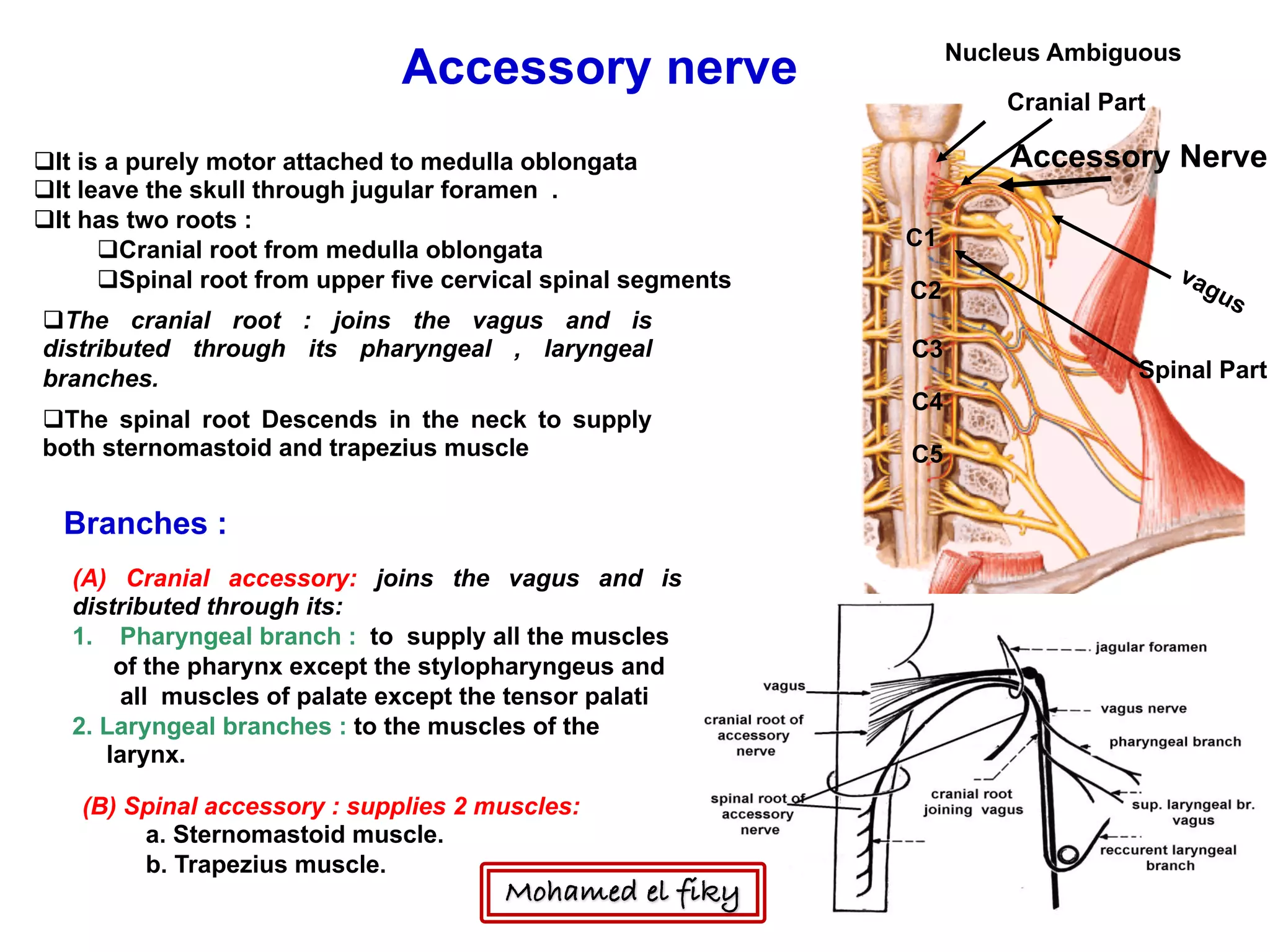
qIt is a purely motor attached to medulla oblongata
qIt leave the skull through jugular foramen .
qIt has two roots :
qCranial root from medulla oblongata
qSpinal root from upper five cervical spinal segments
qThe cranial root : joins the vagus and is
distributed through its pharyngeal , laryngeal
branches.
qThe spinal root Descends in the neck to supply
both sternomastoid and trapezius muscle
Branches :
(A) Cranial accessory: joins the vagus and is
distributed through its:
1. Pharyngeal branch : to supply all the muscles
of the pharynx except the stylopharyngeus and
all muscles of palate except the tensor palati
2. Laryngeal branches : to the muscles of the
larynx.
(B) Spinal accessory : supplies 2 muscles:
a. Sternomastoid muscle.
b. Trapezius muscle.
Mohamed el fiky
Thyro-
hyoid
Hypoglossal Nucleus
Omohyoid
Sternothyroid
Hypoglossal Nerve
Hypoglossal nerve
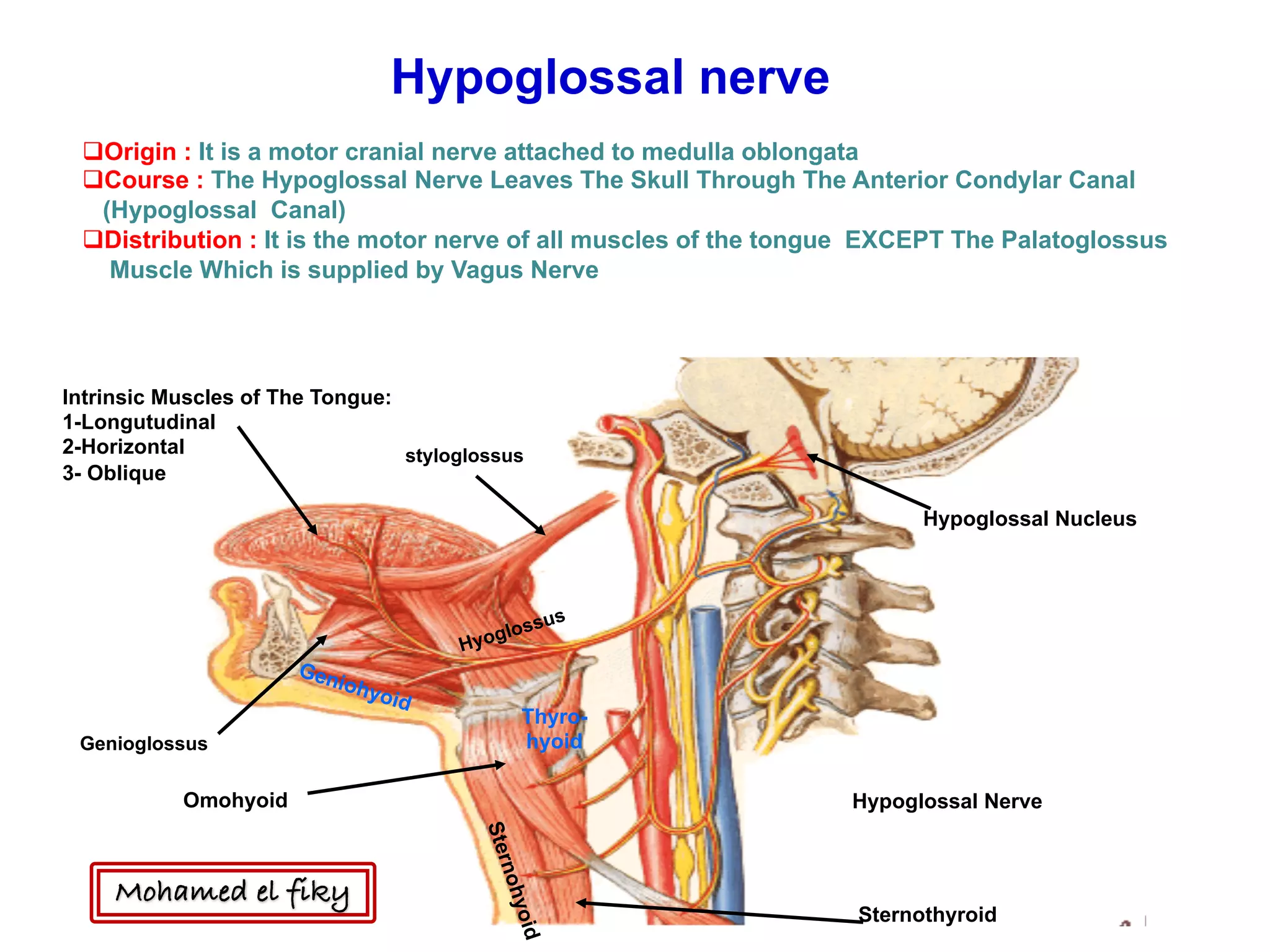
qOrigin : It is a motor cranial nerve attached to medulla oblongata
qCourse : The Hypoglossal Nerve Leaves The Skull Through The Anterior Condylar Canal
(Hypoglossal Canal)
qDistribution : It is the motor nerve of all muscles of the tongue EXCEPT The Palatoglossus
Muscle Which is supplied by Vagus Nerve
Intrinsic Muscles of The Tongue:
1-Longutudinal
2-Horizontal
3- Oblique
Genioglossus
styloglossus
Mohamed el fiky
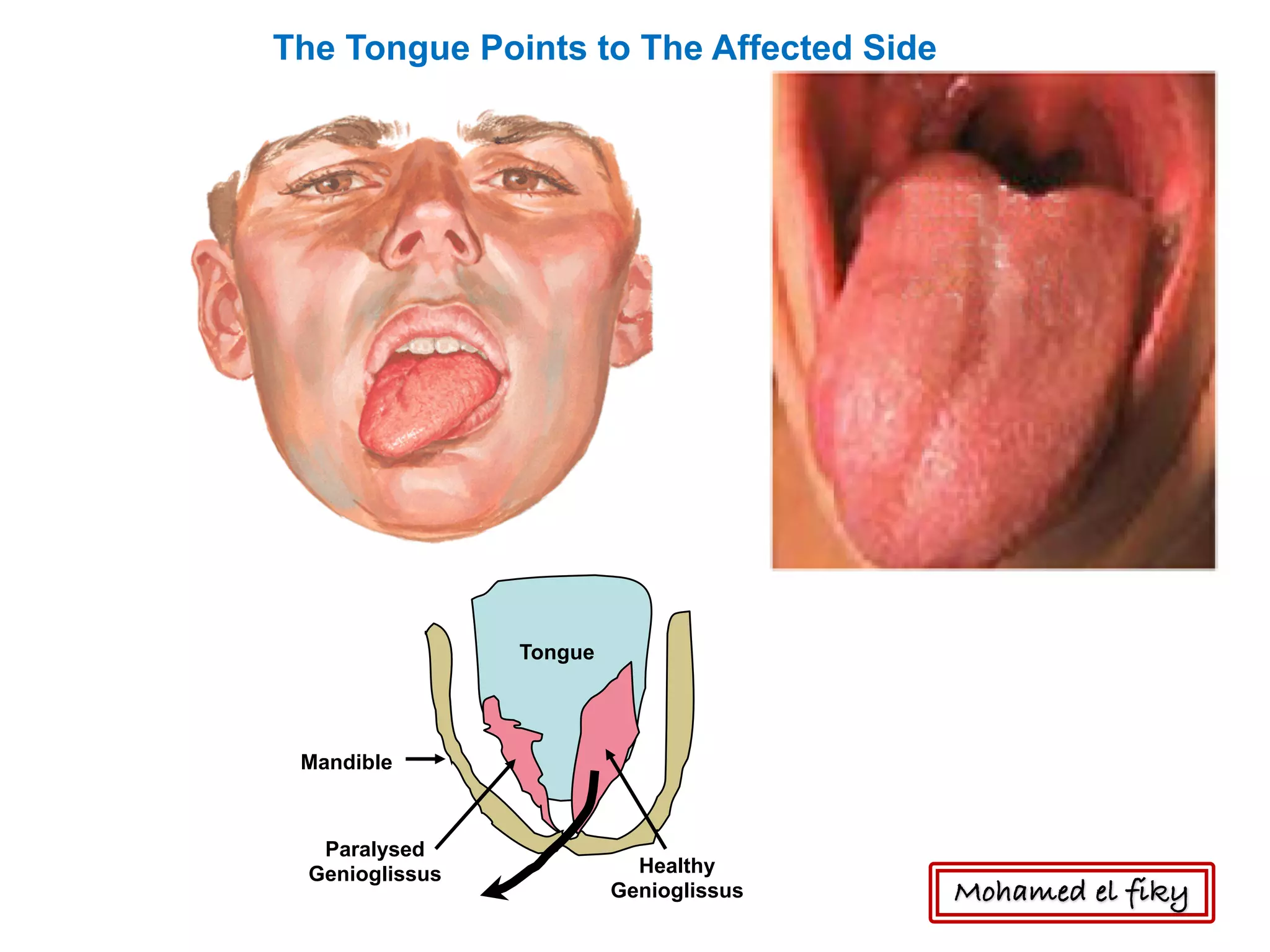
The Tongue Points to The Affected Side
Tongue
Healthy
Genioglissus
Mandible
Paralysed
Genioglissus
Mohamed el fiky
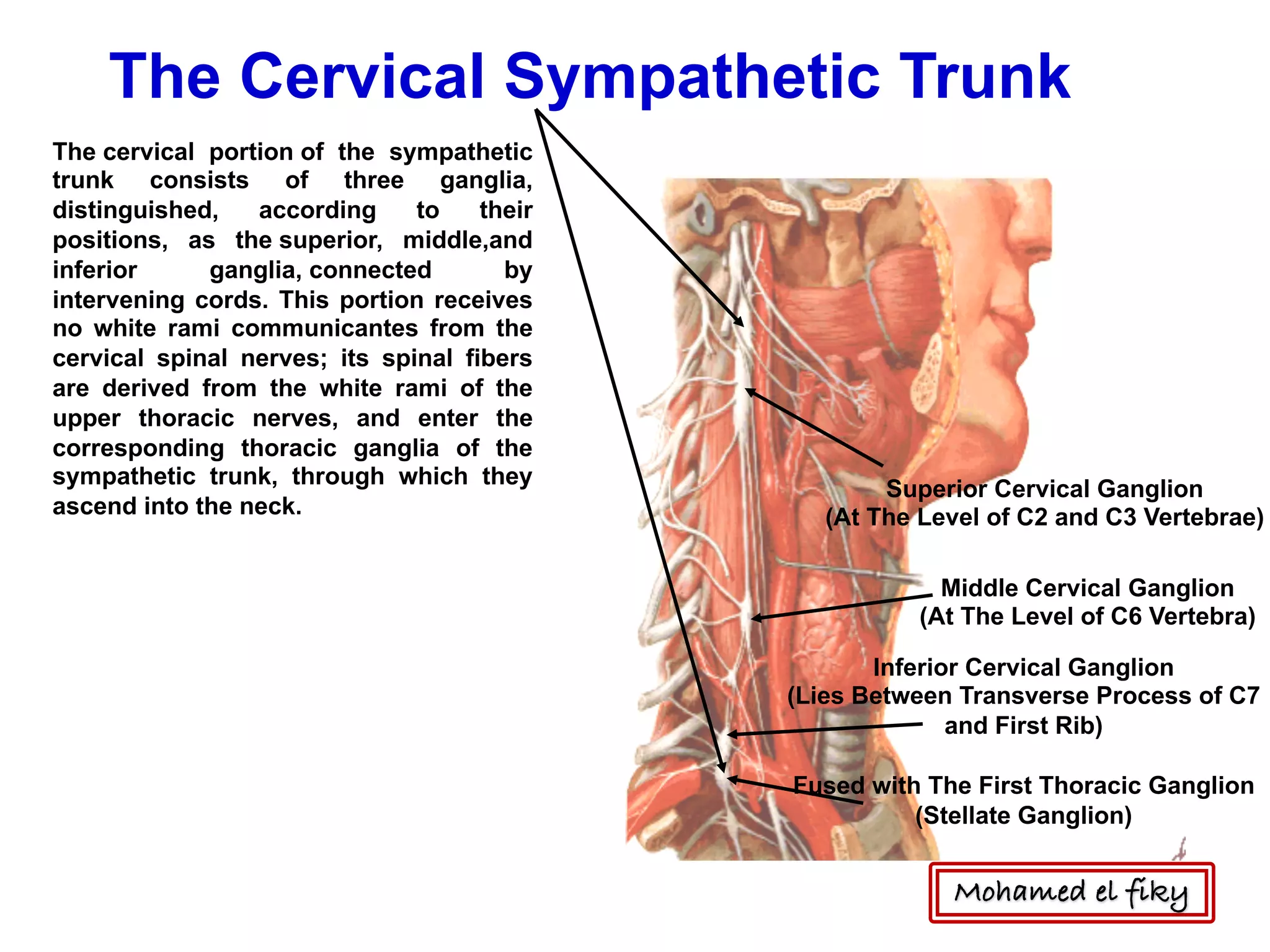
The Cervical Sympathetic Trunk
Superior Cervical Ganglion
(At The Level of C2 and C3 Vertebrae)
Middle Cervical Ganglion
(At The Level of C6 Vertebra)
Inferior Cervical Ganglion
(Lies Between Transverse Process of C7
and First Rib)
Fused with The First Thoracic Ganglion
(Stellate Ganglion)
The cervical portion of the sympathetic
trunk consists of three ganglia,
distinguished, according to their
positions, as the superior, middle,and
inferior ganglia, connected by
intervening cords. This portion receives
no white rami communicantes from the
cervical spinal nerves; its spinal fibers
are derived from the white rami of the
upper thoracic nerves, and enter the
corresponding thoracic ganglia of the
sympathetic trunk, through which they
ascend into the neck.
Mohamed el fiky
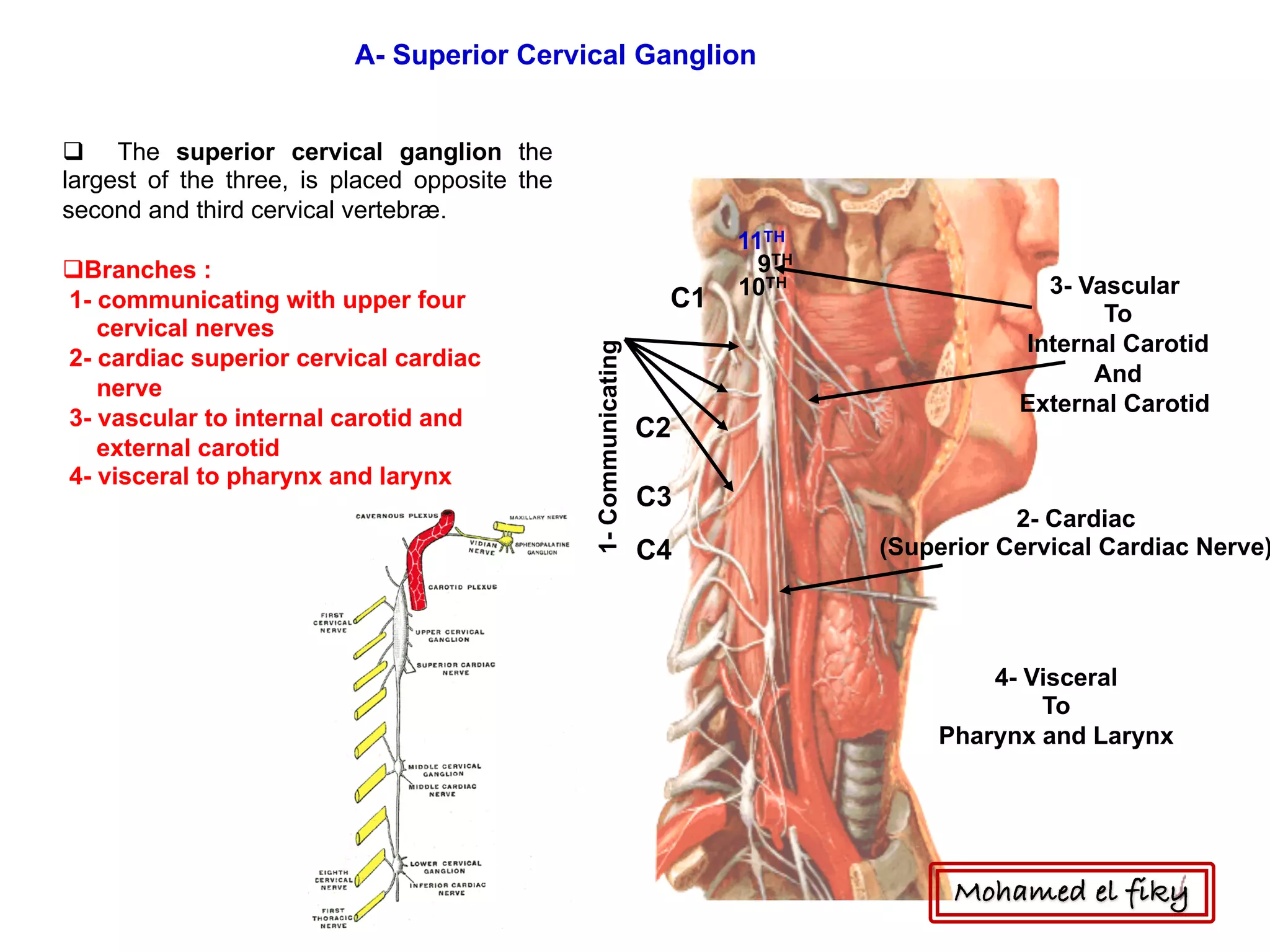
1-Communicating
C1
C2
C3
C4
9TH
10TH
11TH
2- Cardiac
(Superior Cervical Cardiac Nerve)
3- Vascular
To
Internal Carotid
And
External Carotid
4- Visceral
To
Pharynx and Larynx
A- Superior Cervical Ganglion
q The superior cervical ganglion the
largest of the three, is placed opposite the
second and third cervical vertebræ.
qBranches :
1- communicating with upper four
cervical nerves
2- cardiac superior cervical cardiac
nerve
3- vascular to internal carotid and
external carotid
4- visceral to pharynx and larynx
Mohamed el fiky
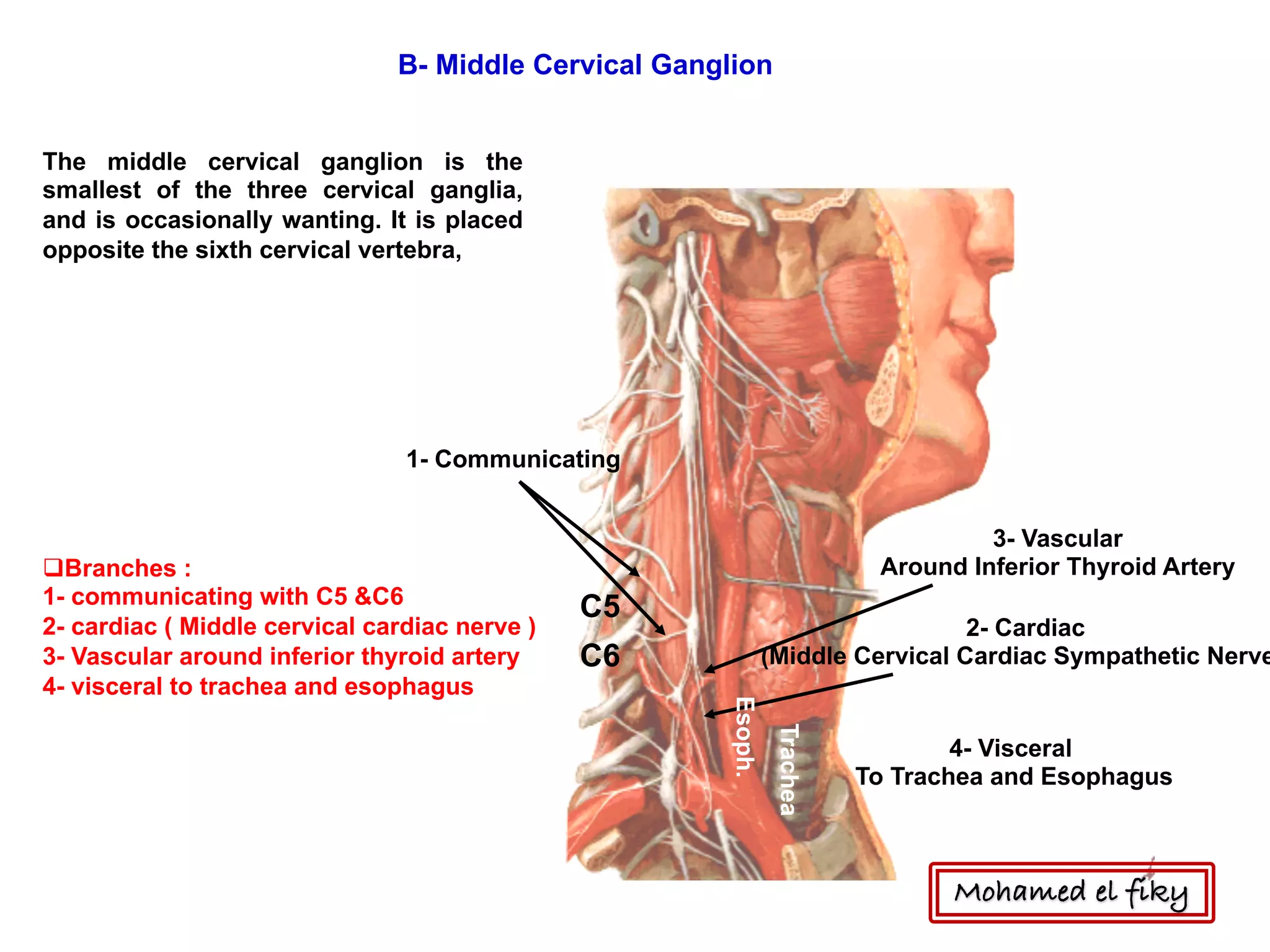
C5
C6
1- Communicating
2- Cardiac
(Middle Cervical Cardiac Sympathetic Nerve
3- Vascular
Around Inferior Thyroid Artery
4- Visceral
To Trachea and EsophagusTrachea
Esoph.
B- Middle Cervical Ganglion
The middle cervical ganglion is the
smallest of the three cervical ganglia,
and is occasionally wanting. It is placed
opposite the sixth cervical vertebra,
qBranches :
1- communicating with C5 &C6
2- cardiac ( Middle cervical cardiac nerve )
3- Vascular around inferior thyroid artery
4- visceral to trachea and esophagus
Mohamed el fiky
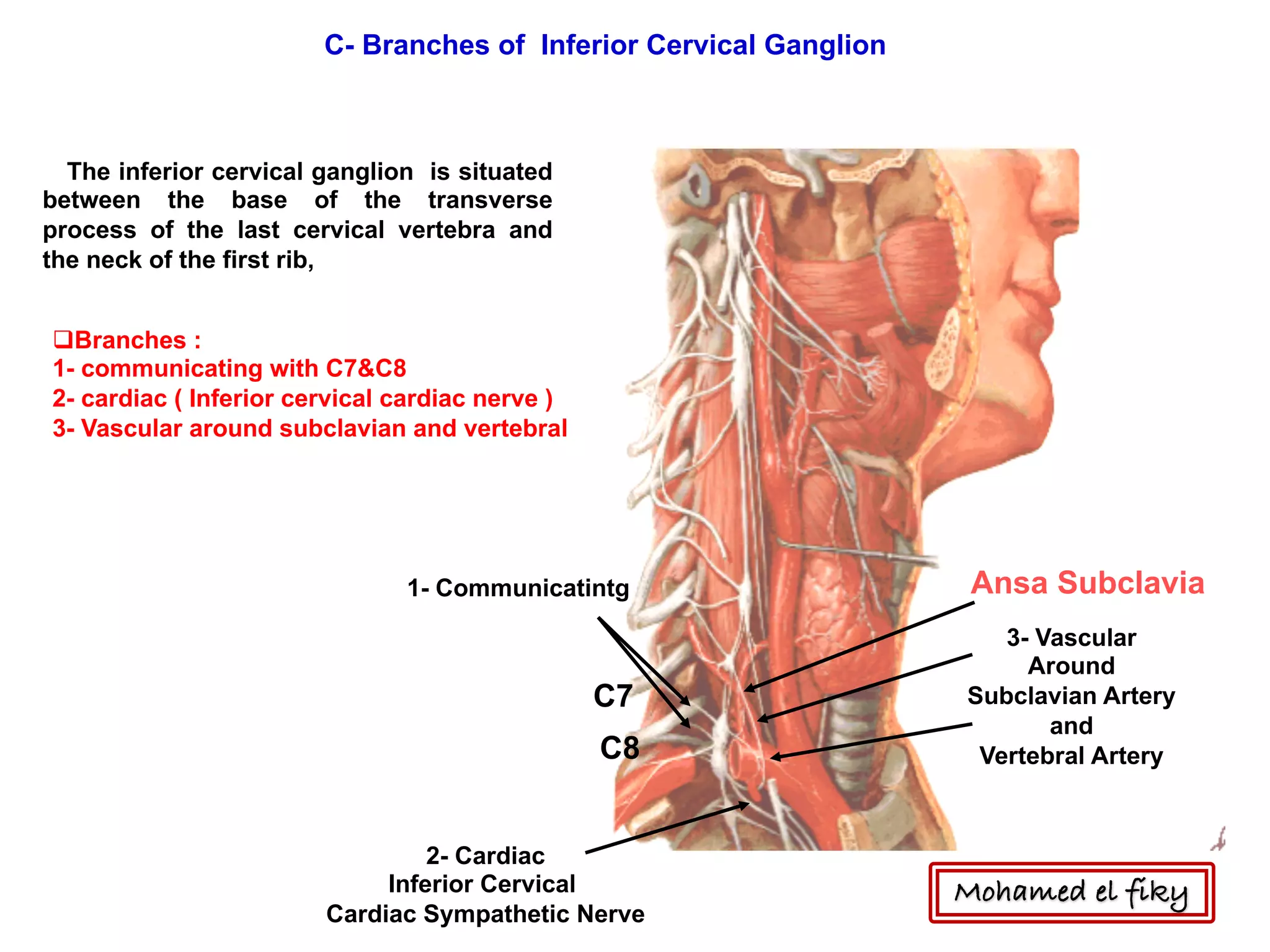
C- Branches of Inferior Cervical Ganglion
C7
C8
1- Communicatintg
2- Cardiac
Inferior Cervical
Cardiac Sympathetic Nerve
3- Vascular
Around
Subclavian Artery
and
Vertebral Artery
Ansa Subclavia
The inferior cervical ganglion is situated
between the base of the transverse
process of the last cervical vertebra and
the neck of the first rib,
qBranches :
1- communicating with C7&C8
2- cardiac ( Inferior cervical cardiac nerve )
3- Vascular around subclavian and vertebral
Mohamed el fiky
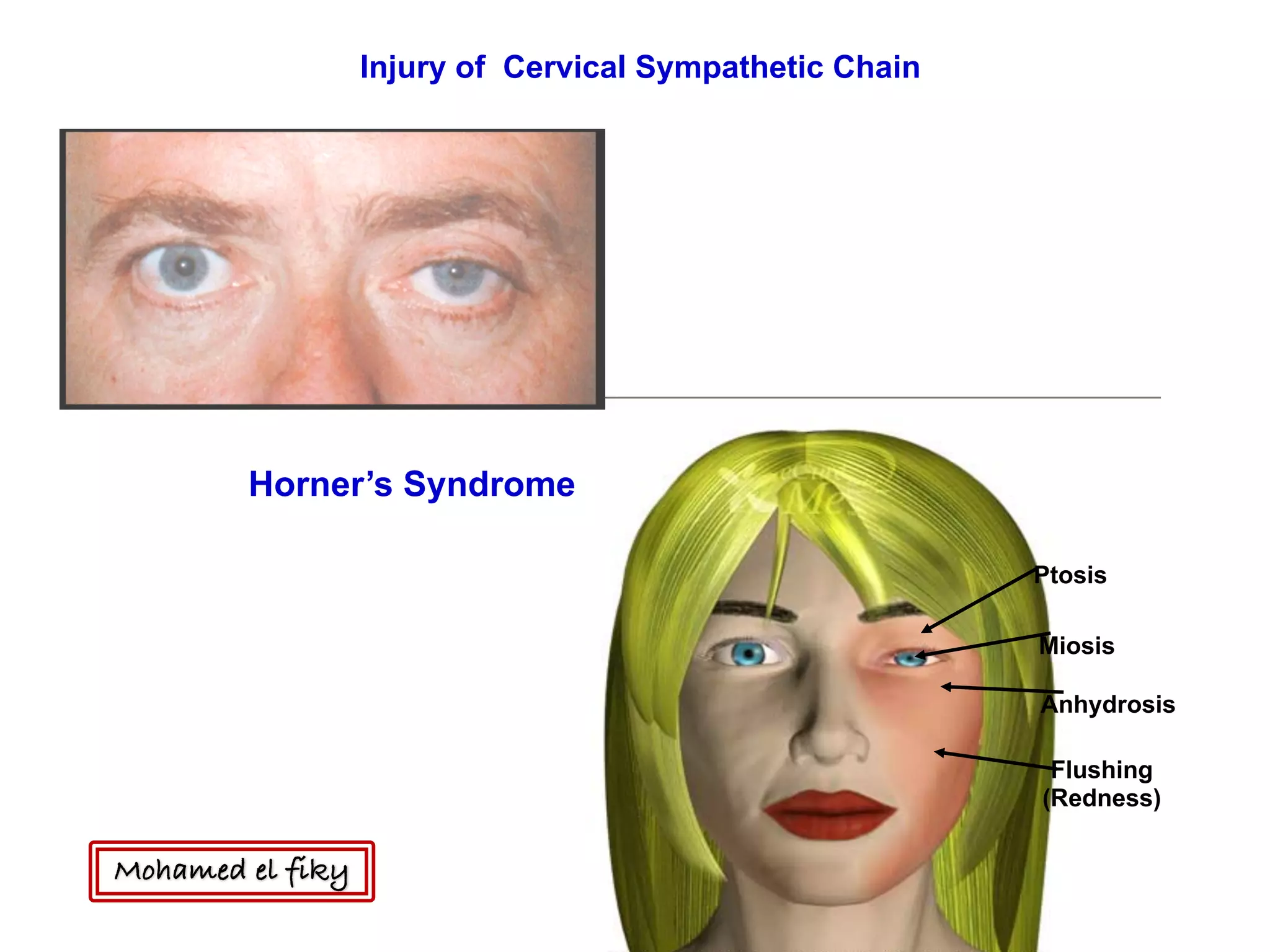
Horner’s Syndrome
Ptosis
Miosis
Anhydrosis
Flushing
(Redness)
Injury of Cervical Sympathetic Chain
Mohamed el fiky

Lower four cranial nerves bmc

  • 1.
    Head and Neck Lowerfour cranial nerves Professor Dr. Mohamed El Fiky Professor of anatomy and embryology
  • 2.
    Cranial Nerves Motor Sensorymixed 3,4,6,11&12 1,2&8 5,7,9,10 Cranial nerves contain parasympathetic fibers 3,7,9&10 Attachment of Cranial nerves to brain stem 3&4 midbrain 5,6,7&8 pons 9,10,11&12 Medulla oblongata Mohamed el fiky
  • 3.
    Rootlets of the HypoglossalNerve Olive Preolivary Fissure Pyramid oculomtor trochlear abducent facial vestibulocochlear glossopharyngeal vagus accessory trigeminal Attachment of Cranial nerves to brain stem Mohamed el fiky
  • 4.
    Vagus Nerve Facial Nerve Glossopharyngeal Nerve qOrigin: It is a mixed cranial nerve attached to medulla oblongata qCourse : The glossopharyngeal Nerve Leaves The Skull Through jugular foramen . Course and Distribution : qLeaves the skull thorough the jugular formen. qPasses with the stylopharyngeus between the external and internal carotid arteries qPasses deep to the hyoglossus muscle. q Enters the pharynx between the superior and middle constrictor muscles of the pharynx. Branches: 1. Tympanic nerve (nerve of jacopson): carry parasympathetic to to the parotid gland. 2. Carotid branch : to the carotid sinus and the carotid body. 3. Pharyngeal branches : forms the sensory part of the of the pharyngeal plexus; carrying sensations from the pharynx. 4. Muscular branch : supplies the stylopharyngeus muscle. 5. Tonsillar branches : to the palatine tonsil 6. Lingual branches : convey taste and general sensations from the posterior 1/3 of the tongue. Glossopharyngeal nerve Mohamed el fiky
  • 5.
    qOrigin : Itis mixed cranial nerve attached to medulla oblongata qCourse : The vagus Nerve Leaves The Skull Through The jugular foramen qCourse and Distribution : It is present in the carotid sheath and it inter the thorax . It gives the follwing branches in the neck : 1- auricular branch . 2- meningeal branch 3- pharyngeal branch to share in the pharyngeal plexus 4- superior laryngeal nerve which is subdivided into : a. internal laryngeal which is sensory to cavity of larynx above vocal cord . b. external laryngeal which is motor to cricothyroid muscle Vagus Nerve 5- branch to carotid body 6- cardiac branches to cardiac plexus 7- right recurrent laryngeal ( the left one arise in the thorax) Mohamed el fiky
  • 6.
    Unilateral Paralysis Accumulation of Saliva andFood Paralyzed Side During Phonation Removal of Arytenoid Cartilage Injury of Vagus Nerves Mohamed el fiky
  • 7.
    Accessory nerve Accessory Nerve CranialPart C1 C2 C3 C4 C5 Nucleus Ambiguous Spinal Part qIt is a purely motor attached to medulla oblongata qIt leave the skull through jugular foramen . qIt has two roots : qCranial root from medulla oblongata qSpinal root from upper five cervical spinal segments qThe cranial root : joins the vagus and is distributed through its pharyngeal , laryngeal branches. qThe spinal root Descends in the neck to supply both sternomastoid and trapezius muscle Branches : (A) Cranial accessory: joins the vagus and is distributed through its: 1. Pharyngeal branch : to supply all the muscles of the pharynx except the stylopharyngeus and all muscles of palate except the tensor palati 2. Laryngeal branches : to the muscles of the larynx. (B) Spinal accessory : supplies 2 muscles: a. Sternomastoid muscle. b. Trapezius muscle. Mohamed el fiky
  • 8.
    Thyro- hyoid Hypoglossal Nucleus Omohyoid Sternothyroid Hypoglossal Nerve Hypoglossalnerve qOrigin : It is a motor cranial nerve attached to medulla oblongata qCourse : The Hypoglossal Nerve Leaves The Skull Through The Anterior Condylar Canal (Hypoglossal Canal) qDistribution : It is the motor nerve of all muscles of the tongue EXCEPT The Palatoglossus Muscle Which is supplied by Vagus Nerve Intrinsic Muscles of The Tongue: 1-Longutudinal 2-Horizontal 3- Oblique Genioglossus styloglossus Mohamed el fiky
  • 9.
    The Tongue Pointsto The Affected Side Tongue Healthy Genioglissus Mandible Paralysed Genioglissus Mohamed el fiky
  • 10.
    The Cervical SympatheticTrunk Superior Cervical Ganglion (At The Level of C2 and C3 Vertebrae) Middle Cervical Ganglion (At The Level of C6 Vertebra) Inferior Cervical Ganglion (Lies Between Transverse Process of C7 and First Rib) Fused with The First Thoracic Ganglion (Stellate Ganglion) The cervical portion of the sympathetic trunk consists of three ganglia, distinguished, according to their positions, as the superior, middle,and inferior ganglia, connected by intervening cords. This portion receives no white rami communicantes from the cervical spinal nerves; its spinal fibers are derived from the white rami of the upper thoracic nerves, and enter the corresponding thoracic ganglia of the sympathetic trunk, through which they ascend into the neck. Mohamed el fiky
  • 11.
    1-Communicating C1 C2 C3 C4 9TH 10TH 11TH 2- Cardiac (Superior CervicalCardiac Nerve) 3- Vascular To Internal Carotid And External Carotid 4- Visceral To Pharynx and Larynx A- Superior Cervical Ganglion q The superior cervical ganglion the largest of the three, is placed opposite the second and third cervical vertebræ. qBranches : 1- communicating with upper four cervical nerves 2- cardiac superior cervical cardiac nerve 3- vascular to internal carotid and external carotid 4- visceral to pharynx and larynx Mohamed el fiky
  • 12.
    C5 C6 1- Communicating 2- Cardiac (MiddleCervical Cardiac Sympathetic Nerve 3- Vascular Around Inferior Thyroid Artery 4- Visceral To Trachea and EsophagusTrachea Esoph. B- Middle Cervical Ganglion The middle cervical ganglion is the smallest of the three cervical ganglia, and is occasionally wanting. It is placed opposite the sixth cervical vertebra, qBranches : 1- communicating with C5 &C6 2- cardiac ( Middle cervical cardiac nerve ) 3- Vascular around inferior thyroid artery 4- visceral to trachea and esophagus Mohamed el fiky
  • 13.
    C- Branches ofInferior Cervical Ganglion C7 C8 1- Communicatintg 2- Cardiac Inferior Cervical Cardiac Sympathetic Nerve 3- Vascular Around Subclavian Artery and Vertebral Artery Ansa Subclavia The inferior cervical ganglion is situated between the base of the transverse process of the last cervical vertebra and the neck of the first rib, qBranches : 1- communicating with C7&C8 2- cardiac ( Inferior cervical cardiac nerve ) 3- Vascular around subclavian and vertebral Mohamed el fiky
  • 14.