Introduction to Anatomy
Dr. Subina Gautam
MS. Clinical Anatomy
Course matter
• Explain the body as a whole
• Explain anatomical position of the body,
organs and cavities.
General concepts: Anatomy
• Anatomy is the study of the structure of the
body
• One of the oldest basic medical sciences
• Anatome (Greek)= cutting up/ taking apart
Subdivisions of Anatomy
• Gross Anatomy
– Regional anatomy
– Systemic anatomy
– Surface anatomy
– Radiological anatomy
• Neuroanatomy
• Histology
• Embryology
• Medical Genetics
• Comparative anatomy
• Anatomy of variations
Important anatomical terms
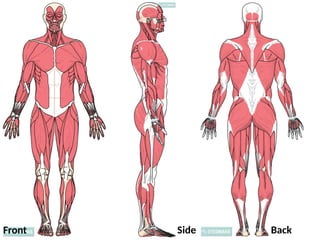
Anatomical position
• It is the standard reference position of the body used to
describe location of structures
The body is in the anatomical position when
• standing upright with feet together, hands by the side
and face looking forward
• mouth closed and the facial expression neutral
•eyes open and focused on something in the distance
•palms face forward with the fingers straight and
together and with the pad of the thumb turned 90° to
the pads of the fingers
•The toes point forward
Front Side Back
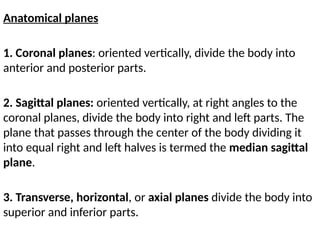
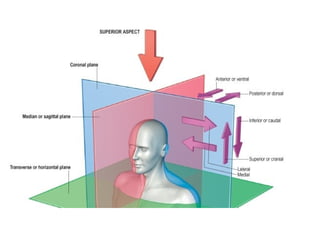
Anatomical planes
1. Coronal planes: oriented vertically, divide the body into
anterior and posterior parts.
2. Sagittal planes: oriented vertically, at right angles to the
coronal planes, divide the body into right and left parts. The
plane that passes through the center of the body dividing it
into equal right and left halves is termed the median sagittal
plane.
3. Transverse, horizontal, or axial planes divide the body into
superior and inferior parts.
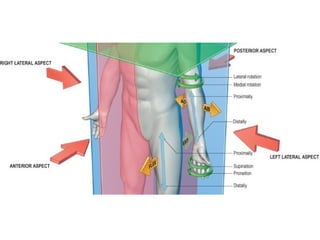
•Terms to describe location
Anterior (or ventral) and posterior (or dorsal): 'front' and
'back' of the body.
o For example, the nose is an anterior (ventral) structure
whereas the vertebral column is a posterior (dorsal)
structure. Also, the nose is anterior to the ears and the
vertebral column is posterior to the sternum.
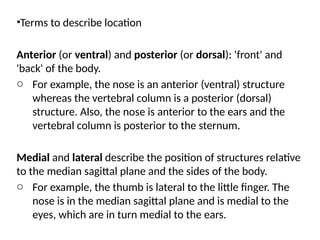
Medial and lateral describe the position of structures relative
to the median sagittal plane and the sides of the body.
o For example, the thumb is lateral to the little finger. The
nose is in the median sagittal plane and is medial to the
eyes, which are in turn medial to the ears.
•Superior and inferior (cranial and caudal) describe
structures in reference to the vertical axis of the body. Eg.
head is superior to the shoulders and the knee joint is inferior
to the hip joint
•Proximal and distal are used with reference to being closer
or farther from a structure's origin, particularly in the limbs.
o For example, the hand is distal to the elbow joint. The
shoulder joint is proximal to the elbow joint.
o These terms are also used to describe the relative
positions of branches along the course of linear structures,
such as airways, vessels, and nerves.
o Eg. The distal branches occur farther away towards the
ends of the system whereas proximal branches occur
closer and towards the origin of the system.
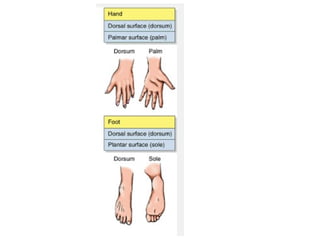
Superficial and Deep- are used to describe the
relative positions of two structures with respect
to the surface of the body. Eg. The sternum is
superficial to the heart, the stomach is deep to
the abdominal wall
Plantar and Palmar surfaces: In relation to sole
and palm respectively
Terminologies regarding movement at joints
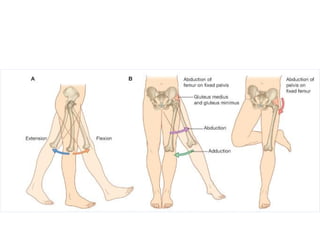
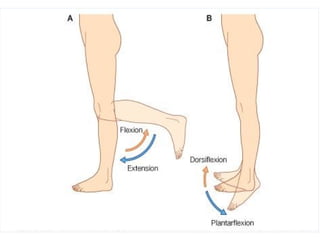
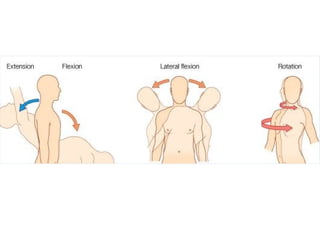
•Flexion: Decrease in angle of the joint while movement
•Extension: Increase in angle of the joint while movement
•Flexor surface: comes close during flexion
•Extensor surface: opposite to flexor surface
(These surfaces are different in upper and lower limb)
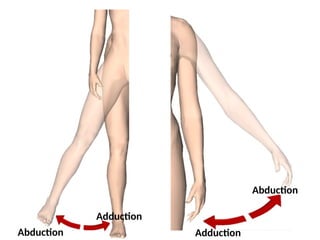
•Abduction: moving away from median plane
•Adduction: moving toward median plane
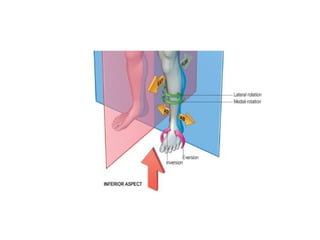
•Eversion: plantar surface turning laterally
•Inversion: plantar surface turning medially
Terms related to movement
• Flexion/ extension/ lateral flexion
• Dorsiflexion/plantarflexion
• Abduction/ adduction
• circumduction
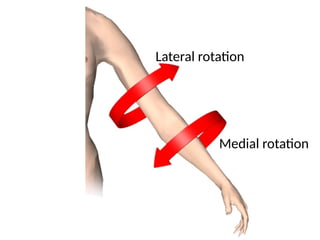
• Medial rotation/ lateral rotation
Terms related to position
• Medial/ lateral
• Anterior/ posterior
• Ventral, palmar, plantar/ dorsal
• Superior/ inferior
• Proximal/ distal
• Cephalic, cranial/ caudal
Terms related to position (contd..)
• Superficial/ intermediate/ deep
• External / internal
• Ipsilateral/ contralateral
• Supine/ prone
• Invagination/ evagination
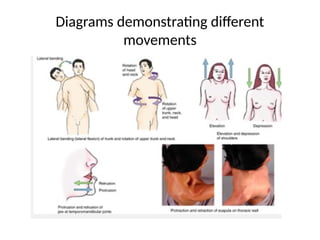
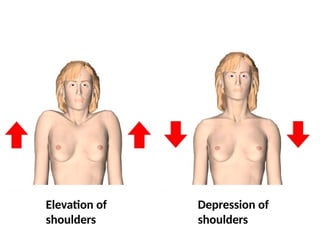
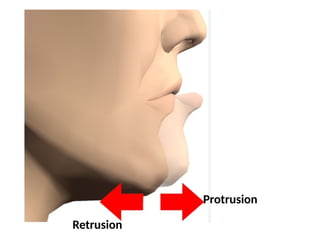
Diagrams demonstrating different
movements
Elevation of
shoulders
Depression of
shoulders
Lateral rotation
Medial rotation
Adduction
Abduction
Adduction
Abduction
Protrusion
Retrusion
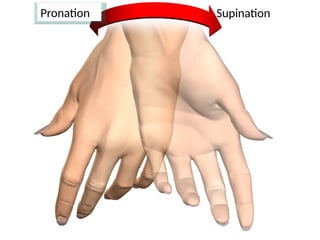
Supination
Pronation
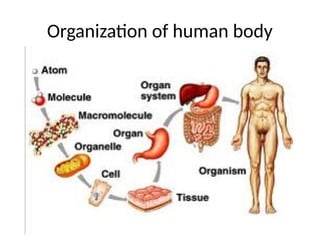
Organization of human body
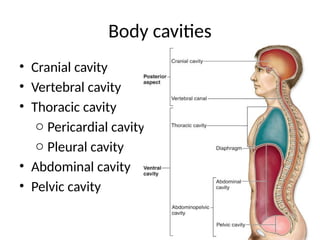
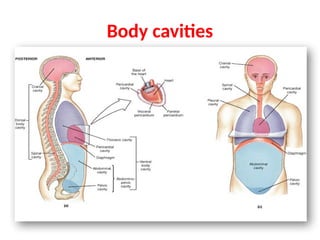
Body cavities
• Cranial cavity
• Vertebral cavity
• Thoracic cavity
o Pericardial cavity
o Pleural cavity
• Abdominal cavity
• Pelvic cavity
Contents of the body cavities
• Cranial: Brain, meninges
• Vertebral: Spinal cord
• Pericardial: Heart
• Pleural: Lungs
• Abdominal: Stomach, intestines, liver, spleen
• Pelvic: urinary bladder, uterus, prostate
Body Regions
• Human body is partitioned into 2 main
regions:
 Axial region includes head, neck, and trunk
which comprise main vertical axis of our
body
 Our limbs, or appendages, and limb girdles
attach to the body’s axis and make up
appendicular region
• Cephalic region: head
• Facial region: face
• Cervical region: neck
• Nuchal region: back of
neck
• Thoracic region: chest
• Abdominal region:
abdomen
• Inguinal region: groin
• Pubic region: external
genitalia
• Vertebral region: over
spine
• Interscapular region:
between scapula
• Perineal region: between
genitalia and anus
Axial region of body
Appendicular region of body
• Gluteal region: buttocks
• Scapular region: over shoulder girdle
• Axillary region: armpits
• Brachial region: arm
• Cubital region: elbow
• Antebrachial region: forearm
• Femoral region: thigh
• Crural region: leg
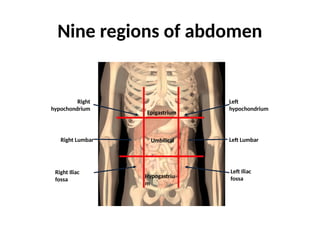
Nine regions of abdomen
Left
hypochondrium
Right
hypochondrium
Right Lumbar Left Lumbar
Left Iliac
fossa
Right Iliac
fossa
Epigastrium
Hypogastriu
m
Umbilical
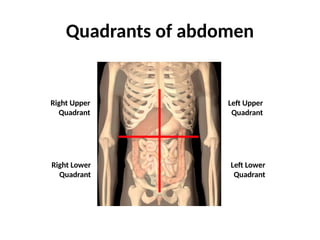
Quadrants of abdomen
Right Upper
Quadrant
Left Upper
Quadrant
Left Lower
Quadrant
Right Lower
Quadrant
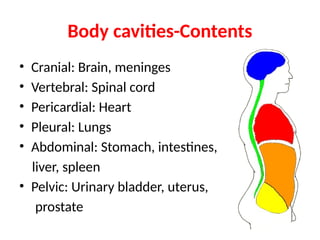
Body cavities-Contents
• Cranial: Brain, meninges
• Vertebral: Spinal cord
• Pericardial: Heart
• Pleural: Lungs
• Abdominal: Stomach, intestines,
liver, spleen
• Pelvic: Urinary bladder, uterus,
prostate
Body cavities
THANK YOU!

GENERAL INTRODUCTION.pptx details for nursesh

  • 1.
    Introduction to Anatomy Dr.Subina Gautam MS. Clinical Anatomy
  • 2.
    Course matter • Explainthe body as a whole • Explain anatomical position of the body, organs and cavities.
  • 3.
    General concepts: Anatomy •Anatomy is the study of the structure of the body • One of the oldest basic medical sciences • Anatome (Greek)= cutting up/ taking apart
  • 4.
    Subdivisions of Anatomy •Gross Anatomy – Regional anatomy – Systemic anatomy – Surface anatomy – Radiological anatomy • Neuroanatomy • Histology • Embryology • Medical Genetics • Comparative anatomy • Anatomy of variations
  • 5.
    Important anatomical terms Anatomicalposition • It is the standard reference position of the body used to describe location of structures The body is in the anatomical position when • standing upright with feet together, hands by the side and face looking forward • mouth closed and the facial expression neutral •eyes open and focused on something in the distance •palms face forward with the fingers straight and together and with the pad of the thumb turned 90° to the pads of the fingers •The toes point forward
  • 6.
  • 7.
    Anatomical planes 1. Coronalplanes: oriented vertically, divide the body into anterior and posterior parts. 2. Sagittal planes: oriented vertically, at right angles to the coronal planes, divide the body into right and left parts. The plane that passes through the center of the body dividing it into equal right and left halves is termed the median sagittal plane. 3. Transverse, horizontal, or axial planes divide the body into superior and inferior parts.
  • 8.
    •Terms to describelocation Anterior (or ventral) and posterior (or dorsal): 'front' and 'back' of the body. o For example, the nose is an anterior (ventral) structure whereas the vertebral column is a posterior (dorsal) structure. Also, the nose is anterior to the ears and the vertebral column is posterior to the sternum. Medial and lateral describe the position of structures relative to the median sagittal plane and the sides of the body. o For example, the thumb is lateral to the little finger. The nose is in the median sagittal plane and is medial to the eyes, which are in turn medial to the ears.
  • 12.
    •Superior and inferior(cranial and caudal) describe structures in reference to the vertical axis of the body. Eg. head is superior to the shoulders and the knee joint is inferior to the hip joint •Proximal and distal are used with reference to being closer or farther from a structure's origin, particularly in the limbs. o For example, the hand is distal to the elbow joint. The shoulder joint is proximal to the elbow joint. o These terms are also used to describe the relative positions of branches along the course of linear structures, such as airways, vessels, and nerves. o Eg. The distal branches occur farther away towards the ends of the system whereas proximal branches occur closer and towards the origin of the system.
  • 13.
    Superficial and Deep-are used to describe the relative positions of two structures with respect to the surface of the body. Eg. The sternum is superficial to the heart, the stomach is deep to the abdominal wall Plantar and Palmar surfaces: In relation to sole and palm respectively
  • 15.
    Terminologies regarding movementat joints •Flexion: Decrease in angle of the joint while movement •Extension: Increase in angle of the joint while movement •Flexor surface: comes close during flexion •Extensor surface: opposite to flexor surface (These surfaces are different in upper and lower limb) •Abduction: moving away from median plane •Adduction: moving toward median plane •Eversion: plantar surface turning laterally •Inversion: plantar surface turning medially
  • 16.
    Terms related tomovement • Flexion/ extension/ lateral flexion • Dorsiflexion/plantarflexion • Abduction/ adduction • circumduction • Medial rotation/ lateral rotation
  • 17.
    Terms related toposition • Medial/ lateral • Anterior/ posterior • Ventral, palmar, plantar/ dorsal • Superior/ inferior • Proximal/ distal • Cephalic, cranial/ caudal
  • 18.
    Terms related toposition (contd..) • Superficial/ intermediate/ deep • External / internal • Ipsilateral/ contralateral • Supine/ prone • Invagination/ evagination
  • 19.
  • 23.
  • 24.
  • 25.
  • 26.
  • 27.
  • 28.
  • 29.
    Body cavities • Cranialcavity • Vertebral cavity • Thoracic cavity o Pericardial cavity o Pleural cavity • Abdominal cavity • Pelvic cavity
  • 30.
    Contents of thebody cavities • Cranial: Brain, meninges • Vertebral: Spinal cord • Pericardial: Heart • Pleural: Lungs • Abdominal: Stomach, intestines, liver, spleen • Pelvic: urinary bladder, uterus, prostate
  • 31.
    Body Regions • Humanbody is partitioned into 2 main regions:  Axial region includes head, neck, and trunk which comprise main vertical axis of our body  Our limbs, or appendages, and limb girdles attach to the body’s axis and make up appendicular region
  • 32.
    • Cephalic region:head • Facial region: face • Cervical region: neck • Nuchal region: back of neck • Thoracic region: chest • Abdominal region: abdomen • Inguinal region: groin • Pubic region: external genitalia • Vertebral region: over spine • Interscapular region: between scapula • Perineal region: between genitalia and anus Axial region of body
  • 33.
    Appendicular region ofbody • Gluteal region: buttocks • Scapular region: over shoulder girdle • Axillary region: armpits • Brachial region: arm • Cubital region: elbow • Antebrachial region: forearm • Femoral region: thigh • Crural region: leg
  • 34.
    Nine regions ofabdomen Left hypochondrium Right hypochondrium Right Lumbar Left Lumbar Left Iliac fossa Right Iliac fossa Epigastrium Hypogastriu m Umbilical
  • 35.
    Quadrants of abdomen RightUpper Quadrant Left Upper Quadrant Left Lower Quadrant Right Lower Quadrant
  • 36.
    Body cavities-Contents • Cranial:Brain, meninges • Vertebral: Spinal cord • Pericardial: Heart • Pleural: Lungs • Abdominal: Stomach, intestines, liver, spleen • Pelvic: Urinary bladder, uterus, prostate
  • 37.
  • 38.

Editor's Notes

  • #6 standing upright with feet together, hands by the side and face looking forward mouth closed and the facial expression neutral eyes open and focused on something in the distance palms face forward with the fingers straight and together and with the pad of the thumb turned 90° to the pads of the fingers The toes point forward