Development of head and neck
Professor Dr. Mohamed El Fiky
Professor of anatomy and embryology
Pharyngeal arches & pouches
Face , tongue , palate and nasal cavity
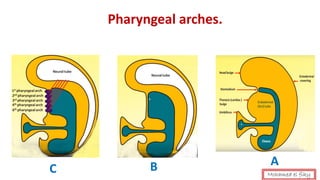
Pharyngeal arches.
C B A
Mohamed el fiky
Development of head and neck
• The most distinctive feature in development of the
head and neck is the presence of pharyngeal arches.
These arches appear in the fourth and fifth weeks of
development and contribute to the characteristic
external appearance of the embryo . Initially, they
consist of bars of mesenchymal tissue separated by
deep clefts known as pharyngeal cleft.
• Simultaneously, with development of the arches and
clefts, a number of out pocketings , the pharyngeal
pouches, appear along the lateral walls of the pharynx,
the most cranial part of the foregut .
Mohamed el fiky
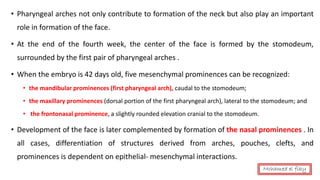
• Pharyngeal arches not only contribute to formation of the neck but also play an important
role in formation of the face.
• At the end of the fourth week, the center of the face is formed by the stomodeum,
surrounded by the first pair of pharyngeal arches .
• When the embryo is 42 days old, five mesenchymal prominences can be recognized:
• the mandibular prominences (first pharyngeal arch), caudal to the stomodeum;
• the maxillary prominences (dorsal portion of the first pharyngeal arch), lateral to the stomodeum; and
• the frontonasal prominence, a slightly rounded elevation cranial to the stomodeum.
• Development of the face is later complemented by formation of the nasal prominences . In
all cases, differentiation of structures derived from arches, pouches, clefts, and
prominences is dependent on epithelial- mesenchymal interactions.
Mohamed el fiky
PHARYNGEAL ARCHES
• Each pharyngeal arch consists of a core of mesenchymal tissue covered on the outside by
surface ectoderm and on the inside by epithelium of endodermal origin . In addition to
mesenchyme derived from paraxial and lateral plate mesoderm, the core of each arch
receives
• Substantial numbers of neural crest cells, which migrate into the arches to contribute to
skeletal components of the face. The original mesoderm of the arches gives rise to the
musculature of the face and neck. Thus, each pharyngeal arch is characterized by its own
muscular components.
• The muscular components of each arch have their own cranial nerve, and wherever the
muscle cells migrate, they carry their nerve component with them . In addition, each arch
has its own arterial component .
Mohamed el fiky
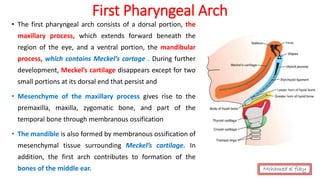
First Pharyngeal Arch
• The first pharyngeal arch consists of a dorsal portion, the
maxillary process, which extends forward beneath the
region of the eye, and a ventral portion, the mandibular
process, which contains Meckel’s cartage . During further
development, Meckel’s cartilage disappears except for two
small portions at its dorsal end that persist and
• Mesenchyme of the maxillary process gives rise to the
premaxilla, maxilla, zygomatic bone, and part of the
temporal bone through membranous ossification
• The mandible is also formed by membranous ossification of
mesenchymal tissue surrounding Meckel’s cartilage. In
addition, the first arch contributes to formation of the
bones of the middle ear. Mohamed el fiky
• Musculature of the first pharyngeal arch includes the muscles of mastication
(temporalis, masseter, and pterygoids), anterior belly of the digastric, mylohyoid, tensor
tympani, and tensor palatini.
• The nerve supply to the muscles of the first arch is provided by the mandibular branch of
the trigeminal nerve . Because mesenchyme from the first arch also contributes to the
dermis of the face, sensory supply to the skin of the face is provided by ophthalmic,
maxillary, and mandibular branches of the trigeminal nerve.
• Muscles of the arches do not always attach to the bony or cartilaginous components of
their own arch but sometimes migrate into surrounding regions. Nevertheless, the origin
of these muscles can always be traced because their nerve supply is derived from the
arch of origin. Mohamed el fiky
Second Pharyngeal Arch
• The cartilage of the second or hyoid arch (Reichert’s cartilage) gives rise
to the stapes, styloid process of the temporal bone, stylohyoid ligament,
and ventrally, the lesser horn and upper part of the body of the hyoid
bone . Muscles of the hyoid arch are the stapedius, stylohyoid, posterior
belly of the digastric, auricular, and muscles of facial expression. The
facial nerve, the nerve of the second arch, supplies all of these muscles.
Mohamed el fiky
Third Pharyngeal Arch
• The cartilage of the third pharyngeal arch produces the lower part of
the body and greater horn of the hyoid bone . The musculature is
limited to the stylopharyngeus muscles. These muscles are innervated
by the glossopharyngeal nerve, the nerve of the third arch .
Mohamed el fiky
Fourth and Sixth Pharyngeal Arches
• Cartilaginous components of the fourth and sixth pharyngeal arches
fuse to form the thyroid, cricoid, arytenoid, corniculate, and cuneiform
cartilages of the larynx . Muscles of the fourth arch (cricothyroid,
levator palatini, and constrictors of the pharynx) are innervated by the
superior laryngeal branch of the vagus, the nerve of the fourth arch.
Intrinsic muscles of the larynx are supplied by the recurrent laryngeal
branch of the vagus, the nerve of the sixth arch.
Mohamed el fiky
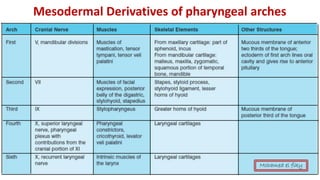
Mesodermal Derivatives of pharyngeal arches
Mohamed el fiky
Mohamed el fiky
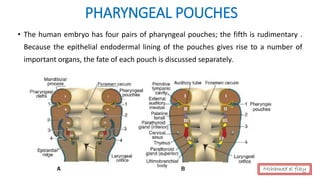
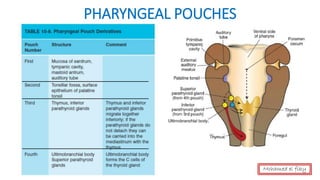
• The human embryo has four pairs of pharyngeal pouches; the fifth is rudimentary .
Because the epithelial endodermal lining of the pouches gives rise to a number of
important organs, the fate of each pouch is discussed separately.
PHARYNGEAL POUCHES
Mohamed el fiky
PHARYNGEAL POUCHES
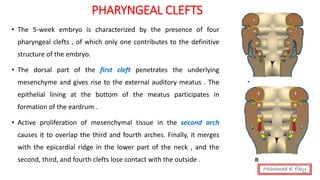
PHARYNGEAL CLEFTS
• The 5-week embryo is characterized by the presence of four
pharyngeal clefts , of which only one contributes to the definitive
structure of the embryo.
• The dorsal part of the first cleft penetrates the underlying
mesenchyme and gives rise to the external auditory meatus . The
epithelial lining at the bottom of the meatus participates in
formation of the eardrum .
• Active proliferation of mesenchymal tissue in the second arch
causes it to overlap the third and fourth arches. Finally, it merges
with the epicardial ridge in the lower part of the neck , and the
second, third, and fourth clefts lose contact with the outside .
Mohamed el fiky
Clinical Correlates
• Ectopic Thymic and Parathyroid Tissue : Because glandular tissue
derived from the pouches undergoes migration, it is not unusual for
accessory glands or remnants of tissue to persist along the pathway.
This is true particularly for thymic tissue, which may remain in the neck,
and for the parathyroid glands. The inferior parathyroids are more
variable in position than the superior ones and are some- times found
at the bifurcation of the common carotid artery.
Mohamed el fiky
• Branchial Fistulas : Branchial fistulas occur when the second pharyngeal
arch fails to grow caudally over the third and fourth arches, leaving
remnants of the second, third, and fourth clefts in contact with the surface
by a narrow canal . Such a fistula, found on the lateral aspect of the neck
directly anterior to the sternocleidomastoid muscle.
• Internal branchial fistulas : are rare; they occur when the cervical sinus is
connected to the lumen of the pharynx by a small canal, which usually
opens in the tonsillar region . Such a fistula results from a rupture of the
membrane between the second pharyngeal cleft and pouch at some time
during development
Clinical Correlates
Mohamed el fiky
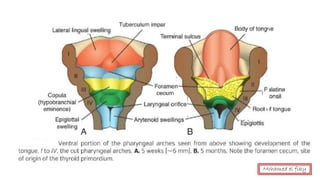
• The tongue appears in embryos of approximately 4 weeks in the form of two
lateral lingual swellings and one medial swelling, the tuberculum impar .
• These three swellings originate from the first pharyngeal arch. A second
median swelling, the copula, or hypobranchial eminence, is formed by
mesoderm of the second, third, and part of the fourth arch.
• Finally, a third median swelling, formed by the posterior part of the fourth
arch, marks development of the epiglottis. Immediately behind this swelling is
the laryngeal orifice, which is flanked by the arytenoid swellings
• As the lateral lingual swellings increase in size, they overgrow the tuberculum
impar and merge, forming the anterior two-thirds, or body, of the tongue .
TONGUE
Mohamed el fiky
• Because the mucosa covering the body of the tongue originates from the
first pharyngeal arch, sensory innervation to this area is by the mandibular
branch of the trigeminal nerve ( Lingual nerve ) .
• The body of the tongue is separated from the posterior third by a V-shaped
groove, the terminal sulcus
• The posterior part, or root, of the tongue originates from the second, third,
and parts of the fourth pharyngeal arch. The fact that sensory innervation to
this part of the tongue is supplied by the glossopharyngeal nerve indicates
that tissue of the third arch overgrows that of the second.
Mohamed el fiky
• The epiglottis and the extreme posterior part of the tongue are
innervated by the superior laryngeal nerve, reflecting their
development from the fourth arch.
• Some of the tongue muscles probably differentiate in situ, but most
are derived from myoblasts originating in occipital somites. Thus,
tongue musculature is innervated by the hypoglossal nerve.
Mohamed el fiky
Mohamed el fiky
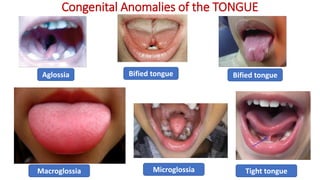
Aglossia Bified tongue Bified tongue
Macroglossia Microglossia Tight tongue
Congenital Anomalies of the TONGUE
Development of FACE
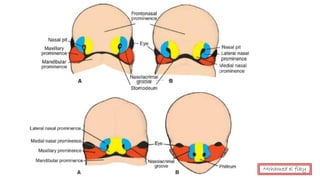
• At the end of the fourth week, facial prominences consisting primarily of neural
crest-derived mesenchyme and formed mainly by the first pair of pharyngeal
arches appear. Maxillary prominences can be distinguished lateral to the
stomodeum, and mandibular prominences can be distinguished caudal to this
structure . The frontonasal prominence, formed by proliferation of mesenchyme
ventral to the brain vesicles, constitutes the upper border of the stomodeum. On
both sides of the frontonasal prominence, local thickenings of the surface
ectoderm, the nasal (olfactory) placodes, originate under inductive influence of
the ventral portion of the forebrain
Mohamed el fiky
Mohamed el fiky
• During the fifth week, the nasal placodes invaginate to form nasal pits. In so doing, they create a ridge of tissue that
surrounds each pit and forms the nasal prominences.
• The prominences on the outer edge of the pits are the lateral nasal prominences; those on the inner edge are the medial
nasal prominences
• During the following 2 weeks, the maxillary prominences continue to increase in size. Simultaneously, they grow medially,
compressing the medial nasal prominences toward the midline. Subsequently, the cleft between the medial nasal
prominence and the maxillary prominence is lost, and the two fuse .
• Hence, the upper lip is formed by the two medial nasal prominences and the two maxillary prominences. The lateral
nasal prominences do not participate in formation of the upper lip.
Mohamed el fiky
• The lower lip and jaw form from the mandibular prominences that merge across the midline.
• Initially, the maxillary and lateral nasal prominences are separated by a deep furrow, the
nasolacrimal groove . Ectoderm in the floor of this groove forms a solid epithelial cord that
detaches from the overlying ectoderm.
• After canalization, the cord forms the nasolacrimal duct; its upper end widens to form the
lacrimal sac. Following detachment of the cord, the maxillary and lateral nasal prominences
merge with each other.
• The nasolacrimal duct then runs from the medial corner of the eye to the inferior meatus of the
nasal cavity, and the maxillary prominences enlarge to form the cheeks and maxillae.
• The nose is formed from five facial prominences : the frontal prominence gives rise to the
bridge, the merged medial nasal prominences provide the crest and tip, and the lateral nasal
prominences form the sides (alae)
Mohamed el fiky
Unilateral cleft lip
Bilateral cleft lip
Facial cleft
Mohamed el fiky
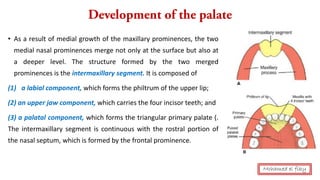
• As a result of medial growth of the maxillary prominences, the two
medial nasal prominences merge not only at the surface but also at
a deeper level. The structure formed by the two merged
prominences is the intermaxillary segment. It is composed of
(1) a labial component, which forms the philtrum of the upper lip;
(2) an upper jaw component, which carries the four incisor teeth; and
(3) a palatal component, which forms the triangular primary palate (.
The intermaxillary segment is continuous with the rostral portion of
the nasal septum, which is formed by the frontal prominence.
Mohamed el fiky
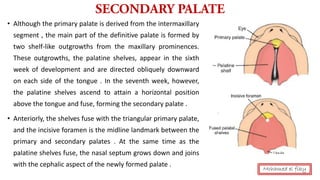
• Although the primary palate is derived from the intermaxillary
segment , the main part of the definitive palate is formed by
two shelf-like outgrowths from the maxillary prominences.
These outgrowths, the palatine shelves, appear in the sixth
week of development and are directed obliquely downward
on each side of the tongue . In the seventh week, however,
the palatine shelves ascend to attain a horizontal position
above the tongue and fuse, forming the secondary palate .
• Anteriorly, the shelves fuse with the triangular primary palate,
and the incisive foramen is the midline landmark between the
primary and secondary palates . At the same time as the
palatine shelves fuse, the nasal septum grows down and joins
with the cephalic aspect of the newly formed palate .
Mohamed el fiky
Clinical Correlates
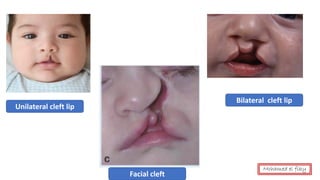
• Facial Clefts
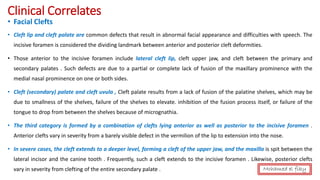
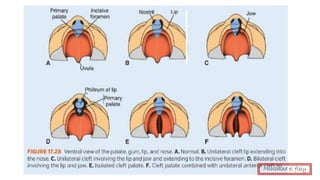
• Cleft lip and cleft palate are common defects that result in abnormal facial appearance and difficulties with speech. The
incisive foramen is considered the dividing landmark between anterior and posterior cleft deformities.
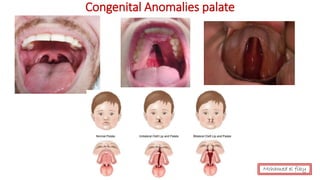
• Those anterior to the incisive foramen include lateral cleft lip, cleft upper jaw, and cleft between the primary and
secondary palates . Such defects are due to a partial or complete lack of fusion of the maxillary prominence with the
medial nasal prominence on one or both sides.
• Cleft (secondary) palate and cleft uvula , Cleft palate results from a lack of fusion of the palatine shelves, which may be
due to smallness of the shelves, failure of the shelves to elevate. inhibition of the fusion process itself, or failure of the
tongue to drop from between the shelves because of micrognathia.
• The third category is formed by a combination of clefts lying anterior as well as posterior to the incisive foramen .
Anterior clefts vary in severity from a barely visible defect in the vermilion of the lip to extension into the nose.
• In severe cases, the cleft extends to a deeper level, forming a cleft of the upper jaw, and the maxilla is spit between the
lateral incisor and the canine tooth . Frequently, such a cleft extends to the incisive foramen . Likewise, posterior clefts
vary in severity from clefting of the entire secondary palate . Mohamed el fiky
Mohamed el fiky
Congenital Anomalies palate
Mohamed el fiky
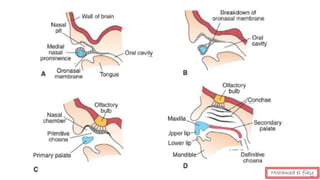
• During the sixth week, the nasal pits deepen considerably, partly because of growth of
the surrounding nasal prominences and partly because of their penetration into the
underlying mesenchyme . At first. the oronasal membrane separates the pits from the
primitive oral cavity by way of the newly formed foramina, the primitive choanae
• These choanae lie on each side of the midline and immediately behind the primary
palate. Later, with formation of the secondary palate and further development of the
primitive nasal chambers , the definitive choanae lie at the junction of the nasal cavity
and the pharynx. Paranasal air sinuses develop as diverticula of the lateral nasal wall
and extend into the maxilla, ethmoid, frontal, and sphenoid bones. They reach their
maximum size during puberty and contribute to the definitive shape of the face.
NASAL CAVITIES
Mohamed el fiky
Mohamed el fiky

Development of head and neck

  • 1.
    Development of headand neck Professor Dr. Mohamed El Fiky Professor of anatomy and embryology Pharyngeal arches & pouches Face , tongue , palate and nasal cavity
  • 2.
    Pharyngeal arches. C BA Mohamed el fiky
  • 3.
    Development of headand neck • The most distinctive feature in development of the head and neck is the presence of pharyngeal arches. These arches appear in the fourth and fifth weeks of development and contribute to the characteristic external appearance of the embryo . Initially, they consist of bars of mesenchymal tissue separated by deep clefts known as pharyngeal cleft. • Simultaneously, with development of the arches and clefts, a number of out pocketings , the pharyngeal pouches, appear along the lateral walls of the pharynx, the most cranial part of the foregut . Mohamed el fiky
  • 4.
    • Pharyngeal archesnot only contribute to formation of the neck but also play an important role in formation of the face. • At the end of the fourth week, the center of the face is formed by the stomodeum, surrounded by the first pair of pharyngeal arches . • When the embryo is 42 days old, five mesenchymal prominences can be recognized: • the mandibular prominences (first pharyngeal arch), caudal to the stomodeum; • the maxillary prominences (dorsal portion of the first pharyngeal arch), lateral to the stomodeum; and • the frontonasal prominence, a slightly rounded elevation cranial to the stomodeum. • Development of the face is later complemented by formation of the nasal prominences . In all cases, differentiation of structures derived from arches, pouches, clefts, and prominences is dependent on epithelial- mesenchymal interactions. Mohamed el fiky
  • 5.
    PHARYNGEAL ARCHES • Eachpharyngeal arch consists of a core of mesenchymal tissue covered on the outside by surface ectoderm and on the inside by epithelium of endodermal origin . In addition to mesenchyme derived from paraxial and lateral plate mesoderm, the core of each arch receives • Substantial numbers of neural crest cells, which migrate into the arches to contribute to skeletal components of the face. The original mesoderm of the arches gives rise to the musculature of the face and neck. Thus, each pharyngeal arch is characterized by its own muscular components. • The muscular components of each arch have their own cranial nerve, and wherever the muscle cells migrate, they carry their nerve component with them . In addition, each arch has its own arterial component . Mohamed el fiky
  • 6.
    First Pharyngeal Arch •The first pharyngeal arch consists of a dorsal portion, the maxillary process, which extends forward beneath the region of the eye, and a ventral portion, the mandibular process, which contains Meckel’s cartage . During further development, Meckel’s cartilage disappears except for two small portions at its dorsal end that persist and • Mesenchyme of the maxillary process gives rise to the premaxilla, maxilla, zygomatic bone, and part of the temporal bone through membranous ossification • The mandible is also formed by membranous ossification of mesenchymal tissue surrounding Meckel’s cartilage. In addition, the first arch contributes to formation of the bones of the middle ear. Mohamed el fiky
  • 7.
    • Musculature ofthe first pharyngeal arch includes the muscles of mastication (temporalis, masseter, and pterygoids), anterior belly of the digastric, mylohyoid, tensor tympani, and tensor palatini. • The nerve supply to the muscles of the first arch is provided by the mandibular branch of the trigeminal nerve . Because mesenchyme from the first arch also contributes to the dermis of the face, sensory supply to the skin of the face is provided by ophthalmic, maxillary, and mandibular branches of the trigeminal nerve. • Muscles of the arches do not always attach to the bony or cartilaginous components of their own arch but sometimes migrate into surrounding regions. Nevertheless, the origin of these muscles can always be traced because their nerve supply is derived from the arch of origin. Mohamed el fiky
  • 8.
    Second Pharyngeal Arch •The cartilage of the second or hyoid arch (Reichert’s cartilage) gives rise to the stapes, styloid process of the temporal bone, stylohyoid ligament, and ventrally, the lesser horn and upper part of the body of the hyoid bone . Muscles of the hyoid arch are the stapedius, stylohyoid, posterior belly of the digastric, auricular, and muscles of facial expression. The facial nerve, the nerve of the second arch, supplies all of these muscles. Mohamed el fiky
  • 9.
    Third Pharyngeal Arch •The cartilage of the third pharyngeal arch produces the lower part of the body and greater horn of the hyoid bone . The musculature is limited to the stylopharyngeus muscles. These muscles are innervated by the glossopharyngeal nerve, the nerve of the third arch . Mohamed el fiky
  • 10.
    Fourth and SixthPharyngeal Arches • Cartilaginous components of the fourth and sixth pharyngeal arches fuse to form the thyroid, cricoid, arytenoid, corniculate, and cuneiform cartilages of the larynx . Muscles of the fourth arch (cricothyroid, levator palatini, and constrictors of the pharynx) are innervated by the superior laryngeal branch of the vagus, the nerve of the fourth arch. Intrinsic muscles of the larynx are supplied by the recurrent laryngeal branch of the vagus, the nerve of the sixth arch. Mohamed el fiky
  • 11.
    Mesodermal Derivatives ofpharyngeal arches Mohamed el fiky
  • 12.
    Mohamed el fiky •The human embryo has four pairs of pharyngeal pouches; the fifth is rudimentary . Because the epithelial endodermal lining of the pouches gives rise to a number of important organs, the fate of each pouch is discussed separately. PHARYNGEAL POUCHES
  • 13.
  • 14.
    PHARYNGEAL CLEFTS • The5-week embryo is characterized by the presence of four pharyngeal clefts , of which only one contributes to the definitive structure of the embryo. • The dorsal part of the first cleft penetrates the underlying mesenchyme and gives rise to the external auditory meatus . The epithelial lining at the bottom of the meatus participates in formation of the eardrum . • Active proliferation of mesenchymal tissue in the second arch causes it to overlap the third and fourth arches. Finally, it merges with the epicardial ridge in the lower part of the neck , and the second, third, and fourth clefts lose contact with the outside . Mohamed el fiky
  • 15.
    Clinical Correlates • EctopicThymic and Parathyroid Tissue : Because glandular tissue derived from the pouches undergoes migration, it is not unusual for accessory glands or remnants of tissue to persist along the pathway. This is true particularly for thymic tissue, which may remain in the neck, and for the parathyroid glands. The inferior parathyroids are more variable in position than the superior ones and are some- times found at the bifurcation of the common carotid artery. Mohamed el fiky
  • 16.
    • Branchial Fistulas: Branchial fistulas occur when the second pharyngeal arch fails to grow caudally over the third and fourth arches, leaving remnants of the second, third, and fourth clefts in contact with the surface by a narrow canal . Such a fistula, found on the lateral aspect of the neck directly anterior to the sternocleidomastoid muscle. • Internal branchial fistulas : are rare; they occur when the cervical sinus is connected to the lumen of the pharynx by a small canal, which usually opens in the tonsillar region . Such a fistula results from a rupture of the membrane between the second pharyngeal cleft and pouch at some time during development Clinical Correlates Mohamed el fiky
  • 17.
    • The tongueappears in embryos of approximately 4 weeks in the form of two lateral lingual swellings and one medial swelling, the tuberculum impar . • These three swellings originate from the first pharyngeal arch. A second median swelling, the copula, or hypobranchial eminence, is formed by mesoderm of the second, third, and part of the fourth arch. • Finally, a third median swelling, formed by the posterior part of the fourth arch, marks development of the epiglottis. Immediately behind this swelling is the laryngeal orifice, which is flanked by the arytenoid swellings • As the lateral lingual swellings increase in size, they overgrow the tuberculum impar and merge, forming the anterior two-thirds, or body, of the tongue . TONGUE Mohamed el fiky
  • 18.
    • Because themucosa covering the body of the tongue originates from the first pharyngeal arch, sensory innervation to this area is by the mandibular branch of the trigeminal nerve ( Lingual nerve ) . • The body of the tongue is separated from the posterior third by a V-shaped groove, the terminal sulcus • The posterior part, or root, of the tongue originates from the second, third, and parts of the fourth pharyngeal arch. The fact that sensory innervation to this part of the tongue is supplied by the glossopharyngeal nerve indicates that tissue of the third arch overgrows that of the second. Mohamed el fiky
  • 19.
    • The epiglottisand the extreme posterior part of the tongue are innervated by the superior laryngeal nerve, reflecting their development from the fourth arch. • Some of the tongue muscles probably differentiate in situ, but most are derived from myoblasts originating in occipital somites. Thus, tongue musculature is innervated by the hypoglossal nerve. Mohamed el fiky
  • 20.
  • 21.
    Aglossia Bified tongueBified tongue Macroglossia Microglossia Tight tongue Congenital Anomalies of the TONGUE
  • 22.
    Development of FACE •At the end of the fourth week, facial prominences consisting primarily of neural crest-derived mesenchyme and formed mainly by the first pair of pharyngeal arches appear. Maxillary prominences can be distinguished lateral to the stomodeum, and mandibular prominences can be distinguished caudal to this structure . The frontonasal prominence, formed by proliferation of mesenchyme ventral to the brain vesicles, constitutes the upper border of the stomodeum. On both sides of the frontonasal prominence, local thickenings of the surface ectoderm, the nasal (olfactory) placodes, originate under inductive influence of the ventral portion of the forebrain Mohamed el fiky
  • 23.
  • 24.
    • During thefifth week, the nasal placodes invaginate to form nasal pits. In so doing, they create a ridge of tissue that surrounds each pit and forms the nasal prominences. • The prominences on the outer edge of the pits are the lateral nasal prominences; those on the inner edge are the medial nasal prominences • During the following 2 weeks, the maxillary prominences continue to increase in size. Simultaneously, they grow medially, compressing the medial nasal prominences toward the midline. Subsequently, the cleft between the medial nasal prominence and the maxillary prominence is lost, and the two fuse . • Hence, the upper lip is formed by the two medial nasal prominences and the two maxillary prominences. The lateral nasal prominences do not participate in formation of the upper lip. Mohamed el fiky
  • 25.
    • The lowerlip and jaw form from the mandibular prominences that merge across the midline. • Initially, the maxillary and lateral nasal prominences are separated by a deep furrow, the nasolacrimal groove . Ectoderm in the floor of this groove forms a solid epithelial cord that detaches from the overlying ectoderm. • After canalization, the cord forms the nasolacrimal duct; its upper end widens to form the lacrimal sac. Following detachment of the cord, the maxillary and lateral nasal prominences merge with each other. • The nasolacrimal duct then runs from the medial corner of the eye to the inferior meatus of the nasal cavity, and the maxillary prominences enlarge to form the cheeks and maxillae. • The nose is formed from five facial prominences : the frontal prominence gives rise to the bridge, the merged medial nasal prominences provide the crest and tip, and the lateral nasal prominences form the sides (alae) Mohamed el fiky
  • 26.
    Unilateral cleft lip Bilateralcleft lip Facial cleft Mohamed el fiky
  • 27.
    • As aresult of medial growth of the maxillary prominences, the two medial nasal prominences merge not only at the surface but also at a deeper level. The structure formed by the two merged prominences is the intermaxillary segment. It is composed of (1) a labial component, which forms the philtrum of the upper lip; (2) an upper jaw component, which carries the four incisor teeth; and (3) a palatal component, which forms the triangular primary palate (. The intermaxillary segment is continuous with the rostral portion of the nasal septum, which is formed by the frontal prominence. Mohamed el fiky
  • 28.
    • Although theprimary palate is derived from the intermaxillary segment , the main part of the definitive palate is formed by two shelf-like outgrowths from the maxillary prominences. These outgrowths, the palatine shelves, appear in the sixth week of development and are directed obliquely downward on each side of the tongue . In the seventh week, however, the palatine shelves ascend to attain a horizontal position above the tongue and fuse, forming the secondary palate . • Anteriorly, the shelves fuse with the triangular primary palate, and the incisive foramen is the midline landmark between the primary and secondary palates . At the same time as the palatine shelves fuse, the nasal septum grows down and joins with the cephalic aspect of the newly formed palate . Mohamed el fiky
  • 29.
    Clinical Correlates • FacialClefts • Cleft lip and cleft palate are common defects that result in abnormal facial appearance and difficulties with speech. The incisive foramen is considered the dividing landmark between anterior and posterior cleft deformities. • Those anterior to the incisive foramen include lateral cleft lip, cleft upper jaw, and cleft between the primary and secondary palates . Such defects are due to a partial or complete lack of fusion of the maxillary prominence with the medial nasal prominence on one or both sides. • Cleft (secondary) palate and cleft uvula , Cleft palate results from a lack of fusion of the palatine shelves, which may be due to smallness of the shelves, failure of the shelves to elevate. inhibition of the fusion process itself, or failure of the tongue to drop from between the shelves because of micrognathia. • The third category is formed by a combination of clefts lying anterior as well as posterior to the incisive foramen . Anterior clefts vary in severity from a barely visible defect in the vermilion of the lip to extension into the nose. • In severe cases, the cleft extends to a deeper level, forming a cleft of the upper jaw, and the maxilla is spit between the lateral incisor and the canine tooth . Frequently, such a cleft extends to the incisive foramen . Likewise, posterior clefts vary in severity from clefting of the entire secondary palate . Mohamed el fiky
  • 30.
  • 31.
  • 32.
    • During thesixth week, the nasal pits deepen considerably, partly because of growth of the surrounding nasal prominences and partly because of their penetration into the underlying mesenchyme . At first. the oronasal membrane separates the pits from the primitive oral cavity by way of the newly formed foramina, the primitive choanae • These choanae lie on each side of the midline and immediately behind the primary palate. Later, with formation of the secondary palate and further development of the primitive nasal chambers , the definitive choanae lie at the junction of the nasal cavity and the pharynx. Paranasal air sinuses develop as diverticula of the lateral nasal wall and extend into the maxilla, ethmoid, frontal, and sphenoid bones. They reach their maximum size during puberty and contribute to the definitive shape of the face. NASAL CAVITIES Mohamed el fiky
  • 33.