Face and scalp
Anatomy
DR. Mohamed Elfiky
Professor of anatomy and embryology
Mohamed el fiky
Blood supply of the SCALP
Arteries supplying the scalp are branches of either the external carotid artery or
the ophthalmic artery, which is a branch of the internal carotid artery.
Branches from the ophthalmic artery ( internal carotid )
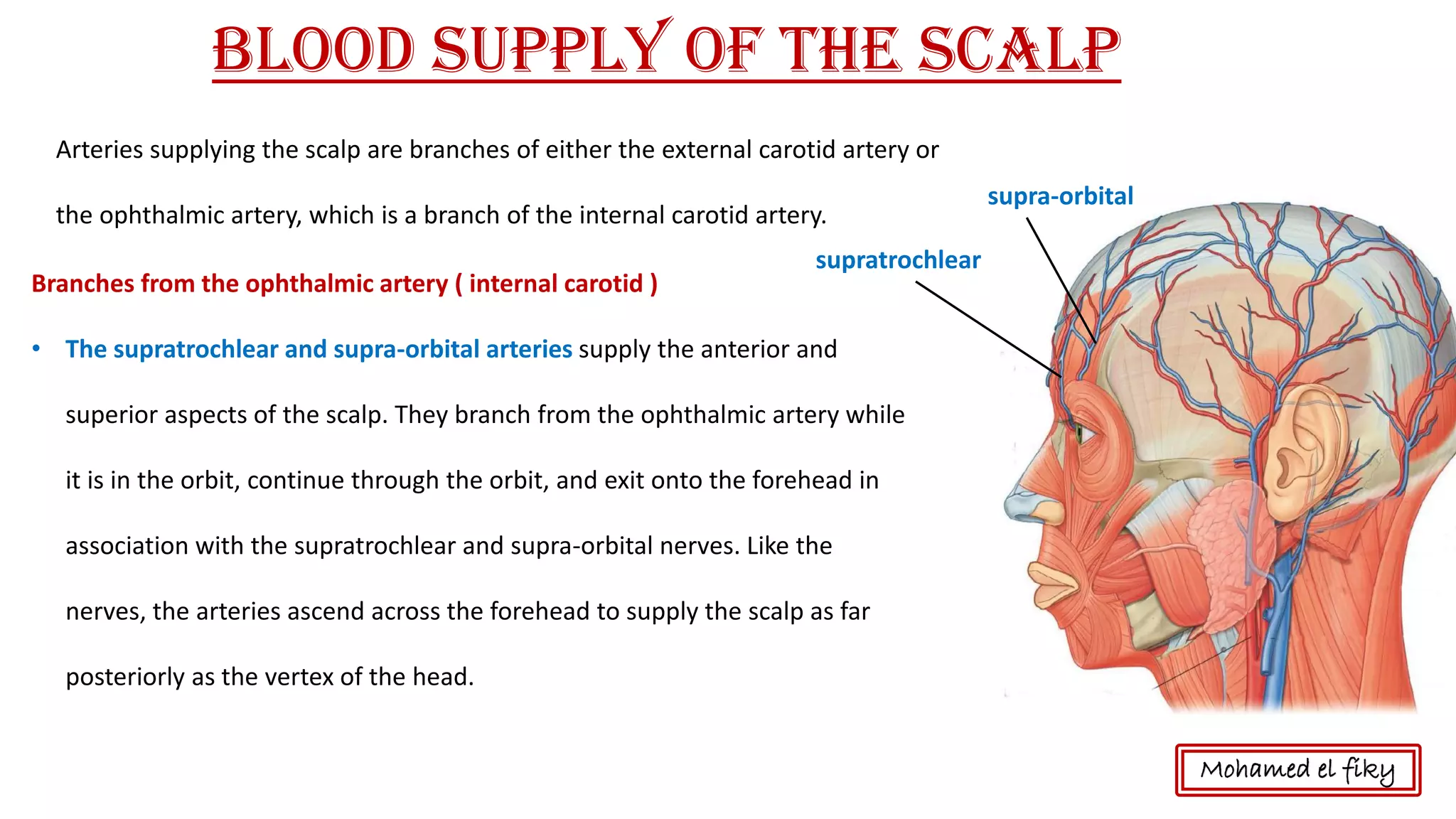
• The supratrochlear and supra-orbital arteries supply the anterior and
superior aspects of the scalp. They branch from the ophthalmic artery while
it is in the orbit, continue through the orbit, and exit onto the forehead in
association with the supratrochlear and supra-orbital nerves. Like the
nerves, the arteries ascend across the forehead to supply the scalp as far
posteriorly as the vertex of the head.
supratrochlear
supra-orbital
Blood supply of the SCALP
Branches from the external carotid artery
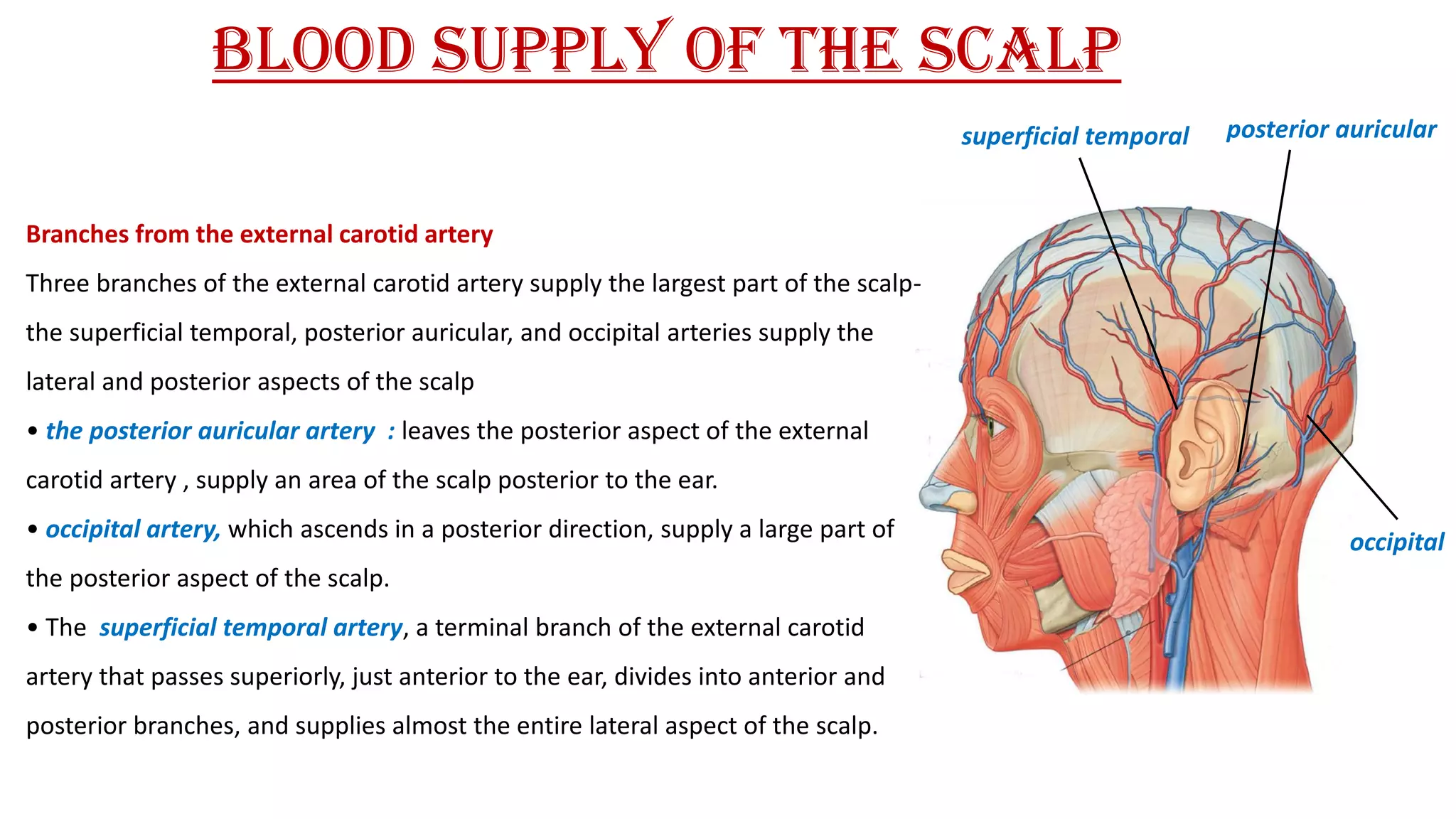
Three branches of the external carotid artery supply the largest part of the scalp-
the superficial temporal, posterior auricular, and occipital arteries supply the
lateral and posterior aspects of the scalp
• the posterior auricular artery : leaves the posterior aspect of the external
carotid artery , supply an area of the scalp posterior to the ear.
• occipital artery, which ascends in a posterior direction, supply a large part of
the posterior aspect of the scalp.
• The superficial temporal artery, a terminal branch of the external carotid
artery that passes superiorly, just anterior to the ear, divides into anterior and
posterior branches, and supplies almost the entire lateral aspect of the scalp.
posterior auricular
occipital
superficial temporal
Mohamed el fiky
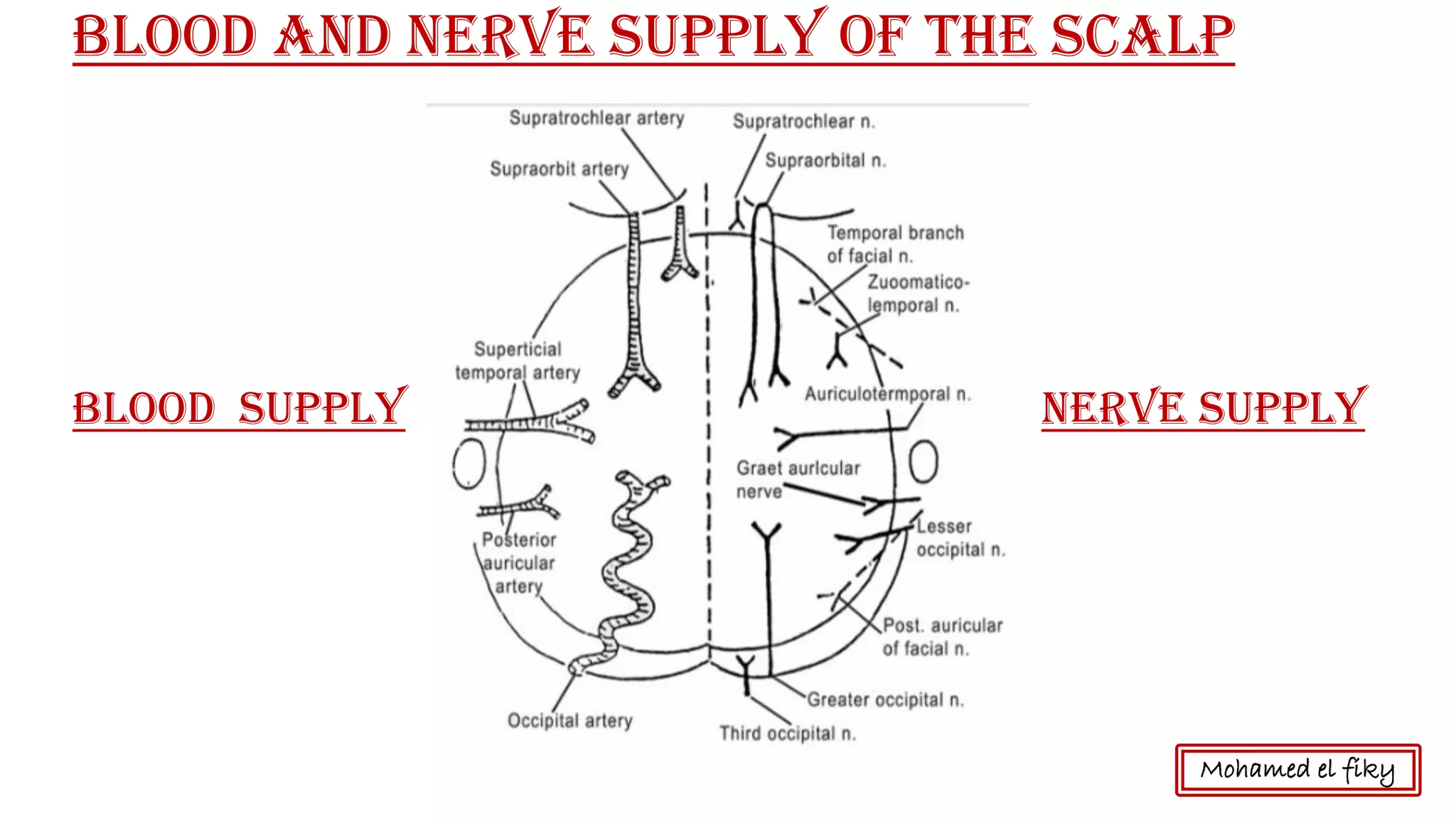
Blood and nerve supply of the SCALP
nerve supplyBlood supply
Venous drainage of scalp and Face
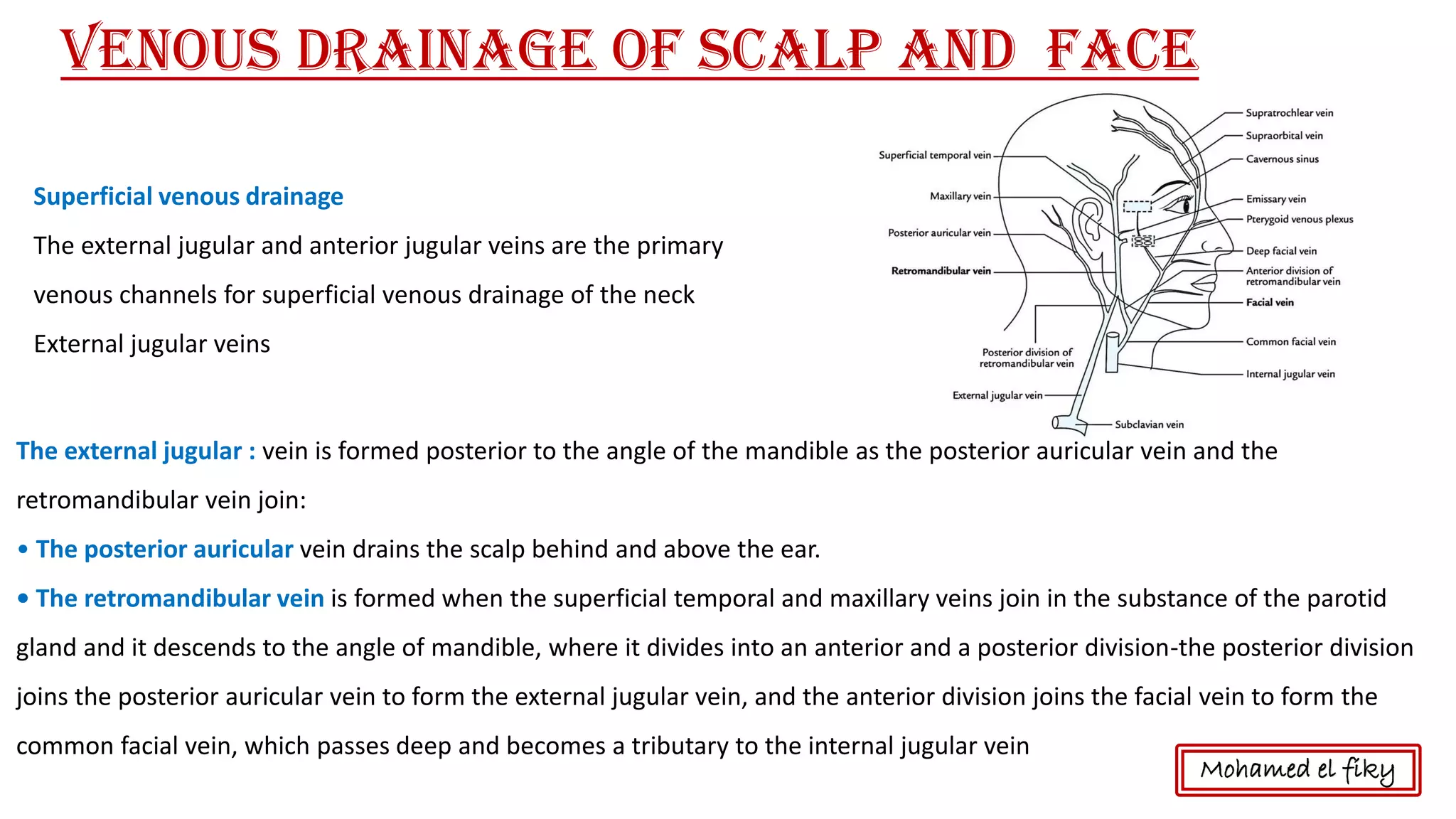
Superficial venous drainage
The external jugular and anterior jugular veins are the primary
venous channels for superficial venous drainage of the neck
External jugular veins
The external jugular : vein is formed posterior to the angle of the mandible as the posterior auricular vein and the
retromandibular vein join:
• The posterior auricular vein drains the scalp behind and above the ear.
• The retromandibular vein is formed when the superficial temporal and maxillary veins join in the substance of the parotid
gland and it descends to the angle of mandible, where it divides into an anterior and a posterior division-the posterior division
joins the posterior auricular vein to form the external jugular vein, and the anterior division joins the facial vein to form the
common facial vein, which passes deep and becomes a tributary to the internal jugular vein
Mohamed el fiky
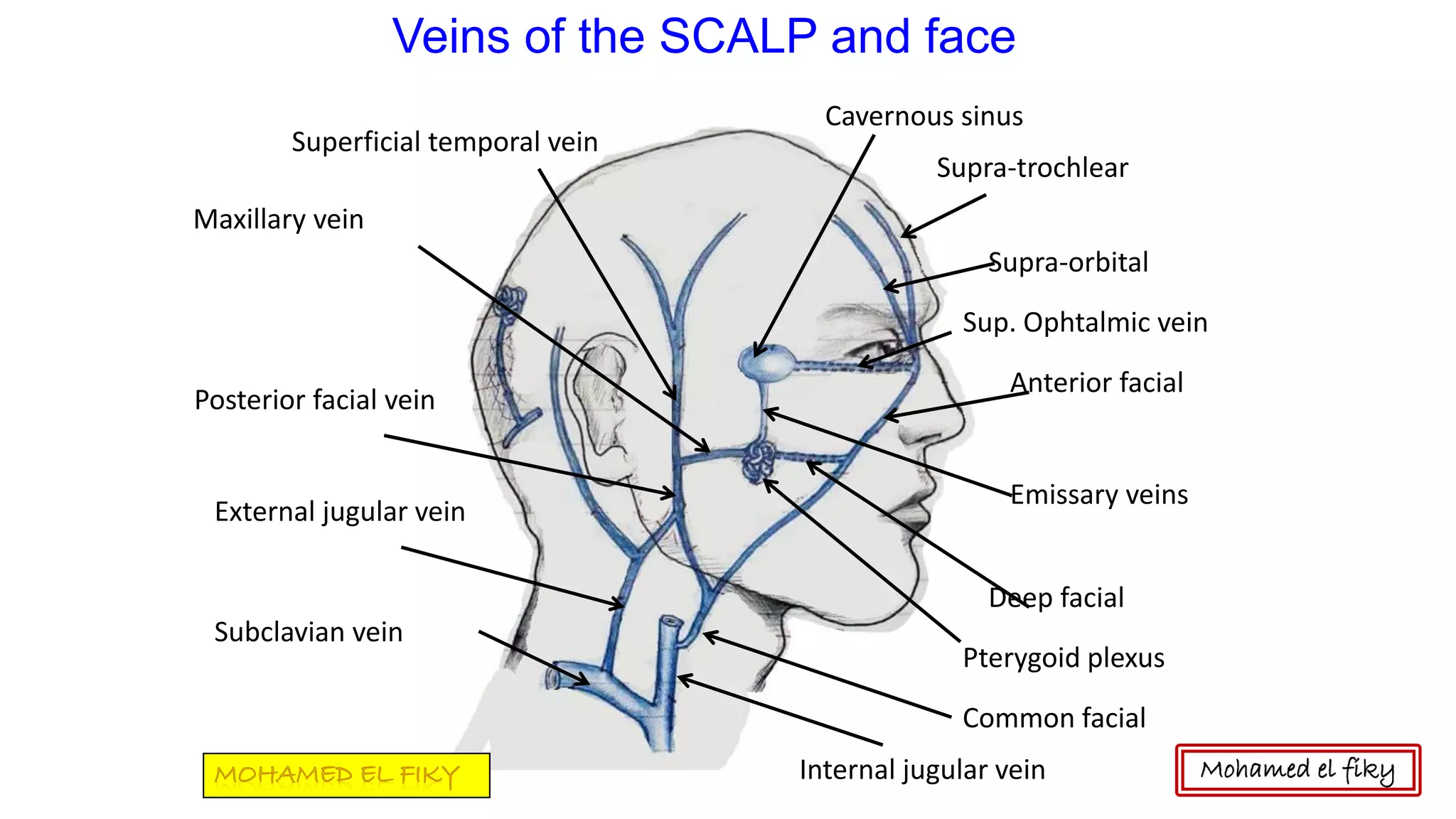
Veins of the SCALP and face
Supra-trochlear
Supra-orbital
Anterior facial
Deep facial
Common facial
Internal jugular vein
Cavernous sinus
Sup. Ophtalmic vein
Superficial temporal vein
Maxillary vein
Posterior facial vein
External jugular vein
Subclavian vein
Pterygoid plexus
Emissary veins
Mohamed el fiky
Superficial venous drainage
The external jugular and anterior jugular veins are the primary venous channels for superficial venous drainage of the neck
External jugular veins
The external jugular : vein is formed posterior to the angle of the mandible as the posterior auricular vein and the
retromandibular vein join:
• The posterior auricular vein drains the scalp behind and above the ear.
• The retromandibular vein is formed when the superficial temporal and maxillary veins join in the substance of the parotid
gland and it descends to the angle of mandible, where it divides into an anterior and a posterior division (Fig. 8.160)-the
posterior division joins the posterior auricular vein to form the external jugular vein, and the anterior division joins the facial
vein to form the common facial vein, which passes deep and becomes a tributary to the internal jugular vein
Venous drainage of scalp and Face
Mohamed el fiky
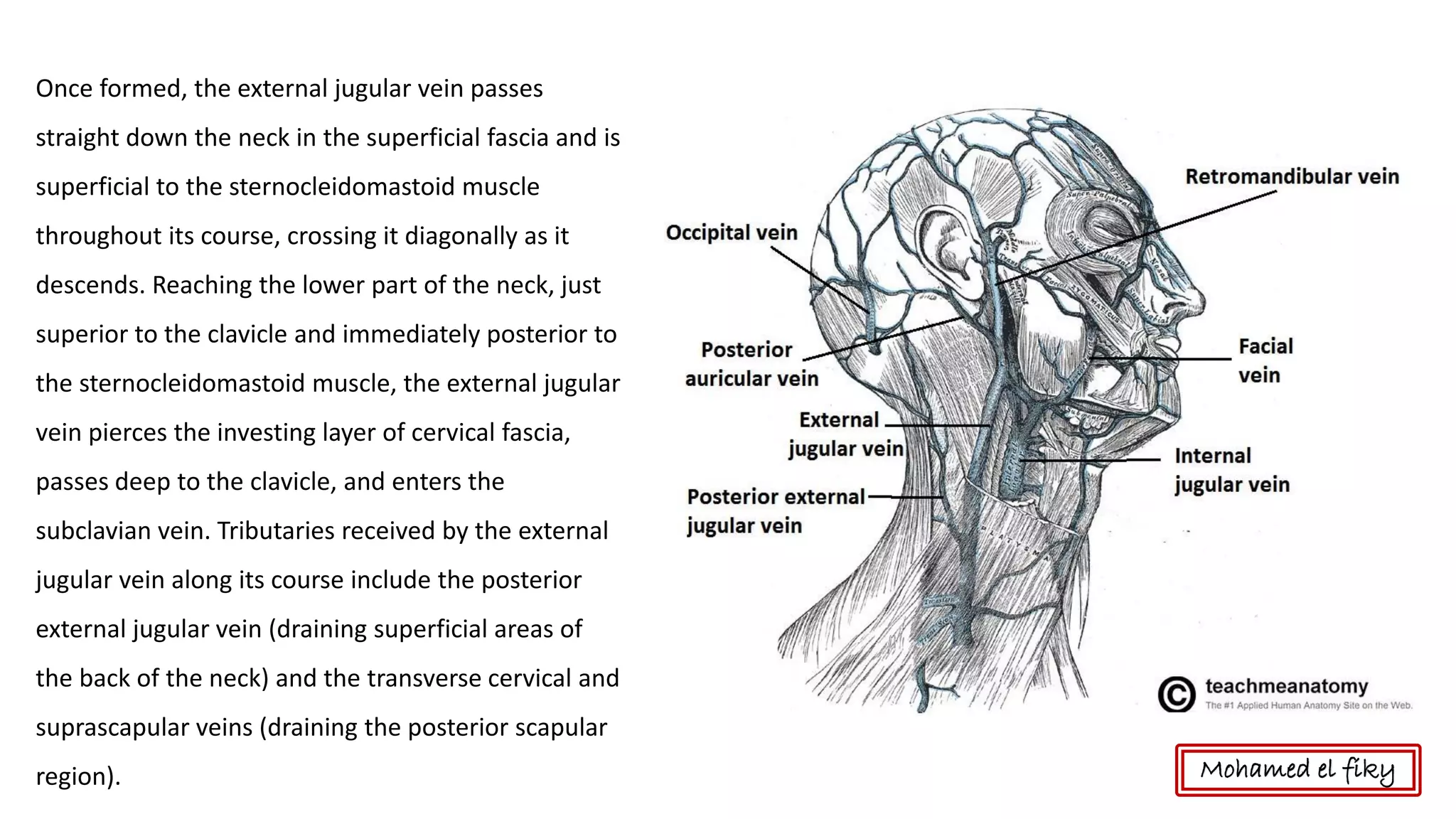
Once formed, the external jugular vein passes
straight down the neck in the superficial fascia and is
superficial to the sternocleidomastoid muscle
throughout its course, crossing it diagonally as it
descends. Reaching the lower part of the neck, just
superior to the clavicle and immediately posterior to
the sternocleidomastoid muscle, the external jugular
vein pierces the investing layer of cervical fascia,
passes deep to the clavicle, and enters the
subclavian vein. Tributaries received by the external
jugular vein along its course include the posterior
external jugular vein (draining superficial areas of
the back of the neck) and the transverse cervical and
suprascapular veins (draining the posterior scapular
region). Mohamed el fiky
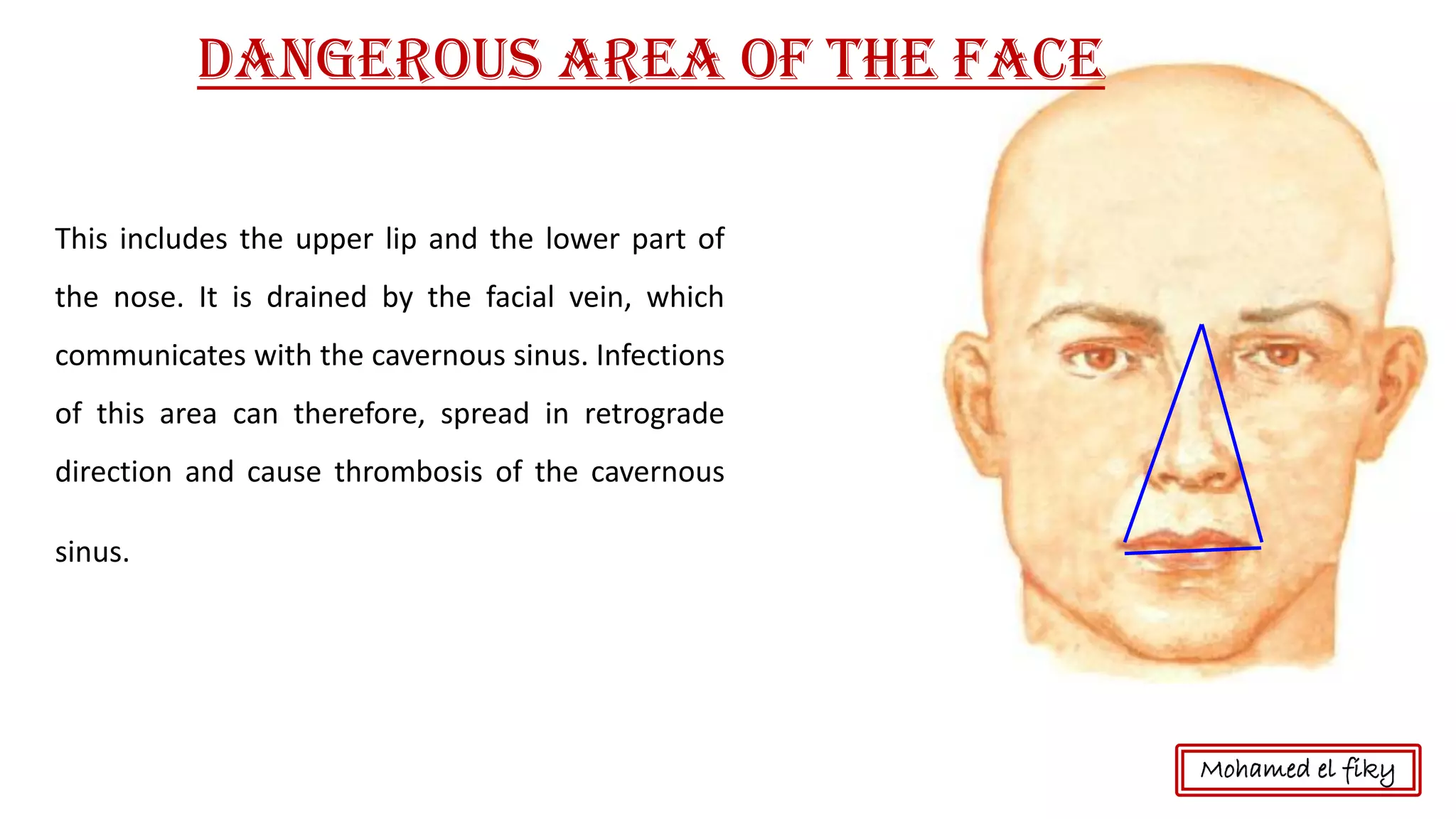
Dangerous Area of the Face
This includes the upper lip and the lower part of
the nose. It is drained by the facial vein, which
communicates with the cavernous sinus. Infections
of this area can therefore, spread in retrograde
direction and cause thrombosis of the cavernous
sinus.
Mohamed el fiky
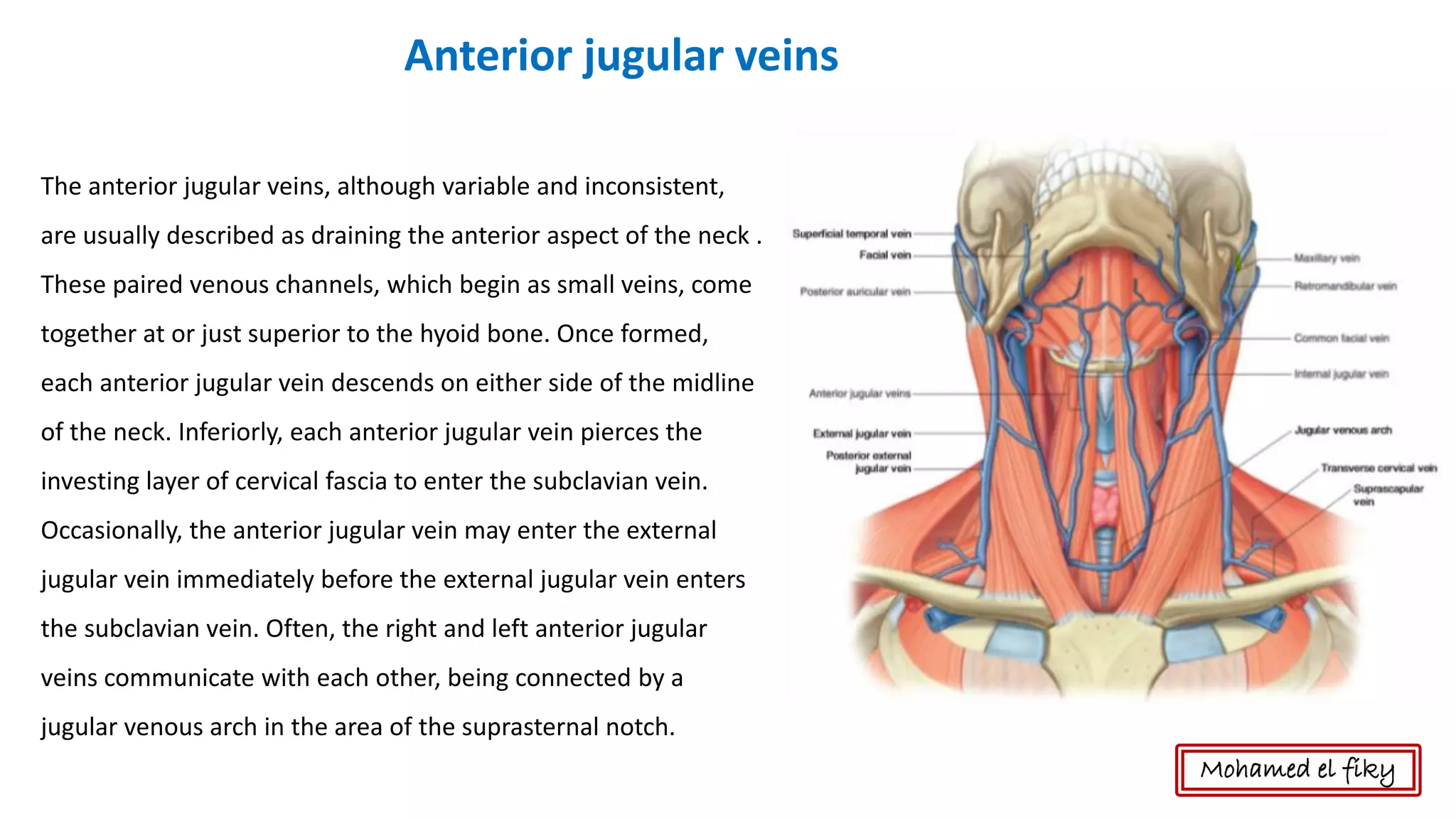
The anterior jugular veins, although variable and inconsistent,
are usually described as draining the anterior aspect of the neck .
These paired venous channels, which begin as small veins, come
together at or just superior to the hyoid bone. Once formed,
each anterior jugular vein descends on either side of the midline
of the neck. Inferiorly, each anterior jugular vein pierces the
investing layer of cervical fascia to enter the subclavian vein.
Occasionally, the anterior jugular vein may enter the external
jugular vein immediately before the external jugular vein enters
the subclavian vein. Often, the right and left anterior jugular
veins communicate with each other, being connected by a
jugular venous arch in the area of the suprasternal notch.
Anterior jugular veins
Mohamed el fiky
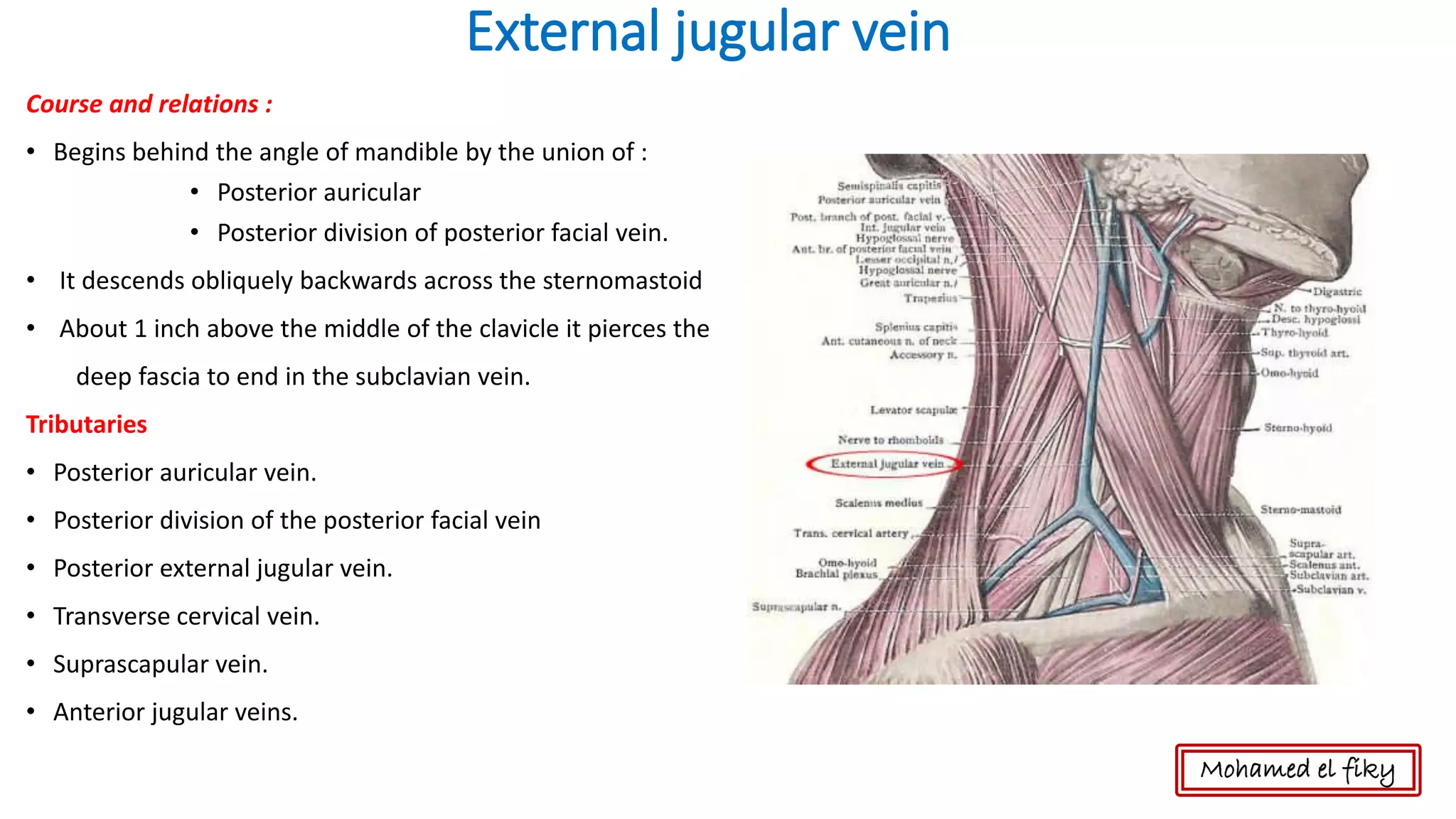
External jugular vein
Course and relations :
• Begins behind the angle of mandible by the union of :
• Posterior auricular
• Posterior division of posterior facial vein.
• It descends obliquely backwards across the sternomastoid
• About 1 inch above the middle of the clavicle it pierces the
deep fascia to end in the subclavian vein.
Tributaries
• Posterior auricular vein.
• Posterior division of the posterior facial vein
• Posterior external jugular vein.
• Transverse cervical vein.
• Suprascapular vein.
• Anterior jugular veins.
Mohamed el fiky
NERVE supply of the SCALP
Sensory innervation of the scalp is from two major sources, cranial nerves or
cervical nerves, depending on whether it is anterior or posterior to the ears
and the vertex of the head .
The occipitofrontalis muscle is innervated by branches of the facial nerve [VII].
Anterior to the ears and the vertex
Branches of the trigeminal nerve [V] supply the scalp anterior to the ears and the vertex of the head .
These branches are:
1. Supratrochlear, (Ophthalmic )
2. Supra-orbital, (Ophthalmic )
3. Zygomaticotemporal, ( Maxillary )
4. Auriculotemporal ( Mandibular)
Mohamed el fiky
Nerve supply of the Face
During development a cranial nerve becomes associated with each of the pharyngeal arches. Because the face is
primarily derived from the first and second pharyngeal arches, innervation of neighboring facial structures is as
follows:
• The trigeminal nerve [V] innervates facial structures derived from the first arch.
• The facial nerve [VII] innervates facial structures derived from the second arch.
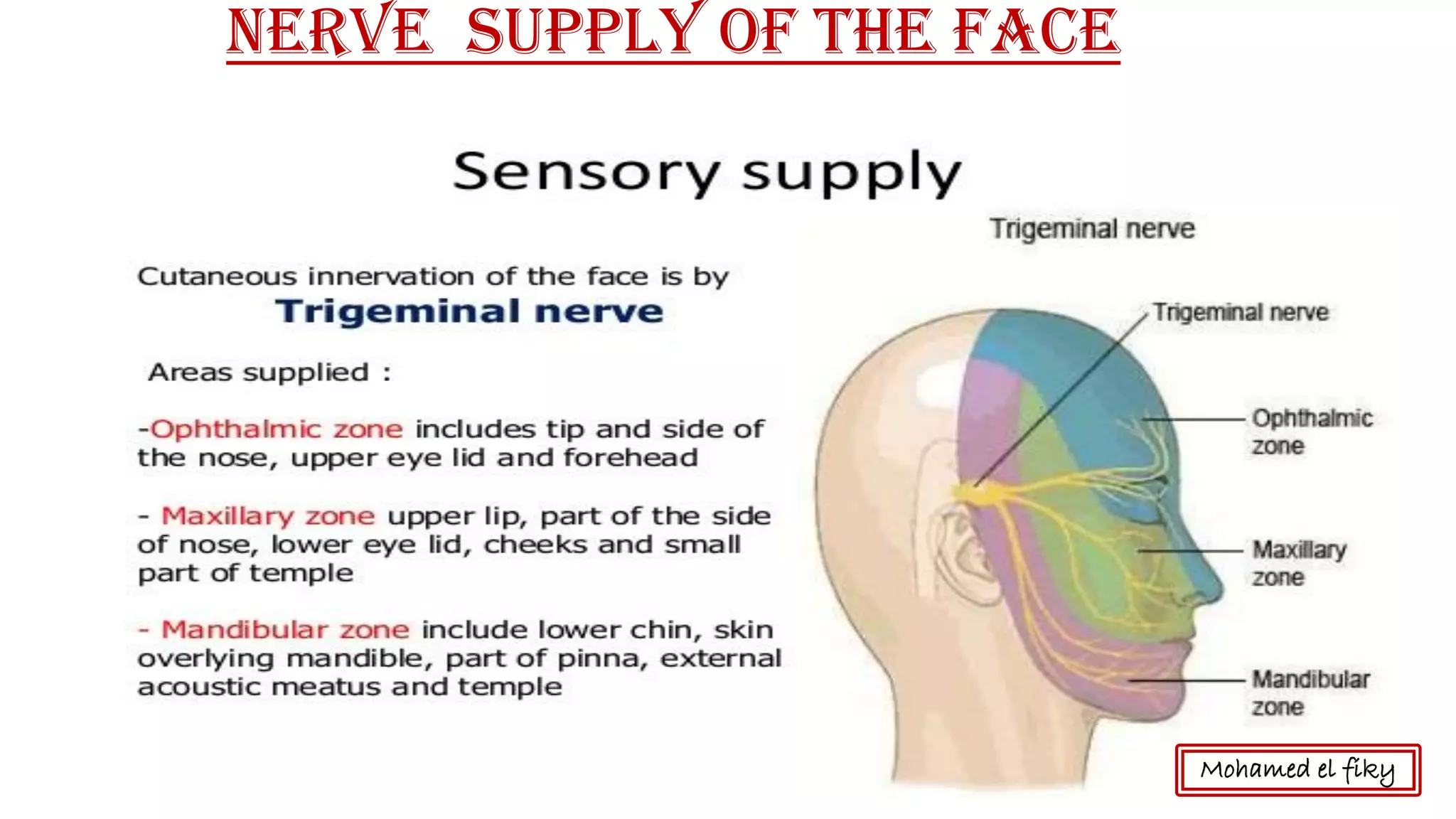
Sensory innervation
Because the face is derived developmentally from a number of structures originating from the first pharyngeal
arch, cutaneous innervation of the face is by branches of the trigeminal nerve [V]. The trigeminal nerve [V] divides
into three major divisions-the ophthalmic [V1], maxillary [V2], and mandibular [V 3] nerves-before leaving the
middle cranial fossa (Fig. 8.61). Each of these divisions passes out of the cranial cavity to innervate a part of the
face, so most of the skin covering the face is innervated solely by branches of the trigeminal nerve [V]. The
exception is a small area covering the angle and lower border of the ramus of the mandible and parts of the ear,
where the facial [VII], vagus [X], and cervical nerves contribute to the innervation. Mohamed el fiky
Nerve supply of the Face
Sensory innervation
The trigeminal nerve [V] divides into three major divisions-the ophthalmic [V1], maxillary [V2], and
mandibular [V 3] to innervate the face, so most of the skin covering the face is innervated solely by branches
of the trigeminal nerve [V]. The exception is a small area covering the angle and lower border of the ramus
of the mandible and parts of the ear, where the facial [VII], vagus [X], and cervical nerves contribute to the
innervation.
Mohamed el fiky
Nerve supply of the Face
Mohamed el fiky
The ophthalmic nerve [V 1] exits the skull through the
superior orbital fissure and enters the orbit. Its branches
(Fig. 8.61) that innervate the face include:
• the supra-orbital and supratrochlear nerves, which leave
the orbit superiorly and innervate the upper eyelid,
forehead, and scalp
• the infratrochlear nerve, which exits the orbit in the
medial angle to innervate the medial half of the upper
eyelid, the skin in the area of the medial angle, and the side
of the nose;
• the lacrimal nerve, which exits the orbit in the lateral
angle to innervate the lateral half of the upper eyelid and
the skin in the area of the lateral angle; and
• the external nasal nerve, which supplies the anterior part
of the nose .
Ophthalmic nerve [V1,]
Mohamed el fiky
The maxillary nerve [V 2] exits the skull through the
foramen rotundum. Branches that innervate the face
include:
• Zygomaticotemporal branch, which exits the
zygomatic bone and supplies a small area of the anterior
temple above the zygomatic arch;
• Zygomaticofacial branch, which exits the zygomatic
bone and supplies a small area of skin over the
zygomatic bone; and
• infra-orbital nerve, which exits the maxilla through the
infra-orbital foramen and immediately divides into
multiple branches to supply the lower eyelid, cheek, side
of the nose, and upper lip .
Maxillary nerve [V2]
Mohamed el fiky
The mandibular nerve [V 3] exits the skull through the
foramen ovale. Branches (Fig. 8.62) innervating the face
include:
• the auriculotemporal nerve, which enters the face just
posterior to the temporomandibular joint, passes through
the parotid gland, and ascends just anterior to the ear to
supply the external acoustic meatus, the surface of the
tympanic membrane (eardrum), and a large area of the
temple;
• the buccal nerve, which is on the surface of the
buccinator muscle supplying the cheek; and
• the mental nerve, which exits the mandible through the
mental foramen and immediately divides into multiple
branches to supply the skin and mucous membrane of the
lower lip and skin of the chin
Mandibular nerve [V3]
Mohamed el fiky
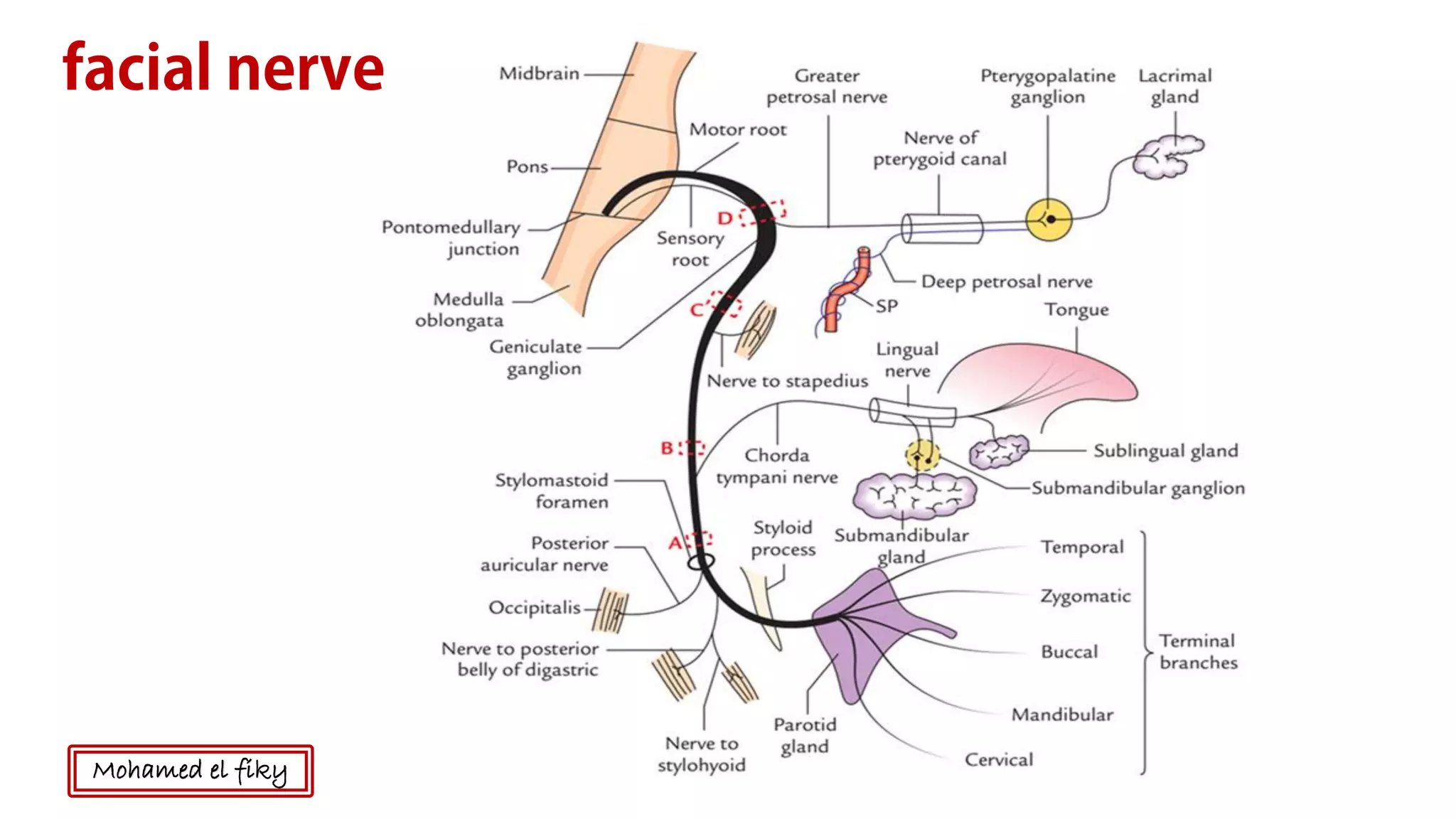
Motor Nerves of the Face ( facial nerve )
• Orgin : from the pons Type : mixed nerve motor , sensory and
containing parasympathetic .
• Course in the face : after the facial nerve comes out from the
stylomastoid foramen it inter the parotid gland superficial to external
carotid artery and posterior facial vein and with in the parotid gland
the nerve gives five terminal branches .
• Branches :
• A- before it inter the parotid gland ( distal to the stylomastoid foramen
1- posterior auricular to the occiptal belly of occiptofrontalis muscle
and muscles around ear
• 2- Branch to posterior belly of digasteric and stylohyoid muscle
Mohamed el fiky
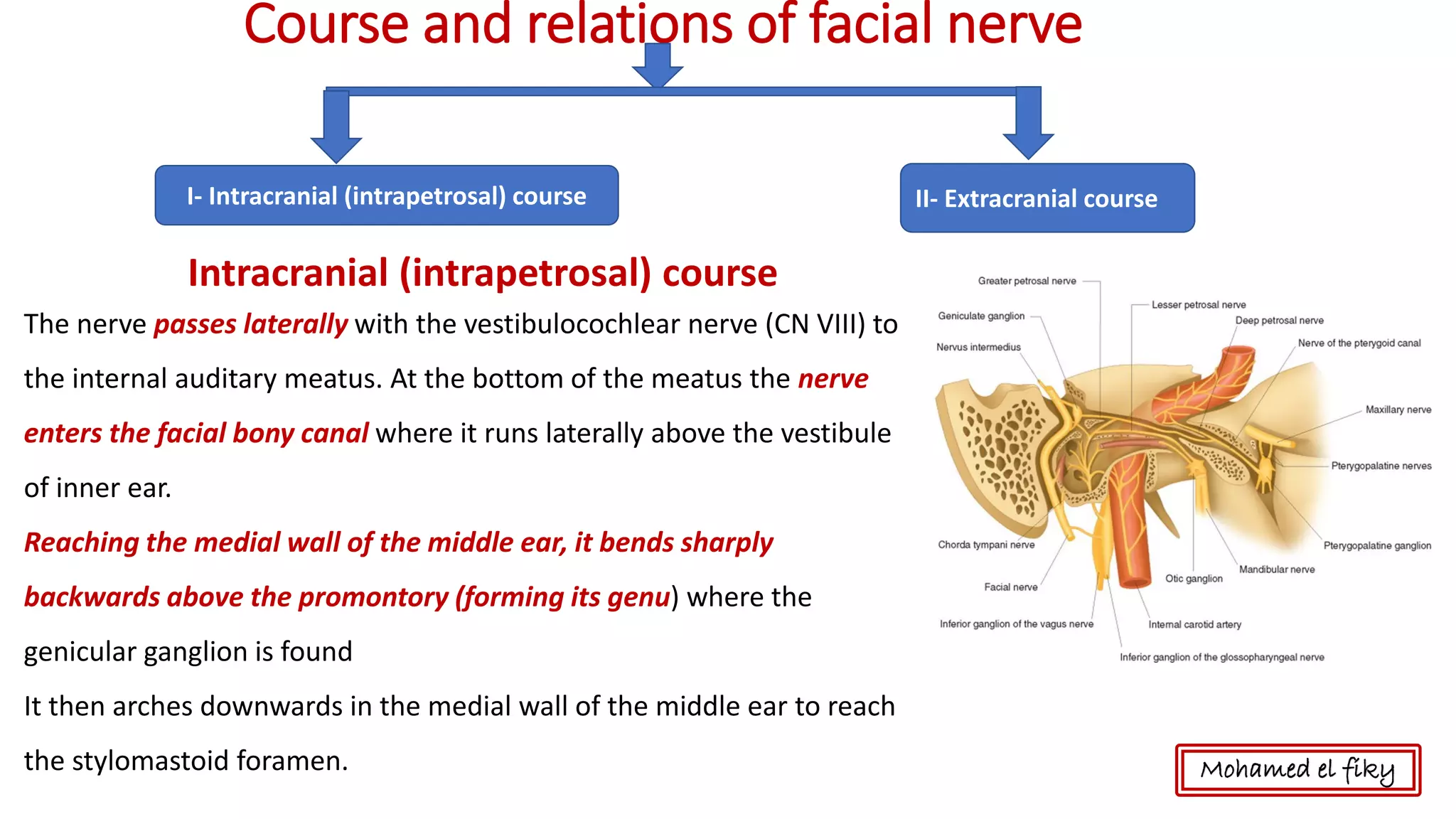
Course and relations of facial nerve
Intracranial (intrapetrosal) course
The nerve passes laterally with the vestibulocochlear nerve (CN VIII) to
the internal auditary meatus. At the bottom of the meatus the nerve
enters the facial bony canal where it runs laterally above the vestibule
of inner ear.
Reaching the medial wall of the middle ear, it bends sharply
backwards above the promontory (forming its genu) where the
genicular ganglion is found
It then arches downwards in the medial wall of the middle ear to reach
the stylomastoid foramen. Mohamed el fiky
I- Intracranial (intrapetrosal) course II- Extracranial course
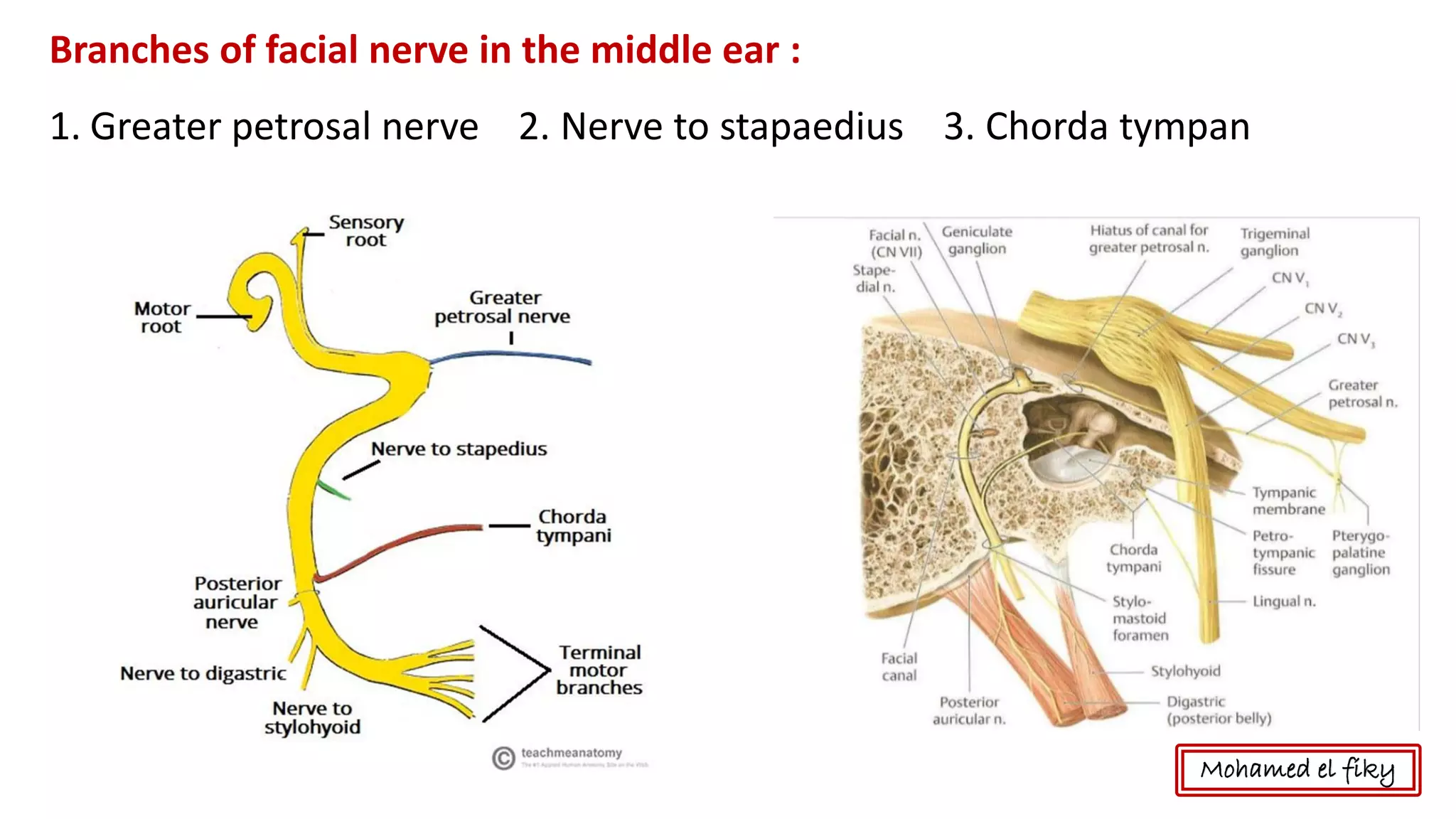
Branches of facial nerve in the middle ear :
1. Greater petrosal nerve 2. Nerve to stapaedius 3. Chorda tympan
Mohamed el fiky
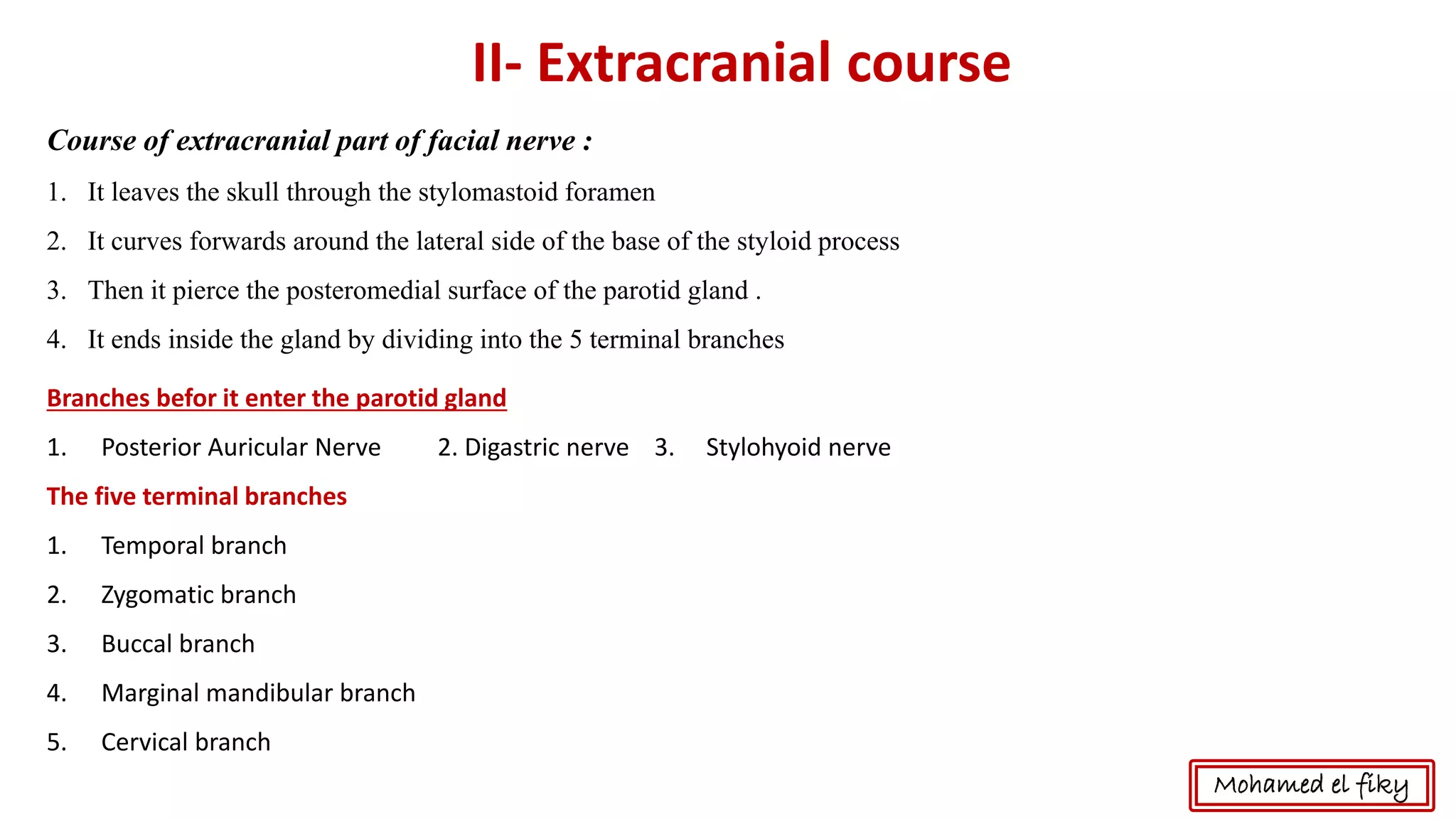
II- Extracranial course
Branches befor it enter the parotid gland
1. Posterior Auricular Nerve 2. Digastric nerve 3. Stylohyoid nerve
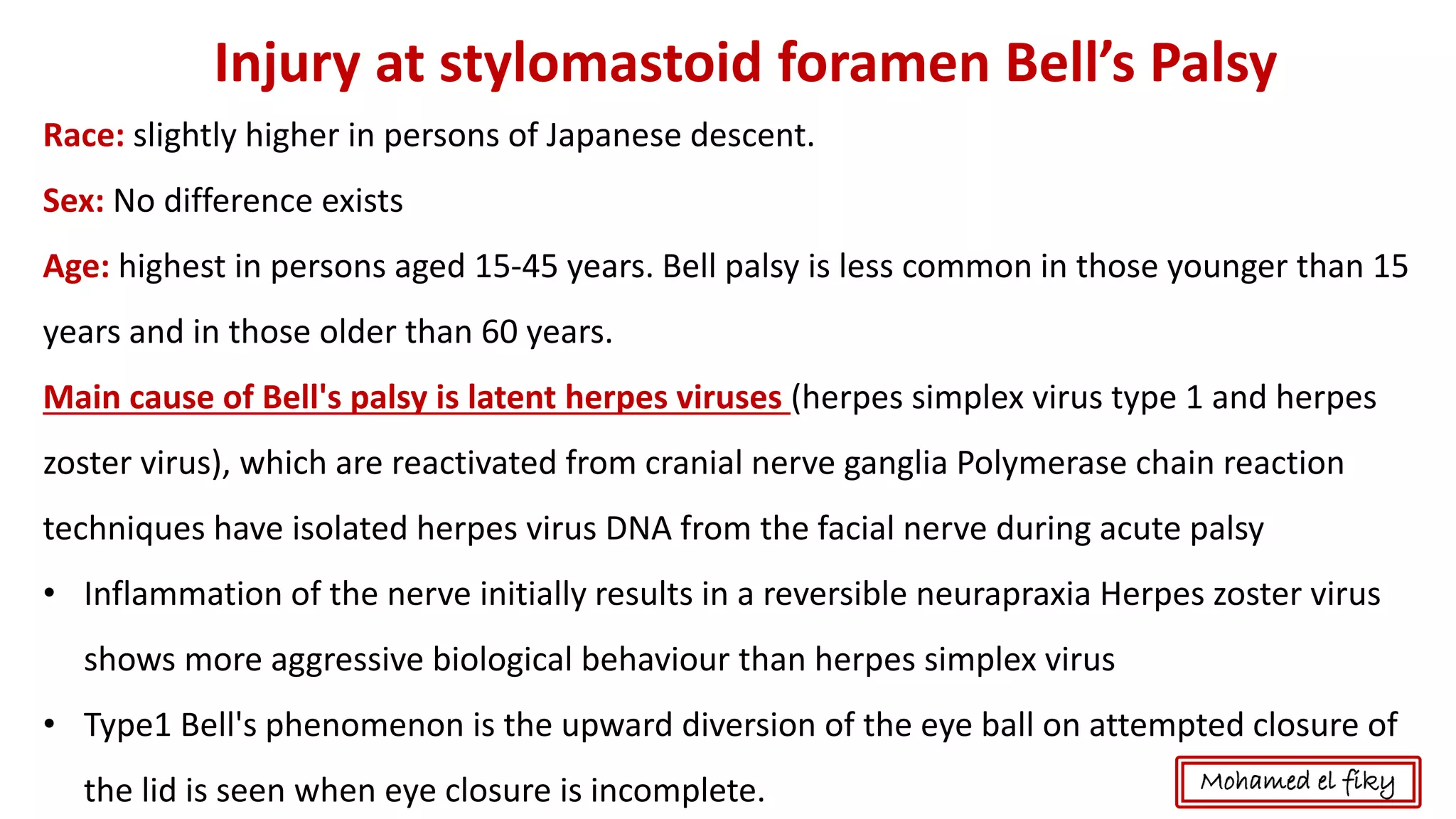
The five terminal branches
1. Temporal branch
2. Zygomatic branch
3. Buccal branch
4. Marginal mandibular branch
5. Cervical branch
Mohamed el fiky
Course of extracranial part of facial nerve :
1. It leaves the skull through the stylomastoid foramen
2. It curves forwards around the lateral side of the base of the styloid process
3. Then it pierce the posteromedial surface of the parotid gland .
4. It ends inside the gland by dividing into the 5 terminal branches
Mohamed el fiky
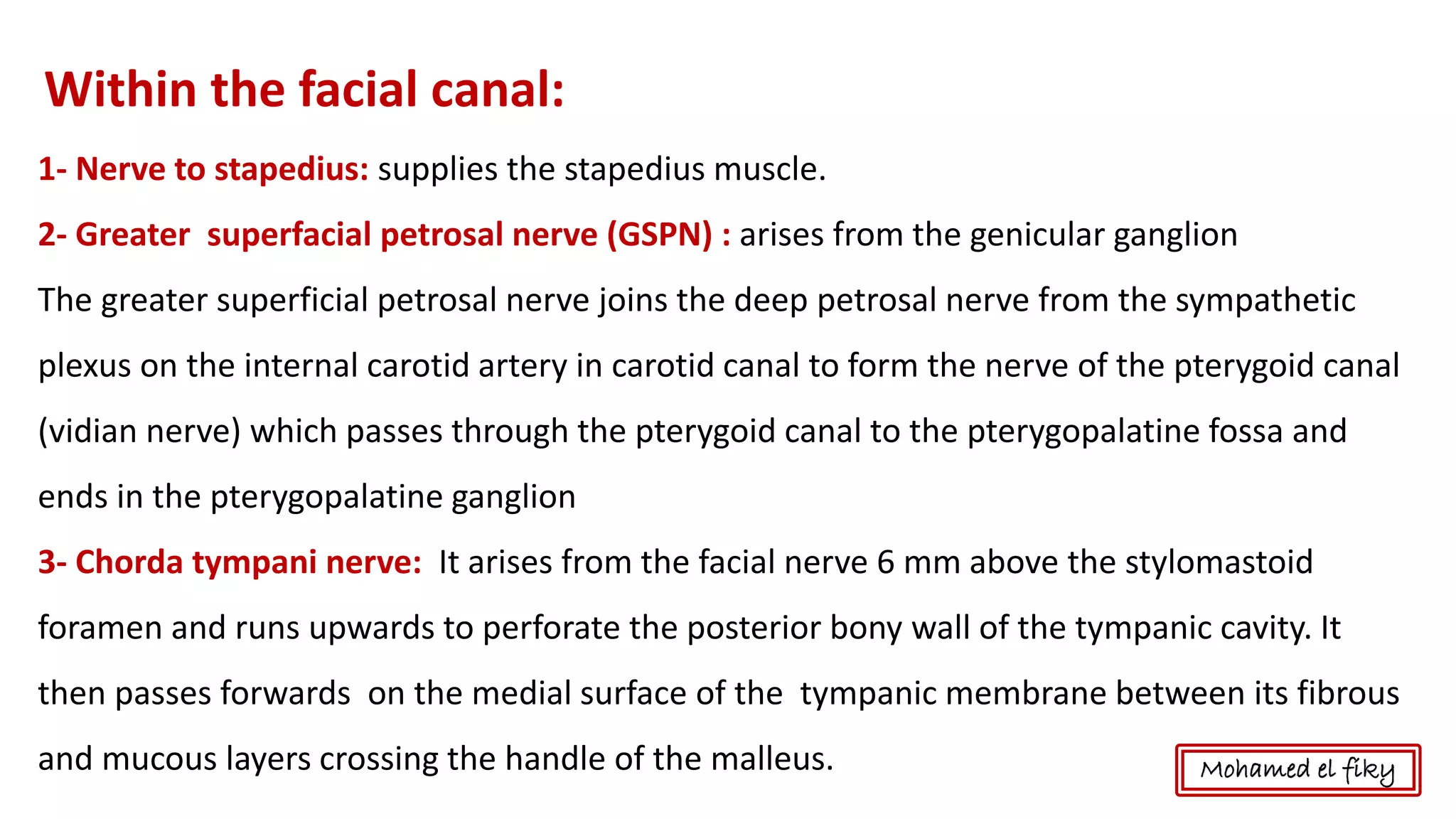
Within the facial canal:
1- Nerve to stapedius: supplies the stapedius muscle.
2- Greater superfacial petrosal nerve (GSPN) : arises from the genicular ganglion
The greater superficial petrosal nerve joins the deep petrosal nerve from the sympathetic
plexus on the internal carotid artery in carotid canal to form the nerve of the pterygoid canal
(vidian nerve) which passes through the pterygoid canal to the pterygopalatine fossa and
ends in the pterygopalatine ganglion
3- Chorda tympani nerve: It arises from the facial nerve 6 mm above the stylomastoid
foramen and runs upwards to perforate the posterior bony wall of the tympanic cavity. It
then passes forwards on the medial surface of the tympanic membrane between its fibrous
and mucous layers crossing the handle of the malleus. Mohamed el fiky
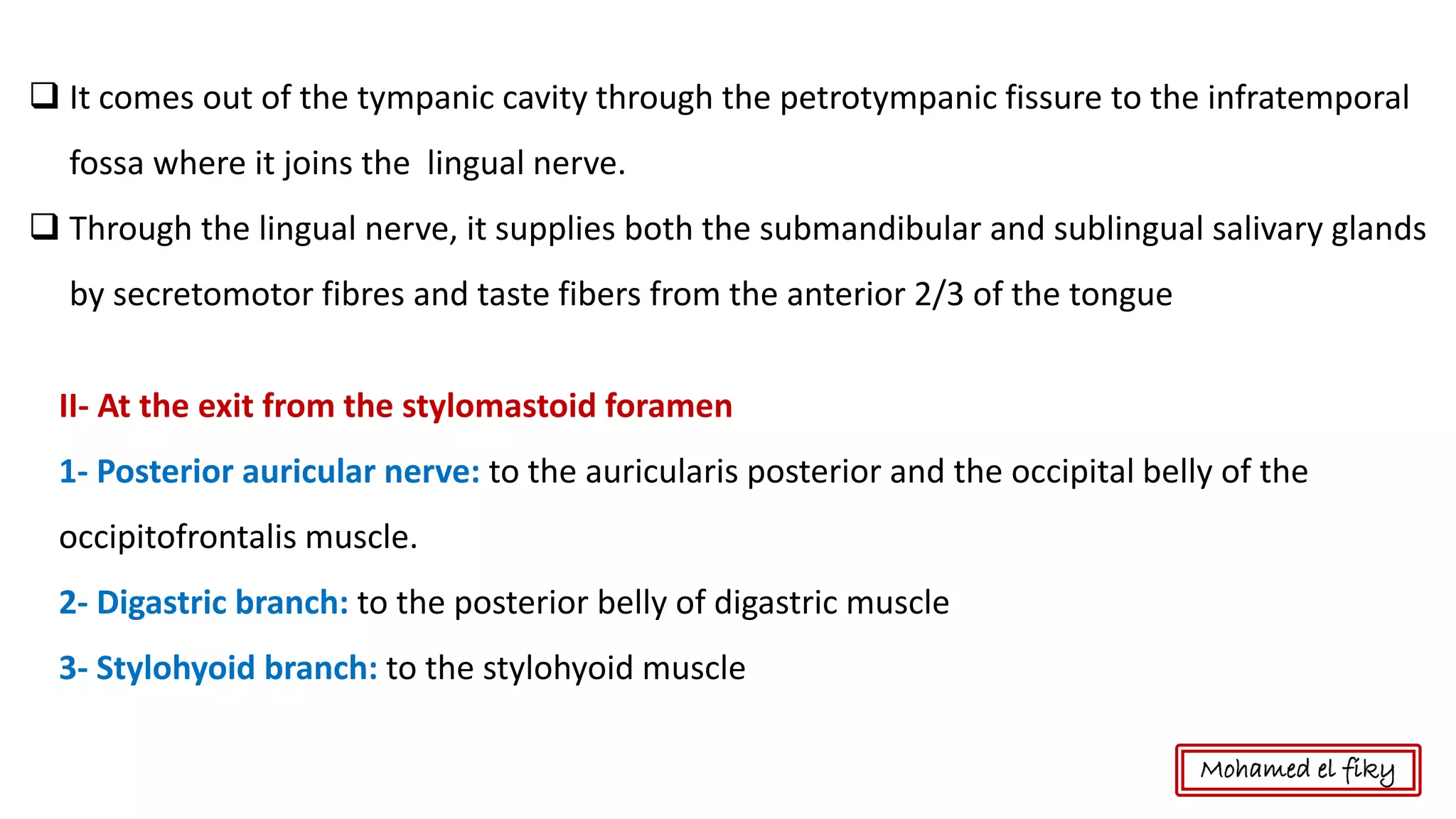
❑ It comes out of the tympanic cavity through the petrotympanic fissure to the infratemporal
fossa where it joins the lingual nerve.
❑ Through the lingual nerve, it supplies both the submandibular and sublingual salivary glands
by secretomotor fibres and taste fibers from the anterior 2/3 of the tongue
II- At the exit from the stylomastoid foramen
1- Posterior auricular nerve: to the auricularis posterior and the occipital belly of the
occipitofrontalis muscle.
2- Digastric branch: to the posterior belly of digastric muscle
3- Stylohyoid branch: to the stylohyoid muscle
Mohamed el fiky
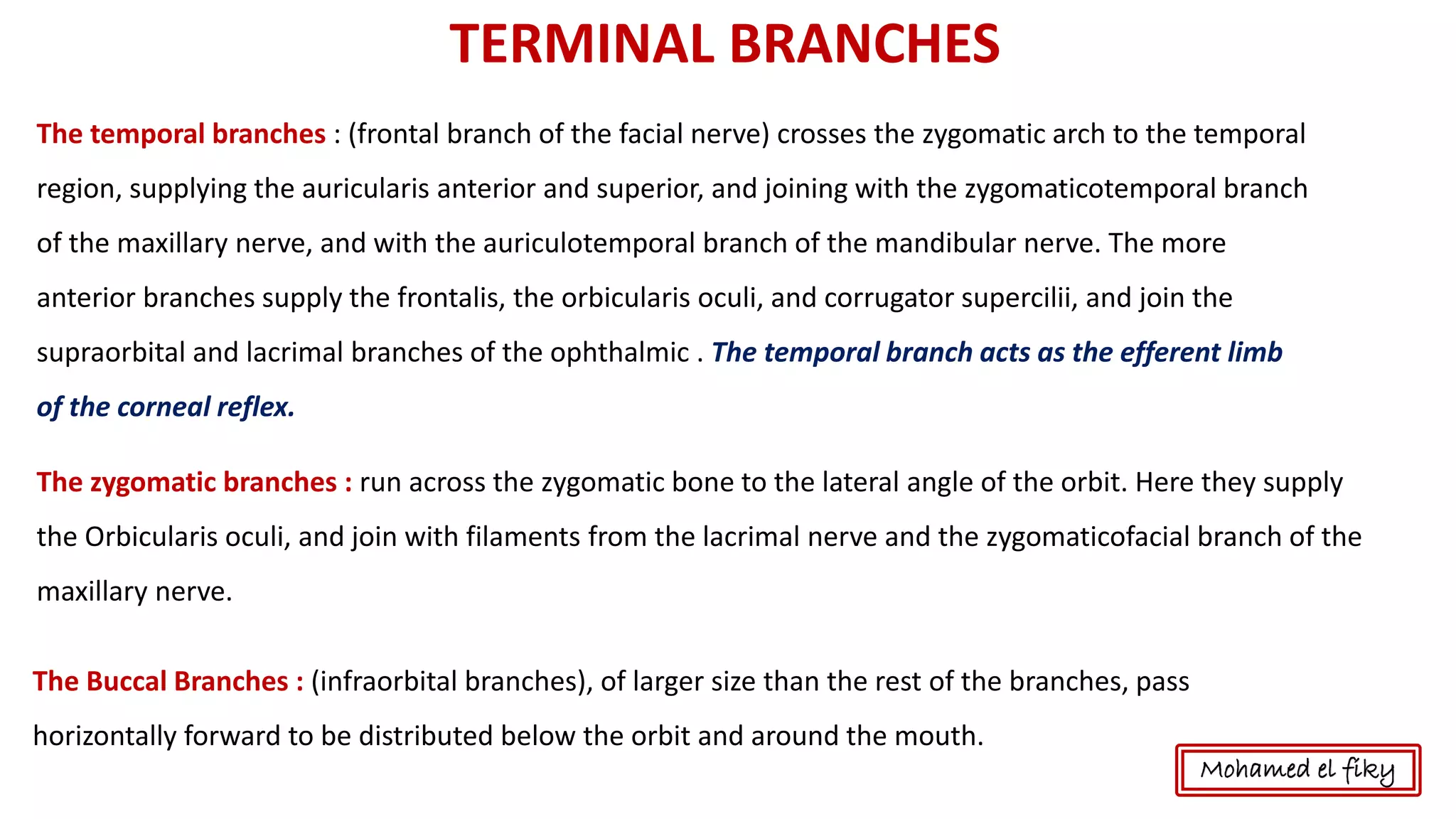
TERMINAL BRANCHES
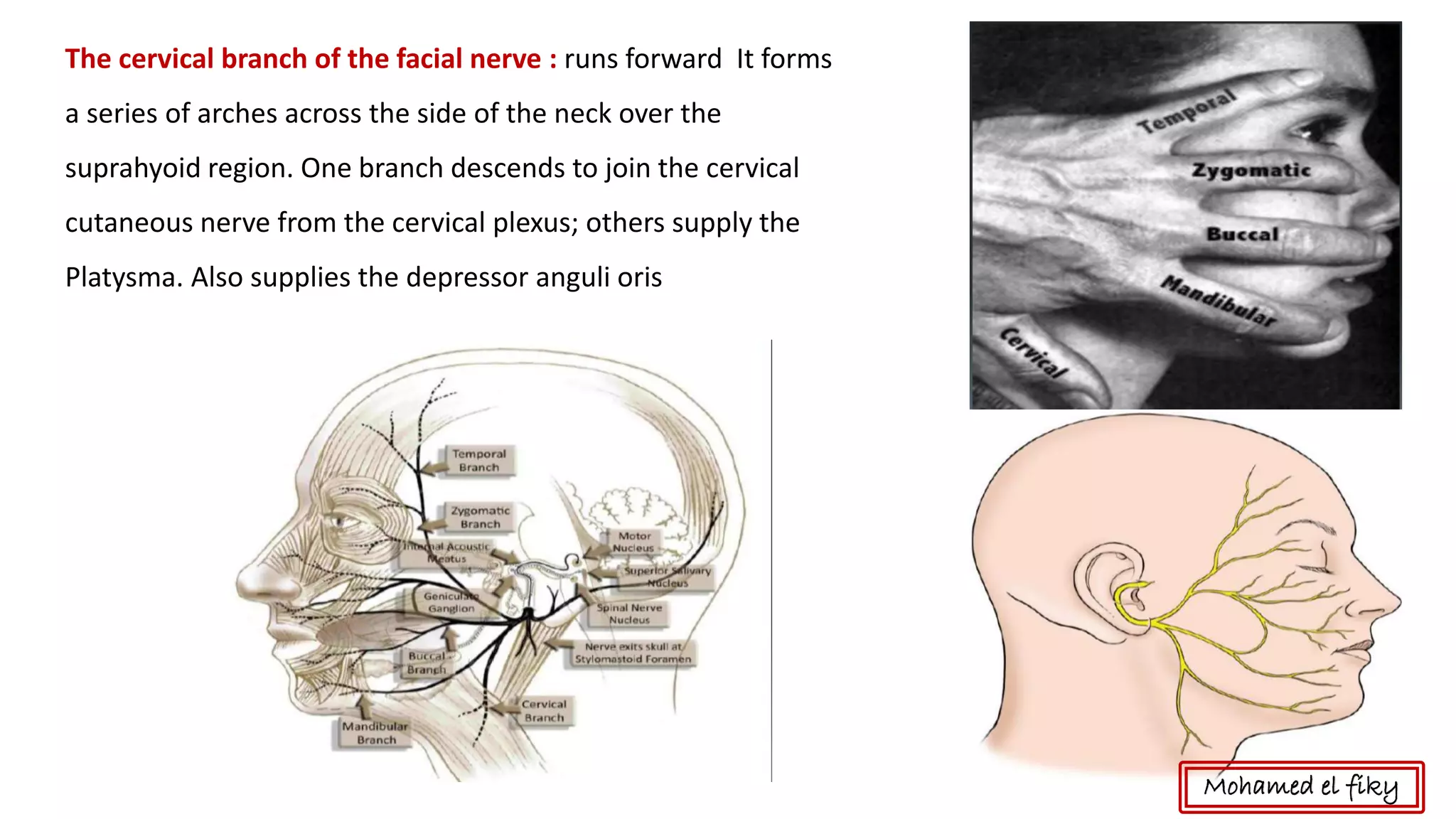
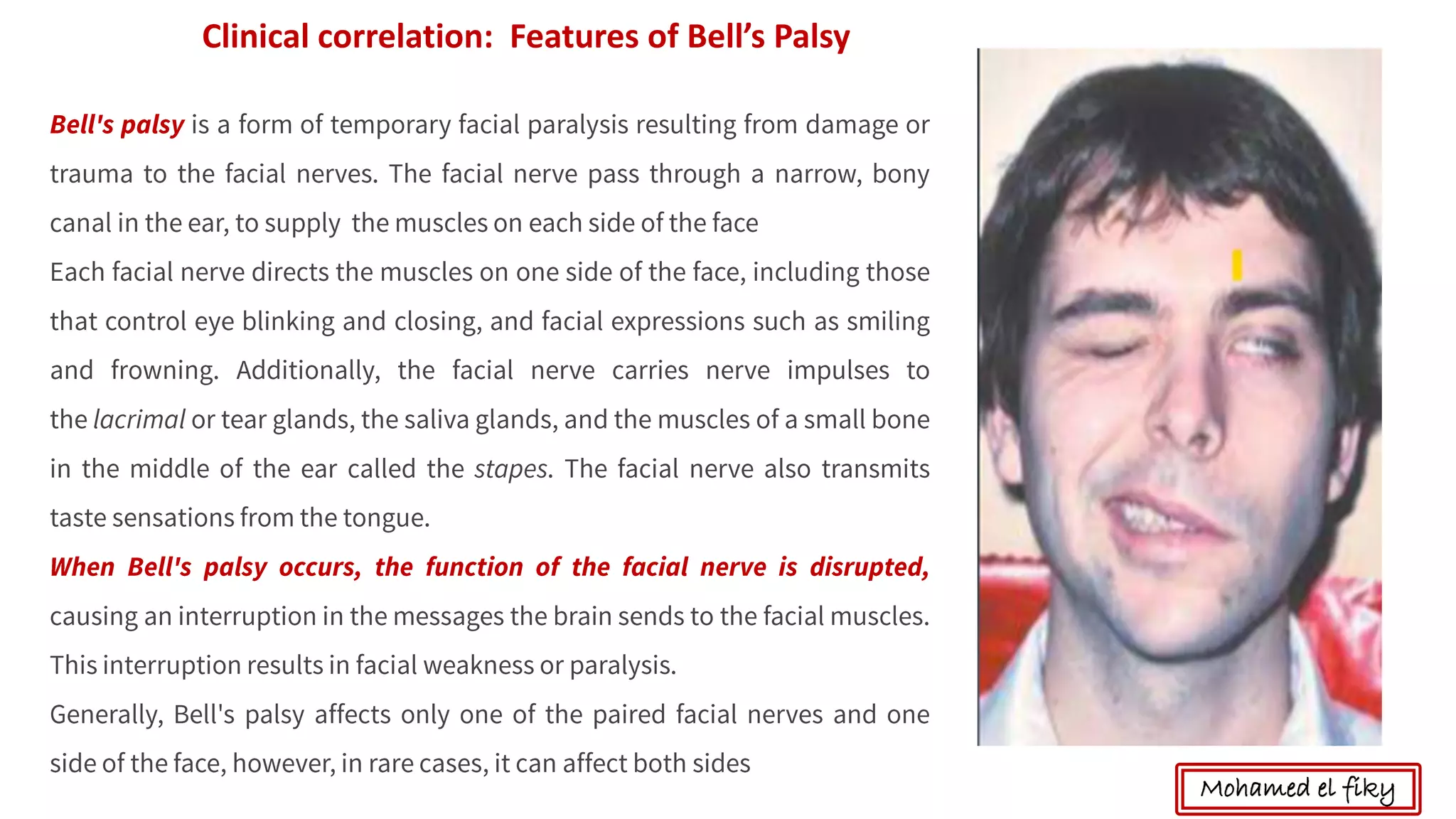
The temporal branches : (frontal branch of the facial nerve) crosses the zygomatic arch to the temporal
region, supplying the auricularis anterior and superior, and joining with the zygomaticotemporal branch
of the maxillary nerve, and with the auriculotemporal branch of the mandibular nerve. The more
anterior branches supply the frontalis, the orbicularis oculi, and corrugator supercilii, and join the
supraorbital and lacrimal branches of the ophthalmic . The temporal branch acts as the efferent limb
of the corneal reflex.
The zygomatic branches : run across the zygomatic bone to the lateral angle of the orbit. Here they supply
the Orbicularis oculi, and join with filaments from the lacrimal nerve and the zygomaticofacial branch of the
maxillary nerve.
The Buccal Branches : (infraorbital branches), of larger size than the rest of the branches, pass
horizontally forward to be distributed below the orbit and around the mouth.
Mohamed el fiky
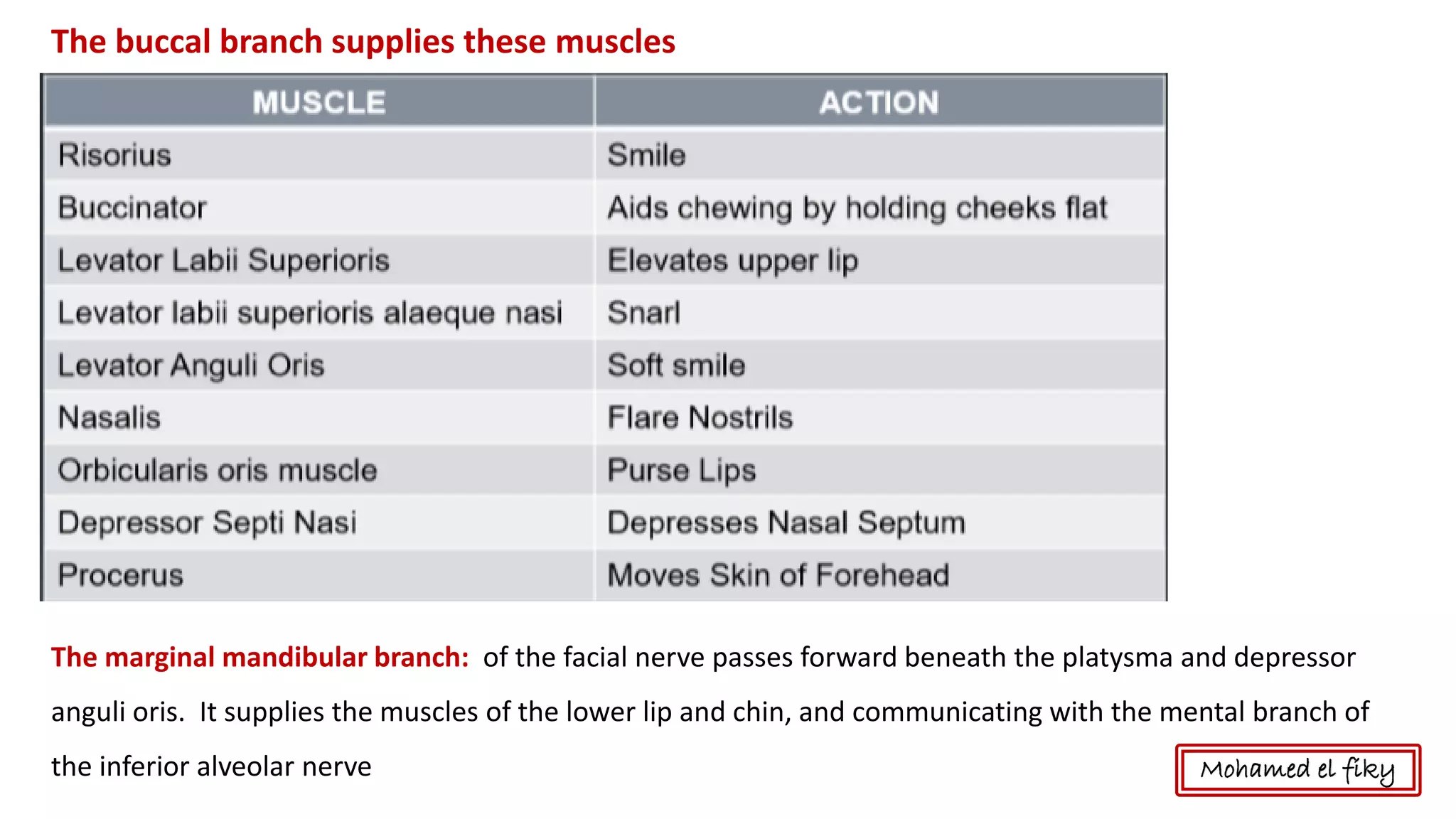
The buccal branch supplies these muscles
The marginal mandibular branch: of the facial nerve passes forward beneath the platysma and depressor
anguli oris. It supplies the muscles of the lower lip and chin, and communicating with the mental branch of
the inferior alveolar nerve Mohamed el fiky
The cervical branch of the facial nerve : runs forward It forms
a series of arches across the side of the neck over the
suprahyoid region. One branch descends to join the cervical
cutaneous nerve from the cervical plexus; others supply the
Platysma. Also supplies the depressor anguli oris
Mohamed el fiky
Injury at stylomastoid foramen Bell’s Palsy
Race: slightly higher in persons of Japanese descent.
Sex: No difference exists
Age: highest in persons aged 15-45 years. Bell palsy is less common in those younger than 15
years and in those older than 60 years.
Main cause of Bell's palsy is latent herpes viruses (herpes simplex virus type 1 and herpes
zoster virus), which are reactivated from cranial nerve ganglia Polymerase chain reaction
techniques have isolated herpes virus DNA from the facial nerve during acute palsy
• Inflammation of the nerve initially results in a reversible neurapraxia Herpes zoster virus
shows more aggressive biological behaviour than herpes simplex virus
• Type1 Bell's phenomenon is the upward diversion of the eye ball on attempted closure of
the lid is seen when eye closure is incomplete. Mohamed el fiky
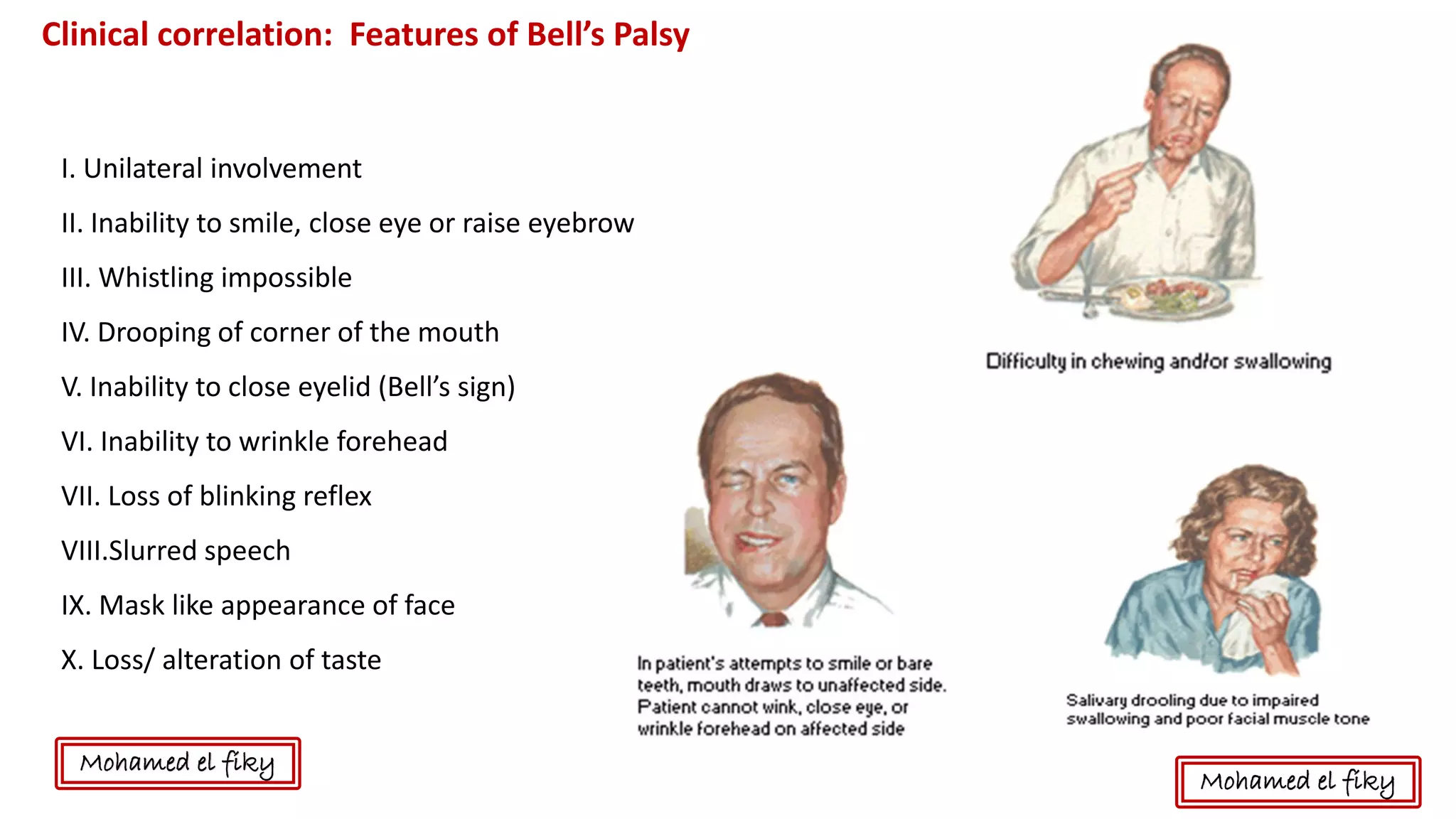
Clinical correlation: Features of Bell’s Palsy
Mohamed el fiky
Clinical correlation: Features of Bell’s Palsy
I. Unilateral involvement
II. Inability to smile, close eye or raise eyebrow
III. Whistling impossible
IV. Drooping of corner of the mouth
V. Inability to close eyelid (Bell’s sign)
VI. Inability to wrinkle forehead
VII. Loss of blinking reflex
VIII.Slurred speech
IX. Mask like appearance of face
X. Loss/ alteration of taste
Mohamed el fiky
Mohamed el fiky
Clinical correlation: Trigeminal Neuralgia TN
▪
▪
▪
▪
▪
▪
Mohamed el fiky

Anatomy of scalp and face

  • 1.
    Face and scalp Anatomy DR.Mohamed Elfiky Professor of anatomy and embryology
  • 2.
    Mohamed el fiky Bloodsupply of the SCALP Arteries supplying the scalp are branches of either the external carotid artery or the ophthalmic artery, which is a branch of the internal carotid artery. Branches from the ophthalmic artery ( internal carotid ) • The supratrochlear and supra-orbital arteries supply the anterior and superior aspects of the scalp. They branch from the ophthalmic artery while it is in the orbit, continue through the orbit, and exit onto the forehead in association with the supratrochlear and supra-orbital nerves. Like the nerves, the arteries ascend across the forehead to supply the scalp as far posteriorly as the vertex of the head. supratrochlear supra-orbital
  • 3.
    Blood supply ofthe SCALP Branches from the external carotid artery Three branches of the external carotid artery supply the largest part of the scalp- the superficial temporal, posterior auricular, and occipital arteries supply the lateral and posterior aspects of the scalp • the posterior auricular artery : leaves the posterior aspect of the external carotid artery , supply an area of the scalp posterior to the ear. • occipital artery, which ascends in a posterior direction, supply a large part of the posterior aspect of the scalp. • The superficial temporal artery, a terminal branch of the external carotid artery that passes superiorly, just anterior to the ear, divides into anterior and posterior branches, and supplies almost the entire lateral aspect of the scalp. posterior auricular occipital superficial temporal
  • 4.
    Mohamed el fiky Bloodand nerve supply of the SCALP nerve supplyBlood supply
  • 5.
    Venous drainage ofscalp and Face Superficial venous drainage The external jugular and anterior jugular veins are the primary venous channels for superficial venous drainage of the neck External jugular veins The external jugular : vein is formed posterior to the angle of the mandible as the posterior auricular vein and the retromandibular vein join: • The posterior auricular vein drains the scalp behind and above the ear. • The retromandibular vein is formed when the superficial temporal and maxillary veins join in the substance of the parotid gland and it descends to the angle of mandible, where it divides into an anterior and a posterior division-the posterior division joins the posterior auricular vein to form the external jugular vein, and the anterior division joins the facial vein to form the common facial vein, which passes deep and becomes a tributary to the internal jugular vein Mohamed el fiky
  • 6.
    Veins of theSCALP and face Supra-trochlear Supra-orbital Anterior facial Deep facial Common facial Internal jugular vein Cavernous sinus Sup. Ophtalmic vein Superficial temporal vein Maxillary vein Posterior facial vein External jugular vein Subclavian vein Pterygoid plexus Emissary veins Mohamed el fiky
  • 7.
    Superficial venous drainage Theexternal jugular and anterior jugular veins are the primary venous channels for superficial venous drainage of the neck External jugular veins The external jugular : vein is formed posterior to the angle of the mandible as the posterior auricular vein and the retromandibular vein join: • The posterior auricular vein drains the scalp behind and above the ear. • The retromandibular vein is formed when the superficial temporal and maxillary veins join in the substance of the parotid gland and it descends to the angle of mandible, where it divides into an anterior and a posterior division (Fig. 8.160)-the posterior division joins the posterior auricular vein to form the external jugular vein, and the anterior division joins the facial vein to form the common facial vein, which passes deep and becomes a tributary to the internal jugular vein Venous drainage of scalp and Face Mohamed el fiky
  • 8.
    Once formed, theexternal jugular vein passes straight down the neck in the superficial fascia and is superficial to the sternocleidomastoid muscle throughout its course, crossing it diagonally as it descends. Reaching the lower part of the neck, just superior to the clavicle and immediately posterior to the sternocleidomastoid muscle, the external jugular vein pierces the investing layer of cervical fascia, passes deep to the clavicle, and enters the subclavian vein. Tributaries received by the external jugular vein along its course include the posterior external jugular vein (draining superficial areas of the back of the neck) and the transverse cervical and suprascapular veins (draining the posterior scapular region). Mohamed el fiky
  • 9.
    Dangerous Area ofthe Face This includes the upper lip and the lower part of the nose. It is drained by the facial vein, which communicates with the cavernous sinus. Infections of this area can therefore, spread in retrograde direction and cause thrombosis of the cavernous sinus. Mohamed el fiky
  • 10.
    The anterior jugularveins, although variable and inconsistent, are usually described as draining the anterior aspect of the neck . These paired venous channels, which begin as small veins, come together at or just superior to the hyoid bone. Once formed, each anterior jugular vein descends on either side of the midline of the neck. Inferiorly, each anterior jugular vein pierces the investing layer of cervical fascia to enter the subclavian vein. Occasionally, the anterior jugular vein may enter the external jugular vein immediately before the external jugular vein enters the subclavian vein. Often, the right and left anterior jugular veins communicate with each other, being connected by a jugular venous arch in the area of the suprasternal notch. Anterior jugular veins Mohamed el fiky
  • 11.
    External jugular vein Courseand relations : • Begins behind the angle of mandible by the union of : • Posterior auricular • Posterior division of posterior facial vein. • It descends obliquely backwards across the sternomastoid • About 1 inch above the middle of the clavicle it pierces the deep fascia to end in the subclavian vein. Tributaries • Posterior auricular vein. • Posterior division of the posterior facial vein • Posterior external jugular vein. • Transverse cervical vein. • Suprascapular vein. • Anterior jugular veins. Mohamed el fiky
  • 12.
    NERVE supply ofthe SCALP Sensory innervation of the scalp is from two major sources, cranial nerves or cervical nerves, depending on whether it is anterior or posterior to the ears and the vertex of the head . The occipitofrontalis muscle is innervated by branches of the facial nerve [VII]. Anterior to the ears and the vertex Branches of the trigeminal nerve [V] supply the scalp anterior to the ears and the vertex of the head . These branches are: 1. Supratrochlear, (Ophthalmic ) 2. Supra-orbital, (Ophthalmic ) 3. Zygomaticotemporal, ( Maxillary ) 4. Auriculotemporal ( Mandibular) Mohamed el fiky
  • 13.
    Nerve supply ofthe Face During development a cranial nerve becomes associated with each of the pharyngeal arches. Because the face is primarily derived from the first and second pharyngeal arches, innervation of neighboring facial structures is as follows: • The trigeminal nerve [V] innervates facial structures derived from the first arch. • The facial nerve [VII] innervates facial structures derived from the second arch. Sensory innervation Because the face is derived developmentally from a number of structures originating from the first pharyngeal arch, cutaneous innervation of the face is by branches of the trigeminal nerve [V]. The trigeminal nerve [V] divides into three major divisions-the ophthalmic [V1], maxillary [V2], and mandibular [V 3] nerves-before leaving the middle cranial fossa (Fig. 8.61). Each of these divisions passes out of the cranial cavity to innervate a part of the face, so most of the skin covering the face is innervated solely by branches of the trigeminal nerve [V]. The exception is a small area covering the angle and lower border of the ramus of the mandible and parts of the ear, where the facial [VII], vagus [X], and cervical nerves contribute to the innervation. Mohamed el fiky
  • 14.
    Nerve supply ofthe Face Sensory innervation The trigeminal nerve [V] divides into three major divisions-the ophthalmic [V1], maxillary [V2], and mandibular [V 3] to innervate the face, so most of the skin covering the face is innervated solely by branches of the trigeminal nerve [V]. The exception is a small area covering the angle and lower border of the ramus of the mandible and parts of the ear, where the facial [VII], vagus [X], and cervical nerves contribute to the innervation. Mohamed el fiky
  • 15.
    Nerve supply ofthe Face Mohamed el fiky
  • 16.
    The ophthalmic nerve[V 1] exits the skull through the superior orbital fissure and enters the orbit. Its branches (Fig. 8.61) that innervate the face include: • the supra-orbital and supratrochlear nerves, which leave the orbit superiorly and innervate the upper eyelid, forehead, and scalp • the infratrochlear nerve, which exits the orbit in the medial angle to innervate the medial half of the upper eyelid, the skin in the area of the medial angle, and the side of the nose; • the lacrimal nerve, which exits the orbit in the lateral angle to innervate the lateral half of the upper eyelid and the skin in the area of the lateral angle; and • the external nasal nerve, which supplies the anterior part of the nose . Ophthalmic nerve [V1,] Mohamed el fiky
  • 17.
    The maxillary nerve[V 2] exits the skull through the foramen rotundum. Branches that innervate the face include: • Zygomaticotemporal branch, which exits the zygomatic bone and supplies a small area of the anterior temple above the zygomatic arch; • Zygomaticofacial branch, which exits the zygomatic bone and supplies a small area of skin over the zygomatic bone; and • infra-orbital nerve, which exits the maxilla through the infra-orbital foramen and immediately divides into multiple branches to supply the lower eyelid, cheek, side of the nose, and upper lip . Maxillary nerve [V2] Mohamed el fiky
  • 18.
    The mandibular nerve[V 3] exits the skull through the foramen ovale. Branches (Fig. 8.62) innervating the face include: • the auriculotemporal nerve, which enters the face just posterior to the temporomandibular joint, passes through the parotid gland, and ascends just anterior to the ear to supply the external acoustic meatus, the surface of the tympanic membrane (eardrum), and a large area of the temple; • the buccal nerve, which is on the surface of the buccinator muscle supplying the cheek; and • the mental nerve, which exits the mandible through the mental foramen and immediately divides into multiple branches to supply the skin and mucous membrane of the lower lip and skin of the chin Mandibular nerve [V3] Mohamed el fiky
  • 19.
    Motor Nerves ofthe Face ( facial nerve ) • Orgin : from the pons Type : mixed nerve motor , sensory and containing parasympathetic . • Course in the face : after the facial nerve comes out from the stylomastoid foramen it inter the parotid gland superficial to external carotid artery and posterior facial vein and with in the parotid gland the nerve gives five terminal branches . • Branches : • A- before it inter the parotid gland ( distal to the stylomastoid foramen 1- posterior auricular to the occiptal belly of occiptofrontalis muscle and muscles around ear • 2- Branch to posterior belly of digasteric and stylohyoid muscle Mohamed el fiky
  • 20.
    Course and relationsof facial nerve Intracranial (intrapetrosal) course The nerve passes laterally with the vestibulocochlear nerve (CN VIII) to the internal auditary meatus. At the bottom of the meatus the nerve enters the facial bony canal where it runs laterally above the vestibule of inner ear. Reaching the medial wall of the middle ear, it bends sharply backwards above the promontory (forming its genu) where the genicular ganglion is found It then arches downwards in the medial wall of the middle ear to reach the stylomastoid foramen. Mohamed el fiky I- Intracranial (intrapetrosal) course II- Extracranial course
  • 21.
    Branches of facialnerve in the middle ear : 1. Greater petrosal nerve 2. Nerve to stapaedius 3. Chorda tympan Mohamed el fiky
  • 22.
    II- Extracranial course Branchesbefor it enter the parotid gland 1. Posterior Auricular Nerve 2. Digastric nerve 3. Stylohyoid nerve The five terminal branches 1. Temporal branch 2. Zygomatic branch 3. Buccal branch 4. Marginal mandibular branch 5. Cervical branch Mohamed el fiky Course of extracranial part of facial nerve : 1. It leaves the skull through the stylomastoid foramen 2. It curves forwards around the lateral side of the base of the styloid process 3. Then it pierce the posteromedial surface of the parotid gland . 4. It ends inside the gland by dividing into the 5 terminal branches
  • 23.
  • 24.
    Within the facialcanal: 1- Nerve to stapedius: supplies the stapedius muscle. 2- Greater superfacial petrosal nerve (GSPN) : arises from the genicular ganglion The greater superficial petrosal nerve joins the deep petrosal nerve from the sympathetic plexus on the internal carotid artery in carotid canal to form the nerve of the pterygoid canal (vidian nerve) which passes through the pterygoid canal to the pterygopalatine fossa and ends in the pterygopalatine ganglion 3- Chorda tympani nerve: It arises from the facial nerve 6 mm above the stylomastoid foramen and runs upwards to perforate the posterior bony wall of the tympanic cavity. It then passes forwards on the medial surface of the tympanic membrane between its fibrous and mucous layers crossing the handle of the malleus. Mohamed el fiky
  • 25.
    ❑ It comesout of the tympanic cavity through the petrotympanic fissure to the infratemporal fossa where it joins the lingual nerve. ❑ Through the lingual nerve, it supplies both the submandibular and sublingual salivary glands by secretomotor fibres and taste fibers from the anterior 2/3 of the tongue II- At the exit from the stylomastoid foramen 1- Posterior auricular nerve: to the auricularis posterior and the occipital belly of the occipitofrontalis muscle. 2- Digastric branch: to the posterior belly of digastric muscle 3- Stylohyoid branch: to the stylohyoid muscle Mohamed el fiky
  • 26.
    TERMINAL BRANCHES The temporalbranches : (frontal branch of the facial nerve) crosses the zygomatic arch to the temporal region, supplying the auricularis anterior and superior, and joining with the zygomaticotemporal branch of the maxillary nerve, and with the auriculotemporal branch of the mandibular nerve. The more anterior branches supply the frontalis, the orbicularis oculi, and corrugator supercilii, and join the supraorbital and lacrimal branches of the ophthalmic . The temporal branch acts as the efferent limb of the corneal reflex. The zygomatic branches : run across the zygomatic bone to the lateral angle of the orbit. Here they supply the Orbicularis oculi, and join with filaments from the lacrimal nerve and the zygomaticofacial branch of the maxillary nerve. The Buccal Branches : (infraorbital branches), of larger size than the rest of the branches, pass horizontally forward to be distributed below the orbit and around the mouth. Mohamed el fiky
  • 27.
    The buccal branchsupplies these muscles The marginal mandibular branch: of the facial nerve passes forward beneath the platysma and depressor anguli oris. It supplies the muscles of the lower lip and chin, and communicating with the mental branch of the inferior alveolar nerve Mohamed el fiky
  • 28.
    The cervical branchof the facial nerve : runs forward It forms a series of arches across the side of the neck over the suprahyoid region. One branch descends to join the cervical cutaneous nerve from the cervical plexus; others supply the Platysma. Also supplies the depressor anguli oris Mohamed el fiky
  • 29.
    Injury at stylomastoidforamen Bell’s Palsy Race: slightly higher in persons of Japanese descent. Sex: No difference exists Age: highest in persons aged 15-45 years. Bell palsy is less common in those younger than 15 years and in those older than 60 years. Main cause of Bell's palsy is latent herpes viruses (herpes simplex virus type 1 and herpes zoster virus), which are reactivated from cranial nerve ganglia Polymerase chain reaction techniques have isolated herpes virus DNA from the facial nerve during acute palsy • Inflammation of the nerve initially results in a reversible neurapraxia Herpes zoster virus shows more aggressive biological behaviour than herpes simplex virus • Type1 Bell's phenomenon is the upward diversion of the eye ball on attempted closure of the lid is seen when eye closure is incomplete. Mohamed el fiky
  • 30.
    Clinical correlation: Featuresof Bell’s Palsy Mohamed el fiky
  • 31.
    Clinical correlation: Featuresof Bell’s Palsy I. Unilateral involvement II. Inability to smile, close eye or raise eyebrow III. Whistling impossible IV. Drooping of corner of the mouth V. Inability to close eyelid (Bell’s sign) VI. Inability to wrinkle forehead VII. Loss of blinking reflex VIII.Slurred speech IX. Mask like appearance of face X. Loss/ alteration of taste Mohamed el fiky Mohamed el fiky
  • 32.
    Clinical correlation: TrigeminalNeuralgia TN ▪ ▪ ▪ ▪ ▪ ▪ Mohamed el fiky