Fetal	membranes	,	placenta	&	twins	
Dr.	Mohamed	El	fiky
Professor	of	anatomy	and	embryology
Early Human Development
Mohamed el fiky
Early Human Development
Mohamed el fiky
Early Human Development
Mohamed el fiky
Early Human Development
Mohamed el fiky
Embryo after folding
Head swelling
Cardiac swelling
Umbilical cord
Y.S
G
U
T
Mohamed el fiky
• The	term	fetal	membrane	is	applied	to	those	structures	derived	from	
the	blastocyst	which	do	not	contribute	to	the	embryo.	
ØThe	amnion,	
Øthe	chorion,	
Øthe	yolk	sac	
ØAllantois
ØUmbilical	cord
Mohamed el fiky
Amnion
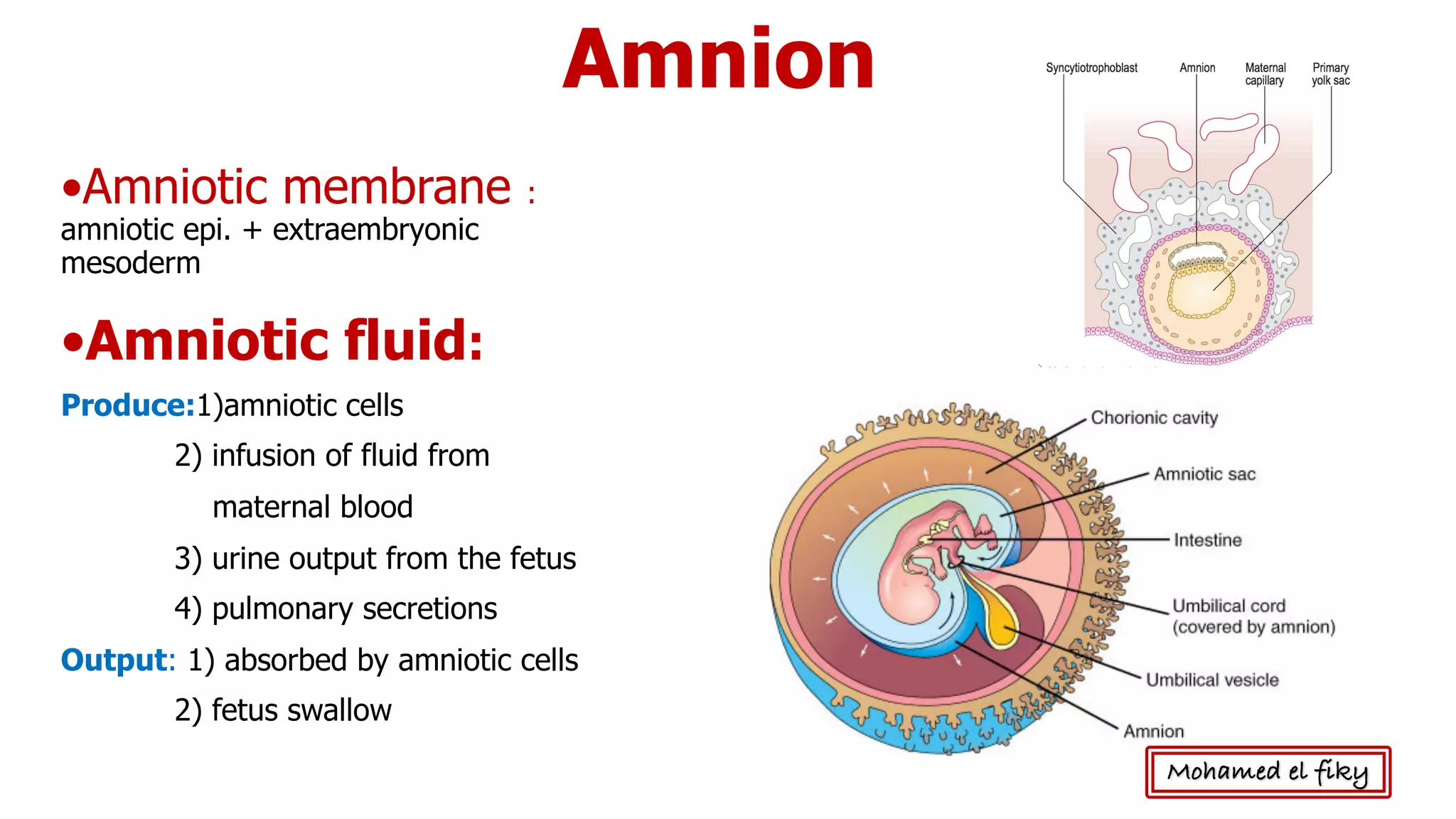
•Amniotic membrane :
amniotic epi. + extraembryonic
mesoderm
•Amniotic fluid:
Produce:1)amniotic cells
2) infusion of fluid from
maternal blood
3) urine output from the fetus
4) pulmonary secretions
Output: 1) absorbed by amniotic cells
2) fetus swallow
Mohamed el fiky
Amniotic	Fluid
• Plays	a	major	role	in	fetal	growth	and	development.
• Daily	contribution	of	fluid	from	respiratory	tract	is	300-400	ml.
• 500	ml	of	urine	is	added	daily	during	the	late	pregnancy.
• Amniotic	fluid	volume	is	30	ml	at	10	weeks,	350	ml	at	20	weeks,	
700-1000	ml	at	37	weeks.
Mohamed el fiky
Composition	of	Amniotic	Fluid
• 99	%	is	water
• Desquamated	fetal	epithelial	cells
• Organic	&	inorganic	salts
• Protein,	carbohydrates,	fats,	enzymes,	hormones
• Meconium	&	urine	in	the	late	stage
Abnormalities	of	amniotic	fluid
• Oligo-hydramnios: the	volume	of	the	amniotic	fluid	is	less	than	½	litre.	This	may	lead	to	
adhesions	between	the	embryo		and	the	amnion.
• Poly-hydramnios: the	volume	of	the	amniotic	fluid	is	more	than	2	litres.	This	may	lead	to	
premature	rupture	of	the	amnion.
Mohamed el fiky
Significance of Amniotic Fluid
• Permits	symmetrical	external	growth	of	the	embryo	and	fetus
• Acts	as	a	barrier	to	infection
• During	labor	it	help		dilatation	of	the	cervix	of	the	uterus		and	It	wash	birth	canal		and	
protect	the	fetus	against	infections	
• Prevents	adherence	of	amnion	to	fetus
• Cushions	&	protects	the	embryo	and	fetus
• Helps	maintain	the	body	temperature
• Enables	the	fetus	to	move	freely	
Mohamed el fiky
Yolk Sac
• It	is	large	at	32	days
• Shrinks	to	5mm	pear	shaped	
remnant	by	10th week	&	
connected	to	the	midgut	by	a	
narrow	yolk	stalk
• Becomes	very	small	at	20	
weeks
• Usually	not	visible	thereafter
Primary	yolk	sac
secondary	yolk	sac
Mohamed el fiky
Significance of Yolk Sac
• Has	a	role	in	transfer	of	nutrients during	the	2nd and	
3rd weeks
• Blood	development	first	occurs	here
• Incorporate	into	the	endoderm	of	embryo	as	a	
primordial	gut
• Primordial	germ	cells	appear	in	the	endodermal	lining	
of	the	wall	of	the	yolk	sac	in	the	3rd week
Mohamed el fiky
Fate of Yolk Sac
• At	10	weeks	lies	in	the	chorionic	cavity	between	chorionic	and	amniotic	sac
• Atrophies	as	pregnancy	advances
• Sometimes	it	persists	throughout	the	pregnancy	but	of	no	significance
• In	about	2%	of	adults	the	proximal	intra-abdominal	part	of	yolk	stalk	persists	
as	an	ileal diverticulum	or	Meckel	diverticulum
Mohamed el fiky
Allantois
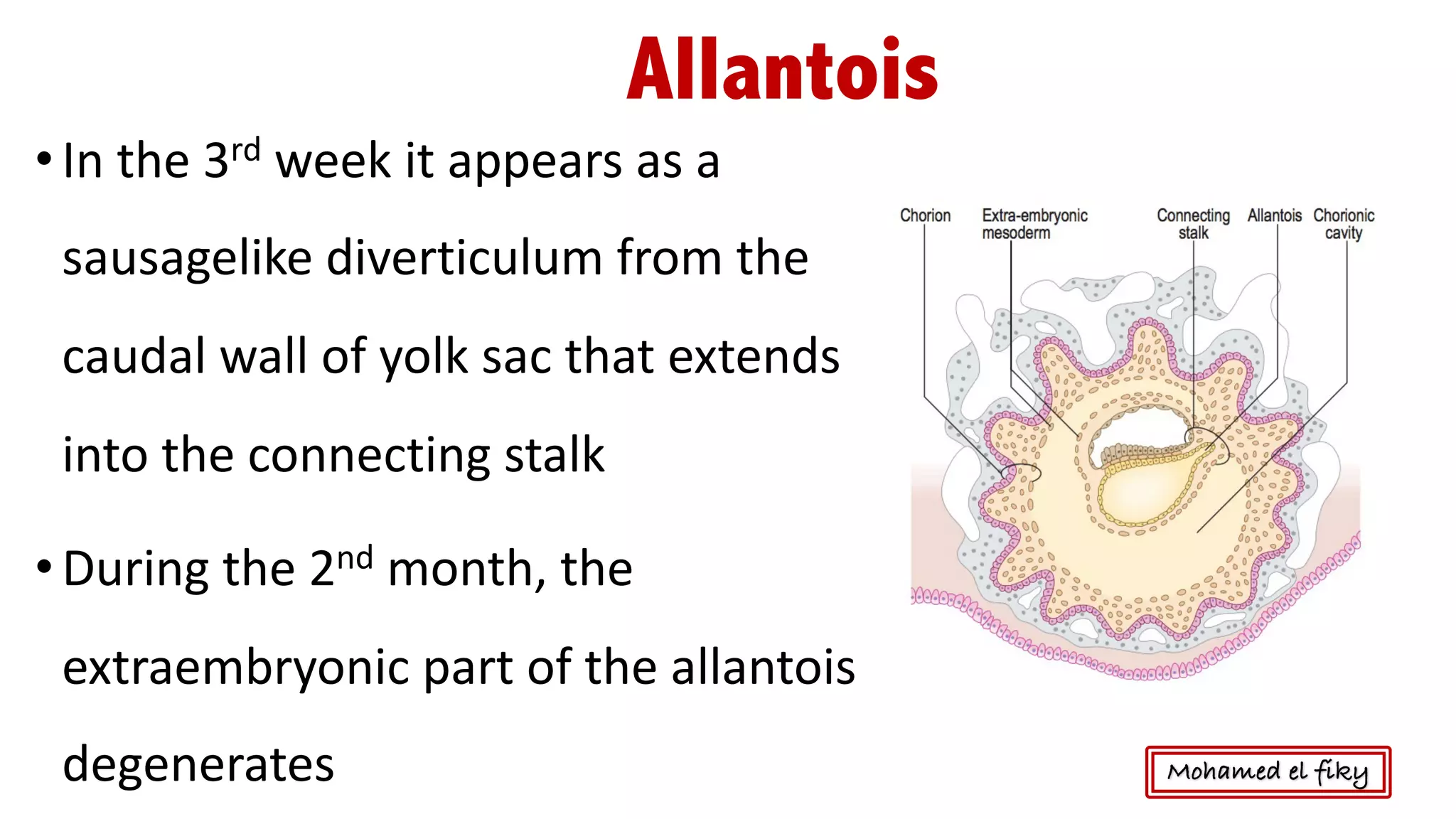
• In	the	3rd week	it	appears	as	a	
sausagelike diverticulum	from	the	
caudal	wall	of	yolk	sac	that	extends	
into	the	connecting	stalk
• During	the	2nd month,	the	
extraembryonic	part	of	the	allantois	
degenerates Mohamed el fiky
Functions of Allantois
• Blood	formation	occurs	in	the	wall	during	the	3rd to	5th
week
• Its	blood	vessels	persist	as	the	umbilical	vein	and	
arteries
• Becomes	Urachus and	after	birth	is	transformed	into	
median	umbilical	ligament	extends	from	the	apex	of	
the	bladder	to	the	umbilicus
Anomalies	of	allantois:
• Urachal	fistula:	The	urachus remains	patent,	urine	
discharges	from	the	umbilicus.
• Urachal	sinus:	The	upper	end	of	the	urachus remains	
patent.
• Urachal	cyst	:The	middle	part	of	the	urachus remains	
patent.	
Mohamed el fiky
The	Umbilical	Cord
Anatomy
•Origin	:	 It	develops	
from	the	connecting	
stalk.
•Length:	
At	term,	it	measures	
about	50	cm.
•Diameter:	 2	cm.
Mohamed el fiky
Structure: It consists of mesodermal
connective tissue called Wharton's
jelly, covered by amnion.
It contains:
1. One umbilical vein carries
oxygenated blood from the placenta
to the foetus
2. Two umbilical arteries carry
deoxygenated blood from the foetus
to the placenta,
3. Remnants of the yolk sac and
allantois.
The	Umbilical	Cord
Mohamed el fiky
Insertion:
•The cord is inserted in
the foetal surface of the
placenta near the center
"eccentric insertion"
(70%)
• Or at the center "central
insertion" (30%).
The	Umbilical	Cord
Mohamed el fiky
Abnormalities	Of	The	
Umbilical	Cord
(A)	Abnormal	cord	insertion
1. Marginal insertion : in the placenta ( battledore insertion).
2. Velamentous insertion: in the membranes and vessels
connect the cord to the edge of the placenta.
• If these vessels pass at the region of the internal os , the
condition is called " Vasa praevia".
1. Short cord which may lead to :
i-Intrapartum haemorrhage due to premature separation of the
placenta,
ii-Delayed descent of the foetus druing labour,
iii-Inversion of the uterus.
2. Long cord which may lead to
i-Cord presentation and cord prolapse,
ii-Coiling of the cord around the neck,
iii-True knots of the cord. Mohamed el fiky
Velamentous insertion(B)	Abnormal	cord	length
Chorion
Chorion	
1- extraembryonic	mesoderm	
2- cytotrophoblast
3- Syncytiotrophoblast
Chorion
• Definition	: Chorion	is	the	name	given	
to	the	trophoblast	after	the	formation	
of	the	extraembryonic	mesoderm	
from	its	inner	surface.
• The	chorion	is	composed	of	:
• Syncito-trophoblast (outer layer).
• Cytotrophoblast (middle	layer).
• Extra-embryonic	mesoderm	(inner	
layer).
Mohamed el fiky
CHORION	FRONDOSUM	AND	DECIDUA	BASALIS
• In	the	early	weeks	of	development,	villi	
cover	the	entire	surface	of	the	chorion	.	
As	pregnancy	advances,	villi	on	the	
embryonic	pole	continue	to	grow	and	
expand,	giving	rise	to	the	chorion	
frondosum	(bushy	chorion).	Villi	on	the	
abembryonic pole	degenerate	and	by	the	
third	month	this	side	of	the	chorion,	now	
known	as	the	chorion	laeve,	is	smooth	
Mohamed el fiky
Chorion
• Chorionic	villi	cover	the	entire	chorionic	sac	until	the	beginning	of	8th week
• As	this	sac	grows,	the	villi	associated	with	decidua	capsularis are	compressed,	reducing	the	
blood	supply	to	them
• These	villi	soon	degenerates	producing	an	avascular	bare	area	smooth	chorion	(chorion	
laeve)
• As	the	villi	disappear,	those	associated	with	the	decidua	basalis	rapidly	increase	in	number
• Branch	profusely	and	enlarge
• This	bushy	part	of	the	chorionic	sac	is	villous	chorion
Mohamed el fiky
CHORIONIC	VELLI
• By	the	beginning	of	the	third	week, the	trophoblast	is	characterized	by	
primary	villi	that	consist	of	a	cytotrophoblastic core	covered	by	a	syncytial	
layer.	During	further	development,	mesodermal	cells	penetrate	the	core	of	
primary	villi	and	grow	toward	the	decidua.	The	newly	formed	structure	is	
known	as	a	secondary	villus	.	
• By	the	end	of	the	third	week,	mesodermal	cells	in	the	core	of	the	villus	begin	
to	differentiate	into	blood	cells	and	small	blood	vessels,	forming	the	villous	
capillary	system	.	The	villus	is	now	known	as	a	tertiary	villus	or	definitive	
placental	villus. Mohamed el fiky
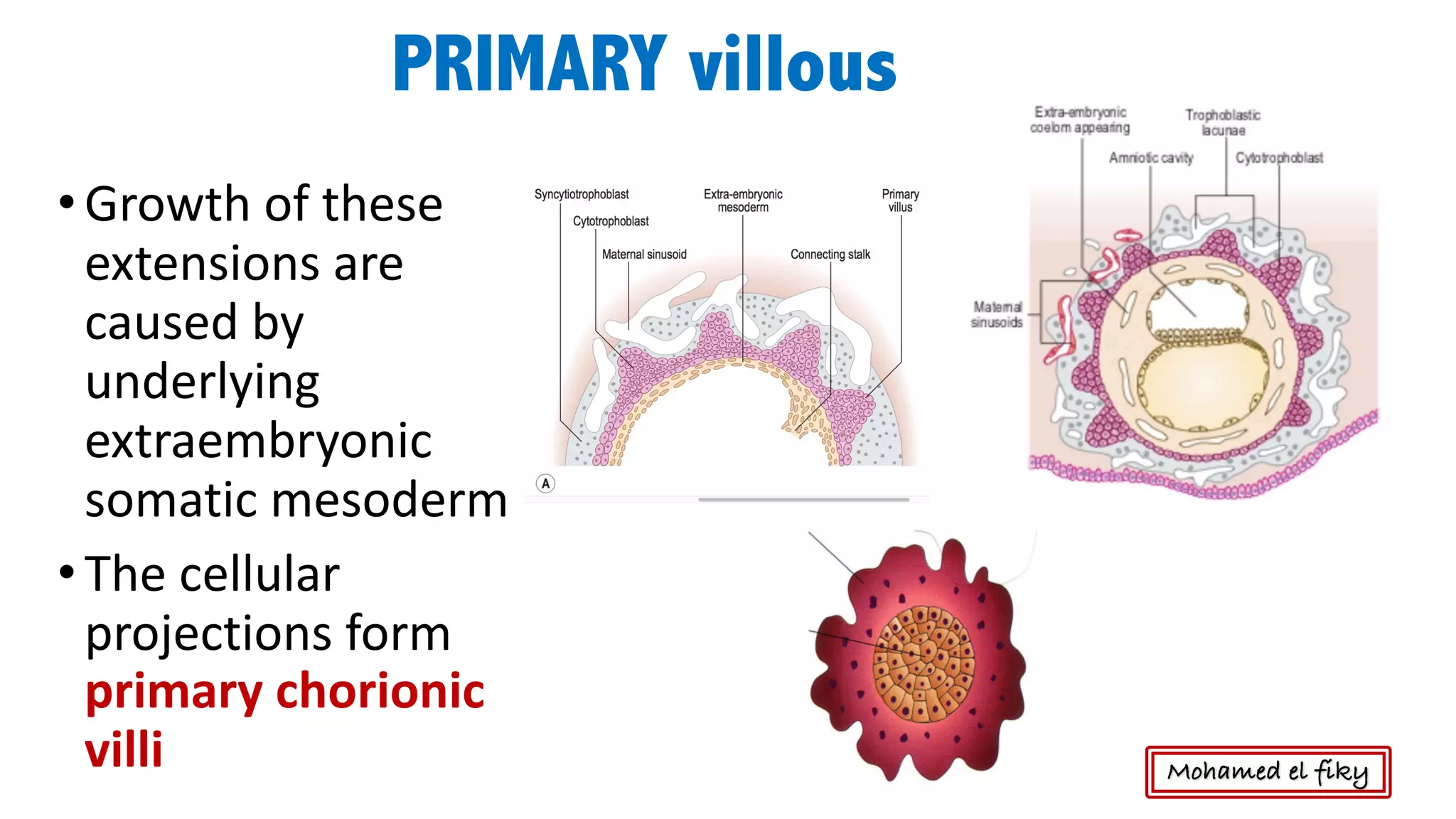
PRIMARY villous
•Growth	of	these	
extensions	are	
caused	by	
underlying	
extraembryonic	
somatic	mesoderm
•The	cellular	
projections	form	
primary	chorionic	
villi Mohamed el fiky
SECONDARY CHORIONIC VILLI
Early	in	3rd
week,	
extraembryonic	
mesoderm	
extends	inside	
the	villi
Mohamed el fiky
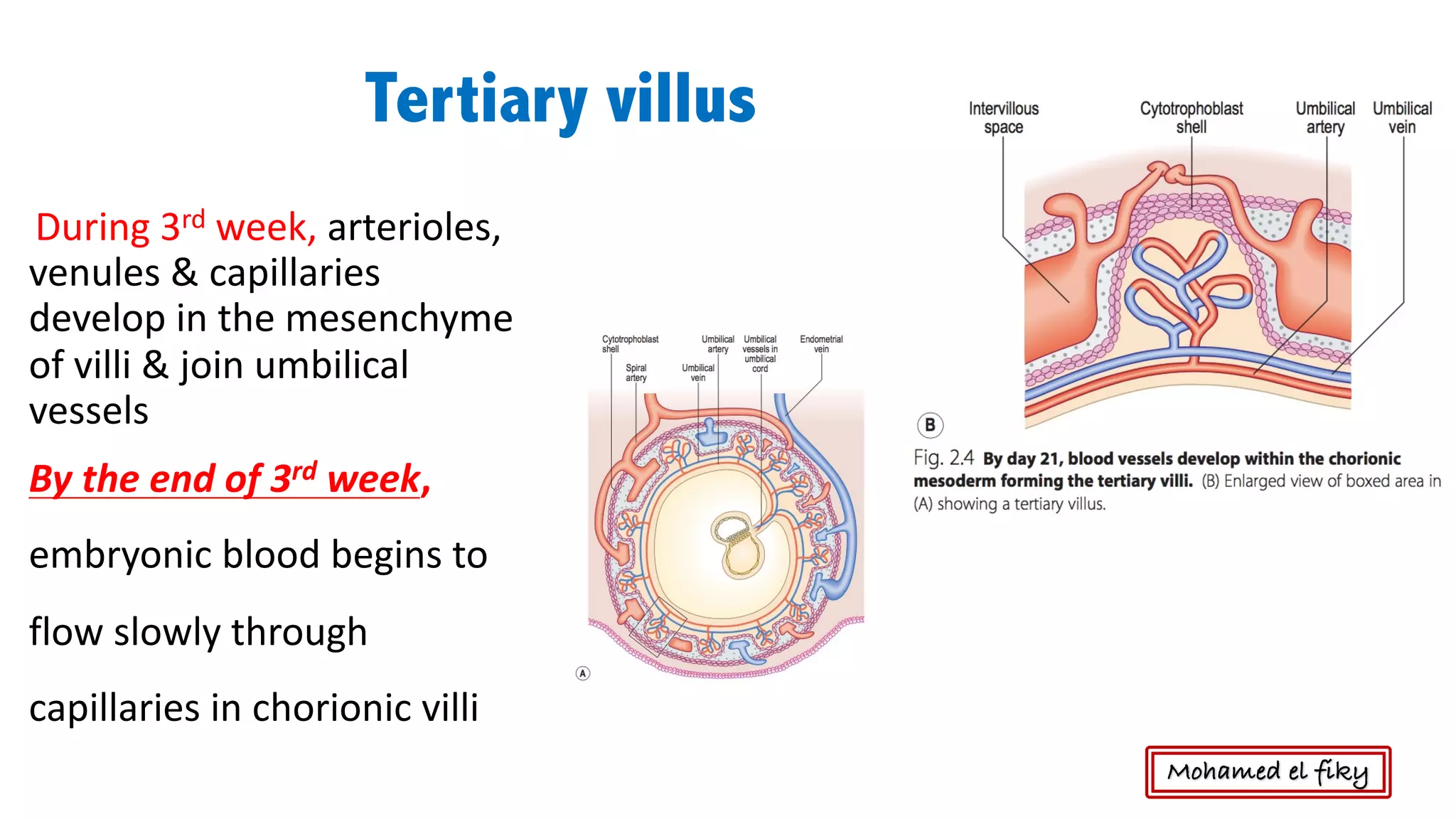
Tertiary villus
During	3rd week,	arterioles,	
venules &	capillaries	
develop	in	the	mesenchyme	
of	villi	&	join	umbilical	
vessels
By	the	end	of	3rd week,	
embryonic	blood	begins	to	
flow	slowly	through	
capillaries	in	chorionic	villi
Mohamed el fiky
Decidua
• The	gravid	endometrium	is	known	as	
decidua
• It	is	the	functional	layer	of	endometrium	in	
a	pregnant	woman
• This	part	of	the	endometrium	separates	
from	the	rest	of	the	uterus	after	
parturition
Mohamed el fiky
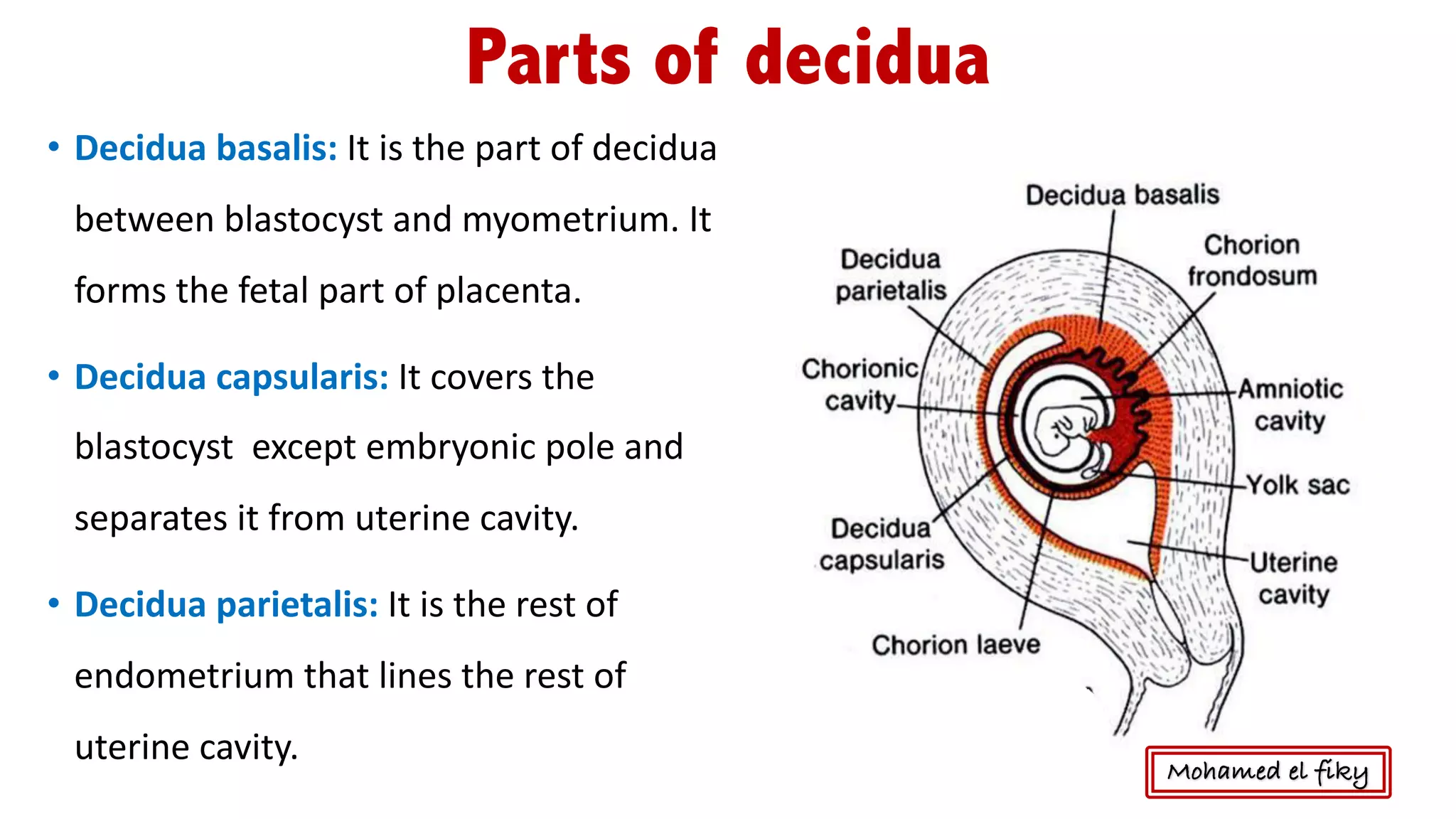
Parts of decidua
• Decidua	basalis: It	is	the	part	of	decidua	
between	blastocyst	and	myometrium.	It	
forms	the	fetal	part	of	placenta.
• Decidua	capsularis: It	covers	the	
blastocyst		except	embryonic	pole	and	
separates	it	from	uterine	cavity.
• Decidua	parietalis: It	is	the	rest	of	
endometrium	that	lines	the	rest	of	
uterine	cavity. Mohamed el fiky
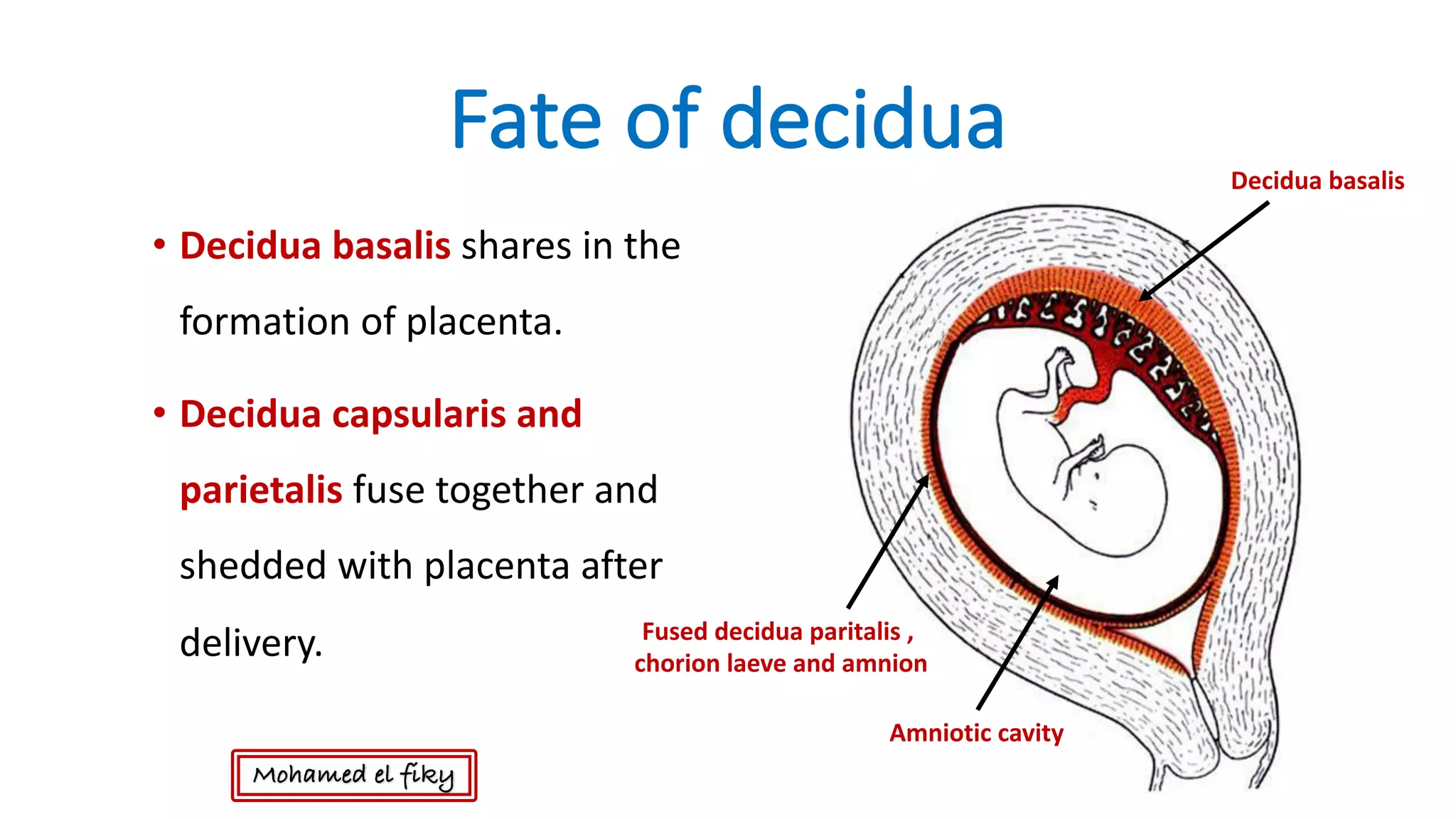
Fate	of	decidua
• Decidua	basalis	shares	in	the	
formation	of	placenta.
• Decidua	capsularis	and	
parietalis	fuse	together	and	
shedded	with	placenta	after	
delivery.
Decidua	basalis	
Amniotic	cavity
Fused	decidua	paritalis	,
chorion	laeve	and	amnion
Mohamed el fiky
32
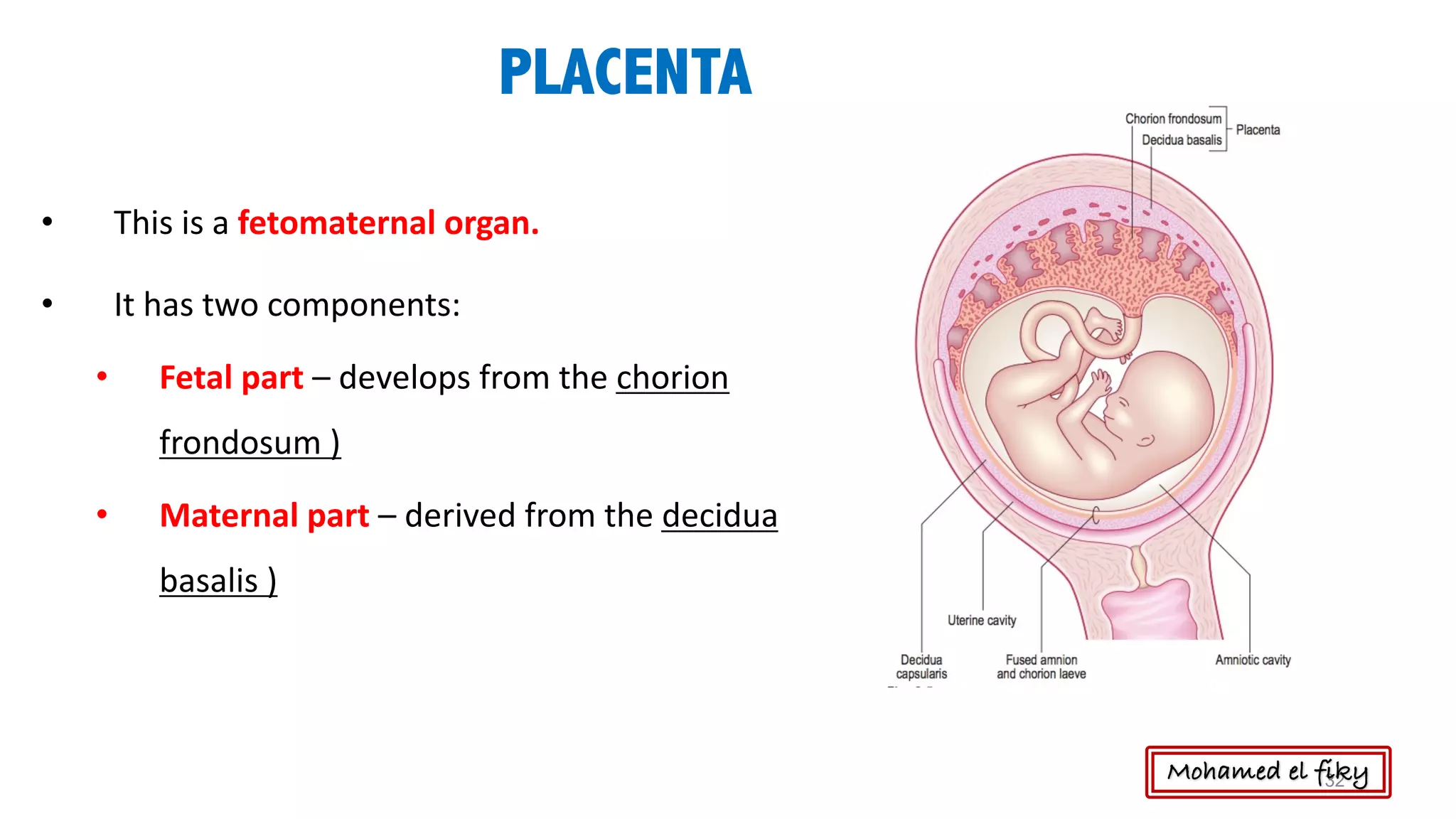
PLACENTA
• This	is	a	fetomaternal organ.
• It	has	two	components:
• Fetal	part – develops	from	the	chorion	
frondosum	)
• Maternal	part – derived	from	the	decidua	
basalis	)
Mohamed el fiky
Mohamed el fiky
• During	the	4th and	5th month,	the	decidua	forms	a	number	of	
decidual septa,	which	project	into	the	intervillous space.
• As	a	result	of	this	septum	formation,	the	placenta	is	divided	
into	a	number	of	compartments	(cotyledons).
Mohamed el fiky
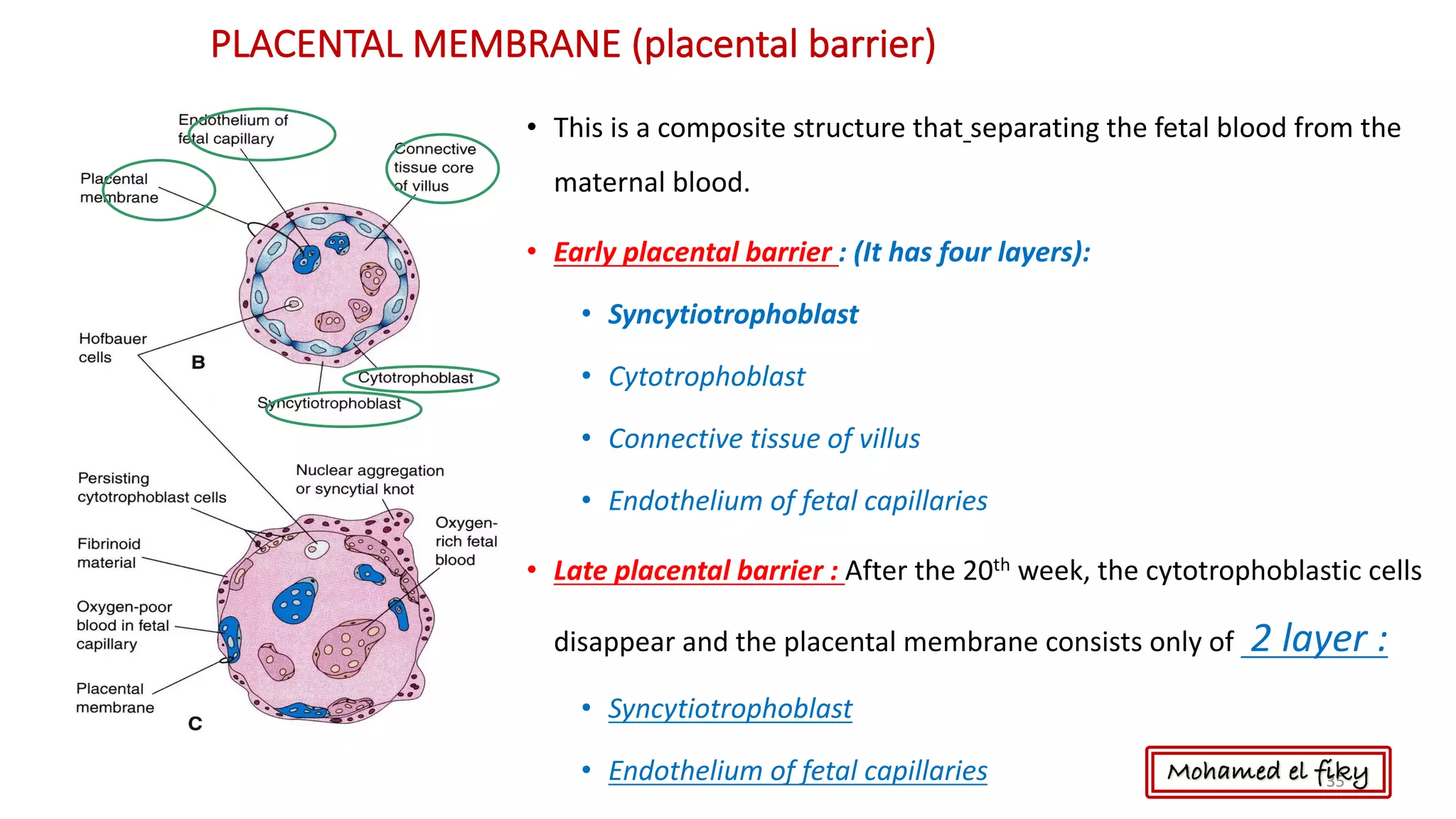
PLACENTAL	MEMBRANE	(placental	barrier)
• This	is	a	composite	structure	that separating	the	fetal	blood	from	the	
maternal	blood.
• Early	placental	barrier	:	(It	has	four	layers):
• Syncytiotrophoblast
• Cytotrophoblast
• Connective	tissue	of	villus
• Endothelium	of	fetal	capillaries
• Late	placental	barrier	:	After	the	20th week,	the	cytotrophoblastic cells	
disappear	and	the	placental	membrane	consists	only	of	 2	layer	:
• Syncytiotrophoblast
• Endothelium	of	fetal	capillaries 35Mohamed el fiky
36
It separates fetal from maternal
blood.
It prevents mixing of them.
It is an incomplete barrier as it
only prevents large molecules to
pass ( heparin & bacteria)
But cannot prevents passage of
viruses(e.g. rubella), micro-
organisms(toxoplama, treponema
pallidum) drugs and hormones.
Mohamed el fiky
is	discoid	in	shape.	
n Diameter	=	15-25	cm,	
n 2-3	cm	thick,	
n Weight	=	0.5	kg.
n Umbilical	cord	is	attached	to	its	center.	
nPosition : in the upper uterine
segment (99.5%), either in the posterior
surface (2/3) or the anterior surface (1/3).
The	full	term	placenta	
Mohamed el fiky
1- Fetal	surface:	which	is	smooth	and	
shinny	because	it	is	covered	by	an	
amniotic		membrane.	The	umbilical	cord	
is	attached	centrally	to	this	surface.
2- Maternal	surface:	which	is	rough,	
reddish,	and	has	15	– 20	elevated	areas	
called	cotyledons	with	deep	grooves	in	
between	made	by	the	decidual septa.
Surfaces
Mohamed el fiky
Function	of	placenta:-
1. Respiratory	function
2. Excretory	function
3. Nutritional	function
4. Endocrine	function:- placenta	acts	as	endocrine	
gland	
5. Barrier	function:- prevents	transfer	of	maternal	
infection.	
6. Enzymatic	action-
7. Immunological	function:- ig	G.
Mohamed el fiky
Abnormalities	Of	The	Placenta
(A) Abnormal Shape
(B) Abnormal Diameter
(C) Abnormal Weight
(D) Abnormal Position
(E) Abnormal Adhesion
Mohamed el fiky
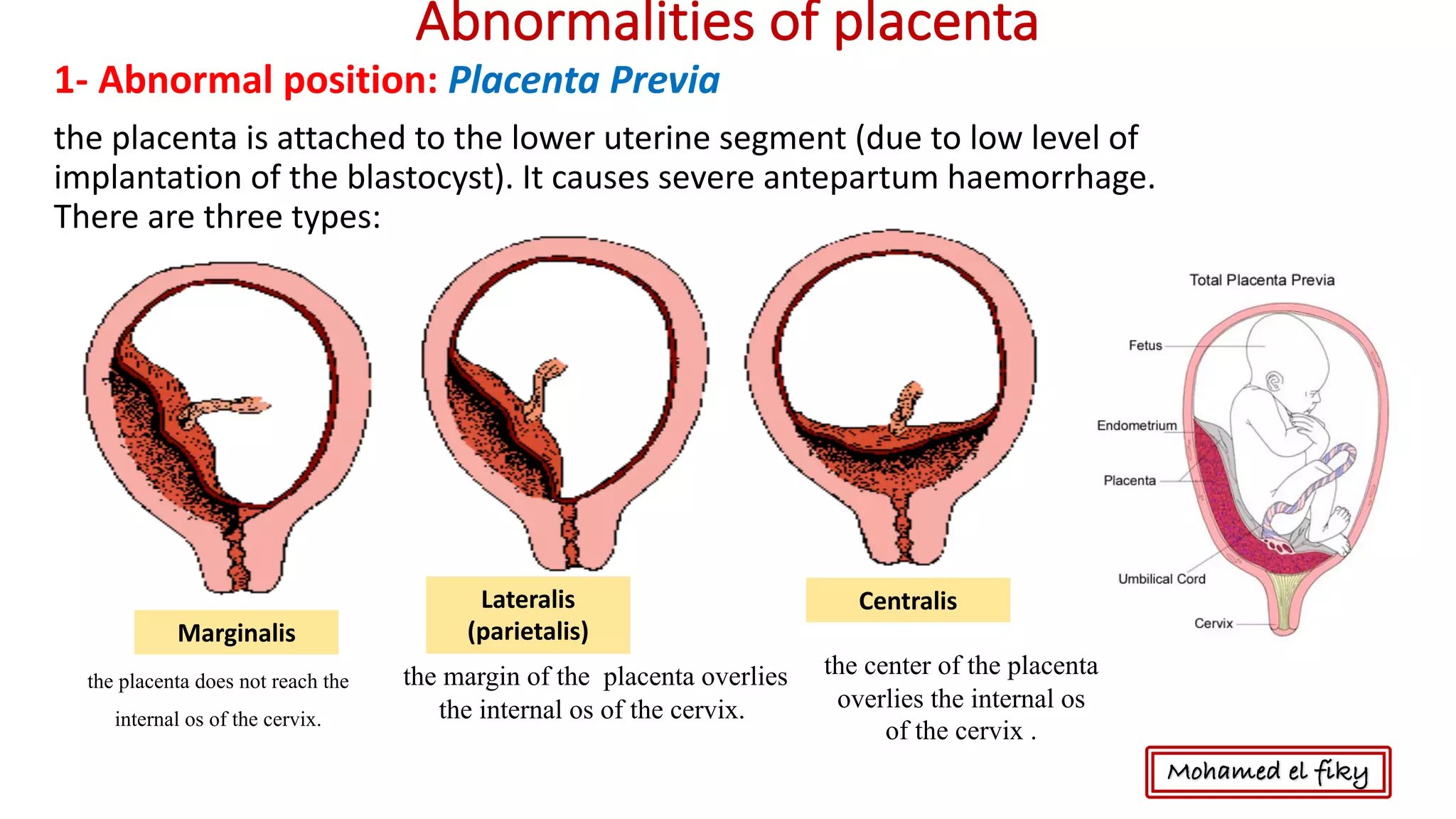
Abnormalities	of	placenta
1- Abnormal	position:	Placenta	Previa
the	placenta	is	attached	to	the	lower	uterine	segment	(due	to	low	level	of	
implantation	of	the	blastocyst).	It	causes	severe	antepartum	haemorrhage.	
There	are	three	types:	
Mohamed el fiky
Marginalis
Lateralis
(parietalis)
Centralis
the placenta does not reach the
internal os of the cervix.
the margin of the placenta overlies
the internal os of the cervix.
the center of the placenta
overlies the internal os
of the cervix .
2- Abnormal	adhesion:
1- Placenta	accreta:	due	to	abnormal	
adhesion	between	the	chorionic		villi	and	
the	uterine	wall.
2- Placenta	percreta:	The	chorionic	villi	
penetrate	the	myometrium	all	the	way	to	
the	perimetrium.
- the	placenta	fails	to	separate	from	the	
uterus	after	birth	and	may	cause	severe	
postpartum	hemorrhage.
Mohamed el fiky
3- Abnormal	attachment	of	umbilical	cord:
a- Velamentous attachment:
The	cord	does	not	reach	the	placenta	itself	but	is	attached	to	amniotic	membrane	over	the	
fetal	surface	of	placenta.	The	umbilical	vessels	pass	in	the	membrane	to	reach	the	placenta.	
It	is	easly torn.
Mohamed el fiky
(4)	Abnormal	Shape
A- Accessory	placenta: one	or	two	lobes	are	completely	separated	from	the	main	
placenta.	Bilobate , Bipartite
B- Placenta Fenestrate
(5)	Abnormal	Diameter	:	Placenta	membranacea :	The	placenta	is	large,	thin	and	may	
measure	30-40	cm	in	diameter.	may	encroach	on	the	lower	uterine	segment	
Mohamed el fiky
Twins
Mohamed el fiky
Twins
• Di-zygotic	twins	
• Incidece : more	common	(70%).
• Mechanism	of	development	: results	from	fertilization	of	2	ova	(from	2	
ovaries	)	during	an	overian cycle	by	2	separate	sperms.	
• Placenta	: 2	separate	placentae.	
• Chorion	: 2	separate	chorionic	sacs.	
• Sex	: may	be	of	the	same	or	different	sex.	
• Features	:	different	fetures.			 Mohamed el fiky
Twins
•zygotic	-Mono
• Incidece :	less	common. results	from	fertilization	of	one	ova	by	one		sperms.	
• Mechanism	of	development	:	results	from	division	of	a	single	fertilized	ovum	
during	one	of	the	following	stages	of	development:
• Two	cell	stage.	
• Stage	of	blastocyst,	where	the	inner	cell	mass	divides	into	2	masses.
• Placenta	:	single	common	placenta.
• Chorion	:	single	common	chorionic	sac.
• Sex	:	always	of	the	same	sex.	
• Features	:	exactly	identical.
Mohamed el fiky

Fetal membranes , placenta and twins